- Product Description Description
- Table of Contents TOC
- List of Table & Figure LOT
- Get Free Sample PDF Sample PDF
Global Petrochemicals Market Summary
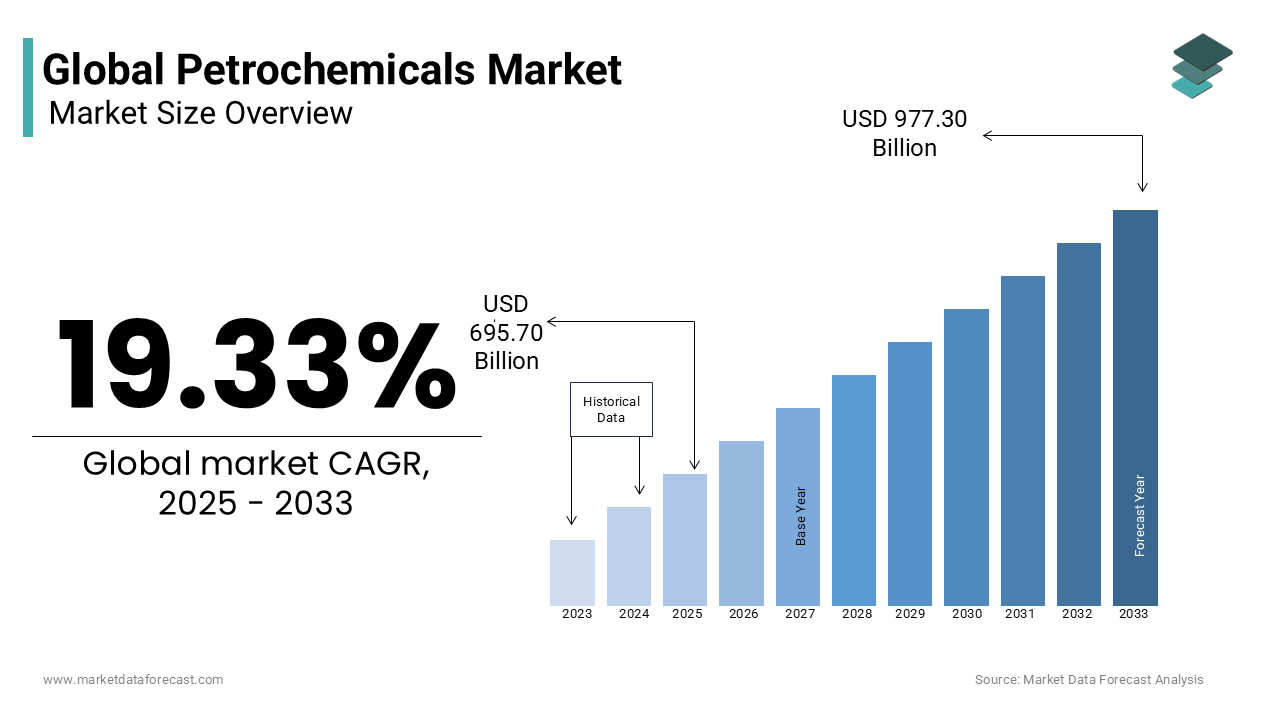
The global petrochemicals market was valued at USD 666.76 billion in 2024, is estimated to reach USD 695.70 billion in 2025, and is projected to expand to USD 977.30 billion by 2033, growing at a CAGR of 19.33% from 2025 to 2033. The growth of the global petrochemicals market is driven by rising demand from the packaging, automotive, and construction industries, coupled with rapid industrialization in emerging economies. Increasing applications in plastics, fertilizers, textiles, and synthetic materials further support the strong demand outlook.
Key Market Trends
- Rising demand for ethylene and propylene as building blocks for plastics and polymers.
- Expanding use of petrochemicals in packaging and consumer goods.
- Growth of sustainable petrochemical production leveraging bio-based feedstocks.
- Increasing petrochemical investments in the Asia-Pacific and the Middle East.
- Adoption of advanced cracking technologies to optimize production efficiency.
Segmental Insights
- Based on type, the ethylene segment dominated the global petrochemicals market with 34.6% of production volume in 2024, reflecting its wide usage in plastics, packaging, and chemicals.
- Based on end-use industry, the packaging segment led with 37.3% of the global share in 2024, driven by surging demand for flexible and rigid packaging solutions.
Regional Insights
- Asia-Pacific was the top-performing region in 2024, supported by large-scale petrochemical capacity, booming manufacturing sectors, and strong demand from China and India.
- North America shows steady growth, fueled by shale gas-based feedstock availability and downstream industries.
- Europe is emphasizing sustainable petrochemical innovations in line with environmental regulations.
- Latin America and the Middle East & Africa are expanding rapidly, backed by petrochemical investments and growing demand in end-use sectors.
Competitive Landscape
Key players in the global petrochemicals market include BASF SE, SABIC, ExxonMobil Corporation, Dow Inc., LyondellBasell Industries N.V., Chevron Phillips Chemical Company LLC, INEOS Group, Reliance Industries Limited, Royal Dutch Shell PLC, and China National Petroleum Corporation (CNPC). These companies are focusing on capacity expansion, sustainability initiatives, and technological advancements to strengthen their market leadership.
Global Petrochemicals Market Size
The Petrochemicals Market was valued at USD 666.76 billion in 2024, is estimated to reach USD 695.70 billion in 2025, and is projected to reach USD 977.30 billion by 2033, growing at a CAGR of 19.33% from 2025 to 2033.
Petrochemicals are chemical products derived from petroleum and natural gas, which serve as foundational elements in the production of plastics, synthetic rubber, fertilizers, solvents, and detergents. These compounds are primarily categorized into olefins and aromatics and are manufactured through complex refining and cracking processes. As per the study, global petrochemical feedstock demand is significant, a figure projected to rise despite broader energy transitions. The sector plays a pivotal role in industrial value chains, with a portion of manufactured goods relying on petrochemical-derived inputs at some stage. According to the U.S. Energy Information Administration (EIA), U.S. ethylene exports were 1.1 million metric tons in 2023. The expansion of urban infrastructure and consumer goods in emerging economies continues to deepen dependency on these chemical derivatives.
MARKET DRIVERS
Surging Demand for Plastics in Packaging and Consumer Goods
Rising global demand for lightweight, durable, and cost-effective packaging materials propels the growth of the petrochemicals market. E-commerce is expanding. Global online retail sales surged, according to the study, so does the need for plastic packaging. In Asia-Pacific, where a portion of the world’s population resides, per capita plastic consumption has increased, according to research. Apart from these, flexible plastic packaging constitutes a portion of total packaging use worldwide due to its efficiency in preserving food and reducing transportation weight. This sustained demand is further amplified by rising urbanization and single-serve product trends in developing economies which ensure continued reliance on petrochemical feedstocks despite environmental scrutiny.
Expansion of Infrastructure and Automotive Sectors in Emerging Economies
Rapid industrialization and infrastructure development in countries such as India, Indonesia, and Nigeria are driving the growth of petrochemicals market. This surges the demand for petrochemical-based materials like polystyrene, polyvinyl chloride (PVC), and synthetic rubbers. As per the research, emerging markets invested significant amount in infrastructure projects, with construction materials heavily reliant on petrochemical derivatives. PVC, for instance, accounts for a portion of all plastic used in building and construction in developing regions, as per the study. Concurrently, the automotive sector’s growth, India’s vehicle production surpassing millions of units, according to the study, drives demand for lightweight polymer components that improve fuel efficiency. This strengthens the structural linkage between industrial development and petrochemical consumption.
MARKET RESTRAINTS
Stringent Environmental Regulations Targeting Single-Use Plastics
Governments worldwide are intensifying regulatory burden on petrochemical-intensive products, particularly single-use plastics, to mitigate environmental degradation, which restricts the growth of petrochemicals market. The European Union’s Single-Use Plastics Directive, effective since 2021, has led to a reduction in the consumption of targeted plastic items across member states, as per the research. Apart from these, many countries have implemented some form of plastic bag ban or tax, according to the United Nations Environment Programme. These measures directly constrain demand for low-density polyethylene, a key petrochemical derivative. Furthermore, extended producer responsibility (EPR) mandates require manufacturers to finance recycling and waste management, increasing operational costs.
Volatility in Crude Oil and Natural Gas Feedstock Prices
The price instability of crude oil and natural gas, which serve as primary feedstocks, is degrading the growth of the petrochemicals market. In 2022, benchmark Brent crude prices surged per barrel due to geopolitical disruptions, as per the study, leading to an increase in naphtha prices, the principal feedstock for steam crackers. Such volatility disrupts production planning and erodes profit margins, particularly for margin-sensitive derivatives like methanol and benzene. Moreover, regions dependent on imported feedstocks, such as Northeast Asia, face heightened cost burdens. Japan recorded a year-on-year increase in petrochemical import costs which weakens competitiveness and discouraging capacity expansion.
MARKET OPPORTUNITIES
Integration of Circular Economy Models through Advanced Recycling Technologies
The increased adoption of chemical recycling and pyrolysis technologies to convert post-consumer plastic waste into virgin-grade feedstocks, which aligns with circular economy principles, is setting up new opportunities for the growth of the petrochemicals market. As per the research, chemical recycling could process a portion of global plastic waste by 2030. Companies have already launched commercial-scale advanced recycling units, with the latter producing notable metric tons of recycled polymers. The European Chemical Industry Council estimates that scaling these technologies could reduce the sector’s reliance on fossil feedstocks by 2040. Apart from these, regulatory incentives such as the EU’s Carbon Border Adjustment Mechanism are encouraging investments in low-carbon production pathways. This shift not only mitigates environmental liabilities but also opens new revenue streams and strengthens supply chain resilience amid tightening resource constraints.
Strategic Expansion into Non-OECD Regions with Growing Manufacturing Bases
Emerging economies in Southeast Asia, the Middle East, and Africa are becoming focal points for new petrochemical investments, which is likely to promote new opportunities for the petrochemicals market. This is due to favorable feedstock availability, growing domestic markets, and industrial policy support. Saudi Aramco and France's TotalEnergies are investing approximately $11 billion in the AMIRAL refinery and petrochemical complex, which will be integrated with the existing SATORP refinery in Jubail. The complex is projected to become commercially operational in 2027. It will produce 1.65 million tons of ethylene per year, with plans to also produce other high-value chemicals including aromatics. These regions offer lower labor costs and access to expanding middle-class consumer bases which position petrochemical producers to capitalize on long-term structural growth beyond saturated OECD markets.
MARKET CHALLENGES
Decarbonization Burden and the Shift Toward Renewable Feedstocks
The mounting burden to reduce its carbon footprint challenges the petrochemicals market. It accounts for a portion of global CO₂ emissions, a figure expected to grow without intervention, according to the research. Unlike power and transport, petrochemical processes are inherently carbon-intensive due to process emissions from steam cracking. In response, the European Commission has proposed a Carbon Contracts for Difference scheme to subsidize low-carbon production, but implementation remains uneven. Moreover, bio-based alternatives such as bio-ethylene are currently limited. Scaling these alternatives requires substantial R&D investment and feedstock availability which poses a technological and economic hurdle for traditional petrochemical operators aiming to meet net-zero commitments by 2050.
Geopolitical Fragmentation Affecting Supply Chain Resilience
The global supply chain is increasingly vulnerable to geopolitical disruptions, trade restrictions, and regional protectionism, which challenge the growth of the petrochemicals market. The Red Sea shipping crisis in 2024 forced most carriers, including those shipping petrochemicals, to reroute Asia-Europe trade via the Cape of Good Hope, as per research. Apart from these, U.S.-China trade tensions have led to tariffs on key petrochemical products. These disruptions compel firms to reconfigure supply chains toward regionalization by increasing capital expenditure. The trend toward friend-shoring and dual sourcing, while enhancing security, fragments economies of scale and complicates long-term investment planning in a capital-intensive industry.
REPORT COVERAGE
| REPORT METRIC | DETAILS |
| Market Size Available | 2024 to 2033 |
| Base Year | 2024 |
| Forecast Period | 2025 to 2033 |
| Segments Covered | By Type, End-Use, and Region |
| Various Analyses Covered | Global, Regional, & Country Level Analysis; Segment-Level Analysis, Drivers, Restraints, Opportunities, Challenges, PESTLE Analysis, Porter’s Five Forces Analysis, Competitive Landscape, Analyst Overview of Investment Opportunities |
| Regions Covered | North America, Europe, Asia Pacific, Latin America, Middle East, and Africa |
| Key Market Players | BASF SE, SABIC, ExxonMobil Corporation, Dow Inc., LyondellBasell Industries N.V., Chevron Phillips Chemical Company LLC, INEOS Group, Reliance Industries Limited, Royal Dutch Shell PLC, China National Petroleum Corporation (CNPC) |
SEGMENTAL ANALYSIS
By Type Insights
The ethylene segment dominated the petrochemicals market by capturing 34.6% of global production volume in 2024. The growth of the ethylene segment is primarily driven by its role as the foundational building block for polyethylene, the most widely used plastic globally. The surging demand for high-density and low-density polyethylene in flexible and rigid packaging directly fuels ethylene consumption. Furthermore, ethylene is indispensable in producing ethylene oxide and glycols, which are essential for antifreeze and polyester fibers. According to a study, global ethylene capacity reached a significant million metric tons, with a portion of new steam cracker projects, particularly in China and the Middle East which focus on maximizing ethylene yield from naphtha and ethane feedstocks. This strengthens its market dominance.
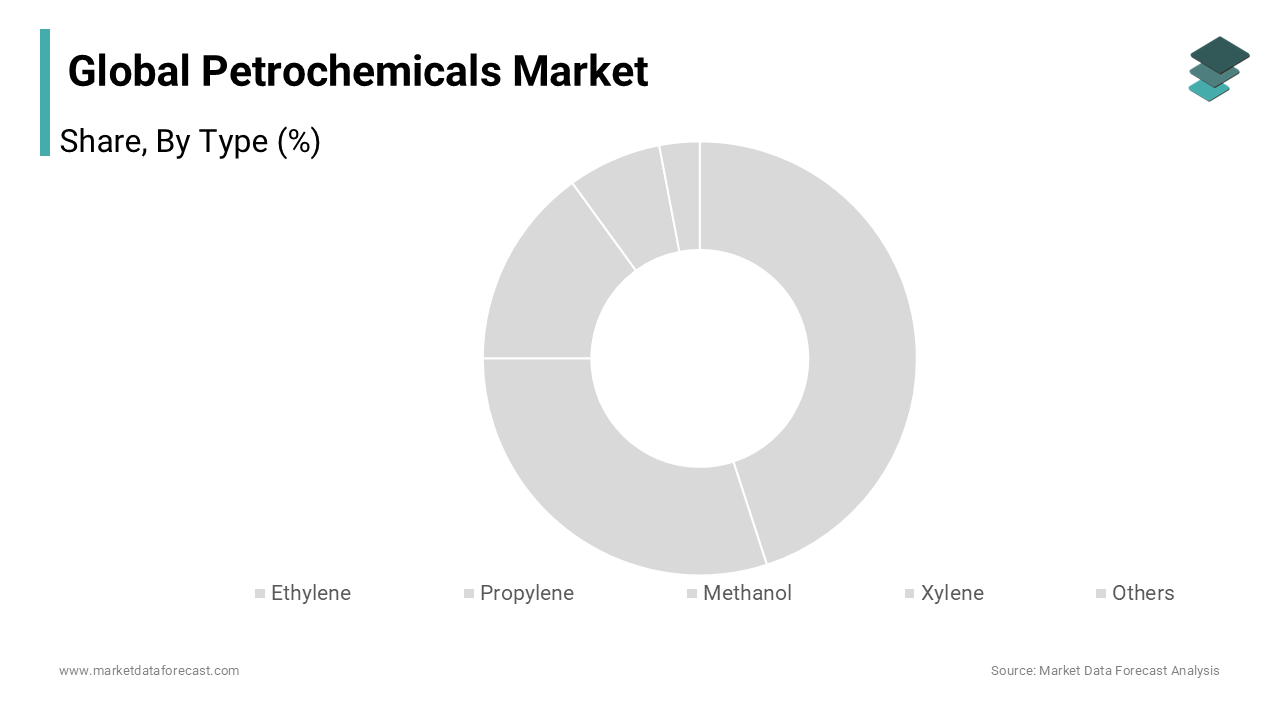
The methanol segment is predicted to witness the highest CAGR of 6.8% from 2025 to 2033 due to its expanding role as a clean-burning fuel and feedstock in alternative energy applications. In China, methanol is increasingly blended into transportation fuels, with several vehicles running on methanol-gasoline blends. Apart from these, methanol serves as a key precursor for formaldehyde and acetic acid, both of which are important in resin and adhesive manufacturing. According to research, demand for methanol in olefins production, via the methanol-to-olefins (MTO) process, surpassed significant metric tons, particularly in coal-rich regions, where natural gas scarcity makes coal-based methanol economically viable. This dual utility in energy and chemical synthesis positions methanol as a pivotal transitional molecule in diversified industrial economies.
By End-Use Industry Insights
The packaging segment led the petrochemicals market by capturing 37.3% of the global market share in 2024. The pervasive reliance on polyethylene, polypropylene, and polystyrene in both rigid and flexible packaging formats is propelling the growth of the packaging segment. The exponential rise of e-commerce has intensified demand for lightweight, durable, and moisture-resistant materials. As per a study, global online retail sales surged substantially which necessitates vast quantities of plastic films, bottles, and protective cushioning. Moreover, in developing economies, packaged food consumption has grown annually over the past years, driven by urbanization and changing dietary habits, as per the research. Each ton of packaged goods typically incorporates tons of petrochemical-based polymers.
The electronics segment is predicted to witness the highest CAGR of 7.2% over the forecast period owing to the integration of high-performance polymers in printed circuit boards, encapsulants, and semiconductor packaging. Materials such as polyimide films, epoxy resins, and brominated flame retardants are derived from benzene, phenol, and xylene. These are essential for thermal stability and electrical insulation. According to research, global semiconductor sales increased significantly, with a year-on-year increase, largely fueled by AI hardware, 5G infrastructure, and electric vehicle electronics. Each advanced semiconductor package contains grams of petrochemical-derived encapsulants. Thus, the dependency on engineered petrochemicals in electronics is poised to deepen which outpaces growth in more mature industrial sectors.
REGIONAL ANALYSIS
Asia Pacific Petrochemicals Market Insights
Asia-Pacific was the top performer in the global petrochemicals market in 2024 and accounted for 52.2% of the global market share in 2024. The growth of the Asia Pacific in the global market is primarily driven by robust industrial expansion, particularly in China, India, and South Korea. China alone accounts for a portion of global methanol demand and operates millions of metric tons of ethylene capacity, according to the study. The country’s coal-to-chemicals strategy has enabled energy security through non-conventional feedstocks. India’s domestic demand for polymers is growing which is driven by infrastructure and packaging needs. Apart from these, ASEAN’s rising middle class is increasing the consumption of plastic-intensive goods. Therefore, Asia-Pacific remains the primary engine of global petrochemical growth which is supported by integrated refineries and expanding downstream industries.
North America Petrochemicals Market Insights
North America is the second-largest in the petrochemical market and accounted for 22.6% of the global market share in 2024. The growth of North America in the global market is propelled by abundant and low-cost shale gas, which provides ethane-rich feedstocks for steam crackers. The U.S. Gulf Coast hosts a notable share of the nation’s ethylene production, with ethane supply in million barrels per day, according to the study. This feedstock advantage has spurred a wave of investment. Including Furthermore, the U.S. exported notable tons of polyethylene, primarily to Latin America and Asia, as per research. The integration of petrochemicals with refining and the push for circular economy initiatives show the region’s sustained relevance in the global supply chain despite environmental scrutiny.
Europe Petrochemicals Market Insights
Europe grew steadily in the petrochemicals market due to a technologically advanced and highly regulated sector. The region excels in high-value specialty chemicals and innovation in recycling. On the other hand, growth is moderate due to stringent environmental policies and declining domestic feedstock availability. Germany and Belgium serve as core hubs by hosting major steam crackers at sites like Ludwigshafen and Antwerp. Apart from these, the REACH regulation and Carbon Border Adjustment Mechanism are accelerating investments in bio-based feedstocks and electrified cracking. Europe remains a leader in sustainable petrochemical innovation and high-performance polymer applications.
Middle East Petrochemicals Market Insights
Middle East grew steadily in the global petrochemical market due to low-cost feedstock and strategic export orientation. Saudi Arabia’s integrated complexes, such as Jubail and Yanbu, produce large tons of derivatives yearly, leveraging subsidized ethane prices. The UAE and Kuwait are expanding into derivatives like polyethylene and ethylene glycol to diversify beyond crude exports. Therefore, the region is targeting high-growth Asian markets with cost-advantaged and large-scale production by shifting from volume to value.
COMPETITIVE LANDSCAPE
KEY MARKET PLAYERS
Some of the companies that are playing a dominating role in the global petrochemicals market include
- BASF SE
- SABIC
- ExxonMobil Corporation
- Dow Inc.
- LyondellBasell Industries N.V.
- Chevron Phillips Chemical Company LLC
- INEOS Group
- Reliance Industries Limited
- Royal Dutch Shell PLC
- China National Petroleum Corporation (CNPC)
The petrochemicals market is characterized by intense competition shaped by regional disparities in feedstock access, technological advancement, and regulatory environments. Incumbent giants from the Middle East and Asia leverage cost advantages and scale, while North American producers capitalize on shale-derived ethane. European firms differentiate through innovation in recycling and specialty chemicals rather than volume. New entrants from Southeast Asia and India are expanding rapidly, supported by government industrial policies and growing domestic demand. Competitive dynamics are further complicated by the dual forces of decarbonization and supply chain reconfiguration, prompting companies to pursue divergent strategies, some focusing on scale and exports, others on sustainability and niche applications. Mergers, technological collaborations, and backward integration are common tactics. As environmental regulations tighten and circular economy models gain traction, the competitive landscape is shifting from pure production capacity to innovation, agility, and long-term sustainability credentials.
Top Players in the Petrochemicals Market
SABIC (Saudi Basic Industries Corporation)
SABIC has established a formidable presence in the Asia-Pacific petrochemicals landscape through strategic partnerships and technology-driven expansions. The company operates integrated manufacturing complexes in Singapore and China, serving as important hubs for polyethylene, polycarbonates, and specialty chemicals. Its focus on high-performance materials and sustainability aligns with Asia-Pacific’s evolving industrial and regulatory environment, enhancing its long-term competitiveness.
Reliance Industries Limited
Reliance Industries has emerged as a dominant force in the Asia-Pacific petrochemical sector, leveraging its Jamnagar refinery, the world’s largest, to produce a broad spectrum of olefins and aromatics. The company supplies polymers to many countries across Asia, with polyethylene and polyester forming the core of its export portfolio. It also forged alliances with global brands like Unilever and Patagonia to supply recycled polyester for packaging and apparel. The company is advancing its shift toward circular feedstocks by investing in enzymatic recycling technologies through its partnership with Canada’s Loop Industries.
Formosa Plastics Corporation
Formosa Plastics has strengthened its influence in the Asia-Pacific petrochemicals market through large-scale production and vertical integration across upstream and downstream chains. Based in Taiwan, the company operates major complexes in Mailiao and Yunlin, producing ethylene, PVC, and engineering plastics that serve electronics, construction, and automotive industries across Southeast Asia. Apart from these, Formosa has intensified its focus on reducing emissions, installing carbon capture pilot units and committing to net-zero operations by 2050. Its strong regional distribution network and emphasis on product quality have made it a preferred supplier for Japanese and South Korean manufacturers.
Top Strategies Used by Key Market Participants
Key players in the petrochemicals market are deploying a range of strategic initiatives to consolidate their positions and adapt to evolving market dynamics. Major strategies include vertical integration to secure feedstock supply and reduce cost volatility, particularly among Middle Eastern and Asian producers. Companies are increasingly investing in circular economy solutions, such as advanced recycling and bio-based feedstocks, to meet regulatory and consumer sustainability demands. Greenfield and brownfield expansions in emerging markets, especially in Southeast Asia and India, allow firms to tap into rising domestic consumption. Strategic joint ventures and partnerships with technology providers are accelerating innovation in low-carbon production methods, including electrified cracking and carbon capture. Apart from these, asset optimization through digitalization and AI-driven process control is enhancing operational efficiency. Export diversification and localization of production hubs are further enabling resilience against geopolitical disruptions and trade barriers.
MARKET SEGMENTATION
The research report on the petrochemicals market has been segmented and sub-segmented based on categories.
By Type
- Ethylene
- Propylene
- Methanol
- Xylene
- Others
By End-Use Industry
- Packaging
- Electronics
- Construction
- Automotive
- Others
By Region
- North America
- Europe
- Asia-Pacific
- Latin America
- Middle East and Africa