- Product Description Description
- Table of Contents TOC
- List of Table & Figure LOT
- Get Free Sample PDF Sample PDF
Market Size, 2025
$219.5 BnMarket Estimate, 2026
$225 BnMarket Forecast, 2034
$274.2 BnCAGR, 2026–2034
2.50%Executive Summary: Pickup Trucks Market
- Market Scope: Comprehensive global pickup trucks market analysis covering fuel types, vehicle weight categories, regional leadership frameworks, e-commerce delivery demands, and EV electrification trends.
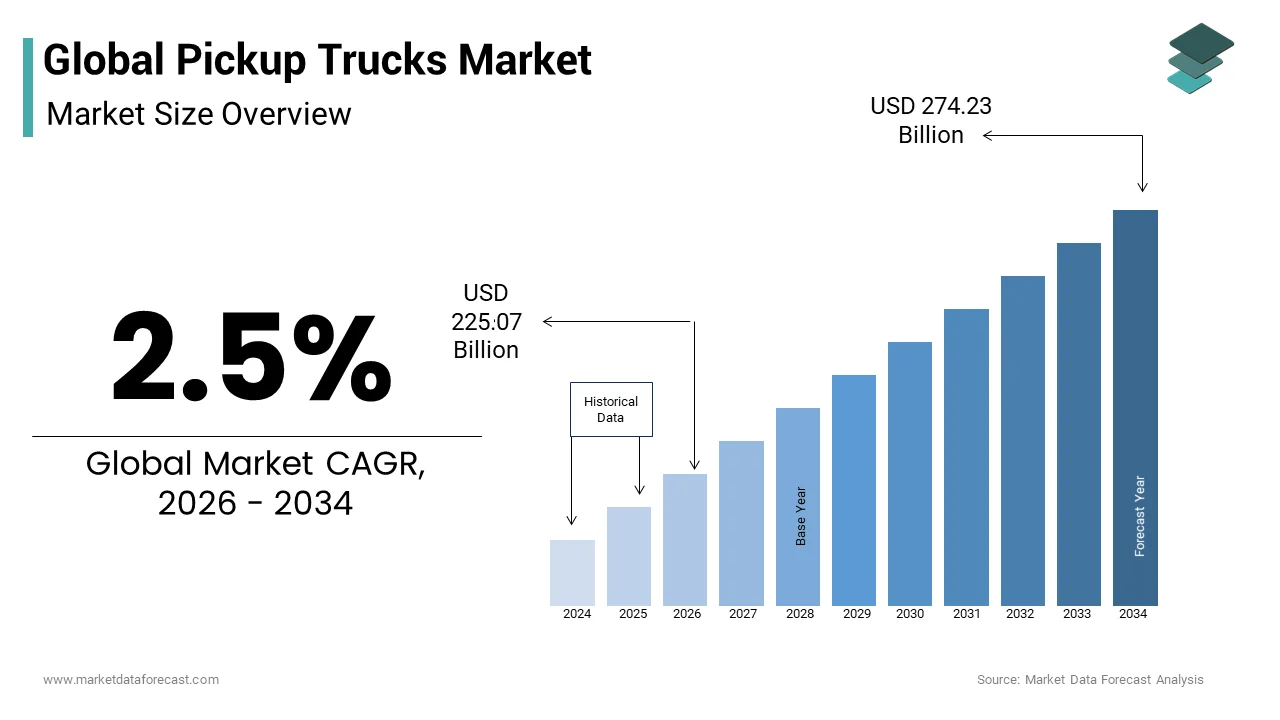
- Market Valuation: Valued at USD 219.58 billion (2025), estimated at USD 225.07 billion (2026), and projected to reach USD 274.23 billion by 2034, registering a steady CAGR of 2.5% (2026–2034).
- Primary Growth Drivers: Increasing e-commerce sector delivery needs for bulky goods, growing urbanization, infrastructure development requiring versatile commercial vehicles, and the rise of low-operating-cost electric pickup trucks.
Key Market Segment Metrics (2026–2034)
| Category | Leading Segment (Position) | Fastest-Growing Segment |
|---|---|---|
| By Fuel Type | Diesel (held the most significant share driven by durability and user preference) | Electric Pickups (anticipated to register healthy growth as manufacturers electrify lineups) |
| By Vehicle Category | Light-Duty Vehicles (captured largest segment share due to high consumer popularity) | Heavy-Duty Pickups (expected to gain traction during the forecast period) |
| By Region | North America (captured leading regional share, maintaining dominance) | Global markets expanding via urban infrastructure and commercial fleet electrification |
Major Market Players & Market Structure
Market Structure: Highly competitive global automotive landscape featuring leading multinational vehicle manufacturers competing on EV production facility investments, charging ecosystem integration, and commercial versatility.
Key Companies: Nissan Motor Co. Ltd., Volkswagen Group, Tata Motors Ltd., Ashok Leyland Ltd., Suzuki Motor Corp., Kia Corporation, Mahindra & Mahindra Ltd., Ford Motor Company, Toyota Motor Corp., General Motors Company, Stellantis N.V., and Hyundai Motor Company.
Global Pickup Trucks Market Size
The global pickup trucks market size was valued at USD 219.58 billion in 2025 and is anticipated to reach a valuation of USD 225.07 billion in 2026 and USD 274.23 billion by 2034, growing at a CAGR of 2.5%, from 2026 to 2034.
Pickup trucks serve dual purposes, functioning as both personal transport for families and robust workhorses for commercial applications in construction, agriculture, and logistics. As per the United States Department of Agriculture, the agricultural sector contributes approximately USD 1 trillion to the national economy annually. The versatility of these vehicles allows them to navigate rough terrains while providing comfortable seating for passengers, making them indispensable in rural and suburban areas. According to the Federal Highway Administration, over 60% of freight movement in the United States occurs via road networks, where pickup trucks play a crucial role in last-mile delivery and small business logistics. The cultural significance of pickup trucks is evident in North America, where they symbolize ruggedness and independence. In emerging markets, demand is rising due to infrastructure development projects requiring durable transport solutions. The International Energy Agency notes that light-duty vehicles account for nearly 45% of global oil consumption, highlighting the environmental impact of this segment. Manufacturers are increasingly focusing on improving fuel efficiency and integrating advanced safety technologies to meet regulatory standards. The shift towards electrification is also gaining momentum as governments implement stricter emission norms. This market continues to evolve, balancing traditional utility with modern technological advancements to meet the changing needs of consumers and businesses alike.
MARKET DRIVERS
Robust Growth in Construction and Infrastructure Development Projects
The expansion of construction activities and large-scale infrastructure development projects globally is a significant factor propelling the pickup trucks market growth. Governments worldwide are investing heavily in roads, bridges, and urban development, creating a sustained demand for reliable utility vehicles. According to Global Construction Perspectives, global construction output is projected to reach 15.5 trillion dollars by 2030, driven by public spending and private investment. Pickup trucks are essential for transporting tools, materials, and personnel to remote or uneven job sites where larger commercial vehicles cannot operate efficiently. Data from the Associated General Contractors of America indicates that over 80% of construction firms utilize pickup trucks as their primary fleet vehicle due to their versatility and payload capacity. The ability to tow heavy equipment such as trailers and generators further enhances their utility in this sector. In regions like Asia-Pacific and the Middle East, rapid urbanization is fuelling a construction boom that requires durable and high-performance vehicles. The European Commission reports that infrastructure investment in the EU has increased by 15% in recent years to support green transition projects. Pickup trucks equipped with four-wheel-drive systems are particularly valued for their off-road capabilities in challenging terrain. As construction timelines tighten, the reliability and availability of these vehicles become critical for project success. The ongoing maintenance and expansion of utility networks, including electricity and water, also contribute to steady demand. This consistent industrial usage ensures that pickup trucks remain a staple in the commercial vehicle segment despite fluctuations in consumer preferences.
Increasing Consumer Preference for Versatile Lifestyle Vehicles
The shifting consumer preference towards versatile lifestyle vehicles that combine utility with comfort and technology significantly propels the pickup trucks market expansion. Modern buyers increasingly view pickup trucks not just as work tools, but as premium family vehicles capable of handling outdoor adventures and daily commutes. According to J.D. Power, over 50% of pickup truck buyers in the United States use their vehicles primarily for personal transportation rather than commercial work. This trend is driven by the availability of luxury features such as advanced infotainment systems, leather interiors, and driver assistance technologies in newer models. The Outdoor Industry Association reports that participation in outdoor recreational activities such as camping, boating, and hiking has increased by 20% since 2020, boosting demand for vehicles with high towing and payload capacities. Pickup trucks offer the unique advantage of securing gear in the bed while providing a spacious cabin for passengers. Automakers are responding by introducing crew cab configurations that offer ample legroom and storage space comparable to sport utility vehicles. According to the data from Cox Automotive, the average transaction price for pickup trucks has risen steadily, which is reflecting their positioning as premium products. The cultural appeal of pickup trucks as symbols of freedom and capability resonates strongly with millennials and Gen Z consumers. Social media influence and marketing campaigns highlighting adventurous lifestyles further reinforce this perception. As urban dwellers seek escape from city life, the ability of pickup trucks to traverse diverse landscapes makes them an attractive choice. This broadening appeal beyond traditional commercial users expands the total addressable market for manufacturers.
MARKET RESTRAINTS
Stringent Emission Regulations and Fuel Efficiency Standards
Stringent government regulations regarding vehicle emissions and fuel efficiency are impeding the expansion of the global pickup trucks market, particularly for traditional internal combustion engine models. Policymakers globally are implementing tougher standards to combat climate change, forcing manufacturers to invest heavily in cleaner technologies. According to the Environmental Protection Agency, new greenhouse gas emission standards for light-duty vehicles require a significant reduction in carbon dioxide output by 2032. Compliance with these norms often necessitates expensive engineering changes, such as lightweighting materials and advanced exhaust treatment systems, which increase production costs. The International Council on Clean Transportation notes that meeting Euro 7 standards in Europe could increase vehicle costs by up to 2000 euros per unit. Pickup trucks, due to their size and weight, face greater challenges in achieving high fuel efficiency ratings compared to smaller passenger cars. Consumers are often reluctant to pay higher upfront prices for compliant vehicles, especially in price-sensitive segments. Additionally, the existing infrastructure for alternative fuels remains underdeveloped in many regions, limiting the viability of non-conventional powertrains. Data from the American Petroleum Institute indicates that diesel fuel prices remain volatile, affecting the operating costs of traditional pickup trucks. Regulatory uncertainty in different jurisdictions complicates global product planning for manufacturers. Some regions may ban the sale of new internal combustion engines entirely by 2035, creating pressure to accelerate electrification. These regulatory pressures constrain profit margins and slow down the introduction of new models as companies navigate complex compliance requirements.
High Initial Purchase Prices and Total Cost of Ownership
The high initial purchase prices and elevated total cost of ownership associated with modern pickup trucks restrain market growth among budget-conscious consumers, which is further hampering the global market expansion. Over the past decade, pickup trucks have evolved into premium vehicles with average transaction prices exceeding 50000 dollars in the United States, according to Kelley Blue Book. This price point places them out of reach for many entry-level buyers and small businesses operating on tight margins. The complexity of modern features, including advanced safety systems and connectivity modules, contributes to higher manufacturing and maintenance costs. Data from Edmunds suggests that the five-year cost to own a full-size pickup truck can exceed 60000 dollars when factoring in depreciation, insurance, and fuel. Insurance premiums for pickup trucks are typically higher due to their classification as larger vehicles and higher repair costs following accidents. The scarcity of affordable financing options in emerging markets further limits accessibility for potential buyers. Economic inflation and rising interest rates have also made auto loans more expensive, reducing purchasing power. According to the Federal Reserve Bank of New York, auto loan delinquency rates have risen, indicating financial stress among borrowers. Small business owners who rely on pickup trucks for operations may delay replacements due to these financial burdens. The lack of competitive pricing in the used car market for late-model trucks also affects affordability. As consumers prioritize value for money, the high cost of ownership becomes a decisive factor against purchasing new pickup trucks. This financial barrier restricts market penetration, particularly in developing economies where income levels are lower.
MARKET OPPORTUNITIES
Expansion of Electric Pickup Truck Segment
The emergence and expansion of the electric pickup truck segment is a substantial opportunity for market growth as consumers and fleets seek sustainable alternatives. Major automakers are launching electric models that offer instant torque, low maintenance costs, and zero tailpipe emissions, appealing to environmentally conscious buyers. According to BloombergNEF, electric vehicle sales are expected to account for 50% of global passenger vehicle sales by 2040, with pickup trucks being a key category. Electric pickups provide unique advantages such as onboard power outlets for tools and silent operation, which are beneficial for commercial users. The US Department of Energy highlights that electricity costs are generally lower and more stable than gasoline or diesel prices, reducing long-term operating expenses. Government incentives such as tax credits and rebates further enhance the affordability of electric pickups. Data from the Alliance for Automotive Innovation shows that several states offer additional benefits for commercial electric vehicle adoption. Fleet operators are increasingly interested in electric pickups to meet corporate sustainability goals and reduce carbon footprints. The integration of vehicle-to-grid technology allows these trucks to serve as mobile energy storage units, adding value for homeowners and businesses. Charging infrastructure is rapidly expanding with major investments from private and public sectors. As battery technology improves, range anxiety diminishes, making electric pickups viable for longer trips. This transition opens new revenue streams for manufacturers through software updates and energy services. The novelty and innovation associated with electric pickups attract tech-savvy consumers, expanding the customer base beyond traditional buyers.
Growth in Emerging Markets with Rising Disposable Incomes
The growth in emerging markets, characterized by rising disposable incomes and expanding middle classes offers a lucrative opportunity for the global pickup trucks market. Countries in Asia-Pacific, Latin America, and Africa are experiencing increased demand for versatile vehicles that can handle diverse road conditions and multifunctional uses. According to the World Bank, the middle class in developing nations is projected to grow by 1 billion people by 2030, driving consumption of durable goods, including automobiles. In regions with limited public transportation infrastructure, pickup trucks serve as essential family and business vehicles. The Asian Development Bank reports that infrastructure development in Southeast Asia is creating new opportunities for utility vehicles in construction and logistics. Local manufacturing initiatives in countries like Thailand and India are reducing costs and making pickup trucks more accessible to local buyers. Cultural preferences in these regions favor durable and high-ground-clearance vehicles suitable for rural and semi-urban environments. Data from the International Organization of Motor Vehicle Manufacturers indicates that light commercial vehicle sales in emerging markets are growing at twice the rate of developed markets. Governments are also promoting local assembly through favorable policies, encouraging global manufacturers to establish production facilities. The rise of e-commerce in these regions increases demand for last-mile delivery vehicles where small pickup trucks are ideal. As economic stability improves, consumers are upgrading from motorcycles and basic cars to more capable pickup trucks. This demographic shift provides a vast untapped market for manufacturers seeking growth beyond saturated Western markets.
MARKET CHALLENGES
Supply Chain Disruptions and Raw Material Volatility
Persistent supply chain disruptions and volatility in raw material prices pose significant challenges to the pickup trucks market, which is affecting production schedules and profitability. The automotive industry relies on a complex global network of suppliers for components such as semiconductors, steel, and aluminum. According to the International Monetary Fund, global supply chain pressures remained elevated, causing delays in vehicle production. The semiconductor shortage, which began in 2020, continued to impact the availability of electronic control units essential for modern pickup trucks. Data from S&P Global Mobility indicates that millions of vehicles were lost in production due to chip shortages, affecting revenue and market share. Fluctuations in steel and aluminum prices, driven by geopolitical tensions and trade policies and this increases manufacturing costs. As per the World Steel Association, steel prices varied by over 30% in the past two years, which is creating uncertainty for budgeting. Logistics bottlenecks at ports and transportation hubs further delay the delivery of parts and finished vehicles. Manufacturers struggle to pass these increased costs onto consumers without dampening demand. The reliance on single-source suppliers for critical components exacerbates vulnerability to disruptions. Natural disasters and political instability in key sourcing regions also threaten supply continuity. These challenges force companies to hold higher inventory levels, tying up capital and increasing storage costs. The inability to meet delivery timelines damages brand reputation and customer loyalty. Addressing these supply chain vulnerabilities requires significant investment in diversification and resilience strategies.
Intense Competition and Market Saturation in Key Regions
Intense competition and market saturation in key regions, such as North America presents major challenges for manufacturers striving to maintain growth in the pickup trucks market. The segment is dominated by a few major players who fiercely compete on price, features, and brand loyalty, making it difficult for new entrants to gain a foothold. According to Statista, the top three pickup truck brands in the United States account for over 70% of total sales, indicating a highly concentrated market. Differentiation becomes increasingly challenging as competitors offer similar specifications and capabilities. Price wars erode profit margins, forcing companies to cut costs, potentially compromising quality. Data from Consumer Reports shows that customer satisfaction scores among leading brands are closely clustered, leaving little room for error. Marketing expenditures must remain high to maintain visibility and brand relevance in a crowded marketplace. The maturity of the market means that replacement demand, rather than new buyer acquisition, drives sales, limiting growth potential. Economic downturns disproportionately affect discretionary spending on premium pickup trucks, leading to volatile sales volumes. Regulatory pressures to innovate quickly add to the competitive burden, requiring continuous investment in research and development. Legacy manufacturers face threats from agile electric vehicle startups entering the segment with innovative technologies. The need to balance traditional internal combustion engine production with electric vehicle development strains resources. Maintaining dealer networks and after-sales service quality across vast geographies adds operational complexity. In such a saturated environment, even minor missteps in product launch or pricing can result in significant market share losses.
REPORT COVERAGE
| REPORT METRIC | DETAILS |
| Market Size Available | 2025 to 2034 |
| Base Year | 2025 |
| Forecast Period | 2026 to 2034 |
| CAGR | 2.5% |
| Segments Covered | By Fuel Type, Vehicle Type, and Region. |
| Various Analyses Covered | Global, Regional, and Country-Level Analysis, Segment-Level Analysis, DROC, PESTLE Analysis, Porter’s Five Forces Analysis, Competitive Landscape, Analyst Overview of Investment Opportunities |
| Regions Covered | North America, Europe, APAC, Latin America, Middle East & Africa |
| Market Leaders Profiled | Nissan Motor Co. Ltd., Volkswagen Group, Tata Motors Ltd., Ashok Leyland Ltd., Suzuki Motor Corp., Kia Corporation, Mahindra & Mahindra Ltd., Ford Motor Company, Toyota Motor Corp., General Motors Company, Stellantis N.V., Hyundai Motor Company, and Others. |
SEGMENTAL ANALYSIS
By Powertrain Insights
The petrol segment accounted for the highest share of the global market in 2025 due to its superior acceleration, smoother operation, and widespread availability of refueling infrastructure. Consumers, particularly in North America, prefer petrol engines for their refined driving experience, which aligns with the growing trend of using pickup trucks as personal lifestyle vehicles. According to the United States Energy Information Administration, petrol accounts for approximately 60% of light-duty vehicle fuel consumption in the United States, reflecting strong consumer preference. Petrol engines are generally lighter than diesel counterparts, allowing for better handling and ride comfort, which is crucial for daily commuting and family use. Data from IHS Markit indicates that over 70% of half-ton pickup trucks sold in North America are equipped with petrol engines. The lower upfront cost of petrol vehicles compared to diesel models makes them more accessible to a broader range of buyers. Additionally, advancements in direct injection and turbocharging technologies have significantly improved the fuel efficiency and torque output of modern petrol engines, narrowing the performance gap with diesel. The extensive network of petrol stations ensures convenience for long-distance travel and off-road adventures. Regulatory pressures on diesel emissions have also led some manufacturers to focus more on optimizing petrol powertrains. The versatility of petrol engines in supporting hybrid systems further enhances their appeal. As consumers prioritize comfort and technology over raw towing capacity, the dominance of petrol-fueled pickup trucks remains robust across major markets.
However, the electric segment is emerging as the fastest-growing category in the global pickup trucks market and is estimated to record a prominent CAGR of 26.6% over the forecast period owing to the stringent emission regulations and technological advancements. Governments worldwide are implementing policies to phase out internal combustion engines, which is creating a favorable environment for electric vehicle adoption. According to the International Energy Agency, global electric car sales reached 14 million units in recent cycles, with pickup trucks becoming an increasingly popular segment. Electric pickups offer instant torque, zero tailpipe emissions, and lower maintenance costs, which appeal to both commercial fleets and environmentally conscious consumers. Data from BloombergNEF suggests that the total cost of ownership for electric pickup trucks will reach parity with petrol models due to falling battery prices. Major automakers are launching high-profile electric models with impressive range and towing capabilities, addressing previous consumer concerns. The US Department of Energy highlights that federal tax credits of up to 7500 dollars significantly reduce the purchase price of eligible electric trucks. Charging infrastructure is expanding rapidly with investments from private companies and governments, ensuring greater convenience. Fleet operators are adopting electric pickups to meet corporate sustainability goals and reduce operational expenses. The integration of vehicle-to-load technology allows these trucks to power tools and equipment, adding unique value for professional users. As battery technology improves and production scales up, the electric segment is poised for exponential growth, transforming the traditional pickup truck landscape.
By Vehicle Insights
The light-duty segment led the market by holding the largest share of the global market in 2025 due to its versatility, affordability, and suitability for both personal and light commercial use. These vehicles typically include half-ton and quarter-ton models that offer sufficient payload and towing capacity for most household needs and small business operations. According to Ward’s Intelligence, light-duty pickup trucks account for over 80% of total pickup sales in the United States, highlighting their mass-market appeal. The comfortable ride quality and advanced interior features make light-duty trucks attractive alternatives to sport utility vehicles for families. Data from J.D. Power shows that customer satisfaction scores for light-duty trucks are consistently high due to their reliability and ease of use. They are ideal for urban and suburban environments where maneuverability and parking ease are important. The lower purchase price and insurance costs compared to heavy-duty models make them accessible to a wider demographic. Small business owners, such as landscapers and contractors, prefer light-duty trucks for their balance of utility and fuel efficiency. Manufacturers continuously innovate in this segment by offering diverse cab configurations and bed lengths to meet specific user requirements. The availability of various engine options, including efficient V6 and turbocharged four-cylinder engines, further enhances their appeal. As the line between work and leisure blurs, light-duty pickup trucks serve as all-purpose vehicles that cater to a broad spectrum of lifestyles and professional needs, ensuring their continued market leadership.
However, the heavy-duty segment is experiencing rapid growth and is predicted to register a CAGR of 7.5% over the forecast period in the global market owing to the rising demand from construction, agriculture, and industrial sectors. These vehicles, including three-quarter-ton and one-ton models, are designed for maximum towing and payload capacity, making them essential for demanding commercial applications. According to the Association of Equipment Manufacturers, sales of heavy-duty trucks have increased by 15% in recent years, reflecting robust industrial activity. The expansion of infrastructure projects and energy sector operations requires vehicles capable of hauling heavy machinery and materials over long distances. Data from the American Trucking Associations indicates that heavy-duty pickup trucks are increasingly used for last-mile logistics and specialized transport services. Advances in diesel engine technology and transmission systems have improved the efficiency and durability of heavy-duty models. Commercial fleets are upgrading to newer heavy-duty trucks to benefit from enhanced safety features and connectivity tools that improve operational productivity. The growing popularity of recreational activities, such as boat and trailer towing among affluent consumers, also contributes to this growth. Manufacturers are introducing premium heavy-duty models with luxury interiors and advanced driver assistance systems, attracting individual buyers. Government incentives for commercial vehicle upgrades further stimulate demand. As industrial output rises and supply chains expand, the need for robust and reliable heavy-duty pickup trucks continues to accelerate, which is driving significant market expansion.
REGIONAL ANALYSIS
North America Market Analysis
North America held the dominant share of the global market in 2025. The dominance of North America in the global market is majorly driven by deep cultural affinity, extensive road infrastructure, and strong economic conditions. The United States and Canada are the primary contributors, where pickup trucks are integral to daily life and work. According to the Alliance for Automotive Innovation, pickup trucks represent three of the top five best-selling vehicles in the United States, demonstrating their mainstream popularity. The vast geographic expanse and rural population in North America necessitate vehicles with high utility and off-road capability. Data from the Bureau of Labor Statistics shows that industries such as construction and agriculture, which heavily rely on pickup trucks, contribute significantly to the regional economy. The presence of major domestic manufacturers like Ford, General Motors, and Stellantis ensures a wide variety of models and competitive pricing. Government policies supporting domestic manufacturing and relatively lower fuel prices compared to Europe further bolster demand. The trend towards premiumization has led to higher average transaction prices, boosting market value. Consumers in this region view pickup trucks as symbols of independence and capability, reinforcing brand loyalty. The well-established dealer network and after-sales service infrastructure enhance customer confidence. As electrification gains traction, North American manufacturers are leading the development of electric pickup models. This combination of cultural significance, economic utility, and industrial strength ensures North America remains the undisputed leader in the global pickup truck market.
Asia Pacific Market Analysis
Asia-Pacific is likely to display accelerated market expansion over the next few years driven by aggressive urban build out and manufacturing shifts. Countries such as Thailand, Australia, and India are key drivers of this growth, with Thailand serving as a major production hub for global exports. According to the Thai Automotive Industry Association, Thailand produces over 1 million pickup trucks annually, many of which are exported to other regions. The construction boom in Southeast Asia creates substantial demand for durable utility vehicles capable of handling rough terrain. Data from the Asian Development Bank indicates that infrastructure investment in the region is growing at 9% annually, supporting vehicle sales. In Australia, pickup trucks are popular for both agricultural use and lifestyle purposes due to the country’s vast rural areas. Rising middle-class populations in China and India are increasingly adopting pickup trucks for small business operations and personal use. Local manufacturers are introducing affordable models tailored to regional preferences, such as higher ground clearance and diesel engines. Government initiatives promoting local manufacturing and reducing import duties further stimulate market growth. The expansion of e-commerce and logistics sectors increases demand for light commercial pickup trucks. As urbanization continues and economic activities diversify, the Asia-Pacific region presents immense opportunities for manufacturers seeking to expand beyond saturated Western markets.
COMPETITIVE LANDSCAPE
The competition in the Pickup Trucks Market is characterized by intense rivalry among established automotive giants who strive to differentiate through performance technology and brand loyalty. Major players compete on the basis of towing capacity fuel efficiency interior comfort and advanced safety features. The market sees frequent launches of new models including electric variants that challenge traditional dominance and reshape consumer expectations. Price competition remains significant particularly in the entry level segments prompting companies to optimize manufacturing costs through platform sharing and economies of scale. However leading firms mitigate this by offering specialized trims and custom configurations that command higher margins. Brand heritage plays a crucial role as consumers often exhibit strong loyalty to specific manufacturers based on perceived reliability and resale value. The entry of new electric vehicle startups adds pressure on legacy automakers to accelerate innovation and digital transformation. Intellectual property protection regarding battery technology and software algorithms becomes increasingly important. Regional preferences influence competitive dynamics with North America favoring large full size trucks while other regions prefer compact utility vehicles. Continuous investment in research and development is essential to stay ahead in this rapidly evolving industry where technological superiority and customer experience define market leadership.
KEY MARKET PLAYERS
Some of the market players dominate the global pickup truck market.
- Nissan Motor Co. Ltd.
- Volkswagen Group
- Tata Motors Ltd.
- Ashok Leyland Ltd
- Suzuki Motor Corp.
- Kia Corporation
- Mahindra & Mahindra Ltd.
- Ford Motor Company
- Toyota Motor Corp.
- General Motors Company,
- Stellantis N.V
- Hyundai Motor Company
Top Players In The Market
- Ford Motor Company remains a dominant force in the Pickup Trucks Market through its iconic F Series lineup which has been the best selling truck in the United States for decades. The company focuses on innovation by introducing advanced materials such as high strength steel and aluminum to improve fuel efficiency and payload capacity. Recent actions include the launch of the all electric F 150 Lightning which targets both commercial fleets and individual consumers seeking sustainable options. Ford actively invests in software defined vehicle technologies to enhance connectivity and over the air update capabilities. Their Pro division specifically caters to commercial customers with tailored services and telematics solutions. By expanding production capacity for electric models and maintaining robust internal combustion engine offerings Ford strengthens its leadership position. The company also emphasizes durability testing and customer feedback to refine product quality ensuring long term brand loyalty and market relevance in a highly competitive segment.
- General Motors Company plays a pivotal role in the Pickup Trucks Market with its Chevrolet Silverado and GMC Sierra brands which are renowned for their versatility and power. The company leverages its Ultium battery platform to develop competitive electric pickup trucks such as the Chevrolet Silverado EV and GMC Hummer EV. Recent initiatives include significant investments in battery manufacturing facilities to secure supply chains and reduce costs. GM focuses on integrating advanced driver assistance systems and digital cockpit experiences to attract tech savvy buyers. Their professional grade branding for GMC appeals to premium commercial users requiring high performance and luxury features. The company also enhances its dealer network services to support the transition to electric vehicles including charging infrastructure installation. By balancing traditional diesel and petrol engines with emerging electric technologies General Motors ensures it meets diverse customer needs while driving innovation and maintaining a strong competitive stance in the global pickup truck landscape.
- Stellantis N.V. contributes significantly to the Pickup Trucks Market through its Ram brand which is celebrated for its innovative design and superior ride comfort. The company distinguishes itself with unique features such as the multifunction tailgate and class exclusive storage solutions that enhance utility for users. Recent actions include the introduction of the Ram 1500 REV an all electric pickup truck designed to compete directly with established rivals. Stellantis invests heavily in lightweight materials and aerodynamic improvements to boost fuel efficiency across its lineup. Their focus on interior luxury and technology integration appeals to consumers who use trucks for personal transportation. The company also expands its commercial vehicle offerings with specialized upfitting programs for business customers. By leveraging global manufacturing capabilities and focusing on distinct brand identities within its portfolio Stellantis strengthens its market presence. Continuous improvement in towing capacity and payload ratings ensures that Ram remains a preferred choice for demanding work and lifestyle applications worldwide.
Top Strategies Used By Key Market Participants
Key players in the Pickup Trucks Market primarily employ strategies centered on product diversification electrification and digital integration to maintain competitive advantage. Companies heavily invest in developing electric and hybrid models to comply with stringent emission regulations and meet growing consumer demand for sustainable vehicles. Enhancing towing capacity payload limits and off road capabilities ensures these vehicles remain practical for commercial and recreational use. Strategic partnerships with technology firms facilitate the integration of advanced connectivity features and autonomous driving aids. Manufacturers also focus on premiumization by offering luxury interiors and sophisticated infotainment systems to attract lifestyle buyers. Expanding production facilities and securing battery supply chains are critical for scaling electric vehicle output. Providing comprehensive fleet management services and telematics solutions strengthens relationships with commercial clients. These multifaceted approaches enable market participants to address evolving regulatory requirements and consumer preferences while capturing growth opportunities in the dynamic global pickup truck sector.
MARKET SEGMENTATION
This research report on the global pickup trucks market is segmented and sub-segmented into the following categories.
By Fuel Type
- Diesel
- Petrol
- Electric
- Other
By Vehicle Type
- Light-duty
- Heavy-duty
By Region
- North America
- Europe
- Asia-Pacific
- Latin America
- Middle East and Africa