- Product Description Description
- Table of Contents TOC
- List of Table & Figure LOT
- Get Free Sample PDF Sample PDF
Market Size, 2025
$7.95 BnMarket Estimate, 2026
$9.16 BnMarket Forecast, 2034
$28.41 BnCAGR, 2026–2034
15.2%Global Plant-Based Meat Market Size
The global plant-based meat market size was valued at USD 7.95 billion in 2025, and the global market size is expected to grow from USD 9.16 billion in 2026 to USD 28.41 billion by 2034, growing at a CAGR of 15.2% from 2026 to 2034.
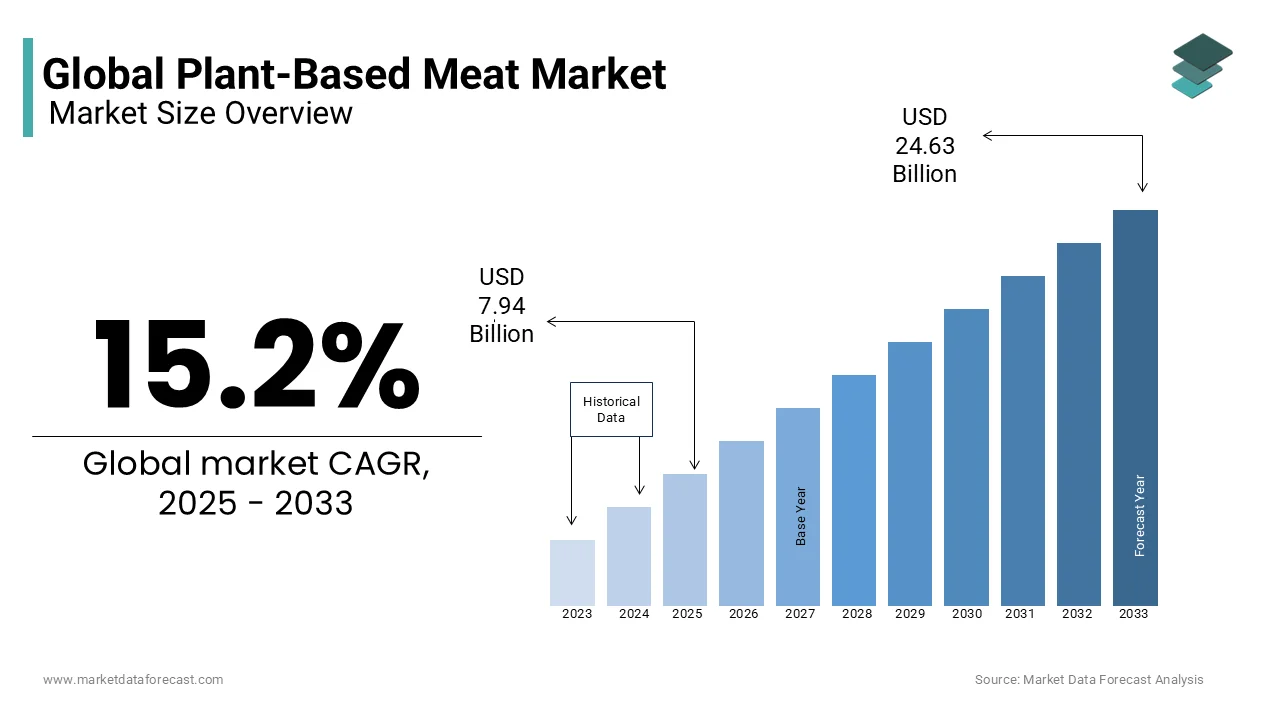
The global market for plant-based meat has been picking up nicely in the last few years and is expected to fuel further during the forecast period. As more people adopt a vegetarian diet free of animal-based items, plant-based meat is increasingly a staple of the vegan diet. While some customers choose vegetarian ingredients to avoid animal cruelty and to consume sustainable food and beverage products, others are moving toward veganism for ethical and health reasons. In addition, soy contains all nine of the standard amino acids, which are necessary for the development of the human body. The need for soy in plant-based meat products is projected to increase in the next years due to its capacity to improve the end product's water absorption, solubility, emulsification, viscosity, anti-oxidation, and texture. The popularity of many plant-based meat alternatives is increasing, which broadens and diversifies the category. In addition to plant-based beef, there is a growing demand for plant-based poultry, pork, and seafood. Over the forecast period, the exponential expansion of chilled plant-based meat is expected to continue. It indicates a change in the plant-based industry's merchandising tactics as well as product innovation.
MARKET DRIVERS
The rising awareness of the benefits of a vegan diet is one of the major factors propelling the expansion of the global plant-based meat market. In several large nations, the number of vegans has significantly increased. More vegan food alternatives are being added to dishes by more than 39% of Americans. On the other hand, favourable marketing and positioning of plant-based meat is another major driver that propels the global plant-based meat market share during the forecast period. To remain competitive and boost sales, businesses must concentrate on this criterion. By extending their global reach and consumer relationships, they need to position themselves. The plant-based meat market's growth can be further accelerated by appropriate labeling. The goal is to increase consumer demand, particularly from consumers who are health-conscious, vegetarians, flexitarians, and vegans. The product must be placed correctly through the appropriate sales channel. The labeling standard, likewise observed by the Asia Pacific region, is relatively prioritized by the North American and European markets for plant-based meat, resulting in plan-based meat market expansion.
MARKET RESTRAINTS
Although plant-based meat alternatives are nutritious and provide necessary elements, eating them has some negative effects that limit their expansion. Soy's anti-nutritional components may contribute to health problems including soy allergies. People who are gluten intolerant are more likely to develop celiac disease because of an allergic reaction to the gluten proteins in wheat, barley, rye, and occasionally oats. In celiac disease, an allergic response to gluten in the diet results in inflammation and damage to the inner lining of the small intestine.
REPORT COVERAGE
| REPORT METRIC | DETAILS |
| Market Size Available | 2025 to 2034 |
| Base Year | 2025 |
| Forecast Period | 2026 to 2034 |
| CAGR | 15.2% |
| Segments Covered | By Type, Source, Application, Product And Region |
| Various Analyses Covered | Global, Regional and Country Level Analysis; Segment-Level Analysis; DROC; PESTLE Analysis; Porter’s Five Forces Analysis; Competitive Landscape; Analyst Overview of Investment Opportunities |
| Regions Covered | North America, Europe, APAC, Latin America, Middle East & Africa |
| Market Leaders Profiled | Beyond Meat, Impossible Foods Inc, Maple Leaf Foods (Field Roast & Maple Leaf), Vegetarian ButcherConagra, Inc. (Gardein Protein International), Kellogg NA Co. (MorningStar Farms), Quorn, Amy's Kitchen, Inc, Tofurky, Gold&Green Foods Ltd. |
SEGMENTAL ANALYSIS
By Source Insights
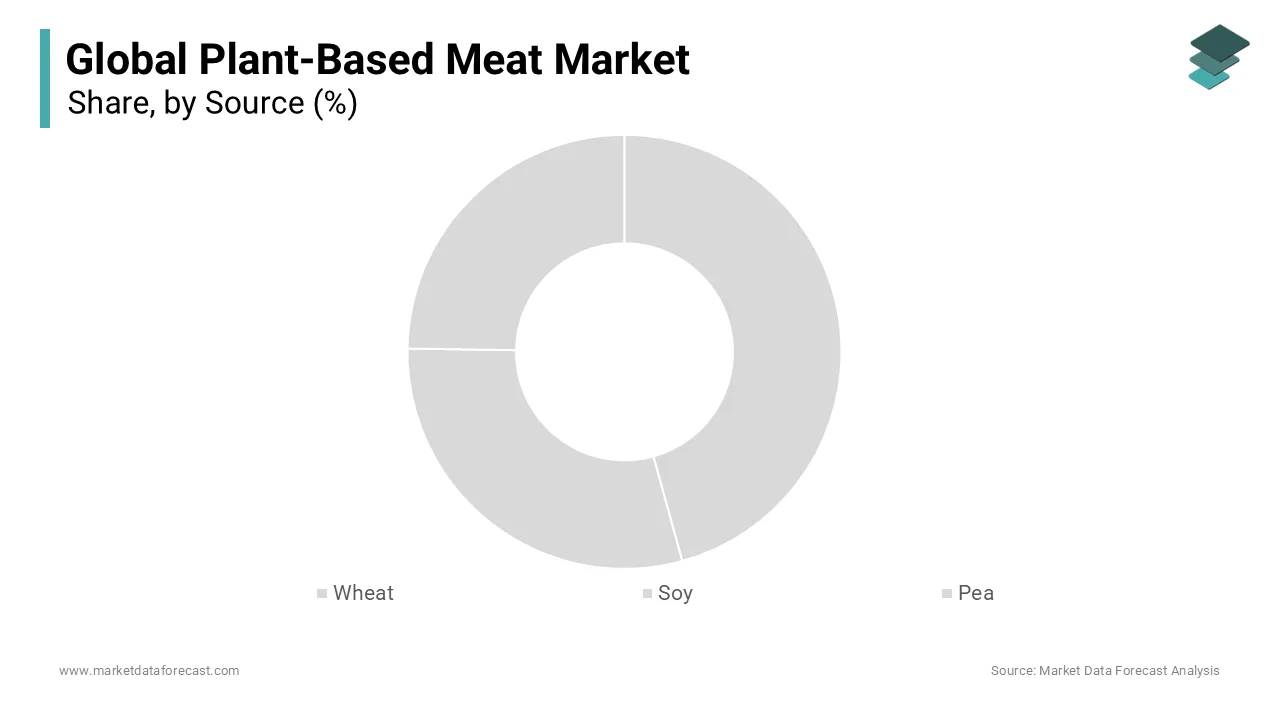
The wheat segment is anticipated to hold the dominating share of the worldwide market during the forecast period. Wheat is a source of antioxidants, vitamins, minerals, and fiber and is one of the most popular cereal grains consumed worldwide. Wheat protein is utilized in the food processing industry as a substitute for meat products, and as consumers accept plant-based meat products more frequently, this is anticipated to grow the market for wheat protein.
By Product Insights
The strips and nuggets segment is likely to play a promising role in the global plant-based meat market during the forecast period. Plant-based meat products such as strips and nuggets produced from chickpeas, wheat, soy, corn, rice, and oats, are being added to the product lineups of several corporations in an effort to diversify their product lines.
By Type Insights
The chicken segment is predicted to grow at a significant CAGR in the global market during the forecast period. The growing demand for plant-based chicken meat is a result of the availability of plant-based chicken in a variety of culinary products, including strips, nuggets, cutlets, and burger patties. While the other nutrients in plant-based chicken products may differ, the protein amount is roughly the same. Chicken patties made from plants contain fibre but have a lot of sodium.
By Distribution Channel Insights
The E-commerce segment is predicted to experience the highest CAGR growth in terms of value. The purchasing and selling of goods and services over an electronic network, primarily the Internet, is made possible by e-commerce, a distribution channel. This distribution channel serves to improve market potential while also giving brands more control over consumer involvement and marketing.
REGIONAL ANALYSIS
North America was the largest regional segment in the global market in 2023. With a significant CAGR in the market for plant-based meat, North America is the region that is expanding the fastest. Meat is a significant component of many Americans' diets. However, because plant-based diets offer a healthier alternative to animal meat, consumers are gravitating toward them as more researchers have highlighted the health hazards associated with the intake of red meat. Flexitarian lifestyles are becoming increasingly popular in the area, and many consumers are adding plant-based meals to their regular diets. Additionally, the region is seeing a rise in the vegan trend, which is fuelling the expansion of the plant-based meat market in the North American region.
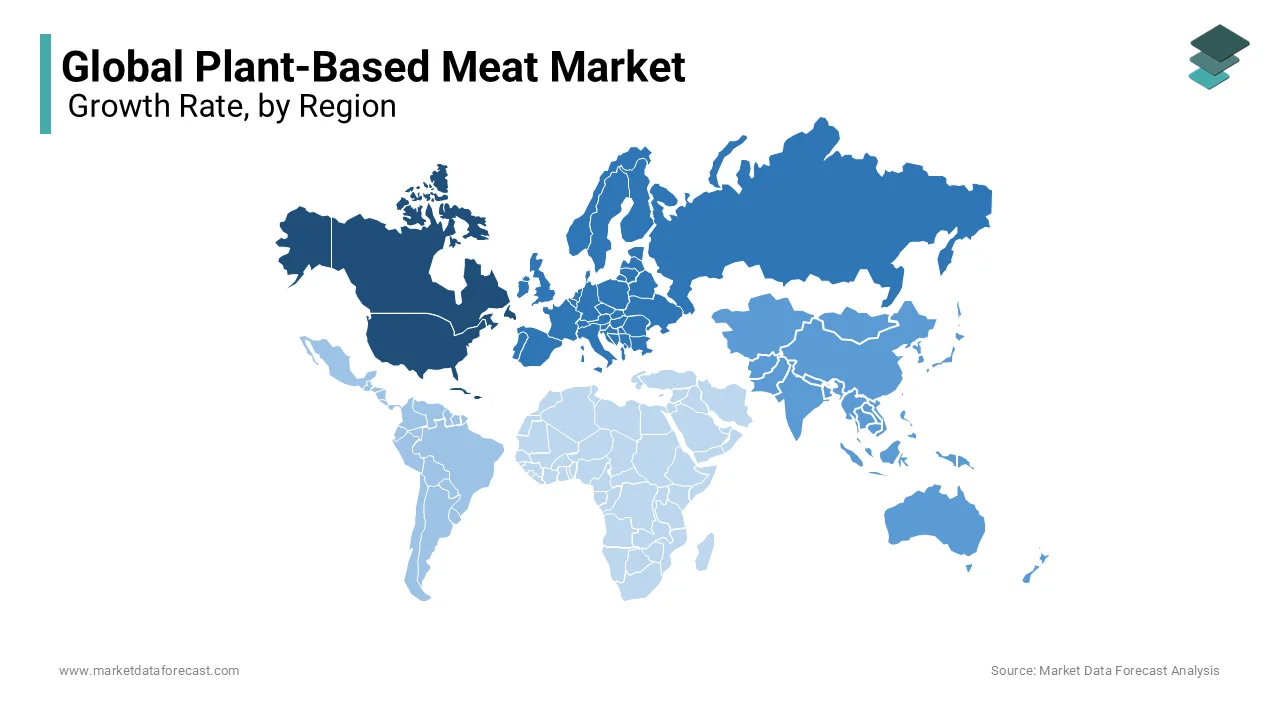
Europe is another major regional segment in the global plant-based meat market.The market in Europe is predicted to experience the fastest growth rate over the course of the forecast period due to favourable customer perceptions of vegetarian and vegan meat products as well as the application of strict laws against animal cruelty. To boost their sales in the local market, major manufacturers are pursuing strategic initiatives such capacity development, product innovation, and mergers and acquisitions.
KEY MARKET PLAYERS
Beyond Meat, Impossible Foods Inc, Maple Leaf Foods (Field Roast & Maple Leaf), Vegetarian ButcherConagra, Inc. (Gardein Protein International), Kellogg NA Co. (MorningStar Farms), Quorn, Amy's Kitchen, Inc, Tofurky and Gold&Green Foods Ltd are a few of the prominent companies in the global plant-based meat market.
RECENT HAPPENINGS IN THE GLOBAL MARKET
- Unilever announced in May 2021 that it would collaborate with the food technology firm ENOUGH to introduce new plant-based meat products. To produce a high-quality protein, ENOUGH's technology employs a novel zero-waste fermentation technique. Natural fungi are fed by wheat and corn, which results in ABUNDA mycoprotein, a complete food element. This distinctive protein will be ideal for The Vegetarian Butcher, a rapidly expanding meat substitute brand from Unilever.
MARKET SEGMENTATION
This research report on the global plant-based meat market has been segmented and sub-segmented based on type, source, application, product and Region
By Source
- Wheat
- Soy
- Pea
By Product
- Sausages
- Burger Patties
- Meat Balls
- Strips & Nuggets
By Type
- Beef
- Pork
- Chicken
By Distribution Channel
- E-Commerce
- Food Retail
By Region
- North America
- Europe
- The Asia Pacific
- Latin America
- The Middle East And Africa