- Product Description Description
- Table of Contents TOC
- List of Table & Figure LOT
- Get Free Sample PDF Sample PDF
Market Size, 2025
$14.37 BnMarket Estimate, 2026
$15.45 BnMarket Forecast, 2034
$27.60 BnCAGR, 2026–2034
7.52%Global Plasticizers Market Size, Growth, Trends & Forecast (2026–2034)
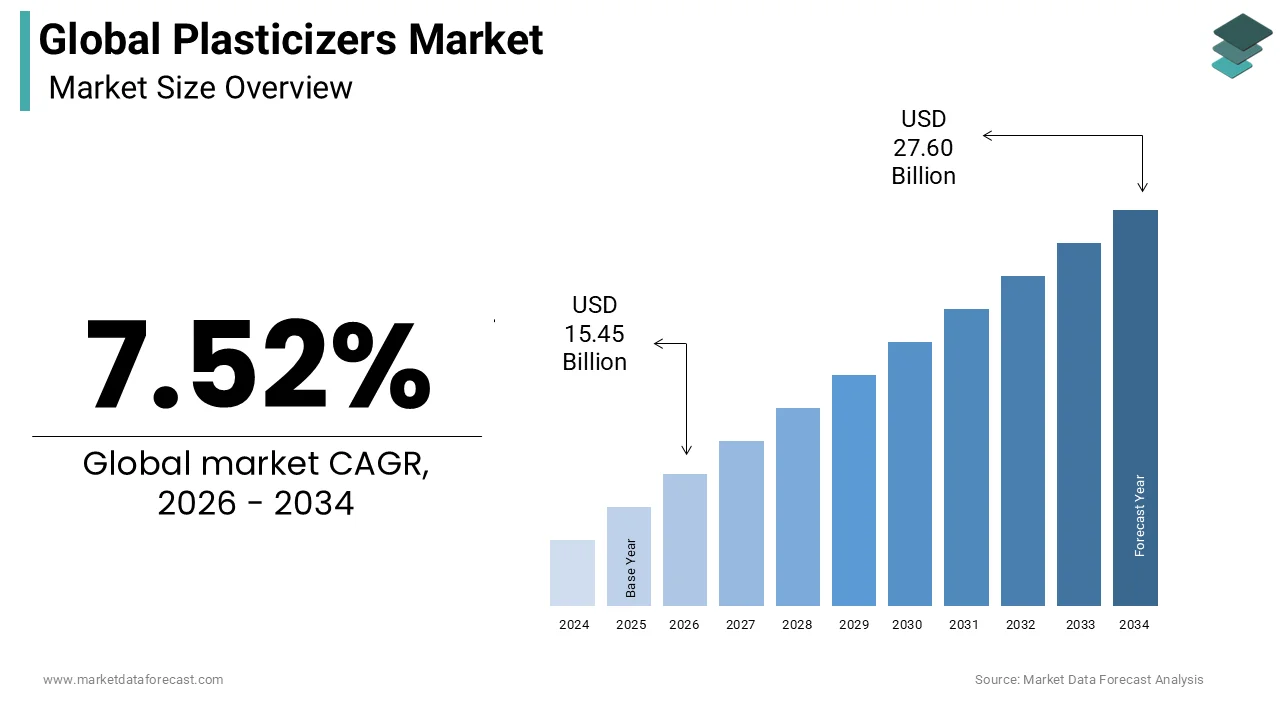
The global plasticizers market size was valued at USD 14.37 billion in 2025, stands at USD 15.45 billion in 2026, and is projected to reach USD 27.60 billion by 2034, registering a compound annual growth rate (CAGR) of 7.52% during the forecast period from 2026 to 2034. Growth is heavily impelled by the soaring demand for flexible polyvinyl chloride (PVC) across diverse construction, automotive, and packaging applications, alongside an industry-wide transition toward phthalate-free and high-molecular-weight sustainable alternatives.
Key Executive Metrics (At-a-Glance)
- 2025 Base Valuation: USD 14.37 Billion
- 2026 Current Valuation: USD 15.45 Billion
- 2034 Forecast Valuation: USD 27.60 Billion
- Compound Annual Growth Rate (CAGR): 7.52% (2026–2034)
- Dominant Type Segment: Phthalates currently command over 60% of market share due to cost-efficiency and wide availability, though face strict regulatory limits.
- Fastest Growing Type Segment: Non-phthalates are projected to grow at the fastest rate, driven by regulatory shifts and eco-friendly alternatives.
- Fastest Growing Application Segment: Films & sheets lead growth momentum, heavily fueled by expanding food and beverage packaging and rising health and hygiene awareness.
- Regional Market Leadership: Asia-Pacific captures the largest market share and highest CAGR, propelled by rapid urbanization, massive infrastructure development, and thriving automotive manufacturing.
Core Market Drivers
- Flexible PVC Demand: The need for resilient, high-performance flexible PVC materials lasting up to 50 years across construction, wiring, and automotive interiors.
- Shift Toward Safer Chemistry: Growing corporate and regulatory alignment pushing for phthalate-free, bio-based, and renewable raw material plasticizers.
Primary Market Restraints & Challenges
- Regulatory Bans: Stricter global rules and outright bans (such as EU restrictions on DEHP, DBP, and BBP) curbing traditional ortho-phthalate usage in sensitive applications like toys and packaging.
- Toxicity & Environmental Pressures: Health concerns raised by NGOs forcing manufacturers to accelerate costly product reformulations.
Global Plasticizers Market Segmentation Breakdown
| Segment Category | Key Offerings / Categories | Largest / Leading Sub-Segment | Fastest Growing Sub-Segment |
|---|---|---|---|
| By Type | Phthalates, Non-phthalates | Phthalates (>60% share) | Non-phthalates |
| By Application | Flooring & wall covering, Wire & cable, Coated fabric, Consumer goods, Film & sheet | Wire & Cable / Flooring | Film & Sheet |
| By Region | North America, Europe, Asia Pacific, Latin America, Middle East & Africa | Asia Pacific | Asia Pacific |
Major Industry Players Profiled
Key market participants operating across the global plasticizers market include UPC Group, Exxon Mobil Corporation, Aekyung Chemical, BASF SE, Nan Ya Plastics Corporation, Eastman Chemical Company, Evonik Industries AG, LG Chem, DIC Corporation, Jiangsu Zhengdan Chemical Industry Co., Kao Corporation, KLJ Group, Lanxess, and Polynt.
Global Plasticizers Market Size
The global plasticizers market size was valued at USD 14.37 billion in 2025, and the market size is expected to be worth USD 27.60 billion by 2034 from USD 15.45 billion by 2026. The market is growing at a CAGR of 7.52% during the forecast period.
A strong call for plasticizers in various applications, such as floor and wall coatings, wire and cable, coated fabrics, consumer goods, and films and foils, is driving the plasticizers market. The worldwide plasticizers market is driven by the growing call for flexible PVC in different applications, the increasing adoption of phthalate-free and high molecular weight phthalate-free plasticizers, and the expansion of the packaging industries. The strict regulatory bans on some of the phthalates and the toxicity of PVC limit market expansion. Plastic additives are important chemical compounds that are generally added to plastic or polymer to change, alter, modify, or improve its physical and chemical properties. These types of additives alter the general physical properties of the substance. In the market, the product may be available in low-volatility liquids or in solids. In general, plasticizers decrease the attraction between monomers or within a polymer chain to make it more flexible and elastic.
During the last 60 years, of all the substances studied for their plasticizing capacity, around 50% are currently employed in commerce. Most of these plasticizers are consumed primarily by polyvinyl chloride (PVC) plastics. Plasticizers find application in almost all major end-use industries, namely construction, automotive, electronics and electrical, consumer goods, and packaging, among others.
MARKET DRIVERS
PVC, in general, is a rigid thermoplastic polymer. Plasticizers play an essential role in making PVC more flexible, giving it the necessary flexible and durable properties. PVC products that are softened with plasticizers are known as flexible PVC. These flexible PVCs open up new application markets due to their high-performance durability property of up to 50 years. The use of PVC has grown steadily since the 1930s due to its excellent water resistance and non-flammable properties. Flexible PVC represents around 30 to 40% of the total PVC market. Flexible PVC finds applications primarily in pipes, floors, wall coverings, towels, cling films, pool liners, extruded yarns, automotive, synthetic leather-coated textiles, and medical devices. The increasing call for lightweight PVC materials in various end-use industries and the longer lifespan of conventional PVC are driving the call for flexible PVC. Furthermore, the growing population and the rising standard of living are also increasing the call for flexible PVC materials in various construction and automotive applications.
MARKET RESTRAINTS
Phthalate plasticizers account for more than 60% of the total plasticizer market. They are the most widely employed plasticizers due to their easy availability at low cost. Many companies are deliberately moving away from phthalate plasticizers as a growing number of studies expose the health effects caused by the use of phthalate plasticizers. Additionally, non-governmental organizations (NGOs) such as the U.S. Green Building Council (USGBC) promote the use of phthalate-free plasticizers due to their eco-friendly nature. The European Parliament bans the use of three phthalate plasticizers, namely DEHP, DBP, and BBP, in toys and childcare articles. DINP, DIDP, and DNOP are also prohibited for use in sensitive applications. These strict regulations are the main limitations to the expansion of the phthalate plasticizers market.
MARKET OPPORTUNITIES
Strict regulations, as well as the supply of harmful phthalates, such as DOP, DBP, BBP, and DEP, have led to the development of environmentally friendly plasticizers to replace traditional phthalates. Approximately 90.0% of all plasticizers are consumed by PVC manufacturers to change the ownership of their PVC products according to end-user requirements. Plasticizers are the key component employed to make flexible PVC where flexibility and durability are essential properties that are required. They are employed in a variety of applications, such as flooring, car interiors, cables, and toys. The plasticizers industry is focused on introducing safer alternatives, with the recent emphasis on renewable and bio-sourced raw materials that offer a more favorable environmental footprint. Due to their harmful nature and various laws, phthalate plasticizers are being replaced by alternatives such as bio-based plasticizers. Therefore, suppliers are introducing bio-based alternatives to meet the call for green plasticizers. Therefore, bio-based plasticizers should be a crucial opportunity to capitalize on market players.
MARKET CHALLENGES
Strict regulations on the use of phthalate plasticizers in packaging, toys, and consumer goods are likely to limit worldwide market expansion during evaluation periods.
REPORT COVERAGE
| REPORT METRIC | DETAILS |
| Market Size Available | 2025 to 2034 |
| Base Year | 2025 |
| Forecast Period | 2026 to 2034 |
| CAGR | 7.52% |
| Segments Covered | By Type, Application, and Region |
| Various Analyses Covered | Global, Regional & Country Level Analysis, Segment-Level Analysis, DROC, PESTLE Analysis, Porter’s Five Forces Analysis, Competitive Landscape, Analyst Overview on Investment Opportunities |
| Regions Covered | North America, Europe, Asia Pacific, Latin America, and Middle East & Africa |
| Market Leaders Profiled | UPC GroupExxon Mobil Corporation., AEKYUNG CO, BASF SE, NAN YA PLASTICS CORPORATION, Eastman Chemical Company, Evonik Industries AG, LG Chem., Bloomberg L.P., Chemamde, DIC CORPORATION, Jiangsu Zhengdan Chemical Industry Co, Kao Corporation |
MARKET SEGMENTATION
This research report on the global plasticizers market has been segmented and sub-segmented based on type, application, and region.
Global Plasticizers Market By Type
- Phthalates
- Non-phthalates
Non-phthalates are predicted to be the fastest-growing plasticizer market segment by type.
Global Plasticizers Market By Application
- Flooring & wall covering
- Wire & cable
- Coated fabric
- Consumer goods
- Film & sheet
Films and sheets are predicted to be the fastest-growing segment of the plasticizers market. The expansion in this segment is attributed to the growing call for packaging applications in the food and beverage industry. Health and hygiene awareness further stimulates the packaging industry market, thus driving the application of films and foils.
Global Plasticizers Market By Region
- North America
- Europe
- Asia Pacific
- Latin America
- Middle East & Africa
The Asia Pacific region market accounted for the largest share in 2025. The Asia Pacific market is predicted to grow at the highest CAGR over the foreseen period. This is mainly attributed to rapid urbanization, the development of infrastructure projects, and the strong expansion of the automotive industry in this region. In addition, the growing call for the product from the toy manufacturing, packaging, and consumer goods industry is predicted to promote the expansion of this regional market. Europe held the second-largest market share in 2023. The countries, namely Germany, Italy, France, and Spain, are the main contributors to the regional market due to the high call for the product from the well-established automotive industry in this region. North America is also predicted to see healthy expansion in the worldwide plasticizers market. The United States is predicted to be the main contributor to regional market expansion due to increased reconstruction activity in this market.
KEY MARKET PLAYERS
UPC GroupExxon Mobil Corporation, AEKYUNG CO, BASF SE, NAN YA PLASTICS CORPORATION, Eastman Chemical Company, Evonik Industries AG, LG Chem., Bloomberg L.P., Chemamde, DIC CORPORATION, Jiangsu Zhengdan Chemical Industry Co, Kao Corporation, KLJ Group, LANXESS, OXEA GmbH, Polynt , Velsicol Chemical LLC, Shandong Hongxin Chemicals Industry Co, Ltd, Vertellus Specialities Inc, Supreme Plasticizers are some of the notable companies in the global Plasticizers market.
RECENT HAPPENINGS IN THE MARKET
- Evonik this year launched a new generation of PVC plasticizers with its new ELATUR® brand of products.