- Product Description Description
- Table of Contents TOC
- List of Table & Figure LOT
- Get Free Sample PDF Sample PDF
Market Size, 2025
$866.67 MnMarket Estimate, 2026
$1052.66 MnMarket Forecast, 2034
$4986.01 MnCAGR, 2026–2034
21.46%Global Polylactic Acid Market Summary
The global polylactic acid (PLA) market was valued at USD 866.67 million in 2025, is anticipated to reach USD 1052.66 million in 2026, and is projected to grow significantly to USD 4986.01 million by 2034, expanding at a CAGR of 21.46% from 2026 to 2034. The growth of the global polylactic acid market is driven by increasing demand for sustainable and biodegradable plastics, strict environmental regulations on conventional plastics, and the rising adoption of PLA in packaging, consumer goods, agriculture, textiles, and biomedical applications.
Key Market Trends
- Strong push for bioplastics adoption to replace petroleum-based plastics.
- Expanding demand for PLA packaging solutions in food & beverages and retail.
- Increasing PLA usage in 3D printing filaments and industrial applications.
- Growth in medical implants and biomedical applications using PLA.
- Rising investments in bio-based feedstock and circular economy initiatives.
Segmental Insights
- Based on raw material, the corn starch segment dominated the PLA market with a 65.5% share in 2025, attributed to abundant availability, cost-effectiveness, and suitability for mass-scale PLA production.
- Based on application, the rigid thermoformed PLA products segment captured 48.2% of the market share in 2025, driven by its usage in packaging, containers, and disposable consumer goods.
Regional Insights
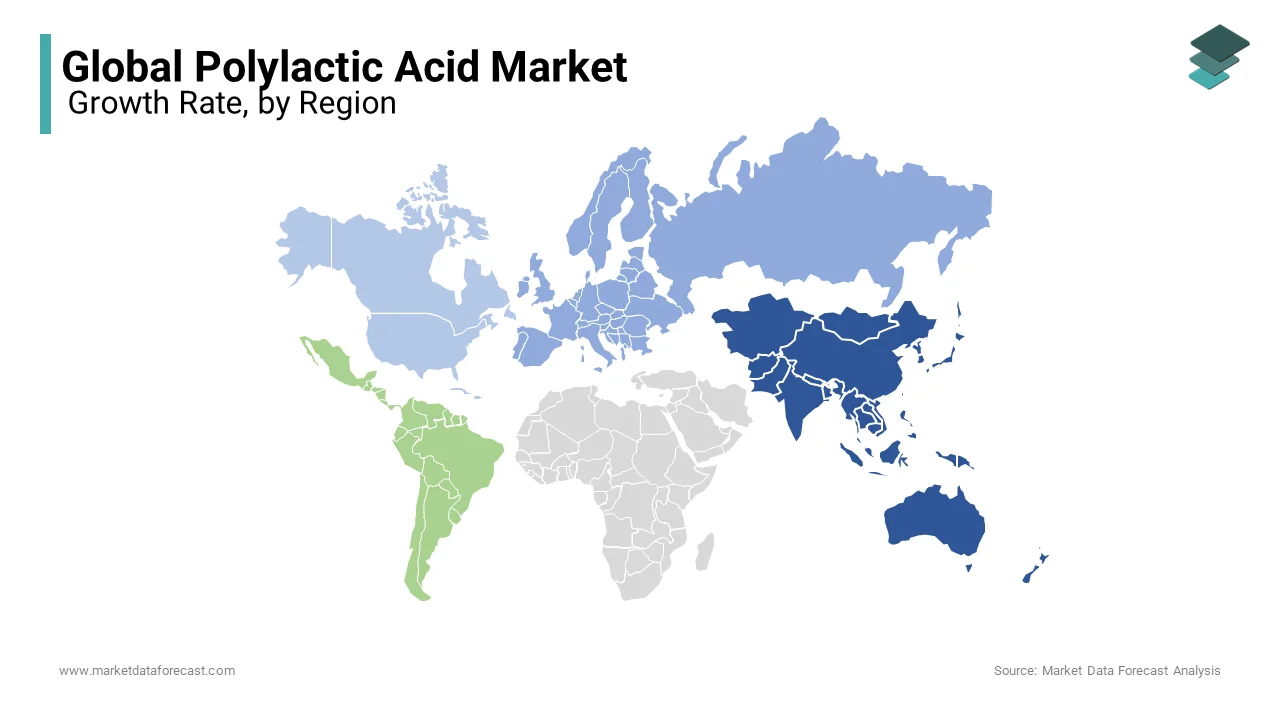
- Asia-Pacific was the top-performing region in the global PLA market with a 36.4% share in 2025, fueled by strong demand from the packaging, consumer goods, and textile industries.
- North America is witnessing rapid adoption, supported by favorable regulatory frameworks and growing consumer awareness of sustainable products.
- Europe remains a significant market, driven by stringent environmental policies and the European Green Deal initiatives.
- Latin America is emerging, with rising applications in agriculture and packaging.
- Middle East & Africa show gradual growth, supported by demand for eco-friendly alternatives and government-led plastic reduction policies.
Competitive Landscape
Key players in the global PLA market include TotalEnergies Corbion BV, NatureWorks LLC, JIANGSU SUPLA BIOPLASTICS CO., LTD., Futerro, COFCO, Jiangxi Keyuan Biopharm Co., Ltd., Shanghai Tong-jie-liang Biomaterials Co., Ltd., Zhejiang Hisun Biomaterials Co., Ltd., BASF SE, Danimer Scientific, Mitsubishi Chemical America, Inc., and UNITIKA LTD. These companies are investing in capacity expansions, partnerships, and advanced biopolymer technologies to strengthen their global presence.
 Download Free Sample Report
Global Polylactic Acid Market Size
The global polylactic acid market size was valued at USD 866.67 million in 2025 and is anticipated to reach a valuation of USD 1052.66 million in 2026 and USD 4986.01 million by 2034, growing at a CAGR of 21.46%, from 2026 to 2034.
Polylactic acid (PLA) is a biodegradable and bio-based thermoplastic derived primarily from renewable resources such as corn starch, sugarcane, and cassava. PLA serves as a sustainable alternative to conventional petroleum-based plastics in applications ranging from packaging and disposable tableware to medical implants and 3D printing filaments. Its compostability under industrial conditions and low carbon footprint during production have positioned it at the forefront of the global shift toward circular materials. According to the United Nations Environment Programme (UNEP), approximately 19 to 23 million metric tons of plastic waste leak into aquatic ecosystems annually.
MARKET DRIVERS
Regulatory Push for Single-Use Plastic Substitution in Developed Economies
Stringent legislative actions targeting non-recyclable and persistent plastic waste are accelerating the growth of the polylactic acid market. The European Union’s Single-Use Plastics Directive has banned a wide range of disposable plastic items, including cutlery, plates, and straws. In response, manufacturers are reformulating products using compostable materials like PLA. Similarly, California’s SB 54 legislation requires that 100% of plastic packaging be recyclable or compostable by 2032, and 65% of single-use plastic packaging be recycled by the same year.
Rising Consumer Demand for Sustainable and Compostable Packaging in E-Commerce
The rapid expansion of online retail has intensified the need for environmentally responsible packaging solutions, which boosts the growth of the polylactic acid market. Also, consumers are increasingly favoring brands that adopt biodegradable materials. As per the study, global e-commerce generated a substantial amount in sales in 2023, much of which relies on single-use plastic void-fillers and protective wraps. In response, major retailers have committed to incorporating compostable alternatives, including PLA-based films and molded trays, into their shipping systems.
MARKET RESTRAINTS
Limited Industrial Composting Infrastructure in Key Markets
Its environmental benefits are contingent upon proper disposal in industrial composting facilities, which remain underdeveloped in many regions, and degrade the growth of the polylactic acid market. According to the study, only a portion of U.S. municipalities offer curbside collection for compostable plastics, severely limiting PLA’s effective end-of-life management. In India and Southeast Asia, where informal waste sectors dominate, a smaller share of organic waste is processed in controlled composting environments, as per the research. PLA does not degrade efficiently in natural or landfill conditions, where it can persist for years without breaking down, which weakens its sustainability claims. Furthermore, contamination of recycling streams with PLA, chemically distinct from PET, can compromise the quality of recycled plastics.
High Production Costs and Feedstock Competition with Food Supply
The production remains cost-intensive compared to conventional plastic, which restricts the growth of the polylactic acid market. This is primarily due to expensive fermentation and purification processes. Apart from these, reliance on food-grade crops such as corn and sugarcane raises concerns about agricultural resource allocation. According to a study, global ethanol and bioplastics production consumed significant metric tons of cereal grains. In regions where sugarcane is diverted from sugar to bioplastics, price volatility in both food and feedstock markets has emerged. This competition threatens long-term scalability and raises ethical questions about land use, particularly in food-insecure regions.
MARKET OPPORTUNITIES
Expansion into Medical and Pharmaceutical Applications
The advanced medical applications are gearing up new opportunities for the growth of the polyactic acid market. It is widely used in absorbable sutures, drug delivery systems, and tissue engineering scaffolds, where it safely degrades within the human body over weeks to months. According to the research, many medical devices utilizing PLA were approved in the U.S., including orthopedic fixation devices and 3D-printed implants. Innovations such as electrospun PLA nanofibers for wound healing and microencapsulated drug carriers are expanding their clinical utility.
Technological Advancements in Non-Food Biomass Feedstocks
The emerging innovations in feedstock diversification, enabling PLA production from non-food biomass, are accelerating the growth of the polylactic acid market. It reduces pressure on agricultural resources and enhances sustainability credentials. Companies are piloting lactic acid fermentation using cellulosic sugars derived from agricultural residues such as corn stover and sugarcane bagasse. According to the study, lignocellulosic biomass availability in the United States exceeds notable metric tons annually, offering a vast, underutilized feedstock pool. As per the study, cellulosic PLA production can reduce greenhouse gas emissions compared to corn-based PLA. Apart from these, research has demonstrated successful lactic acid fermentation from algae biomass, potentially unlocking marine-based feedstock chains.
MARKET CHALLENGES
Performance Limitations in High-Temperature and Long-Term Applications
The inferior thermal and mechanical stability compared to conventional plastics threatens the growth of the polylactic acid market. Its glass transition temperature ranges between 55°C and 60°C, which causes deformation under typical sterilization or hot-fill conditions. This limits its applicability in hot beverage containers, microwaveable packaging, and automotive components. According to the European Packaging Federation, PLA-based containers exposed to temperatures above 50°C during transport or storage experience a higher failure rate than polypropylene counterparts. Annealing and blending with polycaprolactone or nanoclay reinforcements can improve heat resistance. These modifications increase production complexity and cost.
Greenwashing Risks and Misleading Consumer Perceptions
Misleading consumer perceptions and greenwashing risks degrade the growth of the polyactic acid market. However, PLA requires specific industrial composting conditions, temperatures above 58°C, high humidity, and microbial activity, to degrade within several days, as defined by the ASTM D6400 standard. According to a study published in Environmental Science & Technology, a portion of consumers incorrectly believe PLA decomposes in backyard composts or marine settings, leading to improper disposal and contamination of recycling streams. This misperception exposes brands to greenwashing accusations when PLA items persist in landfills or oceans. The UK’s Competition and Markets Authority has launched investigations into several packaging suppliers for unsubstantiated biodegradability claims.
REPORT COVERAGE
| REPORT METRIC | DETAILS |
| Market Size Available | 2025 to 2034 |
| Base Year | 2025 |
| Forecast Period | 2026 to 2034 |
| CAGR | 21.46% |
| Segments Covered | By Raw Material, Application, and Region |
| Various Analyses Covered | Global, Regional, & Country Level Analysis; Segment-Level Analysis; DROC, PESTLE Analysis; Porter’s Five Forces Analysis; Competitive Landscape; Analyst Overview of Investment Opportunities |
| Regions Covered | North America, Europe, APAC, Latin America, Middle East & Africa |
| Market Leaders Profiled | TotalEnergies Corbion bv, NatureWorks LLC, JIANGSU SUPLA BIOPLASTICS CO., LTD., Futerro, COFCO, Jiangxi Keyuan Biopharm Co.,Ltd., Shanghai Tong-jie-liang Biomaterials Co.,LTD., Zhejiang Hisun Biomaterials Co., Ltd., BASF SE, Danimer Scientific, Mitsubishi Chemical America, Inc., UNITIKA LTD. |
SEGMENTAL ANALYSIS
By Raw Material Insights
The corn starch segment dominated the polylactic acid (PLA) market by capturing 65.5% of the global market share in 2025. The growth of the corn starch segment is propelled by its established supply chain, high purity, and compatibility with existing fermentation technologies used in lactic acid production. The United States is a leading producer of corn, contributing significantly to this trend, with millions of metric tons of corn harvested annually, as per the. This abundant domestic feedstock ensures cost-effective and scalable PLA production, particularly for companies that operate the world’s largest PLA production facility in Blair, Nebraska. The facility, capable of producing over significant metric tons of Ingeo biopolymer annually, relies almost exclusively on corn-derived glucose. Apart from these, advancements in enzymatic hydrolysis have increased starch-to-glucose conversion efficiency.

The cassava segment is likely to experience the fastest CAGR of 14.3% from 2025 to 2033 due to its cultivation in tropical regions with low agricultural opportunity cost, making it a sustainable alternative to food-competing crops in certain geographies. Thailand, a major exporter of cassava, shipped significant metric tons of dried cassava chips, as per research. These exports increasingly supply bioplastics manufacturers, where cassava-based PLA pilot plants are scaling up. The crop’s resilience to drought and ability to grow on marginal lands reduces pressure on prime farmland.
By Application Insights
The rigid thermoformed PLA products segment led the polylactic acid market by capturing 48.2% of the market share in 2025. The growth of the Rigid thermoformed PLA products segment is driven by the packaging industry’s urgent shift toward sustainable materials, particularly for disposable food containers, trays, and clamshells used in retail and food service. The European Union’s Single-Use Plastics Directive, which banned several conventional plastic items, has accelerated adoption, with a portion of fresh food packaging in Germany utilizing bioplastics, including PLA thermoforms, as per research.
The bottles segment is anticipated to witness the fastest CAGR of 12.8% during the forecast period 2025 to 203, owing to rising demand for compostable beverage containers and advancements in PLA modification technologies that improve barrier properties and thermal stability. Traditionally limited by low heat resistance and gas permeability, PLA bottles have seen breakthroughs through blending with polycaprolactone (PCL) and coating with polyhydroxyalkanoates (PHA), extending shelf life and enabling hot-fill applications. Pilot production lines are already producing notable tons annually of PLA bottles for dairy and juice applications, which demonstrates scalable commercialization.
REGIONAL ANALYSIS
Asia-Pacific Market Analysis
Asia-Pacific was the top performer in the olylactic market in 2025 and accounted for 36.4% of the market share in 2025. China alone accounts for a portion of regional output, which is driven by aggressive industrial policy and investment in bioplastics infrastructure. The National Development and Reform Commission of China mandated in 2020 that all major cities ban non-degradable plastic bags by 2022, stimulating domestic PLA demand. As of 2023, China’s PLA production capacity exceeded significant metric tons per year, with companies expanding facilities. Apart from these, Thailand and India are emerging as regional hubs for cassava and sugarcane-based PLA, which is supported by agricultural abundance and favorable government incentives.
Europe Market Analysis
Europe was positioned second by accounting for 27.1% of the polylactic acid market in 2025, with its regulatory prominence and high consumer awareness. Germany, Italy, and France are at the forefront, with Germany alone accounting for a portion of Europe’s bioplastic processing. Compostability standards have enabled widespread use of PLA in organic waste collection bags and catering ware. Furthermore, the Horizon Europe program has funded PLA innovation projects, including the development of marine-degradable PLA blends.
North America Market Analysis
North America grew steadily in the polylactic acid market. Factors such as the robust R&D infrastructure and early commercialization of biopolymers are propelling the growth of North America in the global market. The United States is the primary driver by hosting NatureWorks, whose Ingeo brand accounts for a portion of global PLA output.
Latin America Market Analysis
Latin America is expected to be the most lucrative region in the polylactic acid market. The region is gaining traction as a sustainable feedstock supplier and an emerging production base. Brazil leads the region with its vast sugarcane resources, producing millions of metric tons annually, according to research. This abundance supports Braskem’s Green PE and creates potential for sugarcane-based PLA expansion. Although current PLA production remains limited, pilot projects like the one at the University of São Paulo demonstrated a lactic acid yield from sugarcane bagasse. This signals future scalability. There has been a year-on-year increase in bioplastic inquiries from packaging firms. Countries are also introducing plastic tax policies.
Middle East and Africa Market Analysis
The Middle East and Africa are likely to grow in the polylactic acid market during the forecast period. The growth of the Middle East and Africa can be attributed to its strategic investments, which are laying the foundation for growth. South Africa is the regional leader, with the Council for Scientific and Industrial Research (CSIR) launching a biopolymers initiative aimed at converting cassava and sugarcane waste into lactic acid. Egypt, facing severe plastic pollution in the Nile, introduced a national plastic reduction strategy targeting a cut in single-use plastics, as per research. The current PLA consumption is minimal.
COMPETITON LANDSCAPE
The competition in the polylactic acid market is intensifying as both established chemical giants and specialized biotech firms race to capture growing demand for sustainable alternatives to conventional plastics. While a few dominant players control significant production capacity, the market remains dynamic due to technological advancements and regional policy shifts. New entrants from Asia, particularly China and India, are scaling up production, increasing competitive pressure on pricing and innovation. Differentiation is increasingly based on feedstock sustainability, product performance, and end-of-life management. Strategic collaborations between material suppliers, packaging converters, and waste management firms are reshaping competitive boundaries. Companies are also competing on certification standards, compostability claims, and lifecycle transparency.
KEY MARKET PLAYERS
A few of the dominating players in the global polylactic acid market include
- TotalEnergies Corbion bv
- NatureWorks LLC
- JIANGSU SUPLA BIOPLASTICS CO., LTD.
- Futerro
- COFCO
- Jiangxi Keyuan Biopharm Co., Ltd.
- Shanghai Tong-jie-liang Biomaterials Co., LTD.
- Zhejiang Hisun Biomaterials Co., Ltd.
- BASF SE
- Danimer Scientific
- Mitsubishi Chemical America, Inc.
- UNITIKA LTD.
Top Players In The Market
- NatureWorks, headquartered in the United States, is a pioneering force in the global polylactic acid market and maintains a strong footprint across the Asia-Pacific region. The company operates its Ingeo biopolymer brand, one of the most recognized PLA lines worldwide, and has established strategic partnerships with Asian manufacturers in China, Japan, and South Korea to expand distribution and application development. The company also opened a regional innovation center to accelerate customer-specific formulations and support local regulatory compliance. Nature Works has increased transparency in carbon footprint reporting, which aligns with Asia-Pacific’s tightening environmental regulations and strengthening its reputation as a technology and sustainability leader in the bioplastics space.
- Total Energies Corbion PLA, a joint venture between TotalEnergies and Corbion, plays a pivotal role in advancing sugarcane-based polylactic acid production in the Asia-Pacific market. Based in Thailand, its 75,000 metric ton per year facility is one of the largest PLA plants in the world and serves as a key supply hub for customers across Southeast Asia and beyond. The company has actively engaged with packaging converters in Indonesia and Vietnam to develop compostable films for food packaging, responding to regional plastic waste challenges.
- Futerro, a Belgian-based biotech company, has significantly expanded its influence in the Asia-Pacific polylactic acid market through technology licensing and joint ventures with regional manufacturers. While its production base is in Europe, Futerro has licensed its proprietary fermentation and polymerization technology to partners in China, which enables localized PLA production with reduced carbon footprint.
Top Strategies Used by the Key Market Participants
Key players in the polylactic acid market are deploying a mix of vertical integration, strategic partnerships, and innovation-driven expansion to consolidate their positions. Companies are investing heavily in securing upstream feedstock supply through alliances with agricultural firms to ensure sustainable and cost-effective raw material access. Technology licensing has emerged as a preferred strategy, which enables rapid market entry in regions like the Asia-Pacific without heavy capital expenditure. Major firms are also collaborating with research institutions to enhance PLA’s thermal and barrier properties by broadening its application scope. Mergers and acquisitions are on the rise, particularly targeting firms with composting infrastructure or specialty formulation expertise. Apart from these, companies are establishing regional innovation centers to tailor products to local regulatory and consumer demands.
MARKET SEGMENTATION
This research report on the polylactic acid market is segmented and sub-segmented into the following categories.
By Raw Material
- Corn starch
- Sugarcane
- Cassava
- Others
By Application
- Rigid Thermoform
- Film & sheets
- Bottles
- Others
By End-use
- Packaging
- Agriculture
- Automotive & transportation
- Electronics
- Textile
- Consumer goods
- Bio-medical
- Others
By Region
- North America
- Europe
- Asia-Pacific
- Latin America
- Middle East and Africa