- Product Description Description
- Table of Contents TOC
- List of Table & Figure LOT
- Get Free Sample PDF Sample PDF
Market Size, 2025
$3.21 BnMarket Estimate, 2026
$3.35 BnMarket Forecast, 2034
$4.66 BnCAGR, 2026–2034
4.21%Executive Summary: Global Polyurethane Sealants Market
- Market Scope: Comprehensive global market analysis covering resin types, end-user industry applications, and regional market dynamics for moisture-cured and high-performance structural sealants.
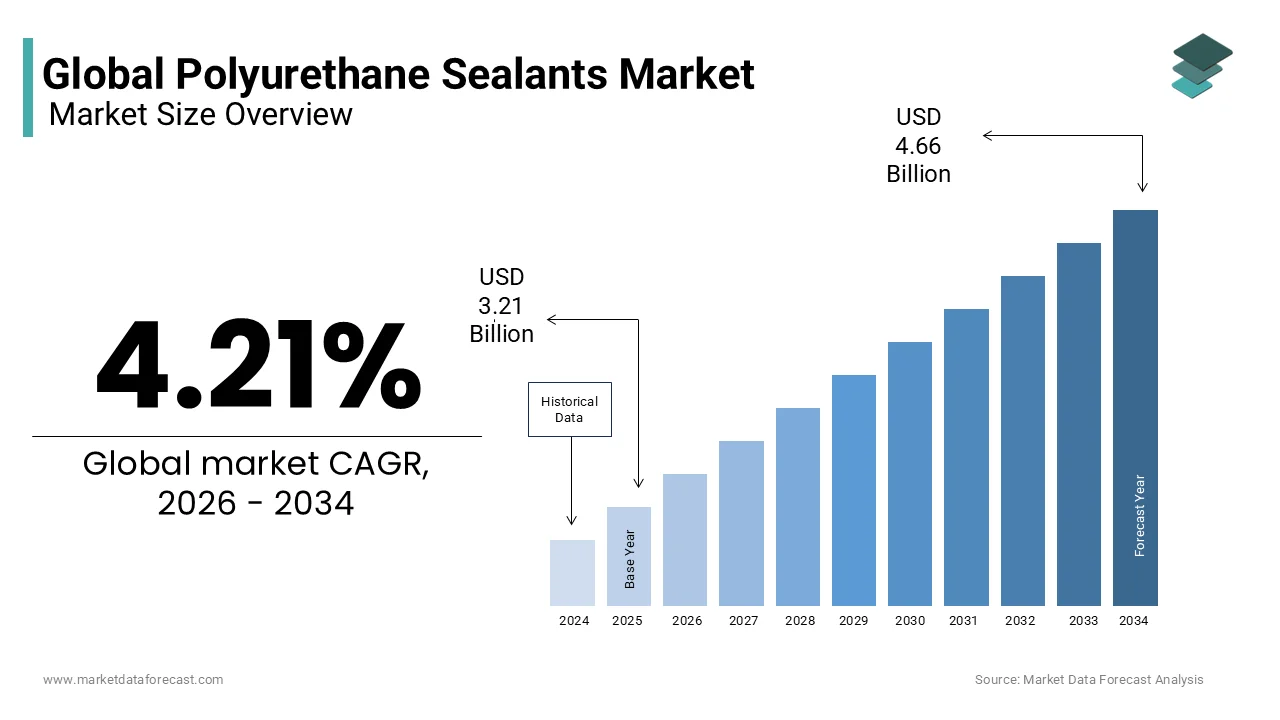
- Market Valuation: Valued at USD 3.21 billion (2025), estimated at USD 3.35 billion (2026), and projected to reach USD 4.66 billion by 2034, registering a CAGR of 4.21% (2026–2034).
- Primary Growth Drivers: Escalating construction and automotive manufacturing activities, rising disposable incomes leading to higher standards of living, and the pressing need for lightweight, weather-resistant, and high-load-bearing bonding materials.
Key Market Segment Metrics (2026–2034)
| Category | Leading Segment (2025 Position) | Fastest-Growing / Key Segment Trends |
|---|---|---|
| By Resin Type | One-Component Polyurethane Sealants (predicted to dominate due to ease of application and fast drying) | Two-Component Polyurethane Sealants (driven by heavy-duty civil and on-site applications) |
| By End-Use Industry | Building and Construction (estimated largest segment in volume terms, followed by automotive) | Automotive & General Industrial (focused on lightweight structural design and fuel efficiency compliance) |
| By Region | Asia-Pacific (predicted to dominate and grow at the highest rate, driven by China, India, and Vietnam) | Eastern Europe & Middle East/Africa (expanding via infrastructure development and capacity expansions) |
Major Market Players & Market Structure
Market Structure: Highly competitive global industry featuring top specialty chemical and adhesive manufacturers emphasizing green R&D investments, low-VOC bio-based formulations, and robust regional production footprints.
Key Companies: 3M, Arkema S.A., Sika AG, H.B. Fuller, Henkel AG & Company KGaA, BASF SE, The Dow Chemical Company, Mapei S.p.A., Asian Paints Limited, ITW Polymers Sealants North America, Soudal N.V., Konishi Co. Ltd., and Pidilite Industries Limited.
Global Polyurethane Sealants Market Size
The global polyurethane sealants market size was valued at USD 3.21 billion in 2025 and is expected to reach USD 4.66 billion by 2034 from USD 3.35 billion in 2026, growing at a CAGR of 4.21%.
Polyurethane sealants introduction spans industrial chemistry and elastomeric bonding solutions that feature exceptional tensile strength, flexibility, and abrasion resistance. According to comprehensive reports by the International Organisation of Motor Vehicle Manufacturers, global automobile production rebounded dynamically, reaching 96.4 million total units produced. These specialized material formulations prevent moisture infiltration, isolate structural vibration, and accommodate thermal expansion across expanding building envelopes, dynamic civil infrastructure joints, and automotive windshield assemblies. As per infrastructure statistics published by the United States Census Bureau, annual commercial construction expenditure surpassed 120 billion dollars, accelerating total volume demand for weather-proofing perimeter joints and structural concrete barriers. Furthermore, according to the data compiled by the United States Department of Energy, high-performance elastomeric seals significantly reduce thermal bridging and air leakage in commercial buildings, directly supporting national energy conservation targets. The rising adoption of lightweight composite assemblies, continuous urban infrastructure modernization, and stringent building energy efficiency codes across global markets fundamentally drive operational dependency on these high-performance polymer seals. Chemical engineers continuously optimize these formulations to withstand severe weathering, ultraviolet exposure, and dynamic mechanical stresses over extended structural lifecycles spanning several decades.
MARKET DRIVERS
Urban Commercial Construction and Civil Infrastructure Growth
Global expansion of urban commercial construction and civil infrastructure projects drives the global polyurethane sealants market growth. As per civil construction metrics published by the United States Census Bureau, annual commercial non-residential construction spending expanded beyond 120 billion dollars, maintaining sustained demand for durable elastomeric joint barriers. According to data published by the International Organisation of Motor Vehicle Manufacturers, overall global vehicle production climbed 3.9% year-over-year to reach 96.4 million units. Polyurethane formulations deliver superior movement capability, excellent concrete adhesion, and long-term tear resistance compared to conventional silicone alternatives. Structural engineers specify these elastomeric compounds across high-traffic expansion joints, precast concrete panel seams, curtain wall facades, and bridge decks to prevent water ingress and structural spalling. Additional insights from the Federal Highway Administration emphasize that protecting bridge expansion joints with resilient polyurethane sealants prevents costly corrosion of underlying rebar structures, extending infrastructure maintenance intervals. The direct relationship between surging commercial building construction, rigorous public works investments, and elastomeric sealing requirements reinforces robust market expansion across developed and emerging economies alike.
Lightweight Automotive Manfacturing and EV Battery Enclosure Sealing
Rapid growth in lightweight automotive manufacturing and electric vehicle battery enclosure sealing drives polyurethane sealants market expansion. According to global automotive production data released by the International Organisation of Motor Vehicle Manufacturers, electric and new energy vehicle manufacturing in China surged by 29% in a single year to hit 16.626 million units. As per industrial production surveys published by the European Automobile Manufacturers Association, automotive OEMs increased structural bonding adhesive application per chassis by 18% to replace traditional mechanical fasteners. Polyurethane sealants offer exceptional structural flexibility and stress distribution when joining dissimilar materials, such as aluminum, composite plastics, and high-strength steel. Modern electric vehicle battery packs rely heavily on moisture-proof, flame-retardant polyurethane seals to safeguard lithium-ion cells against water intrusion and thermal runaways, creating steady industrial demand. Furthermore, research findings published by the National Renewable Energy Laboratory indicate that weight reduction achieved through advanced structural adhesives directly improves electric vehicle driving range and energy efficiency. Automotive design engineers leverage these high-strength polymers to optimize crashworthiness, reduce cabin noise through effective acoustic damping, and streamline high-speed automated assembly line operations.
MARKET RESTRAINTS
Stringent Environmental Mandates and Diisocyanate Regulations
Stringent environmental and health regulations limiting toxic monomeric diisocyanate content hampers the global polyurethane sealants market growth. According to occupational health guidelines published under the European Union Registration, Evaluation, Authorisation and Restriction of Chemicals framework, strict mandatory safety restrictions took effect enforcing mandatory employee training for handling products containing 0.1% or more of monomeric diisocyanates. As per environmental compliance updates from the United States Environmental Protection Agency, industrial Volatile Organic Compound emission limits for architectural sealants were lowered below 250 grams per liter across multiple state jurisdiction zones. These regulatory mandates force chemical manufacturers to incur substantial research expenses to reformulate traditional polyurethane lines into low-emission or micro-emission alternatives. The burden of mandatory worker safety certification, costly chemical reformulations, and specialized handling protocols restricts standard product distribution across regulated markets. Additionally, reports from the Occupational Safety and Health Administration emphasize that tightening workplace exposure limits for unreacted diisocyanates necessitate costly engineering controls and continuous air monitoring systems in manufacturing facilities. Chemical producers must balance strict compliance with economic viability, which temporarily impedes rapid market penetration for older, non-compliant solvent-borne sealant lines.
Application Moisture Sensitivity and Curing Speed Limitations
Sensitivity to moisture during application and slow curing speeds under low humidity conditions hinder job site productivity, which is further hindering the global market growth. As per technical performance benchmarks published by the Adhesive and Sealant Council, single-component polyurethane sealants require ambient relative humidity levels above 50% to achieve full depth crosslinking, often taking up to 7 days for complete cure in dry environments. According to field installation audits by the Associated General Contractors of America, weather-related construction delays linked to improper sealant curing cause average project timeline extensions of 12% on exterior envelope builds. Uncured polyurethane polymers react adversely with excess surface moisture during application, forming carbon dioxide gas bubbles that ruin seam aesthetics and compromise joint structural integrity. Construction contractors frequently substitute faster-curing hybrid polymers when operating under extreme climatic conditions, damp substrates, or tight handover deadlines. Furthermore, technical bulletins from the National Institute of Standards and Technology highlight that premature exposure of uncured polyurethane joints to heavy rainfall or extreme thermal fluctuations leads to adhesive failure, delamination, and expensive rework. Job site supervisors must carefully monitor ambient temperature and substrate moisture content, adding operational complexity to commercial construction schedules.
MARKET OPPORTUNITIES
Advancements in Silane-Terminated Hybrid Polyurethane Formulations
Rapid development and commercialization of silane-terminated polyurethanes open advanced hybrid sealant markets, which is a prominent opportunity for the global polyurethane sealants market. According to product innovation reports published by the Adhesive and Sealant Council, hybrid silane-terminated polyurethanes demonstrate a 40% faster skin-over time compared to traditional moisture-curing polyurethanes while remaining completely free of unreacted diisocyanates. As per environmental building metrics from the United States Green Building Council, certified green building projects incorporating low volatile organic compound adhesives grew by 14% year-over-year. Silane-modified formulations blend the superior mechanical strength and abrasion resistance of classic polyurethanes with the bubble-free curing and UV stability of silicones. Developing non-hazardous, solvent-free hybrid products enables chemical manufacturers to capture premium pricing tiers and satisfy green building rating systems across North American and European markets. Moreover, technical evaluations by the National Institute of Building Sciences indicate that silane-terminated polymers offer exceptional primerless adhesion to challenging substrates like anodized aluminum and treated wood. This technological convergence allows formulators to address evolving consumer preferences for eco-friendly, high-performance construction materials without compromising on long-term weatherproofing durability or application efficiency.
Integration of Automated Robotic Dispensing Technologies
Accelerating adoption of automated dispensing technology in industrial manufacturing expands high-precision sealant applications, which is another notable opportunity for the polyurethane sealants market. As per industrial automation statistics published by the International Federation of Robotics, global operational robot density reached a record 390 units per 10,000 employees across the manufacturing sector, with automated dispensing systems representing a primary growth segment. According to automotive assembly metrics from the European Automobile Manufacturers Association, automated robotic bead dispensing reduced material waste by 22% during direct glazing vehicle assembly operations. Formulators developing automated-friendly, non-sag polyurethane sealants with tailored rheological properties secure long-term supply contracts with high-volume industrial manufacturers. The integration of robotic dispensing machinery in electronics, aerospace, and modular building factories creates high-margin commercial avenues for specialized sealant suppliers. Furthermore, manufacturing productivity reports from the National Institute of Standards and Technology emphasize that robotic application ensures consistent bead thickness, eliminates human fatigue-induced errors, and accelerates cycle times on high-throughput assembly lines. Chemical formulators collaborate closely with robotics engineers to design specialized viscosity-controlled polyurethane formulations that flow smoothly through automated nozzles without clogging or stringing.
MARKET CHALLENGES
Petrochemical Feedstock Price Volatility and Margin Pressures
Raw material price volatility stemming from fluctuating petrochemical feedstocks are major challenges to the global polyurethane sealants market. According to chemical pricing indices published by the Independent Commodity Intelligence Services, key polyurethane raw material prices, including toluene diisocyanate and methylene diphenyl diisocyanate, experienced price swings exceeding 35% over a 12-month period. As per global energy trade metrics from the International Energy Agency, crude oil benchmark price volatility caused petrochemical derivative input costs to fluctuate across a monthly band of 50 dollars per barrel. MDI and TDI production depends directly on complex petrochemical refining chains that are vulnerable to geopolitical tensions, supply chain disruptions, and unexpected facility outages. Chemical formulators face immense difficulty in maintaining stable wholesale pricing structures for downstream construction distributors, resulting in squeezed gross profit margins during raw material price spikes. Additionally, economic analyses published by the United States Department of Commerce indicate that feedstock supply chain bottlenecks frequently force temporary production curtailments across downstream specialty chemical sectors. Procurement managers must implement sophisticated hedging strategies and dual-sourcing frameworks to mitigate unpredictable cost spikes and maintain steady inventory levels for industrial clients.
Competitive Pressure from Silicone and Silane-Modified Polymers
Intense performance competition from silane-modified polymers and silicone sealants limits market expansion in exterior glazing. According to architectural engineering performance reviews published by the National Institute of Building Sciences, silicone sealants exhibit up to 3 times greater ultraviolet radiation resistance and weathering longevity than standard aromatic polyurethane sealants in continuous exterior curtain wall applications. As per market distribution data from the Adhesive and Sealant Council, hybrid silyl-modified polymers captured an additional 8% of the structural joint seal sector over a 3-year period due to their primerless adhesion capabilities. Aromatic polyurethanes suffer from yellowing, surface chalking, and loss of elasticity when subjected to prolonged sun exposure without protective coatings. The rapid technical advancement and falling unit costs of competing silicone and hybrid chemistries pose a persistent competitive threat to traditional polyurethane market expansion. Furthermore, durability studies conducted by the United States Army Corps of Engineers demonstrate that silicone formulations maintain superior flexibility across extreme temperature ranges from negative fifty to over one hundred fifty degrees Celsius. To counter this competitive pressure, polyurethane manufacturers invest heavily in aliphatic chemistry modifications and protective topcoat technologies to enhance long-term UV resistance in architectural glazing applications.
REPORT COVERAGE
| REPORT METRIC | DETAILS |
| Market Size Available | 2025 to 2034 |
| Base Year | 2025 |
| Forecast Period | 2026 to 2034 |
| CAGR | 4.21% |
| Segments Covered | By Type, End User Industry, and Region. |
| Various Analyses Covered | Global, Regional & Country Level Analysis, Segment-Level Analysis, DROC, PESTLE Analysis, Porter’s Five Forces Analysis, Competitive Landscape, Analyst Overview of Investment Opportunities |
| Regions Covered | North America, Europe, APAC, Latin America, Middle East & Africa |
| Market Leaders Profiled | 3M (U.S.), Arkema S.A. (France), Sika AG (Switzerland), H.B. Fuller (U.S.), Henkel AG & Company, KGaA (Germany), BASF SE (Germany), The Dow Chemical Company (U.S.), Mapei S.p.A. (Italy), Asian Paints Limited (India), ITW Polymers Sealants North America (U.S.), Soudal N.V. (Belgium), Konishi Co. Ltd. (Japan), SelDýþTicaretveKimya Sanayi A.Þ. (Turkey), Pidilite Industries Limited (India), EMS-CHEMIE HOLDING AG (Switzerland), and others. |
SEGMENTAL ANALYSIS
By Type Insights
The one component formulations segment accounted for the dominant share of 61.5% of the global market in 2025. The dominance of this segment in the global market is majorly driven by its pre-mixed, ready-to-use convenience that eliminates human mixing errors, reduces job site labor costs, and simplifies application procedures across large-scale construction projects. According to application studies published by the Adhesive and Sealant Council, ready-to-use one-component moisture-cure sealants eliminate manual measuring steps, saving up to 30% in direct application labor time on construction sites. Furthermore, data released by the United States Census Bureau shows that annual commercial construction spending surpassed 120 billion dollars, requiring vast quantities of convenient weatherproofing caulks for window perimeters, expansion joints, and concrete panel seams. The moisture curing mechanism allows workers to extrude the product directly from standard cartridges, reacting with ambient atmospheric humidity to form a tough elastomeric seal. Eliminating complex volumetric mixing equipment makes one-component systems the preferred material choice for building contractors, ensuring their continued primary market standing. Moreover, guidelines published by the Occupational Safety and Health Administration note that single-component products reduce worker exposure risks compared to complex multi-part chemical mixing systems. Technical support literature from the Federal Emergency Management Agency also highlights the reliability of these sealants in emergency structural rehabilitation and disaster response construction projects where speed and ease of application are paramount.
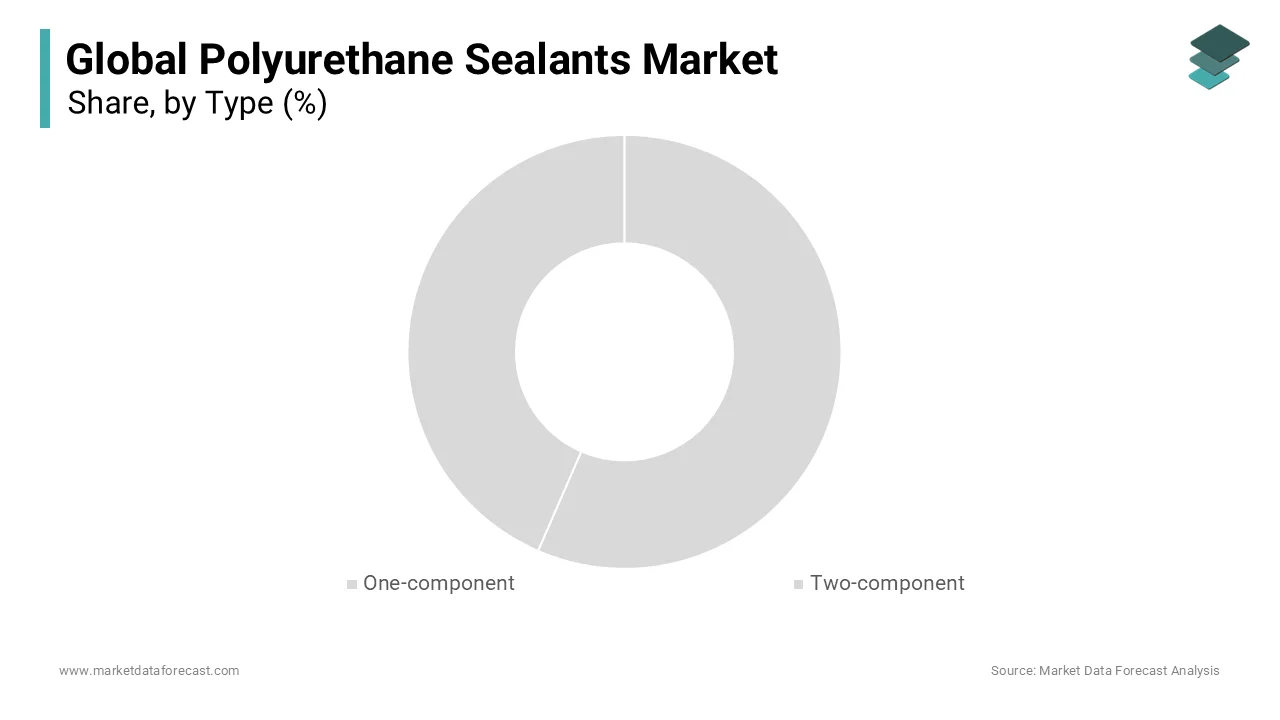
On the other end, the two component polyurethane sealants segment is predicted to register a CAGR of 6.06% over the forecast period in the global market owing to the escalating demand for high-speed industrial production lines, structural vehicle assembly, and heavy civil infrastructure projects where atmospheric moisture curing is too slow or unviable. According to industrial manufacturing statistics from the International Federation of Robotics, global operational robot density reached a record 390 units per 10,000 workers, accelerating the adoption of fast-curing two-component dispensing systems on automated assembly lines. Additionally, data published by the International Organisation of Motor Vehicle Manufacturers shows that global vehicle output reached 96.4 million units, with automated body shops utilizing multi-component adhesives for rapid handling strength. Two-component systems cure uniformly throughout the entire joint depth via a chemical reaction-driven crosslinking mechanism independent of ambient humidity. This enables fast handling strength within minutes rather than days, making two-component polyurethanes indispensable for high-throughput automotive manufacturing and thick structural joint applications. Furthermore, engineering reports published by the United States Department of Transportation emphasize that two-component structural adhesives provide superior load transfer capabilities in heavy transportation and bridge construction compared to standard moisture-cure alternatives. Industrial fabrication facilities continually upgrade their dispensing infrastructure to harness the precise stoichiometry and rapid curing profiles characteristic of these advanced multi-part systems.
By End Use Industry Insights
The building and construction segment held a dominant position in the global market in 2025 by commanding 52.5% of the global market share. The dominance of building and construction segment in the global market is majorly driven by the vast physical scale of global residential, commercial, and civil engineering projects that rely on elastomeric seals for building envelope integrity and weatherization. According to building safety data published by the United States Green Building Council, certified green commercial developments incorporating high-performance weather proofing seals grew by 14% year-over-year, reducing HVAC energy losses. Furthermore, as per global construction statistics from the World Bank, global construction expenditure represents roughly 40% of total regional material demand in key developing hubs. Polyurethane sealants are extensively applied across concrete expansion joints, curtain wall glazing, roofing membranes, and floor tile installations due to their high movement capability and superior adhesion to porous masonry substrates. The ongoing global investments in smart city infrastructure, structural retrofits, and building energy efficiency programs guarantee that the construction sector remains the primary revenue generator. In addition, architectural guidelines published by the National Institute of Building Sciences underscore that high-performance polyurethane elastomeric seals prevent moisture-induced degradation of building foundations, thereby extending structural lifecycles. Public sector investments in sustainable urban development frameworks further secure long-term demand for premium weather proofing and structural joint protection materials.
On the other side, the automotive manufacturing segment is estimated to witness a CAGR of 6.5% over the forecast period in the global market owing to the global shift toward electric vehicle production, lightweight vehicle architecture, and the replacement of traditional mechanical rivets with structural elastomeric seals. According to global automotive production metrics from the International Organisation of Motor Vehicle Manufacturers, electric and new energy vehicle production in China alone expanded by 29% year-over-year to reach 16.626 million units. Additionally, field surveys published by the European Automobile Manufacturers Association indicate that car manufacturers increased structural polyurethane sealant consumption per chassis by 18% to bond dissimilar materials like aluminum and composites. Polyurethane sealants provide crucial structural bonding, direct glazing strength for windshields, acoustic damping, and moisture sealing for sensitive electric vehicle battery enclosures. The rapid transition toward electric mobility and lightweight automotive body designs propels this segment's swift market expansion. Furthermore, safety research published by the National Highway Traffic Safety Administration indicates that advanced structural adhesives enhance crash energy absorption and overall vehicle torsional rigidity. Automotive design engineers increasingly rely on high-performance polyurethane systems to meet stringent fuel economy standards and passenger safety mandates across global markets.
REGIONAL ANALYSIS
North America Polyurethane Sealants Market Analysis
North America dominated the market by capturing 36.9% of the global market share in 2025 and is poised for steady expansion over the next few years. Market strength across the United States and Canada is anchored by major commercial construction expenditures, advanced architectural specifications, and strong structural sealant demand in automotive assembly. According to data published by the United States Census Bureau, annual commercial non-residential construction spending exceeded 120 billion dollars, maintaining sustained demand for elastomeric joint sealants. Furthermore, reports from the Adhesive and Sealant Council indicate that North American automotive OEMs increased structural polyurethane usage by 12% across electric chassis production lines. The enforcement of strict building energy codes and high adoption of advanced joint sealing technologies ensure North America remains a dominant revenue center. Additionally, infrastructure investment frameworks overseen by the United States Department of Transportation allocate substantial capital toward bridge and highway rehabilitation, generating consistent demand for high-durability civil engineering sealants. Regional chemical manufacturers and distributors maintain robust supply chain networks to serve stringent commercial building codes and rigorous industrial performance specifications.
Europe Polyurethane Sealants Market Analysis
Europe is likely to exhibit stable development over the coming years and maintaining an established, highly regulated position in the regional market. Market dynamics across European Union nations are heavily governed by stringent environmental standards, worker health mandates, and sustainable building directives. According to regulatory updates under the European Union Registration, Evaluation, Authorisation and Restriction of Chemicals framework, strict safety guidelines took effect requiring specialized training for handling sealants containing 0.1% or more monomeric diisocyanates. Additionally, as per industrial statistics from the European Automobile Manufacturers Association, regional vehicle assembly plants increased low-emission polyurethane sealant procurement by 15%. European developers actively prioritize low volatile organic compound, micro-emission polyurethane sealants to meet strict indoor air quality criteria. Moreover, European Green Deal directives enforced by the European Commission mandate rigorous thermal efficiency standards for building renovations, further driving demand for high-grade weatherproofing elastomeric materials. Industrial manufacturers across the region continuously innovate to comply with these strict environmental thresholds while maintaining optimal mechanical performance.
Latin America Polyurethane Sealants Market Analysis
Latin America is anticipated to record moderate growth over the next few years, occupying a developing position in the global market. Market development across the region is propelled by expanding urban infrastructure, residential housing programs, and automotive assembly plant investments in Mexico and Brazil. According to economic construction reports from the Economic Commission for Latin America and the Caribbean, regional infrastructure spending grew by 3.2% year-over-year, with public residential developments driving building material consumption. Additionally, trade data from the Association of Mexican Automotive Industry shows that domestic vehicle assembly expanded by 8.5%, boosting structural joint sealant procurement. Modernizing municipal building codes and growing commercial real estate projects continuously strengthen Latin America's market presence. Furthermore, development banking initiatives supported by the Inter-American Development Bank provide essential funding for regional transportation networks and municipal sanitation projects, creating steady commercial opportunities for heavy-duty construction sealants. Local contractors increasingly adopt modern elastomeric joint solutions to enhance building envelope resilience against tropical weathering and high seismic activity.
Asia Pacific Polyurethane Sealants Market Analysis
Asia Pacific is expected to experience robust growth over the next few years and is exhibiting the most dynamic growth profile globally. The region's market expansion is fueled by massive urban construction investments, rapid industrialization, and high-volume automotive manufacturing across China, and Southeast Asia. According to statistics from the World Bank, Asia Pacific accounts for approximately 40% of total global construction spending. Furthermore, data from the International Organisation of Motor Vehicle Manufacturers shows that vehicle manufacturing in China surged to 16.626 million electric units. Massive infrastructure projects, high-density high-rise housing developments, and expanding transport assembly networks drive Asia Pacific's rapid market growth. Moreover, government-backed urban renewal initiatives and transit-oriented development policies across developing economies accelerate the consumption of advanced building envelope materials. Regional manufacturing hubs continue to expand production capacities, attracting foreign direct investment from multinational chemical corporations seeking to capture rising domestic demand.
Middle East and Africa Polyurethane Sealants Market Analysis
Middle East and Africa is projected to achieve progressive advancement over the coming years, holding a strategic growth position. Market momentum across Gulf Cooperation Council nations is driven by ambitious mega real estate developments, luxury commercial high-rises, and transportation infrastructure investments. According to regional development statistics published by the Saudi Arabian Civil Defense Authority, national building mandates require certified fire-resistant and elastomeric weatherproofing sealants across all new commercial high-rise developments. Furthermore, construction surveys from the UAE Ministry of Infrastructure Development confirm that public infrastructure projects expanded by 4.5%, driving demand for heavy-duty concrete joint sealants. The ongoing execution of giga projects across the region secures strong growth for high-performance sealants. Additionally, strategic economic diversification programs, such as Saudi Vision 2030, spur massive non-oil sector investments, boosting commercial real estate and industrial manufacturing construction. Structural engineers specify specialized polyurethane sealants designed to withstand extreme ambient temperatures and intense solar radiation characteristic of arid desert environments.
COMPETITIVE LANDSCAPE
The Polyurethane Sealants Market exhibits intense competition characterized by established multinational chemical corporations, specialized adhesive developers, and aggressive regional formulators. Competition revolves around chemical movement capability, cure speed, tensile strength, environmental safety profiles, and cost efficiency across construction and transport sectors. Industry leaders utilize extensive global distribution footprints, fully integrated chemical manufacturing facilities, and diverse intellectual property portfolios to maintain a broad market presence. Mid size participants compete by providing customized sealant formulations, rapid field delivery, and specialized technical support for localized civil construction projects. Strategic focus across the market has shifted rapidly toward low volatile organic compound and monomer free chemistries, as regulatory bodies enforce stricter worker protection guidelines. Partnerships with original equipment manufacturers and automated robotics integrators have intensified market rivalry, with suppliers aiming to secure exclusive material specifications early in vehicle and building design cycles. Unpredictable petrochemical raw material pricing continues to pressure gross profit margins, compelling companies to streamline operational supply networks and pursue strategic business consolidation. Moreover, comprehensive economic outlooks published by the World Bank emphasize that industry leaders must maintain agile supply chain frameworks and robust risk management strategies to navigate geopolitical uncertainties and fluctuating raw material input costs effectively.
KEY MARKET PLAYERS
Some of the key players in the global polyurethane sealants market are
- 3M (U.S.)
- Arkema S.A. (France)
- Sika AG (Switzerland)
- H.B. Fuller (U.S.)
- Henkel AG & Company
- KGaA (Germany)
- BASF SE (Germany)
- The Dow Chemical Company (U.S.)
- Mapei S.p.A. (Italy)
- Asian Paints Limited (India)
- ITW Polymers Sealants North America (U.S.)
Top Players in the Market
- Sika AG develops specialized elastomeric polyurethane sealants designed for structural expansion joints, civil engineering infrastructure, and building facades. The organization engineers high performance moisture curing formulations that deliver long term dynamic movement capability and weatherproofing protection. Sika strengthens its market position through continuous production network expansion and targeted regional acquisitions. To enhance its supply chain footprint, Sika agreed to acquire Akkim, expanding its global manufacturing reach for adhesives and sealants. Sika also launched ultra low monomer polyurethane sealants to meet strict European occupational safety standards without requiring specialized handler training. Furthermore, technical documentation published by the European Standardization Committee validates that Sika's advanced elastomeric formulations comply with rigorous harmonize standards for exterior wall and flooring joints. The company maintains an extensive global technical support network, collaborating with major architectural firms and civil engineering contractors to secure prime project specifications across international commercial building sectors.
- Henkel AG and Company KGaA supplies industrial polyurethane sealants and structural adhesives tailored for automotive assembly, direct glazing, and general industrial maintenance. The firm produces versatile bonding formulations that accommodate multi material joint stress across lightweight vehicle frames. Henkel reinforces its market standing through substantial capital investments in manufacturing modernization and strategic MRO acquisitions. The enterprise completed the acquisition of Seal for Life Industries to expand its protective sealing solutions across infrastructure, energy, and water sectors. Additionally, Henkel invested significantly to expand its Bopfingen adhesives manufacturing plant, boosting production efficiency for regional markets. Moreover, corporate sustainability reports published by Henkel highlight the company's commitment to reducing lifecycle carbon emissions through bio-based raw material integration and energy-efficient chemical processing technologies. Henkel collaborates extensively with leading automotive OEMs to engineer custom structural bonding solutions that optimize crash safety and reduce overall vehicle weight.
- The 3M Company manufactures high modulus polyurethane sealants and hybrid elastomeric joint compounds for transit equipment, marine hulls, and industrial manufacturing. The corporation focuses on engineering advanced adhesive chemistries that exhibit high tensile strength, UV resistance, and excellent dielectric properties. 3M advances its market position by expanding automated dispensing product options and developing hybrid curing platforms for industrial clients. The company rolled out an advanced dual cure polyurethane hybrid system combining UV and moisture curing for automated electronic and industrial assemblies. 3M maintains strong technical consulting networks to secure long term supply agreements with global original equipment manufacturers. Furthermore, research publications from the National Institute of Standards and Technology recognize 3M's contributions to advanced dielectric bonding materials utilized in sensitive electronics and aerospace manufacturing. The company leverages its extensive intellectual property portfolio and global research and development infrastructure to continuously introduce innovative, high-performance sealing solutions tailored for demanding industrial applications.
Top Strategies Used by Key Market Participants
Key players in the Polyurethane Sealants Market focus heavily on developing micro emission and low monomer formulations to satisfy stringent international occupational safety regulations. Manufacturers invest substantially in research to engineer silane terminated hybrids and ultra low diisocyanate products that eliminate mandatory hazardous material handling certifications. Another core strategy involves strategic acquisitions of regional chemical producers to expand distribution networks, gain specialized technology platforms, and establish localized manufacturing plants near high growth construction hubs. Leading companies partner with automated equipment suppliers to optimize robotic bead dispensing for electric vehicle battery pack enclosures and high speed industrial assembly lines. Additionally, suppliers emphasize circular manufacturing and low volatile organic compound chemical lines to align with global green building certification standards. Direct technical support, specialized installer training programs, and integrated building design software partnerships remain vital to securing long term commercial specification contracts. Furthermore, industry reports from the International Council of Chemical Associations indicate that leading enterprises allocate significant capital toward green chemistry initiatives, ensuring long-term regulatory compliance and market resilience. Strategic patenting and proprietary resin synthesis also enable major market participants to maintain competitive differentiation against low-cost generic formulators.
Polyurethane Sealants Market News
- In April 2024, Henkel, an adhesive and sealing technologies provider, acquired Seal for Life Industries, a protective coatings and sealing solutions enterprise. This acquisition is anticipated to allow Henkel to offer more comprehensive protective sealing solutions and strengthen the Polyurethane Sealants Market presence. Market analysts note that this strategic integration expands Henkel's portfolio into critical infrastructure rehabilitation, pipeline protection, and municipal water management sectors, providing significant cross-selling opportunities across global industrial distribution networks. Furthermore, technical synergy between Henkel's structural adhesives and Seal for Life's advanced corrosion-resistant coatings enables the combined entity to deliver comprehensive asset protection packages for heavy industrial clients worldwide.
- In September 2024, Arkema, a specialty materials manufacturer, acquired Dow's flexible packaging adhesives business, a solvent free adhesives producer. This acquisition is anticipated to allow Arkema to offer more comprehensive polyurethane systems and strengthen the Polyurethane Sealants Market presence. Industry experts highlight that this transaction enhances Arkema's position in eco-friendly, solvent-free adhesive technologies, perfectly aligning with tightening global environmental regulations regarding volatile organic compound emissions. By integrating Dow's advanced formulation expertise, Arkema broadens its technological capabilities across high-performance packaging and industrial bonding segments, driving long-term revenue growth and operational synergies.
- In May 2025, Sika, a construction chemicals specialist, launched Sikaflex Purform, an ultra low monomer polyurethane sealant. This launch is anticipated to allow Sika to offer more comprehensive safety compliant joint sealants and strengthen the Polyurethane Sealants Market presence. Safety compliance reports indicate that this innovative product formulation reduces unreacted monomeric diisocyanate levels below 0.1%, effectively exempting professional users from mandatory European occupational safety training requirements under REACH regulations. This major technological milestone enables Sika to capture increased market share among commercial contractors seeking high-performance elastomeric sealants that prioritize worker health and safety without sacrificing curing speed or mechanical strength.
- In October 2025, DuPont, a building solutions developer, launched Great Stuff Wide Spray Foam Sealant, a high volume insulation sealant. This launch is anticipated to allow DuPont to offer more comprehensive structural building envelope seals and strengthen the Polyurethane Sealants Market presence. Building energy efficiency evaluations confirm that this high-yield foaming formulation significantly improves thermal insulation and air sealing performance across residential and commercial wall cavities, supporting green building certification standards. DuPont's strategic product expansion addresses rising consumer demand for energy-saving retrofit materials that reduce building heating and cooling energy consumption effectively.
- In February 2026, Sika, a global construction materials leader, acquired Akkim, an adhesives and sealants producer. This acquisition is anticipated to allow Sika to offer more comprehensive joint sealing solutions and strengthen the Polyurethane Sealants Market presence. Strategic corporate disclosures indicate that integrating Akkim's robust manufacturing footprint and regional distribution channels reinforces Sika's competitive positioning across high-growth emerging construction markets. This acquisition accelerates Sika's capacity to deliver localized, high-performance polyurethane and hybrid sealant solutions, meeting surging demand from rapid industrialization and urban infrastructure development.
MARKET SEGMENTATION
This research report on the global polyurethane sealants market has been segmented and sub-segmented based on type, end-user industry, and region.
By Type
- One-component
- Two-component
By End-User Industry
- Building and Construction
- Automotive
- General Industrial
- Marine
By Region
- North America
- Europe
- Asia Pacific
- Latin America
- The Middle East and Africa