- Product Description Description
- Table of Contents TOC
- List of Table & Figure LOT
- Get Free Sample PDF Sample PDF
Market Size, 2025
$24.26 BnMarket Estimate, 2026
$27.1 BnMarket Forecast, 2034
$65.67 BnCAGR, 2026–2034
11.7%Executive Summary: Global Pool Equipment and Maintenance Market
- Market Scope: Comprehensive global evaluation of the pool equipment and maintenance market assessing mechanical systems, chemical treatments, automation technologies, and professional servicing across residential and commercial sectors.
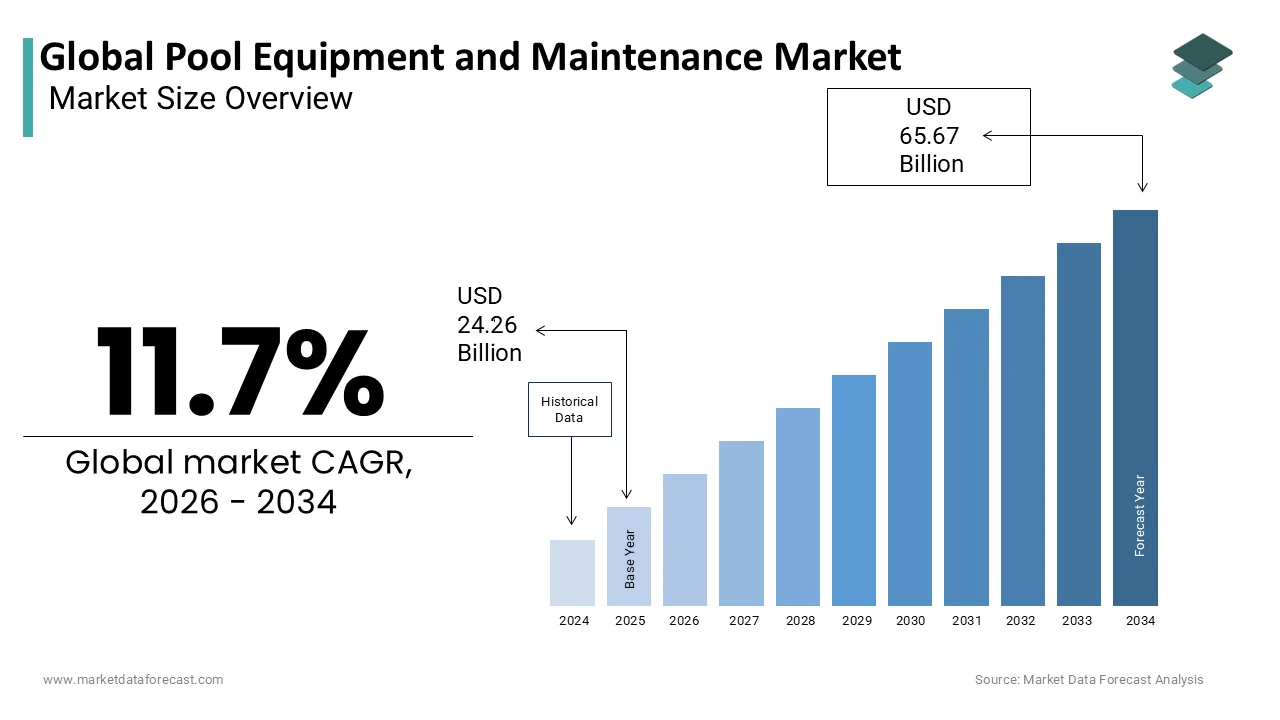
- Market Valuation: Valued at USD 24.26 billion in 2025, reaching USD 27.10 billion in 2026, and projected to scale up to USD 65.67 billion by 2034, registering a strong compound annual growth rate (CAGR) of 11.7% from 2026 to 2034.
- Primary Growth Drivers: Proliferation of residential real estate with integrated outdoor amenities, stringent government health and safety regulations governing water quality, and the increasing convergence of IoT with smart pool management systems.
Key Market Segment Metrics (2026–2034)
| Category | Leading Segment / Core Focus | Fastest-Growing / Key Segments |
|---|---|---|
| By End-User Type | Residential Swimming Pools (accounted for a substantial share of total industry value in 2025 anchored by private pools in suburban housing and backyard wellness spaces) | Commercial Swimming Pools (expanding at the fastest CAGR of 7.9% driven by wellness tourism, hospitality investments, and public recreation infrastructure) |
| By Design Type | In-Ground Swimming Pools (held a dominant 64.7% share in 2025 due to permanent installation, high lifecycle expenditures, and advanced mechanical requirements) | Above-Ground Swimming Pools (experiencing the fastest growth with a projected CAGR of 8.3% fueled by affordability, ease of installation, and premium semi-permanent designs) |
| By Region | North America (led the market with a 41.6% share in 2025 anchored by high residential pool penetration in the U.S., mature service infrastructure, and strict safety acts) | Asia-Pacific & Middle East (accelerating through luxury real estate developments, tourism infrastructure, and smart water conservation mandates) |
Major Market Players & Industry Landscape
Competitive Structure: Highly dynamic landscape featuring global technology leaders, regional equipment manufacturers, and specialized service networks competing on digital connectivity, energy efficiency, and regulatory compliance.
Key Companies Profiled: Pentair Ltd., Hayward Industries, Inc., Fluidra S.A., Emaux Water Technology, Adolph Kiefer & Associates, Desjoyaux, In The Swim, DSL Tech. Group, Waterco, Laswim Pool and SPA Equipment Co. Ltd., Aqua Industrial Group, and Expertos en Piscinas y Spas AstralPool.
Global Pool Equipment and Maintenance Market Size
The Global Pool Equipment and Maintenance market was valued at USD 24.26 billion in 2025, is expected to grow at a CAGR of 11.7% from 2026 to 2034 and be worth USD 65.67 billion by 2034 from USD 27.10 billion in 2026.
Pool Equipment and Maintenance refers to the ecosystem of mechanical systems, chemical treatments, automation technologies, and professional services designed to ensure the safe, efficient, and hygienic operation of residential, commercial, and public swimming pools. This includes filtration systems, pumps, heaters, chlorinators, robotic cleaners, and routine maintenance protocols that maintain water quality and structural integrity. Improperly maintained pools can harbor pathogens such as Pseudomonas aeruginosa and Cryptosporidium, and the CDC documents thousands of U.S. recreational water–associated illnesses annually. The American Red Cross estimates that more than 4,000 drowning deaths occur in the U.S. each year, many linked to inadequate supervision and faulty pool safety equipment. These public health imperatives, combined with rising property values tied to pool amenities, are driving stricter compliance with safety standards and increasing demand for reliable, technologically advanced pool management solutions.
MARKET DRIVERS
Expansion of Residential Real Estate with Integrated Outdoor Amenities
The proliferation of single-family homes featuring private pools in suburban and exurban developments is a primary catalyst for growth in the pool equipment and maintenance sector. As per the U.S. Census, roughly 1.4 million housing completions in 2023; Sun Belt states accounted for a substantial share of growth. The National Association of Home Builders points out that a swimming pool can increase a home’s value by 5–8% in high-demand markets, reinforcing its appeal to developers and buyers alike. Roughly one in five Australian households have pools in certain regions. This residential expansion necessitates continuous investment in filtration, heating, and automated cleaning systems, along with recurring maintenance contracts to ensure regulatory compliance and operational safety. Besides, the trend toward “staycation” lifestyles has amplified demand for high-end pool features. Houzz and similar home-improvement surveys report strong homeowner interest in outdoor/pool upgrades since 2020. These consumers are increasingly adopting smart pool controls, integrated with home automation platforms like Apple HomeKit and Google Nest, which require professional installation and ongoing service support. The convergence of real estate value enhancement and lifestyle-driven design is creating sustained demand for both initial equipment installation and long-term maintenance services, particularly in middle- to high-income neighborhoods where discretionary spending on outdoor living spaces remains resilient.
Stringent Health and Safety Regulations Governing Public and Commercial Pools
Government-mandated compliance with water quality and safety standards is a critical force shaping the pool equipment and maintenance landscape. In the European Union, the European Committee for Standardization (CEN) enforces EN 16713 regulations, which dictate minimum requirements for disinfection, filtration, and anti-entrapment systems in public aquatic facilities. Similarly, the U.S. Virginia Graeme Baker Pool and Spa Safety Act mandates anti-entrapment drain covers and requires regular inspection of suction fittings, with non-compliance resulting in fines and facility closures. The VGB Act and related standards have substantially reduced entrapment incidents since their adoption. Canadian provinces/municipalities set testing frequencies (often multiple times per day) for commercial pools. These regulatory frameworks compel facility operators to invest in compliant equipment and scheduled servicing. Singapore’s NEA specifies strict testing and maintenance requirements for public pools (including frequent testing and periodic audits). Royal Life Saving Society / RLSS UK audits have flagged sanitation issues in a share of leisure centers. The World Health Organization further recommends free chlorine levels of 1–3 mg/L for safe swimming, a benchmark that requires precise dosing equipment and continuous calibration. As urbanization increases the number of community pools and water parks, regulatory scrutiny will continue to elevate the necessity of professional-grade equipment and certified maintenance, particularly in densely populated areas.
MARKET RESTRAINTS
High Upfront Costs of Advanced Pool Automation and Energy-Efficient Systems
Despite long-term savings, the initial investment required for modern pool equipment remains a significant barrier to adoption, particularly among middle-income homeowners and municipal operators. A complete retrofit with a variable-speed pump, saltwater chlorinator, and smart control system can be costly. This cost disparity limits replacement cycles, especially in regions with economic volatility. In South Africa, electricity tariffs rose. Municipal pools in Latin America often operate with outdated infrastructure due to budget constraints, delaying compliance with modern safety and hygiene standards. Moreover, financing options for pool upgrades remain limited in many markets. Unlike solar panels or HVAC systems, pool retrofits are rarely eligible for government rebates or green financing programs, despite their potential for energy savings. As per a study by the International Energy Agency, variable-speed pumps could reduce residential pool energy consumption by 60–80%, yet penetration remains low in the U.S. due to cost sensitivity. These financial hurdles impede the widespread adoption of next-generation equipment, slowing the pace of technological diffusion and limiting the growth potential of premium maintenance service contracts tied to smart systems.
Seasonal Demand Fluctuations and Labor Shortages in Maintenance Services
The pool maintenance industry faces pronounced seasonality, with service demand peaking during warm months and collapsing in colder climates during winter, creating operational inefficiencies and workforce instability. This cyclical pattern discourages full-time employment in the sector, leading to high turnover and difficulty retaining skilled technicians. Compounding this issue is the growing shortage of certified pool operators, particularly in regions with strict licensing requirements. The lack of standardized training programs across regions further exacerbates skill gaps. As demand for specialized services, such as UV sanitation system calibration and robotic cleaner diagnostics, rises, the mismatch between technical requirements and available labor threatens service quality and scalability, particularly for small and mid-sized operators.
MARKET OPPORTUNITIES
Integration of IoT and Smart Pool Management Systems
The convergence of the Internet of Things (IoT) with pool infrastructure is unlocking transformative opportunities for remote monitoring, predictive maintenance, and energy optimization. Smart pool controllers, such as Pentair’s IntelliCenter and Hayward’s OmniHub, allow users to manage pumps, heaters, and lighting via mobile apps, adjusting settings based on weather forecasts and usage patterns. These systems generate actionable data that enhances maintenance efficiency. For example, real-time pH and chlorine monitoring enables automatic chemical dosing, reducing human error and preventing unsafe water conditions. Service providers are leveraging this data to offer subscription-based monitoring plans, preempting equipment failures and reducing emergency callouts. In commercial settings, hotels in Dubai and Miami now use AI-powered analytics to optimize filtration schedules based on bather load, cutting energy costs. As cybersecurity improves and interoperability with home automation platforms expands, smart pool systems are poised to become standard in new constructions and high-end retrofits.
Rising Adoption of Sustainable and Low-Chemical Pool Technologies
Environmental concerns and consumer demand for eco-friendly alternatives are accelerating the shift toward sustainable pool systems that minimize chemical use, energy consumption, and water waste. Additionally, ultraviolet (UV) and ozone-based sanitation systems are gaining traction. Water conservation is another key driver. In drought-prone regions like California and Cape Town, pool covers are now required by law in some municipalities to reduce evaporation, which can account for up to 70% of water loss, as per the U.S. Environmental Protection Agency. Robotic cleaners with advanced filtration capture debris without backwashing, conserving thousands of gallons annually. As climate regulations tighten and consumers prioritize sustainability, manufacturers and service providers offering green-certified equipment and chemical-free maintenance packages are gaining competitive advantage, particularly in environmentally conscious markets.
MARKET CHALLENGES
Regulatory Fragmentation in Equipment Standards and Chemical Usage
The pool equipment and maintenance industry operates under a patchwork of regional and national regulations, complicating compliance for manufacturers and service providers. In the United States, pool safety standards are governed at both federal and state levels, with California’s Title 24 energy efficiency regulations imposing stricter pump efficiency requirements than federal mandates. Similarly, the European Union’s CE marking system coexists with national standards in Germany (DIN), France (NF), and Italy (UNI), requiring multiple certifications for market entry. Chemical regulation adds another layer of complexity. In Australia, chlorine limits vary between states forcing maintenance crews to adjust protocols regionally. The World Health Organization’s guidelines are often adapted inconsistently, leading to divergent enforcement. This regulatory fragmentation increases operational costs, delays product launches, and undermines consumer confidence in uniform safety and performance.
Increasing Incidence of Cybersecurity Risks in Connected Pool Systems
As pool equipment becomes more connected, it is increasingly vulnerable to cyber threats that can compromise safety, privacy, and system functionality. Smart pool controllers, often linked to home Wi-Fi networks, have been found to contain unpatched vulnerabilities that allow remote access to operational settings. In 2022, cybersecurity researchers at Tenable identified critical flaws in several major brands’ IoT pool systems, enabling attackers to disable pumps, alter chemical levels, or lock users out of their devices. Also, compromised pool controls could lead to chemical imbalances, creating hazardous water conditions or equipment damage. The lack of standardized security protocols in consumer-grade pool devices exacerbates the risk. Unlike industrial control systems, most residential pool IoT products do not undergo rigorous penetration testing or firmware encryption. Thus, manufacturers must prioritize cybersecurity by design, including regular over-the-air updates, multi-factor authentication, and network segmentation to prevent cascading failures in integrated smart homes.
REPORT COVERAGE
| REPORT METRIC | DETAILS |
| Market Size Available | 2025 to 2034 |
| Base Year | 2025 |
| Forecast Period | 2026 to 2034 |
| Segments Covered | By End-users Type, Design Type, and Region |
| Various Analyses Covered | Global, Regional & Country Level Analysis, Segment-Level Analysis, DROC, PESTLE Analysis, Porter’s Five Forces Analysis, Competitive Landscape, Analyst Overview of Investment Opportunities |
| Regions Covered | North America, Europe, Asia-Pacific, Latin America, Middle East, and Africa |
| Key Market Players | Emaux Water Technology, Adolph Kiefer & Associates, Desjoyaux, In The Swim, Hayward Industries, Inc., Pentair Ltd., DSL Tech. Group, Waterco, Laswim Pool and SPA Equipment Co. Ltd., Aqua Industrial Group, and Expertos en Piscinas y Spas AstralPool |
SEGMENTAL ANALYSIS
By End-Users Type Insights
The residential swimming pools segment dominated the pool equipment and maintenance market by accounting for a substantial share of total industry value in 2025. This preeminence is anchored in the widespread integration of private pools into suburban housing developments, particularly in warm-climate regions where outdoor living is a cultural and economic priority. The real estate sector reinforces this trend, incentivizing both developers and homeowners to install and maintain pool systems. The growing consumer preference for automated, smart-enabled pool equipment is a key driver of residential dominance. These systems require professional installation and recurring maintenance, creating sustained service demand. Additionally, the rise of “stay-at-home” lifestyles post-pandemic has amplified investment in backyard wellness spaces. With maintenance contracts typically ranging from $1,200 to $2,500 per year, the residential segment generates consistent, high-margin revenue for service providers.
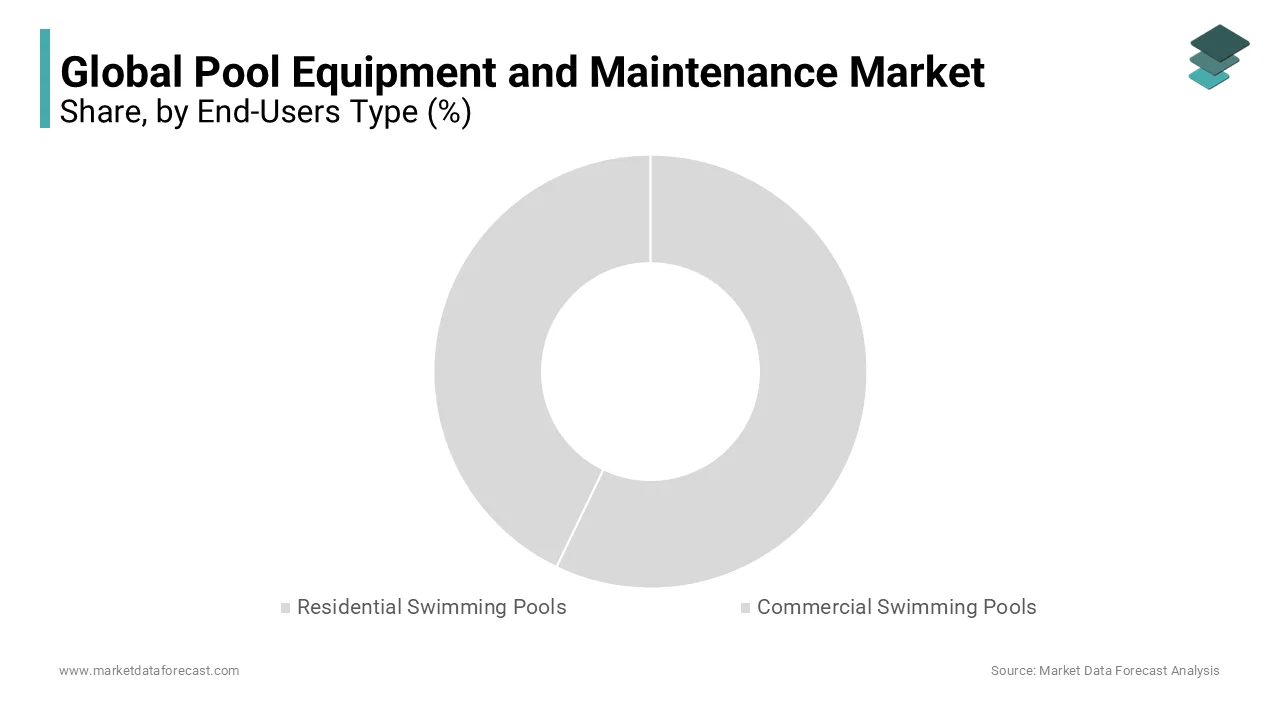
The commercial swimming pools segment is expanding at the fastest CAGR of 7.9%. It is driven by rising investments in hospitality, wellness tourism, and public recreation infrastructure. Also, fitness centers and private clubs are incorporating lap pools and hydrotherapy zones to attract premium memberships. Regulatory compliance is another critical growth catalyst. Besides, aging municipal pools in cities like Toronto and Berlin are undergoing modernization, often bundled with long-term service contracts. As urbanization and wellness tourism expand, commercial pools are becoming high-visibility infrastructure requiring sophisticated, compliant, and continuously maintained systems.
By Design Type Insights
The inground swimming pools segment held a dominant 64.7% share of the global pool equipment and maintenance market in 2025. This lead position is due to their higher construction cost, permanent installation, and greater demand for advanced mechanical systems. Unlike above-ground models, inground pools typically require full-scale filtration, heating, automation, and structural maintenance, generating significantly higher equipment and service expenditures over their lifecycle. Its association with long-term property value and lifestyle enhancement is a primary factor reinforcing this segment’s dominance. These pools often feature complex designs, such as vanishing edges, integrated spas, and tanning ledges, that require specialized equipment like multi-speed pumps, automatic covers, and tile grouting maintenance. Additionally, inground pools have a lifespan of 20–30 years, necessitating ongoing resurfacing, liner replacement, and mechanical upgrades.
The above ground swimming pools segment is experiencing the fastest growth in the market, with a projected CAGR of 8.3%. It is fueled by affordability, ease of installation, and shifting consumer preferences toward temporary or semi-permanent leisure solutions. These pools typically cost between $2,000 and $10,000, making them accessible to middle-income families, particularly in regions with seasonal climates. A further key growth driver is the introduction of premium, semi-permanent above ground designs that blur the line with inground aesthetics. Companies like Intex and Bestway now offer metal-walled pools with decking, ladders, and sand filtration systems that mimic traditional in-ground installations. These models often include smart features such as app-controlled pumps and UV sanitizers, increasing equipment value and service requirements. Additionally, rental and vacation property owners are adopting above ground pools for seasonal deployment, creating demand for portable maintenance kits and short-term service contracts. This flexibility, combined with technological upgrades, is transforming above ground pools from temporary fixtures into viable, service-intensive alternatives.
REGIONAL ANALYSIS
North America Pool Equipment and Maintenance Market Insights
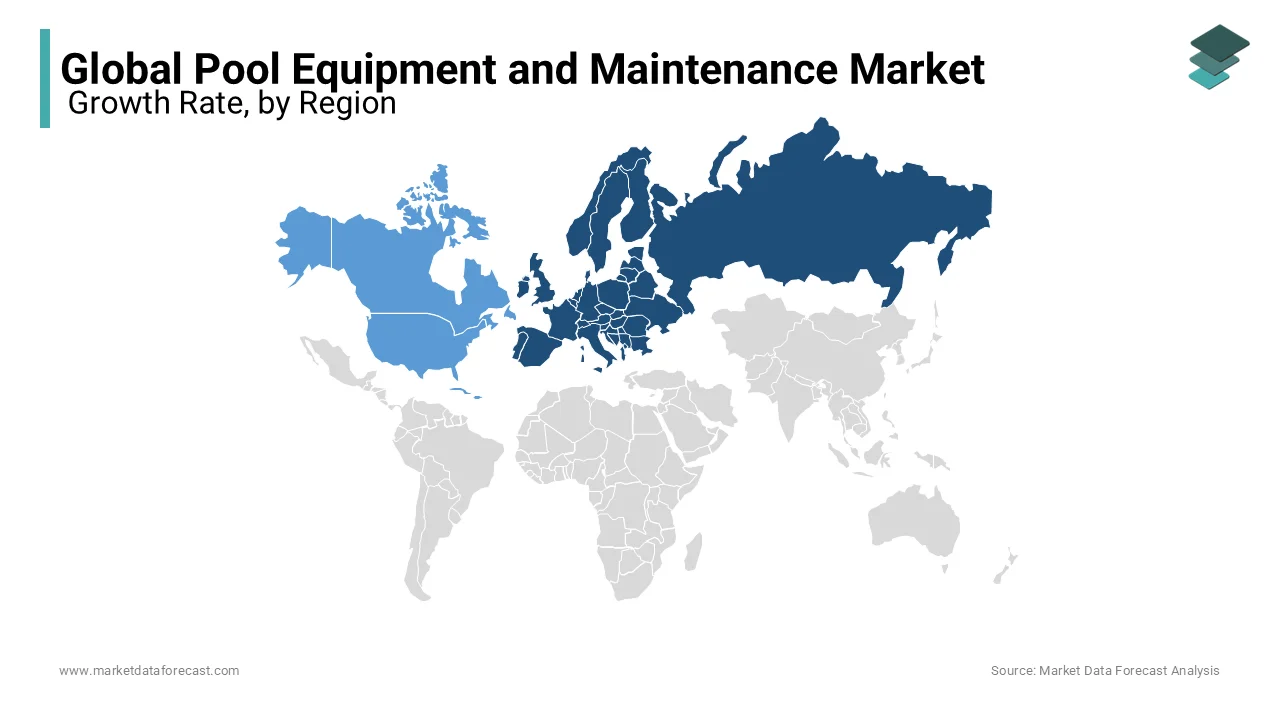
North America led the market by commanding 41.6% share of the global pool equipment and maintenance market. It is driven by high residential pool penetration and advanced service infrastructure. The United States alone accounts for over 90% of regional demand, where an estimated 10.4 million residential pools exist, according to the Pool & Hot Tub Alliance. Florida, California, and Texas represent the highest concentration. The region’s mature market is characterized by rapid adoption of smart technologies. Additionally, strict safety regulations such as the Virginia Graeme Baker Act mandate anti-entrapment devices and routine inspections, ensuring consistent demand for compliant equipment and professional maintenance services across both private and public facilities.
Europe Pool Equipment and Maintenance Market Insights
Europe is a regulated and evolving market, with France, Italy, and Spain leading in private pool ownership and Germany dominating public aquatic infrastructure. According to the European Pool & Spa Federation, over 2.8 million residential pools exist across the EU, with France accounting for nearly 40% of the total. The region’s growth is shaped by stringent water safety and energy efficiency standards, France’s NF P90-308 regulation requires covers/barriers for private pools. Additionally, rising demand for saltwater and UV-based sanitation systems, spurred by health concerns over chloramines, is accelerating equipment upgrades. With increasing urbanization and wellness tourism, Southern Europe is witnessing a resurgence in villa-based pool installations, particularly in coastal regions of Spain and Greece.
Asia Pacific Pool Equipment and Maintenance Market Insights
Asia Pacific is a lucrative player in the global market and is emerging as a high-growth frontier due to rising disposable incomes and luxury real estate development. Australia leads the region, with one in five households owning a pool, according to the Australian Bureau of Statistics, and strict state-level regulations requiring safety fencing and regular water testing. India’s luxury housing sector is also integrating pools as standard amenities in gated communities across Hyderabad and Pune. The region’s growth is further supported by government investments in public recreation, Singapore’s ActiveSG program has upgraded 45 community pools since 2021. However, service fragmentation and lack of standardized technician certification remain challenges, though international operators are beginning to establish formal maintenance networks.
Middle East Pool Equipment and Maintenance Market Insights
The Middle East holds a significant share of the market, with the UAE and Saudi Arabia driving demand through luxury real estate and tourism infrastructure. The UAE’s Green Building Regulations promote water-saving pool covers. Saudi Arabia’s NEOM and Red Sea Project are incorporating thousands of resort and residential pools, with contracts awarded to international maintenance firms for long-term service management. High evaporation rates, up to 15 mm per day in summer, necessitate advanced covers and chemical balancing, creating sustained demand for high-frequency maintenance and water conservation systems.
Latin America Pool Equipment and Maintenance Market Insights
Latin America is an emerging market, with Brazil and Mexico leading adoption in urban and resort areas. However, service infrastructure remains fragmented. Water scarcity in regions like northern Mexico is prompting adoption of saltwater systems and covers, supported by local regulations in Monterrey that limit pool refilling. Despite economic volatility, rising tourism and urban affluence are laying the foundation for long-term market expansion, particularly in premium residential and hospitality segments.
KEY MARKET PLAYERS AND COMPETITIVE LANDSCAPE
Emaux Water Technology, Adolph Kiefer & Associates, Desjoyaux, In The Swim, Hayward Industries, Inc., Pentair Ltd., DSL Tech. Group, Waterco, Laswim Pool and SPA Equipment Co. Ltd., Aqua Industrial Group, and Expertos en Piscinas y Spas AstralPool are some of the leading players in the global pool equipment and maintenance market.
The competition in the Pool Equipment and Maintenance Market is intensifying as global technology leaders, regional manufacturers, and specialized service providers vie for dominance in a fragmented yet rapidly evolving landscape. Incumbents leverage brand reputation, R&D capabilities, and integrated ecosystems to differentiate themselves, while regional players compete on cost and localized service delivery. The rise of smart and sustainable pool systems has shifted competition from basic functionality to digital connectivity, energy efficiency, and regulatory compliance. In Asia Pacific, where market maturity varies widely, companies are adopting hybrid models combining premium equipment sales with long-term maintenance contracts. Differentiation increasingly hinges on technician certification, remote monitoring capabilities, and alignment with green building standards. As consumer expectations rise and regulatory pressures grow, competitive advantage is shifting toward those who offer end-to-end solutions that ensure safety, efficiency, and minimal environmental impact.
TOP PLAYERS IN THE MARKET
Pentair plc
Pentair has established a significant presence in the Asia Pacific pool equipment and maintenance market by introducing energy-efficient, smart-enabled solutions tailored to regional climatic and regulatory conditions. The company launched its IntelliFlow variable-speed pump and EasyTouch automation system across Australia, India, and Southeast Asia, enabling homeowners and resorts to reduce energy consumption by up to 90% compared to conventional pumps. It also expanded its service network in Australia by training over 500 certified technicians in smart system diagnostics and water chemistry management. By aligning with green building standards such as Singapore’s BCA Green Mark and India’s IGBC, Pentair is positioning itself as a sustainability-driven technology provider, reinforcing trust among environmentally conscious consumers and institutional clients.
Hayward Holdings, Inc.
Hayward has strengthened its footprint in the Asia Pacific region by deploying advanced pool automation, UV sanitation, and robotic cleaning technologies across residential and commercial segments. The company introduced its OmniCore control system and AquaRite saltwater chlorinators in Japan, South Korea, and Australia, addressing consumer demand for low-chemical, high-efficiency solutions. It also launched a regional training initiative in partnership with the Australian Institute of Plumbing and Mechanical Services to certify technicians in advanced equipment servicing. By emphasizing product durability in high-humidity and saline environments, Hayward has gained traction in coastal markets. Its focus on interoperability with global smart home platforms further enhances its appeal to premium homeowners and hospitality operators seeking seamless integration.
Fluidra S.A.
Fluidra has emerged as a key innovator in the Asia Pacific pool equipment market by leveraging its global R&D network to introduce modular, scalable solutions for diverse climatic zones. The company’s Zodiac brand of robotic cleaners and saltwater systems has been adopted in large-scale residential communities in Malaysia and Indonesia, where tropical conditions accelerate algae growth and equipment corrosion. It also acquired a local service distributor in Australia to expand its direct maintenance network and improve response times. By integrating IoT-enabled diagnostics into its AquaLink automation platform, Fluidra enables predictive servicing and remote troubleshooting, reducing downtime. Its strategic partnerships with property management firms in India and the Philippines are accelerating the adoption of centralized pool management systems in gated communities and resort complexes.
TOP STRATEGIES USED BY THE KEY MARKET PLAYERS
Key players in the Pool Equipment and Maintenance Market are deploying a combination of technological innovation, strategic partnerships, geographic expansion, and service ecosystem development to solidify their market leadership. Companies are investing in smart, energy-efficient products—such as variable-speed pumps and app-based controls—to meet rising consumer demand for automation and sustainability. Strategic alliances with real estate developers and hospitality chains ensure integration of equipment at the design stage. Firms are also expanding certified technician networks to enhance after-sales service and customer retention. Acquisitions of regional distributors and service providers enable faster market penetration and localized support. Additionally, compliance with regional safety and environmental regulations is being used as a competitive differentiator, particularly in markets adopting green building codes and water conservation mandates.
RECENT HAPPENINGS IN THE MARKET
- In January 2025, Pentair launched its IntelliChem water monitoring system in Australia, enabling real-time pH and chlorine tracking with automatic dosing, enhancing water safety and reducing manual maintenance for residential and commercial pool operators.
- In March 2025, Hayward partnered with Emaar Properties to supply smart pool automation systems for 1,200 luxury villas in Dubai South, integrating remote control and energy optimization features into new residential developments across the UAE.
- In August 2025, Fluidra opened a regional innovation hub in Singapore focused on developing climate-adaptive pool technologies, including corrosion-resistant pumps and solar-powered filtration systems for tropical environments in Southeast Asia.
- In November 2025, Pentair expanded its technician certification program in India, training over 300 service professionals in smart system installation and maintenance in collaboration with the Indian Plumbing Association to strengthen after-sales support.
- In February 2025, Hayward introduced the AquaRite Pro SE saltwater chlorinator in Japan, designed to operate efficiently in hard water conditions, addressing a key regional challenge and improving adoption in high-mineral-content areas.
MARKET SEGMENTATION
This research report on the global pool equipment and maintenance market has been segmented and sub-segmented into the following categories.
By End-Users Type
- Residential Swimming Pools
- Commercial Swimming Pools
By Design Type
- In-Ground Swimming Pools
- Above-Ground Swimming Pools
By Region
- North America
- Europe
- Asia Pacific
- Latin America
- The Middle East and Africa