- Product Description Description
- Table of Contents TOC
- List of Table & Figure LOT
- Get Free Sample PDF Sample PDF
Market Size, 2025
$1.95 BnMarket Estimate, 2026
$2.13 BnMarket Forecast, 2034
$4.40 BnCAGR, 2026–2034
9.50%Global Precipitated Silica Market Report Summary
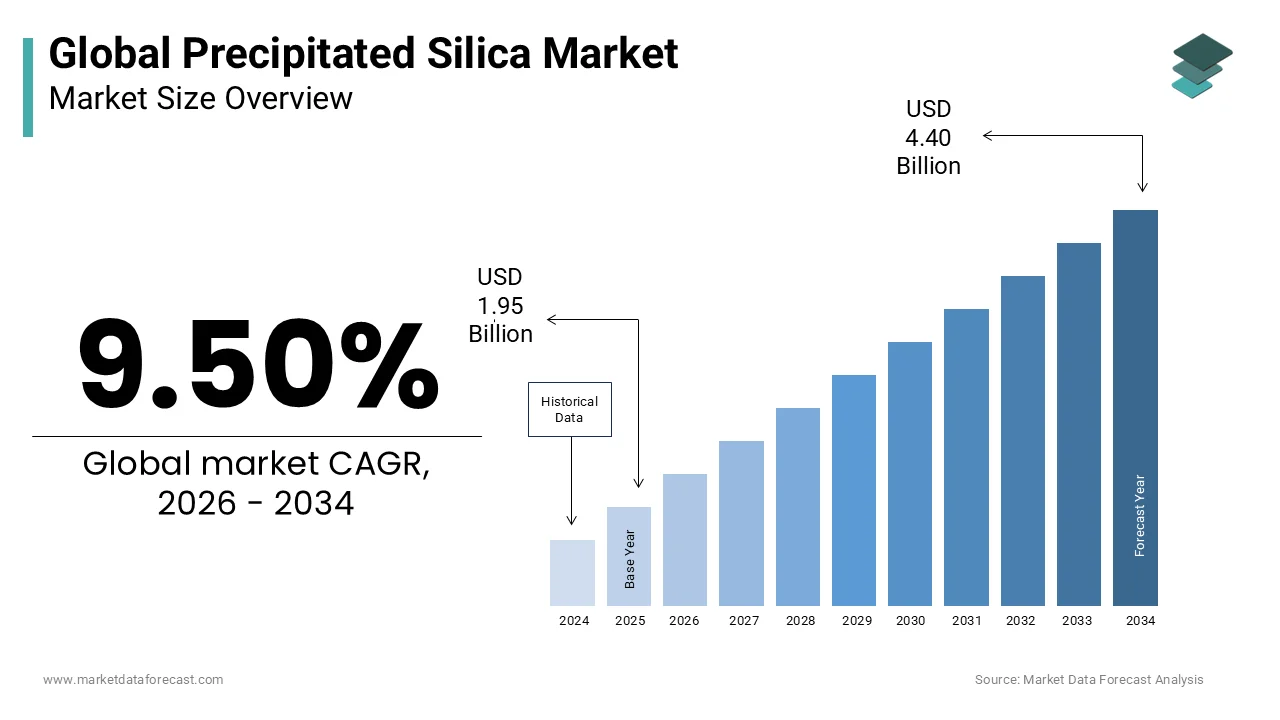
The global precipitated silica market was valued at USD 1.95 billion in 2025, is estimated to reach USD 2.13 billion in 2026, and is projected to reach USD 4.40 billion by 2034, growing at a CAGR of 9.50% during the forecast period. Market growth is driven by increasing demand from automotive and tire manufacturing industries, expanding applications in rubber and personal care products, and rising adoption of high performance materials across industrial sectors. Precipitated silica is widely used for reinforcement, thickening, anti caking, and polishing applications due to its versatile physical properties. The growing emphasis on fuel efficient tires and sustainable industrial materials is further supporting strong market expansion globally.
Key Market Trends
- Increasing demand for fuel efficient and high performance tires is driving market growth.
- Growing adoption of precipitated silica in rubber manufacturing and industrial applications is boosting market expansion.
- Rising demand from automotive, personal care, and food processing industries is supporting market development.
- Expansion of sustainable manufacturing and advanced material technologies is enhancing market opportunities.
- Innovation in specialty silica formulations and performance enhancement applications is influencing industry growth.
Segmental Insights
- Based on process, the wet process segment accounted for a substantial share of the global precipitated silica market in 2025. This dominance is attributed to cost effectiveness, scalability, and broad industrial adoption.
- Based on end use, the automobiles segment held 43.2% of the global precipitated silica market share in 2025, driven by growing demand for green tires and automotive rubber components.
- Based on application, the rubber segment accounted for 54.7% of the global precipitated silica market share in 2025, supported by extensive use in tire manufacturing and industrial rubber products.
Regional Insights
- Asia Pacific accounted for 43.5% of the global precipitated silica market share in 2025 and emerged as the leading regional market. Rapid industrialization, growing automotive production, and expanding manufacturing activities across key economies continue to strengthen regional market growth.
Competitive Landscape
The global precipitated silica market is highly competitive, with key players focusing on production capacity expansion, specialty silica development, and advanced material innovation to strengthen their market position. Companies are investing in sustainable manufacturing technologies and high performance industrial solutions. Prominent players in the global precipitated silica market include PPG Industries, Inc., Industrias Químicas del Ebro, S.A., Evonik Industries AG, Tata Chemicals Ltd., AntenChem Co., Ltd., Solvay SA, PQ Corporation, W.R. Grace & Co., Oriental Silica Corporation, Tosoh Silica Corporation, Huber Engineered Materials, Supercell Chemicals (I) Pvt. Ltd., Madhu Silica Pvt. Ltd., Gujarat Multi Gas Base Chemicals Pvt. Ltd., and Wacker Chemie AG.
Global Precipitated Silica Market Size
The size of the global precipitated silica market was estimated at USD 1.95 billion in 2025. Over the forecast period, the global market is predicted to showcase a healthy CAGR of 9.50% from 2026 to 2034 and be worth USD 2.13 billion in 2026 and USD 4.40 billion by 2034.
Precipitated silica is a synthetically engineered amorphous form of silicon dioxide manufactured through the controlled precipitation of sodium silicate solutions using mineral acids. This versatile material serves as a critical reinforcing filler across multiple industrial verticals, with particular significance in European manufacturing ecosystems. According to European chemical landscape data, the regional specialty silica sector processes hundreds of thousands of metric tons annually, with precipitated variants heavily dominating the volume to supply the automotive and consumer goods sectors. Production facilities across Germany, France, and Italy operate under the strict legal mandate of EU REACH regulations, ensuring comprehensive chemical safety and compliance across all downstream applications.The European Union's industrial strategy emphasizes circular economy principles, prompting manufacturers to explore bio based feedstocks for silica production. According to the European Environment Agency, sustained modernization and decarbonization initiatives within the regional chemical manufacturing sector have driven significant long-term reductions in greenhouse gas emissions over the past decade. Precipitated silica finds extensive application in tire manufacturing, oral care formulations, food processing aids, and industrial coatings. European automotive manufacturers increasingly specify high dispersibility grades to meet performance standards for fuel efficient vehicle platforms. The material's unique surface chemistry enables tailored interactions with polymer matrices, enhancing mechanical properties while maintaining processing efficiency. Regulatory frameworks governing substance registration and workplace exposure limits continue to shape production methodologies and product specifications across the European market landscape.
MARKET DRIVERS
Expanding Green Tire Adoption Across European Automotive Manufacturing
The European automotive sector demonstrates robust demand for precipitated silica driven by stringent emissions regulations and consumer preference for fuel efficient vehicles, which fuels the growth of the precipitated silica market. Driven by strict EU CO2 emission targets, the adoption of low rolling resistance tires has become a standard compliance strategy for European OEMs, with the European Tyre and Rubber Manufacturers’ Association (ETRMA) reporting that high-performance eco-tires now dominate original equipment (OE) fitments to maximize fleet efficiency. Advanced 'Green Tire' tread formulations typically utilize high-dispersibility precipitated silica loadings of 50 to 90 phr (parts per hundred rubber), a critical threshold required to optimize the 'Magic Triangle' of rolling resistance, wet grip, and wear life. According to the German Association of the Automotive Industry (VDA), domestic passenger car production reached 4.1 million units in 2024, maintaining stable demand for high-performance elastomer additives despite broader industrial stagnation. The transition toward electric mobility further amplifies silica demand, as electric vehicles demand tires with enhanced durability and reduced noise generation. As per the International Energy Agency, electric vehicle sales in Europe stagnated in 2024, remaining flat at approximately 3.0 to 3.2 million units and holding a steady market share of roughly 20% amid shifting subsidy landscapes. Tire manufacturers operating within the European market increasingly collaborate with silica suppliers to develop application specific grades that address weight management challenges inherent to battery electric platforms. This technological convergence between material science and automotive engineering sustains structural demand growth for precipitated silica across European supply chains.
Growing Consumer Preference for Premium Oral Care Products
European consumers demonstrate an increasing willingness to invest in advanced oral hygiene solutions, which boosts the expansion of the precipitated silica market. This trend creates a sustained demand for precipitated silica in toothpaste and dental care formulations. According to industry data compiled by Cosmetics Europe, the European cosmetics and personal care market is valued at over €96 billion, with the oral care segment consistently representing approximately 9% to 10% of total industry expenditure. Precipitated silica serves dual functionality in dentifrice applications, acting as both abrasive agent for plaque removal and thickening agent for product stabilization. Major European oral care manufacturers specify silica particle sizes between 5 and 20 microns to achieve optimal cleaning efficacy while preserving enamel integrity. Analysis of the European oral care sector indicates a sustained shift toward premiumization, with the whitening and sensitivity segments driving value growth significantly faster than the standard oral hygiene baseline. This growth trajectory correlates directly with increased consumption of precipitated silica grades engineered for specific rheological and aesthetic properties. While Silicon Dioxide (E551) remains a widely authorized food additive in the European Union, it is currently subject to rigorous re-evaluation by the European Food Safety Authority (EFSA) regarding particle size and potential nanotoxicity, rather than receiving new expansion approvals. Manufacturers continue investing in surface modification technologies to enhance silica compatibility with fluoride systems and natural flavoring agents, reinforcing the material's strategic importance within European personal care supply chains.
MARKET RESTRAINTS
Elevated Energy Costs Impacting Production Economics
European precipitated silica manufacturers face persistent margin pressure stemming from volatile energy pricing and carbon compliance obligations, which hampers the growth of the precipitated silica market. According to data from Eurostat, average industrial electricity prices in the European Union remained structurally elevated through 2024, representing a substantial long-term increase compared to pre-crisis 2020 levels. The precipitation process requires substantial thermal energy for drying and finishing operations, with typical production facilities consuming between 2.5 and 3.8 megawatt hours per metric ton of finished product. As per the European Commission's Industrial Emissions Directive, chemical manufacturing installations must strictly implement Best Available Techniques (BAT) to limit atmospheric emissions, necessitating ongoing capital investments in modern abatement technologies. These regulatory requirements increase operational expenditures without corresponding revenue enhancements, particularly for commodity grade silica products. Economic assessments from Cefic emphasize that uncompetitive energy and raw material costs continue to strain European chemical manufacturers, disproportionately impacting energy-intensive production facilities across the region. Smaller production facilities lacking economies of scale face heightened vulnerability to energy price fluctuations, potentially limiting capacity expansion initiatives. The interplay between decarbonization mandates and production economics continues to shape competitive dynamics within the European precipitated silica landscape.
Stringent Regulatory Compliance Requirements Increasing Operational Complexity
European chemical manufacturers navigate an increasingly complex regulatory environment that elevates compliance costs and extends product development timelines, and as a result hinders the expansion of the precipitated silica market. According to the European Chemicals Agency, while over 28,000 unique chemical substances are registered under REACH, specialized silica derivatives remain subject to targeted substance evaluation procedures to verify human and environmental safety profiles. Compliance documentation for precipitated silica includes comprehensive toxicological profiles, exposure scenario assessments, and supply chain communication protocols. As per the European Food Safety Authority, food-grade silica (E551) is subject to stringent, ongoing safety re-evaluations regarding particle characterization, creating a complex compliance landscape for manufacturers serving global food and beverage supply chains. The implementation of the European Green Deal introduces further layers of scrutiny regarding lifecycle emissions and circularity metrics. Industry Position Papers from the European Chemical Industry Council highlight that navigating the increasingly complex EU regulatory framework requires significant administrative overhead, consuming a noticeable share of operational resources for regional chemical producers. These resource allocations divert capital from innovation initiatives and capacity modernization projects. Furthermore, divergent national interpretations of European regulations create market fragmentation, requiring manufacturers to maintain multiple product specifications and documentation packages. This regulatory complexity disproportionately affects small and medium enterprises, potentially consolidating market share among larger players with dedicated compliance infrastructure.
MARKET OPPORTUNITIES
Development of Bio Circular Silica Production Pathways
European precipitated silica manufacturers possess significant opportunity to differentiate through sustainable production methodologies utilizing renewable feedstocks, which is expected to boost the growth of the precipitated silica market. Aligned with the European Commission's Circular Economy Action Plan and broader green transition objectives, expanding the utilization of bio-based and circular raw materials is prioritized as a key mechanism to meaningfully lower long-term industrial greenhouse gas emissions. Several European advanced material facilities now process precipitated silica using sodium silicate derived from rice husk ash or other agricultural residues, achieving substantial carbon footprint reductions of approximately 35% compared to conventional mineral-based manufacturing routes. As per Solvay's corporate disclosures, the company's Livorno facility in Italy successfully inaugurated an industrial-scale bio-circular silica production line in early 2026, establishing a local agricultural value chain to supply tire manufacturers with highly dispersible silica (HDS). This innovation aligns with European automotive manufacturers' Scope 3 emission reduction targets, creating premium pricing opportunities for certified low carbon silica grades. According to market intelligence from the European coatings sector, the regional paints and coatings market represents a multi-billion-euro industry, with industrial coatings segments commanding a substantial share of total market value Manufacturers investing in circular feedstock partnerships with agricultural processors position themselves to capture growing demand from environmentally conscious brand owners. Technical validation of bio circular silica performance in demanding applications such as green tires and premium oral care formulations continues to expand commercial viability across European markets.
Expansion of Specialty Silica Applications in Advanced Industrial Coatings
European industrial coatings manufacturers increasingly specify precipitated silica for performance enhancement in protective and decorative formulations. This provides major opportunities for the precipitated silica market. According to market intelligence from the European coatings sector, the regional paints and coatings market represents a multi-billion-euro industry, with industrial coatings segments commanding a substantial share of total market value. Precipitated silica functions as rheology modifier, anti settling agent, and matting agent in solvent based and waterborne coating systems. As per technical formulations within the European paint industry, engineered silica loadings typically ranging from 0.5% to 2.5% by weight are utilized to precisely optimize viscosity control, anti-settling characteristics, and surface finish matting effects. The growing adoption of powder coatings and high solids formulations creates demand for surface treated silica grades with enhanced compatibility and dispersion properties. European infrastructure renewal initiatives, including bridge maintenance and industrial facility refurbishment, drive consumption of high performance protective coatings containing precipitated silica. Manufacturers developing application specific grades for corrosion resistant coatings and architectural finishes capture value through technical service support and formulation expertise. The transition toward low volatile organic compound coatings further amplifies opportunities for silica grades engineered for aqueous dispersion systems. European research institutions continue advancing silica surface modification technologies, enabling novel functionality in smart coatings and self healing materials.
MARKET CHALLENGES
Maintaining Consistent Product Quality Across Diverse Application Requirements
European precipitated silica producers face persistent challenges in delivering uniform product specifications across increasingly diversified application portfolios, which constrains the growth of the precipitated silica market. According to industrial standardization frameworks, a complex matrix of distinct international testing standards and regional validation protocols governs chemical characterization, compounding the administrative burden on specialty chemical quality assurance teams. Tire manufacturers require precise control of silica surface area, structure, and dispersibility to achieve consistent compound performance, while oral care applications demand strict limits on heavy metal content and particle size distribution. Industrial manufacturing data indicates that even marginal batch-to-batch variability in key physical parameters can alter compound performance, frequently triggering downstream production delays and customer quality complaints. European manufacturers operating multiple production lines must implement sophisticated process analytical technologies to maintain specification compliance across product grades. The proliferation of customized silica formulations for niche applications further strains quality management resources and increases inventory complexity. Operational benchmarks within specialty chemical manufacturing underscore that optimizing process stability and minimizing out-of-specification batches are critical to protecting total output value and maintaining lean manufacturing margins. Addressing this challenge requires continuous investment in process automation, real time monitoring systems, and operator training programs. Manufacturers balancing cost efficiency with stringent quality expectations must optimize production scheduling and raw material sourcing to minimize specification deviations while maintaining competitive pricing structures.
Navigating Supply Chain Vulnerabilities for Critical Raw Materials
Ongoing global supply chain instability creates continuous sourcing challenges for European precipitated silica firms requiring high-purity sodium silicate and process acids, which in turn inhibits the expansion of the precipitated silica market. Local chemical manufacturers leverage well-established domestic networks for foundational industrial quartz sand inputs to support regional production. Sodium silicate production depends on consistent availability of high purity silica sand and soda ash, with price volatility affecting production cost predictability. Macroeconomic tracking from the European Chemical Industry Council highlights that post-crisis logistical friction and maritime trade disruptions have structurally complicated global raw material procurement, requiring highly adaptive inventory management strategies. European manufacturers maintaining just in time production systems face heightened vulnerability to transportation delays and port congestion. Furthermore, environmental regulations governing mining activities in source countries create uncertainty regarding long term raw material availability. As per the European Commission's Critical Raw Materials Act, supply chain diversification and processing targets are heavily prioritized to secure high-tech industries, establishing a regulatory blueprint for broader industrial supply chain resilience across the continent. Manufacturers investing in vertical integration through sodium silicate production or long term supply agreements gain competitive advantage in managing input cost volatility. However, capital requirements for such initiatives remain substantial, potentially limiting participation to larger market players with sufficient financial resources and technical capabilities.
REPORT COVERAGE
| REPORT METRIC | DETAILS |
| Market Size Available | 2025 to 2034 |
| Base Year | 2025 |
| Forecast Period | 2026 to 2034 |
| CAGR | 9.50% |
| Segments Covered | By Process, End Use, Application, and Region. |
| Various Analyses Covered | Global, Regional & Country Level Analysis, Segment-Level Analysis, DROC, PESTLE Analysis, Porter’s Five Forces Analysis, Competitive Landscape, Analyst Overview of Investment Opportunities |
| Regions Covered | North America, Europe, Asia Pacific, Latin America, Middle East & Africa. |
| Market Leaders Profiled | PPG Industries, Inc. (the US), Industrias Químicas del Ebro, SA ( Spain), Evonik Industries AG (Germany), Tata Chemicals Ltd (India), AntenChem Co., Ltd, Solvay SA (Belgium), PQ Corporation (US), W.R. Grace & Co. (US), Oriental Silica Corporation (Taiwan), Tosoh Silica Corporation (Japan), Huber Engineered Materials (US), Supersil Chemicals (I) Pvt. Ltd (India), Madhu Silica Pvt. Ltd (India), Gujarat Multi Gas Base Chemicals Pvt. Ltd (India), Wacker Chemie AG (Germany), and Others. |
SEGMENTAL ANALYSIS
By Process Insights
The wet process segment led the global precipitated silica market and captured a substantial share in 2025. This leading position of the segment was attributed to the process's superior ability to produce highly dispersible silica grades essential for green tire manufacturing. Wet process precipitation enables precise control over particle morphology, surface area, and pore structure, delivering performance characteristics that dry process alternatives cannot replicate. According to chemical industry processing standards, the manufacturing of tire-grade highly dispersible silica (HDS) relies entirely on wet chemistry precipitation routes to fulfill stringent rolling resistance and wet-grip parameters. The process involves reacting sodium silicate with mineral acids under controlled pH and temperature conditions, yielding amorphous silica with tailored reinforcement properties. Technical disclosures from advanced material manufacturers indicate that wet-precipitation processes are precisely tuned to optimize aggregate morphology, ensuring uniform filler dispersion and structural integrity within high-performance tire formulations. Major global specialty chemical producers have funneled significant capital investments into expanding local precipitated silica facilities, directly addressing the scaling demand from automotive original equipment manufacturers. The process also supports production of food grade and pharmaceutical grade silica meeting regulatory purity thresholds, further broadening its commercial relevance across diversified end markets.
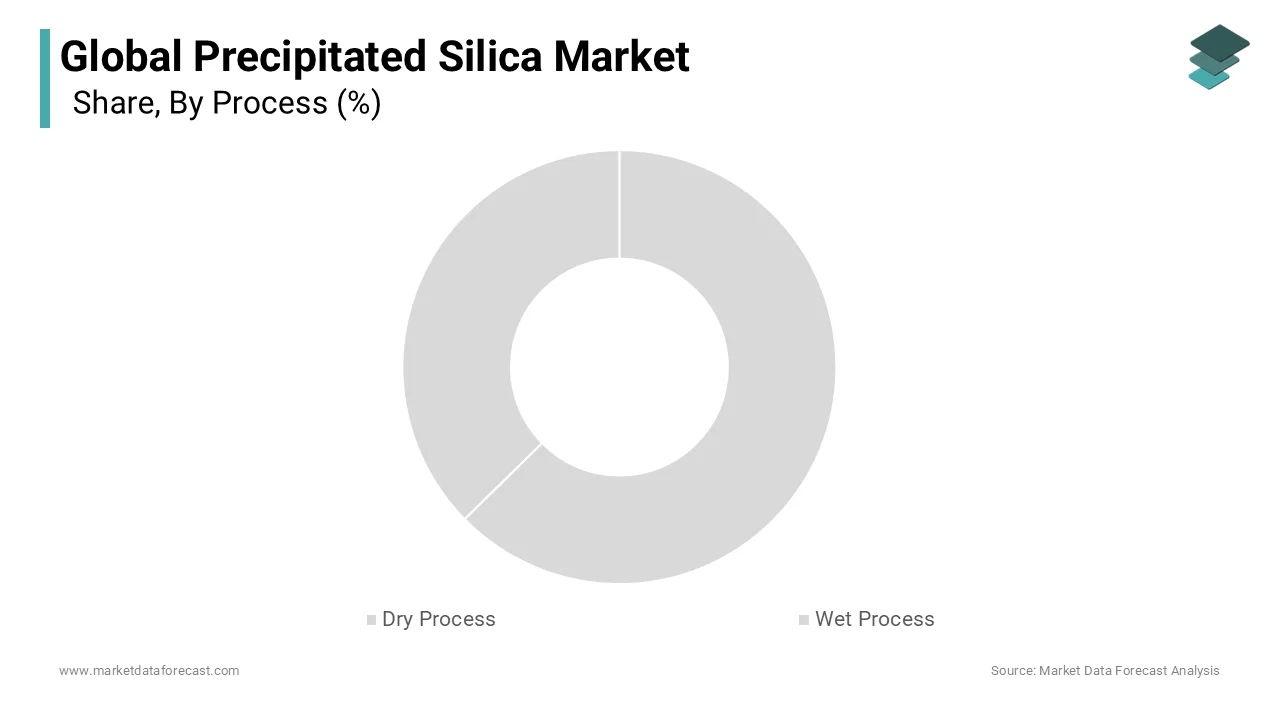
The dry process segment is predicted to witness the highest CAGR of 4.9% over the forecast period owing to growing interest in energy efficient production methods and applications requiring lower surface area silica grades. Industrial process data indicates that dry-method pyrogenic manufacturing inherently eliminates major aqueous reaction blocks, altering the baseline wastewater and water-consumption profile compared to traditional wet-precipitation routes. The process yields silica with distinct particle size distributions suited for free flow agents, anti caking applications, and certain industrial coating formulations. Industry environmental assessments highlight that dry gas-phase chemical synthesis allows facilities to drastically minimize direct liquid effluent discharge, aiding alignment with tightening regional wastewater and environmental regulations. Emerging applications in battery separator coatings and agricultural chemical carriers are driving specification development for dry process grades with controlled porosity and moisture absorption characteristics. Technical publications within the agricultural sector highlight that specialized amorphous silica grades are experiencing steady demand as advanced carrier media, helping optimize powder flowability and formulation dispersion stability in agrochemical products. Manufacturers are investing in advanced milling and classification technologies to enhance product consistency, enabling dry process silica to penetrate performance sensitive applications previously dominated by wet process variants.
By End Use Insights
The automobiles segment held the majority share of 43.2% of the global precipitated silica market in 2025. This supremacy derives from silica's indispensable role in manufacturing low rolling resistance tires that improve fuel efficiency and reduce vehicle emissions. Industrial chemical analyses indicate that high-performance silica-silane systems have become the standard baseline for European passenger tire treads, significantly improving wet traction and rolling resistance to meet strict EU environmental mandates. Tire manufacturers typically incorporate 50 to 80 parts per hundred rubber of precipitated silica to achieve optimal balance between wet grip performance and energy conservation. As per the International Energy Agency, electric vehicle sales in Europe have stabilized at approximately one in five new car registrations, sustaining strong demand for specialized, high-durability silica grades engineered for heavier EV battery weights. Automotive supply chain assessments show that Germany’s automotive manufacturing sector represents a major consumer of high-dispersibility silica, heavily driven by premium tire manufacturers shifting toward green tire formulations. Original equipment manufacturers increasingly collaborate with silica suppliers to develop application specific grades addressing weight management challenges inherent to battery electric platforms. This technological convergence between material science and automotive engineering sustains structural demand growth for precipitated silica across European and global automotive supply chains.
But the electronics segment is estimated to register the fastest CAGR of 8.7% from 2026 to 2034 due to growing adoption of precipitated silica in semiconductor packaging, printed circuit board manufacturing, and lithium ion battery components. According to the Semiconductor Industry Association, global semiconductor market revenue grew by 16.0% in 2024, reflecting an industry expansion that drives substantial volume demand for silica-based encapsulants. Precipitated silica functions as a reinforcing filler in epoxy molding compounds, improving mechanical strength while maintaining low coefficient of thermal expansion critical for device reliability. Studies show that global annual lithium-ion battery demand crossed the 1 terawatt-hour (1,000 GWh) mark, increasing the application of silica-based coatings to improve thermal safety margins. Manufacturers specify silica particle sizes between 0.5 and 5 microns to achieve optimal dispersion in polymer matrices without compromising electrical insulation characteristics. Technical literature published via electronic engineering repositories confirms that modifying epoxy molding encapsulants with nano-silica structures drastically enhances thermal cycling stability and reduces moisture absorption compared to traditional pure resin formulations. The proliferation of electric vehicles, renewable energy storage systems, and 5G infrastructure continues to expand application opportunities for specialty silica grades engineered for high performance electronic assemblies.
By Application Insights
The rubber application segment dominated the global precipitated silica market and accounted for a 54.7% share in 2025 because of silica's critical function as a reinforcing filler in tire manufacturing where it enhances tread wear resistance, wet traction, and fuel efficiency. According to global rubber market indicators, the automotive sector remains the primary driver of precipitated silica consumption, with high-performance silica-reinforced compounds increasingly dominating modern passenger car tire formulations to optimize vehicle efficiency. To balance the 'Magic Triangle' of rolling resistance, wear life, and wet grip, tire manufacturers typically incorporate highly dispersible precipitated silica at loadings ranging from 50 to 90 phr (parts per hundred rubber). Automotive efficiency studies indicate that substituting carbon black with silica-based green tires reduces overall vehicle fuel consumption by roughly 3% to 5%, serving as a critical engineering mechanism for meeting stringent global emissions regulations. According to advanced material technical disclosures, highly dispersible silica (HDS) grades significantly lower the compound's Mooney viscosity during mixing, markedly improving processing throughput and minimizing energy expenditure on the factory floor. The transition toward electric mobility further amplifies silica demand as electric vehicles require tires with enhanced load carrying capacity and reduced noise generation. This technological convergence between material science and automotive engineering sustains structural demand growth for precipitated silica across global rubber manufacturing ecosystems.
On the contrary, the battery separator application segment is anticipated to witness the fastest CAGR of 12.3% during the forecast period. This swift growth of the segment is fuelled by growing adoption of precipitated silica in lithium ion and lead acid battery separator coatings that enhance thermal stability and electrolyte retention. Global lithium-ion battery market data highlights a massive scaling of production capacity, with advanced separator coatings emerging as a vital performance mechanism to safeguard thermal stability and prolong cycle life. Precipitated silica functions as a pore forming agent and mechanical reinforcement in polyethylene and polypropylene separator films, preventing thermal shrinkage and internal short circuits. Technical specifications for advanced battery components show that precisely engineered silica coatings optimize porosity and wettability, significantly enhancing ionic conductivity without compromising the mechanical thickness of the separator. Research published in electrochemistry literature demonstrates that silica-modified ceramic separators dramatically reduce thermal shrinkage at high temperatures, preventing internal short circuits compared to standard, uncoated polyolefin alternatives. The proliferation of electric vehicles, renewable energy storage systems, and portable electronics continues to expand application opportunities for specialty silica grades engineered for high performance battery applications. Manufacturers are investing in surface modification technologies to enhance silica compatibility with polymer matrices and electrolyte systems, reinforcing the material's strategic importance within global battery supply chains.
REGIONAL ANALYSIS
Asia Pacific Precipitated Silica Market Analysis
Asia Pacific occupied the dominant position in the global precipitated silica market and captured a 43.5% share in 2025. This growth of the APAC market was driven by robust automotive production, expanding tire manufacturing capacity, and growing personal care consumption across China India and Southeast Asian economies. According to data from the China Rubber Industry Association, domestic tire production surged past 1 billion units in 2024, maintaining its position as the world's largest consumer of precipitated silica for green tire and high-performance automotive applications. Chinese manufacturers increasingly specify high dispersibility grades to meet export quality standards for European and North American automotive original equipment manufacturers. As per national vehicle registration data in India, domestic electric vehicle sales experienced robust double-digit growth in 2024, accelerating institutional demand for specialized, silica-reinforced tires engineered to manage the heavy torque and low-noise thresholds of electric drivetrains. Market intelligence across the Asia-Pacific personal care sector indicates consistent multi-year growth, supporting steady volume demand for oral care and cosmetic-grade hydrated silica additives. Government initiatives promoting domestic chemical manufacturing and environmental compliance are encouraging investments in advanced precipitation technologies and sustainable production methods. This convergence of industrial growth regulatory support and technological advancement positions Asia Pacific for continued market leadership through the forecast period.
Europe Precipitated Silica Market Analysis
Europe followed closely behind in the global precipitated silica market and accounted for a 21.8% share in 2025. This mature market emphasizes high performance applications and sustainability compliance across automotive personal care and industrial segments. Driven by strict EU CO2 fleet emission targets, low rolling resistance tire technologies have become standard equipment for European vehicle registrations, utilizing precise loadings of highly dispersible precipitated silica to minimize energy losses. Industry supply chain assessments emphasize that the German automotive sector remains a primary consumer of premium-grade highly dispersible silica (HDS) to support local tire manufacturing and green mobility initiatives. European manufacturers increasingly specify bio circular silica grades produced from renewable feedstocks to support circular economy objectives. According to the European Environment Agency, sustained modernization and efficiency optimizations within the regional chemical sector have contributed to a significant long-term reduction in overall industrial greenhouse gas emissions. Regulatory frameworks governing substance registration and workplace exposure limits continue to shape production methodologies and product specifications across the European market landscape. This emphasis on performance sustainability and regulatory compliance positions Europe as a technology leader in advanced silica applications despite moderate volume growth relative to emerging regions.
North America Precipitated Silica Market Analysis
North America holds a noteworthy share of the global precipitated silica market owing to technological innovation and application diversification across automotive personal care and industrial segments. According to industry data from the U.S. Tire Manufacturers Association (USTMA), domestic tire shipments exceed 330 million units annually, with silica-reinforced compounding accounting for an expanding share of passenger car tire formulations to enhance fuel efficiency. US manufacturers increasingly collaborate with silica suppliers to develop application specific grades addressing weight management challenges inherent to battery electric platforms. According to automotive market statistics, electric vehicle sales in the United States reached approximately 1.4 million units in 2024, capturing a record market share and amplifying the demand for specialized silica grades tailored to lower rolling resistance and maximize battery range. Industry data highlights that steady consumer spending on personal care and dental hygiene products across North America continues to secure a highly stable market for specialized thickening and abrasive silica grades. Manufacturers are investing in advanced precipitation technologies and surface modification capabilities to serve growing demand from high performance applications. This focus on innovation application development and regulatory compliance positions North America for sustained value growth despite moderate volume expansion relative to emerging regions.
Latin America Precipitated Silica Market Analysis
Latin America witnessed a steady growth in the global precipitated silica market. This market demonstrates growth potential driven by expanding automotive production infrastructure development and rising personal care consumption. Brazilian tire manufacturers increasingly specify high dispersibility grades to serve export markets in Europe and North America where performance requirements are more stringent. Regional infrastructure investments in road construction and industrial facilities are driving consumption of silica modified coatings and adhesives with enhanced durability characteristics. Manufacturers are investing in distribution infrastructure and technical service capabilities to serve growing demand from diverse end markets. This combination of industrial growth regulatory alignment and market development positions Latin America for accelerated expansion through the forecast period.
Middle East and Africa Precipitated Silica Market Analysis
The Middle East and Africa region is anticipated to expand significantly in the global precipitated silica market from 2026 to 2034 owing to infrastructure development automotive assembly expansion and growing personal care consumption. Saudi Arabian automotive assembly facilities increasingly specify silica modified compounds to serve regional and export markets where performance standards are evolving. Regional infrastructure investments in transportation energy and industrial facilities are driving consumption of silica modified coatings and adhesives with enhanced durability characteristics. Manufacturers are investing in distribution partnerships and technical service capabilities to serve growing demand from diverse end markets. This combination of infrastructure development regulatory evolution and market expansion positions the Middle East and Africa for steady growth through the forecast period.
COMPETITIVE LANDSCAPE
The precipitated silica market exhibits moderate concentration with the top five players controlling an estimated 55 to 65 percent of global volume according to industry assessments. Competition centers on product performance pricing tactics customization capabilities and sustainability credentials. Leading manufacturers differentiate through technical service support application development expertise and regulatory compliance capabilities. Price competition remains significant for commodity grade silica serving tire applications while innovation in surface treated and application specific grades provides margin protection for specialty products. Regional players in China and India challenge incumbents with cost effective propositions and agile supply chain networks serving domestic markets. Global manufacturers respond through capacity expansions technology transfers and strategic partnerships to maintain competitive positioning. The convergence of sustainability mandates electric vehicle adoption and regulatory complexity continues to reshape competitive dynamics favoring players with innovation capabilities and sustainable production pathways. Market participants increasingly compete on lifecycle emissions circularity metrics and supply chain transparency alongside traditional performance and cost parameters.
KEY MARKET PLAYERS
The major key players in the global precipitated silica market include
- PPG Industries, Inc. (U.S.)
- Industrias Químicas del Ebro, S.A. (Spain)
- Evonik Industries AG (Germany)
- Tata Chemicals Ltd. (India)
- AntenChem Co., Ltd.
- Solvay SA (Belgium)
- PQ Corporation (U.S.)
- W.R. Grace & Co. (U.S.)
- Oriental Silica Corporation (Taiwan)
- Tosoh Silica Corporation (Japan)
- Huber Engineered Materials (U.S.)
- Supercell Chemicals (I) Pvt. Ltd. (India)
- Madhu Silica Pvt. Ltd. (India)
- Gujarat Multi Gas Base Chemicals Pvt. Ltd. (India)
- Wacker Chemie AG (Germany)
Top Players in the Market
- Evonik Industries maintains a leadership position in the global precipitated silica market through its comprehensive portfolio of highly dispersible and specialty silica grades. The company's ULTRASIL and SIPERNAT brands serve critical applications in tire manufacturing personal care and industrial coatings. The company pioneered bio circular silica production using rice husk ash derived sodium silicate achieving significant carbon footprint reduction. Evonik's integration of material science expertise with global manufacturing capabilities positions it to capture growth from electric vehicle adoption and sustainability mandates across diverse end markets.
- Solvay SA leverages its Zeosil brand portfolio to serve demanding applications in tire reinforcement oral care and food ingredients. Solvay's research and development investments focus on surface modification technologies enhancing silica compatibility with polymer matrices and electrolyte systems. The company's partnership with Hankook Tire on circular silica initiatives demonstrates commitment to sustainable supply chain development. Solvay's global manufacturing footprint and application expertise enable responsive service to automotive personal care and industrial customers across diverse geographic markets.
- PPG Industries serves the precipitated silica market through its HI SIL brand addressing tire reinforcement oral care and industrial coating applications. The company's Delfzijl Netherlands facility recently completed capacity expansion to serve European demand for high performance silica grades. PPG integrates silica production with its broader coatings and specialty materials portfolio enabling cross application innovation and technical service support. The company's investments in surface treatment technologies enhance silica dispersibility and compatibility with diverse polymer systems. PPG's focus on application development and customer collaboration positions it to capture growth from electric vehicle adoption and sustainability mandates across automotive and industrial end markets.
Top Strategies Used by Key Market Participants
Key players in the precipitated silica market employ capacity expansion as a primary strategy to serve growing demand from tire and personal care applications. Manufacturers invest in bio circular production pathways using renewable feedstocks to achieve carbon footprint reductions and meet sustainability mandates. Strategic partnerships with automotive original equipment manufacturers enable development of application specific silica grades addressing performance requirements for electric vehicle platforms. Companies pursue vertical integration through sodium silicate production to secure raw material supply and manage cost volatility. Research and development investments focus on surface modification technologies enhancing silica compatibility with polymer matrices and electrolyte systems. Geographic diversification through facility expansions in Asia Pacific and North America enables responsive service to regional customers and mitigates supply chain risks. Digitalization initiatives including process analytical technologies and real time monitoring systems improve product consistency and operational efficiency across manufacturing networks.
MARKET SEGMENTATION
This research report on the global precipitated silica market has been segmented and sub-segmented based on resin type, product, technology, application, and region.
By Process
- Dry Process
- Wet Process
By End-Use
- Automobiles
- Cosmetics
- Electronics
- Agriculture
By Application
- Rubber
- Personal Care
- Food
- Battery Separator
- Coating & Inks
- Adhesives & Sealants
By Region
- North America
- Europe
- Asia-Pacific
- Latin America
- The Middle East & Africa