- Product Description Description
- Table of Contents TOC
- List of Table & Figure LOT
- Get Free Sample PDF Sample PDF
Market Size, 2025
$42.43 BnMarket Estimate, 2026
$44.21 BnMarket Forecast, 2034
$61.44 BnCAGR, 2026–2034
4.2%Global Process Chemicals for Water Treatment Market Report: Size, Share, Trends & Forecast (2026–2034)
- Market Scope: Comprehensive global process chemicals for water treatment industry evaluation covering chemical types, end-use industries, functions, applications, forms, and regional adoption dynamics.
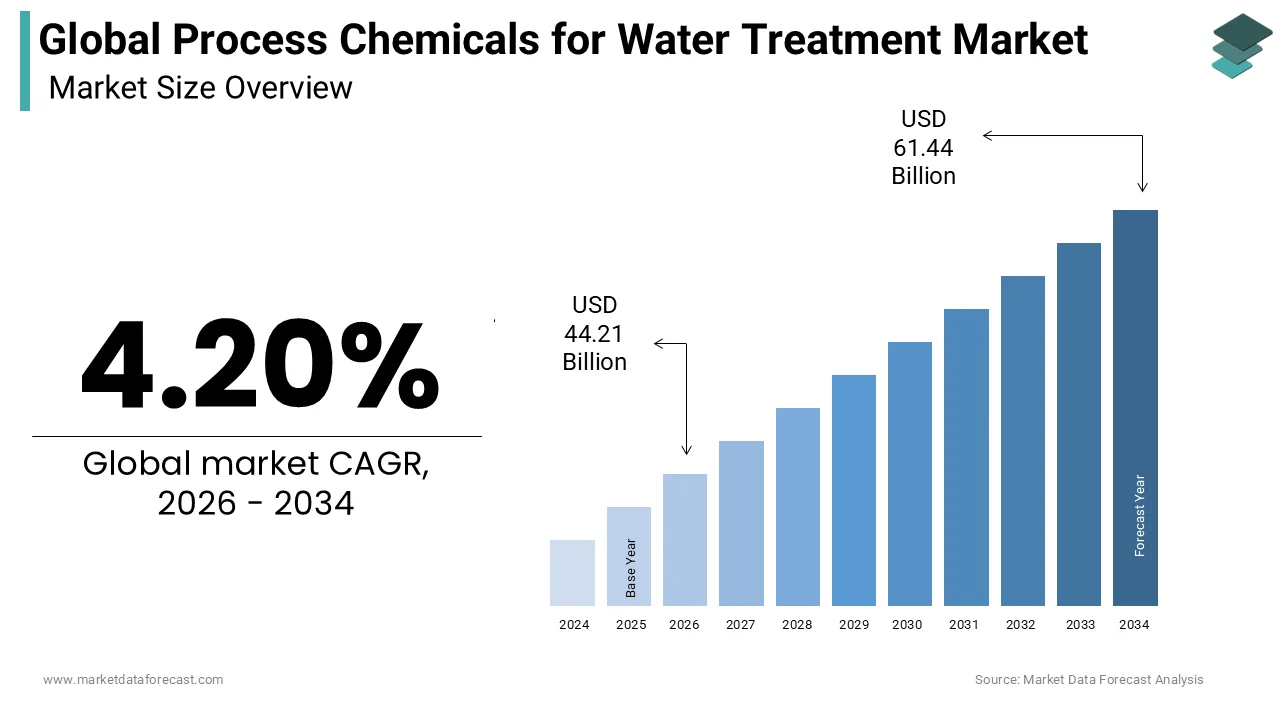
- Market Valuation: Valued at USD 42.43 billion in 2025, estimated at USD 44.21 billion in 2026, and projected to reach USD 61.44 billion by 2034, growing at a steady CAGR of 4.20% during the forecast period from 2026 to 2034.
- Primary Growth Drivers: Stringent environmental regulations and discharge standards, rapid industrialization and urbanization in emerging economies, and the continuous expansion of power generation and oil & gas wastewater demands.
Key Global Process Chemicals for Water Treatment Market Segment Metrics (2026–2034)
| Category | Leading Segment / Position | Fastest-Growing / Prominent Trend |
|---|---|---|
| By Chemical / Function | Coagulants (accounted for 35.4% share in 2025 due to primary wastewater turbidity removal and solid-liquid separation) | Flocculants (projected to register high growth driven by complex industrial effluents and enhanced sludge dewatering) |
| By Application | Power Generation (largest application holding 28.3% share in 2025 for cooling towers, boilers, and flue gas systems) | Oil and Gas (expected to register the fastest CAGR of 7.2% driven by produced water management and enhanced oil recovery) |
| By End-Use Industry | Petrochemicals (largest end-use sector holding 30.3% share in 2025 for steam cracking, cooling, and washing) | Food & Beverages (emerging rapidly at a 6.5% CAGR driven by strict hygiene standards and potable quality mandates) |
| By Region | Europe & North America (Europe holds 28.3% share anchored by strict EU green targets; North America follows with mature infrastructure) | Asia-Pacific (projected to grow steadily at the fastest CAGR driven by rapid industrialization, urbanization, and infrastructure upgrades) |
Major Global Process Chemicals for Water Treatment Companies & Competitive Landscape
Market Structure: Highly competitive global marketplace featuring major chemical corporations and specialty water tech providers focusing on green chemistry, digital dosing technologies, and localized manufacturing.
Key Companies: BASF SE, Ecolab Inc., Kemira Oyj, SNF Group, Solenis LLC, AkzoNobel N.V., The Dow Chemical Company, SUEZ Water Technologies & Solutions, Buckman Laboratories International, Inc., and Kurita Water Industries Ltd.
 Download Free Sample Report
Global Process Chemicals for Water Treatment Market Size
The process chemicals for water treatment market was calculated to be USD 42.43 billion in 2025 and is anticipated to be worth USD 61.44 billion by 2034, growing from USD 44.21 billion in 2026 at a CAGR of 4.20% during the forecast period.
The process chemicals for water treatment are specialized substances, including coagulants, flocculants, disinfectants, and pH adjusters, designed to purify industrial, municipal, and wastewater streams. These chemical agents are fundamental in removing suspended solids, organic contaminants, heavy metals, and pathogens to meet stringent regulatory discharge standards and ensure operational efficiency in cooling towers, boilers, and reverse osmosis systems. According to the United Nations World Water Development Report, approximately 80% of global wastewater is released into the environment without adequate treatment, creating an urgent imperative for advanced chemical solutions. The European Environment Agency states that industrial facilities in the EU must comply with the Urban Wastewater Treatment Directive, which mandates strict limits on nitrogen, phosphorus, and hazardous substance concentrations in effluent. As per data from the US Environmental Protection Agency, public water systems serve over 300 million people, requiring continuous dosing of chlorine, chloramine,s and fluoride to prevent waterborne diseases. The complexity of industrial processes in sectors such as pharmaceuticals, textiles, and power generation necessitates tailored chemical formulations that address specific contaminant profiles while minimizing environmental footprint. Modern treatment protocols increasingly integrate green chemistry principles to reduce toxicity and enhance biodegradability of residual sludge. Regulatory frameworks like the REACH regulation in Europe restrict the use of certain hazardous substances, driving innovation in safer alternatives. The integration of real-time monitoring sensors allows for precise chemical dosing, optimizing consumption and reducing operational costs for utilities and industrial plants globally.
MARKET DRIVERS
Stringent Environmental Regulations and Discharge Standards
The global governments are implementing increasingly rigorous environmental regulations that mandate lower pollutant levels in industrial and municipal wastewater discharge,s thereby driving demand for advanced process chemicals. The stringent environmental regulations and discharge standards are driving the growth of the process chemicals for water treatment market. According to the European Commission, the revised Urban Wastewater Treatment Directive requires member states to remove micro pollutants and nutrients more effectively by 2045, compelling utilities to upgrade treatment infrastructure and chemical dosing protocols. The US Clean Water Act empowers the Environmental Protection Agency to set national standards for wastewater discharge,s with recent updates targeting per- and polyfluoroalkyl substances PFAS which require specialized adsorbents and oxidizing agents for removal. The Indian Central Pollution Control Board has tightened norms for textile and tannery industries, requiring zero liquid discharge systems that rely heavily on coagulants and antiscalants to maximize water recovery. Compliance with these legal frameworks is non-negotiable, with penalties for violations reaching millions of dollars, prompting facilities to invest in high-efficiency chemical treatments.
Rapid Industrialization and Urbanization in Emerging Economies
The accelerated pace of industrialization and urban population growth in emerging economies creates substantial demand for process chemicals to manage expanding wastewater volumes and maintain water quality. The rapid industrialization and urbanization in emerging economies are additionally promoting the growth of the process chemicals for water treatment market. According to the United Nations Department of Economic and Social Affairs, the global urban population is projected to reach 6.7 billion by 2050, with 90% of this growth occurring in Asia and Africa, necessitating massive expansion of municipal water treatment infrastructure. The developing countries in Asia need to invest 150 billion dollars annually in water supply and sanitation to keep pace with demographic shifts, driving procurement of coagulants, disinfectants, and sludge dewatering agents. India’s Smart Cities Mission aims to provide universal water coverage, requiring enhanced treatment capacity that relies on consistent chemical supply chains. The textile industry in Bangladesh and Vietnam, which contributes significantly to GD, P generates highly colored and toxic effluent requiring specialized decolorizing agents and flocculants. The urban residents in sub-Saharan Africa have access to safely managed sanitation services, creating immense opportunities for chemical suppliers supporting new treatment plant construction.
MARKET RESTRAINTS
Volatility in Raw Material Prices and Supply Chain Disruptions
The production of process chemicals relies heavily on petrochemical derivatives and mineral resources, whose prices are subject to significant volatility due to geopolitical tensions, which is limiting the growth of the process chemicals for the water treatment market. The energy costs for chemical manufacturing in Europe increased by 45%, following the energy crisis, forcing producers to pass higher costs onto water treatment facilities, as per the study. Supply chain disruptions caused by logistical bottlenecks and trade restrictions further exacerbate availability issues, with lead times for key ingredients extending by 4 to 6 weeks compared to historical norms. As per the research, the price of alum, a primary coagulant, rose by 20% in 2023 due to mining constraints and transportation challenges in major producing regions. Water treatment plants operating on fixed budget contracts struggle to absorb these sudden cost increases, leading to deferred maintenance or reduced chemical dosing, which compromises treatment efficacy. The reliance on single-source suppliers for specialized additives creates vulnerability to production outages at manufacturing sites. Currency exchange rate fluctuations also affect import costs for countries dependent on foreign chemical supplies, adding financial uncertainty. These economic pressures constrain market growth as end users seek alternative technologies or negotiate longer-term fixed price agreements to mitigate risk.
Health and Safety Concerns Associated with Hazardous Chemicals
The handling, storage, and application of certain process chemicals pose significant health and safety risks to workers and surrounding communities, leading to strict operational constraints and liability concerns. The health and safety concerns associated with hazardous chemicals are also hindering the growth of the process chemicals for water treatment market. The exposure to chlorine gas used widely for disinfection, can cause severe respiratory damage and even fatality if leaks occur during transport or dosing operations. Many traditional coagulants and biocides are hazardous substances requiring specialized personal protective equipment and extensive training for personnel, which increases operational overheads. The improper handling of water treatment chemicals contributes to thousands of occupational injuries annually, particularly in developing regions with limited safety infrastructure. Public opposition to the use of toxic chemicals near residential areas often delays project approvals and forces municipalities to adopt more expensive but safer alternatives. The Basel Convention regulates the transboundary movement of hazardous waste, including spent chemical containers, adding compliance burden to suppliers and users. Accidental spills can result in severe environmental contamination and legal repercussions, as seen in several high-profile incidents involving acid and alkali releases. Insurance premiums for facilities storing large quantities of hazardous chemicals have risen by 15%, according to a survey.
MARKET OPPORTUNITIES
Adoption of Green and Bio-Based Chemical Alternatives
The growing environmental awareness and regulatory pressure for manufacturers to develop green and bio-based process chemicals that offer effective treatment with minimal ecological impact. The adoption of green and bio-based chemical alternatives is likely to set up new opportunities for the growth of the process chemicals for water treatment market. The research into plant-based coagulants derived from Moringa oleifera seeds and chitosan from crustacean shells has demonstrated comparable performance to synthetic polymers with superior biodegradability. The European Union’s Green Deal promotes the substitution of hazardous substances with safer alternatives, providing funding and incentives for companies innovating in green chemistry. Enzyme-based treatments for breaking down organic pollutants in wastewater offer targeted action without generating harmful byproducts, aligning with circular economy principles. The Japanese Ministry of Environment supports initiatives to replace conventional disinfectants with ozone and UV-compatible enzymes, reducing the formation of trihalomethanes. Corporate sustainability goals drive multinational corporations to prefer suppliers offering certified eco-friendly products, enhancing brand value. Startups focusing on microbial consortia for nutrient removal are attracting venture capital investment, indicating strong commercial potential. The transition to green chemicals also reduces sludge volume and toxicity, lowering disposal costs for treatment plants.
Integration of Digital Dosing and Smart Monitoring Technologies
The emergence of digital technologies with chemical treatment processes for optimizing dosage, reducing waste, and improving operational efficiency is another factor to boost the growth of the process chemical for water treatment market. The smart water management solutions incorporating IoT sensors and artificial intelligence can reduce chemical consumption by up to 20% through real-time adjustment of dosing rates based on influent quality, as per the study. The digital twin technology allows operators to simulate chemical reactions and predict optimal dosing strategies before implementation, minimizing trial-and-error costs. The intelligent control systems using machine learning algorithms have improved turbidity removal efficiency while lowering polymer usage in municipal plants. Cloud-based platforms enable remote monitoring of chemical inventory levels, automating replenishment orders and preventing stockouts that could disrupt treatment processes. The adoption of automated feedback loops ensures consistent water quality despite fluctuations in flow rate and contaminant load, enhancing regulatory compliance. Utilities in Singapore and Israel are pioneering fully automated chemical dosing systems that integrate with broader smart city infrastructure, demonstrating scalability and reliability. Service providers offering chemical management as a service bundled with digital monitoring tools create recurring revenue streams and deeper customer engagement.
MARKET CHALLENGES
Complexity of Emerging Contaminants and Micropollutants
The increasing presence of emerging contaminants, such as pharmaceuticals, personal care products, and endocrine-disrupting compounds in water sources, is a significant challenge for the growth of the process chemicals for water treatment market. Traditional coagulants and disinfectants are often ineffective against these micropollutants, necessitating the development of novel chemical formulations that target specific molecular structures. The European Commission identifies microplastics and PFAS as priority pollutants requiring innovative treatment solutions that are currently not widely available or cost-effective. Removing trace organic contaminants requires high doses of ozone or activated carbon, which significantly increases operational costs and chemical consumption. The lack of standardized testing methods for many emerging pollutants complicates regulatory compliance and performance validation for chemical suppliers. Treatment plants face uncertainty in designing processes for contaminants that are not yet regulated but may be in the future, leading to hesitation in capital investment. The variability of contaminant profiles across different geographic regions requires customized chemical solutions that are difficult to scale globally.
High Operational Costs and Energy Intensity of Advanced Treatments
The implementation of advanced chemical treatment processes often entails high operational costs and significant energy consumption, which constrains adoption particularly in resource-constrained regions. The high operational costs and energy intensity of advanced treatments are a huge challenge for the growth of the process chemicals for water treatment market. According to the International Energy Agency, water treatment accounts for approximately 4% of global electricity consumption, with chemical production and dosing systems contributing substantially to this load. Advanced oxidation processes using hydrogen peroxide and UV light require considerable energy input, making them economically viable only for high-value industrial applications or strict regulatory environments. Many municipal utilities in developing countries operate at a financial deficit, limiting their ability to purchase premium chemicals or upgrade to energy-efficient dosing equipment. The cost of specialized chemicals for reverse osmosis pretreatment, such as antiscalants and biocides, adds to the overall expense of desalination projects, which are for water-scarce regions. The need for frequent calibration and maintenance of automated dosing systems adds to labor and technical support costs. Small and medium-sized enterprises often lack the financial resources to implement sophisticated chemical management systems, relying instead on basic treatments that may not meet evolving standards.
REPORT COVERAGE
| REPORT METRIC | DETAILS |
| Market Size Available | 2025 to 2034 |
| Base Year | 2025 |
| Forecast Period | 2026 to 2034 |
| CAGR | 4.2% |
| Segments Covered | By Chemical, End-Use Industry, Function, Application, Form, and Region |
| Various Analyses Covered | Global, Regional & Country Level Analysis, Segment-Level Analysis, DROC, PESTLE Analysis, Porter’s Five Forces Analysis, Competitive Landscape, Analyst Overview of Investment Opportunities |
| Regions Covered | North America, Europe, Asia Pacific, Latin America, and the Middle East & Africa |
| Market Leaders Profiled | BASF SE, Ecolab Inc., Kemira Oyj, SNF Group, Solenis LLC, AkzoNobel N.V., The Dow Chemical Company, SUEZ Water Technologies & Solutions, Buckman Laboratories International, Inc., Kurita Water Industries Ltd, and others. |
SEGMENTAL ANALYSIS
By Chemical Insights
The coagulants segment was the largest by accounting for 35.4% of the process chemicals for water treatment market share in 2025 due to their fundamental role in primary wastewater treatment and solid-liquid separation. The universal requirement for turbidity removal in municipal and industrial wastewater streams before further processing or discharge. The US Environmental Protection Agency mandates that public water systems achieve specific turbidity levels below 1 nephelometric turbidity unit, which necessitates consistent dosing of aluminum sulfate, ferric chloride, and polyaluminum chloride. Industrial sectors, such as mining and textiles, rely heavily on coagulants to settle heavy metals and dyes, preventing equipment fouling and ensuring regulatory adherence. The cost-effectiveness of inorganic coagulants compared to advanced oxidation processes makes them the preferred first line of defense in high-volume applications. Emerging economies are expanding municipal infrastructure rapidly, with China adding 20 million cubic meters of daily treatment capacity in 2023, according to the Chinese Ministry of Housing and Urban Rural Development, driving substantial procurement of bulk coagulant chemicals.
Flocculants represent the fastest-growing segment with a projected compound annual growth rate of 6.8% through 2030, driven by the increasing complexity of industrial effluents and the need for enhanced sludge dewatering efficiency. The stringent regulation regarding sludge disposal and the push toward zero liquid discharge systems, which require superior solid separation capabilities. According to the research, the volume of sewage sludge produced in the EU exceeds 10 million tonnes of dry solids annually, requiring efficient flocculation to reduce volume and transportation costs for disposal or incineration. Polyacrylamide-based flocculants are increasingly favored for their ability to bridge fine particles into larger flocs that settle rapidly, improving throughput in clarifiers and centrifuges. The paper and pulp industry is a major consumer using flocculants to recover fibers and fillers from process water, supporting circular economy initiatives. The Indian Central Pollution Control Board has mandated stricter limits on total suspended solids in industrial discharge, prompting textile and tannery clusters to upgrade flocculation systems. Innovations in bio-based flocculants derived from starch and chitosan are gaining traction due to their non-toxic profile, aligning with green chemistry principles promoted by the Organisation for Economic Co-operation and Development.
By Application Insights
The power generation application segment was the largest by holding 28.3% of the process chemical for water treatment market share in 2025, with the extensive use of water in cooling towers, boilers, and flue gas desulfurization systems in thermal and nuclear power plants. According to the International Energy Agency, thermal power plants account for 40% of global freshwater withdrawals, requiring robust chemical treatment programs to manage millions of gallons of circulating water daily. Scale inhibitors and corrosion inhibitors are essential for maintaining the integrity of boiler tubes and condenser surfaces under high temperature and pressure conditions. As per data from the Electric Power Research Institute, adoption of closed-loop cooling systems in new power plants has increased chemical concentration cycles, necessitating specialized antiscalants and dispersants to prevent precipitation. The transition to renewable energy does not eliminate this demand, as biomass and geothermal plants also require intensive water chemistry management. Regulatory frameworks such as the Clean Water Act restrict thermal discharge temperatures and chemical residuals, compelling operators to use environmentally benign treatment chemicals. The aging infrastructure in developed markets requires rehabilitation and continuous chemical maintenance, ensuring steady demand for high-performance treatment solutions.
The oil and gas application segment is expected to register the fastest CAGR of 7.2% from 2026 to 2034, with the enhanced oil recovery techniques and stringent regulations on produced water management. The primary growth factor is the increasing water cut in mature oil fields, which generates vast volumes of contaminated produced water requiring sophisticated treatment before reinjection or discharge. According to the International Petroleum Industry Environmental Conservation Association, the global oil and gas industry produces approximately 250 million barrels of produced water daily, necessitating large quantities of demulsifiers, scale inhibitors, and biocides. Hydraulic fracturing operations in shale plays generate flowback water with high salinity and total dissolved solids requiring specialized chemical formulations to prevent formation damage and equipment corrosion. Offshore platforms face strict discharge limits under the Oslo Paris Convention, requiring advanced treatment to remove hydrocarbons and heavy metals before releasing water into the marine environment. Huge investments in water injection projects to maintain reservoir pressure, with Saudi Aramco implementing large-scale centralised treatment facilities. Regulatory pressure to reduce freshwater usage in drilling operations encourages recycling of produced water, which relies on effective chemical conditioning to remove contaminants and stabilize emulsions.
By End-Use Insights
The petrochemicals end-use segment was the largest by holding 30.3% of the share in 2025 due to the intensive water requirements for steam cracking, cooling, and product washing in refineries and chemical plants. The need to protect expensive capital equipment from fouling and corrosion, while ensuring product purity and process safety. According to the American Chemistry Council, the US petrochemical industry consumes approximately 1.5 billion gallons of water daily for process and cooling applications requiring continuous chemical treatment to maintain system reliability. Scale formation in heat exchangers can reduce energy efficiency by 20%, leading to higher operational costs and increased greenhouse gas emissions, which conflicts with corporate sustainability goals. As per data from the Society of Petroleum Engineers, refineries utilize complex blends of corrosion inhibitors, oxygen scavengers, and biocides to manage water quality in once-through and recirculating systems. The European Chemical Industry Council reports that strict REACH regulations compel manufacturers to use safer and more efficient treatment chemicals, reducing environmental liability. Integration of water reuse systems in petrochemical complexes increases the concentration of contaminants, requiring robust chemical programs to handle higher salinity and organic loads. The expansion of petrochemical capacity in Asia, particularly in China and India, drives significant demand for specialized treatment solutions tailored to local water quality characteristics and regulatory frameworks.
The food and beverages end-use segment is swiftly emerging at a fastest CAGR of 6.5% from 2026 to 2034, owing to the stringent hygiene standards and increasing production volumes globally. The primary growth factor is the regulatory mandate for potable quality water in food processing and the need to minimize microbial contamination risks in final products. The waterborne diseases remain a significant public health concern, prompting food manufacturers to adopt rigorous disinfection protocols using chlorine dioxide, ozone, and peracetic acid. The US Food and Drug Administration requires Good Manufacturing Practices that include regular monitoring of water quality parameters such as pH, turbidity, and microbial counts, necessitating consistent chemical dosing. The rise of craft brewing and dairy processing industries in emerging markets increases demand for specialized cleaning and sanitizing chemicals that ensure equipment sterility without leaving harmful residues. Consumer preference for clean-label products drives the adoption of non-toxic and biodegradable treatment chemicals that align with brand sustainability narratives.
REGIONAL ANALYSIS
North America Process Chemicals for Water Treatment Market Analysis
North America was the top performer in the global process chemicals for water treatment market by holding 25.3% of the market share in 2025, with its mature industrial infrastructure and stringent environmental regulations. The United States dominates the regional market share with its large petrochemical power generation and municipal water sectors. According to the study, over 150000 public water systems serve the population, requiring continuous compliance with Safe Drinking Water Act standards, which drives steady demand for coagulants and disinfectants. The shale gas boom has created substantial demand for produced water treatment chemicals in states like Texas and Pennsylvania, where hydraulic fracturing generates millions of barrels of wastewater. Canada contributes to regional growth through its oil sands operations in Alberta, which require intensive water treatment for bitumen extraction and tailings management. The Canadian Council of Ministers of the Environment enforces strict guidelines for industrial effluent discharge, promoting the adoption of eco-friendly chemical alternatives. The presence of major chemical manufacturers ensures a robust supply chain and technological innovation in the region.
Europe Process Chemicals for Water Treatment Market Analysis
Europe process chemicals for the water treatment market were positioned second by holding 28.3% of the market share in 2025, owing to the aggressive sustainability targets and advanced wastewater treatment technologies. The European Union’s Green Deal and Zero Pollution Action Plan mandate significant reductions in industrial discharges and microplastic pollution, driving the adoption of high-efficiency process chemicals. The EU treats over 90% of its urban wastewater with tertiary treatment, becoming standard in many member states, requiring advanced flocculants and disinfectants, as per research. Germany, France, and Italy are the largest consumers due to their strong chemical, pharmaceutical, and automotive industries, which generate complex effluents requiring tailored treatment solutions. The regulations restrict the use of hazardous substances, prompting a shift toward bio-based and readily biodegradable treatment chemicals. The Netherlands leads in innovation with its circular economy approach, promoting water reuse in industrial parks, which necessitates robust chemical programs to manage concentrated contaminants. Spain and Italy face water scarcity issues, driving the adoption of desalination and wastewater reuse technologies that rely heavily on antiscalants and membrane cleaning agents.
Asia-Pacific Process Chemicals for Water Treatment Market Analysis
Asia-Pacific process chemicals for water treatment market is anticipated to grow steadily at the fastest CAGR throughout the forecast period, driven by rapid industrialization, urbanization, and government initiatives to improve water security. China, India, and Southeast Asian nations are the primary contributors due to expanding manufacturing bases and municipal infrastructure development. Countries in Asia need to invest 150 billion dollars annually in water supply and sanitation, creating massive demand for basic treatment chemicals like alum and lime. China’s 14th Five-Year Plan prioritizes ecological protection with strict limits on industrial discharge in key river basins, driving upgrades in wastewater treatment capacity. The textile industry in Bangladesh and Vietnam generates significant colored effluent requiring specialized decolorizing agents and coagulants to meet export standards. Japan and South Korea lead in technology adoption using advanced oxidation and membrane bioreactors that require specialized chemical maintenance. Rising awareness of waterborne diseases prompts households and institutions to adopt point-of-use treatment systems, increasing retail demand for disinfectants.
Latin America Process Chemicals for Water Treatment Market Analysis
Latin America's process chemicals for the water treatment market growth is likely to grow with the mining, agriculture, and municipal water treatment needs. Brazil, Mexico, and Chile are the key contributors due to their large industrial sectors and water resource challenges. The urban wastewater in Latin America receives treatment, promoting significant potential for market growth, as infrastructure improves. Brazil’s mining sector is a major consumer of flocculants and coagulants for tailings management following strict dam safety regulations implemented after recent incidents. The industrial users must comply with effluent standards, driving the adoption of chemical treatment in pulp, paper, and sugar ethanol industries. Mexico faces water stress in northern regions, prompting industries to adopt water reuse systems requiring specialized chemical programs to manage high salinity and organic loads. Chile’s copper mining industry uses large volumes of water for ore processing, requiring effective scale and corrosion inhibition to protect equipment in arid environments. Argentina’s agricultural sector utilizes treated wastewater for irrigation, driving demand for disinfectants to ensure pathogen-free water.
Middle East and Africa Process Chemicals for Water Treatment Market Analysis
The Middle East and Africa process chemicals for water treatment market growth is driven primarily by desalination, oil and gas activities, and urban development in Gulf Cooperation Council countries. Saudi Arabia, the United Arab Emirates, and South Africa are the leading consumers due to water scarcity and industrial activity. Saudi Arabia’s Vision 2030 includes massive investments in water infrastructure and industrial cities, driving demand for comprehensive water treatment solutions. The rapid urbanization in Nigeria, Kenya, and Egypt creates pressure on municipal water systems, necessitating expansion of treatment capacity and chemical supply. South Africa’s mining industry is a significant user of process chemicals for mineral processing and tailings dam management, requiring robust flocculation and pH control. The oil and gas sector in Iraq and Algeria generates produced water requiring treatment for reinjection or disposal, adhering to international environmental standards. Water scarcity drives the adoption of wastewater reuse in agriculture and landscaping, increasing demand for disinfectants and nutrient removal chemicals.
COMPETITION OVERVIEW
The Process Chemicals for Water Treatment Market exhibits a highly competitive landscape characterized by global giants and specialized regional players vying for dominance through innovation and service excellence. Major corporations leverage their extensive research capabilities and global supply chains to offer comprehensive solutions tailored to diverse industrial needs. These entities compete primarily on product efficacy, technical support, and sustainability credentials rather than price alone. Smaller niche players differentiate themselves through customized formulations for specific contaminants or local regulatory requirements. Intense competition drives continuous innovation in green chemistry and digital monitoring technologies to improve efficiency and reduce environmental impact. Regulatory compliance serves as a significant barrier to entry, ensuring that only qualified manufacturers can participate in regulated markets. Mergers and acquisitions are common strategies employed by leading firms to expand geographic reach and acquire proprietary technologies. The market remains dynamic with participants constantly adapting to shifting environmental policies and evolving customer preferences for sustainable and cost-effective treatment solutions across various industrial sectors globally.
KEY MARKET PLAYERS
A few major players of the global process chemicals for water treatment market include
- BASF SE
- Ecolab Inc
- Kemira Oyj
- SNF Group
- Solenis LLC
- AkzoNobel N.V
- The Dow Chemical Company
- SUEZ Water Technologies & Solutions
- Buckman Laboratories International, Inc
- Kurita Water Industries Ltd
Top Strategies Used by Key Market Participants
Key players in the Process Chemicals for Water Treatment Market primarily focus on product innovation and localized manufacturing to maintain a competitive advantage. Companies invest heavily in research and development to create eco-friendly and bio-based alternatives that comply with stringent environmental regulations. Strategic partnerships with local distributors and engineering firms enable deeper market penetration and enhanced technical support services. Expansion into emerging markets through joint ventures and acquisitions helps secure raw material supplies and reduce logistical barriers. Digital integration offers value-added services such as remote monitoring and predictive analytics, optimizing chemical usage, and reducing operational costs. Manufacturers prioritize sustainability by developing circular economy solutions that minimize waste and energy consumption. Compliance with international safety standards ensures product reliability and builds trust among industrial clients. These strategies collectively drive market growth and address evolving customer demands for efficient and sustainable water treatment solutions globally.
Leading Players in the MEA Process Chemicals for Water Treatment Market
- Veolia Water Technologies serves as a pivotal provider of advanced water treatment solutions across the Middle East and Africa, focusing on industrial and municipal sectors. The company delivers comprehensive chemical programs for desalination power generation, oil and gas applications, ensuring optimal system performance and regulatory compliance. Veolia recently expanded its local manufacturing capabilities in Saudi Arabia to produce specialized antiscalants and coagulants, reducing lead times and enhancing supply chain resilience for regional clients. This strategic move aligns with national localization initiatives and supports large-scale infrastructure projects under Vision 2030. The firm integrates digital monitoring tools with chemical dosing systems, allowing real-time optimization of treatment processes for major utility partners. Veolia collaborates closely with government entities to develop sustainable water reuse strategies addressing severe scarcity issues in arid regions. Its commitment to innovation includes developing low-carbon footprint chemicals that meet stringent environmental standards while maintaining high efficacy in harsh operating conditions typical of the Gulf region.
- Ecolab Incorporated maintains a strong presence in the MEA region by offering integrated water hygiene and sustainability solutions tailored to diverse industrial needs. The company focuses on delivering customized chemical formulations for cooling towers, boilers, and wastewater treatment plants in sectors such as mining, food processing, and hospitality. Ecolab recently launched a new suite of bio-based cleaning agents in South Africa and the United Arab Emirates, catering to growing demand for environmentally responsible products. These initiatives support corporate sustainability goals and help clients reduce their ecological footprint while maintaining operational efficiency. The organization invests heavily in technical service teams, who provide on-site expertise and training to ensure proper chemical application and safety compliance. Ecolab leverages its global research network to adapt innovative technologies to local water quality challenges such as high salinity and temperature. Strategic partnerships with local distributors enhance market reach and enable rapid response to customer requirements across remote locations in Africa and the Middle East.
- SNF Group is a leading manufacturer of water-soluble polymers, including flocculants and coagulants, with significant operations in the Middle East and Africa. The company plays a critical role in supporting mining, municipal wastewater, and oil recovery projects by providing high-performance separation chemicals. SNF recently inaugurated a new production facility in Egypt to serve the African market more effectively, reducing logistics costs and improving product availability for local customers. This expansion strengthens its ability to support large-scale infrastructure developments and industrial growth in North Africa. The group focuses on developing tailored polymer solutions that address specific contaminant profiles found in regional water sources, such as heavy metals and organic matter. SNF collaborates with engineering firms to optimize flocculation processes in treatment plants, enhancing sludge dewatering efficiency and reducing disposal costs. Its technical support teams work directly with operators to fine-tune dosing parameters, ensuring maximum effectiveness and cost savings. The company emphasizes sustainable practices by promoting biodegradable polymer options that align with evolving environmental regulations in the region.
MARKET SEGMENTATION
This research report on the global process chemicals for the water treatment market has been segmented and sub-segmented based on chemical, end-use industry, function, application, form, and region.
By Type
- Coagulants
- Flocculants
- pH adjusters
- Biocides
- Corrosion inhibitors, scale inhibitors
- Others
By End-Use Industry
- Municipal water treatment
- Industrial water treatment
- Commercial water treatment
- Others
By Function
- Primary treatment chemicals
- Secondary treat chemicals
- Tertiary treatment chemicals
By Application
- Drinking water treatment
- Wastewater treatment
- Desalination treatment
- Process water treatment
- Others
By Form
- Liquid
- Powder
- Granular chemicals
By Region
- North America
- Europe
- Asia-Pacific
- Latin America
- Middle East & Africa