- Product Description Description
- Table of Contents TOC
- List of Table & Figure LOT
- Get Free Sample PDF Sample PDF
Market Size, 2025
$11.33 BnMarket Estimate, 2026
$12.71 BnMarket Forecast, 2034
$31.93 BnCAGR, 2026–2034
12.2%Global Product Information Management Market Size, Growth, Trends & Forecast (2026–2034)
The global product information management (PIM) market size was valued at USD 11.33 billion in 2025, stands at USD 12.71 billion in 2026, and is projected to reach USD 31.93 billion by 2034, growing at a compound annual growth rate (CAGR) of 12.20% during the forecast period from 2026 to 2034. Driven by the explosive growth of global e-commerce, the need for centralized multichannel data architectures, and rising corporate investments in advanced enterprise technologies, the market is expanding rapidly worldwide.
Key Executive Metrics (At-a-Glance)
- 2025 Base Valuation: USD 11.33 Billion
- 2026 Current Valuation: USD 12.71 Billion
- 2034 Forecast Valuation: USD 31.93 Billion
- Compound Annual Growth Rate (CAGR): 12.20% (2026–2034)
- Leading Component Segment: Training, Support & Maintenance (ensuring cost-effective performance optimization for in-house staff) alongside Solutions
- Leading Deployment Segment: On-Premises & Cloud (growing rapidly as enterprises seek secure, scalable database frameworks)
- Leading Organization Size: Large Enterprises (supplemented by increasing adoption among small and medium-sized enterprises)
- Regional Leader: North America (commanding the largest market share backed by established PIM vendors and technological infrastructure)
Core Market Drivers
- E-Commerce Expansion: Flourishing digital retail marketplaces generating massive volumes of structured and unstructured product catalog data that require automated synchronization.
- Enhanced Customer Experience: Corporate focus on delivering accurate, uniform product content across all consumer touchpoints to boost satisfaction and conversion rates.
Primary Market Restraints & Challenges
- Data Privacy & Security Risks: Misapprehensions regarding data leakage, cross-channel synchronization vulnerabilities, and cloud storage security.
- Regulatory Compliance: Strict global government data mandates and compliance frameworks governing consumer and corporate information management.
Global Product Information Management Market Segmentation Breakdown
| Segment Category | Leading Sub-Segment | Other Key Sub-Segments |
|---|---|---|
| By Component | Training, Support & Maintenance / Solutions | Consulting & Implementation, Multi-Domain, Single-Domain, Probes/Tags |
| By Deployment Type | On-Premises & Cloud | Hybrid Deployments |
| By Organization Size | Large Enterprises | Small and Medium-Sized Enterprises (SMEs) |
| By Vertical | Consumer Goods and Retail | BFSI, Manufacturing, IT & Telecom, Transportation, Healthcare, Media |
| By Region | North America | Asia-Pacific (Fastest Growing), Europe, Latin America, Middle East & Africa |
Major Industry Players Profiled
Key global market participants shaping the product information management ecosystem include Oracle (US), SAP (US), IBM (US), Informatica (US), Salsify (US), Akeneo (France), Stibo Systems (Denmark), Syndigo (US), Pimcore (Austria), and Riversand (US).
 Download Free Sample Report
Global Product Information Management Market Size
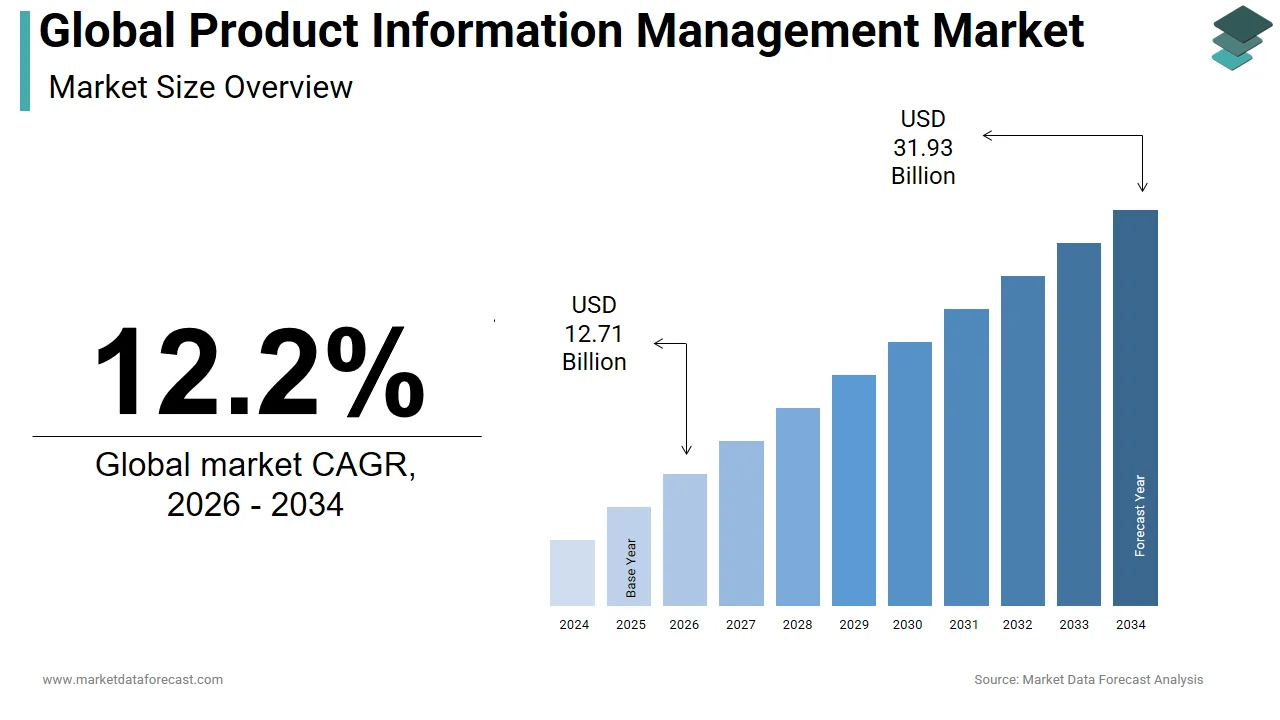
The global product information management market was worth USD 11.33 billion in 2025. The global market is predicted to reach USD 12.71 billion in 2026 and USD 31.93 billion by 2034, growing at a CAGR of 12.2% during the forecast period.
MARKET DRIVERS
One of the major driving factors that helps the growth of the global Product Information Management market is the rising demand for PIM solutions and the flourishing e-commerce industry.
Increasing need to offer enhanced customer services is another major growth promoting factor of Product Information Management market. Huge investments by the major key players contributed to the innovation of advanced technologies, which also increased the revenue of the Product Information Management business.
MARKET RESTRAINTS
Privacy risks are one of the major challenges affecting the growth of the global Product Information Management market. Another major restraint hindering the expansion of the market is misapprehensions about data security. Strict government regulations are also a growth controlling factor of this business around the world.
REPORT COVERAGE
| REPORT METRIC | DETAILS |
| Market Size Available | 2025 to 2034 |
| Base Year | 2025 |
| Forecast Period | 2026 to 2034 |
| CAGR | 12.2% |
| Segments Covered | By Component, Deployment Type, Organization Type, Vertical, and Region. |
|
Various Analyses Covered | Global, Regional & Country Level Analysis, Segment-Level Analysis, DROC, PESTLE Analysis, Porter’s Five Forces Analysis, Competitive Landscape, Analyst Overview on Investment Opportunities |
| Regions Covered | North America, Europe, APAC, Latin America, Middle East & Africa |
|
Market Leaders Profiled | Magnitude Software (US), Plytix (Denmark), Profisee (US), Censhare (Germany), Vinculum (India), Pimworks (US), Truecommerce (US), Pimcore (Austria), Akeneo (France), Inriver (Sweden), Winshuttle (US), Riversand (US), Salsify (US), Oracle (US), SAP (US), IBM (US), Informatica (US), Aprimo (US), Stibo Systems (Denmark), Contentserv (Switzerland), Mobius (India), Perfion (Denmark), Vimedici (Germany) and Syndigo (US) and Others. |
SEGMENTAL ANALYSIS
By Component Insights
Among these, the training, support and maintenance segment holds the major share of the product information and management market as these services provide a cost-effective way to ensure the performance at the highest level of in-house staff.
REGIONAL ANALYSIS
Among these regions, North America holds the major share of the market, attributed to the presence of lPIM vendors and technologically advanced countries such as the United States and Canada. The North American region is also expected to dominate the market during the conjecture period.
The Asia Pacific region is expected to have the second-largest share of the market because of the increasing need to offer enhanced customer services to users in local provinces like India, China, Japan, etc., and foreign nations.
The Europe region also has a good market share following the Asia Pacific and North American markets due to the huge investments by companies in research and development to implement novel technologies in this field.
KEY MARKET PLAYERS
Some of the key players of the global Product Information Management market are: Magnitude Software (US), Plytix (Denmark), Profisee (US), Censhare (Germany), Vinculum (India), Pimworks (US), Truecommerce (US), Pimcore (Austria), Akeneo (France), Inriver (Sweden), Winshuttle (US), Riversand (US), Salsify (US), Oracle (US), SAP (US), IBM (US), Informatica (US), Aprimo (US), Stibo Systems (Denmark), Contentserv (Switzerland), Mobius (India), Perfion (Denmark), Vimedici (Germany) and Syndigo (US).
RECENT MARKET HAPPENINGS
- In October 2020, Pimcore introduced new features and improvements, such as an editable dialog box, improved cache performance, and tree sorting.
- In June 2020, Winshuttle collaborated with ABBYY, an intelligence company, to help organizations and businesses with digital transformation, which involves extracting data from physical documents and automatically loading it into SAP.
MARKET SEGMENTATION
This research report on the global product information management market has been segmented and sub-segmented based on the component, deployment type, organization type, vertical, and region.
By Component
- Solutions
- Multi Domain
- Single Domain
- Services
- Consulting & Implementation
- Training
- Support and Maintenance
By Deployment Type
- On-Premises
- Cloud
By Organization Size
- Large Enterprises
- Small and Medium Sized Enterprises (SMEs)
By Verticals
- Banking
- Financial Services and Insurance (BFSI)
- Consumer Goods and Retail
- Manufacturing
- IT and Telecom
- Transportation and Logistics
- Media and Entertainment
- Education
- Travel and hospitality
By Region
- North America
- Europe
- Asia-Pacific
- Latin America
- The Middle East and Africa