- Product Description Description
- Table of Contents TOC
- List of Table & Figure LOT
- Get Free Sample PDF Sample PDF
Market Size, 2025
$28.92 BnMarket Estimate, 2026
$30.72 BnMarket Forecast, 2034
$49.74 BnCAGR, 2026–2034
6.21%Global Protective Packaging Market Size, Growth, Trends & Forecast (2026–2034)
The global protective packaging market size was valued at USD 28.92 billion in 2025, stands at USD 30.72 billion in 2026, and is projected to reach USD 49.74 billion by 2034, registering a compound annual growth rate (CAGR) of 6.21% during the forecast period from 2026 to 2034. Growth is heavily impelled by the rapid global expansion of direct-to-consumer e-commerce, strict regulatory frameworks focusing on transit damage reduction, and corporate commitments toward circular economy compliance.
Key Executive Metrics (At-a-Glance)
- 2025 Base Valuation: USD 28.92 Billion
- 2026 Current Valuation: USD 30.72 Billion
- 2034 Forecast Valuation: USD 49.74 Billion
- Compound Annual Growth Rate (CAGR): 6.21% (2026–2034)
- Dominant Material Segment: Paper and paperboard-based protective solutions led with a 49.5% market share in 2025, propelled by curbside-recyclable mandates and e-commerce sustainability demands.
- Fastest Growing Material Segment: Foam plastics are predicted to grow at the highest CAGR of 7.8%, driven by high-value electronics and medical device shipments.
- Dominant Type Segment: Flexible protective systems captured 44.1% of market share in 2025 due to adaptable, space-efficient void fill capabilities.
- Fastest Growing Type Segment: Rigid protective packaging is expected to register a CAGR of 8.5%, fueled by warehouse automation compatibility and returnable logistics.
- Dominant Function Segment: Cushioning systems dominated with a 51.5% share in 2025 to mitigate last-mile parcel damage.
- Fastest Growing Function Segment: Blocking and bracing systems project a CAGR of 9.2%, driven by ocean freight volatility and oversized cargo logistics.
- Regional Market Leadership: Asia-Pacific captured the largest market share at 43.8% in 2025, synchronized with massive e-commerce expansion and export manufacturing.
Core Market Drivers
- E-Commerce Logistics Surge: Exponential growth in direct-to-consumer parcel shipping requiring multi-drop handling endurance.
- Regulatory Push for Sustainability: European Union’s PPWR and global mandates targeting waste elimination, carbon efficiency, and material minimization.
Primary Market Restraints & Challenges
- Testing Infrastructure Scarcity: Acute shortage of ISTA and ASTM distribution simulation testing labs in emerging markets leading to over-engineering.
- Automation Incompatibility: Rigid geometric demands of robotic pick-and-place fulfillment systems conflicting with irregular protective structures.
Global Protective Packaging Market Segmentation Breakdown
| Segment Category | Key Offerings / Categories | Largest / Leading Sub-Segment | Fastest Growing Sub-Segment |
|---|---|---|---|
| By Material | Foam plastics, Paper & paperboard | Paper & Paperboard (49.5%) | Foam Plastics (7.8% CAGR) |
| By Type | Flexible, Rigid, Foam | Flexible (44.1%) | Rigid (8.5% CAGR) |
| By Function | Cushioning, Blocking & bracing, Void fill | Cushioning Systems (51.5%) | Blocking & Bracing (9.2% CAGR) |
| By Application | Food & beverage, Consumer electronics, Industrial, Medical, Automotive | Consumer Electronics & E-commerce | Medical & Aerospace Components |
| By Region | North America, Europe, Asia Pacific, Latin America, Middle East & Africa | Asia Pacific (43.8%) | Asia Pacific |
Major Industry Players Profiled
Key market participants operating across the global protective packaging market include Smurfit Kappa, Sealed Air Corporation, Sonoco Products Company, Amcor plc, Huhtamaki, DS Smith plc, Pregis LLC, Pro-Pac Packaging Limited, WestRock Company, International Paper, Storopack Hans Reichenecker GmbH, Ranpak, Protective Packaging Corporation, APEX Packaging Corporation, BDL Supply, and Wisconsin Foam Products.
 Download Free Sample Report
Global Protective Packaging Market Size
The global protective packaging market size was valued at USD 28.92 billion in 2025 and is anticipated to reach USD 30.72 billion in 2026 from USD 49.74 billion by 2034, growing at a CAGR of 6.21% during the forecast period from 2026 to 2034.
Protective packaging refers to engineered systems from molded pulp inserts to shock-absorbing air cushions. It is designed to mitigate mechanical, thermal, and environmental hazards during product transit and storage. Unlike generic containment, these solutions are calibrated to fragility profiles, drop heights, vibration frequencies, and climatic exposure thresholds specific to each product category. As per the study, a portion of global consumer electronics shipped required ISTA 3A-certified packaging to survive parcel carrier handling cycles.
MARKET DRIVERS
E-commerce Boom Driving Demand for Protective Packaging
The exponential growth in direct-to-consumer e-commerce propels the growth of protective packaging market. These products endure handling events per shipment, a frequency higher than traditional retail distribution, according to study. In the U.S. , e-commerce parcel volume was in billions of units, as per research, with a portion of returns attributed to transit damage, which triggers brands to invest in custom-fit molded fiber and honeycomb paper solutions. China saw a 31% year-over-year increase in fragile item shipments, primarily glassware and ceramics, which is driving adoption of corrugated cornerboards with crush-resistant flute profiles.
Regulatory Push for Damage Reduction Fuels Market Growth
The global regulatory pivot toward damage reduction as a core component of circular economy compliance, where packaging failure equates to resource waste and carbon inefficiency, is attributing to the growth of protective packaging market. The preventable product damage in transit accounts for notable metric tons of avoidable CO₂ emissions annually. The European Union’s PPWR requires protective packaging to be designed to the minimum necessary for its function, reducing overall material while still providing adequate product protection.
MARKET RESTRAINTS
Lack of Testing Infrastructure Limits Market Expansion
The acute shortage of standardized performance validation infrastructure in emerging economies where damage claims are rising but testing labs remain scarce, is restricting the expansion of protective packaging market. Fewer laboratories globally are accredited for ISTA or ASTM D4169 distribution simulation testing, while e-commerce fulfillment centers operate in Southeast Asia alone. A small parcel damage claims in Latin America is due to unvalidated cushioning system, primarily due to lack of access to calibrated drop testers and vibration tables. Brands resort to over-engineering by inflating material use and negating sustainability gains or face costly returns and brand erosion due to the lack of accessible and affordable testing.
Automation Incompatibility Slows Protective Packaging Use
The persistent incompatibility between high-performance protective systems and automated fulfillment workflows, where robotic pick-and-place systems require rigid and uniform geometries, slows down the growth of protective packaging market. Irregularly shaped molded pulp inserts caused more sortation errors than uniform corrugated trays, forcing brands to compromise protection for machine compatibility.
MARKET OPPORTUNITIES
Bio-Based Packaging Creates Sustainable Growth Prospects
The rapid commercialization of bio-based, compostable protective foams and molded structures, particularly for premium electronics, medical devices, and gourmet food shipments, where brand sustainability narratives converge with regulatory tailwinds, provides new opportunities for the protective packaging market. As per the Organisation for Economic Co-operation and Development, global demand for mycelium-based and starch-foam protective inserts grew by 38% in 2023, with the European Bioplastics Association forecasting 180,000 metric tons of annual bio-protective capacity additions by 2026. Companies like Ecovative and Ranpak now offer mushroom-root molded end caps that absorb 4x more impact energy than EPS, as validated by the Fraunhofer Institute for Environmental, Safety, and Energy Technology. These innovations not only meet ESG mandates but unlock premium pricing in certified green supply chains, which transforms packaging from waste generator to circular asset.
AI and Digital Twins Revolutionize Packaging Design
The digital integration of protective packaging design, where AI-driven simulation tools predict drop impact, vibration resonance, and compression failure before physical prototyping, also serves a high-growth opportunity for the protective packaging market. As per research, manufacturers deploying digital twin platforms for packaging reduced damage-related returns and accelerated time-to-market months. Dell Technologies correlates product-fragility and transit-condition datasets to recommend optimal cushioning thickness and material modulus.
MARKET CHALLENGES
Shortage of Skilled Engineers Restrains Market Expansion
The shortage of skilled packaging engineers capable of balancing protective performance, material efficiency, automation compatibility, and circular compliance, particularly in high-growth regions, degrades the expansion of protective packaging market. As per research, fewer certified protective packaging specialists are active globally, while over millions of SKUs require transit validation. In India, where e-commerce parcel volume grew, vocational training enrollments in packaging technology declined, as per study. This deficit leads to overpackaging, underperformance, and compliance failures. The market growth continues to be impeded by human capital constraints because of the lack of scalable education infrastructure.
Reverse Logistics Gaps Hinder Reusable Packaging Growth
The incompatibility between reusable protective packaging systems and global reverse logistics fragmentation, where collection, sanitization, and redistribution networks remain underdeveloped outside controlled B2B corridors, hinders the growth of protective packaging market. As per the study, less share of reusable protective totes deployed in cross-border e-commerce achieved more than three round trips due to loss, contamination, or misrouting. This misalignment between circular intent and logistical reality threatens to stall reusable adoption despite its environmental promise.
REPORT COVERAGE
| REPORT METRIC | DETAILS |
| Market Size Available | 2025 to 2034 |
| Base Year | 2025 |
| Forecast Period | 2026 to 2034 |
| CAGR | 6.21% |
| Segments Covered | By Material, Type, Function, Application, and Region |
| Various Analyses Covered | Global, Regional & Country Level Analysis, Segment-Level Analysis, DROC, PESTLE Analysis, Porter’s Five Forces Analysis, Competitive Landscape, Analyst Overview on Investment Opportunities |
| Regions Covered | North America, Europe, Asia Pacific, Latin America, and Middle East & Africa |
| Market Leaders Profiled | Smurfit KappaSealed Air, Sonoco Products Company, Amcor plc, Huhtamaki, DS Smith, Pregis LLC,Pro-Pac Packaging Limited, WestRock Company, International Paper, STOROPACK HANS , REICHENECKER GMBH, Ranpak, STREET WEAR OFFICIAL LLC, Protective Packaging Corporation, APEX Packaging Corporation, BDL Supply, Wisconsin Foam Products |
SEGMENTAL ANALYSIS
By Material Insights
The paper and paperboard-based protective solutions segment was the prominent segment in the protective packaging market by capturing 49.5% of share in 2025. The growth of paper and paperboard segment is propelled by e-commerce’s demand for lightweight, curbside-recyclable cushioning, particularly in regions enforcing Extended Producer Responsibility. According to the research, a percentage of corrugated protective packaging placed on U.S. markets was recovered for recycling, a rate unmatched by plastic alternatives. In the EU, where PPWR requires paper-based packaging content, molded pulp end caps and honeycomb dividers grew in adoption per Eurostat. Even in price-sensitive India, where e-commerce parcel volume surged, as per the study, demand for flute-reinforced corner protectors rose to replace foam.
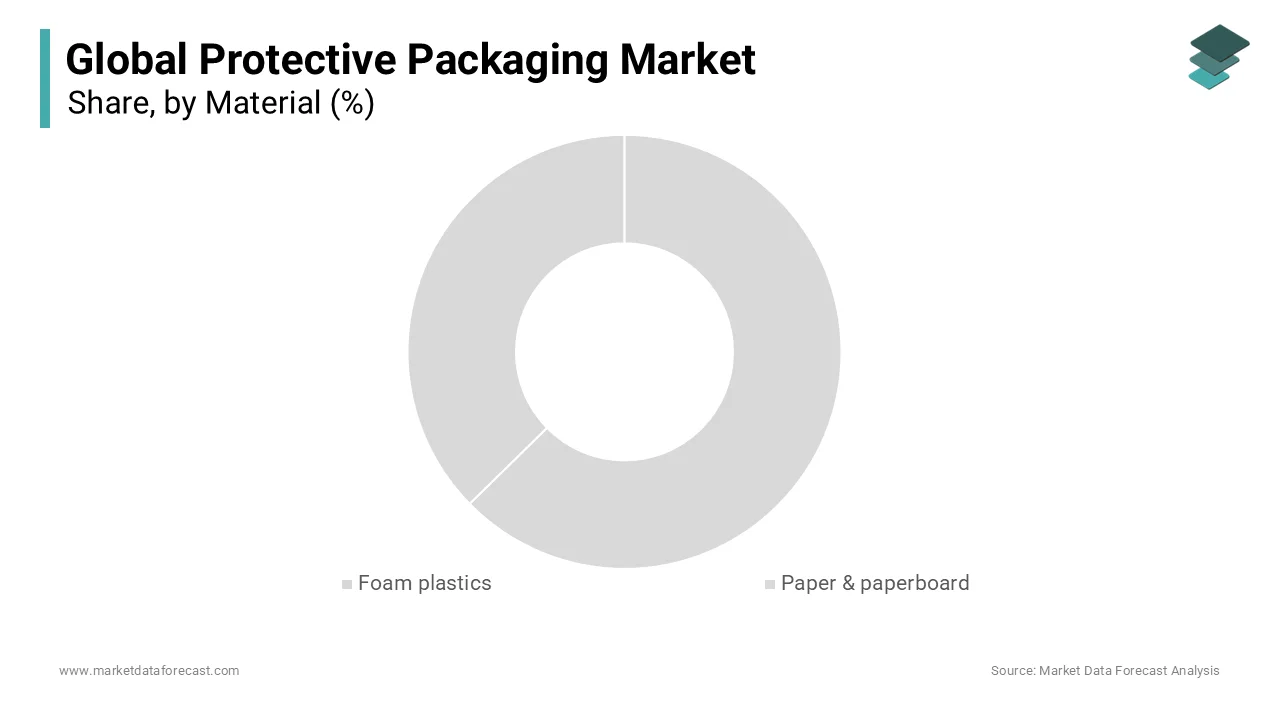
The foam plastics segment is predicted to experience the highest CAGR of 7.8% during the forecast period. High-value electronics, medical devices, and aerospace components requiring calibrated energy absorption are fuelling the growth of the foam plastics segment. As per research, a portion of Class III medical device shipments mandated static-dissipative polyethylene foam to prevent electrostatic discharge damage. In Southeast Asia, where ambient temperatures exceed 35°C, phase-change PU foams with latent heat buffering grew to protect temperature-sensitive biologics during last-mile delivery.
By Type Insights
The flexible protective systems segment was accounted in holding 44.1% of the global protective packaging market share in 2025, which is attributed to e-commerce’s need for adaptable and space-efficient void fill that conforms to irregular product geometries without adding dimensional weight. Flexible air-cushion systems reduced dimensional weight penalties versus rigid alternatives. It is a vital advantage under carrier cubic pricing models.
The rigid protective packaging segment is expected to register a CAGR of 8.5% over the forecast period. The swift growth of rigid protective packaging segment is due to automation compatibility and returnable logistics mandates, sectors where dimensional uniformity and stackability are non-negotiable. In Japan, where labor shortages accelerated warehouse automation, demand for nestable corrugated partitions surged to enable robotic singulation, which transforms rigidity from cost center to throughput enabler.
By Function Insights
The cushioning systems segment dominated the protective packaging market by accounting for 51.5% of share in 2025. The growth of cushioning systems segment is primarily driven by the physics of parcel logistics, where a portion of product damage occurs during last-mile handling, according to study. Also, smartphones, tablets, and glassware, which collectively represent a share of e-commerce damage claims, require calibrated deceleration profiles only achievable through custom foam or convoluted paper structures. In China, where Cainiao Network recorded billions of cross-province fragile shipments, demand for dual-density EPE inserts grew to protect ceramics and LCD panels.
The blocking and bracing systems segment is expected to exhibit a noteworthy CAGR of 9.2% during the forecast period due to ocean freight volatility and oversized cargo logistics, sectors where load stability directly correlates with insurance premiums and regulatory compliance. As per the research, a portion of container losses at sea were attributable to inadequate internal bracing, which triggers mandatory CSC plate validations for blocking systems. In Germany, here has been a surge in demand for high-performance corrugated packaging materials.
REGIONAL ANALYSIS
Asia Pacific Market Analysis
Asia Pacific outperformed other regions in the protective packaging market by capturing 43.8% share of the global market share in 2025. The domination of Asia Pacific in the global market is driven by synchronized e-commerce expansion and export-oriented manufacturing. China’s reported billions of parcels shipped. Vietnam’s electronics export surge, drove adoption of static-dissipative foam for semiconductor trays. Here, protective packaging is embedded in national export quality frameworks, synchronized with carrier handling realities, labor constraints, and green certification mandates, which makes it a non-negotiable layer of trade competitiveness.
Europe Market Analysis
Europe’s protective packaging market held 23.7% of share in 2025 due to regulatory precision and circular economy enforcement. As per the research, a portion of protective packaging placed on EU markets was paper-based or reusable. In Germany, a portion of automotive suppliers now use returnable HDPE totes validated for 50+ cycles. The region’s progress lies in compliance architecture, where packaging failure equates to legal liability, and innovation is measured in return rates, not cost per unit.
North America Market Analysis
North America advanced steadily in the protective packaging market owing to its performance-essential applications in medical, aerospace, and automated fulfillment. Canada’s aerospace sector, contributing to national GDP, drove growth in vibration-damped corrugated trays for avionics modules. According to study, every reduction in product breakage reduces supply chain emissions, which accelerates adoption of AI-designed cushioning for solar panel shipments.
Latin America Market Analysis
Latin America is moving ahead gradually in the protective packaging market due to export logistics resilience and urban e-commerce fragmentation. Brazil reported tons of fragile agricultural exports, primarily glass-bottled juices and ceramics. Mexico’s nearshoring boom triggered growth in reusable dunnage for automotive parts bound for U.S. assembly lines.
Middle East & Africa Market Analysis
Middle East & Africa is likely to grow in the protective packaging market due to extreme-environment logistics and state-led infrastructure projects. Saudi Arabia’s NEOM giga-project allocating notable amount to construction, requires dust-proof and UV-stable rigid trays for precision instrument shipments across desert corridors.
COMPETITIVE LANDSCAPE
KEY MARKET PLAYERS
A few of the notable players in the global protective packaging market include
- Smurfit Kappa
- Sealed Air
- Sonoco Products Company
- Amcor plc
- Huhtamaki
- DS Smith
- Pregis LLC
- Pro-Pac Packaging Limited
- WestRock Company
- International Paper
- STOROPACK HANS REICHENECKER GMBH
- Ranpak
- STREET WEAR OFFICIAL LLC
- Protective Packaging Corporation
- APEX Packaging Corporation
- BDL Supply
- Wisconsin Foam Products
COMPETITION OVERVIEW
The protective packaging market is defined by physics-based performance sovereignty rather than price competition, players differentiate through calibrated energy absorption, automation compatibility, and circular compliance. Incumbents dominate via embedded partnerships with e-tailers, medical device OEMs, and automotive assemblers, which transforms packaging from commodity to co-engineered logistics interface. Regulatory fragmentation across regions demands hyper-localized validation, while automation mandates necessitate dimensional precision by creating high barriers for generic suppliers. Competition centers on innovation velocity, who can simulate, certify, and scale next-gen protection fastest under regional stress conditions.
TOP PLAYERS IN THE MARKET
Sealed Air Corporation
Sealed Air drives global innovation through application-specific protective systems for e-commerce, healthcare, and industrial logistics. Partnering with UPS, Sealed Air co-engineered right-sized inflatable dunnage for automated sortation hubs, reducing void fill waste. Its platform tracks reusable HDPE totes across B2B lanes, embedding RFID and QR codes for sanitation compliance.
Sonoco Products Company
Sonoco anchors its global strategy in fiber-based, automation-compatible protective solutions for high-value electronics and automotive sectors. Collaborating with Samsung, Sonoco co-developed stackable corrugated trays with integrated ESD shielding for semiconductor logistics across Southeast Asia. Sonoco also deployed machine vision-guided die-cut systems in Mexico and Poland, enabling real-time geometry adjustments for robotic pick compatibility, which transforms rigidity into supply chain velocity.
DS Smith plc
DS Smith supports its global footprint through circular-by-design protective packaging aligned with Extended Producer Responsibility mandates. Partnering with IKEA, DS Smith co-engineered flat-pack protective inserts for global parcel distribution, reducing dimensional weight. DS Smith also embedded blockchain-tracked material passports in all EU-bound protective shipments.
MARKET SEGMENTATION
This research report on the global protective packaging market has been segmented and sub-segmented based on material, type, function, application, and region.
By Material
- Foam plastics
- Paper & paperboard
By Type
- Flexible
- Rigid
- Foam
By Function
- Cushioning
- Blocking & bracing
- Void fill
By Application
- Food & beverage
- Consumer electronics
By Region
- North America
- Europe
- Asia Pacific
- Latin America
- Middle East & Africa