- Product Description Description
- Table of Contents TOC
- List of Table & Figure LOT
- Get Free Sample PDF Sample PDF
Global Pyridine Market Size
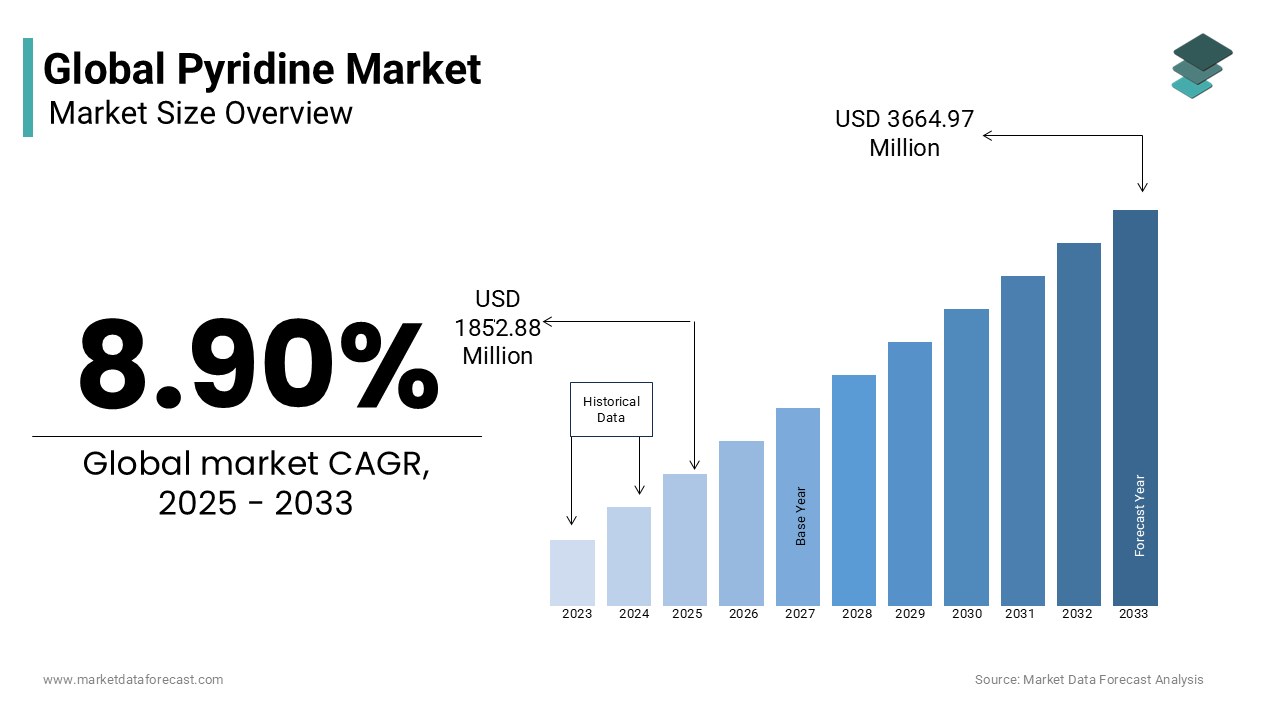
The global pyridine market was valued at USD 1701.45 million in 2024, is estimated to reach USD 1852.88 million in 2025, and is projected to reach USD 3664.97 million by 2033, growing at a CAGR of 8.90% from 2025 to 2033.
Pyridine is a heterocyclic aromatic organic compound with the molecular formula C₅H₅N, which serves as a pivotal building block in agrochemicals, pharmaceuticals, and specialty chemicals. Pyridine is primarily synthesized via the Chichibabin reaction or through catalytic ammonoxidation of methylpyridines. As of 2023, global pyridine production capacity is estimated to exceed 200,000 metric tons annually, with China accounting for over 60% of total output as per the U.S. Geological Survey.
MARKET DRIVERS
Expanding Demand for Herbicides and Insecticides in Modern Agriculture
The escalating global demand for high-efficiency crop protection agents has significantly boosted the growth of the pyridine market. As per the Food and Agriculture Organization, global pesticide consumption reached approximately 4.1 million metric tons in 2022. The compound’s role in enhancing the systemic activity and environmental persistence of herbicides makes it indispensable in large-scale monoculture farming systems.
Rising Incorporation in Pharmaceutical Synthesis and Drug Development
Pyridine’s structural versatility and nitrogen-containing ring system are amplifying the growth of the pyridine market. As per the American Chemical Society, approximately 120 small-molecule drugs approved by the U.S. Food and Drug Administration between 2015 and 2023 contain pyridine moieties, including therapeutics for oncology, respiratory diseases, and central nervous system disorders. The global pharmaceutical sector consumed an estimated 18,000 metric tons of pyridine derivatives in 2023, which is driven by the expansion of targeted therapies and personalized medicine. Pyridine is a core component in drugs such as crizotinib and ivermectin, both of which experienced double-digit demand growth in emerging markets. According to the World Health Organization, increased access to patented medicines in low- and middle-income countries has further accelerated the demand for pyridine-based intermediates.
MARKET RESTRAINTS
Stringent Environmental and Occupational Safety Regulations
The production and handling of pyridine are increasingly constrained by rigorous environmental and health regulations due to its toxicity, volatility, and potential for groundwater contamination, which is hindering the growth of the pyridine market. As per the European Chemicals Agency, pyridine is classified under REACH as a substance of very high concern (SVHC) due to its aquatic toxicity and persistent nature. In the United States, the Environmental Protection Agency mandates that industrial emissions of pyridine be monitored and reported under the Toxics Release Inventory, with facilities releasing more than 10 pounds annually required to file disclosures. Furthermore, the permissible exposure limit set by OSHA at 5 parts per million over an 8-hour workday necessitates costly ventilation and personal protective equipment systems.
Volatility in Raw Material Supply and Dependence on Petrochemical Feedstocks
Pyridine synthesis is heavily reliant on petrochemical derivatives such as acetaldehyde, ammonia, and formaldehyde is degrading the growth of pyridine market. As per the International Energy Agency, crude oil price volatility in 2022 led to a 22% year-on-year increase in the cost of acetaldehyde. This directly impacted pyridine production economics, particularly in regions without integrated supply chains.
MARKET OPPORTUNITIES
Development of Sustainable and Green Synthesis Pathways
The emerging advancements in technologies and biocatalysis is set to showcase new opportunities for the growth of pyridine market. Additionally, the European Commission’s Horizon Europe program has allocated €27 million since 2021 to projects focused on nitrogen-containing heterocycle synthesis, signaling strong institutional support. In Japan, companies like Mitsubishi Chemical have piloted electrochemical synthesis techniques that cut energy consumption by 30%, according to the National Institute of Advanced Industrial Science and Technology.
Expansion into High-Growth Specialty Chemical Applications
Pyridine is gaining traction in niche specialty chemical sectors, including electronic materials, corrosion inhibitors, and ligands for catalysis, where its electron-donating properties enhance performance. In the automotive sector, pyridine-containing corrosion inhibitors are being adopted in electric vehicle battery cooling systems due to their thermal stability and compatibility with aluminum alloys.
MARKET CHALLENGES
High Capital Intensity and Technological Barriers in Production
Establishing pyridine manufacturing facilities requires substantial investment in high-pressure reactors, advanced distillation systems, and emission control technologies, which creates significant entry barriers. According to the International Council of Chemical Associations, the average capital expenditure for a new pyridine plant with a capacity of 10,000 metric tons per year exceeds $120 million, with an additional $20 million allocated for environmental compliance. The complexity of the Chichibabin reaction—requiring precise temperature control and catalyst management—further limits operational efficiency, with yield losses averaging 12–15% in non-optimized plants, as per technical assessments by the American Institute of Chemical Engineers. In emerging markets, lack of skilled personnel and inconsistent power supply exacerbate these challenges. A 2023 World Bank study on chemical infrastructure in Africa found that only 22% of proposed pyridine-related projects reached commissioning due to financing and technical capability gaps.
Increasing Competition from Alternative Heterocyclic Compounds
The pyridine market faces growing substitution pressure from structurally similar heterocycles such as pyrimidine, pyrazine, and triazine, which offer enhanced solubility, lower toxicity, or better metabolic stability in certain applications. According to the Royal Society of Chemistry, over 1,200 peer-reviewed studies published between 2020 and 2023 explored non-pyridine scaffolds for pharmaceutical use, with pyrazine-based compounds showing superior blood-brain barrier penetration in neurological drug candidates. In agrochemicals, triazine derivatives have captured 18% of the herbicide market previously dominated by pyridine analogs, as reported by the CropLife International 2023 review. Additionally, the development of fluorinated pyridines, though promising has been hampered by high production costs and regulatory scrutiny, allowing cheaper alternatives to gain ground. As per the German Chemical Industry Association, R&D spending on pyridine alternatives increased by 34% between 2021 and 2023, signaling a strategic shift among major chemical firms.
REPORT COVERAGE
| REPORT METRIC | DETAILS |
| Market Size Available | 2024 to 2033 |
| Base Year | 2024 |
| Forecast Period | 2025 to 2033 |
| Segments Covered | By Type, Application and Region. |
| Various Analyses Covered | Global, Regional, & Country Level Analysis; Segment-Level Analysis, Drivers, Restraints, Opportunities, Challenges, PESTLE Analysis, Porter’s Five Forces Analysis, Competitive Landscape, Analyst Overview of Investment Opportunities |
| Regions Covered | North America, Europe, Asia Pacific, Latin America, Middle East, and Africa |
| Key Market Players | Jubilant Life Sciences Ltd., Vertellus Holdings LLC, Lonza Group Ltd., Resonance Specialties Limited, Shandong Luba Chemical Co., Ltd., Koei Chemical Co., Ltd., Red Sun Group, Novasyn Organics Pvt. Ltd., Bayer AG, Merck KGaA, The Dow Chemical Company, C-Chem Co., Ltd., BASF SE, ProChem, Inc., Nanjing Redsun Co., Ltd., Weifang Sunwin Chemicals Co., Ltd., Labex Corporation, LOBA Feinchemie AG, Sinopec Qilu Petrochemical, and Chang Chun Petrochemical Co., Ltd |
SEGMENTAL ANALYSIS
By Type Insights
The beta picoline (3-methylpyridine) segment is projected to grow with an anticipated CAGR of 7.8% during the forecast period, synthesizing vitamin B3 (niacin), an essential nutrient in animal feed and fortified foods. Global niacin production exceeded 55,000 metric tons in 2023, with over 90% derived from beta picoline oxidation, according to the International Feed Industry Federation. Rising livestock intensification, particularly in China and Brazil, has driven demand for niacin-supplemented feed, where deficiency can impair growth and reproduction. As per the International Energy Agency, the global electric vehicle fleet surpassed 40 million units in 2023, spurring demand for advanced electrolyte components. Beta picoline-based mediators are also being explored in vanadium redox flow batteries, where they improve electron transfer efficiency by up to 22%, according to findings published in Advanced Energy Materials in 2023.

By Application Insights
The agrochemicals segment accounted in holding 58.2% of the global pyridine market share in 2024 with the integration of pyridine and its alkylated derivatives particularly 3,5-lutidine and beta picoline, into a wide array of herbicides, insecticides, and fungicides. The molecular architecture of pyridine enables high target specificity in pest control agents, reducing off-site toxicity while maintaining field efficacy. According to the Pesticide Action Network, over 45 active ingredients in commercial use contain pyridine rings, including globally dominant products like imidacloprid and chlorpyrifos. The persistent need for yield optimization in the face of climate-induced pest proliferation is expected to fuel the growth of the pyridine market.
The electronics application segment is swiftly emerging with an anticipated CAGR of 9.3% during the forecast period with the pyridine’s role as a ligand and surface modifier in semiconductor fabrication and printed circuit board (PCB) manufacturing. Its nitrogen atom readily coordinates with metal ions, making it ideal for stabilizing copper and palladium catalysts used in electroless plating processes. According to the Institute of Electrical and Electronics Engineers, over 80% of advanced PCBs produced in 2023 utilized pyridine-based bath solutions to enhance metallization uniformity and adhesion. The integration of pyridine derivatives in OLED and flexible display technologies is accelerating the growth of pyridine market. As per the Society for Information Display, pyridine-containing electron transport layers improve device efficiency and operational lifespan by reducing charge recombination.
REGIONAL ANALYSIS
Asia Pacific Pyridine Market Analysis
Asia Pacific was the top performer of the pyridine market by capturing 62.3% of the market share in 2024. China is the largest contributor in the pyridine market with the largest manufacturer and exporter of pyridine and its derivatives. The country hosts integrated chemical complexes in Zhejiang and Jiangsu provinces, where companies like Shandong Luba and Hubei Baoxie dominate output. The region’s competitive advantage lies in lower production costs, streamlined regulatory pathways for chemical manufacturing, and proximity to key agricultural markets.
North America Pyridine Market Analysis
North America pyridine market held 14.2% of the pyridine market share in 2024. The United States pyridine market growth is likely to grow with the pharmaceutical and specialty chemical applications rather than agrochemicals, which face tighter regulatory constraints. The U.S. Food and Drug Administration has approved over 110 pyridine-containing drugs since 2010. As per the National Institutes of Health, oncology therapeutics many of which incorporate pyridine scaffolds accounted for 37% of new molecular entity approvals between 2020 and 2023. However, production remains limited due to environmental restrictions; only two primary pyridine manufacturing facilities operate in the region, both located in Texas.
Europe Pyridine Market Analysis
Europe pyridine market is quietly to grow with the highest CAGR during the forecast period. Stringent REACH regulations have led to the closure of several domestic synthesis plants, shifting reliance toward imported intermediates.
Latin America Pyridine Market Analysis
Latin America pyridine market is growing with Brazil and Argentina emerging as key demand centers due to their expansive agricultural sectors. As per the Union of Industrial Chemicals of Argentina, pyridine imports surged by 19% in 2023, primarily to support pesticide formulation for soybean and corn cultivation. Brazil, the world’s largest soybean exporter, applied over 700,000 metric tons of insecticides in 2022, many of which are pyridine-based, according to the Brazilian Ministry of Agriculture.
Middle East and Africa Pyridine Market Analysis
Middle East and Africa pyridine market is driven by South Africa, Saudi Arabia, and Egypt. As per the African Chemical Industry Report, demand is primarily import-dependent and concentrated in pharmaceutical compounding and water treatment applications. South Africa imports over 80% of its pyridine needs, mainly for API synthesis, according to the South African Bureau of Standards. In the Gulf Cooperation Council states, pyridine is increasingly used in oilfield chemicals, particularly as a corrosion inhibitor in high-salinity extraction environments.
COMPETITIVE LANDSCAPE
The pyridine market exhibits a consolidated yet dynamic competitive landscape, dominated by a few integrated chemical manufacturers with advanced production capabilities. Competition is primarily driven by cost efficiency, product purity, and regulatory compliance rather than price wars. Companies differentiate through technological expertise in catalytic synthesis and environmental management systems. While Chinese firms lead in volume and scale, Western and Japanese players focus on high-purity, specialty-grade derivatives for pharmaceuticals and electronics. Strategic investments in R&D, particularly in sustainable synthesis and waste minimization, are becoming competitive levers. The market also faces pressure from substitution threats and regulatory scrutiny, prompting firms to innovate beyond traditional applications.
KEY MARKET PLAYERS
A few of the major companies in the global pyridine market include
- Jubilant Life Sciences Ltd.
- Vertellus Holdings LLC
- Lonza Group Ltd.
- Resonance Specialties Limited
- Shandong Luba Chemical Co., Ltd.
- Koei Chemical Co., Ltd.
- Red Sun Group
- Novasyn Organics Pvt. Ltd.
- Bayer AG
- Merck KGaA
- The Dow Chemical Company
- C-Chem Co., Ltd.
- BASF SE
- ProChem, Inc.
- Nanjing Redsun Co., Ltd.
- Weifang Sunwin Chemicals Co., Ltd.
- Labex Corporation
- LOBA Feinchemie AG
- Sinopec Qilu Petrochemical
- Chang Chun Petrochemical Co., Ltd.
Top Players in the Pyridine Market
Shandong Luba Chemical Co., Ltd.
Shandong Luba is a leading Chinese manufacturer specializing in heterocyclic compounds, with pyridine and its derivatives forming the core of its product portfolio. The company operates an integrated production facility in Shandong Province, utilizing advanced catalytic ammonoxidation technology to ensure high-purity output. It has strengthened its position in the Asia Pacific market by expanding downstream capabilities into 3-methylpyridine and picolinic acid, catering to the pharmaceutical and animal nutrition sectors.
Hubei Baoxie Group Co., Ltd.
Hubei Baoxie is a major Chinese chemical enterprise with a dominant presence in the pyridine value chain, producing over 30,000 metric tons annually of pyridine and related alkylpyridines. The company supplies key intermediates to agrochemical giants for the synthesis of herbicides and insecticides, particularly in Southeast Asia and India. In recent years, Hubei Baoxie has focused on vertical integration by securing long-term contracts with domestic ammonia and acetaldehyde producers, which is reducing feedstock volatility. It launched a dedicated R&D center in Wuhan in 2022 to develop low-emission synthesis routes and improve yield efficiency.
Vertellus Holdings LLC
Vertellus, headquartered in the United States but with significant manufacturing and distribution reach across Asia Pacific, is a global leader in specialty chemicals, including pyridine-based active pharmaceutical ingredients and performance materials. The company operates a high-purity pyridine derivative facility in Singapore, serving pharmaceutical and electronics clients in Japan, Taiwan, and Malaysia. Vertellus has differentiated itself through stringent quality control and regulatory support by enabling faster approval timelines for customers in highly regulated markets.
Top Strategies Used by Key Market Participants
Key players in the pyridine market are deploying vertical integration, technological innovation, and strategic partnerships to consolidate their positions. Companies are investing in backward integration to secure feedstocks such as acetaldehyde and ammonia, reducing exposure to petrochemical price swings. Forward integration into high-value derivatives like niacin and pharmaceutical intermediates allows for margin enhancement. Firms are also adopting advanced catalytic processes to improve yield and reduce environmental impact, aligning with tightening global regulations. Geographical expansion through export networks and regional distribution hubs is common, particularly targeting fast-growing markets in South and Southeast Asia.
MARKET SEGMENTATION
The research report on the global pyridine market has been segmented and sub-segmented based on categories.
By Type
- Pyridine
- Beta Picoline
- Alpha Picoline
- Gamma Picoline
- Others
By Application
- Agrochemicals
- Pharmaceuticals
- Electronics
- Plastics
- Food & Beverage
- Others
By Region
- North America
- Europe
- Asia-Pacific
- Latin America
- Middle East and Africa