- Product Description Description
- Table of Contents TOC
- List of Table & Figure LOT
- Get Free Sample PDF Sample PDF
Market Size, 2025
$592.90 MnMarket Estimate, 2026
$639.15 MnMarket Forecast, 2034
$1165 MnCAGR, 2026–2034
7.80%Executive Summary: Global Quantum Sensing Market
- Market Scope: Comprehensive global quantum sensing market analysis covering product variants, end-user industry verticals, regional innovation programs, and physical measurement metrics.
- Market Valuation: Valued at USD 592.90 million in 2025, anticipated to reach USD 639.15 million in 2026, and projected to scale up to USD 1,165 million by 2034, expanding at a steady CAGR of 7.8% over the forecast period from 2026 to 2034.
- Primary Growth Drivers: Rising demand for high-accuracy precision navigation and motion monitoring in autonomous/electric vehicles; critical military and defense applications (positioning data and submarine detection); and advanced healthcare innovations (early cancer identification via free radical measurement). Major operational challenges include isolating sensitive quantum states from external environmental disturbances and mitigating spectral errors.
Key Market Segment Metrics (2026–2034)
| Category | Leading Segment (Base Position) | Fastest-Growing Segment |
|---|---|---|
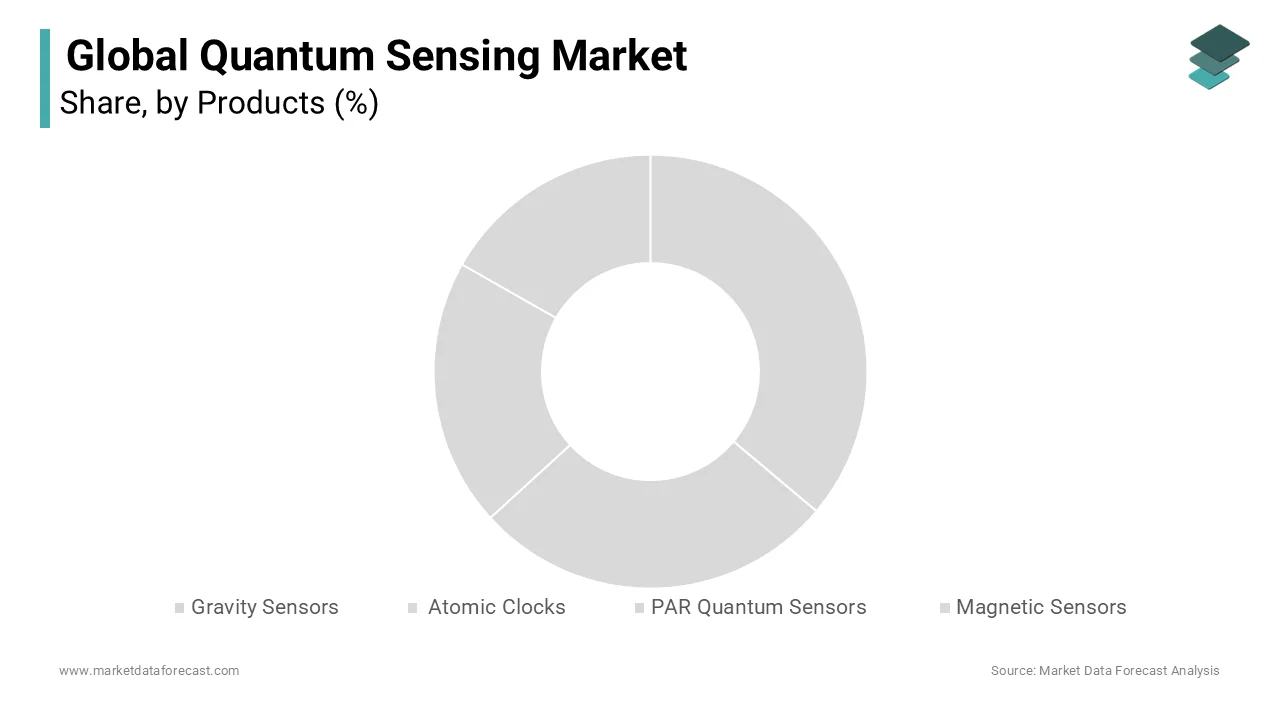
| By Products | Atomic Clocks and Magnetic Sensors (vital for synchronized timing, telecommunications, and defense infrastructure) | Gravity and Magnetic Sensors |
| By End-Users | Military & Defense and Automotive Sectors (driving primary commercial demand due to requirements for GPS-denied navigation and autonomous vehicle systems) | Automotive and Healthcare sectors |
| By Region / Country | Europe (leads the global market due to early-stage strategic investments, such as the UK’s National Quantum Technologies Programme) | North America and Europe |
Major Market Players & Market Structure
Market Structure: Highly specialized, R&D-intensive global deep-tech ecosystem featuring quantum innovators, precision instrument manufacturers, and aerospace firms competing on coherence stability, quantum gravimeters, and miniaturized sensor payloads.
Key Companies: Networking (Oscilloquartz), Apogee Instrument Inc., GWR Instruments Inc., Spectrum Technologies Inc., Adcon Telemetry GmbH, METER Group, Microchip Technology, Impedans Ltd., and M-Squared Lasers Limited.
Global Quantum Sensing Market Size
The global quantum sensing market size was valued at USD 592.90 million in 2025 and is anticipated to reach a valuation of USD 639.15 million in 2025 and USD 1165 million by 2034, growing at a CAGR of 7.8% from 2026 to 2034.
Quantum sensing utilizes properties of the quantum mechanism, such as quantum entanglement, quantum interference, and quantum state squeezing, which have perfect clarity and beat current limits in sensor technology, and evade the Heisenberg uncertainty principle. A quantum sensor is a device that works by detecting the variation and vibration of microgravity using the principles of quantum physics. Devices that rely on quantum coherence to measure dynamic and static physical quantities at any moment, such as force, pressure, light intensity, and electromagnetic fields. To make them highly efficient quantum sensors, they comprise magnetometers, atomic clocks, and avalanche photodiodes, because of which they become highly efficient sensitivity measurement instruments. Quantum sensors are mostly used in a variety of industries, including military and defense, automotive, space, and healthcare, where quantum sensors convert incoming photons directly into an electrical signal.
MARKET DRIVERS
Because of the growing demand for advanced automotive technology, quantum sensors are increasingly being used in the automotive industry.
Quantum sensors used in automotive applications can reliably monitor motion, acceleration, gravity, rotation, imaging, and other parameters. Because quantum sensing provides highly accurate measurements, they are increasingly being used for precision navigation in automobiles. This indicates the major driving factors for the increase in demand for the quantum sensing market. The increase in number of sensors per car has increased exponentially as a result of the demand for autonomous vehicles and electric vehicles. Because of this demand, the majority of sensor producers in the world are concentrating their efforts on the automobile sector. This indicates the major driving factors for the growth of the quantum sensing market.
These quantum sensors are also mainly found in the military and defense sectors, as well as in space and healthcare. The quantum sensors in the military and defense industry range from providing highly accurate positioning data to detecting submarines in the world's oceans. This is also one of the major driving factors for the growth of the quantum sensing market.
Quantum sensors also play a vital role in the healthcare sector. For instance, quantum sensors are also used to identify cancer before symptoms appear. This is accomplished by measuring free radicals in the body, which are a specific signal for a range of disorders, particularly cancer. Similarly, patients will be able to selectively control prostheses in the future via nerve impulses and sensors.
MARKET DRIVERS
The conflict between isolating the sensitive quantum states from external disturbances and being able to modify the quantum states and expose them to the physical quantity to be measured is a major challenge in quantum sensing. There are several error causes that might lower the precision of light measurements. One of these errors is the spectral error, which was discovered in quantum sensors.
REPORT COVERAGE
| REPORT METRIC | DETAILS |
| Market Size Available | 2026 to 2034 |
| Base Year | 2025 |
| Forecast Period | 2026 to 2034 |
| CAGR | 7.8% |
| Segments Covered | By Products, End Users, and Region |
|
Various Analyses Covered | Global, Regional & Country Level Analysis, Segment-Level Analysis, DROC, PESTLE Analysis, Porter’s Five Forces Analysis, Competitive Landscape, Analyst Overview on Investment Opportunities |
| Regions Covered | North America, Europe, APAC, Latin America, Middle East & Africa |
| Market Leaders Profiled | Networking, Apogee Instrument Inc., GWR Instruments Inc., Spectrum Technologies Inc., Thomas Industrial Network Inc., Apogee Instrument Inc., Adcon Telemetry GmbH, METER Group, Microchip, Impedans Ltd, M-Squared Lasers Limited, Thomas Industrial Network Inc., and Others. |
SEGMENTAL ANALYSIS
By Products Insights
By End-Users Insights
The automotive sector is one of the dominant sectors in the quantum sensing market, as the increasing demand for quantum sensors in the automotive industry contributes to maximum growth for the quantum sensors market.
REGIONAL ANALYSIS
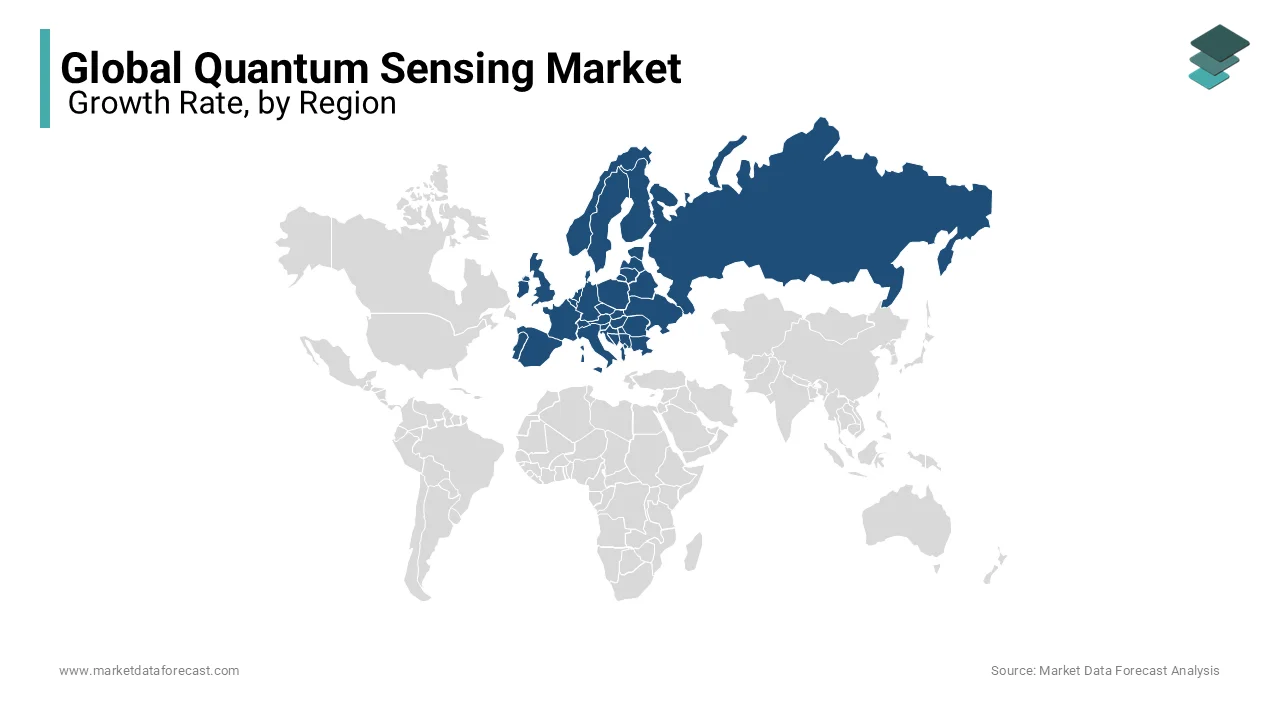
Europe is projected to lead the market since it is one of the areas that invested early in the market and has made some strategic plans for the future.
The United Kingdom was an early mover in quantum technology. Furthermore, the UK government recognized the potential of emerging quantum technologies and announced GBP 270 million in the 2013 Autumn Statement to establish the National Quantum Technologies Programme.
Europe accounted for the most growth in the Quantum Sensors Market. This increase can be attributed to the region's early investment in quantum technology. As a result, this region will drive the Quantum Sensors Market in the future. Furthermore, the United Kingdom is the market's largest contributor. Furthermore, the UK government launched the National Quantum Technologies Programme in the Autumn Statement. Furthermore, the increased demand for these sensors in the military and defense industries propels the Quantum Sensors Market in this region.
KEY MARKET PLAYERS
Major Key Players in the Global Quantum Sensing Market are
- Networking (Oscilloquartz)
- Apogee Instrument Inc.
- GWR Instruments Inc.
- Spectrum Technologies Inc.
- Thomas Industrial Network Inc.
- Adcon Telemetry GmbH
- METER Group
- Microchip, Impedans Ltd.
- M-Squared Lasers Limited
- Thomas Industrial Network Inc.
RECENT MARKET NEWS
- May 2020 - M Squared announced a major new investment round of EUR 32.5 million to support company growth and technological advances. According to the company, this investment from the newly founded Scottish National Investment Bank would allow M Squared to advance its R&D efforts. This is important for scaling up its pioneering work in quantum innovation as well as its innovations to combat climate change.
- Muquans SAS announced the operationalization of its quantum differential gravimeter in February 2020. This equipment, developed in collaboration with LNE-SYRTE, can detect both gravity (g) and its vertical gradient (dg/dz) at the same time. According to the company, the instrument opens up new and exciting possibilities in geophysics. It is anticipated that this combined measurement will give enhanced information for monitoring geophysical processes and detecting underground cavities.
- In March 2021, the Australian startup Q-Ctrl launched a quantum sensor into Earth orbit, the moon, and eventually Mars. The Company is collaborating with Fleet Space Technologies, an Australian nanosatellite startup, to build quantum sensors for the nanosatellites. In addition, the company is working on quantum sensors to detect liquid water and mineral resources, as well as quantum-enhanced precision navigation and timing systems.
MARKET SEGMENTATION
This research report on the global quantum sensing market segmentation has been segmented and sub-segmented based on products, end-users, and regions.
By Products
- Gravity Sensors
- Atomic Clocks
- PAR Quantum Sensors
- Magnetic Sensors
By End-Users
- Military and Defence
- Automotive
- Oil and Gas
- Healthcare
- Others
By Region
- North America
- Europe
- Asia Pacific
- Latin America
- Middle East and Africa