- Product Description Description
- Table of Contents TOC
- List of Table & Figure LOT
- Get Free Sample PDF Sample PDF
Market Size, 2025
$75.16 BnMarket Estimate, 2026
$80.44 BnMarket Forecast, 2034
$138.42 BnCAGR, 2026–2034
7.02%Global Recycled Metal Market Size
The Recycled metal market size was valued at USD 75.16 billion in 2025, and the market size is expected to reach USD 138.42 billion by 2034 from USD 80.44 billion in 2026. The market's promising CAGR for the predicted period is 7.02%.
Recycled metal refers to the metals derived from end-of-life products, manufacturing scrap, and post-consumer waste. This sector plays a crucial role in resource conservation, reducing environmental degradation, and supporting circular economy principles by reintroducing metals such as aluminum, copper, steel, and precious metals back into production cycles. Unlike primary metal production, which relies on mining and extraction—processes that are energy-intensive and environmentally disruptive—recycling offers a more sustainable alternative with significantly lower carbon emissions.
Globally, the recycling industry has gained momentum due to rising awareness around sustainability and stricter environmental regulations. In many countries, government policies now mandate the recovery of metals from electronic waste, vehicles, and construction debris.
In addition, industries such as automotive, electronics, and construction are progressively adopting recycled metals to meet corporate sustainability goals and regulatory compliance. These factors collectively underscore the growing relevance of the recycled metal market in shaping a sustainable industrial future.
 MARKET DRIVERS
Rising Environmental Awareness and Regulatory Push
The increasing emphasis on environmental sustainability and regulatory mandates aimed at reducing industrial carbon footprints is one of the key drivers of the recycled metal market. Governments across developed and emerging economies have introduced stringent environmental laws that encourage or require the use of recycled materials in manufacturing processes. For example, the European Union’s Circular Economy Action Plan mandates higher recycling rates for metals used in electronics and automobiles, while China’s National Sword policy has reshaped global scrap metal trade flows by restricting imports of low-quality recyclables.
Additionally, organizations like the U.S. Environmental Protection Agency (EPA) have found that recycling metals reduces greenhouse gas emissions equivalent to taking millions of cars off the road annually.
Corporate sustainability commitments are further amplifying this trend. Major automakers such as Tesla and BMW have pledged to increase their use of recycled aluminum and steel in vehicle production. Similarly, electronics giants including Apple and Dell have adopted closed-loop supply chains, where old devices are disassembled and their metallic components recovered for reuse. These developments are not only improving resource efficiency but also reinforcing demand for recycled metals across high-tech and industrial sectors.
Economic Advantage Over Virgin Metal Extraction
The substantial cost advantage associated with recycling over extracting and refining raw metals is another critical driver fueling the growth of the recycled metal market. Mining operations are capital-intensive, involving extensive exploration, excavation, and processing activities that consume vast amounts of water, energy, and labor. In contrast, recycling metal scrap requires significantly less investment and yields faster returns, making it a preferred option for manufacturers seeking cost-effective raw materials.
Moreover, fluctuations in global commodity prices often make recycled metals more stable and predictable in terms of pricing compared to virgin materials, which are subject to geopolitical tensions and supply chain disruptions.
This economic incentive has led to increased adoption of recycled metals in sectors such as construction, packaging, and transportation. Similar trends are observed in Europe and Asia, where metal processors and foundries prioritize scrap-based production to optimize costs and maintain competitiveness in volatile markets.
MARKET RESTRAINTS
Contamination and Quality Concerns in Scrap Metal
The issue of contamination and inconsistent quality in scrap metal feedstock is a major restraint affecting the growth of the recycled metal market. Not all metal scrap is suitable for direct reuse, especially when mixed with non-metallic materials or exposed to hazardous substances during its lifecycle. Contaminated scrap can compromise the integrity of the final product, leading to performance issues and safety concerns, particularly in high-stakes applications such as aerospace, medical equipment, and precision engineering.
Furthermore, the lack of standardized classification systems across regions complicates the global trade of scrap metal, limiting cross-border transactions and creating bottlenecks in the supply chain.
In response, industry stakeholders are investing in advanced sorting technologies such as optical sensors and AI-driven material recognition systems. However, these solutions remain costly and are not yet widely adopted, especially in developing economies.
High Initial Investment in Recycling Infrastructure
The high capital expenditure required to establish and maintain modern recycling infrastructure is another significant barrier to the expansion of the recycled metal market. While recycling offers long-term economic benefits, setting up efficient sorting, processing, and refining facilities demands substantial upfront investment. This includes costs related to machinery, automation, pollution control systems, and workforce training—all of which can be prohibitive, particularly for small and medium-sized enterprises (SMEs).
Many local governments and private investors hesitate to fund such projects due to long payback periods and uncertain returns, especially in regions where informal recycling practices dominate.
Moreover, the need for continuous upgrades to comply with evolving environmental regulations adds to the financial burdenWithout adequate funding and supportive policy incentives, the development of advanced recycling infrastructure remains slow, limiting the market's ability to meet growing demand efficiently.
MARKET OPPORTUNITIES
Expansion of E-Waste Recycling Initiatives
The rapid expansion of e-waste recycling initiatives is one of the most promising opportunities in the recycled metal market. Electronic waste contains a wealth of valuable metals, including gold, silver, copper, and palladium, making it a lucrative source for secondary metal extraction. With the proliferation of smartphones, laptops, and other electronic devices, the volume of e-waste generated globally continues to rise sharply.
Governments and private sector players are increasingly recognizing this opportunity. The United Nations University reports that several countries, including India, Brazil, and South Africa, have launched national e-waste management programs aimed at boosting formal recycling capacity. Also, companies like Apple and Dell have initiated take-back schemes to reclaim metals from end-of-life devices, contributing to a more circular approach in the electronics industry.
Technological advancements are also facilitating better e-waste metal recovery. Innovations such as hydrometallurgical and bioleaching techniques offer more efficient and eco-friendly alternatives to traditional smelting, enhancing both yield and environmental performance.
Growth in Renewable Energy and Green Infrastructure
The accelerating transition toward renewable energy and green infrastructure presents a significant opportunity for the recycled metal market. As countries invest heavily in solar farms, wind turbines, electric vehicles (EVs), and energy-efficient buildings, the demand for metals such as copper, aluminum, and nickel is surging. Recycling these metals offers a sustainable solution to meet rising industrial needs without over-relying on newly mined resources.
Wind turbines, for example, contain large quantities of copper and rare earth metals, while EV batteries rely heavily on lithium, cobalt, and nickel—all of which can be sourced from recycled materials.
Several governments and corporations are integrating recycled metals into their clean energy strategies. The European Commission has outlined plans to develop a domestic battery recycling industry to support its EV ambitions, aiming to reduce dependency on imported raw materials. Similarly, the U.S. Department of Energy has funded research into advanced metal recovery techniques to support grid modernization and renewable infrastructure.
These developments indicate a paradigm shift in how metals are sourced for sustainable development, positioning the recycled metal market as a cornerstone of the green economy.
MARKET CHALLENGES
Fluctuating Scrap Metal Prices and Supply Volatility
The volatility in scrap metal prices and inconsistent supply availability is one of the most pressing challenges facing the recycled metal market. Unlike traditional commodities, scrap metal values are highly sensitive to global economic conditions, trade policies, and shifts in industrial demand. This unpredictability makes it difficult for recyclers and manufacturers to plan long-term investments and maintain stable production schedules.
These price swings impact the profitability of recycling businesses, particularly smaller operators who lack the financial cushion to absorb sudden downturns.
Additionally, seasonal variations and regional disparities in scrap generation affect the consistency of supply. For instance, construction booms in one region may lead to an oversupply of steel scrap, while another area may face shortages due to reduced consumer electronics disposal rates. Such imbalances create inefficiencies in the market and limit the ability of recyclers to operate at full capacity year-round.
Lack of Public Awareness and Participation in Metal Recycling
Despite the environmental and economic benefits of metal recycling, a persistent challenge remains the lack of public awareness and active participation in recycling programs. Many consumers and businesses are either unaware of proper recycling procedures or indifferent to separating metal waste from general refuse, leading to significant volumes of recyclable material ending up in landfills or incinerators.
In emerging economies, the rate is even lower due to inadequate waste segregation infrastructure and limited access to recycling services.
Educational campaigns and municipal recycling programs have made some progress, but engagement remains inconsistent. To address this, industry stakeholders and policymakers must collaborate on targeted awareness initiatives, improve accessibility to recycling facilities, and implement incentives to encourage responsible disposal.
REPORT COVERAGE
| REPORT METRIC | DETAILS |
| Market Size Available | 2025 to 2034 |
| Base Year | 2025 |
| Forecast Period | 2026 to 2034 |
| CAGR | 7.02% |
| Segments Covered | By Metal Type, Scrap Type, Usage, and Region. |
| Various Analyses Covered | Global, Regional and Country Level Analysis; Segment-Level Analysis; DROC; PESTLE Analysis; Porter’s Five Forces Analysis; Competitive Landscape; Analyst Overview of Investment Opportunities |
| Regions Covered | North America, Europe, APAC, Latin America, Middle East & Africa |
| Market Leaders Profiled | Tata Steel, ArcelorMittal, European Metal Recycling Limited, Nucor Corporation, and others |
SEGMENTAL ANALYSIS
By Metal Type
The ferrous metals segment dominated with substantial share of the global recycled metal market in 2025. The dominance of this segment is primarily attributed to the widespread use of iron and steel across multiple industrial sectors, including construction, automotive manufacturing, and heavy machinery. An additional key driver behind the strong presence of ferrous metal recycling is the sheer volume of steel scrap generated globally. The abundance of post-industrial and post-consumer steel waste ensures a steady supply of feedstock for recycling operations.
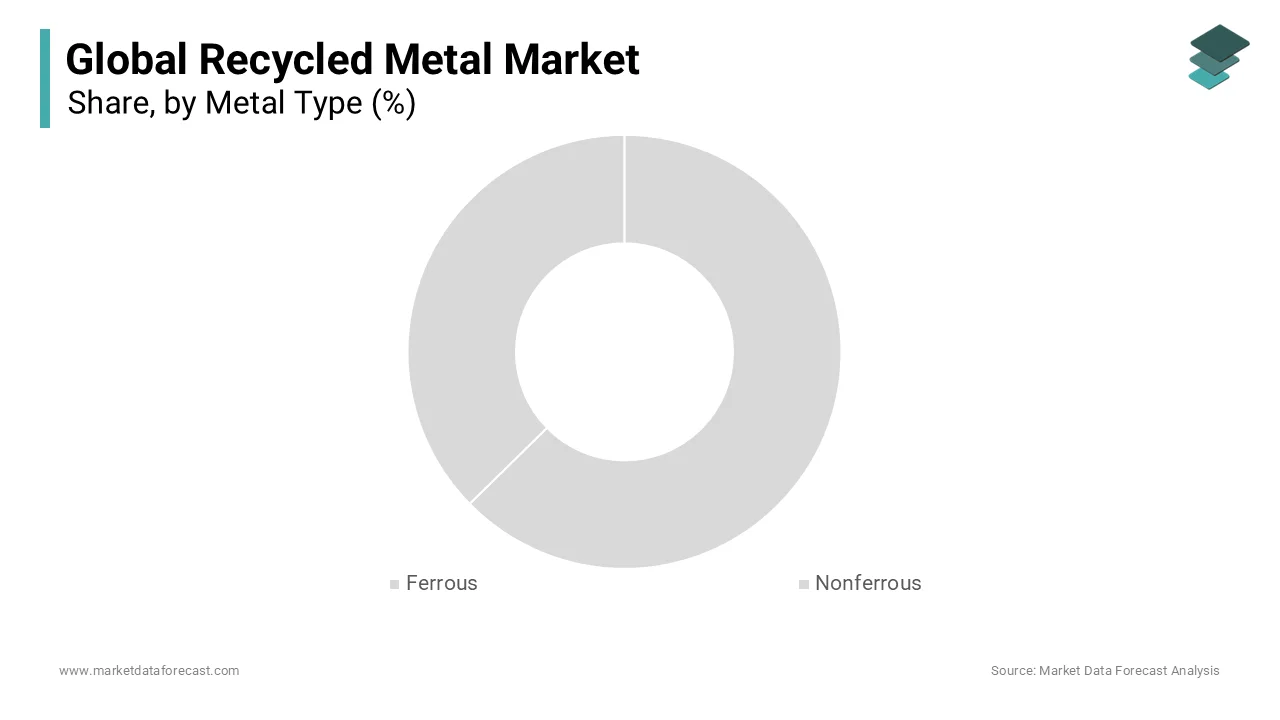
Additionally, ferrous metals are highly compatible with existing electric arc furnace (EAF) technology, which relies heavily on scrap as a raw material input. Governments and industries have also prioritized ferrous metal recycling due to its environmental benefits. These factors collectively reinforce the dominance of ferrous metals in the global recycled metal landscape.
The nonferrous metals segment is projected to grow at the highest CAGR of 8.6% from 2026 to 2034. The rapid expansion of this segment is driven by increasing demand for metals such as aluminum, copper, zinc, and precious metals in high-tech applications, renewable energy systems, and electronics manufacturing. A further major factor fueling this growth is the rising adoption of electric vehicles (EVs), which require significant amounts of copper and aluminum for batteries and motor components. Recycling provides a sustainable alternative to meet this surge in demand without relying solely on newly mined resources. An additional contributing factor is the increasing value of nonferrous metals, which makes them economically attractive for recovery and reuse. Moreover, technological advancements in metal separation and refining processes have improved recovery rates of nonferrous metals from complex waste streams like e-waste and end-of-life vehicles. Innovations such as eddy current separators and advanced hydrometallurgical techniques have enhanced efficiency, further accelerating market growth.
Lastly, growing regulatory emphasis on resource efficiency and circular economy principles has encouraged industries to incorporate more recycled nonferrous metals into their supply chains. Governments in Europe and Asia have introduced policies promoting the use of secondary metals, particularly in green infrastructure projects and electronic device manufacturing.
By Scrap Type Insights
The new scrap segment constituted the largest scrap type in the recycled metal market by accounting for a 58.4% of total metal recycling activities in 2025. Its purity and ease of processing is one of the main reasons for new scrap’s dominance. This category includes metal waste generated during industrial manufacturing processes, such as trimmings, turnings, and excess material from forging, casting, or machining operations.
Unlike old scrap, which comes from end-of-life products and often requires extensive sorting and cleaning, new scrap is typically homogeneous and free from contamination. Additionally, manufacturers prefer using new scrap because it can be reintroduced directly into production cycles, reducing reliance on virgin materials and lowering overall costs.
Industrialization trends in emerging economies have further boosted new scrap generation. Countries like India and Vietnam have seen a rise in metal fabrication units, leading to increased volumes of process-derived scrap.
The old scrap segment is expected to grow at the fastest CAGR of 9.2% between 2026 and 2034 and is driven by rising urban mining initiatives and expanding end-of-life product recycling programs. Old scrap refers to metals recovered from discarded consumer goods, vehicles, buildings, and industrial equipment after their useful life. A further growth driver is the exponential increase in electronic waste (e-waste) generation. Automotive recycling is another major contributor. As vehicle ownership rises worldwide, so does the volume of end-of-life cars requiring dismantling and metal recovery.
Furthermore, government regulations mandating extended producer responsibility (EPR) schemes have spurred greater collection and recycling of old scrap. Advancements in metal extraction technologies, such as bioleaching and plasma arc smelting, are also improving recovery efficiency from old scrap. These innovations allow for cleaner and more efficient processing of mixed and contaminated materials, further boosting the segment’s growth prospects.
By Usage Insights
The construction industry was the top performing application of the recycled metal market by capturing a 34.3% of total usage in 2025. Steel, in particular, is extensively used in structural frameworks, reinforcement bars, roofing, and prefabricated components, all of which increasingly rely on recycled content. One more key driver of this dominance is the massive scale of global infrastructure development. Much of this demand is being met through recycled steel due to its cost-effectiveness and environmental advantages.
Recycled steel is widely accepted in construction because it maintains mechanical properties comparable to virgin steel while significantly reducing carbon emissions. Moreover, governments in various countries are promoting the use of recycled materials in public infrastructure projects. The availability of demolition scrap from aging infrastructure also contributes to sustained growth in this segment. As cities undergo redevelopment and retrofitting, older buildings are deconstructed, yielding significant volumes of reusable steel and reinforcing the continuous supply of raw materials for the construction sector.
The electrical and electronics segment is anticipated to grow at the highest CAGR of 10.3% from 2026 to 2034 which is fueled by the rapid proliferation of consumer electronics, data centers, and renewable energy systems. These sectors rely heavily on metals such as copper, aluminum, gold, and rare earth elements, many of which are sourced from recycled materials. An additional growth driver is the surging demand for electric vehicles (EVs) and renewable energy infrastructure. As these industries expand, so does the need for sustainable sourcing of critical metals, driving the adoption of recycled alternatives.
Consumer electronics also contribute significantly to this trend. With short product lifecycles and increasing sales of smartphones, laptops, and tablets, the volume of e-waste generated globally continues to rise. In addition, major tech companies are adopting closed-loop supply chain models. Apple, for instance, has developed a robotic disassembly system named Daisy, capable of recovering up to 14 different types of metals from old iPhones. Similarly, Dell and HP have implemented take-back programs to reclaim metals from end-of-life computers. Government policies are also playing a role in accelerating this growth. These combined factors are propelling the electrical and electronics segment to become the fastest-growing application area in the recycled metal market.
REGIONAL ANALYSIS
Asia Pacific
Asia Pacific spearheaded with 33.7% share of the global recycled metal market in 2025 which is driven by rapid industrialization, urbanization, and strong government support for circular economy initiatives. The region’s growing manufacturing base, especially in China, India, and Japan, has created a robust demand for secondary metals across construction, automotive, and electronics sectors.China remains the dominant player in the region, despite recent policy shifts aimed at regulating import quality. The country’s domestic scrap recycling industry has expanded significantly, supported by state-backed initiatives such as the "National Sword" policy, which redirected focus toward internal waste management. India is also emerging as a key market, with rising investments in infrastructure and a booming automobile industry. Additionally, the country’s informal recycling sector is gradually transitioning to organized operations, enhancing efficiency and compliance. Japan, known for its advanced recycling infrastructure, continues to lead in high-efficiency metal recovery from electronic waste and automobiles. With continued urban expansion and evolving regulatory frameworks, Asia Pacific is expected to maintain its leadership position in the global recycled metal market.
Europe
Europe accounts for a significant share of the global recycled metal market, benefiting from stringent environmental regulations, well-established waste management systems, and a strong emphasis on circular economy principles. The European Union has been at the forefront of promoting metal recycling through directives such as the Waste Framework Directive and the End-of-Life Vehicles Directive, which mandate high levels of material recovery and reuse. Germany leads the region in terms of both volume and technological innovation in recycling. The country’s dual system for waste collection, managed by organizations like Duales System Holding (DSH), ensures high recycling rates across multiple metal categories. France and Italy also play crucial roles in the regional market. France’s National Low Carbon Strategy emphasizes increasing the use of recycled metals in infrastructure and transport, while Italy has developed a strong network of small and medium-sized metal recyclers specializing in copper and brass.
North America
North America contributes majorly to the global recycled metal market, underpinned by a mature recycling ecosystem, strong industrial demand, and supportive policy frameworks. The United States dominates the regional market, followed by Canada and Mexico, where recycling plays a central role in resource management strategies. The U.S. is home to some of the world’s largest metal recycling companies, including Schnitzer Steel Industries and Sims Metal Management. Steel and aluminum recycling form the backbone of the U.S. market, with electric arc furnaces (EAFs) heavily reliant on scrap inputs. Canada has also made significant strides in metal recycling, particularly in provinces like Ontario and Quebec, where strong municipal recycling programs and industrial partnerships have boosted collection rates. Meanwhile, Mexico is strengthening its recycling infrastructure in response to growing demand from the automotive and construction sectors.
Latin America
Latin America is another key player in the global recycled metal market, with Brazil, Mexico, and Argentina serving as key contributors to regional growth. While the market is still developing compared to North America and Europe, increasing industrial activity and environmental awareness are fostering stronger recycling practices. Brazil is the largest market in the region, driven by its expanding construction and automotive industries. The government has also introduced incentives for recycling through the National Solid Waste Policy, which promotes corporate responsibility and waste reduction. Mexico’s proximity to the U.S. gives it access to scrap exports and integrated supply chains, particularly in the automotive sector. Argentina and Chile are also showing progress, with increasing investments in scrap collection and processing facilities. However, the region faces challenges related to informal recycling practices and inconsistent regulatory enforcement, which limit efficiency and scalability.
Middle East and Africa
The Middle East and Africa holds a notable share the global recycled metal market in 2025, with growth primarily driven by urban development, infrastructure expansion, and increasing awareness of sustainable resource use. While still an emerging market, several countries in the Gulf Cooperation Council (GCC) and South Africa are making notable strides in metal recycling. The UAE stands out as a regional leader, investing heavily in waste-to-resource initiatives and green infrastructure. The Dubai Integrated Sustainable City project incorporates recycled metals in construction and utilities, aligning with broader sustainability goals. Saudi Arabia is also advancing its recycling capabilities as part of Vision 2030, which includes ambitious plans for waste management reform. The Saudi Green Initiative supports the development of modern recycling plants, particularly for aluminum and steel, to reduce reliance on imported raw materials. South Africa, though facing economic constraints, maintains a relatively strong informal recycling sector, particularly for copper and aluminum. The South African Bureau of Standards has introduced guidelines to formalize and regulate this sector, improving efficiency and safety.
KEY MARKET PLAYERS AND COMPETITIVE LANDSCAPE
Tata Steel, ArcelorMittal, European Metal Recycling Limited, Nucor Corporation are some of the notable companies in the global recycled metal market.
The competition in the recycled metal market is highly dynamic, characterized by a mix of large multinational corporations, regional players, and emerging startups striving to capture market share through innovation and operational efficiency. Established firms leverage their extensive networks, technological capabilities, and strong supply chain linkages to maintain dominance, while smaller players focus on niche markets and specialized recycling services to differentiate themselves. The industry is witnessing a shift toward greater integration, with companies expanding vertically to control both upstream collection and downstream processing, thereby enhancing profitability and reducing dependency on fluctuating scrap prices.
Innovation is a key battleground, with leading firms investing in advanced sorting technologies, automation, and digital platforms to improve recovery rates and material purity. Environmental, social, and governance (ESG) considerations are also reshaping competitive strategies, as companies align their operations with global sustainability goals to meet the growing demand for responsibly sourced materials. Additionally, regulatory pressures and trade policies are influencing market dynamics, prompting firms to reconfigure their sourcing and logistics strategies to remain compliant and resilient in the face of geopolitical uncertainties.
Strategic partnerships and mergers are becoming increasingly common as companies seek to strengthen their market positions and expand into new geographies. Governments and industry bodies are also playing a role in shaping the competitive landscape by promoting policy frameworks that encourage formalization, transparency, and investment in recycling infrastructure. As the demand for recycled metals continues to rise across sectors such as construction, automotive, and electronics, the competitive environment is expected to become even more intense, with firms vying to offer sustainable, high-quality, and cost-effective solutions.
TOP PLAYERS IN THE MARKET
Sims Metal Management
Sims Metal Management is a global leader in metal recycling, playing a crucial role in shaping sustainable resource management practices. With operations spanning North America, Europe, Asia, and Australia, the company specializes in the collection, processing, and trading of ferrous and nonferrous metals. Sims has been instrumental in advancing industry standards for sorting technologies, emissions reduction, and responsible sourcing. Its commitment to innovation and environmental stewardship has made it a preferred partner for manufacturers and governments seeking reliable recycled metal supply chains.
Gerdau S.A.
Gerdau is one of the largest steelmakers in the Americas and a major player in the global recycled metal market. The company heavily relies on scrap metal as a primary feedstock for its electric arc furnace-based steel production. Gerdau’s emphasis on circular economy principles has enabled it to integrate recycled materials into high-quality steel products used in construction, infrastructure, and automotive applications. Its influence extends beyond production, as it actively promotes scrap collection programs and sustainable industrial policies across Latin America and the United States.
Hindalco Industries Limited
Hindalco, a subsidiary of the Aditya Birla Group, is a key player in aluminum and copper recycling, particularly in Asia. The company has made significant strides in integrating recycled content into its metal production processes, reducing dependency on virgin resources. Hindalco operates some of the most advanced metal recycling facilities in India and the U.S., focusing on efficient recovery and processing of post-consumer and industrial scrap. Its initiatives in green manufacturing and sustainable sourcing have positioned it as a leader in responsible metal production and recycling.
TOP STRATEGIES USED BY KEY MARKET PLAYERS
One of the most prevalent strategies among key players in the recycled metal market is expanding global recycling networks through strategic acquisitions and partnerships. Companies are investing in new processing facilities and acquiring regional scrap dealers to enhance collection efficiency and ensure a steady supply of raw materials across key markets.
Another major approach is adopting advanced sorting and processing technologies to improve the quality and efficiency of recycled metal recovery. Leading firms are integrating AI-powered sorting systems, optical sensors, and automated separation techniques to handle complex scrap streams and extract higher-value metals with minimal contamination.
A third key strategy is strengthening relationships with end-use industries such as automotive, construction, and electronics by offering tailored recycling solutions. By aligning with manufacturers committed to sustainability goals, recyclers are securing long-term supply contracts and promoting the use of secondary metals in high-performance applications, reinforcing market growth and stability.
RECENT HAPPENINGS IN THE MARKET
- In February 2025, Sims Metal Management launched a new AI-powered scrap sorting facility in Germany, designed to enhance the efficiency and accuracy of nonferrous metal recovery. This initiative supports the company’s broader objective of increasing recycling yields while reducing operational waste.
- In May 2023, Gerdau announced a strategic partnership with a Brazilian electric vehicle manufacturer to supply steel produced entirely from recycled scrap. This collaboration aligns with the automaker’s sustainability goals and reinforces Gerdau’s role in promoting circularity in the automotive industry.
- In September 2023, Hindalco expanded its copper recycling operations in the United States by acquiring a specialized processing unit focused on recovering metals from electronic waste. This move strengthens Hindalco’s presence in North America and enhances its ability to supply high-purity recycled copper.
- In November 2023, a leading European metal recycling firm introduced a blockchain-based traceability system to track the origin and movement of scrap metal across its supply chain. This innovation improves transparency and ensures compliance with global sustainability and ethical sourcing standards.
- In January 2025, a major U.S.-based scrap processor unveiled a new mobile scrap collection platform that connects industrial generators directly with recycling facilities. The digital solution streamlines logistics, reduces transportation emissions, and improves scrap recovery rates across multiple sectors.
MARKET SEGMENTATION
This research report on the global recycled metal market has been segmented and sub-segmented based on metal type, scrap type, usage, and region.
By Metal Type
- Ferrous
- Nonferrous
By Scrap Type
- New scrap
- Old scrap
By Usage
- Construction
- Automobiles
- Electrical & electronics
- Others (Toys and decoratives)
By Region
- North America
- Asia Pacific
- Europe
- Latin America
- Middle East and Africa