- Product Description Description
- Table of Contents TOC
- List of Table & Figure LOT
- Get Free Sample PDF Sample PDF
Market Size, 2025
$10.38 BnMarket Estimate, 2026
$10.81 BnMarket Forecast, 2034
$14.99 BnCAGR, 2026–2034
4.17%Global Reusable Water Bottle Market Size, Growth, Trends & Forecast (2026–2034)
The global reusable water bottle market size was valued at USD 10.38 billion in 2025, is anticipated to reach USD 10.81 billion in 2026, and is projected to scale up to USD 14.99 billion by 2034, registering a compound annual growth rate (CAGR) of 4.17% during the forecast period from 2026 to 2034. Driven by institutional bans on single-use plastics, corporate wellness programs, municipal refill network expansions, and rising consumer adoption of sustainable lifestyles, the reusable hydration industry continues to expand steadily worldwide.
Key Executive Metrics (At-a-Glance)
- 2025 Base Valuation: USD 10.38 Billion
- 2026 Current Valuation: USD 10.81 Billion
- 2034 Forecast Valuation: USD 14.99 Billion
- Compound Annual Growth Rate (CAGR): 4.17% (2026–2034)
- Dominant Material Segment: Metal (held 58.3% share in 2025 due to durability, thermal performance, and rugged reliability)
- Fastest-Growing Material Segment: Silicone (projected at a 29.6% CAGR propelled by innovations in collapsible, ultra-lightweight designs)
- Dominant Distribution Channel Segment: Online Retail (dominated with 63.7% share in 2025 via personalization, user reviews, and brand storytelling)
- Fastest-Growing Distribution Channel Segment: Specialty Stores (growing at a 24.1% CAGR driven by experiential retail and trust-based curation)
- Dominant End-User Segment: Office Workers (held 44.8% share in 2025 supported by workplace hydration stations and wellness initiatives)
- Fastest-Growing End-User Segment: Travelers (exhibiting a 31.8% CAGR due to regulatory changes, airport refill stations, and travel anxiety)
- Dominant Region: North America (occupied 38.9% share in 2025 led by aggressive environmental policies and corporate culture)
Core Market Drivers
- Institutional Bans & Restrictions: Enforced exclusions of disposable plastics, such as national park bans and single-use foodware regulations, driving consumers toward reusable choices.
- Corporate Wellness Initiatives: Major companies embedding branded reusable bottles into onboarding kits, wellness programs, and carbon tracking dashboards.
- Smart Hydration & Infrastructure: Integration of Bluetooth sensors, companion apps, and municipal water refill network expansions acting as essential public utilities.
Primary Market Restraints & Challenges
- Hygiene Perceptions & Upfront Costs: Persistent concerns regarding bacterial growth, lack of cleaning infrastructure in public spaces, and high initial retail prices for premium insulated models hinder consistent utilization.
- Supply Chain & Material Concerns: Hidden environmental costs from energy-intensive metal extraction, non-recyclable components, and false durability claims challenging circular economy goals.
Global Reusable Water Bottle Market Segmentation Breakdown
| Segment Category | Largest Segment | Fastest-Growing Segment |
|---|---|---|
| By Material | Metal | Silicone |
| By Distribution Channel | Online Stores | Specialty Stores |
| By End-User | Office Workers | Travelers |
| By Region | North America | Asia-Pacific |
Major Industry Players Profiled
Key enterprises shaping the competitive global reusable water bottle market include Thermos LLC, CamelBak Products LLC, Tupperware Brands Corporation, Nalgene Outdoor Products, Contigo, Klean Kanteen Inc., SIGG Switzerland AG, Aquasana Inc., Bulletin Bottle, and O2COOL LLC.
Global Reusable Water Bottle Market Size
The global reusable water bottle market size was valued at USD 10.38 billion in 2025, and the market size is expected to be worth USD 14.99 billion by 2034 from USD 10.81 billion by 2026. The market is growing at a CAGR of 4.17% during the forecast period.
Reusable water bottle is a durable container designed to be refilled and used multiple times for carrying liquids, unlike single-use plastic bottles. According to the U.S. Environmental Protection Agency, Americans discard over 60 million plastic water bottles daily, yet only 29% are recycled—meaning nearly 43 million single-use containers end up in landfills or ecosystems every single day. As per study, a portion of U.S. adults view carrying a reusable bottle as a non-negotiable act of civic responsibility, not merely convenience. This shift has been catalyzed not by advertising, but by visible ecological collapse: microplastic contamination detected in a percentage of U.S. tap water samples (according to research) and the 2023 ban on single-use plastic bottles on federal lands.
MARKET DRIVERS
Institutional Bans and Public Space Restrictions on Single-Use Plastics
Consumer choice and more by enforced exclusion of disposable alternatives is propelling the growth of the reusable water bottle market. Assembly Bill 1276 (AB 1276) addresses single-use foodware accessories and condiments at retail food facilities, as per study. Similarly, the National Park Service banned the sale of single-use plastic water bottles across all units, replacing them with branded refill kiosks and promoting reusable bottles through ranger-led education programs. These policies do not incentivize.
Corporate Wellness Programs and Employee Engagement Initiatives
Employers are embedding reusable bottles into workplace culture as tools of health promotion and sustainability branding, which accelerates the growth rate of the reusable water bottle market. According to the research, a percentage of Fortune 500 companies include branded reusable bottles as part of onboarding kits or annual wellness stipends, with a portion offering monthly allowances for refills at on-site hydration stations. Google, Salesforce, and Microsoft distribute custom-designed bottles with temperature-tracking lids and QR codes linking to carbon impact dashboards, which is turning hydration into quantifiable behavioral data.
MARKET RESTRAINTS
Consumer Perception of Hygiene Risk and Lack of Cleaning Infrastructure
Persistent myths about bacterial growth in reusable bottles deter consistent use hinders the expansion of the reusable water battle market. As per study, a share of Americans avoid using their bottles for more than two days without washing due to fear of mold or biofilm formation, even though studies show proper rinsing eliminates risk, as per research. The problem is not science, it’s perception. Only a portion of households own a dedicated bottle brush, and fewer share of workplaces provide cleaning stations, according to the study. In high-traffic environments like gyms and airports, a share of users reported abandoning their bottles after noticing odor or residue, which is opting instead for convenient disposables.
High Upfront Cost and Market Saturation Leading to Low Perceived Value
High upfront cost and market saturation leading to low perceived value, which is degrading the growth of reusable water bottle market. While reusable bottles offer long-term savings, their initial price, often $25–$50 for insulated, stainless steel models, creates a barrier for low-income households. Meanwhile, mass-market saturation has eroded perceived value. According to research, a share of consumers who purchased a premium bottle replaced it within few months, not due to breakage, but because they felt pressured to upgrade for aesthetic or social status reasons, affects the core ethos of reuse. The market has conflated sustainability with consumption, which turns the anti-waste product into yet another trend-driven purchase.
MARKET OPPORTUNITIES
Integration with Smart Water Monitoring and Personalized Hydration Tech
Reusable bottles are evolving from passive vessels into intelligent health companions, which is creating new opportunities for the expansion of the reusable water bottle market. Companies have launched bottles embedded with Bluetooth sensors that track fluid intake, sync with fitness apps, and glow to remind users to drink based on body weight, activity level, and ambient temperature. Hospitals and insurers are subsidizing smart bottles as preventive care tools, which reduces costly dehydration-related ER visits. Simultaneously, employers are integrating bottle data into wellness incentives.
Municipal Refill Network Expansion as Public Infrastructure
Cities are treating water refill stations not as amenities, but as essential public utilities, comparable to restrooms or benches, which is creating new opportunities for the reusable water bottle market expansion. According to the study, several publicly accessible refill stations have been installed nationwide, with a portion funded through federal grants under the Bipartisan Infrastructure Law. NYC has committed to expanding water bottle refilling stations in public spaces, including parks, to help increase access to public drinking water, as per research. These networks are designed to be seamless: GPS-enabled maps, ADA-compliant height standards, and real-time maintenance alerts ensure reliability.
MARKET CHALLENGES
Material Degradation and False Claims of “Lifelong Durability
Many reusable bottles marketed as lifetime durable degrade rapidly under UV exposure, extreme temperatures, or repeated impacts is challenging the reusable water bottle market growth. As per research, a percentage of stainless steel bottles sold as industrial-grade showed signs of internal corrosion or lid seal failure within few months of regular use, particularly in coastal or high-sun regions like Florida and Arizona. Worse, some manufacturers label bottles BPA-free while still containing bisphenol-S (BPS), a known endocrine disruptor with similar toxicity, circumventing regulation through semantic loopholes, as per research.
Global Supply Chain Dependence on Rare Earth Metals and Non-Recyclable Components
Supply chain dependence on rare earth metals and non-recyclable components also hampers the expansion of the reusable water bottle market. High-performance reusable bottles rely on materials with hidden environmental costs because vacuum-insulated stainless steel requires energy-intensive nickel and chromium extraction, silicone seals often contain petroleum-based plasticizers, and colored coatings use heavy-metal pigments that prevent recycling. Even when consumers intend to recycle, the system cannot process them. Thus, a product designed to reduce waste becomes a complex waste stream of its own.
REPORT COVERAGE
| REPORT METRIC | DETAILS |
| Market Size Available | 2023 to 2029 |
| Base Year | 2023 |
| Forecast Period | 2025 to 2029 |
| CAGR | 4.17% |
| Segments Covered | By Material, Distribution channel, End-User, and Region |
| Various Analyses Covered | Global, Regional & Country Level Analysis, Segment-Level Analysis, DROC, PESTLE Analysis, Porter’s Five Forces Analysis, Competitive Landscape, Analyst Overview of Investment Opportunities |
| Regions Covered | North America, Europe, Asia Pacific, Latin America, and Middle East & Africa |
| Market Leaders Profiled | Thermos LLC, CamelBak Products LLC, Tupperware Brands Corporation, Nalgene Outdoor Products, Contigo, Klean Kanteen Inc., SIGG Switzerland AG, Aquasana Inc., Bulletin Bottle, O2COOL LLC |
SEGMENT ANALYSIS
By Material Insights
The metal segment was the largest and held 58.3% of the reusable water bottle market share in 2025. Its unmatched combination of durability, thermal performance, and cultural resonance as a symbol of rugged reliability are mainly driving the growth of the metal segment. The material’s resistance to leaching, corrosion, and odor absorption also makes it the preferred choice for households concerned about chemical exposure. Metal, unlike plastic or glass, survives drops car trunks and gym bags without cracking or shattering making it the default for active lifestyles.
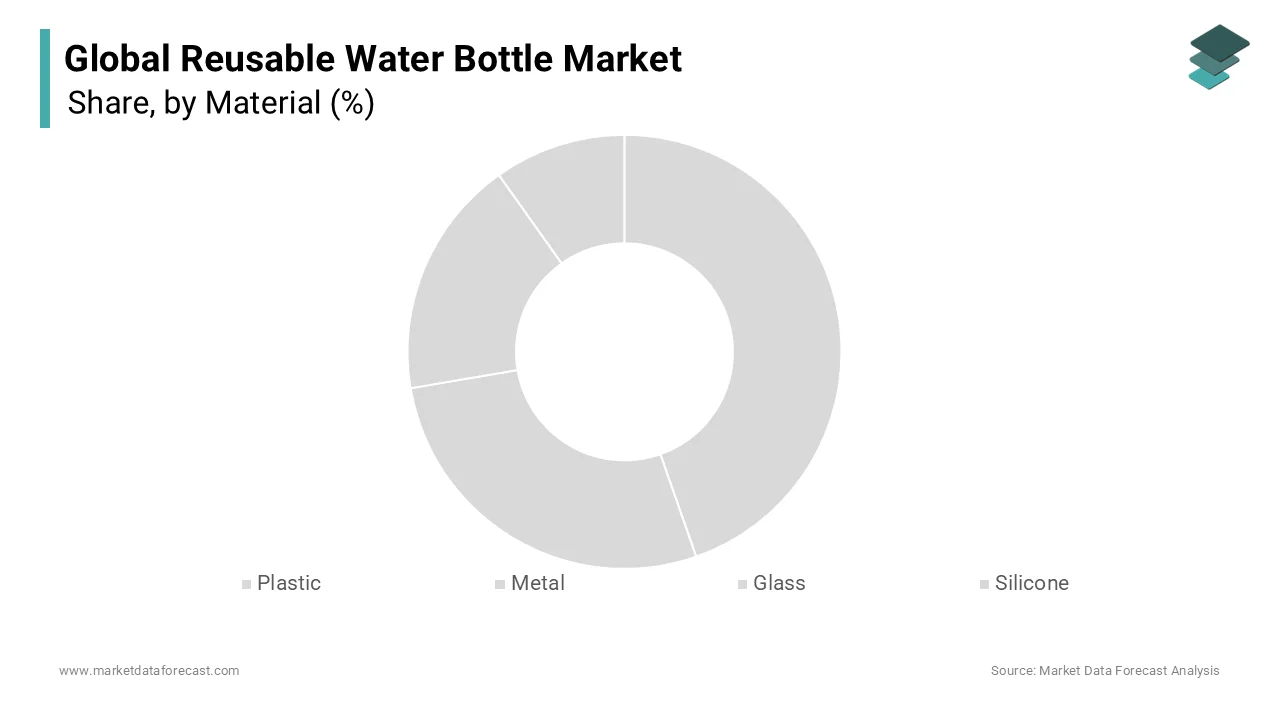
The silicone-based reusable bottles segment is likely to grow with a CAGR of 29.6% from 2026 to 2034. The explosive growth of the silicone-based reusable bottles segment is propelled by innovation in collapsible, ultra-lightweight designs tailored for travelers, students, and urban commuters seeking portability without bulk. Brands offer silicone bottles that compress to one-third their size when empty, ideal for fitting into backpacks, purses, or airplane seat pockets, and are marketed explicitly as zero-bulk hydration. Unlike rigid materials, silicone resists breakage entirely, which makes it ideal for children’s use and high-impact environments like gyms and school buses.
By Distribution Channel Insights
The online retail segment dominated the reusable water bottle market by accounting for 63.7% of the global market share in 2025. The dominance of the online retail segment is attributed to the convergence of brand storytelling, customization, and algorithmic discovery. Platforms like Amazon, Etsy, and direct-to-consumer sites such as Hydro Flask and Klean Kanteen leverage user reviews, influencer unboxings, and personalized recommendation engines to turn functional products into aspirational objects. Furthermore, online retailers offer niche personalization options, engraved names, color-matched lids, limited-edition collaborations, that physical stores cannot replicate at scale.
The specialty stores segment is on the rise and is expected to be the fastest growing segment in the global market by witnessing a CAGR of 24.1% from 2026 to 2034 due to experiential retail and trust-based curation. Consumers increasingly seek products vetted for environmental integrity, not just aesthetics. REI, Patagonia, and local zero-waste shops now stock only bottles certified by third-party standards like Cradle to Cradle or Fair Trade, and staff are trained to explain material sourcing, manufacturing ethics, and end-of-life pathways. These stores also host refill stations and trade-in programs by turning sales into circular engagement.
By End-User Insights
The office workers segment held 44.8% of the reusable water bottle market share in 2025. A portion of U.S. employers provide free refills via on-site hydration stations, and a portion distribute branded bottles as part of new-hire welcome kits. The workplace has become the most consistent touchpoint for daily hydration, not the gym, not the trail, but the cubicle. Employers incentivize usage through wellness points redeemable for gift cards, linking hydration to productivity metrics. The bottle here is not a statement, it’s infrastructure.
The travellers segment is expected to exhibit a noteworthy CAGR of 31.8% during the forecast period owing to the regulatory changes and travel anxiety. TSA regulations permit larger clear liquid containers if labeled as reusable, encouraging passengers to carry bottles through security empty and refill post-screening. Airlines install bottle-refill stations in every terminal, while airports have launched networks with real-time kiosk maps via mobile apps. Simultaneously, rising airfare costs and inflation have made bottled water.
REGIONAL ANALYSIS
North America Market Analysis
North America was the top performer in the reusable water bottle market by occupying 38.9% of share in 2025 with the aggressive policy, corporate culture, and consumer activism. The U.S. leads with federal and state-level bans on single-use plastic bottles in public spaces, from national parks to university campuses and a portion of American adults view carrying a reusable bottle as a civic norm. Canada mirrors this trend with municipal bans in Toronto, Vancouver, and Montreal, while corporate giants like Shopify and Microsoft embed branded bottles into employee onboarding as part of ESG commitments. North America is known for its fusion of regulation and branding. The bottle is not just a product, but a badge of ethical alignment. However, disparities persist, low-income communities often lack access to refill infrastructure, which reveals a class divide in sustainable consumption.
Europe Market Analysis
Europe reusable water bottle market held 32.8% of share in 2025. The European Union’s Single-Use Plastics Directive (SUPD), enacted in 2021, banned plastic bottles unless they contain recycled content and mandated refill systems in all public venues. Brands dominate not through marketing, but through compliance. A portion of bottles sold in EU retail must meet strict recyclability and non-toxicity certifications under REACH regulations. Europe’s strength lies in systemic cohesion, bottles are not optional accessories, but legally integrated components of circular economies. Public transit systems in cities like Paris and Amsterdam offer free refills with QR-code tracking, which turns hydration into a data-driven civic service.
Asia Pacific Market Analysis
Asia Pacific is expected to grow with prominent growth opportunities during the forecast period. China’s Zero Waste Cities initiative has led to mandatory bottle refill stations in Beijing subway stations and Shanghai offices, while India’s Swachh Bharat campaign has spurred grassroots distribution of low-cost stainless steel bottles in rural schools.
Latin America Market Analysis
Latin America is expanding gradually in the global market share, with Brazil, Mexico, and Colombia leading regional adoption. While per-capita consumption remains low compared to North America, the region is experiencing rapid cultural shifts driven by youth activism and NGO-led education.
Middle East and Africa Market Analysis
Middle East and Africa is anticipated to grow in the reusable water bottle market, during the forecast period due to its significance lies in urgent necessity. In water-scarce nations like Jordan, Kenya, and South Africa, reusable bottles are not a trend, they are survival tools. According to the research, a portion of the population in sub-Saharan Africa lacks reliable access to clean tap water by forcing reliance on bottled water despite cost and waste. NGOs like Water.org and UNICEF have partnered with local manufacturers to produce low-cost, durable bottles made from recycled ocean-bound plastics by distributing them through clinics and refugee camps.
COMPETITIVE LANDSCAPE
KEY MARKET PLAYERS
Some of the key players dominating the global reusable water bottle market are
- Thermos LLC
- CamelBak Products LLC
- Tupperware Brands Corporation
- Nalgene Outdoor Products
- Contigo
- Klean Kanteen Inc.
- SIGG Switzerland AG
- Aquasana Inc.
- Bulletin Bottle
- O2COOL LLC
COMPETITION OVERVIEW
The competition in the reusable water bottle market has evolved beyond aesthetics and insulation. It is now a battle for moral authority and systemic integration. The leaders are no longer selling containers. They are architecting behavioral ecosystems that bind personal habits to public infrastructure, environmental justice, and human dignity.
MARKET SEGMENTATION
This research report on the global reusable water bottle market has been segmented and sub-segmented based on material, distribution channel, end-user, and region.
By Material
- Plastic
- Metal
- Glass
- Silicone
By Distribution channel
- Online stores
- Specialty stores
- Hypermarkets/supermarkets
- Convenience stores
- Others
By End-User
- Outdoor enthusiasts
- Fitness enthusiasts
- Students
- Office workers
- Travelers
- Others
By Region
- North America
- Europe
- Asia-Pacific
- Latin America
- Middle East & Africa