- Product Description Description
- Table of Contents TOC
- List of Table & Figure LOT
- Get Free Sample PDF Sample PDF
Market Size, 2025
$24.11 BnMarket Estimate, 2026
$25.54 BnMarket Forecast, 2034
$40.49 BnCAGR, 2026–2034
5.93%Global Rigid Polyurethane Foams Market Summary
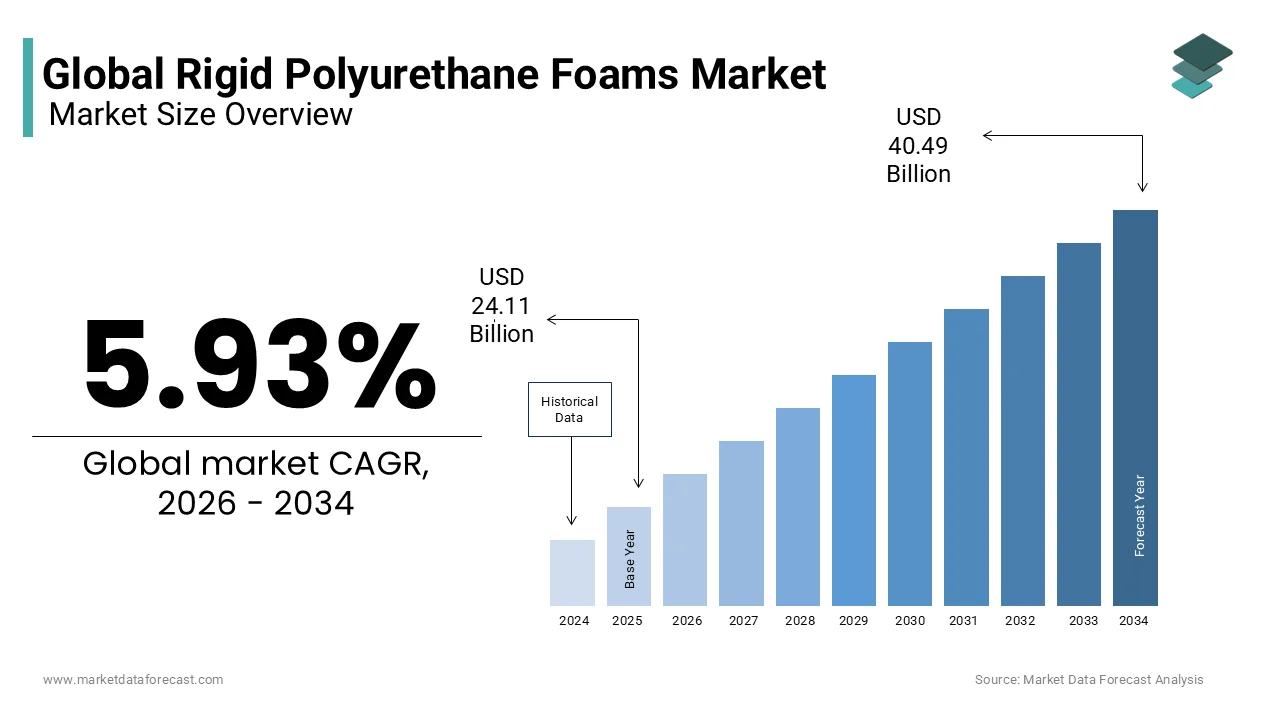
The global rigid polyurethane foams market size was valued at USD 24.11 billion in 2025, is estimated to reach USD 25.54 billion in 2026, and is projected to reach USD 40.49 billion by 2034, growing at a CAGR of 5.93% during the forecast period from 2026 to 2034. The growth of the rigid polyurethane foams market is primarily driven by the increasing demand for energy-efficient insulation materials, rising construction activities, and the growing focus on sustainability and lightweight materials in industrial applications.
Key Market Trends
- Rising use of rigid polyurethane foams in green building projects due to superior thermal insulation properties.
- Increasing adoption in refrigeration, automotive, and packaging applications.
- Growing demand for eco-friendly and low-emission foams to meet regulatory standards.
- Expansion of cold chain logistics boosting the use of rigid foams in refrigeration systems.
- Technological advancements enhancing durability and performance of polyurethane foams.
Segmental Insights
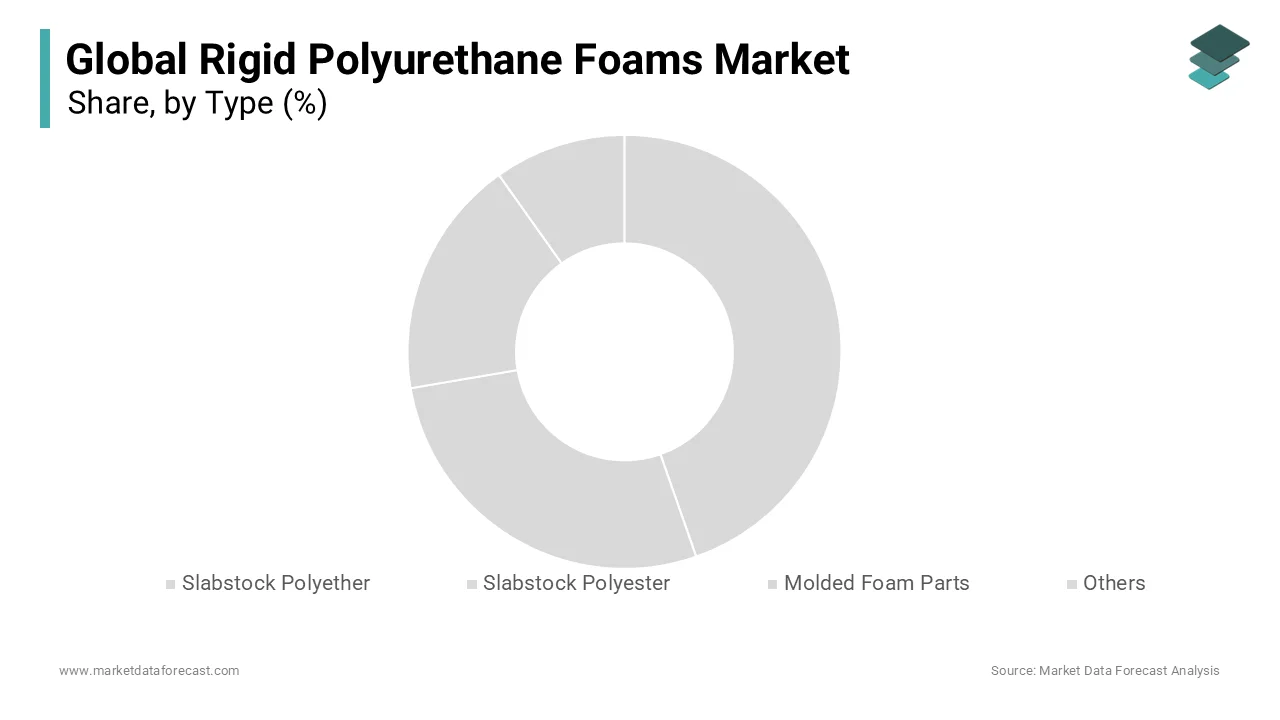
- Based on type, the slabstock polyether segment was the largest, occupying 58.3% of the global rigid polyurethane foams market share in 2025, owing to its extensive use in construction insulation, furniture, and packaging applications due to its high flexibility and excellent insulation characteristics.
- Based on end-use, the building and construction segment was the largest contributor to the rigid polyurethane foams market in 2025, supported by increasing infrastructure development, demand for energy-efficient buildings, and the growing need for thermal insulation in residential and commercial projects.
Regional Insights
- Asia Pacific dominated the global rigid polyurethane foams market in 2025, driven by rapid urbanization, infrastructure growth, and expansion of construction activities in countries like China, India, and Japan.
- North America showed strong growth, supported by rising investments in energy-efficient housing and industrial facilities.
- Europe witnessed steady progress due to stringent building energy codes and a focus on sustainable materials.
- Latin America exhibited emerging growth potential led by the construction and refrigeration sectors.
- Middle East & Africa recorded increasing adoption owing to infrastructure development and industrial expansion.
Competitive Landscape
The global rigid polyurethane foams market is moderately consolidated, with key players focusing on developing high-performance, sustainable foam solutions and expanding their geographic reach through partnerships and acquisitions. Leading companies dominating the market include BASF SE, Covestro AG, Dow Inc., Huntsman Corporation, Recticel NV/SA, Armacell International S.A., Bayer Material Science LLC, Carpenter Co., Sekisui Chemical Co., Ltd., and INOAC Corporation.
Global Rigid Polyurethane Foams Market Size
The global rigid polyurethane foams market size was valued at USD 24.11 billion in 2025, and is expected to be worth USD 40.49 billion by 2034 from USD 25.54 billion by 2026. The market is growing at a CAGR of 5.93% during the forecast period.
Rigid polyurethane foams are high-performance thermoset insulation materials formed through the exothermic reaction of polyols and isocyanates, often enhanced with blowing agents to achieve closed-cell structures. These foams are extensively utilized in building and construction, refrigeration, and industrial applications due to their superior thermal resistance, lightweight nature, and structural integrity. The European Environment Agency reports that improving building envelope efficiency could reduce EU-wide space heating demand by up to 35% by 2050.
MARKET DRIVERS
Stringent Building Energy Efficiency Regulations and Green Construction Standards
Governments worldwide are enforcing rigorous building energy codes to reduce carbon emissions, significantly boosting demand for high-efficiency insulation materials, which is fuelling the growth of Rigid Polyurethane Foams Market. Germany’s EnEV regulations require U-values (thermal transmittance) of less than 0.15 W/m²K for exterior walls, a standard efficiently met by rigid polyurethane foam systems, which achieve thermal conductivities as low as 0.022 W/mK. Similarly, China’s Ministry of Housing and Urban-Rural Development mandates that new urban buildings improve energy efficiency by 65–75% compared to baseline levels, which is driving adoption of advanced insulation.
Expansion of Cold Chain Infrastructure for Food and Pharmaceutical Storage
The global expansion of temperature-controlled logistics networks in refrigerated transport and cold storage facilities is escalating the growth of Rigid Polyurethane Foams Market. According to the World Health Organization, over 50% of vaccines are wasted annually due to temperature deviations during transport with the necessity for thermally stable packaging and storage. Rigid polyurethane foams, with their exceptional thermal insulation and moisture resistance, are the preferred material for refrigerated trucks, cold rooms, and insulated panels.
MARKET RESTRAINTS
Environmental Impact of Blowing Agents with High Global Warming Potential
The rigid polyurethane foams market stems from the use of fluorinated blowing agents, such as hydrofluorocarbons (HFCs), which possess high global warming potential (GWP) is restricting the growth of Rigid Polyurethane Foams Market. According to the Intergovernmental Panel on Climate Change, HFC-134a has a GWP 1,430 times greater than carbon dioxide over a 100-year period, contributing significantly to climate change when released during production or end-of-life disposal. The Kigali Amendment to the Montreal Protocol mandates a phasedown of HFCs by more than 80% over the next three decades, affecting foam manufacturing processes globally.
Volatility in Feedstock Supply and Pricing of Key Raw Materials
The production of rigid polyurethane foams is highly sensitive to fluctuations in the availability and cost of core chemical inputs primarily methylene diphenyl diisocyanate (MDI) and polyols, which is derived from fossil fuel-based feedstocks. According to the International Energy Agency, global MDI prices surged by over 25% in 2022 due to supply chain disruptions and increased crude oil volatility, directly impacting foam manufacturing margins. The American Chemistry Council notes that natural gas prices, a key input for propylene and subsequently polyether polyols, experienced a 40% year-on-year increase in Europe during the 2022 energy crisis, disrupting regional production. Additionally, geopolitical tensions affecting Middle Eastern and Russian petrochemical exports have introduced supply uncertainty.
MARKET OPPORTUNITIES
Development of Bio-Based and Renewable Polyols for Sustainable Foam Production
The shift toward bio-based raw materials for the rigid polyurethane foams industry by aligning with corporate sustainability goals and tightening environmental regulations is creating new opportunities for the growth of Rigid Polyurethane Foams Market. Covestro has commercialized a rigid foam system using up to 70% bio-based content, achieving performance parity with conventional foams while reducing lifecycle carbon emissions by 30%, as verified by third-party life cycle assessments. The U.S. Department of Agriculture’s BioPreferred Program now includes polyurethane insulation products, incentivizing federal procurement of bio-based materials.
Integration with Prefabricated and Modular Construction Systems
The rising adoption of off-site and modular building techniques in insulated sandwich panels and structural composite systems is additionally to enhance the growth of Rigid Polyurethane Foams Market. Rigid polyurethane foams are embedded within metal-faced panels used in walls, roofs, and floors, offering high insulation value, fire resistance, and structural rigidity in a single component. In Scandinavia, over 70% of new residential buildings incorporate prefabricated elements, as reported by the Nordic Wood Council, with polyurethane-core panels dominating due to their durability in cold climates.
MARKET CHALLENGES
Fire Safety and Combustibility Concerns in High-Rise and Public Buildings
The rigid polyurethane foams over fire performance in densely populated urban environments and high-rise structures is also hindering the growth of Rigid Polyurethane Foams Market. According to the National Fire Protection Association, thermal insulation materials contributed to rapid fire spread in 12% of significant building fires in the U.S. between 2018 and 2022. Polyurethane foams, when exposed to high heat, can decompose and release combustible gases, necessitating the inclusion of flame retardants and protective barriers. The Grenfell Tower tragedy in London in 2017, where polyurethane-core cladding accelerated fire propagation, led to sweeping regulatory reforms.
End-of-Life Management and Limited Recyclability of Thermoset Foams
The thermoset nature of rigid polyurethane foams renders them inherently difficult to recycle is additionally to degrade the growth of Rigid Polyurethane Foams Market. According to the European Commission’s Circular Economy Action Plan, over 80% of construction and demolition waste containing polyurethane foams is currently landfilled or incinerated due to the lack of economically viable recycling technologies. Unlike thermoplastics, thermoset foams do not melt upon reheating, preventing mechanical reprocessing.
REPORT COVERAGE
| REPORT METRIC | DETAILS |
| Market Size Available | 2025 to 2034 |
| Base Year | 2025 |
| Forecast Period | 2026 to 2034 |
| CAGR | 5.93% |
| Segments Covered | By Type, End-Use, and Region. |
| Various Analyses Covered | Global, Regional & Country Level Analysis, Segment-Level Analysis, DROC, PESTLE Analysis, Porter’s Five Forces Analysis, Competitive Landscape, Analyst Overview of Investment Opportunities |
| Regions Covered | North America, Europe, APAC, Latin America, Middle East & Africa |
| Market Leaders Profiled | BASF SE; Covestro AG; Dow Inc., Huntsman Corporation; Recticel NV/SA; Armacell International S.A.; Bayer Material Science LLC; Carpenter Co.; Sekisui Chemical Co., Ltd.; INOAC Corporation, and Others. |
SEGMENTAL ANALYSIS
By Type Insights
The slabstock polyether segment was the largest by occupying 58.3% of the Rigid Polyurethane Foams Market share in 2025 with its widespread use in continuous panel lamination for insulated sandwich panels in construction and cold storage applications. According to the U.S. Department of Energy, buildings insulated with polyether-based rigid foams can reduce heating and cooling loads by up to 40%, which is significantly contributing to compliance with energy codes such as ASHRAE 90.1. As reported by the North American Insulation Manufacturers Association (NAIMA), over 90% of rigid polyurethane insulation producers in North America have transitioned to hydrofluoroolefin (HFO)-blown systems, which are fully compatible with polyether polyols.
The molded foam segment is likely to grow with an expected CAGR of 7.4% from 2026 to 2034 with the increasing demand for custom-shaped, high-performance insulation components in specialized industrial and transportation applications. The molded foam parts is their integration into energy-efficient appliances subject to stringent global efficiency standards. According to the International Energy Agency, minimum energy performance standards (MEPS) now cover over 90% of global appliance sales, pushing manufacturers to enhance insulation performance. Whirlpool and Electrolux have adopted molded rigid polyurethane foams in refrigerator doors and cabinets, which is achieving 20–30% improvement in thermal retention compared to older models.
By End-Use Insights
The building and construction segment was the largest by capturing a significant growth of Rigid Polyurethane Foams Market in 2025. The sector utilizes rigid polyurethane foams in spray foam insulation, insulated metal panels (IMPs), and structural insulated panels (SIPs), all of which contribute to reduced energy consumption and improved building durability. The global push for net-zero energy buildings, which mandates ultra-low thermal transmittance in building envelopes. Germany’s Building Energy Act requires new constructions to meet primary energy demand limits of 55 kWh/m²/year, a target efficiently achieved using rigid polyurethane insulation systems.
The cold storage and refrigeration segment is emerging with a CAGR of 8.1% from 2026 to 2034 owing to the expansion of temperature-controlled logistics infrastructure to preserve food and pharmaceuticals, especially in developing economies. Rigid polyurethane foams, with their superior moisture resistance and thermal stability at sub-zero temperatures, are the preferred insulation for cold room panels and refrigerated transport units.
REGIONAL ANALYSIS
Europe Rigid Polyurethane Foams Market Analysis
Europe was the top performer in the global rigid polyurethane foams market by capturing 34.3% of share in 2025 with its rigorous energy efficiency standards and early adoption of sustainable building practices. The European Union’s Energy Performance of Buildings Directive mandates that all new buildings meet nearly zero-energy standards, driving widespread use of high-performance insulation materials. According to Eurostat, over 70% of new residential constructions in Germany, France, and Scandinavia incorporate rigid polyurethane foam in walls, roofs, and foundations.
Asia Pacific Rigid Polyurethane Foams Market Analysis
Asia Pacific was positioned second by holding 32.1% of the Rigid Polyurethane Foams Market share in 2025. In China, the Ministry of Housing and Urban-Rural Development mandates that new public buildings improve energy efficiency by 70% over baseline levels, accelerating the adoption of advanced insulation. Japan’s shift toward prefabricated housing over 15% of new homes being modular, has increased demand for polyurethane-core sandwich panels. Additionally, India’s National Centre for Cold-chain Development estimates that the country needs to add 8 million metric tons of refrigerated storage by 2030, which is creating sustained demand for rigid foam insulation.
North America Rigid Polyurethane Foams Market Analysis
North America Rigid Polyurethane Foams Market growth is expected to have a significant CAGR in the coming years, with the United States serving as the primary driver due to its expanding construction sector and regulatory emphasis on energy conservation. As per the National Association of Home Builders, spray polyurethane foam usage in new single-family homes increased by 22% between 2020 and 2023, driven by homeowner demand for energy savings.
Latin America Rigid Polyurethane Foams Market Analysis
Latin America, with Brazil and Mexico leading regional adoption. Brazil’s construction sector, which contributed 6.8% to GDP in 2023 as per the Brazilian Institute of Geography and Statistics, is increasingly incorporating energy-efficient materials in commercial and residential projects. The São Paulo Metropolitan Region has introduced green building incentives, including tax breaks for structures meeting PROCEL EDIFICA efficiency standards.
Middle East and Africa Rigid Polyurethane Foams Market Analysis
The growth of the Middle East and Africa Market is likely to grow with the Gulf Cooperation Council (GCC) countries driving most demand. The UAE and Saudi Arabia are investing heavily in sustainable urban development, exemplified by projects like NEOM and Masdar City, which mandate high thermal performance in building materials.
COMPETITIVE LANDSCAPE
KEY MARKET PLAYERS
A few of the playing the leading role in the global rigid polyurethane foams market include
- BASF SE
- Covestro AG
- Dow Inc.
- Huntsman Corporation
- Recticel NV/SA
- Armacell International S.A.
- Bayer Material Science LLC
- Carpenter Co.
- Sekisui Chemical Co., Ltd.
- INOAC Corporation
TOP STRATEGIES USED BY KEY MARKET PLAYERS
Key players in the rigid polyurethane foams market are deploying vertical integration, technological innovation, strategic partnerships, geographic expansion, and sustainability-driven product development to consolidate their market standing. Companies are investing in proprietary formulations that enhance thermal performance, fire resistance, and compatibility with low-global-warming-potential blowing agents. Collaborations with construction firms, appliance manufacturers, and governments enable co-development of application-specific solutions. Expansion into high-growth regions ensures proximity to emerging infrastructure and cold chain projects. Emphasis on circularity includes R&D in bio-based polyols and recyclable foam systems.
COMPETITION OVERVIEW
The competition in the rigid polyurethane foams market is characterized by technological differentiation, regulatory adaptation, and regional specialization among global chemical giants and regional manufacturers. Multinational corporations leverage advanced formulations, global supply chains, and sustainability credentials to dominate high-value applications in construction and refrigeration. Regional players in Asia and Latin America compete on cost and localized service, often focusing on slabstock production for domestic construction markets.
TOP PLAYERS IN THE MARKET
- BASF has established a robust presence in the Asia Pacific rigid polyurethane foams market through its integrated production and innovation centers in South Korea, China, and India. The company supplies high-performance insulation solutions for construction, refrigeration, and industrial applications, emphasizing energy efficiency and sustainability. In 2023, BASF launched its spray foam insulation system, Elastopir, in Southeast Asia, engineered to deliver ultra-low thermal conductivity and fire resistance for high-rise buildings. The company also collaborated with Indian construction firms to develop net-zero-ready building envelopes using polyurethane-based systems.
- Dow plays a pivotal role in advancing rigid polyurethane foam applications across Asia Pacific by providing polyol and isocyanate raw materials, as well as formulated systems tailored to regional construction and cold chain demands. The company’s THERMAX™ insulation boards, based on rigid polyurethane technology, are widely used in commercial buildings and industrial facilities across Japan, Australia, and Singapore. In 2025, Dow partnered with a leading Japanese panel manufacturer to introduce lightweight, fire-resistant sandwich panels for modular housing, aligning with urban densification trends. Its Shanghai Innovation Center has developed next-generation foams compatible with low-GWP blowing agents, supporting regional compliance with environmental regulations.
- Covestro has intensified its engagement in the Asia Pacific market by expanding production capacity and advancing sustainable rigid foam technologies. The company operates a major polyurethane manufacturing facility in Shanghai and supports regional customers with technical service centers in Thailand and India. In 2023, Covestro introduced a bio-based rigid foam system using up to 70% renewable raw materials for use in refrigerated transport and cold storage, responding to corporate sustainability mandates in Japan and South Korea. The company also collaborated with Chinese appliance manufacturers to optimize insulation performance in energy-efficient refrigerators. Its Desmodur® and Baytec® product lines are widely adopted in insulated panels and spray foam applications.
MARKET SEGMENTATION
This research report on the global rigid polyurethane foams market is segmented and sub-segmented into the following categories.
By Type
- Slabstock Polyether
- Slabstock Polyester
- Molded Foam Parts
- Others
By End-Use
- Building & Construction
- Oil & Gas
- Automotive
- Others
By Region
- North America
- Europe
- Asia Pacific
- Latin America
- Middle East & Africa