- Product Description Description
- Table of Contents TOC
- List of Table & Figure LOT
- Get Free Sample PDF Sample PDF
Market Size, 2025
$71.49 BnMarket Estimate, 2026
$75.36 BnMarket Forecast, 2034
$114.96 BnCAGR, 2026–2034
5.42%Executive Summary: Global Rolling Stock Management Market
- Market Scope: Comprehensive global analysis of the rolling stock management industry covering rail management systems, infrastructure management, remote diagnostics, station operations, and regional breakdowns.
- Market Valuation: Valued at USD 71.49 billion (2025), estimated at USD 75.36 billion (2026), and projected to reach USD 114.96 billion by 2034, registering a steady CAGR of 5.42% (2026–2034).
- Primary Growth Drivers: Rising demand for cost-effective freight and passenger transportation, heavy public spending on high-speed rail networks, and the imperative need for safety, real-time remote diagnostics, and predictive maintenance to reduce operational downtime.
Key Market Segment Metrics (2026–2034)
| Category | Leading Segment (2025 Position) | Fastest-Growing Segment |
|---|---|---|
| By Management Type | Rail Management segment (commanding the core share due to widespread use in tracking route assets, scheduling, and asset availability) | Infrastructure & Control Room Management (expanding with smart station upgrades and automated fare collection) |
| By Rail Sub-Segment | Train and Wayside Management (crucial for general operations, tracking, and ensuring baseline passenger/freight safety) | Remote Diagnostic Management (surging rapidly due to demand for real-time asset tracking, predictive maintenance, and data analytics) |
| By Region / Country | Europe (dominated by Germany, France, and the UK backed by established rail networks and advanced asset life-cycle tech upgrades) | Asia-Pacific & MEA (fastest-growing corridors driven by massive investments in high-speed rail, urbanization, and economic diversification) |
Major Market Players & Market Structure
Market Structure: Highly consolidated and technologically intensive landscape featuring global railway signaling and transport giants competing on automation, IoT-driven remote diagnostics, and integrated asset management software.
Key Companies: Alstom S.A., Siemens Mobility, Bombardier Transportation, General Electric, ABB, Hitachi, Mitsubishi Heavy Industries, Talgo, Thales Group, and Tech Mahindra.
 Download Free Sample Report
Global Rolling Stock Management Market Size
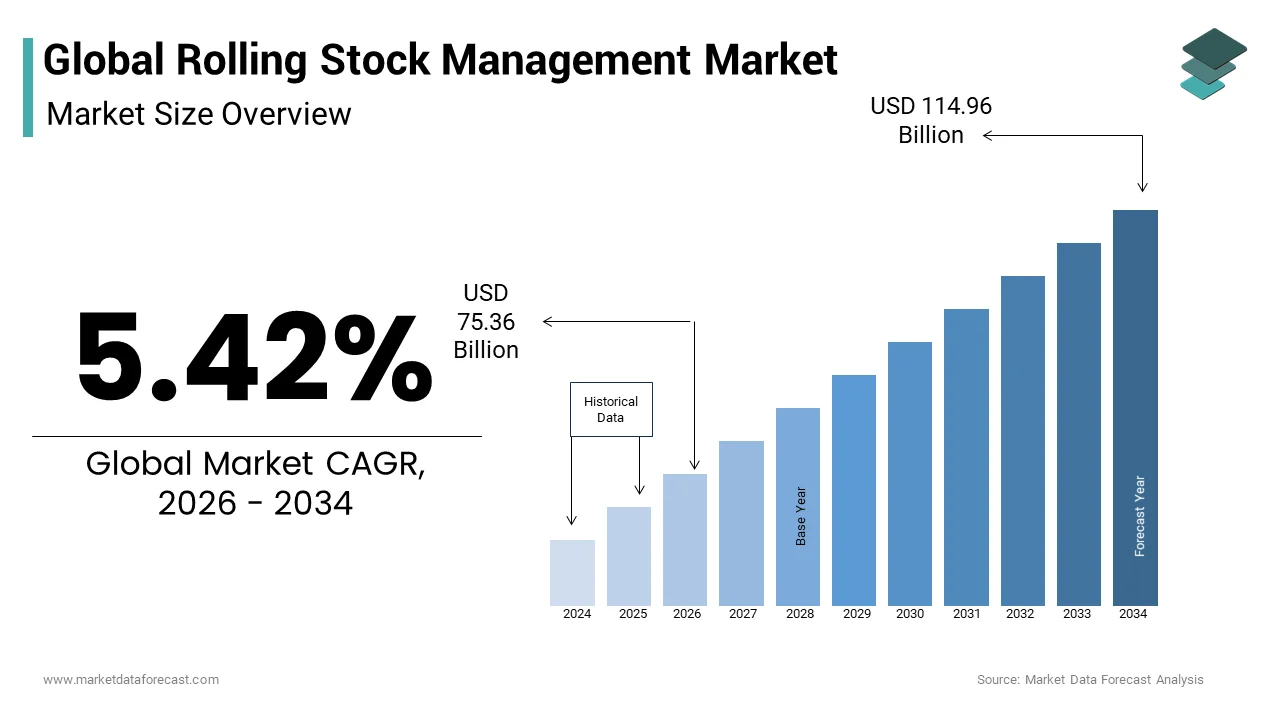
The global rolling stock management market size was valued at USD 71.49 billion in 2025 and is anticipated to reach USD 75.36 billion in 2026, from USD 114.96 billion by 2034, growing at a CAGR of 5.42% during the forecast period from 2026 to 2034.
The rolling stock management system is used to keep track of the wheeled vehicles. It is customary to manage information and record maintenance, inspection, and breakdown of the wheeled vehicle. With the help of this technique, future records are often kept for inspection. The development of the railway and the greater implementation of technology have allowed the railways to work effectively with the implementation of the latest technology and adopt the latest trends in management and other operations. This technique makes operations profitable and reduces transit time further. Several management systems for wheeled vehicles are present in the world and work efficiently.
Growing concerns in safety, inspection, and maintenance within the transportation sector have led to the expansion of the rolling stock management market. This includes not only the fact of reducing future costs but also mitigating normal maintenance methods. Transport is often carried out by air, road, or rail, but its efficiency and its effects on the environment. Emerging countries support the railroad as a suitable means of mass transportation for passengers and cargo.
MARKET DRIVERS
The main factors influencing the expansion of the global rolling stock management market include the growing demand for product transportation, increased spending on rapid transportation systems, and investments in rail infrastructure projects by developing nations around the world. In addition, the transport of goods in wheeled vehicles is reasonable, faster, and involves fewer insurance costs than road transport. The increase in high-speed rail networks in developing countries and the demand for energy-efficient transport, together with the demand for safety and luxury, are the factors that will drive the growth of the rolling stock management market.
MARKET RESTRAINTS
A high initial investment likely to adopt the wheeled vehicle management system can be a key constraining factor in the market. This is supposed to be a serious hurdle to the market during the forecast period. In addition, several countries still use conventional fuel-powered trains, such as diesel and coal locomotives, which are harmful to the environment. They should be banned during the forecast period. This, in turn, is believed to limit the market for the management of rolling stocks.
IMPACT OF COVID-19 ON THE ROLLING STOCK MANAGEMENT MARKET
the 2020 first quarter, we can see a revenue decline compared with the previous year. This decay underlines that, as in numerous segments, the effect of COVID-19 is being felt emphatically in the worldwide rail industry and further away from home. In spite of the fact that the effect isn't equivalent in each locale, this will be examined later. Yet at the same time, the quantity of railroad vehicles requested in 2020 Q1, paying little mind to thetypet, is still over the normal of the most recent five years. With CAGR esteem still around 7.82%, the projection of the rolling stock market is still indicating a hopeful pattern, however, this can't be overgeneralized in all areas of the world.
REPORT COVERAGE
| REPORT METRIC | DETAILS |
| Market Size Available | 2025 to 2034 |
| Base Year | 2025 |
| Forecast Period | 2026 to 2034 |
| CAGR | 5.42% |
| Segments Covered | By Management, Rail, Infrastructure, and Region. |
|
Various Analyses Covered | Global, Regional & Country Level Analysis, Segment-Level Analysis, DROC, PESTLE Analysis, Porter’s Five Forces Analysis, Competitive Landscape, Analyst Overview of Investment Opportunities |
| Regions Covered | North America, Europe, APAC, Latin America, Middle East & Africa |
|
Market Leaders Profiled | Alstom S.A., Siemens Mobility, Bombardier Transportation, General Electric, ABB, Hitachi, Mitsubishi Heavy Industries, Talgo, Thales Group, Tech Mahindra, and Others. |
SEGMENT ANALYSIS
By Management Insights
The railway management system can be a reliable, substantial, secure, and efficient approach to managing the entire railway infrastructure. It involves path projects that include tasks, investments, and deadlines for network interventions; route asset approaches to managing the included asset during a specific route; and distribution schedules. Rail Asset Management System helps freight managers, rail operators, passengers, and infrastructure managers to solve issues such as improving service availability such including performance and mobile usage, increased reliability and punctuality, and bonded and linear assets, alongside reduced service availability.
By Rail Management Insights
Remote diagnostic management provides comprehensive information on components, controls, and the entire train system from a variety of distances. This management process handles large data and provides a complete analysis of the condition. This saves time in operations and maintenance. Remote diagnostic management facilitates rail maintenance management for planning protective and corrective maintenance. These solutions allow proactive management and maintenance of all railway assets. The technical installations of this solution include real-time remote diagnostics, component condition monitoring, and onboard condition monitoring. It also includes major monitoring and reporting capabilities that help support the entire lifecycle management of railway assets. This helps to dramatically improve maintenance strategies and planning.
REGIONAL ANALYSIS
The European region should be dominated by countries like Germany, France, and the United Kingdom. It is estimated that technological advancements and the demand for the long-term operation of wheeled vehicles without failures and errors would boost the market for rolling stock management in Europe. The ECU region has been at the forefront of technological innovation in the management of wheeled vehicles. The investment projects undertaken for infrastructure and transport have fueled the search for services that will extend the life cycle of assets, which in turn will affect the flow of railway working conditions and vehicle components. The main reasons for the technological upgrade in the management of rolling stocks include the need to improve the logistics infrastructure of countries in the Middle East and Africa as they strive to diversify their economies from their current dependence on the oil and gas sector and to make urban transport efficient in growing cities. The abundant natural resources in the area are foreseen to promote the demand for the rolling stock management market in the future. Most countries in the Middle East and Africa specialize in expanding the general rail network or modernizing the rail network infrastructure.
KEY MARKET PLAYERS
These are the market players that are dominating the global rolling stock management market.
- Alstom S.A.
- Siemens Mobility
- Bombardier Transportation
- General Electric
- ABB
- Hitachi
- Mitsubishi Heavy Industries
- Talgo
- Thales Group
- Tech Mahindra
RECENT MARKET NEWS
- Indian Railways is in the process of consolidating its manufacturing units and workshops into a Public Sector Replacement Unit (PSU) - an Indian Railway Wheeled Vehicle Company. The power pack will be structured on the model of the Chinese manufacturer of wheeled vehicles PSU CRRC Group.
- China's largest high-speed rail manufacturer has announced that its first $ 63.4 million venture capital plant in India to repair and manufacture locomotive engines has begun operations.
- The Beena Vision group of programming and gadgets from Trimble Rail and Nexalaise is planned for the administration of rail transport resources, including maintenance, support, and fixing.
MARKET SEGMENTATION
This research report on the global rolling stock management market is segmented and segmented into the following categories.
By Management
- Rail Management
- Infrastructure Management
By Rail Management
- Remote Diagnostic Management
- Wayside Management
- Train Management
- Asset Management
- Cab Advisory
By Infrastructure
- Control Room Management
- Station Management
- Automatic Fare Collection Management
By Region
- North America
- Europe
- Asia Pacific
- Latin America
- Middle East and Africa