- Product Description Description
- Table of Contents TOC
- List of Table & Figure LOT
- Get Free Sample PDF Sample PDF
Market Size, 2025
$8.85 BnMarket Estimate, 2026
$9.28 BnMarket Forecast, 2034
$13.53 BnCAGR, 2026–2034
4.83%Global Sake Market Size, Share & Growth Analysis (2026–2034)
- Market Scope: Comprehensive global sake industry analysis covering major varietal classifications (Junmai, Ginjo, Honjozo), target age groups, e-commerce retail trends, and international culinary pairing expansion.
- Market Valuation: Valued at USD 8.85 billion in 2025, estimated at USD 9.28 billion in 2026, and projected to reach USD 13.53 billion by 2034, registering a steady CAGR of 4.83% during the forecast period.
- Primary Growth Drivers: Rising global popularity of Japanese cuisine, increasing disposable incomes in emerging markets, product innovations such as sparkling and flavored sake variants, and expanding online retail distribution channels.
Global Sake Market Segment Metrics (2026–2034)
| Market Category | Leading Sake Segment (2025 Position) | Fastest-Growing / High-Potential Segment |
|---|---|---|
| By Type | Junmai Sake (dominates global market share due to umami richness, versatile food pairings, and 55–70% rice polishing ratios) | Junmai Sake & Premium Ginjo / Daiginjo Lines |
| By Age Group | 40–60 Years Old (dominates market consumption due to preferences for traditional, premium beverages and higher disposable income) | 20–40 Years Old (young adults experimenting with novel flavors, sparkling, and low-alcohol varieties) |
| By Region / Country | Asia-Pacific (leads global production and consumption, heavily anchored by the traditional Japanese market) | Europe (fastest-growing regional market driven by rising imports, UK craft breweries, and EU demand) |
Major Sake Producers & Market Structure
Market Structure: International alcoholic beverage landscape featuring traditional heritage breweries from Japan and growing overseas craft start-ups competing on rice polish ratios (RPR), international supply chain logistics, and cross-border acquisitions.
Key Sake Companies: Takara Holdings Inc., Ozeki Sake, Asahishuzo Co., Ltd., Tatsuuma-Honke Brewing Co. Ltd., Gekkeikan Sake Co., Ltd., Hakutsuru Sake Brewing Co., Ltd., Sun Masamune Pty Limited, KANPAI London Craft Sake, Blue Current Brewery, and Aramasa Shuzo Co.
Global Sake Market Size
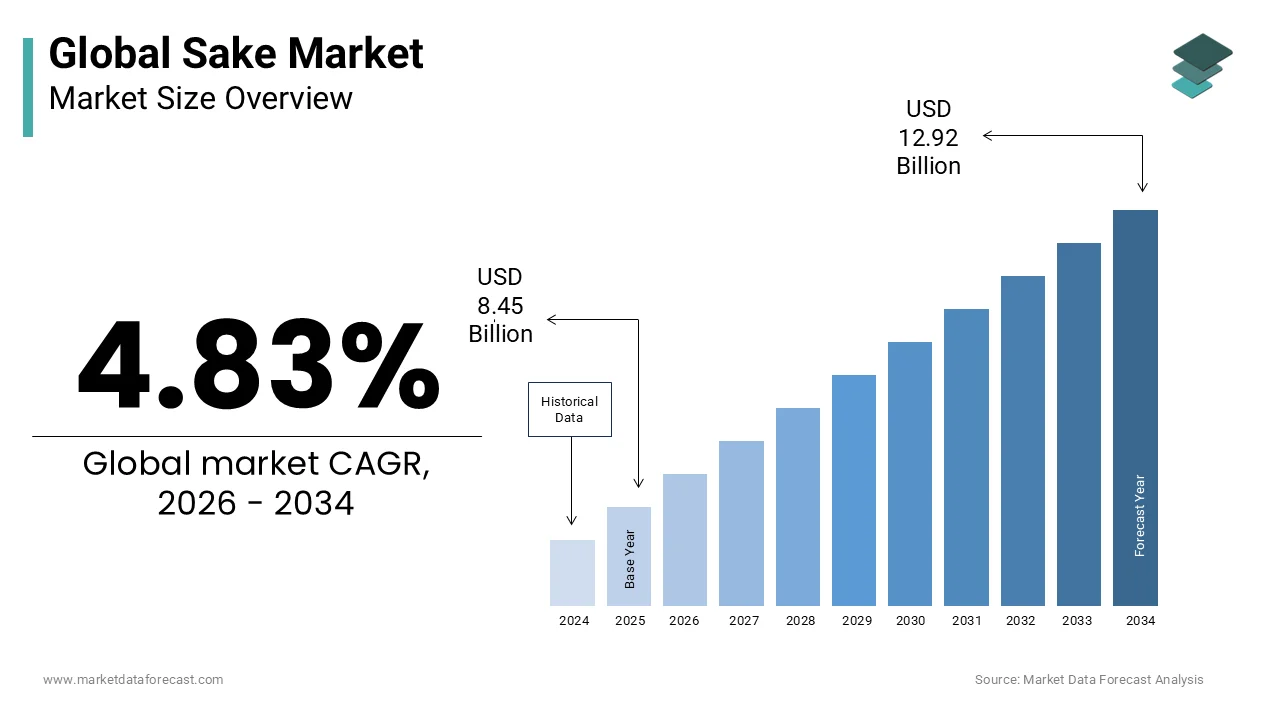
The global sake market size was valued at USD 8.85 billion in 2025, and the global market size is expected to reach USD 13.53 billion by 2034 from USD 9.28 billion in 2026. The market is growing at a CAGR of 4.83% during the forecast period.
Sake, an alcoholic beverage hailing from Japan, is crafted through the fermentation of rice. This libation harmoniously amalgamates four core components rice, water, yeast, and the mold known as koji. However, it's imperative to note that not all rice varieties can be employed in sake production.
Current Scenario of the Global Sake Market
The global sake market is estimated to hold a prominent future during the forecast period. Japan's national drink, sake, unfolds a vast and captivating realm. Within it, a myriad of breweries and flavor profiles await exploration. Diverse sake types are classified based on their rice polish ratio (RPR) and the infusion of brewer's alcohol. The RPR, expressed as a percentage, reveals the extent of the rice's outer layer removal; for instance, a 60 percent RPR signifies a 40 percent outer layer polish. In the summer of 2022, Japan introduced a novel initiative to invigorate the waning alcohol industry, particularly targeting the younger demographic. Named the Sake Viva! Contest, this endeavor, orchestrated by Japan's National Tax Agency, beckons individuals aged 20 to 39 to submit innovative business proposals. The trajectory of sake's popularity exhibits a positive impact, both within Japan and beyond its borders, particularly in Western regions. This trend is poised to catalyze the thriving of the sake market in the foreseeable future.
MARKET DRIVERS
The rising popularity of sake is one of the factors propelling the growth of the global sake market. Sake is a Japanese cuisine. The growing disposable income in the lower and middle-class groups in developing countries are willing to spend more on unique and premium products. This trend is likely to have a positive impact on the premium sake market. Although, over the past decade, exports of Japanese alcoholic beverages have soared by a factor of six, propelled by a surge in demand driven by the popularity of Japanese cuisine. In 2021, overseas whisky shipments increased by 70% to 46.1 billion yen. Escalating due to product scarcity, their average unit value saw a more than 20% rise, coupled with a substantial 40% surge in export volumes. With the advent of the modern era, the sake industry experienced significant growth thanks to streamlined production techniques. Innovations in pasteurization and lactic acid utilization accelerated the sake-making process. Japan's national drink has undergone a remarkable evolution. Presently, sake is prevalent not only in Japanese eateries but also on a global scale.
The rising presence of online retailers, emerging markets, and product innovation present untapped opportunities in the sake market. The burgeoning interest in Japanese culture, tourism, and cuisine within emerging markets unveils substantial growth prospects for the sake market. Countries like China, South Korea, and the United States have observed an uptick in sake consumption due to evolving consumer preferences. Moreover, sake manufacturers can harness these opportunities by introducing inventive sake variations, including flavored, sparkling, and low-alcohol options. Such products have the potential to attract new consumer segments and expand the market's scope.The ascent of e-commerce platforms and online retailing provides a convenient avenue for sake producers to tap into a wider consumer base. Online platforms offer an avenue to not only familiarize consumers with sake but also present an extensive array of purchase options.
MARKET RESTRAINTS
The factors likely to hamper the market growth of the sake market are the regularity barriers associated with beverages and the availability of substitutes. The sake market contends with diverse regulations and trade obstacles encompassing import constraints and labeling prerequisites. These hurdles can impede market expansion, particularly in regions with rigorous regulations. Moreover, sake encounters rivalry with alternative alcoholic beverages like wine, beer, and spirits. The abundance of substitutes presents a market challenge as consumers enjoy multiple options. Furthermore, Japan's tax agency reports a decline in alcohol sales due to declining birth rates, aging demographics, and pandemic-induced lifestyle shifts. These combined factors are projected to curtail market growth.
REPORT COVERAGE
| REPORT METRIC | DETAILS |
| Market Size Available | 2025 to 2034 |
| Base Year | 2025 |
| Forecast Period | 2026 to 2034 |
| CAGR | 4.83% |
| Segments Covered | By Type, Age Group, And Region. |
| Various Analyses Covered | Global, Regional and Country Level Analysis; Segment-Level Analysis; DROC; PESTLE Analysis; Porter’s Five Forces Analysis; Competitive Landscape; Analyst Overview of Investment Opportunities |
| Regions Covered | North America, Europe, APAC, Latin America, Middle East & Africa |
| Market Leaders Profiled | Takara Holdings Inc, Ozeki Sake, Asahishuzo CO., Ltd, Tatsuuma-Honke Brewing Co. Ltd, Gekkeikan Sake Co., Ltd, Hakutsuru Sake Brewing Co., Ltd, Sun Masamune Pty Limited, KANPAI London Craft Sake, Blue Current Brewery, Aramasa Shuzo Co |
SEGMENTAL ANALYSIS
By Type Insights
The Junmai sake segment dominated the sake market in 2023 and it is anticipated to grow at the highest CAGR during the projected period. The sought-after Junmai sake, categorized as premium and characterized by rice polishing levels between 70-55%, holds universal appeal as the most coveted variety of sake worldwide. Boasting a profile filled with umami richness, a delicate sweetness, and notable acidity, Junmai sake takes the lead as the preferred choice for consumers seeking harmonious food pairings. This variety maintains wide availability in specialty stores and dining establishments, a reflection of its strong consumer demand.
Additional sake types, including Ginjo and Junmai Daiginjo, are also expected to experience respectable market growth in the coming years.
By Age Group Insights
The 40-60 years old segment is expected to dominate the Sake market during the forecast period. Sake enjoys greater popularity within the middle-aged demographic compared to other age groups. Those aged between 40 and 60 constitute a significant portion of sake consumers. Sake generally commands a higher price point than standard wines and beers, creating a direct link between per capita income and the affordability of sake consumption on a global scale. Individuals within the middle-aged range tend to exhibit a stronger preference for traditional and premium beverages, which is expected to result in their heightened contribution to the expansion of the sake market share throughout the projected period. On the other hand, the young adult group aged 20-40 years is also expected to generate profitable revenue in the sake market. Since young adults are adventurous and like to try new things, these age groups like to experiment when it comes to food & beverages.
REGIONAL ANALYSIS
Asia-Pacific dominated the sake market. The major contributor in this region is expected to be Japan. While Japan has historically dominated the sake market as its primary producer and consumer, several factors are currently influencing its trajectory. The Japanese market is experiencing a shift towards Western-style beverages, compounded by the aging population within the country, which is adversely affecting the sake market.
Conversely, North America is displaying a significant surge in demand for the sake market. This can be attributed to the nation's high per capita income and the expansion of domestic sake production facilities.
Europe is poised to exhibit the most rapid growth within the global sake market in the foreseeable future. This projection is particularly attributed to a growing demand for sake across various countries within the EU, including the U.K., Germany, and France. Notably, the U.K. has emerged as a significant export hub for Japanese sake. Alongside the escalating import of sake, a notable trend is the rise of small sake breweries as start-ups within the EU. This trend is anticipated to be a driving force behind the expansion of the sake market in the European Union.
On the other hand, the rest of the world is anticipated to record a substantial CAGR during the projected period.
KEY PLAYERS IN THE GLOBAL SAKE MARKET
Takara Holdings Inc, Ozeki Sake, Asahishuzo CO., Ltd, Tatsuuma-Honke Brewing Co. Ltd, Gekkeikan Sake Co., Ltd, Hakutsuru Sake Brewing Co., Ltd, Sun Masamune Pty Limited, KANPAI London Craft Sake, Blue Current Brewery and Aramasa Shuzo Co. are some of the notable companies in the global sake market.
RECENT HAPPENINGS IN THE MARKET
- In May 2023, Takara Holdings Inc. officially revealed today that its subsidiary, Takara Shuzo International Co., Ltd., successfully procured 80.0% ownership of the shares issued by Ontario Limited, recognized as Ontario Spring Water Sake Company. This acquisition establishes Ontario Limited, a producer and distributor of sake and alcoholic beverages in Canada, as a unified subsidiary within the Takara Holdings group.
MARKET SEGMENTATION
This research report on the global sake market has been segmented and sub-segmented based on type, age group, and region.
By Type
- Ordinary Sake
- Junmai
- Honjozo
- Junmai Ginjo
- Ginjo
- Junmai Daiginjo
By Age Group
- 20-40 Years Old
- 40-60 Years Old
- Above 60 Years Old
By Region
- North America
- Europe
- Asia-pacific
- Latin America
- Middle East and Africa