- Product Description Description
- Table of Contents TOC
- List of Table & Figure LOT
- Get Free Sample PDF Sample PDF
Market Size, 2025
$3.02 BnMarket Estimate, 2026
$3.13 BnMarket Forecast, 2034
$4.19 BnCAGR, 2026–2034
3.71%Executive Summary: Global Sand Control Systems Market
- Market Scope: Comprehensive global evaluation of the sand control systems sector, analyzing types (open hole, cased hole), techniques (gravel pack, frac pack, sand screens), applications (onshore, offshore), and regional performance across North America, Europe, Asia-Pacific, Latin America, and the Middle East & Africa.
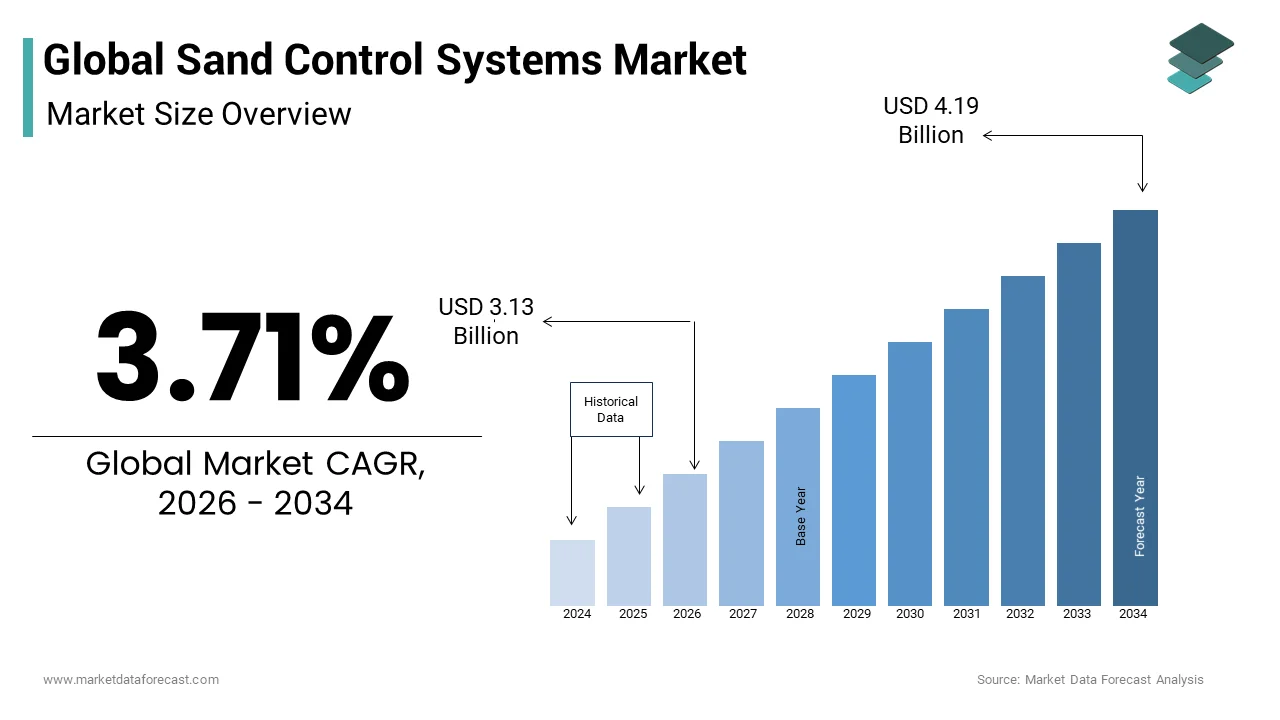
- Market Valuation: Valued at USD 3.02 billion in 2025, reaching USD 3.13 billion in 2026, and projected to expand up to USD 4.19 billion by 2034, registering a compound annual growth rate (CAGR) of 3.71% throughout the forecast period from 2026 to 2034.
- Primary Growth Drivers: Continuous development of shale reserves and optimization of reserve-to-production ratios from mature and existing oil and gas wells; increased mid-sea/offshore drilling activities; and the necessity to eliminate downhole cavities, fluid blending, and equipment erosion.
Key Market Segment Metrics
| Category | Leading Segment (Base Year Position) | Fastest-Growing / High-Impact Segment |
|---|---|---|
| By Type, Technique & Application | Cased Hole Systems (dominant type due to superior structural hole stability), Gravel Pack Technique (largest market share for preventing formation sand entry), & Onshore Applications (largest market share backed by extensive basin production) | Frac Pack Technique (high-conductivity hydraulic fracturing and gravel packing combination) & Offshore Applications (critical growth segment navigating unconsolidated marine formations) |
| By Region | Asia-Pacific (largest regional market driven by rapid industrialization, high energy demand, and intense exploration activities) | Middle East & Africa (fast-growing market propelled by high-pressure/high-temperature sandstone reservoirs in nations like Saudi Arabia) |
Major Market Players & Market Structure
Market Structure: A consolidated oilfield services and equipment landscape dominated by global multinational technology providers engaging in strategic asset acquisitions, cross-border expansions, and advanced downhole tool innovations.
Key Companies: Schlumberger Limited, Weatherford International, Superior Energy Services, Grit Industries, Inc., Halliburton Company, Baker Hughes, Inc., RGL Reservoir Management Inc., Welltec A/S, Tendeka, and Variperm Canada Limited.
Global Sand Control Systems Market Size
The global sand control system market size was valued at USD 3.02 billion in 2025 and is anticipated to reach USD 3.13 billion in 2026 to reach USD 4.19 billion by 2034, growing at a CAGR of 3.71% during the forecast period from 2026 to 2034. The continuous development of the shales and efforts to keep up the reserve-to-production ratio from wells are the major factors driving the market for Sand Control Systems.
The Sand Control Systems are comprised of devices or equipment that assist in taking out the sand arrangements and their blending during the cycle when the hydrocarbons are extracted. The system assumes a significant part in the general fruition interaction, and it upgrades the performance and the productivity of a well. They likewise help in wiping out issues, for example, the downhole cavities and the erosion of the equipment. Sand Control Systems are one of the significant pieces of the oil and gas production system. It takes out the sand creation in the wellbore. The system assumes a significant part in the finishing system, and it recovers the performance and the productivity of the well.
Nowadays, the greater part of the world's oil and gas wells delivered from unconsolidated sandstones produce sand with supply liquids. Issues related to sand production include incorporating the stopping of perforation burrows, collection in surface separators, sanding up of the production span, and possible damage to downhole and surface equipment from erosion. There are a few strategies for limiting sand production from wells. The decisions range from basic changes in working practices to costly consumptions, for example, sand combination or rock pressing. The sand control technique relies upon site-specific conditions, working practices, and monetary considerations.
MARKET DRIVERS
The rising interest in keeping up the reserve-to-production ratio from mature/existing wells is the major factor in driving the global sand control systems market growth during the forecast period.
The reserve-to-production ratio shows the leftover life expectancy of a characteristic asset at a given production rate. With the plunge in unrefined petroleum costs, oilfield operators zero in on existing wells and work on the reserve-to-production ratio. With the decrease in oil reserves, significant oil and gas organizations have moved their attention toward innovative advancements to create tools and strategies expected to reach to remaining reserves in non-traditional wells. Oilfield operator companies are presently centered on expanding production and broadening mature fields, thereby surpassing regular production levels. The quantity of mature oilfields is very high and is expanding because of the rising oil and gas production, which brings about the quick consumption of new fields.
The expanding drilling of the oil and gas field in the inland areas has expanded the market request; subsequently, the rock pack systems have the biggest portion of the overall industry. The seaward fruitions are better than the coastal ones as they help understand the qualities of the intricate repository, improve the existence of apparatuses, and help explore the super profound levels. The developing boring action in the mid-sea likewise expands the interest in Sand Control Systems.
MARKET RESTRAINTS
The major factors responsible for the global sand control systems market growth include price fluctuations in crude oil and harm to drilling activity. However, the fluctuations in the crude oil price, significant expense, and specialized obstructions related to well intervention and tough government regulation exist in certain areas that influence the fracturing and drilling exercises are expected to be the significant restrictions for the sand control system market.
REPORT COVERAGE
| REPORT METRIC | DETAILS |
| Market Size Available | 2025 to 2034 |
| Base Year | 2025 |
| Forecast Period | 2026 to 2034 |
| CAGR | 3.71% |
| Segments Covered | By Type, Technique, Application, and Region. |
| Various Analyses Covered | Global, Regional & Country Level Analysis, Segment-Level Analysis, DROC, PESTLE Analysis, Porter’s Five Forces Analysis, Competitive Landscape, Analyst Overview on Investment Opportunities |
| Regions Covered | North America, Europe, APAC, Latin America, Middle East & Africa |
| Market Leaders Profiled | Schlumberger Limited, Weatherford International, Superior Energy Services, Grit Industries, Inc., Halliburton Company, Baker Hughes, Inc., RGL Reservoir Management Inc., Welltec A/S, Tendek, Variperm Canada Limited, and Others. |
SEGMENTAL ANALYSIS
By Type Insights
The cased hole sand control system method is most widely used because of its technical reasons, which relate to the stability of the hole. First, the production casing is set in the reservoir to complete the casing, guaranteeing safe production activities. It additionally acts as a barrier and stops solids, unwanted liquids, and gases from entering the wellbore. Next, the casing and cement are punctured to permit the hydrocarbons to enter the well stream to produce. This cycle includes running a whole weapon and a reservoir finding gadget into the wellbore, ordinarily through a wireline, slackline, or looped tubing. When the reservoir level has been reached, the weapon then, at that point, shoots holes in the sides of the well to permit hydrocarbons to enter the good stream.
By Technique Insights
The gravel Pack segment contains the largest share of the Sand Control System Market; Gravel packing is a viable method for preventing sand from entering the production string. Gravel pack systems are utilized to build the surface region of the delivering great to expand the production rates. In gravel packing, a steel screen is put in the wellbore. The encompassing annulus is loaded with the pre-arranged gravel of a particular size intended to forestall the entry of formation sand.
The essential goal is to balance out the formation while making insignificant hindrances well efficiency. Gravel pack systems are reasonable for unconsolidated to tight sand formations, both open-hole and cased-hole wells, and for both customary and unpredictable applications.
Frac Pack is expected to have the next place in the share of Sand Control System; Frac packing is a complete procedure that consolidates two particular cycles, water-powered fracturing and gravel packing. The fundamental test of a frac-pack completion is the effective making of high-conductivity breaks with the tip-screen out (TSO) method and the situation of proppant inside those cracks and in the annulus between the screen and wellbore divider. This is additionally compounded by doing so in an ultra-high-permeability environment, where high liquid leak-off rates are evident.
By Application Insights
Onshore applications have the maximum share in the Sand Control System Market, with tremendous onshore oil and gas wells. It expanded to rely on regular oil and gas, the most productive and helpful method for satisfying the energy needs. Gravel packs are essentially introduced for onshore areas. Onshore areas include putting these systems in the wellbore to filter sand during extraction. The developing interest in onshore applications shows expanding oil production from basins like the Permian.
Offshore is expected to record a decent share during the forecast period; in numerous offshore districts, the geologic formations that produce oil and gas are unconsolidated, implying that the sand that makes up these formations is free or inadequately reinforced, similar to the sand on an ocean side. Thus, this free sand can wind up inside the production funneling in the well or production hardware on a superficial level. Sand production is profoundly unwanted since it can plug lines and gear, disintegrate funneling (similar to sandblasting), and lead to erosion of lines and hardware. Disposing of sand production has been one of the fundamental production challenges engineers have faced since the beginning of offshore oil and gas development.
REGIONAL ANALYSIS
Asia-Pacific is expected to have the largest market size in the forecast timeframe; The area represents a significant part of the global oil interest because of the rise in industrialization, urbanization, population growth, and the development of the consumer class. This development in oil demand moves oil and gasexplorationn activities, which drives the market for oilfield hardware and services, including sand control arrangements. The
Middle East and Africa are going to be fast-growing markets. Saudi Arabia has oil and gas caught in sandstone with interesting qualities, which display low-to-direct porosity; however, a high sanding inclination is brought about by unconsolidated stone under high tension and temperature. Attributable to its enormous oil and gas production base with high sanding inclination, the nation is probably the biggest market for sand control systems in the world.
KEY MARKET PLAYERS
These are the market players that are dominating the global sand control systems market.
- Schlumberger Limited
- Weatherford International
- Superior Energy Services
- Grit Industries, Inc.
- Halliburton Company
- Baker Hughes, Inc.
- RGL Reservoir Management Inc.
- Welltec A/S
- Tendeka,
- Variperm Canada Limited
RECENT MARKET NEWS
-
Baker Hughes has collaborated with CAUSEWAYGT for Geothermal Energy projects and technological development.
-
Variperm Canada Limited has announced that it has acquired tGL Reservoir Management Inc. to lead the Sand and Flow Control Space with operations in the US and Canada.
MARKET SEGMENTATION
This research report on the global sand control systems market has been segmented and sub-segmented based on the type, technique, application, and region.
By Type
- Open Hole
- Cased Hole
By Technique
- Gravel Pack
- Frac Pack
- Sand Screens
By Application
- Onshore
- Offshore
By Region
- North America
- Europe
- Asia-Pacific
- Latin America
- The Middle East and Africa