- Product Description Description
- Table of Contents TOC
- List of Table & Figure LOT
- Get Free Sample PDF Sample PDF
Market Size, 2025
$13.75 BnMarket Estimate, 2026
$14.89 BnMarket Forecast, 2034
$28.22 BnCAGR, 2026–2034
8.32%Global Self-Compacting Concrete Market Size
The self-compacting concrete market size was valued at USD 13.75 billion in 2025, and the global market size is predicted to grow from USD 14.89 billion in 2026 to USD 28.22 billion in 2034 at an annual growth rate of 8.32% from 2025 to 2033

The self-compacting concrete are high-performance concrete that flows under its own weight to fill formwork and encapsulate reinforcement without the need for mechanical vibration. This innovative material utilizes superplasticizers and viscosity modifying agents to achieve high fluidity while maintaining stability and resistance to segregation. The adoption of self-compacting concrete is driven by the construction industry's need for faster execution improved surface finish and enhanced durability in complex structural elements. The technology is particularly valued for its ability to reduce noise pollution on urban construction sites and improve working conditions by eliminating vibrators. The production of ready mixed concrete in Europe exceeds 400 million cubic meters annually with a growing portion incorporating advanced admixtures for self-compacting properties. Furthermore, the United Nations Environment Programme states that the construction sector accounts for approximately 39% of global carbon dioxide emissions prompting a shift towards materials that offer longer service life and reduced maintenance. The self-compacting concrete can reduce construction time in heavily reinforced structures. According to Eurostat, the construction industry in the European Union employs over 14 million people making labor efficiency a critical factor in material selection. The integration of self compacting concrete into prefabrication processes further enhances its appeal by ensuring consistent quality and dimensional accuracy in manufactured components.
MARKET DRIVERS
Rapid Urbanization and Infrastructure Development Projects
The accelerating pace of urbanization and the subsequent surge in infrastructure development projects is fuelling the growth of the self-compacting concrete market. As cities expand vertically and horizontally, the demand for high rise buildings bridges and tunnels necessitates construction materials that can handle complex geometries and dense reinforcement layouts. Self-compacting concrete allows for faster pouring rates and superior consolidation in congested rebar zones, which is for meeting tight project deadlines in densely populated urban centers. In Europ, the Trans European Transport Network requires extensive tunneling and bridge construction where self compacting concrete ensures structural integrity and durability. The ability of this material to flow into intricate forms without vibration reduces the risk of honeycombing and voids which are common defects in conventional concrete. This reliability is essential for critical infrastructure projects such as nuclear power plants and offshore wind farms where safety and longevity are paramount. The efficiency gains from using self compacting concrete translate into cost savings and reduced labor requirements making it an attractive option for large scale public works.
Labor Shortages and Need for Construction Efficiency
The persistent shortage of skilled labor in the construction industry combined with the urgent need for operational efficiency is additionally amplifying the growth of the self-compacting concrete market. Many developed nations face an aging workforce and a decline in the number of young workers entering the construction trades creating a gap in skilled vibrator operators. Self-compacting concrete eliminates the need for manual vibration thereby reducing dependency on skilled labor and minimizing physical strain on workers. This automation of the consolidation process leads to faster cycle times and improved site safety by reducing noise levels and vibration exposure. The Occupational Safety and Health Administration emphasizes that reducing noise and vibration hazards is crucial for worker health and compliance with safety regulations. Furthermore, the consistent quality of self-compacting concrete reduces the need for post construction repairs and remediation which often require additional labor and resources. The Associated General Contractors of America notes that labor costs account for a significant portion of total construction expenses making efficiency improvements vital for profitability. This operational advantage is particularly valuable in regions with high labor costs and strict working hour restrictions. The ability to maintain high productivity levels despite labor constraints ensures that self-compacting concrete remains a preferred choice for modern construction projects.
MARKET RESTRAINTS
Higher Initial Material Costs Compared to Conventional Concrete
The elevated initial cost of self compacting concrete compared to traditional vibrated concrete with its widespread adoption is hindering the growth of the self compacting concrete market. The formulation of self compacting concrete requires higher quantities of cementitious materials, such as silica fume fly ash and limestone powder along with expensive chemical admixtures like polycarboxylate ether superplasticizers. For large scale projects with tight budgets, this price premium can be a deterrent despite the long term benefits of reduced labor and faster construction. Small and medium sized contractors often lack the financial flexibility to absorb these higher upfront costs especially when competing for low margin contracts. The fluctuating prices of raw materials such as cement and aggregates further exacerbate cost volatility making budgeting difficult for construction firms. Additionally, the lack of standardized pricing models for self compacting concrete across different regions creates uncertainty for project planners. While the total cost of ownership may be lower due to efficiency gains the immediate cash flow impact of higher material costs remains a barrier. Many clients and developers prioritize initial capital expenditure over lifecycle costs leading them to opt for cheaper conventional alternatives.
Technical Complexity and Quality Control Challenges
The technical complexity associated with the design production and placement with its broader acceptance in the construction industry is also declining the growth of the self compacting concrete market. Achieving the precise balance between flowability and stability requires rigorous mix design and strict quality control measures, which many contractors find difficult to implement consistently. The variations in raw material properties, such as aggregate shape and moisture content can significantly affect the performance of self-compacting concrete leading to potential issues like segregation or blocking. The lack of experienced personnel who understand the rheological properties of self-compacting concrete further complicates its application on site. The European Federation of Concrete Associations highlights that improper handling or pumping techniques can compromise the integrity of the concrete resulting in structural defects. These tests require specialized equipment and trained technicians, which may not be available on all construction sites. The risk of failure due to incorrect mix proportions or poor site practices makes some engineers and architects hesitant to specify self-compacting concrete. Additionally, the sensitivity of the material to environmental conditions such as temperature and humidity requires careful monitoring during transport and placement.
MARKET OPPORTUNITIES
Growth in Prefabrication and Modular Construction
The expanding trend towards prefabrication and modular construction due to the material's suitability for factory based production environments, which is creating new opportunities for the growth of the self compacting concrete market. Prefabricated elements, such as wall panels, beams, and columns require high precision and superior surface finish, which self compacting concrete delivers consistently without the need for manual finishing. Self compacting concrete allows for the efficient casting of complex shapes and thin walled structures that are difficult to produce with conventional methods. The controlled environment of precast plants enables strict quality control and optimization of mix designs maximizing the performance benefits of self compacting concrete. The European Precast Concrete Organization states that prefabrication can reduce construction time by up to 50% and minimize material waste by 30% aligning with sustainability goals. The use of self-compacting concrete in prefabrication also facilitates the integration of insulation and other functional layers into single composite elements enhancing energy efficiency. As governments promote industrialized construction methods to address housing shortages and infrastructure needs, the demand for self compacting concrete in precast applications is poised to rise. The ability to produce high quality standardized components at scale offers significant economic advantages for manufacturers.
Adoption in Sustainable and Green Building Practices
The increasing emphasis on sustainable construction and green building certifications due to its potential to incorporate supplementary cementitious materials is ascribed in boosting the growth of the self compacting concrete market. Self compacting concrete mixes often utilize industrial by products, such as fly ash slag and silica fume which reduce the clinker content and lower the carbon footprint of the material. The use of self compacting concrete contributes to LEED and BREEAM certification points by improving resource efficiency and reducing construction waste. The European Commission’s Green Deal aims to make Europe climate neutral by 2050 encouraging the adoption of sustainable construction practices. Self compacting concrete’s ability to produce smooth surfaces eliminates the need for plastering or rendering further reducing material usage and labor. Additionally, the durability of self compacting concrete extends the service life of structures reducing the frequency of repairs and replacements. The improving the energy efficiency of buildings is key to achieving climate goals and self-compacting concrete supports this through better thermal mass and air tightness. Developers and owners seeking to meet stringent environmental standards are increasingly specifying self-compacting concrete for its sustainability credentials.
MARKET CHALLENGES
Risk of Segregation and Bleeding During Transportation
The susceptibility of self-compacting concrete to segregation and bleeding during transportation and pumping that affects its reliability and performance is also to hinder the growth of the self compacting concrete market. Due to its high fluidity, self-compacting concrete is prone to separation of coarse aggregates from the mortar matrix if not handled properly leading to non-uniform strength and durability issues. The segregation can occur if the concrete is transported over long distances or if the pumping pressure is not carefully controlled. The stability of the mix is highly sensitive to changes in temperature and agitation during transit requiring precise logistics management. Bleeding the rise of water to the surface can result in weak surface layers and increased permeability, which compromises the structural integrity of the element. Preventing these issues requires the use of high quality viscosity modifying agents and strict adherence to mixing protocols which increases production complexity. Contractors must invest in specialized pumping equipment and trained operators to ensure smooth placement without blockages or separation. The risk of material rejection due to quality failures adds financial pressure to projects.
Lack of Standardized Codes and Design Guidelines
The absence of universally accepted codes and design guidelines for self-compacting concrete creates uncertainty and hesitation among engineers and regulators hindering its widespread specification. While national standards exist in countries like Japan and France, many regions lack comprehensive frameworks that address the unique properties and testing requirements of self compacting concrete. The variability in testing methods and acceptance criteria across different jurisdictions complicates international projects and cross border trade. Engineers often rely on empirical data or proprietary guidelines from admixture suppliers, which may not be recognized by local building authorities. This lack of standardization leads to conservative design approaches that underestimate the capabilities of self compacting concrete or impose unnecessary restrictions. The European Committee for Standardization is working towards harmonizing standards but progress is slow due to differing national practices and technical opinions. The uncertainty regarding long term performance and durability under various environmental conditions further discourages adoption in critical infrastructure.
REPORT COVERAGE
| REPORT METRIC | DETAILS |
| Market Size Available | 2025 to 2034 |
| Base Year | 2025 |
| Forecast Period | 2026 to 2034 |
| CAGR | 8.32% |
| Segments Covered | By Application, Type, End User, and Region |
| Various Analyses Covered | Global, Regional & Country Level Analysis, Segment-Level Analysis, DROC, PESTLE Analysis, Porter’s Five Forces Analysis, Competitive Landscape, Analyst Overview on Investment Opportunities |
| Regions Covered | North America, Europe, Asia Pacific, Latin America, and Middle East & Africa |
| Market Leaders Profiled | CEMEX S.A.B. de C.V., ACC Limited, SIKA AG, Lafarge Holcim, BASF SE, Tarmac Trading Limited, Kilsaran, HEIDELBERG CEMENT AG, Unibeton Ready Mix, Ultra Tech Cement Ltd., Breedon Group plc, Firth, Buzzi Unicem USA Inc., UltraTech Cement, Hong Leong Group, Unibeton Ready Mix |
SEGMENTAL ANALYSIS
By Type Insights
The powder type segment was the largest by accounting for 32.1% of the self compacting concrete market share in 2025 due to its ability to achieve high flowability and stability through the use of fine powder materials rather than relying solely on chemical admixtures. This method utilizes increased quantities of limestone powder fly ash or silica fume to enhance the viscosity and cohesiveness of the concrete mix. The availability of industrial by products like fly ash makes this type cost effective and environmentally sustainable aligning with green building initiatives. The European Ready Mixed Concrete Organization states that powder based mixes are preferred in precast industries because they provide consistent surface finishes and reduce the risk of segregation during transport. The robustness of powder type mixes against variations in aggregate moisture content makes them easier to control in production environments. Furthermore, the reduced reliance on expensive viscosity modifying agents lowers the overall material cost making it attractive for large scale infrastructure projects. The widespread adoption of this type in Japan and Europe where self-compacting concrete originated has established a strong technical foundation and supply chain. The proven track record of powder type concrete in delivering high durability and strength ensures its continued dominance in the global market.
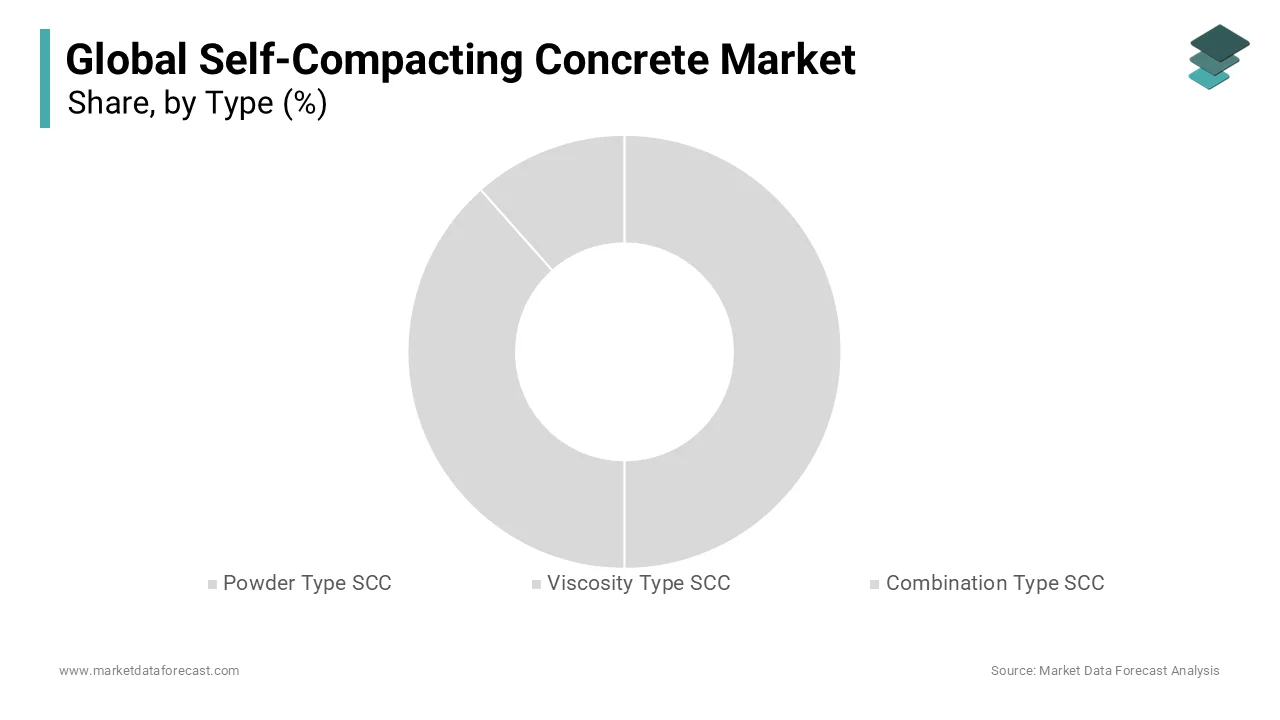
The combination type segment is likely to grow at a fastest CAGR of 6.8% from 2026 to 2034 owing to the synergistic use of both powder materials and viscosity modifying agents to optimize performance and cost efficiency. The combination type mixes allow producers to fine tune rheological properties to meet specific project requirements, such as long-distance pumping or complex formwork filling. This flexibility is particularly valuable in urban construction sites, where space constraints and logistical challenges demand highly adaptable concrete solutions. The ability to reduce the total amount of expensive superplasticizers by balancing them with moderate amounts of fine powders provides an economic advantage. Additionally, this type enables the production of self-compacting concrete with lower cement content thereby reducing the carbon footprint without compromising workability. The growing emphasis on sustainable construction practices encourages the adoption of hybrid formulations that maximize the use of recycled materials. Technological advancements in admixture chemistry have further enhanced the compatibility between powders and viscosity agents making combination types more reliable.
By Application Insights
The concrete frames segment was accounted in holding 44.3% of the self compacting concrete market share in 2025 due to the extensive use of reinforced concrete in high rise buildings and commercial structures. The dense reinforcement layouts typical in columns beams and walls of modern skyscrapers make self-compacting concrete ideal for ensuring proper consolidation without vibration. The number of buildings over 200 meters completed globally has increased significantly with Asia and the Middle East leading the trend. Self-compacting concrete allows for faster construction cycles by eliminating the time-consuming process of mechanical vibration which is difficult to perform in tightly spaced rebar cages. The superior surface finish achieved with self compacting concrete reduces the need for post casting repairs and plastering resulting in additional cost savings. The structural integrity of concrete frames is enhanced by the uniform distribution of materials and the absence of honeycombing defects. The widespread adoption of prefabricated frame elements also drives demand as self compacting concrete ensures high quality replication in factory settings. The efficiency gains and quality improvements make self compacting concrete the preferred choice for large scale framed structures worldwide.
The drilled shafts segment is likely to grow at a fastest CAGR of 7.5% throughout the forecast period owing to the increasing demand for deep foundation systems in infrastructure projects. Drilled shafts are commonly used for bridges highways and heavy industrial facilities where soil conditions require deep load bearing support. The rehabilitation and expansion of bridge infrastructure necessitate the use of reliable deep foundation techniques. Self-compacting concrete is particularly advantageous in drilled shafts because it can flow easily into long narrow casings without segregating ensuring uniform strength along the entire depth. The elimination of tremie pipes and the reduction of concrete waste during placement further enhance efficiency. The Deep Foundations Institute reports that the use of self-compacting concrete in drilled shafts improves the bond between the concrete and the surrounding soil or rock enhancing load transfer capacity. The ability to place concrete continuously without interruption reduces the risk of cold joints which are potential weak points in foundation structures.
By End User Insights
The building and construction sector was the largest by accounting for 34.2% of the Self Compacting Concrete Market share in 2025 with the vast volume of residential commercial and industrial building projects globally. The need for rapid construction schedules and high-quality finishes in urban developments makes self-compacting concrete a preferred material for developers and contractors. As per the United Nations Department of Economic and Social Affairs, the global urban population is expected to reach 68% by 2050 driving continuous demand for new housing and commercial spaces. Self compacting concrete facilitates the construction of complex architectural designs and thin walled structures that are difficult to achieve with conventional methods. The European Commission states that the construction sector accounts for a significant portion of the European Union’s GDP highlighting its economic importance. The reduction in labor requirements and noise pollution associated with self compacting concrete aligns with strict urban regulations and labor shortages. The ability to produce smooth exposed concrete surfaces eliminates the need for additional cladding or finishing materials reducing overall project costs. The widespread use of self compacting concrete in precast manufacturing for building components further boosts demand.
The infrastructure sector segment is attributed to grow at a fastest CAGR of 7.2% from 2026 to 2034 with the massive government investments in transportation energy and water management projects. Infrastructure projects, such as bridges tunnels dams and power plants require durable and high performance materials capable of withstanding harsh environmental conditions. The infrastructure investment needs are estimated at 3.7 trillion dollars annually with a significant portion allocated to developing and maintaining critical assets. Self-compacting concrete is ideal for these applications due to its ability to fill complex forms and densely reinforced sections ensuring structural integrity and longevity. The Asia Pacific alone requires 1.7 trillion dollars in annual infrastructure investment creating substantial demand for advanced construction materials. The use of self-compacting concrete in offshore wind farm foundations and nuclear containment structures highlights its versatility and reliability. The reduced maintenance requirements and extended service life of infrastructure built with self compacting concrete offer long term economic benefits. Government initiatives to upgrade aging infrastructure in North America and Europe further drive adoption.
REGIONAL ANALYSIS
North America Self Compacting Concrete Market Analysis
North America was the top performer in the global Self Compacting Concrete Market by accounting for 34.2% of share in 2025 with the advanced construction technologies and stringent quality standards. The urgent need for bridge and road repairs driving the adoption of high performance materials is also enhancing the growth of the market in this region. The region benefits from a well-established supply chain for chemical admixtures and supplementary cementitious materials. Canada growth is driven by the increasing sustainable construction practices and harsh climate requirements that demand durable concrete solutions. The need for labor efficiency and noise reduction in urban environments is accelerating the growth of the segment. The presence of major concrete producers and research institutions fosters innovation and technical support. Regulatory frameworks such as LEED certification encourage the use of sustainable materials including self compacting concrete with recycled content. The region’s mature construction industry ensures steady demand for specialized concrete solutions. The integration of digital tools for mix design and quality control enhances market sophistication.
Europe Self Compacting Concrete Market Analysis
Europe self compacting concrete market was ranked second by holding 21.3% of share in 2025 with the strict environmental regulations and a long history of using advanced concrete technologies. Countries, such as Germany, France, and the Netherlands are pioneers in the development and application of self-compacting concrete. The region has some of the highest penetration rates of self-compacting concrete in precast and ready mixed applications. The European Union’s Green Deal and Circular Economy Action Plan promote the use of materials that reduce carbon emissions and waste. Self-compacting concrete’s ability to incorporate industrial by products aligns with these sustainability goals. The region’s dense urban centers and noise restrictions favor the use of vibration free concrete methods. The presence of leading admixture manufacturers and research institutes drives continuous innovation. The focus on energy efficient buildings and durable infrastructure supports market growth. Europe’s commitment to high quality construction and environmental stewardship ensures sustained demand for self-compacting concrete.
Asia Pacific Self Compacting Concrete Market Analysis
The Asia Pacific self compacting concrete market growth is likely to grow with the rapid urbanization and massive infrastructure development initiatives. China, India, and Japan, are the primary contributors to the region with China being the largest consumer of concrete globally. The region requires significant investment in transportation and energy infrastructure to support economic growth. Japan has been an early adopter of self-compacting concrete due to its aging workforce and need for high quality construction. China’s belt and road initiative and domestic urbanization projects drive demand for efficient construction methods. India’s smart cities mission and industrial corridor developments also create opportunities for advanced concrete technologies. The region faces challenges related to quality control and standardization but awareness is improving.
Latin America Self Compacting Concrete Market Analysis
Latin America self compacting concrete market is to grow steadily in coming years with the urbanization and infrastructure improvements in key economies. Brazil and Mexico are the largest contributors in the region due to their construction activity and industrial base. The infrastructure deficits in the region create opportunities for modern construction technologies. The adoption of self-compacting concrete is supported by the presence of multinational concrete producers, who introduce advanced solutions. The region faces challenges related to economic volatility and limited technical expertise but training programs are addressing these gaps. The demand for high rise buildings in major cities like Sao Paulo and Mexico City drives the use of self-compacting concrete for framed structures. The mining and oil and gas sectors also contribute to demand for specialized concrete applications. Government initiatives to improve housing and transportation infrastructure support market growth.
Middle East and Africa Self Compacting Concrete Market Analysis
The Middle East and Africa self compacting concrete market growth is driven by mega projects and infrastructure development in the Gulf Cooperation Council countries. Saudi Arabia and the United Arab Emirates are key countries due to ambitious visions, such as Vision 2030 and Expo legacy projects. Massive investments in tourism entertainment and housing drive construction activity. The harsh climate conditions require durable concrete solutions making self-compacting concrete attractive for its density and low permeability. The region relies on imported technology and expertise but local production capabilities are expanding. The African Union’s Agenda 2063 emphasizes infrastructure development, which includes modern construction techniques. The lack of skilled labor in some areas favors the use of self-compacting concrete for its ease of placement.
COMPETITIVE LANDSCAPE
The competition in the Self Compacting Concrete Market is characterized by a mix of global chemical giants and regional ready mixed concrete producers striving for dominance through innovation and service quality. Major players leverage their extensive research capabilities to develop advanced admixtures that enhance the performance and sustainability of self compacting concrete. Companies differentiate themselves through technical support services and training programs that help contractors overcome implementation challenges. Strategic collaborations with universities and industry associations foster innovation and standardization. The shift towards sustainable construction drives competitors to offer green solutions that comply with environmental regulations. Regional players often compete on local knowledge and logistical efficiency. Regulatory standards and certification requirements act as barriers to entry for smaller firms.
KEY MARKET PLAYERS
The major key players in the global self-compacting concrete market are
- CEMEX S.A.B. de C.V.
- ACC Limited
- Sika AG
- LafargeHolcim
- BASF SE
- Tarmac Trading Limited
- Kilsaran
- Heidelberg Materials AG
- Unibeton Ready Mix
- UltraTech Cement Ltd.
- Breedon Group plc
- Buzzi Unicem USA Inc.
- UltraTech Cement
- Hong Leong Group
- Unibeton Ready Mix
- Hope Construction Materials Ltd.
Top Players in the Market
- Sika AG is a global specialty chemicals company that plays a pivotal role in the self compacting concrete market through its advanced admixture solutions. The company provides high performance superplasticizers and viscosity modifying agents that are essential for achieving the flowability and stability of self compacting concrete. Sika recently expanded its production facilities in Asia Pacific to meet the growing demand for sustainable construction materials. This expansion allows the company to supply local markets more efficiently and reduce logistics costs. Sika also invests heavily in research and development to create eco-friendly formulations that reduce the carbon footprint of concrete. Their technical support services help contractors optimize mix designs for specific project requirements.
- BASF SE is a leading chemical manufacturer that contributes significantly to the self compacting concrete market with its MasterGlenium series of superplasticizers. These products enable the production of high quality self compacting concrete with excellent workability and strength. BASF recently launched new digital tools for concrete mix design which help producers optimize formulations and reduce material waste. This initiative enhances customer efficiency and supports sustainable construction practices. The company also collaborates with universities and research institutes to advance the science of concrete rheology. BASF focuses on developing bio based admixtures that align with global environmental regulations. Their extensive distribution network ensures reliable supply to customers worldwide.
- Cemex SAB de CV is a major building materials company that actively promotes the use of self compacting concrete in construction projects globally. The company offers ready mixed self compacting concrete solutions tailored for complex structures and precast applications. Cemex recently introduced Vertua low carbon self compacting concrete which reduces carbon emissions by up to 70% compared to traditional mixes. This product helps clients meet stringent sustainability goals and regulatory requirements. Cemex also provides technical training and support to contractors to ensure proper placement and handling of self compacting concrete.
Top Strategies Used by Key Market Participants
Key players in the Self Compacting Concrete Market primarily focus on product innovation and sustainability to maintain competitive advantage. Companies invest heavily in research and development to create eco friendly admixtures that reduce the carbon footprint of concrete. Strategic partnerships with construction firms and research institutions facilitate the development of customized solutions for complex projects. Expanding production capacities in emerging markets allows companies to capture growth opportunities in regions with rapid urbanization. Digitalization efforts include developing software tools for mix optimization and quality control enhancing operational efficiency. Emphasizing technical support and training services helps customers overcome adoption barriers related to handling and placement. Acquisitions of specialized chemical firms broaden product portfolios and enhance technological capabilities. These strategies collectively drive growth and establish resilience in the evolving self compacting concrete landscape.
MARKET SEGMENTATION
This research report on the global self-compacting concrete market has been segmented and sub-segmented based on application, type, end-user, and region.
By Application
- Metal Decking
- Drilled Shafts
- Columns
- Concrete Frames
By Type
- Powder Type SCC
- Viscosity Type SCC
- Combination Type SCC
By End-User
- Infrastructure
- Oil & Gas
- Building & Construction
By Region
- North America
- Europe
- Asia Pacific
- Latin America
- Middle East & Africa