Global Self-Healing Concrete Market Size Share, Trends, and Growth Analysis Report, Segmented By Form (Intrinsic, Capsule-Based, Vascular), Application & Region (North America, Europe, Latin America, Asia Pacific, Middle East & Africa), Industry Forecast From 2025 to 2033
Global Self-Healing Concrete Market Size
The global self-healing concrete market size was valued at USD 115.50 billion in 2024 and is anticipated to reach USD 157.95 billion in 2025 and USD 1,931.69 billion by 2033, growing at a CAGR of 36.75% during the forecast period from 2025 to 2033.
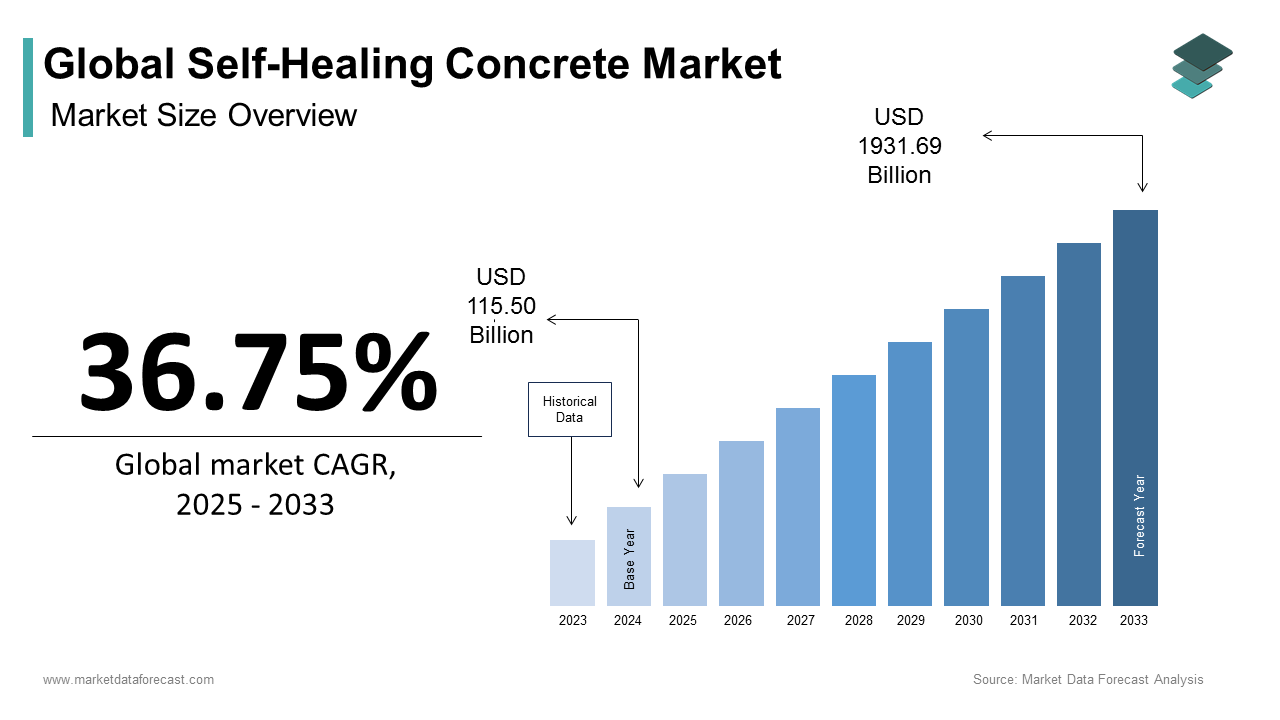
The self-healing concrete is an advanced construction material engineered to autonomously repair cracks and micro-damage through intrinsic or extrinsic mechanisms, thereby enhancing structural durability and reducing maintenance demands. According to the United Nations Environment Programme, the global construction sector accounts for nearly 39% of total carbon dioxide emissions, prompting regulatory and technical shifts toward longer-lasting materials. In Europe, over 75% of bridges and tunnels are older than 30 years, as reported by the European Commission, amplifying the urgency for durable solutions.
MARKET DRIVERS
Infrastructure Degradation and Longevity Benefits Driving Market Growth
The escalating global infrastructure degradation, which necessitates innovative, long-term repair solutions, is driving the growth of the self-healing concrete market. As per the American Society of Civil Engineers, the United States alone requires over $2.6 trillion in infrastructure investment by 2029 to address deficiencies across roads, bridges, and water systems. Self-healing concrete mitigates such challenges by extending service life by up to 50%, as demonstrated in pilot projects at Delft University of Technology, where bacterial-based concrete maintained structural integrity beyond 20 years under accelerated aging tests. This longevity reduces lifecycle costs and disruption, making it highly attractive for government and municipal agencies. Additionally, countries like India are investing heavily in smart cities and sustainable infrastructure, with plans to develop 100 smart cities under its Smart Cities Mission, fostering demand for advanced construction materials. The economic burden of infrastructure deterioration, coupled with rising urbanization, positions self-healing concrete as a strategic solution in modern civil engineering.
Environmental and Regulatory Pressure Supporting Market Expansion
The increasing regulatory and environmental pressure to reduce the carbon footprint of construction activities is expected to fuel the growth of the self-healing concrete market. The cement industry contributes approximately 8% of global CO₂ emissions, as stated by Chatham House in its 2023 report on global cement production. Self-healing concrete reduces the need for frequent repairs and replacements, thereby lowering material consumption and associated emissions. For instance, a study conducted by the University of Cardiff found that widespread adoption of self-healing technologies in the UK could reduce concrete-related emissions by up to 15% over three decades. Furthermore, green building certification systems such as BREEAM and LEED now reward durability and sustainability by encouraging developers to incorporate self-healing elements.
MARKET RESTRAINTS
High Production Costs Limiting Market Adoption
The high initial production cost compared to conventional concrete is restraining the growth of the self-healing concrete market. Manufacturing self-healing variants involves specialized components such as microcapsules, bacteria spores, or polymer-based healing agents, which can increase material costs by 25% to 40%, as documented in a 2022 study published by the International Journal of Concrete Structures and Materials. Additionally, contractors and developers often prioritize upfront savings over long-term lifecycle benefits, especially when maintenance costs are not directly borne by builders. The lack of standardized cost-benefit analysis frameworks further complicates investment justification.
Limited Long-Term Performance Data and Standardization Challenges
The limited long-term performance data and standardization among engineers and regulatory bodies are also expected to degrade the growth of the self-healing concrete market. Although laboratory results show promising crack-sealing efficiency, real-world performance over decades remains uncertain due to the technology’s relatively recent deployment. As per the National Institute of Standards and Technology, fewer than 15 full-scale structural applications of self-healing concrete have been monitored for more than eight years globally. This scarcity of longitudinal evidence impedes integration into national building codes. Countries like Germany and Japan have initiated pilot testing programs, but formal inclusion in standards such as DIN or JIS remains pending. Engineers, bound by liability and compliance requirements, remain cautious.
MARKET OPPORTUNITIES
Integration with Smart Infrastructure and Digital Twin Technologies
The integration of self-healing concrete within smart infrastructure and digital twin technologies is creating new opportunities for the growth of the self-healing concrete market. For instance, the Singapore Smart Nation Initiative employs sensor-embedded structures to predict maintenance needs, and pairing these with self-healing concrete enhances system resilience. Researchers at ETH Zurich have demonstrated hybrid systems where self-healing elements respond to data from embedded fiber-optic sensors, which trigger repair mechanisms upon crack detection. According to the International Data Corporation, global spending on smart city technologies will reach $250 billion by 2026.
Opportunities in Disaster-Resilient and Climate-Adaptive Construction
The expansion of self-healing concrete in disaster-resilient construction in seismically active and climate-vulnerable regions is accelerating the growth of the self-healing concrete market. Earthquakes, floods, and extreme weather events are increasing in frequency and intensity, with the United Nations Office for Disaster Risk Reduction recording over 7,000 major disasters between 2000 and 2019, affecting more than 4 billion people. The Japanese Cabinet Office allocates over ¥1 trillion annually to disaster mitigation, including the development of adaptive building materials. Self-healing concrete, capable of recovering structural integrity post-seismic stress, offers a strategic advantage. A 2021 study by the Tokyo Institute of Technology showed that specimens treated with microbially induced calcite precipitation retained 80% of their original strength after simulated earthquake loading, compared to 50% in conventional concrete.
REPORT COVERAGE
| REPORT METRIC | DETAILS |
| Market Size Available | 2024 to 2033 |
| Base Year | 2024 |
| Forecast Period | 2025 to 2033 |
| CAGR | 36.75% |
| Segments Covered | By Form, Application, and Region |
| Various Analyses Covered | Global, Regional, and Country Level Analysis; Segment-Level Analysis; DROC; PESTLE Analysis; Porter’s Five Forces Analysis; Competitive Landscape; Analyst Overview of Investment Opportunities |
| Regions Covered | North America, Europe, APAC, Latin America, Middle East & Africa |
| Market Leaders Profiled | Basilisk, CEMEX S.A.B. de C.V., ACC Limited, Fescon, Sika AG, GCP Applied Technologies, Kryton International Inc., Xypex Chemical Corporation, Hycrete Inc., BASF SE, Oscrete Construction Products, Avecom NV, Green-Basilisk |
SEGMENTAL ANALYSIS
By Form Insights
The intrinsic self-healing concrete segment dominated the self-healing concrete market by capturing 58.3% of the market share in 2024 with its seamless integration into conventional concrete production without requiring complex modifications. The widespread adoption of bacterial-based intrinsic concrete is particularly evident in European infrastructure projects, where the Netherlands has deployed it in over 30 civil engineering applications since 2010, according to a technical review published by Rijkswaterstaat, the Dutch Directorate General for Public Works.
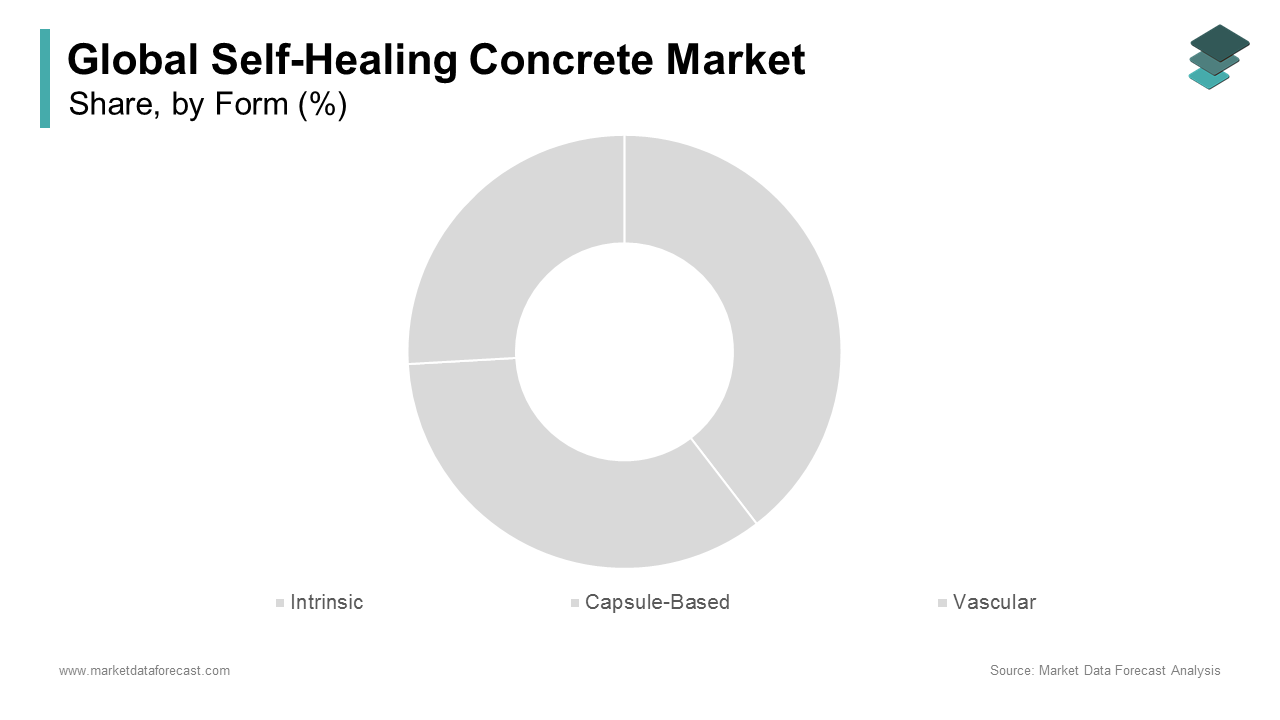
The vascular self-healing concrete segment is projected to register a CAGR of 13.6% during the forecast period, with its superior healing capacity for large-scale and recurrent damage, an advantage in dynamic structural environments. Vascular systems mimic biological circulatory networks, enabling repeated repair through interconnected channels that deliver healing agents to damaged zones. The technology’s adaptability to 3D-printed concrete structures further amplifies its potential, particularly in aerospace and high-performance infrastructure. NASA has explored vascular concrete for lunar habitat construction due to its resilience under extreme thermal cycling, signaling cross-sector interest.
By Application Insights
The infrastructure application segment was the largest and held 46.3% of the self-healing concrete market share in 2024, with the urgent need to reinforce aging transportation and utility networks. In the United States, the Federal Highway Administration estimates that over 45,000 bridges, nearly 7.5% of the national inventory, are structurally deficient. Self-healing concrete is increasingly deployed in tunnels, retaining walls, and wastewater treatment facilities where moisture exposure accelerates deterioration. The Thames Tideway Tunnel project in London, one of Europe’s largest sewage infrastructure undertakings, incorporated self-healing concrete in linings to mitigate sulfate attack and cracking, as confirmed by project engineers from Bazalgette Tunnel Limited. Moreover, China’s Belt and Road Initiative includes over 1,200 infrastructure projects across 140 countries, many of which face harsh environmental conditions, driving demand for durable construction materials.
The commercial application segment is expected to register a CAGR of 12.8% during the forecast period with rising investments in high-performance, sustainable commercial buildings and corporate commitments to green certifications. Developers are increasingly incorporating self-healing concrete in high-rise foundations and parking structures to minimize long-term maintenance liabilities. The Salesforce Tower in San Francisco, for instance, utilized advanced concrete formulations with autogenous healing properties to address seismic resilience and durability concerns. According to the World Green Building Council, 62% of commercial real estate investors now prioritize buildings with lower lifecycle maintenance costs and higher sustainability ratings.
REGIONAL ANALYSIS
Europe Market Analysis
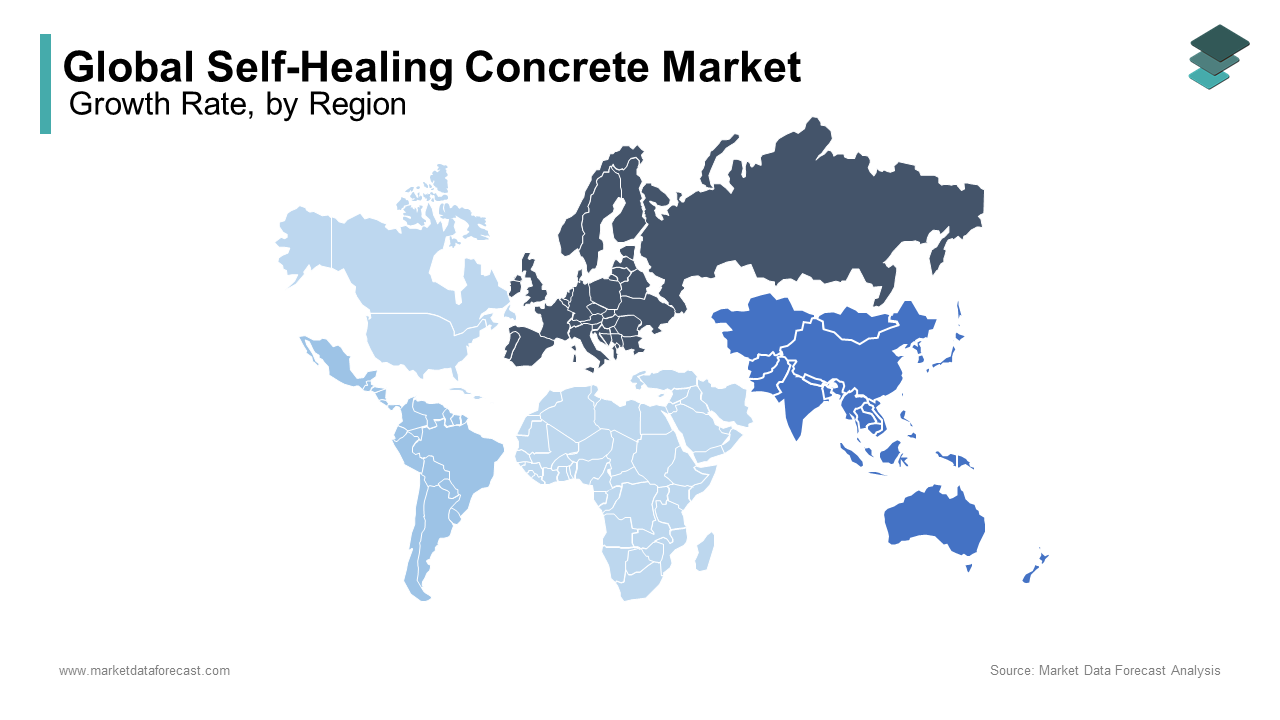
Europe was the largest contributor in the self-healing concrete market by accounting for 38.3% of the market share in 2024, with its proactive regulatory environment and early investment in sustainable construction technologies. Germany’s stringent energy efficiency standards under the EnEV (Energy Saving Ordinance) and France’s Grenelle Environment Forum have incentivized durable, low-maintenance materials. Additionally, the European Commission’s Horizon 2020 program funded more than €150 million in smart construction material research between 2014 and 2023, fostering innovation in self-healing systems.
Asia Pacific Market Analysis
Asia Pacific Self-Healing Concrete Market was positioned second by capturing 30.3% of the share in 2024, with massive infrastructure expansion and urbanization in China and India. China alone invested over $1.8 trillion in infrastructure in 2023, focusing on high-speed rail, smart cities, and coastal protection, as stated by the National Bureau of Statistics of China. India’s National Infrastructure Pipeline is aiming for $1.4 trillion in projects by 2025, and includes provisions for resilient materials in its design guidelines.
North America Market Analysis
North America Self-Healing Concrete Market growth is likely to grow with the technological innovation and federal infrastructure modernization efforts. The United States was the largest contributor in the region, with the Bipartisan Infrastructure Law allocating $1.2 trillion for transportation, water, and energy systems, creating fertile ground for advanced materials. According to the National Institute of Standards and Technology, over 230,000 miles of U.S. roads are rated in poor condition, intensifying the need for long-lasting solutions. Canada, while smaller in scale, has adopted self-healing concrete in bridge decks in Quebec and Ontario to combat de-icing salt damage.
Middle East & Africa Market Analysis
The Middle East & Africa Self-Healing Concrete Market growth is likely to grow in the coming years. The United Arab Emirates is spearheading demand through its vision for sustainable megaprojects like Expo City and NEOM’s cross-border developments. The UAE’s Green Building Regulations mandate a 25% reduction in construction-related emissions by 2030 by encouraging the use of durable materials. Saudi Arabia’s Vision 2030 includes $1 trillion in infrastructure investments, with NEOM alone planning 106 miles of linear urban infrastructure using smart materials. High ambient temperatures and saline groundwater in the region accelerate concrete degradation, which makes self-healing variants particularly valuable.
Latin America Market Analysis
Latin America Self-Healing Concrete Market growth is likely to grow, with Brazil and Mexico leading countries. Brazil has initiated trials of bacterial self-healing concrete in São Paulo’s metro expansion, aiming to reduce maintenance costs in humid, high-traffic environments. Mexico’s new Felipe Ángeles International Airport incorporated advanced concrete formulations to withstand seismic activity and subsidence. However, economic volatility and limited R&D funding constrain large-scale adoption.
COMPETITION OVERVIEW
The competitive landscape of the self-healing concrete market is characterized by technological differentiation, strategic alliances, and a race to establish credibility through real-world validation. While no single company dominates globally, European chemical and construction material giants hold a first-mover advantage due to early R&D investments and strong regulatory support. Competition is intensifying as Asian manufacturers and research institutions begin commercializing indigenous solutions, particularly in China and Japan. Smaller innovators are emerging from university spin-offs, often acquired by larger firms to accelerate product pipelines. Customer education and lifecycle cost demonstration are central to competitive positioning, as decision-makers remain cautious about upfront premiums.
KEY MARKET PLAYERS
A few of the dominating players in the global self-healing concrete market include
- Basilisk
- CEMEX S.A.B. de C.V.
- ACC Limited
- Fescon
- Sika AG
- GCP Applied Technologies
- Kryton International Inc.
- Xypex Chemical Corporation
- Hycrete Inc.
- BASF SE
- Oscrete Construction Products
- Avecom NV
- Green-Basilisk
Top Strategies Used By Key Market Participants
Key players in the self-healing concrete market are primarily deploying collaborative innovation, geographic expansion, product differentiation, strategic acquisitions, and pilot project demonstrations. Companies are increasingly partnering with academic institutions and government agencies to validate long-term performance and gain regulatory acceptance. Firms are also customizing formulations for regional environmental conditions, such as high salinity or seismic activity, to enhance relevance in diverse markets.
LEADING PLAYERS IN THE SELF-HEALING CONCRETE MARKET
BASF SE
BASF SE has emerged as a pivotal innovator in the self-healing concrete domain, which is leveraging its expertise in chemical admixtures to develop advanced intrinsic healing technologies. In 2023, the company launched a dedicated Center for Sustainable Construction in Mumbai, focusing on durability-enhancing solutions tailored to tropical climates. BASF also partnered with the National University of Singapore to study the long-term performance of self-healing formulations under high humidity and salt exposure.
Sika AG
Sika AG has positioned itself as a global frontrunner in construction chemicals, with significant advancements in capsule-based self-healing concrete systems. In the Asia Pacific, Sika has deployed its SikaGrout-213 SH technology in infrastructure projects, including tunnel linings in Japan and bridge decks in Australia. The company established a regional Innovation Hub in Bangkok in 2022, specifically dedicated to smart and durable concrete solutions. In 2024, Sika initiated a joint pilot with Obayashi Corporation in Japan to test self-healing concrete in seismic-resistant structures, combining encapsulated polymers with fiber-reinforced concrete. Additionally, Sika strengthened its technical service network across Southeast Asia, which is training over 500 engineers on proper application techniques.
LafargeHolcim (now Holcim)
LafargeHolcim (now Holcim) has pioneered the integration of microbial self-healing technologies into cementitious materials through its ECOPact green concrete range, which now includes variants with autogenous healing properties. In the Asia Pacific, Holcim has implemented self-healing solutions in large-scale developments in the Philippines and Vietnam, where rapid infrastructure growth meets aggressive environmental degradation. In 2023, the company launched ECOPact Max in Singapore, a carbon-reduced concrete with enhanced durability features designed for high-rise and marine applications. Holcim also partnered with the University of Technology Sydney to evaluate the long-term crack-sealing efficiency of its formulations under coastal exposure.
MARKET SEGMENTATION
This research report on the global self-healing concrete market is segmented and sub-segmented into the following categories.
By Form
- Intrinsic
- Capsule-Based
- Vascular
By Application
- Residential
- Industrial
- Commercial
- Infrastructure
By Region
- North America
- Europe
- Latin America
- Asia Pacific
- Middle East & Africa
Frequently Asked Questions
1. What factors are driving the growth of the self-healing concrete market?
Key drivers include infrastructure degradation, urbanization, demand for sustainable construction materials, regulatory support for carbon reduction, and adoption in smart cities and disaster-resilient infrastructure.
2. What are the main restraints on the market?
High initial production costs, lack of long-term performance data, limited standardization, and reluctance of builders to invest in lifecycle benefits over upfront savings.
3. What opportunities exist in this market?
Integration with smart infrastructure, digital twin technologies, disaster-resilient construction, and sustainable building certifications such as BREEAM and LEED.
4. How does self-healing concrete reduce environmental impact?
It lowers lifecycle emissions by reducing the need for frequent repairs and replacements, cutting down cement use and associated CO₂ emissions.
5. What is the cost difference compared to conventional concrete?
Self-healing concrete can cost 25–40% more than traditional concrete due to specialized healing agents.
6. What types of self-healing mechanisms are used?
The most common include bacterial-based healing, encapsulated polymer healing agents, vascular networks, and mineral admixtures.
7. What role does regulation play in market growth?
Government policies on sustainable construction, carbon reduction, and durability standards support market expansion, but a lack of standardization delays widespread adoption.
8. How does self-healing concrete contribute to smart cities?
It reduces maintenance needs and integrates with sensor technologies in smart infrastructure, enhancing resilience and cost efficiency.
9. What industries or applications use self-healing concrete the most?
Bridges, tunnels, highways, dams, water systems, residential & commercial buildings, and disaster-resilient structures.
10. What is the future outlook for the self-healing concrete market?
The market is expected to grow rapidly due to rising infrastructure investments, urbanization, sustainability mandates, and advancements in smart materials research.
Related Reports
Access the study in MULTIPLE FORMATS
Purchase options starting from
$ 2500
Didn’t find what you’re looking for?
TALK TO OUR ANALYST TEAM
Need something within your budget?
NO WORRIES! WE GOT YOU COVERED!
Call us on: +1 888 702 9696 (U.S Toll Free)
Write to us: sales@marketdataforecast.com