- Product Description Description
- Table of Contents TOC
- List of Table & Figure LOT
- Get Free Sample PDF Sample PDF
Market Size, 2025
$4.56 BnMarket Estimate, 2026
$4.82 BnMarket Forecast, 2034
$7.57 BnCAGR, 2026–2034
5.8%Executive Summary: Global Slewing Bearings Market
- Market Scope: Comprehensive analysis of the global slewing bearings market tracking rolling elements, gear configurations, application domains, design structures, and regional performances.
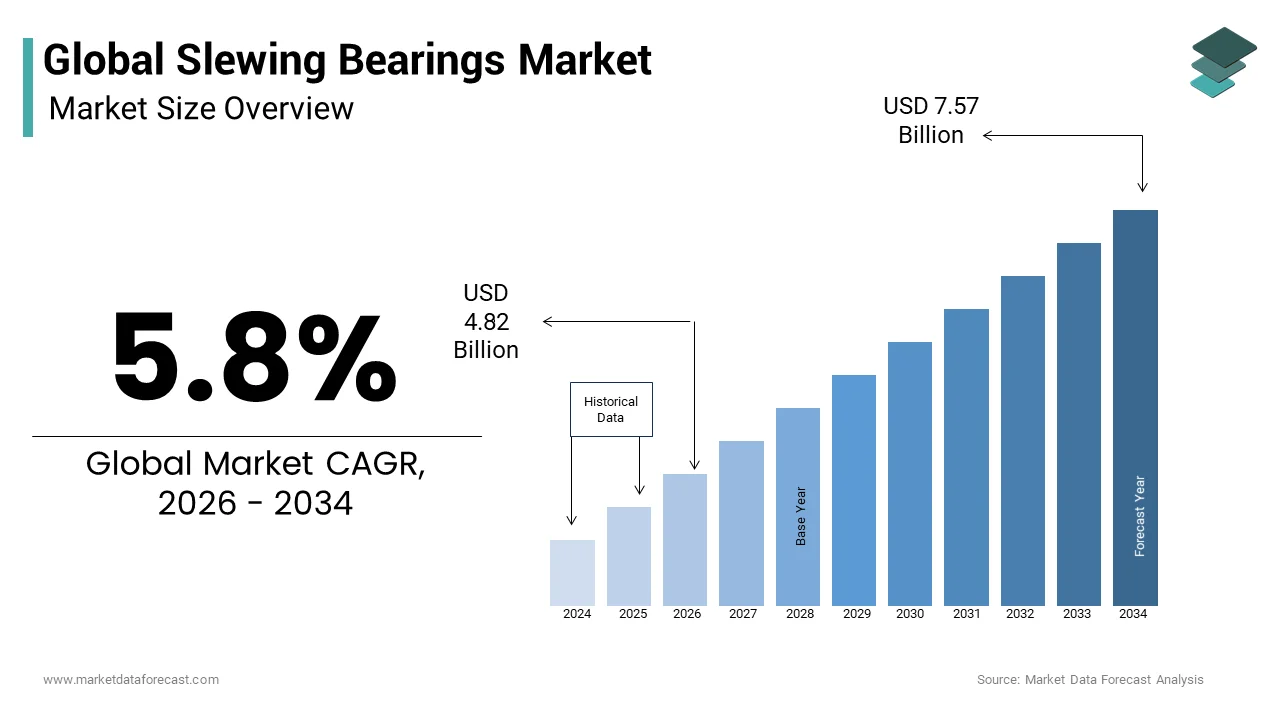
- Market Valuation: Valued at USD 4.56 billion in 2025, estimated at USD 4.82 billion in 2026, and projected to reach USD 7.57 billion by 2034, expanding at a steady CAGR of 5.8% from 2026 to 2034.
- Primary Growth Drivers: Surging global adoption of renewable energy (wind and solar tracking systems), rapid industrial expansion across heavy machinery and construction sectors, and growing automation and robotics deployment.
Key Market Segment Metrics (2026–2034)
| Category | Leading Segment (Base Position) | Fastest-Growing / High-Growth Segment |
|---|---|---|
| By Rolling Element | Roller Segment (dominates market share due to superior heavy-load capacities for construction machinery, cranes, and wind turbines) | Ball Segment (fastest-growing segment ideal for faster rotational speeds, lower friction, and light-to-medium-duty applications) |
| By Gear Type | External Gear (leads share since outer-ring gear teeth offer easy access and attachment for precise positioning equipment) | Internal Gear (high-growth segment valued for its compact, streamlined design in space-restricted environments) |
| By Application | Wind and Solar Energy (dominates market share propelled by global green energy incentives and turbine/tracker positioning needs) | Aerospace and Defense (registers the fastest CAGR driven by radar systems, satellite deployment, and aircraft landing gears) |
| By Design | Cross Roller Slewing Ring Bearing (leads prominent share for high-precision, multidirectional load stability) | Bi-Angular Roller / Taper Segment (gaining high traction across specialized heavy industrial applications) |
| By Region | North America (leads global market revenue backed by robust infrastructure investments, industrial automation, and energy projects) | Asia-Pacific (fastest-growing regional market driven by soaring renewable energy installations and manufacturing in China, India, and Japan) |
Major Market Players & Industry Landscape
Market Structure: Highly competitive global landscape featuring multinational bearing manufacturers focusing on precision engineering, custom design configurations, and high-load durability.
Key Companies: Liebherr-International AG, SKF Group, Xuzhou Helin Slewing Bearing Co., Ltd., Rollix (IMO), The Timken Company, Schaeffler AG, NTN Corporation, ThyssenKrupp AG, JTEKT Corporation, and NSK Ltd.
Global Slewing Bearings Market Size
The global slewing bearings market size will reach USD 4.56 billion in 2025 and is anticipated to reach USD 4.82 billion in 2026 and to reach from USD 7.57 billion by 2034, growing at a CAGR of 5.8% during the forecast period 2026 to 2034.
MARKET OVERVIEW
Slewing bearings enable 360° rotation and heavy-load precision in modern machinery.
The specialized components that allow rotational movement between two components, often a stationary base and a rotating structure, are the slewing bearings, also referred to as turntable bearings. They are made up of an inner and an outer ring with rolling components, allowing for controlled and smooth motion even while carrying big loads. Slewing bearings are essential in various applications, such as industrial machinery, cranes, wind turbines, and construction machinery. Slewing bearings ensure structural integrity and exact positioning while also increasing efficiency by reducing friction and wear. They are increasingly important in modern engineering and manufacturing because they allow 360-degree rotation, which enables machines to perform operations with more accuracy and flexibility.
MARKET DRIVERS
Rising renewable energy adoption is driving strong growth in the slewing bearings market.
The growing demand for renewable energy is one of the significant drivers of the slewing bearings market growth. Slewing bearings play a crucial role as there is an increased focus on renewable energy sources like solar and wind globally. They are essential components of solar tracking systems, ensuring exact panel alignment for maximum sunlight exposure, and wind turbines offer optimal blade positioning for capturing energy. The demand for efficient and reliable slewing bearings is further induced by governments promoting renewable energy through incentives and regulations, and increased environmental awareness, driving investments in wind and solar installations. These attributes are majorly influencing the market for slewing bearings, leading to a boost in market growth.
Rapid industrial expansion is fueling strong demand for slewing bearings across heavy machinery sectors.
The rising industrial expansion is substantially propelling the slewing bearings market growth. The requirement for heavy machinery and equipment with slewing bearings has grown drastically as a result of the rapid expansion of industries, including construction, mining, material handling, and manufacturing. The efficient operation of cranes, excavators, conveyors, and other industrial gear is made possible with the critical function that these bearings play in providing smooth and controlled rotating movement. Hence, this driver significantly contributes to the growing demand for slewing bearings in various industries.
MARKET RESTRAINTS
One of the major restraints on the slewing bearings market expansion is the higher production costs of these bearings. The high cost of slewing bearings production is due to its complex design, precision manufacturing, and use of specialty materials. The affordability and competitiveness of products containing slewing bearings can be affected by these costs, especially in price-sensitive markets. Moreover, the cost-sensitive nature of certain sectors restricts the adoption of slewing bearings, limiting their market penetration as well as preferring more affordable alternatives. Hence, this high-cost factor is restraining the market demand globally.
High manufacturing costs due to complex design and materials are limitingthe slewing bearings market growth.
The technical expertise requirement is another notable restraint on the slewing bearings market growth. Due to the complicated design of these components, proper slewing bearing installation, maintenance, and operation require specialized knowledge and skills. Slewing bearing installation and maintenance can be difficult for end users without sufficient expertise, which could result in early wear, decreased operating effectiveness, and safety issues. Costs associated with hiring skilled employees can go up if companies spend money on training or hiring specialized experts. In addition, the lack of available experience could deter potential users from implementing slewing bearings, particularly in sectors with a shortage of qualified workers. This limitation might prevent slewing bearings from being adopted more widely, hence restricting the market growth.
MARKET OPPORTUNITIES
Rising infrastructure development is boosting demand for slewing bearings.
A significant opportunity for market growth is offered by the expanding infrastructure development. The demand for bulky machinery and devices integrated with slewing bearings increases significantly as cities experience rapid urbanization and transportation networks evolve. Slewing bearings are essential for providing accurate movement and positioning in various structures, including large buildings, modern transportation networks, port facilities, and energy projects. The slewing bearings market is at the forefront of influencing today's urban areas as a result of the boom in infrastructure investments.
Automation growth is boosting demand for slewing bearings in robotic and industrial systems.
The increasing adoption of automation is another significant opportunity for the slewing bearings market growth. The demand for precise rotational movement offered by slewing bearings increases significantly as various sectors adopt automation to boost efficiency and production. Slewing bearings are critical components of automated systems because they provide precise positioning and controlled rotation. Automation systems that use slewing bearings for smooth and effective operation are currently integrated into industries involving manufacturing, shipping, warehousing, and even healthcare. This opportunity is further enhanced by the trend toward Industry 4.0, as modern manufacturing processes require reliable and high-performance slewing bearings for robotic arms, conveyor systems, and other automated machinery. This will collectively contribute to an increase in the demand for slewing bearings as the automation revolution continues in the coming years.
COVID-19 Impact on Slewing Bearings Market
Initially, the COVID-19 pandemic severely impacted market growth due to increasing restrictions and lockdowns, resulting in supply chain disruptions and mainly project delays in several industries. Also, the slewing bearings market sales were hampered by a drop in demand for manufacturing and construction during the pandemic. On the other hand, infrastructure investments and automation promoted slewing bearings in the construction, renewable energy, and logistics industries as economies adapt and recover. Market demand is also fueled by the need for effective machinery to reduce human contact.
REPORT COVERAGE
| REPORT METRIC | DETAILS |
| Market Size Available | 2025 to 2034 |
| Base Year | 2025 |
| Forecast Period | 2026 to 2034 |
| CAGR | 5.8% |
| Segments Covered | By Rolling Element, Application, Design, Gear Type, and Region |
| Various Analyses Covered | Global, Regional & Country Level Analysis, Segment-Level Analysis, DROC, PESTLE Analysis, Porter’s Five Forces Analysis, Competitive Landscape, Analyst Overview on Investment Opportunities |
| Regions Covered | North America, Europe, APAC, Latin America, Middle East & Africa |
| Market Leaders Profiled | Liebherr-International AG, SKF Group, Xuzhou Helin Slewing Bearing, THE TIMKEN COMPANY, Schaeffler AG, NTN Corporation, ThyssenKrupp AG, JTEKT Corporation,n and Others. |
SEGMENTATION ANALYSIS
By Rolling Element Insights
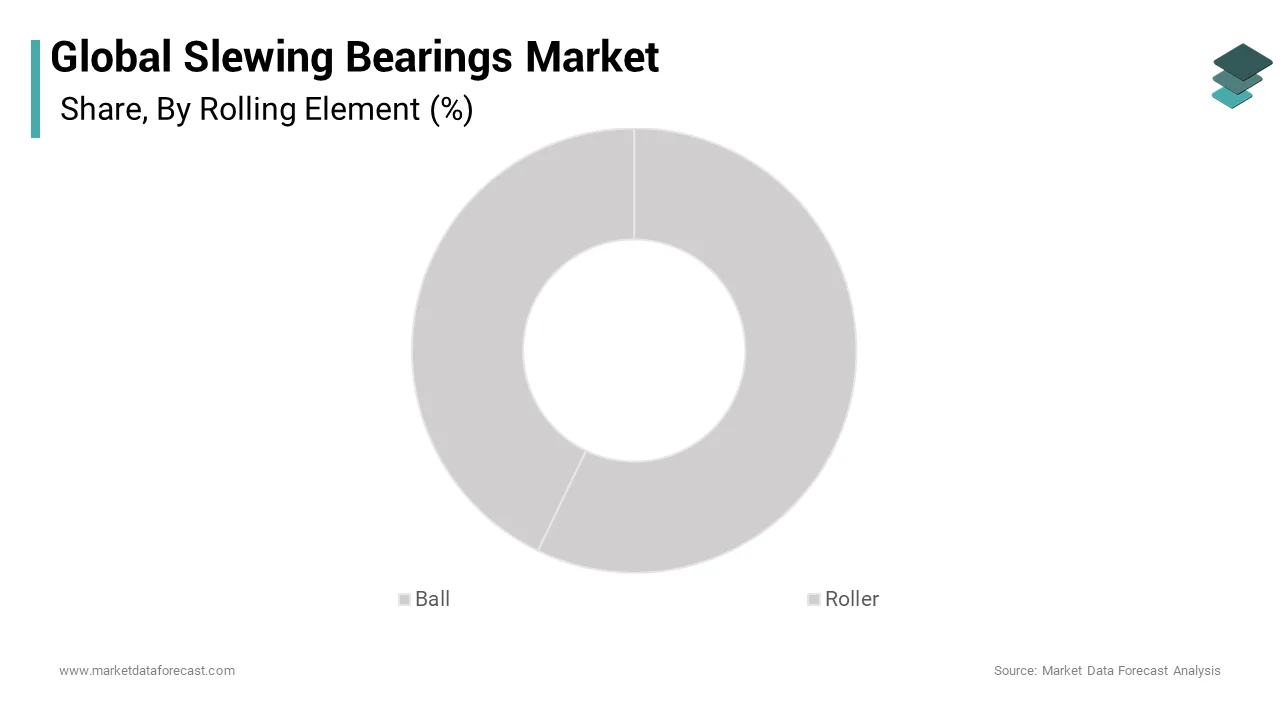
By rolling element, the roller segment is anticipated to dominate the slewing bearings market share during the period of study. As compared to ball bearings, roller slewing bearings can withstand heavier loads and have enhanced capacities. Hence, heavy-duty equipment like construction machinery, cranes, wind turbines, and large industrial machinery uses these bearings. Hence, this segment is majorly influencing the shares of the market. However, the ball segment is expected to grow at the fastest rate during the forecasted perioBallall slewing bearings are suitable for applications requiring faster rotational speeds and lighter loads, to lower friction and move more smoothly. Hence,e boosting its demand for machines and equipment designed for light to medium duty.
By Gear Insights
By gear type, the external gear segment is ruling the slewing bearings market share during the projected period. The outer ring of external gear slewing bearings is equipped with gear teeth. As the external gear can be easily accessed and attached to other components, these bearings are often used for equipment that needs precise positioning and controlled movement. This factor is significantly influencing the market demand for this segment. However, the internal gear segment is deemed to have significant growth in the coming years. As they offer a compact and streamlined design, internal gear slewing bearings are commonly used in applications where space restrictions limit the use of external gears. This considerable attribute influences the shares of the market.
By Application Insights
By application, the wind and solar energy segment is dominating the slewing bearings market share during the anticipated period. In wind turbines and solar tracking systems, slewing bearings serve as crucial components. The requirement for reliable and high-performance slewing bearings in these applications is being driven by the rising demand for renewable energy sources. This factor is notably boosting the market demand in this segment. At the same time, the aerospace and defense segment is expected to grow at the fastest CAGR during the projected period. Slewing bearings are used in various aerospace and defense applications, such as radar systems, satellite deployment mechanisms, aircraft landing gear systems, and more, and provide essential rotational movement and position, ensuring secure and effective operations. This is significantly inducing more demand for slewing bearings in this expanding segment.
By Design Insights
Based on design, the cross roller slewing ring bearing segment is leading the prominent shares of the mmarketet wherethe as the bi-angular roller or taper segment is gaining traction over the growth rate of the market.
REGIONAL ANALYSIS
By region, North America is ruling the market share during the forecasted period. Owing to increasing applications of slewing bearings in various industries, including manufacturing, energy, construction, and more. The slewing bearings market demand in this region is further influenced by the rising infrastructural development, industrial automation, and the renewable energy industry. However, the Asia Pacific segment is expected to grow at the fastest rate during the forecasted period. The demand for slewing bearings continues to grow in this region due to the booming renewable energy industry and the expanding manufacturing industries in countries like China, Japan, South Korea, and India.
KEY MARKET PLAYERS
Major Key Players in the Global Slewing Bearings Market Include
- Liebherr-International AG
- SKF Group
- Xuzhou Helin Slewing Bearing Co., Ltd.
- Rollix, IMO
- THE TIMKEN COMPANY
- Schaeffler AG
- NTN Corporation
- ThyssenKrupp AG
- JTEKT Corporation
- NSK Ltd.
RECENT MARKET NEWS
- In October 2022, Carter Manufacturing established its collaboration with OTAR, situated in Italy. Precision bearings and other equipment required by the aerospace industry are produced and distributed by the former. Both commercial and industrial bearings,a nd those utilized in the aerospace industry, are promoted by the company.
MARKET SEGMENTATION
This research report on the global slewing bearings market is segmented and sub-segmented into the following categories.
By Rolling Element
- Ball
- Roller
By Gear Type
- Internal Gear
- Ungeared
- External Gear
By Application:
- Wind and Solar Energy
- Aerospace and Defense
- Medical
- Industrial Machinery
- Oil and Gas
- Mining
- Others
By Design
- Cross Roller Slewing Ring Bearing
- Bi-Angular Roller or Taper
- Single-row Four Point Contact Ball Slewing Ring Bearing
- Four and Eight Point Contact Ball
- Three-Row Roller Slewing Ring Bearings
- Double-Row Ball Slewing Ring Bearings
By Region
- North America
- Europe
- Asia Pacific
- Latin America
- Middle East And Africa