- Product Description Description
- Table of Contents TOC
- List of Table & Figure LOT
- Get Free Sample PDF Sample PDF
Market Size, 2025
$726.5 BnMarket Estimate, 2026
$836.49 BnMarket Forecast, 2034
$2,584 BnCAGR, 2026–2034
15.14%Global Smart Cities Market Size, Growth, Trends & Forecast (2026–2034)
The global smart cities market size was valued at USD 726.50 billion in 2025, is estimated at USD 836.49 billion in 2026, and is projected to reach USD 2,584.00 billion by 2034, expanding at a compound annual growth rate (CAGR) of 15.14% from 2026 to 2034. Market acceleration is primarily driven by rising government investments, rapid urbanization, public-private partnerships, and the integration of artificial intelligence (AI) and the Internet of Things (IoT) across urban infrastructure.
Key Executive Metrics (At-a-Glance)
- 2025 Base Valuation: USD 726.50 Billion
- 2026 Current Valuation: USD 836.49 Billion
- 2034 Forecast Valuation: USD 2,584.00 Billion
- Compound Annual Growth Rate (CAGR): 15.14% (2026–2034)
- Dominant Focus Area Segment: Smart Transportation & Traffic Management (leading through congestion control and connected vehicle expansion)
- Fastest-Growing Focus Area Segment: Smart Utilities & Infrastructure (surging via advanced metering and distribution management systems)
- Dominant Solution Segment: Emergency Management & Safety Systems (critical for municipal crisis response)
- Dominant Regional Market: Europe & North America (anchored by early technology adoption and structural municipal funding)
- Fastest-Growing Regional Market: Asia-Pacific (propelled by large-scale government smart city missions in India, China, and Southeast Asia)
Core Market Drivers
- Government Initiatives & Funding: Extensive public sector investments, cross-border collaborations, and strategic framework programs designed to optimize resource distribution.
- Technological Convergence (IoT & AI): Escalating deployment of connected hardware, data platforms, and AI-driven automation across healthcare, education, and transport.
Primary Market Restraints & Challenges
- Cybersecurity & Resource Strain: Rising vulnerability to network threats alongside ecological resource depletion caused by concentrated urban scaling.
Global Smart Cities Market Segmentation Breakdown
| Segment Category | Leading Sub-Segment | Fastest-Growing Sub-Segment |
|---|---|---|
| By Focus Area | Transportation | Utilities |
| By Transportation | Traffic Management | Connected Vehicles |
| By Smart Building & Solution | Emergency Management System | Building Energy Optimization |
| By Region | Europe / North America | Asia-Pacific |
Major Industry Players Profiled
Key global technology titans and infrastructure leaders shaping the smart cities ecosystem include IBM Corporation, Cisco Systems Inc., Microsoft Corporation, Oracle Corporation, Huawei Technologies Co. Ltd., Ericsson, Siemens AG, Schneider Electric SE, AT&T Inc., and Hitachi Corporation.
Global Smart Cities Market Size
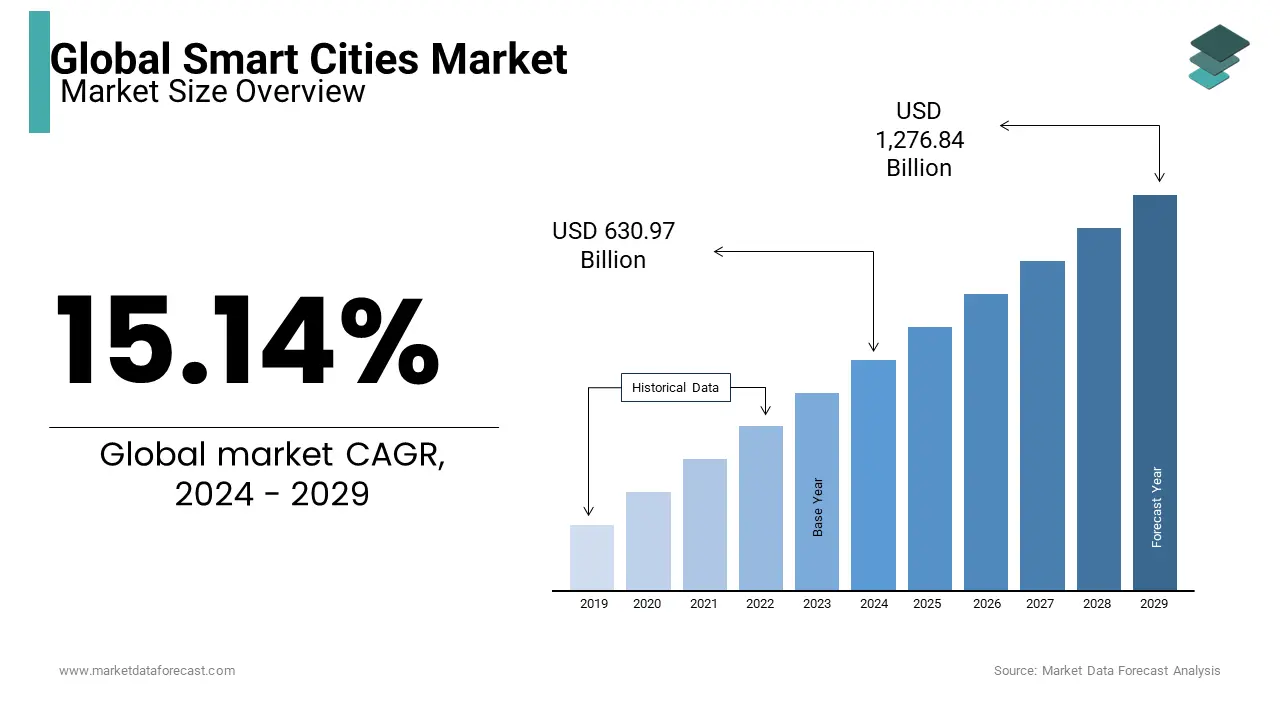
The global smart cities market was valued at USD 726.5 billion in 2025. The global market is predicted to reach USD 836.49 billion in 2026 and USD 2,584 billion by 2034, growing at a CAGR of 15.14% during the forecast period.
MARKET DRIVERS
The government's increasing investment in smart cities and initiatives taken by governments drive the overall demand for smart cities.
In the global smart cities market, various factors play an essential role in growth and development. Also, rising urbanization boosting the technology market in smart cities, which helps the consumer in daily life, is one of the important driving factors for the changing preference of the consumer towards smart city plans. The rising involvement in the sector of corporates and public-private partnerships is the new market-driving opportunity for smart city projects. Also, the manufacturing of electric vehicles has started for smart cities to reduce air and noise pollution, promoting market growth. In the Asia Pacific region, the technology base components are implemented in smart cities, which are pivotal in the growth of the Asia Pacific smart city market. In Latin America, the changing preferences of people towards the smart city and demand for technology give new opportunities for their smart city projects, which are growing. Also, people use Information and communication technology day by day, so the use of internet services drives the new trend in the industry. Hardware and software have increased the market growth with the help of computer-based services in the global smart city market. Besides, the use of Artificial Intelligence in the Smart City market drives the major adoption in the sectors of education, healthcare, transportation, and so on.
MARKET RESTRAINTS
The increasing demand for smart cities is making a few changes in the traditional methods of human beings.
The technology used to improve lifestyle is creating distance between rural areas and urban areas. Continually searching for and acquiring land is the major restraint factor. The growth of Population and well-planned cities in every country create difficulty in providing smart city facilities for everyone. Also, increasing pollution and overcrowding increased because of urbanization and industrialization due to smart cities. Smart City provides a lavish lifestyle, but due to this reason, natural resources are going to exist, and they come in danger. Some government rules are in favor of nature, but they do not give permission for smart cities. A smart city lifestyle is highly cost-effective, so middle-class and lower-class consumers will not adopt the facilities of a smart city. Also, the increasing demand for internet service is creating cybercrime, and it is the most harmful and restraining aspect.
REPORT COVERAGE
| REPORT METRIC | DETAILS |
| Market Size Available | 2025 to 2034 |
| Base Year | 2025 |
| Forecast Period | 2026 to 2034 |
| CAGR | 15.4% |
| Segments Covered | By Focus Area, Transportation, Smart Building and Solution, and Region |
|
Various Analyses Covered | Global, Regional & Country Level Analysis, Segment-Level Analysis, DROC, PESTLE Analysis, Porter’s Five Forces Analysis, Competitive Landscape, Analyst Overview on Investment Opportunities |
| Regions Covered | North America, Europe, APAC, Latin America, Middle East & Africa |
|
Market Leaders Profiled | IBM Corporation (U.S.), Ericsson (Sweden), Cisco Systems Inc.(U.S.), Oracle Corporation (U.S.), Microsoft Corporation (U.S.), Huawei Technologies Co Ltd. (China), AT&T Inc. (U.S), Schneider Electric SE (France), Siemens AG (Germany), Hitachi Corporation (U.S.) and Others. |
SEGMENTAL ANALYSIS
By Focus Area Insights
Air transportation is a major element of a smart city and has a major share. APAC and MEA are the regions that will grow in smart city transportation in the future. Smart utilities are categorized as advanced metering infrastructure, distribution, and management systems. In the utilities sector, the distribution management system drives demand response management, therefore having a notable market share.

By Transportation Insights
In the prime time of smart city management, the focus was on traffic management and passenger information, but now the focus is on the connected vehicle segments.
By Smart Building and Solution Insights
Smart cities will face most of these factors in the future, so the management of this section is really important. Emergency services are the most important part of a smart city.
REGIONAL ANALYSIS

After the European countries, Asia Pacific is the leading smart city market after the European countries. In this region, almost 80 countries have completed the intelligent city infrastructure. With favorable government initiatives, different countries are making some development under smart city projects. For instance, India invested 107.95 crore rupees in smart city projects. China invested 500 crores, and Dubai planned a 100% paperless government.
KEY MARKET PLAYERS
IBM Corporation (U.S.), Ericsson (Sweden), Cisco Systems Inc.(U.S.), Oracle Corporation (U.S.), Microsoft Corporation (U.S.), Huawei Technologies Co Ltd. (China), AT&T Inc. (U.S), Schneider Electric SE (France), Siemens AG (Germany), Hitachi Corporation (U.S.) and Others.
MARKET SEGMENTATION
This research report on the global smart cities market has been segmented and sub-segmented based on the focus area, transportation, smart building and solution, and region.
By Focus Area
- Transportation
- Building
- Utilities
By Transportation
- Smart Ticketing
- Traffic Management
- Passenger Information Management System
- Freight Information System
- Connected Vehicles
By Smart Building and Solution
- Building Energy Optimization
- Emergency Management System
- Parking Management Systems
By Region
- North America
- Europe
- APAC
- LATAM
- Middle East and Africa