- Product Description Description
- Table of Contents TOC
- List of Table & Figure LOT
- Get Free Sample PDF Sample PDF
Market Size, 2025
$4.79 BnMarket Estimate, 2026
$5.34 BnMarket Forecast, 2034
$12.66 BnCAGR, 2026–2034
11.4%Executive Summary: Global Smart Mirror Market
- Market Scope: Comprehensive global smart mirror market assessment analyzing component breakdown, end-user applications, installation formats, distribution channels, and regional adoption trends.
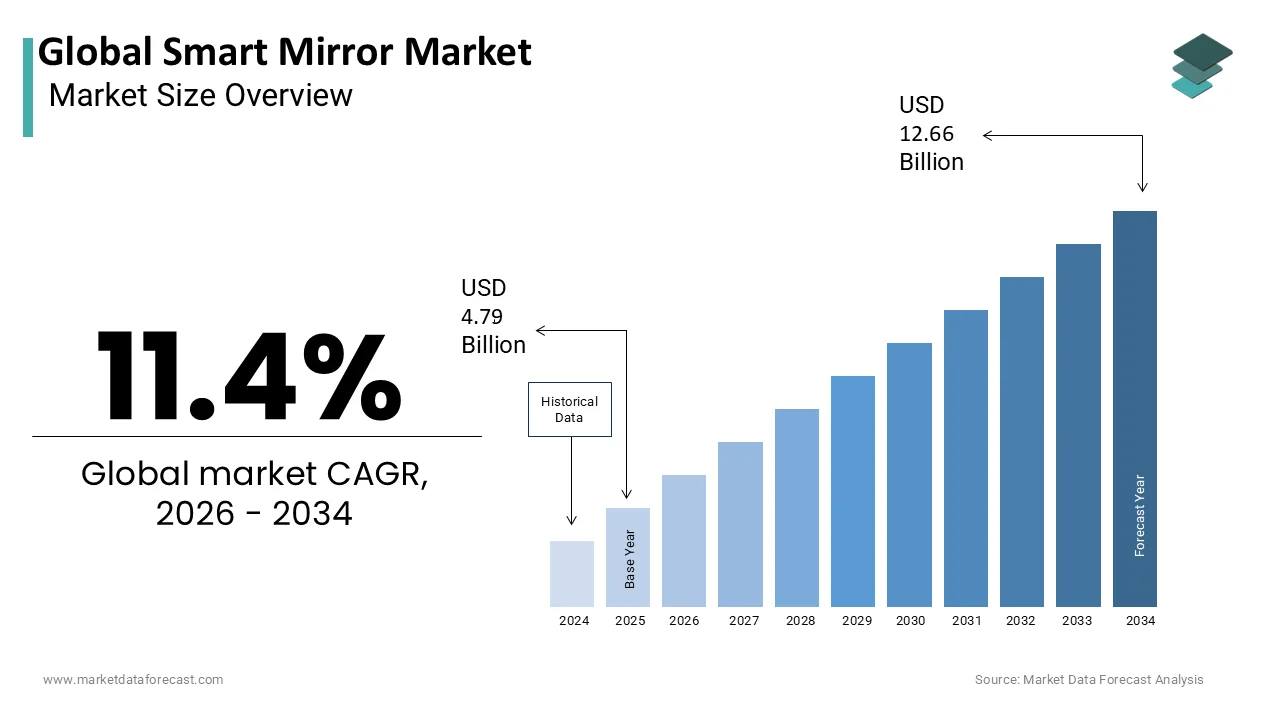
- Market Valuation: Valued at USD 4.79 billion in 2025, estimated at USD 5.34 billion in 2026, and projected to scale up to USD 12.66 billion by 2034, registering a steady CAGR of 11.4% (2026–2034).
- Primary Growth Drivers: Surging demand for smart rear-view mirrors and blind-spot vision systems in automotive sectors, digital store transformations for interactive customer engagement in retail, and the rise of IoT-enabled smart homes.
Key Market Segment Metrics (2026–2034)
| Category | Leading Segment Position | Fastest-Growing / Core Segment |
|---|---|---|
| By Component | Hardware (capturing a major share due to high-end integration of displays, sensors, cameras, and audio/connectivity components) | Software and Services segments supporting customized features and UI platforms |
| By End-User Application | Commercial Application (dominating market revenue and registering high growth alongside expanding hospitality and retail sectors) | Residential and Healthcare segments backed by government concessions and wellness trends |
| By Installation Type | Wall-mounted Segment (accounting for maximum revenue share due to space conservation, enhanced room appearance, and reduced fall risks) | Free-standing segment |
| By Distribution Channel | Offline Distribution Channel (spurring market growth via in-person shopping, touching, and live product interactions) | Online E-commerce platforms gaining rapid adoption |
| By Region | North America (emerging as the largest region with maximum market share driven by household density and new product launches) | Europe (second largest market penetration in the U.K., Germany, and France) and Asia-Pacific |
Major Market Players & Market Structure
Market Structure: Highly competitive landscape comprising specialized smart glass manufacturers, automotive tier-1 suppliers, and electronics giants innovating around multimodal sensors, AI integration, and custom displays.
Key Companies: Electric Mirror, Inc., Seura Solutions, Majestic Mirror & Frame, Avis Electronics, Foshan Eterna Intelligent Bathroom Co., Ltd., MirrorMedia Ltd., Samsung Electronics, LumiDesign, and Gentex Corporation.
Global Smart Mirror Market Size
The Global Smart Mirror Market was valued at USD 4.79 billion in 2025, is estimated to reach USD 5.34 billion in 2026, and is projected to reach USD 12.66 billion by 2034, growing at a CAGR of 11.4% from 2026 to 2034.
A type of mirror incorporated with electronic and smart technologies like IoT is called the smart mirror. These consist of high-quality electronic displays to display various smart mirror features. Smartphones, computers, tablets, and laptops can also be used to operate the smart mirrors remotely. To provide a unique experience and engage more customers, these mirrors are being used in the automotive industries and retail stores.
Market Drivers
The automotive sector is seeing a surge in demand for the adoption of smart mirrors.
In the automotive sector, smart mirrors have the application of a smart rear-view mirror for increasing the driver's safety. It has the advantage of working under numerous conditions, and the device is equipped with a display screen that can provide blind spot vision to the driving person. Switching between the monitor and the traditional view makes it more adaptable to the user. The camera component of the smart mirror is fixed on the rear end of the vehicle to offer an unobstructed view of the rear flanks so that driver can see the blind spot and condition of the traffic. These unique features of smart mirrors act as a driving factor for the increased demand in the automotive sector and propel the smart mirror market.
The retail industry is getting the stores transforming into digital form.
To compete with the competitors, numerous retail stores are finding different ways to engage customers by utilizing technology advancements. Digital stores are providing a digitalized shopping experience to their users. A departmental store in the U.S. has incorporated smart mirrors to streamline the process of retying clothes and help compare the different clothing outfits by placing them side-by-side. This transformation can help the customers share images with friends via social media to express their opinion on the outfit. Such features change the purchasing behavior of the customers, making the retail stores market. The advantage feature for the stores is they can avoid the maintenance cost and reduce the uncertain outfit damages during the trial process. Such new innovative transformations are driving the smart mirror market during the forecast period.
Market Restraints
Many restraints present in the smart mirror market will hinder the growth and revenue generation of the market. When cost compared with traditional mirrors, smart mirrors are expensive. The high cost of smart mirrors limits the initial adoption by users worldwide. The high cost is attributed to the use of high-end components like sensors, cameras, displays, and connectivity systems in manufacturing smart mirrors. The cyber-attacks may occur as data connectivity, i.e., personal and confidential data, is associated with smart mirrors. As a result, the security issues raise obstructing the market growth. Smart mirrors are less aware of the large population in the world, mostly the people living in developing countries, which creates a market hindrance.
Market Opportunities
The surge in the adoption of smart homes, along with the advances in Industry 4.0, is a great opportunity for the smart mirror market growth and development. Smart appliances, smart security, and home infrastructure come under smart homes. These work on the principle of the Internet of Things (IoT). From the living area, the data is collected, stored, and utilized for various applications in smart homes. Smart homes are nowadays becoming a most adopted feature by people. Sensor connectivity and remote access to all appliances in the home are possible with the use of the IoT in smart homes. This feature is the prime reason for the increased demand for smart homes, mostly in developed and developing countries. Many key market players are launching new products the making more adopt smart homes. For instance, the Nest, acquired by Google, has manufactured programmable and wi-fi-enabled thermostats that allow users to operate their homes' temperature systems remotely. The up-surging demand for smart homes is a major opportunity for the smart mirror market growth rate.
COVID-19 Impact on the Smart Mirror Market
The negative impact on the smart mirror market is noticed due to COVID-19. The consequences raised due to the pandemic have changed the market. The imposition of the strict lockdown, travel restrictions, and social distancing resulted in the partial shutdown of the industry and temporary stoppage of operations. The economies of the nations in the world have seen a downfall in growth and revenue. The demand for smart mirrors has drastically declined due to the increased consumer preference for the necessary goods and reduced personal disposable income. The expenses have also increased towards safety and healthcare, where the consumer preference for luxury products and other nonessential goods has reduced. The pandemic has hampered the supply chain, and logistics faced the same problem. The pandemic has created an imbalance between supply and demand due to delayed delivery of raw materials and finished products. The market is expected to regain after the pandemic.
REPORT COVERAGE
| REPORT METRIC | DETAILS |
| Market Size Available | 2025 to 2034 |
| Base Year | 2025 |
| Forecast Period | 2026 to 2034 |
| Segments Covered | By Component, End-User Application, Installation Type, Distribution Channel, Region |
|
Various Analyses Covered | Global, Regional & Country Level Analysis, Segment-Level Analysis, DROC, PESTLE Analysis, Porter’s Five Forces Analysis, Competitive Landscape, Analyst Overview of Investment Opportunities |
| Regions Covered | North America, Europe, APAC, Latin America, Middle East & Africa |
|
Market Leaders Profiled | Electric Mirror, Inc, Seura Solutions , Majestic Mirror & Frame, Avis Electronics, Foshan Eterna Intelligent Bathroom Co., Ltd, MirrorMedia Ltd, Samsung Electronics, LumiDesign, Gentex Corporation. |
Market Segmentation
Global Smart Mirror Market Analysis By Component
-
Hardware
-
Software
-
Services
Based on the component, Hardware is anticipated to have a high market share in the smart mirror market. The hardware accounts for the major part of the cost of the smart mirror system as it consists of various components like displays, sensors, cameras, and connectivity & audio components are also included. Smart mirrors are also used for varied purposes by acting as a platform for shoppers to try new clothes, share information on social media about the tried clothes, and others.
Global Smart Mirror Market Analysis By End-User Application
-
Healthcare
-
Automotive
-
Retail
-
Residential
-
Hospitality
-
Commercial
The commercial application dominates the smart mirror market regarding revenue during the forecast period. This end-user application is also forecasted to register a high CAGR due to its fastest growth rate by maintaining its dominant position in the market. Many new products are being launched with innovative designs and sizes in certain sectors like commercial and hospitality. For example, certain companies like Prestop, electric Mirror, Inc have created a separate portfolios for the smart mirrors in the commercial application. The government of developed countries like Australia, the U.S., and Canada has certain concessions to the users that are expected to spur the residential sector in the smart mirror market to have a dominant share.
Global Smart Mirror Market Analysis By Installation Type
-
Wall-mounted
-
Free-standing
The wall-mounted segment is anticipated to account for the maximum share in terms of revenue in the smart mirror market. More preference for wall-mounted mirrors is observed than the free-standing type due to the decreased risk of falling and the high cost of smart mirrors compared to ordinary mirrors. Space conservation and enhanced room appearance drive the wall-mounted smart mirror segment market. The manufacturers provide customization with the available space. The most market-propelling factor is the increased demand for smart house devices globally.
Global Smart Mirror Market Analysis By Distribution Channel
-
Online
-
Offline
The offline distribution channel is expected to spur the market in the smart mirror market. The increase in the trend for in-person shopping is driving offline channels. Only offline stores have the possibility of the view, touching, and interacting with the actual product. This is the more preferred shopping experience consumers are expecting, are found in a report by Raydiant’s second annual state consumer behavior. In the near future, online stores will also dominate the market with a growing CAGR for the segment. The increasing adoption of e-commerce platforms and easy-to-use features is propelling the market.
Regional Analysis
- North America
- Europe
- Asia Pacific
- Latin America
- Middle East & Africa
North America emerged as a large region and accounted for the maximum share of the smart mirror market. The increase in the number of households and the increased number of manufacturers are market-promoting features. The growing number in terms of new product launches and increased investments caused due to the increased demand for smart mirrors are augmenting the market growth in this region. Europe has the next high market share as this region has increased product penetration in most of the developed nations in it, like the U.K., Germany, and France is augmenting the growth of the market. To increase the consumer base, the market stakeholders are targeting the nations with more populations having more per-capita income by launching new products.
Market Key Players
Electric Mirror, Inc, Seura Solutions , Majestic Mirror & Frame, Avis Electronics, Foshan Eterna Intelligent Bathroom Co., Ltd, MirrorMedia Ltd, Samsung Electronics, LumiDesign, Gentex Corporation, and Others.
Market Key Developments
-
In 2025, Vanity Mirrors was launched by Seura Solutions with the idea of providing mirrors to match every lifestyle. These vanity mirrors are highly customized and entirely crafted to reflect the uniqueness of each personalized product.
-
In 2025, Guardian Optical Technologies was acquired by the Gentex Corporation (NASDAQ GNTX). The Guardian Optical Technologies is an Israeli-based start-up and pioneer in providing a comprehensive suite of driver and cabin monitoring solutions in the automotive industry by using multimodal sensor technology.