- Product Description Description
- Table of Contents TOC
- List of Table & Figure LOT
- Get Free Sample PDF Sample PDF
Market Size, 2025
$29.78 BnMarket Estimate, 2026
$33.95 BnMarket Forecast, 2034
$96.84 BnCAGR, 2026–2034
14%Executive Summary: Global Smart Ticketing Market
- Market Scope: Comprehensive global smart ticketing market analysis covering system types (Smart Card, Open Payment System, NFC), component structures, product variants, application verticals (transportation, sports & entertainment), and regional leadership frameworks.
- Market Valuation: Valued at USD 29.78 billion (2025), estimated at USD 33.95 billion (2026), and projected to reach USD 96.84 billion by 2034, registering a robust CAGR of 14% (2026–2034).
- Primary Growth Drivers: Global shift toward cashless transactions, government investments in public transport infrastructure, integration of contactless payment methods like NFC and open payments, and the adoption of smart cards and biometrics for fraud reduction.
Key Market Segment Metrics (2026–2034)
| Category | Leading Segment (2025 Position) | Fastest-Growing Segment |
|---|---|---|
| By System / Technology | Smart Card, Open Payment System, and Near-Field Communication (NFC) solutions | Open payment systems and biometrics-based contactless ticketing |
| By Component & Product | Software and Hardware infrastructure alongside Ticket Machines, E-Tickets, and E-Kiosks | Cloud-managed E-ticket platforms and sensor-based barrier-free transit hardware |
| By Application | Transportation and Sports & Entertainment sectors digitizing billing systems | Transit systems deploying biometrics and blockchain analytics for personalized traveler services |
| By Region | Europe (holds a major share supported by leading solution providers and blockchain analytics developments) | Asia-Pacific (experiencing accelerated modernization of transport networks and smart city ticketing integrations) |
Major Market Players & Market Structure
Market Structure: Highly competitive global ticketing and electronic payment landscape featuring major semiconductor vendors, security specialists, and transport technology providers collaborating on NFC integrations, smart card deployments, and sensor-based barrier-free gate systems.
Key Companies: HID Global Corporation, Gemalto NV, NXP Semiconductors, Giesecke & Devrient GmbH, Infineon Technologies AG, CPI Card Group Inc., Inside Secure, Xerox Corporation, Confidex Ltd., Cubic Corporation, ASK, and Oberthur Technologies.
Global Smart Ticketing Market Size
The global smart ticketing market was worth USD 29.78 billion in 2025. The global market is predicted to reach USD 33.95 billion in 2025 and USD 96.84 billion by 2034, growing at a CAGR of 14% from 2026 to 2034.
Smart ticketing is a billing system where a ticket is saved electronically on a microchip rather than issued as a paper ticket. In most smart invoice-issuing systems, the microchip in which an invoice is stored is embedded in a smart card. For this reason, smart ticketing schemes are often referred to as smart card schemes, although this application extends far beyond such cards. Smart ticketing uses government-approved ITSO specifications to enable smooth travel on intra-regional and inter-regional routes compatible with different modes of transport. It's fast, more efficient, and saves a lot of paperwork. Governments encourage patronage of public transport by investing in new infrastructure because of its benefits.
Therefore, with the implementation of smart ticketing, governments can significantly influence the demand for public transport by understanding the travel data generated by travelers. One recent example is the Queensland government's month-long test of its smart express ticketing gates at Brisbane Central Station in October 2019. The government wants to understand customers' behavior at the gates, and these ideas will be used for future improvements. In addition, the government aims to fully implement the smart ticketing system in South East Queensland by 2022.
MARKET DRIVERS
The implementation of the smart ticket market is not only limited to the transportation industry but is also gaining popularity in sports, entertainment, BFSI, and healthcare.
The growing demand for transparency solutions through which actors in the transport, entertainment, and sports industries digitize their existing billing systems is driving market growth. Technologies like QR code, NFC, RFID, and open payment systems allow companies in the smart ticketing business to deliver smart solutions in various industries, providing numerous payment options to their users. However, the smart card has a high transaction time compared to the paper ticket, and the difficulty of organizing and managing the entire system limits the rapid development of the market.
The emergence of smart card ticketing results from a global trend towards cashless transactions during transport. With this current change, major credit card companies such as Visa and MasterCard are incorporating smart chips into their cards, which allow them to perform the functions of a public transportation ticket and regular functions. For example, in October 2019, Visa Inc. acquired the Rambus Payments and Ticketing businesses. With these acquisitions, Rambus would complement Visa's efforts, particularly in the transportation sector. Therefore, the switch to multifunction cards would positively affect the global market.
In addition, government and regulatory institutions such as the Competition and Markets Authority are working to protect consumers from excessive prices, fraud, and losses in the secondary market for sports tickets. The implementation of smart cards minimizes the risk associated with fraud. In August 2019, Rangers Football Club (RFC) launched its new smart card ticketing system. These smart cards would be valid for all turnstiles within their designated area. The hike in the implementation of smart cards is foreseen to promote the global market in the future.
REPORT COVERAGE
| REPORT METRIC | DETAILS |
| Market Size Available | 2025 to 2034 |
| Base Year | 2025 |
| Forecast Period | 2026 to 2034 |
| CAGR | 14% |
| Segments Covered | By System, Component, Product, Application, and Region |
|
Various Analyses Covered | Global, Regional & Country Level Analysis, Segment-Level Analysis, DROC, PESTLE Analysis, Porter’s Five Forces Analysis, Competitive Landscape, Analyst Overview on Investment Opportunities |
| Regions Covered | North America, Europe, APAC, Latin America, Middle East & Africa |
|
Market Leaders Profiled | HID Global Corporation, Gemalto NV, NXP Semiconductors, Giesecke & Devrient GmbH, Infineon Technologies AG, CPI Card Group Inc., Inside Secure, Xerox Corporation, Confidex Ltd., Cubic Corporation, ASK, and Oberthur Technologies and Others. |
REGIONAL ANALYSIS
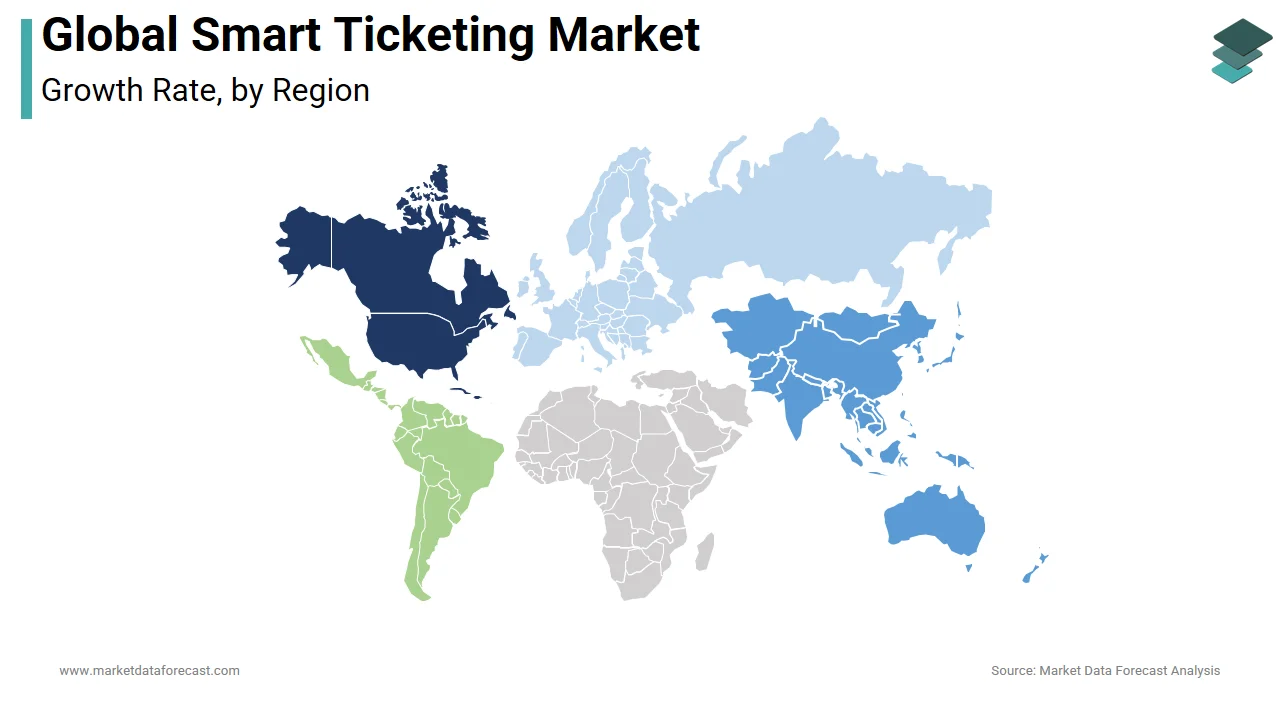
Europe is home to the leading smart ticket solution providers in Europe, such as Infineon Technologies, Gemalto, and Giesecke + Devrient (Germany), which are also strengthening their presence in this market by providing comprehensive payment options through collaborations with various smart ticket developers and operators. In addition, these companies are also developing blockchain and big data analytics to track travelers' travel habits and can then provide secure and personalized services.
KEY MARKET PARTICIPANTS
The major companies operating in the global smart ticketing market include HID Global Corporation, Gemalto NV, NXP Semiconductors, Giesecke & Devrient GmbH, Infineon Technologies AG, CPI Card Group Inc., Inside Secure, Xerox Corporation, Confidex Ltd., Cubic Corporation, ASK, and Oberthur Technologies.
RECENT MARKET HAPPENINGS
-
In October 2019, Delhi Metro Rail Corporation (DMRC) plans to install a new biometrics-based ticketing system to support biometrics-based smart cards. These will be integrated into the automatic fare collection gates in the stations. These initiatives should encourage other operators in the region to implement them. In addition, smart city projects across the country would also complement the growth in smart ticket sales.
-
In August 2019, Hitachi Rail announced that it is testing its new smart ticketing system. This system uses sensors on trains to detect an app on passengers' smartphones when boarding, removing ticket barriers. It would automatically charge passengers the correct fare. This technology is still in the testing phase in Italy.
MARKET SEGMENTATION
This research report on the global smart ticketing market has been segmented and sub-segmented based on the system, component, product, application, and region.
By System
- Smart Card
- Open Payment System
- Near-Field Communication
By Component
- Software
- Hardware
By Product Type
- Ticket Machine
- E-Ticket
- E-Kiosk
- Request Tracker
By Application
- Sports & Entertainment
- Transportation
By Region
-
North America
-
The United States
-
Canada
-
Rest of North America
-
-
Europe
-
The United Kingdom
-
Spain
-
Germany
-
Italy
-
France
-
Rest of Europe
-
-
The Asia Pacific
-
India
-
Japan
-
China
-
Australia
-
Singapore
-
Malaysia
-
South Korea
-
New Zealand
-
Southeast Asia
-
-
Latin America
-
Brazil
-
Argentina
-
Mexico
-
Rest of LATAM
-
-
The Middle East and Africa
-
Saudi Arabia
-
UAE
-
Lebanon
-
Jordan
-
Cyprus
-