- Product Description Description
- Table of Contents TOC
- List of Table & Figure LOT
- Get Free Sample PDF Sample PDF
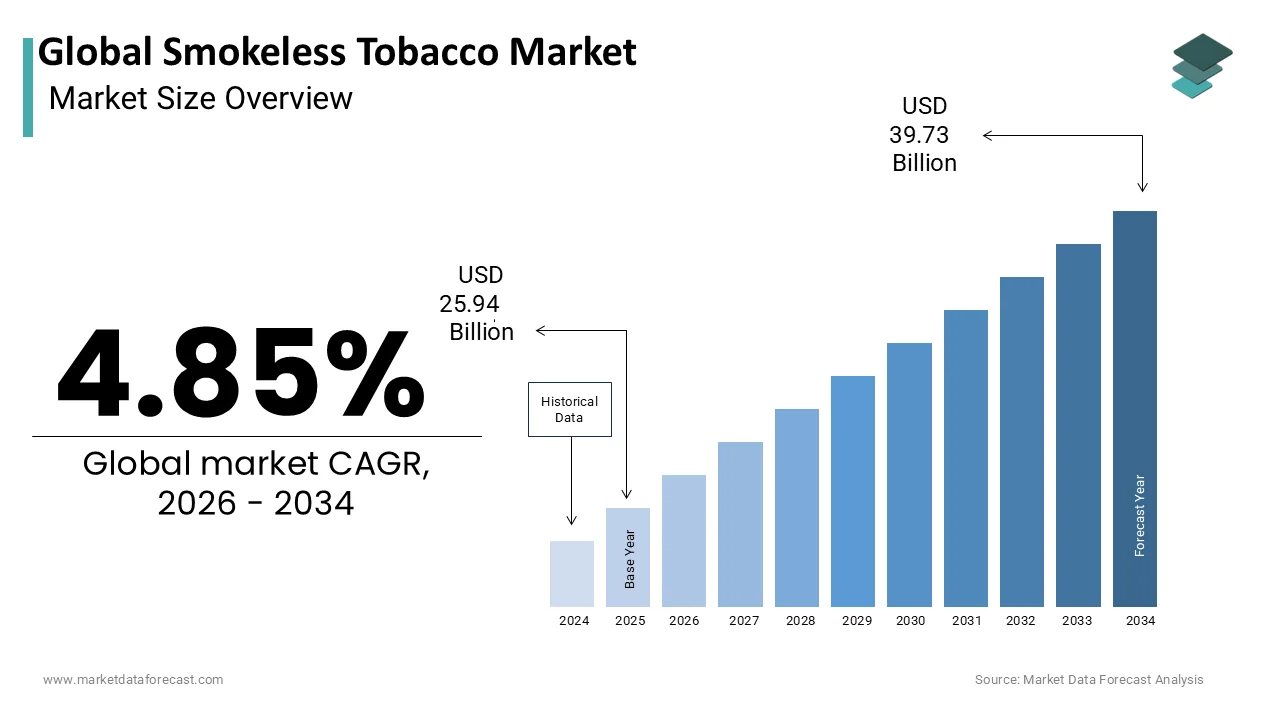
Market Size, 2025
$25.94 BnMarket Estimate, 2026
$27.2 BnMarket Forecast, 2034
$39.73 BnCAGR, 2026–2034
4.85%Global Smokeless Tobacco Market Size
The global smokeless tobacco market was valued at USD 25.94 billion in 2025, is estimated to reach USD 27.20 billion in 2026, and is projected to reach USD 39.73 billion by 2034, growing at a CAGR of 4.85% from 2026 to 2034.
Smokeless tobacco is any tobacco product that is consumed without combustion including snus chewing tobacco moist snuff and nicotine pouches that deliver nicotine through mucosal absorption. This market operates within a complex public health landscape where harm reduction principles intersect with stringent regulatory frameworks. According to the World Health Organization approximately 1.3 billion individuals globally use tobacco products with smokeless variants representing a significant subset particularly in specific regional contexts. In the European Union twenty four percent of the population aged fifteen and above engaged in regular smoking during 2023 creating a backdrop for alternative nicotine delivery systems. Sweden presents a distinctive scenario where smokeless tobacco adoption has contributed to one of the continent's lowest smoking prevalence rates as per national health surveillance data. According to official population-wide tracking by the Public Health Agency of Sweden (Folkhälsomyndigheten) and the Swedish Council for Information on Alcohol and Other Drugs (CAN), 20 percent of men and 7 percent of women across the total adult population use snus daily. While snus use has rapidly spiked among younger demographics aged 16 to 29 (where young female daily usage climbed to roughly 12%–18%). Norway demonstrates a parallel trajectory with daily snus consumption reaching sixteen percent among adults aged sixteen to seventy four by 2023 while cigarette smoking declined to seven percent according to Global State of Tobacco Harm Reduction analysis. These consumption patterns underscore a shifting behavioral paradigm where adult nicotine users increasingly seek non combustible alternatives. The European Commission's Tobacco Products Directive governs product standards labeling requirements and ingredient disclosures for smokeless tobacco across member states establishing a regulatory baseline that shapes market accessibility and innovation pathways. Understanding this market demands examination of public health outcomes consumer preferences and policy evolution rather than purely commercial metrics.
MARKET DRIVERS
Harm Reduction Adoption Among Adult Smokers
The growing acceptance of reduced risk alternatives is a primary factor propelling the Smokeless Tobacco Market. It is driven by adult smokers who seek to mitigate the health consequences associated with combustible tobacco. Epidemiological evidence suggests that switching from smoking to smokeless tobacco substantially lowers exposure to carcinogens and toxicants generated through combustion. According to research published in the journal BMC Medicine the global burden of disease attributable to smokeless tobacco remains considerably lower than that linked to cigarette smoking when evaluated across multiple health endpoints. In Sweden an epidemiological modeling study estimated that approximately 3000 lives per year have been preserved through the substitution of smoking with snus consumption. This risk differential resonates with adult consumers who prioritize nicotine intake while minimizing respiratory and cardiovascular hazards. Demand intensifies as public awareness of harm reduction principles expands through digital health platforms and peer networks. As per data from the Global State of Tobacco Harm Reduction initiative Norway experienced a marked transition where snus usage surpassed cigarette smoking among adults aged sixteen to seventy four by 2023 with sixteen percent using snus daily compared to seven percent smoking cigarettes. The demographic most responsive to this driver comprises males aged twenty five to forty five who exhibit higher propensity to adopt oral tobacco products as smoking cessation aids. Market participation expands when regulatory environments permit clear communication of relative risk profiles enabling informed consumer choice without compromising youth protection protocols.
Nordic Cultural Normalization and Product Innovation
The entrenched cultural acceptance of oral tobacco in Nordic nations combined with continuous product innovation fuels sustained demand for these products and the growth of the Smokeless Tobacco Market. Sweden and Norway exhibit distinct social frameworks where snus usage has evolved from regional tradition to mainstream adult behavior supported by discrete consumption formats and flavor diversification. Innovation manifests through nicotine pouches which contain pharmaceutical grade nicotine without tobacco leaf appealing to consumers seeking tobacco free alternatives. In Sweden pouch volume share expanded from five percent in 2018 to fifty five percent by 2025 indicating rapid consumer migration toward novel formats. This evolution responds to demand for customizable nicotine strengths varied flavor profiles and convenient portioned designs that align with modern lifestyles. Product development focuses on sensory experience dissolution rates and packaging sustainability to retain existing users while attracting new adult consumers. The driver strengthens when manufacturers invest in quality control batch consistency and transparent labeling that reinforce consumer trust. Cultural normalization reduces stigma associated with oral tobacco use enabling broader social acceptance among professional and social circles in regions where regulatory frameworks permit such products.
MARKET RESTRAINTS
Stringent European Union Regulatory Restrictions
The European Union's Tobacco Products Directive prohibits the sale of snus in all member states except Sweden under a specific exemption granted during accession negotiations, which hampers the expansion of the smokeless tobacco market. The regulatory framework restricts characterizing flavors limits ingredient disclosures and mandates tracking systems that increase compliance costs for market participants. As per analysis from the European Respiratory Society the directive aims to reduce tobacco consumption by two percent across Europe creating an inherently restrictive environment for smokeless product expansion. This legislative barrier prevents market entry in populous economies such as Germany France and Italy where consumer interest in oral nicotine alternatives remains underexploited. The exemption for Sweden creates market fragmentation that complicates pan European distribution strategies and brand building initiatives. Regulatory uncertainty intensifies as policymakers debate potential revisions to the directive with some advocacy groups pushing for broader harm reduction recognition while others demand stricter controls on all nicotine products. Manufacturers must navigate divergent national interpretations of EU rules leading to inconsistent enforcement and legal challenges that divert resources from innovation and consumer education. The restraint amplifies when regulatory processes delay approval of novel product formats or require extensive toxicological testing that smaller enterprises cannot afford.
Public Health Opposition and Stigmatization
Persistent opposition from public health organizations and medical associations creates significant barriers for the smokeless tobacco market. This resistance hinders growth through stigmatization and restricted communication channels. According to the World Health Organization all forms of tobacco use including smokeless products carry health risks and no level of exposure is considered safe which shapes policy narratives and public perception. This position influences national health strategies that prioritize complete nicotine abstinence over risk reduction approaches limiting opportunities for smokeless products to be positioned as transitional tools for adult smokers. As per the European Cancer Organisation regulatory frameworks should prevent industry friendly narratives that may undermine tobacco control efforts creating tension between harm reduction advocates and traditional public health stakeholders. Stigmatization manifests through advertising restrictions that prohibit promotional messaging about relative risk reductions even when supported by scientific evidence. Healthcare providers often receive limited training on smokeless tobacco as a cessation option reducing clinical endorsement and patient referrals. The restraint intensifies when media coverage emphasizes isolated health concerns without contextualizing comparative risk profiles leading to consumer confusion and hesitancy. Youth protection concerns further constrain marketing channels as policymakers implement plain packaging flavor bans and age verification systems that increase operational complexity. Public health opposition strengthens when advocacy groups successfully lobby for extended restrictions to emerging categories like nicotine pouches arguing that any nicotine product may serve as a gateway for adolescent use despite limited empirical support for this claim in regulated adult markets.
MARKET OPPORTUNITIES
Expansion of Tobacco Free Nicotine Pouch Segments
The emergence of tobacco-free nicotine pouches offers a substantial opportunity for participants in the smokeless tobacco market. These products help companies navigate regulatory constraints while meeting evolving consumer preferences for clean label options. These pouches contain pharmaceutical grade nicotine plant based fibers and flavorings without tobacco leaf enabling classification outside traditional tobacco regulations in certain jurisdictions. This format appeals to health conscious users who seek nicotine delivery without tobacco specific nitrosamines or combustion byproducts. Innovation focuses on varying nicotine concentrations from three milligrams to twenty milligrams per pouch diverse flavor portfolios including mint berry and citrus and biodegradable materials that address environmental concerns. The opportunity expands when manufacturers secure regulatory clarity for novel product categories enabling distribution through convenience retail e commerce and specialty vape shops. Brand differentiation emerges through premium packaging subscription models and digital engagement tools that foster loyalty among adult users. Market penetration accelerates when clinical research demonstrates favorable toxicological profiles compared to combustible products providing evidence for risk communication frameworks. This segment benefits from cross category migration as former smokers and current snus users experiment with tobacco free options that align with wellness trends and social discretion requirements.
Digital Commerce and Direct to Consumer Engagement
The proliferation of digital commerce platforms opens the door for participants in the Smokeless Tobacco Market. This digital shift enables them to build direct relationships with adult consumers while navigating traditional retail constraints. According to the European Commission the Tobacco Products Directive permits member states to prohibit internet sales of tobacco products yet enforcement varies significantly across jurisdictions enabling strategic market entry. Brands leverage age verification technologies secure payment gateways and discreet shipping protocols to comply with regulatory requirements while delivering convenience and product education. As per market intelligence the Europe pure nicotine market projects expansion from US$ 1050.0 million in 2024 to US$ 1777.5 million by 2035 supported by digital channel growth. Direct to consumer models enable personalized subscription services flavor sampling programs and loyalty rewards that increase customer lifetime value. Digital platforms facilitate responsible marketing through age gated content educational resources about product usage and cessation support tools that align with public health objectives. Data analytics derived from online interactions inform product development inventory management and targeted communications that enhance operational efficiency. The opportunity strengthens when companies invest in cybersecurity customer privacy protections and transparent terms of service that build trust with discerning adult consumers. Social media engagement though restricted for tobacco promotion can support brand awareness through influencer partnerships focused on lifestyle content rather than product endorsement. Digital commerce also enables rapid market testing of new formats flavors and packaging designs reducing time to market and minimizing inventory risk for innovative enterprises.
MARKET CHALLENGES
Youth Access Prevention and Regulatory Scrutiny
Preventing underage access to these tobacco products is a critical challenge to the smokeless tobacco market. This issue intensifies regulatory scrutiny and operational complexity for market participants. According to Eurostat eighteen point four percent of individuals aged fifteen years and above in the European Union were daily smokers in 2019 creating policy pressure to restrict all nicotine product availability to minors. Authorities implement age verification systems point of sale restrictions and flavor limitations that increase compliance costs while potentially limiting adult consumer choice. As per the Global Youth Tobacco Survey prevalence data across WHO European Region countries indicates that adolescent experimentation with tobacco and nicotine products remains a persistent public health concern requiring vigilant enforcement. Manufacturers face challenges designing packaging that deters youth appeal while maintaining brand recognition among adult users. Retail partners must train staff on age verification protocols and refuse sales to underage individuals creating consistency gaps across diverse distribution channels. Digital commerce amplifies this challenge as online platforms require robust age authentication technologies that balance security with user experience. The challenge intensifies when advocacy groups document isolated incidents of youth access using them to justify broader restrictions that impact legitimate adult markets. Regulatory responses often adopt precautionary principles that restrict product formats flavors or marketing channels based on theoretical risks rather than empirical evidence of harm. Companies must invest in responsible marketing practices youth prevention programs and transparent reporting to demonstrate commitment to protecting minors while serving adult consumers. Failure to address this challenge effectively risks reputational damage regulatory penalties and loss of social license to operate in sensitive public health domains.
Scientific Evidence Gaps and Risk Communication Barriers
Inconsistent scientific evidence and restricted channels for communicating relative risk information to adult consumers are also obstructing the expansion of the smokeless tobacco market. According to the World Health Organization while smokeless tobacco products generally present lower health risks than combustible cigarettes they still contain carcinogens and pose health hazards that complicate risk messaging. This nuanced reality creates communication barriers when public health policies prioritize abstinence messages over graduated risk reduction frameworks. As per systematic reviews published in Thorax the health effects associated with smokeless tobacco vary substantially by product type regional formulation and usage patterns making generalized claims difficult to substantiate. Manufacturers struggle to convey scientifically accurate information about product risks when regulatory frameworks prohibit comparative advertising or require standardized warnings that do not differentiate between high and lower risk products. Healthcare providers often lack training on smokeless tobacco as a harm reduction tool limiting clinical guidance for adult smokers seeking alternatives. The challenge amplifies when media coverage emphasizes worst case health outcomes without contextualizing population level risk reductions observed in countries with high smokeless tobacco adoption. Research funding disparities further constrain evidence generation as public health agencies prioritize smoking cessation studies over evaluations of alternative nicotine products. Companies must navigate complex approval processes for health claims investing in toxicological testing and epidemiological research that may not yield immediate commercial returns. This evidence gap creates uncertainty for consumers policymakers and investors hindering market development and innovation. Addressing this challenge requires collaborative research initiatives transparent data sharing and policy dialogues that balance precautionary principles with evidence based harm reduction strategies.
REPORT COVERAGE
| REPORT METRIC | DETAILS |
| Market Size Available | 2025 to 2034 |
| Base Year | 2025 |
| Forecast Period | 2026 to 2034 |
| Segments Covered | By Product Type, Distribution Channel, Consumer Type, and Region |
| Various Analyses Covered | Global, Regional, and Country Level Analysis, Segment-Level Analysis, DROC, PESTLE Analysis, Porter’s Five Forces Analysis, Competitive Landscape, Analyst Overview on Investment Opportunities |
| Regions Covered | North America, Europe, Asia Pacific, Latin America, Middle East, and Africa |
| Market Leaders Profiled | are Altria Group, Inc., British American Tobacco plc, Swedish Match AB, Imperial Brands PLC, Philip Morris International Inc., Japan Tobacco Inc., Reynolds American Inc., Al Fakher Tobacco Trading LLC, Swisher International, Inc., General Snus (Swedish Match) |
SEGMENTAL ANALYSIS
By Product Type Insights
The snuff segment held the majority share of 54.6% of the Smokeless Tobacco Market in 2025. Deep rooted consumer preference in North America, where moist snuff has been culturally embedded for generations, is credited to the supremacy of this segment. The segment benefits from strong brand loyalty toward established names like Copenhagen and Skoal which have maintained consistent quality and flavor profiles over decades. Consumer demand is further sustained by the product's versatility allowing usage in diverse social settings without the need for spitting in modern spit free formulations. Retail availability across convenience channels ensures easy access while flavor innovation including wintergreen mint and straight variants continues to attract repeat purchasers. The segment's stability is reinforced by regulatory frameworks that treat traditional snuff differently from novel nicotine products enabling continued market presence without disruptive compliance burdens. Manufacturers invest in moisture control packaging technology and portion consistency to preserve product integrity which strengthens consumer trust and repeat purchase behavior.
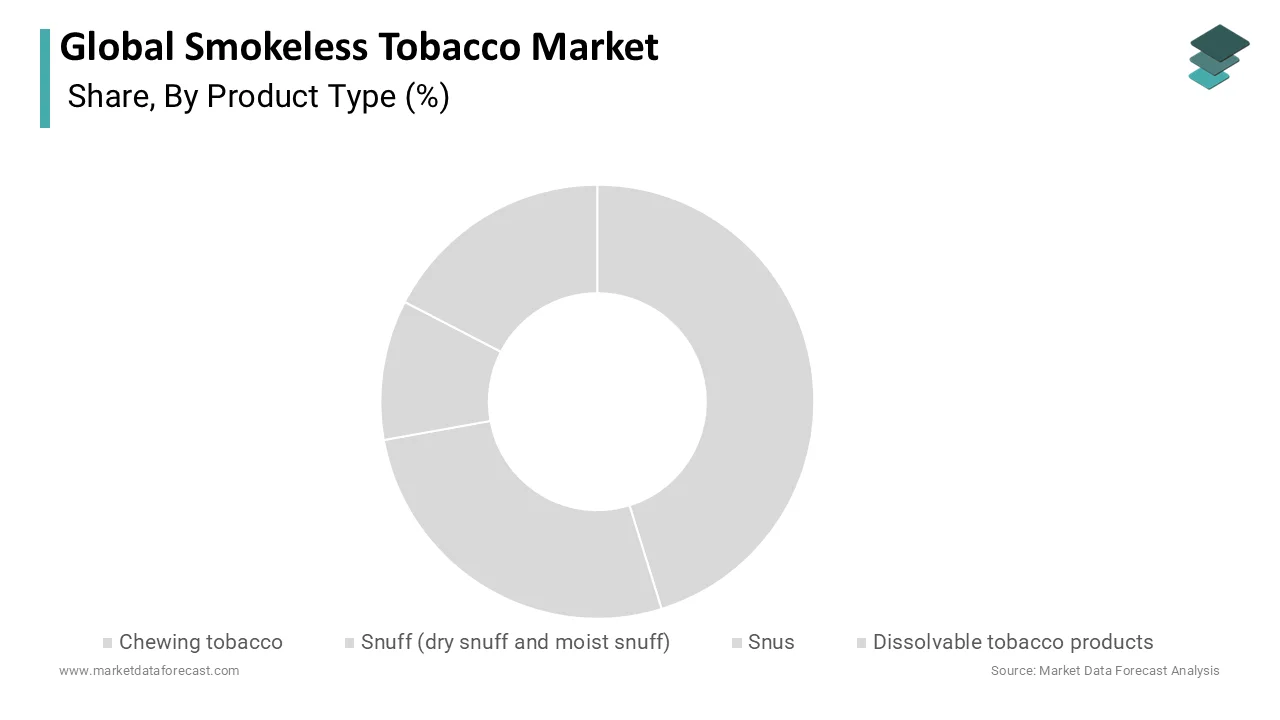
On the other hand, the chewing tobacco segment is predicted to witness the highest CAGR of 8.1% from 2026 to 2034. This acceleration is propelled by rising demand in emerging markets particularly across South Asia where traditional chewing formats align with cultural consumption habits. The segment benefits from minimal processing requirements which enable competitive pricing and wider distribution in rural and semi urban retail environments. Product innovation focuses on flavor diversification including herbal infusions and reduced additive formulations that appeal to health conscious consumers. Regulatory environments in certain Asian markets remain less restrictive toward traditional chewing products enabling faster market penetration compared to novel oral nicotine formats. Manufacturers leverage local supply chains and regional flavor preferences to strengthen brand relevance while maintaining cost efficiency. The segment's growth trajectory is further supported by increasing disposable incomes in developing economies which expand the addressable consumer base for premium chewing tobacco variants.
By Distribution Channel Insights
The convenience stores segment dominated the smokeless tobacco market and accounted for a substantial share in 2025. This dominance of the segment was driven by the channel's unparalleled accessibility. The format aligns with impulse purchase behavior as adult consumers frequently acquire smokeless tobacco during routine visits for fuel snacks or beverages. Retailers optimize shelf placement at eye level near checkout counters which increases product visibility and conversion rates. The channel also enables rapid product rotation allowing manufacturers to test new flavors or limited editions with minimal inventory risk. Staff training programs on age verification and product knowledge further enhance responsible retailing while maintaining sales efficiency. The segment's strength is reinforced by loyalty programs and promotional partnerships that drive repeat visits and basket size expansion among adult smokeless tobacco users.
However, the online stores segment is estimated to register the fastest CAGR of 8.3% during the forecast period due to increasing digital adoption among adult consumers who value discreet purchasing personalized product recommendations and home delivery convenience. E commerce platforms facilitate detailed product information flavor comparisons and subscription models that enhance customer retention. The channel also supports direct to consumer strategies allowing manufacturers to bypass traditional retail margins and build brand loyalty through exclusive offerings. Consumer demand for tobacco free nicotine pouches which are often marketed as wellness adjacent products further accelerates online adoption as these formats align with digital native shopping behaviors. Regulatory clarity in select European markets regarding cross border e commerce of oral nicotine products creates additional growth pathways. Brands invest in mobile optimized experiences and social media integration to drive traffic while maintaining strict age gating protocols to protect minors.
By Consumer Type Insights
In 2025, the regular users segment was the largest in the Smokeless Tobacco Market and occupied a significant share because of habitual consumption patterns among adult nicotine users. According to research, a notable portion of current smokeless tobacco users across European countries reported regular daily usage while only a small portion identified as occasional users. This dominance is driven by nicotine dependence mechanisms that encourage consistent product use to maintain desired physiological effects. Regular users exhibit strong brand loyalty and predictable purchase cycles which enable manufacturers to optimize production planning and inventory management. As per data from the Centers for Disease Control and Prevention smokeless tobacco usage among men in the United States remains concentrated within the twenty five to forty four age demographic which typically demonstrates higher frequency consumption patterns. The segment benefits from product formats designed for all day use including portioned pouches and long lasting flavor profiles that support repeated dosing. Retail strategies focus on subscription models and bulk packaging that cater to regular users seeking cost efficiency and convenience. Public health messaging around harm reduction resonates most strongly with this cohort as they actively seek alternatives to combustible tobacco while maintaining nicotine intake. Manufacturers invest in product consistency and sensory experience to retain this valuable consumer base which represents the core revenue foundation for the smokeless tobacco category.
On the contrary, the new user segment is experiencing the fastest growth within the Smokeless Tobacco Market owing to adult smokers transitioning from combustible products and younger adults exploring oral nicotine alternatives. According to research published in the Journal of Adolescent Health by the age of twenty seven years four point nine percent of young adults reported initiating ever use of smokeless tobacco indicating ongoing recruitment into the category. This expansion is fueled by increased awareness of harm reduction principles as public health communications highlight the relative risk differential between smoking and smokeless products. As per data from the Global State of Tobacco Harm Reduction initiative Norway experienced a marked transition where snus usage surpassed cigarette smoking among adults aged sixteen to seventy four by 2023 demonstrating the appeal of oral formats to new adopters. Product innovation including tobacco free nicotine pouches with customizable strengths and flavors lowers the barrier to entry for consumers seeking discreet and socially acceptable nicotine delivery. Digital marketing channels though restricted for traditional tobacco promotion enable targeted outreach to adult smokers through cessation focused messaging. Retailers support new user acquisition through sampler packs and educational materials that guide product selection and usage techniques. Regulatory frameworks that permit clear communication of relative risk profiles further facilitate informed trial among adult consumers seeking alternatives to smoking.
By Packaging Type Insights
The pouch packaging segment led the Smokeless Tobacco Market and captured a 56.8% share in 2025. This leading position of the segment was attributed to its convenience discretion and portion control benefits that align with modern consumer preferences. According to studies nicotine pouch sales grew considerably from their introduction to 2024 reaching forty three point seven percent of the oral tobacco and nicotine market share. This dominance is propelled by the format's spit free design which enables usage in professional and social settings without inconvenience or stigma. As per research the pouch segment benefits from pharmaceutical grade nicotine delivery plant based fibers and diverse flavor portfolios that appeal to health conscious adult users. Manufacturers invest in biodegradable materials and moisture resistant barriers to enhance product sustainability and shelf life which strengthens brand perception among environmentally aware consumers. The format also supports precise dosing with nicotine concentrations ranging from three milligrams to twenty milligrams per pouch enabling personalized consumption experiences. Retailers favor pouch packaging due to its compact footprint efficient shelf utilization and reduced spillage risk compared to loose formats. The segment's strength is reinforced by regulatory clarity in certain jurisdictions that classify tobacco free pouches outside traditional tobacco restrictions enabling broader distribution and marketing flexibility.
But the can packaging segment is anticipated to witness the fastest CAGR of 8.3% between 2026 and 2034. This quick surge of the segment is fuelled by innovation focused on sustainability functionality and brand differentiation. Moreover, this growth is also driven by consumer demand for reusable and recyclable packaging that aligns with environmental sustainability goals. As per sources, can formats enable premium positioning through metallic finishes embossed branding and tamper evident seals that enhance product perceived value. Manufacturers leverage can packaging to support limited edition releases and seasonal flavor launches which drive collector behavior and social media engagement among adult users. The format also offers superior moisture retention and flavor preservation compared to alternative packaging types ensuring consistent product quality throughout the usage cycle. Retailers benefit from can packaging's stackability and visual impact which increases shelf presence and impulse purchase likelihood. Brands invest in lightweight aluminum and recycled materials to reduce environmental footprint while maintaining structural integrity during transport and storage. This segment's expansion is further supported by regulatory trends favoring child resistant closures and clear labeling which can packaging readily accommodates through engineering innovation.
COUNTRY LEVEL ANALYSIS
North America Smokeless Tobacco Market Analysis
North America was the top performer in the global Smokeless Tobacco Market and accounted for a 76.6% share in 2025. This dominance was driven by deeply entrenched cultural acceptance of oral tobacco particularly in the United States where moist snuff and chewing tobacco have been mainstream products for generations. The region benefits from robust retail infrastructure extensive convenience store networks and favorable regulatory frameworks that permit clear risk communication for adult consumers. As per data from the Centers for Disease Control and Prevention approximately four point two percent of men in the United States currently use smokeless tobacco creating a stable consumer base for category growth. Product innovation focuses on spit free formulations flavor diversification and nicotine pouch expansion which attract both traditional users and new adopters seeking reduced risk alternatives. Manufacturers invest in digital engagement age verification technologies and responsible marketing practices to maintain social license while expanding market reach. The region's maturity enables premium pricing strategies and brand loyalty programs that drive revenue growth despite stable volume trends.
Asia Pacific Smokeless Tobacco Market Analysis
Asia Pacific was positioned second in the global market and captured a major share in 2025. It is also a high-growth region. This position is propelled by traditional consumption patterns in countries like India, Bangladesh, and Pakistan, where smokeless formats such as gutka, khaini, and zarda have been culturally embedded for centuries. The region benefits from large population bases increasing disposable incomes and expanding retail distribution in both urban and rural settings. As per research, growing awareness about the harmful impacts of smoking cigarettes is driving adult consumers toward smokeless alternatives that align with harm reduction principles. Regulatory environments vary significantly across the region with some countries implementing strict controls while others maintain permissive frameworks for traditional products. Manufacturers leverage local flavor preferences herbal infusions and affordable price points to strengthen market relevance. The segment's growth trajectory is further supported by rising health consciousness among middle class consumers who seek reduced risk nicotine options without complete abstinence. Digital commerce expansion enables brands to reach geographically dispersed consumers while collecting valuable insights for product development and targeted engagement.
Europe Smokeless Tobacco Market Analysis
Europe plays a key role in the Smokeless Tobacco Market due to the region's regulatory fragmentation where the European Union's Tobacco Products Directive prohibits snus sales in all member states except Sweden under a specific exemption. Sweden presents a distinctive scenario where smokeless tobacco usage has contributed to one of the continent's lowest smoking prevalence rates as per national health surveillance data. Norway demonstrates a parallel trajectory with daily snus consumption reaching sixteen percent among adults aged sixteen to seventy four by 2023 while cigarette smoking declined to seven percent according to Global State of Tobacco Harm Reduction analysis. The region's growth is constrained by stringent advertising restrictions plain packaging requirements and flavor limitations that increase compliance costs. However emerging categories like tobacco free nicotine pouches are gaining traction in markets with regulatory clarity enabling innovation and consumer choice within responsible frameworks.
Latin America Smokeless Tobacco Market Analysis
Latin America is an emerging region in the Smokeless Tobacco Market owing to traditional consumption patterns and gradual modernization of product offerings. The region benefits from cultural acceptance of oral tobacco in countries like Brazil Argentina and Colombia where formats such as rapé and smokeless blends have historical usage. According to a study, Latin America's growth is supported by increasing urbanization expanding retail networks and rising awareness of harm reduction alternatives among adult smokers. As per research, manufacturers are introducing portioned pouches and spit free variants that align with modern lifestyles while preserving traditional flavor profiles. The segment faces challenges related to regulatory uncertainty economic volatility and limited public health infrastructure that complicate market development. However growing middle class populations and digital commerce adoption create opportunities for brands to reach new consumers through targeted engagement strategies. Product innovation focuses on affordable price points localized flavors and discreet packaging that resonate with regional preferences. Retail partnerships with convenience chains and e commerce platforms enable broader distribution while maintaining age verification protocols to protect minors. The region's growth trajectory depends on balancing traditional consumption patterns with responsible marketing practices that prioritize adult consumer choice and public health objectives.
Middle East and Africa Smokeless Tobacco Market Analysis
The Middle East and Africa region is likely to expand notably in the Smokeless Tobacco Market during the forecast period, with niche consumption patterns and evolving regulatory frameworks. Traditional smokeless products such as toombak in Sudan and shammah in Yemen have historical usage but remain largely informal and unregulated. According to sources, the region's growth potential stems from increasing urbanization rising disposable incomes and growing awareness of reduced risk alternatives among adult tobacco users. As per research, manufacturers are exploring entry strategies that respect cultural norms while introducing modern oral nicotine formats with quality control and responsible marketing standards. The segment faces significant challenges including limited retail infrastructure political instability in certain markets and stringent tobacco control policies aligned with World Health Organization frameworks. However emerging economies like South Africa and the United Arab Emirates present opportunities for premium smokeless products targeting expatriate communities and health conscious consumers. Product development focuses on halal compliant formulations discreet packaging and flavor profiles that align with regional preferences. Digital commerce and cross border trade enable brands to reach dispersed consumers while navigating complex regulatory landscapes. The region's long term growth depends on constructive policy dialogues that balance public health objectives with evidence based harm reduction approaches for adult smokers seeking alternatives to combustible tobacco.
COMPETITVE LANDSCAPE
The Smokeless Tobacco Market features intense competition among established tobacco corporations and emerging nicotine product specialists vying for adult consumer preference in a regulated environment. Market concentration remains high with a few dominant players controlling significant share through brand equity distribution networks and regulatory expertise. Competition centers on product innovation flavor portfolios packaging sustainability and digital engagement capabilities that resonate with health conscious adult users. Companies differentiate through harm reduction messaging clinical research support and responsible marketing practices that build trust with consumers and policymakers. Price competition is moderated by brand loyalty and product quality perceptions though private label offerings create pressure in value oriented segments. Regulatory compliance costs and age verification requirements raise barriers to entry favoring well capitalized incumbents. The competitive landscape continues to evolve as novel oral nicotine formats blur category boundaries and attract investment from adjacent sectors including wellness and pharmaceutical industries. Success depends on balancing innovation with responsible stewardship to serve adult consumers while protecting youth and maintaining public health credibility.
KEY MARKET PLAYERS
Some of the companies that are playing a dominating role in the Global Smokeless Tobacco Market include
- Altria Group, Inc.
- British American Tobacco plc
- Swedish Match AB
- Imperial Brands PLC
- Philip Morris International Inc.
- Japan Tobacco Inc.
- Reynolds American Inc.
- Al Fakher Tobacco Trading LLC
- Swisher International, Inc.
- General Snus (Swedish Match)
TOP LEADING PLAYERS IN THE MARKET
- Swedish Match AB operates as a global leader in smokeless tobacco and oral nicotine products with a strong presence in Nordic and North American markets. The company's portfolio includes iconic snus brands like General and nicotine pouch innovations under the ZYN label which have driven significant consumer migration toward reduced risk alternatives. The company focuses on product quality flavor diversification and sustainability initiatives including biodegradable pouch materials to strengthen brand loyalty among adult users. Recent actions include launching new flavor variants and expanding retail presence in convenience channels across Europe and the United States to capture growing demand for tobacco free nicotine options.
- Altria Group Inc maintains a prominent position in the Smokeless Tobacco Market through its subsidiary U S Smokeless Tobacco Company which produces leading moist snuff brands Copenhagen and Skoal. The company has diversified its smokeless portfolio with the on nicotine pouch brand which offers tobacco free options in multiple strengths and flavors to attract adult consumers seeking discretion and convenience. Altria collaborates with international partners like KT G to accelerate innovation in modern oral nicotine products while investing in manufacturing modernization to improve efficiency and product consistency. Recent regulatory achievements include Food and Drug Administration authorization for on PLUS Mint and Wintergreen variants under a new pilot program aimed at expediting review of modified risk products. These actions reinforce Altria's commitment to providing adult consumers with a range of smokeless alternatives while adhering to responsible marketing standards.
- British American Tobacco plc pursues a strategic transformation toward a smokeless future with significant investments in oral nicotine categories including Velo nicotine pouches and traditional snus offerings. British American Tobacco focuses on geographic expansion product innovation and digital engagement to grow its smokeless portfolio which now accounts for eighteen point two percent of group revenue. Recent initiatives include enhancing retail experiences in travel retail channels and launching new flavor profiles to attract adult consumers seeking reduced risk alternatives. The company's commitment to building a smokeless world by 2035 drives ongoing research and development in next generation oral nicotine delivery systems that prioritize consumer satisfaction and regulatory compliance.
TOP STRATEGIES USED BY KEY MARKET PARTICIPANTS
Key players in the Smokeless Tobacco Market employ product innovation as a primary strategy to differentiate offerings through flavor diversification nicotine strength customization and sustainable packaging solutions. Geographic expansion enables brands to enter high growth regions while adapting products to local preferences and regulatory requirements. Digital commerce investments facilitate direct consumer engagement personalized marketing and age verified transactions that enhance customer loyalty. Strategic partnerships with retailers and technology providers strengthen distribution efficiency and data driven decision making. Responsible marketing practices including clear risk communication and youth prevention initiatives help maintain social license and regulatory goodwill. Mergers and acquisitions allow companies to consolidate market position access new technologies and accelerate portfolio diversification toward reduced risk products.
GLOBAL SMOKELESS TOBACCO MARKET NEWS
- In November 2022 Philip Morris International completed the acquisition of Swedish Match a leader in oral nicotine products to strengthen the Smokeless Tobacco Market through global expansion of the ZYN brand and enhanced innovation capabilities.
- In December 2025 Altria Group received Food and Drug Administration authorization for on PLUS Mint and Wintergreen nicotine pouch variants to strengthen the Smokeless Tobacco Market by expanding its smoke free portfolio under a new regulatory pilot program.
MARKET SEGMENTATION
This research report on the global smokeless tobacco market has been segmented and sub-segmented based on product type, distribution channel, customer type, and region.
By Product Type
- Chewing tobacco
- Snuff (dry snuff and moist snuff)
- Snus
- Dissolvable tobacco products
By Distribution Channel
- Convenience stores
- Supermarkets and hypermarkets
- Online stores
- Others
By Consumer Type
- Occasional
- Regular
- New
By Packaging Type
- Pouches
- Cans
- Others
By Region
- North America
- Europe
- Asia-Pacific
- Latin America
- Middle East & Africa