- Product Description Description
- Table of Contents TOC
- List of Table & Figure LOT
- Get Free Sample PDF Sample PDF
Market Size, 2025
$13.72 BnMarket Estimate, 2026
$14.31 BnMarket Forecast, 2034
$20.06 BnCAGR, 2026–2034
4.31%Global Sodium Silicate Market Size, Growth, Trends & Forecast (2026–2034)
The global sodium silicate market size was valued at USD 13.72 billion in 2025, is estimated at USD 14.31 billion in 2026, and is projected to reach USD 20.06 billion by 2034, registering a compound annual growth rate (CAGR) of 4.31% during the forecast period from 2026 to 2034. Driven by the rising demand for aerospace and automotive precision investment casting, hard-water detergent formulations, and structural fire-retardant applications, the market continues to expand steadily worldwide.
Key Executive Metrics (At-a-Glance)
- 2025 Base Valuation: USD 13.72 Billion
- 2026 Current Valuation: USD 14.31 Billion
- 2034 Forecast Valuation: USD 20.06 Billion
- Compound Annual Growth Rate (CAGR): 4.31% (2026–2034)
- Dominant Type Segment: Liquid Sodium Silicate (favored for immediate solubility, automated metering, and bulk tanker transport)
- Fastest-Growing Type Segment: Solid Sodium Silicate (projected at a 6.9% CAGR due to stability in tropical maritime transport and water-scarce regions)
- Dominant Application Segment: Detergents (captured 34.8% market share in 2025 as a builder and anti-redeposition agent)
- Fastest-Growing Application Segment: Refractories (projected at an 8.3% CAGR driven by EAF steel decarbonization and monolithic linings)
- Dominant Region: Asia-Pacific (commanding 43.6% market share in 2025, driven by China's steel industry and India's expanding detergent sector)
Core Market Drivers
- Aerospace & Automotive Casting: High-temperature alloy casting requirements for turbine blades and engine components relying on high-modulus silicate binders.
- Hard Water Detergent Stabilization: Extensive utility as an alkalinity buffer and water-softening builder across developing regions in South Asia and Sub-Saharan Africa.
- Fire-Resistant Timber Construction: Emerging architectural adoption of pressure-impregnated cross-laminated timber (CLT) utilizing intumescent silicate layers for fire protection.
Primary Market Restraints & Challenges
- Silica Sand Price Volatility: Upstream extraction caps and raw material price fluctuations compressing manufacturer margins.
- Low-Temperature Detergent Incompatibility: Technical challenges of integrating high-pH conventional silicates into modern liquid and single-dose enzyme formats.
- Logistical Degradation: Viscosity increases during extended tropical maritime transit necessitating solid alternatives or specialized refrigerated shipping.
Global Sodium Silicate Market Segmentation Breakdown
| Segment Category | Largest Segment | Fastest-Growing Segment |
|---|---|---|
| By Type | Liquid | Solid (6.9% CAGR) |
| By Grade | Alkaline | Neutral (7.5% CAGR) |
| By Application | Detergents (34.8% share) | Refractories (8.3% CAGR) |
| By Region | Asia-Pacific (43.6% share) | Asia-Pacific & Middle East & Africa |
Major Industry Players Profiled
Key enterprises shaping the competitive global sodium silicate market include PQ Corporation, Evonik Industries AG, Occidental Chemical Corporation (OxyChem), American Elements, J.M. Huber Corporation, MALPRO SILICA PRIVATE LIMITED, PPG Industries, Qingdao Dongyue Sodium Silicate Co. Ltd., Zaclon, Tokuyama Corporation, BASF SE, Nippon Chemical Industrial, and IQE Group.
Global Sodium Silicate Market Size
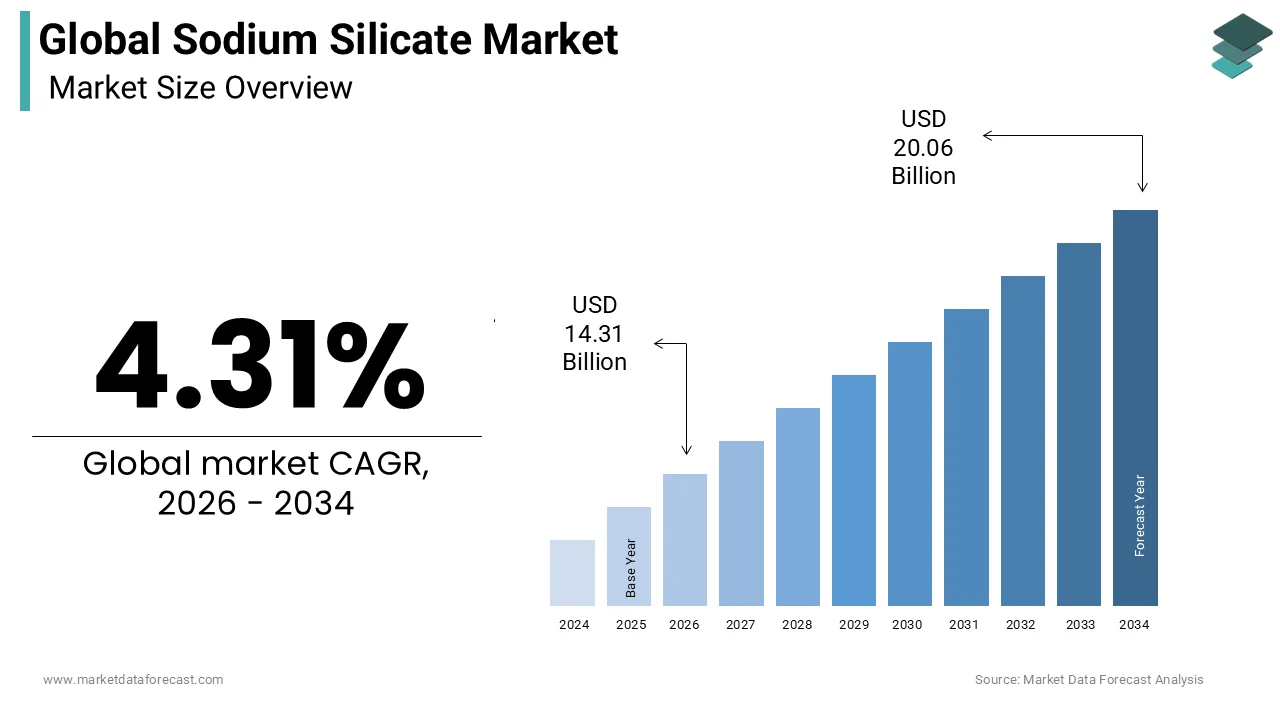
The global sodium silicate market size was valued at USD 13.72 billion in 2025, and the market size is expected to be worth USD 20.06 billion by 2034 from USD 14.31 billion by 2026. The market is growing at a CAGR of 4.31% during the forecast period.
Sodium silicate, colloquially termed “water glass,” is an inorganic polymer composed of alkali metal silicates, primarily sodium oxide and silicon dioxide, engineered into viscous solutions or solid beads for industrial deployment. Its unique colloidal structure enables dual functionality as a binder and sealant, particularly in foundry molds, detergent builders, and—importantly—flat glass surface treatments. As per the American Ceramic Society, a notable share of architectural float glass undergoes sodium silicate-based edge-sealing to prevent atmospheric corrosion during transport and installation. Total global production is known to be in the tens of millions of metric tons annually, according to research. Formulation precision is paramount because this product's value derives from its engineered rheology and controlled SiO₂:Na₂O molar ratios, unlike commodity alkalis.
MARKET DRIVERS
Growing Demand for Sodium Silicate in Aerospace Casting
Its role in precision investment casting for aerospace and automotive turbine components is a primary driver of the sodium silicate market growth. Each metric ton of high-temperature alloy casting requires notable kilograms of sodium silicate binder to form ceramic shell molds capable of withstanding high pour temperatures without deformation. As per studies, global aerospace casting output grew significantly, driven by Boeing and Airbus ramping narrow-body production to notable units per month respectively. Simultaneously, the U.S. Department of Defense allocated funds for next-generation jet engine programs, each requiring significant individually cast turbine blades, locking in multi-year procurement cycles for high-modulus silicate binders with aerospace-grade certification.
Expanding Use of Sodium Silicate in Detergents for Hard Water
Its deployment as a stabilizer in detergent formulations for hard water regions, particularly across South Asia and Sub-Saharan Africa, propels the expansionof the sodium silicate market. According to the World Health Organization, large number of people rely on groundwater with hardness exceeding notable mg/L CaCO₃, where sodium silicate prevents scale deposition on fabrics and washing machine internals. Sodium silicate is added to detergents as a builder to soften water by interacting with metal ions like calcium and magnesium. This makes the detergent more effective in hard water areas and protects washing machines from corrosion, according to sources. So, silicates also provide alkalinity buffering, reducing caustic soda dependency,a cost and safety advantage in informal laundry economies.
MARKET RESTRAINTS
Rising Silica Sand Prices Constrain Market Growth
Volatility of silica sand pricing, which constitutes a key portion of production cost and is subject to regional extraction bans, constrains the growth of the sodium silicate market. As per the U.S. Geological Survey, general industrial sand and gravel production value increased between 2021 and 2022. Prices for high-purity quartz sand are generally high but vary based on market conditions, purity, and demand. Simultaneously, China’s Ministry of Natural Resources imposed output caps on silica quarries in Guangxi and Fujian, which reduces national supply by notable metric tons annually. This upstream disruption forces producers into spot procurement at inflated rates, compressing margins, particularly for small-scale manufacturers lacking long-term sand supply contracts or vertical integration into mineral extraction.
Incompatibility with Modern Low-Temperature Detergents
Technical incompatibility of conventional sodium silicates with next-generation low-temperature detergent systems also restricts the expansion of the sodium silicate market. As per studies, liquid and single-dose detergent formats, growing annually, cannot incorporate high-pH silicate solutions without destabilizing enzymes or surfactants. In Europe, where liquid detergents constitute a portion of household purchases, according to research, silicate usage has declined since 2020. Reformulation efforts to create colloidal silica dispersions compatible with liquid matrices remain commercially immature, which leaves producers stranded in a shrinking powder detergent segment despite proven efficacy in water softening and anti-redeposition.
MARKET OPPORTUNITIES
Increasing Adoption in Fire-Resistant Timber Construction
Its adoption as a fire-retardant impregnant in mass timber construction, a sector expanding annually, creates new opportunities for the sodium silicate market growth. When pressure-injected into cross-laminated timber, silicate solutions form intumescent silica glass layers upon exposure to flame by delaying structural collapse by up to 90 minutes as validated by ASTM E119 testing protocols. Glulam beams can retain load-bearing capacity during a burnout fire. Large timber structures char on the outside, creating an insulating layer that protects the interior, uncharred wood, allowing it to maintain strength. Hence, silicate producers can pivot from commodity binders to performance-enhancing additives commanding premium pricing.
Circular Economy Practices Drive Silicate Recovery Growth
Circular economy mandates in foundry operations, where reclaiming sodium silicate from spent sand is technologically viable, is another factor that is giving new prospects for the sodium silicate market. As per the American Foundry Society, over 10 million tons of molding sand are discarded annually in North America alone. Microwave-assisted processes can achieve high silicate recovery rates. According to studies, there has been a notable recovery of silica nanoparticles using microwave-assisted synthesis. This closed-loop model transforms waste liability into cost-saving procurement strategy, particularly attractive to ESG-focused manufacturers under Scope 3 emissions scrutiny.
MARKET CHALLENGES
Geopolymer Adoption Reduces Sodium Silicate Demand
The rising adoption of geopolymers and magnesium-based binders in refractory applications are directly displacing sodium silicate in steel ladle linings and furnace insulation, which impedes the growth of the sodium silicate market. As per studies, geopolymer-bonded castables exhibit higher thermal shock resistance and emit less CO₂ during curing compared to silicate-bound analogs. ArcelorMittal has announced decarbonization projects and investments at its Ghent plant. Thus, sodium silicate risks marginalization in premium refractory segments despite lower initial cost due to absence of the matching durability or carbon credentials.
Transport Degradation Limits Global Supply Reliability
The logistical degradation of liquid sodium silicate during extended maritime transit, particularly in tropical climates, also challenges the rise of the sodium silicate market. As per sources, viscosity increases have been recorded in shipments from China to Brazil when cargo holds exceed notable temperature for more than several days, which renders product unusable without reheating. This necessitates refrigerated container use, increasing shipping costs, and forces buyers toward regional producers despite price disadvantages. Solid silicate alternatives remain prohibitively expensive for developing economies, which creates a supply reliability gap that erodes trust in globalized procurement models.
REPORT COVERAGE
| REPORT METRIC | DETAILS |
| Market Size Available | 2025 to 2034 |
| Base Year | 2025 |
| Forecast Period | 2026 to 2034 |
| CAGR | 4.31% |
| Segments Covered | By Type, Grade, Application, and Region. |
| Various Analyses Covered | Global, Regional & Country Level Analysis, Segment-Level Analysis, DROC, PESTLE Analysis, Porter’s Five Forces Analysis, Competitive Landscape, Analyst Overview of Investment Opportunities |
| Regions Covered | North America, Europe, APAC, Latin America, Middle East & Africa |
| Market Leaders Profiled | American Elements, J.M. Huber Corporation, MALPRO SILICA PRIVATE LIMITED, PPG Industries, Qingdao Dongyue Sodium Silicate Co. Ltd., Zaclon, Tokuyama Corporation, BASF SE, Nippon Chemical Industrial, Evonik Industries AG, and IQE Group, and Others. |
SEGMENTAL ANALYSIS
By Type Insights
The liquid sodium silicate segment led the sodium silicate market and captured substantial share of global market in 2025. Its immediate solubility, ease of metering in continuous industrial processes, and compatibility with automated dispensing systems in foundries and detergent plants are largely attributing to the growth of the liquid sodium silicate segment. Its prominence is strengthened by the fact that a notable share of investment casting operations, as per sources, require liquid binders to infiltrate complex ceramic shell molds uniformly. In China, significant metric tons of liquid silicate were consumed for refractory and adhesive applications, as per research. The logistical advantage of segment in bulk tanker transport further entrenches its dominance, particularly where just-in-time production cycles disfavor solid reconstitution delays.
The solid sodium silicate segment is on the rise and is expected to be the fastest growing segment in the global market by witnessing a CAGR of 6.9% from 2026 to 2034. Factors such as the demand in water-scarce regions and high-temperature export corridors has majorly contributed to the expansion of the solid sodium silicate segment. Solid beads eliminate viscosity instability during tropical maritime transit, a vital advantage for shipments to Sub-Saharan Africa and Southeast Asia, where ambient temperatures routinely exceed 35°C. According to studies, some casting facilities increased solid silicate procurement to circumvent spoilage losses from degraded liquid shipments.
By Grade Insights
The alkaline-grade sodium silicate segment held a substantial share of the sodium silicate market in 2025. The growth of the alkaline-grade sodium silicate segment in the global market is fuelled by its superior binding kinetics in foundry applications and enhanced detergency in hard water environments. High-alkalinity formulations (SiO₂:Na₂O ratio below 2.0) accelerate gelation in ceramic shell molds by reducing curing time, a decisive factor for aerospace foundries producing turbine blades under Boeing’s AS9100 quality mandates. In detergent manufacturing, alkaline grades neutralize fatty acids and suspend soil particles more effectively. Like, India is a major consumer of sodium silicate for detergents and that the alkaline grade is dominant. The Indian market is driven by detergent consumption and government initiatives.
The neutral-grade sodium silicate segment is expected to exhibit a noteworthy CAGR of 7.5% from 2026 to 2034. The rapid expansion of the neutral-grade sodium silicate segment is due to compatibility with enzyme-stabilized liquid detergents and pH-sensitive adhesives used in medical device assembly. Procter & Gamble’s 2023 reformulation of its European liquid detergent lines incorporated neutral silicate dispersions to preserve protease activity, which triggers a procurement surge from specialty chemical suppliers.
By Application Insights
The detergents segment dominated the sodium silicate market by accounting for 34.8% share in 2025. Its dual function as a builder and anti-redeposition agent in powder formulations are boosting the growth of the detergents segment. In regions with hard water, particularly India, Pakistan, and Egypt, silicate inclusion is non-negotiable. India’s regulations focus on the minimum percentage of active ingredients, which do the actual cleaning. Silicates are one of many compounds, including phosphates, that are added as builders to enhance a detergent's performance. According to sources, even as liquid detergents grow, powder variants retain notable market share in emerging economies due to cost and efficacy—sustaining structural demand. Silicate’s ability to buffer pH between 9.5 and 11.5 without corroding washing machine components further cements its irreplaceability.
The refractories segment is predicted to witness the highest CAGR of 8.3% during the forecast period owing to steel industry decarbonization and adoption of silicate-bonded monolithic linings in electric arc furnaces. As per studies, global EAF steel output was approximately 550 million metric tons in 2023, requiring kilograms of sodium silicate per ton of steel for gunning mixes and repair mortars.
REGIONAL ANALYSIS
North America Market Analysis
North America expanded consistently in the sodium silicate market due to aerospace casting and automotive refractory demand. The region’s position is supported by technological precision. General Electric’s Asheville turbine blade foundry consumes metric tons annually of high-modulus liquid silicate to meet FAA-certified dimensional tolerances. According to sources, foundries adopting microwave reclamation systems reduced virgin silicate purchases, which creates a hybrid demand model. Simultaneously, the EPA’s Sustainable Materials Management program incentivizes silicate recovery from spent foundry sand by diverting notable million tons from landfills.
Latin America Market Analysis
Latin America grew moderately in the sodium silicate market, with Brazil and Mexico driving consumption through automotive casting and construction adhesives. Brazil’s foundry output expanded in 2023, according to research, fueled by export contracts with European EV manufacturers requiring silicate-bonded aluminum housings. Mexico’s maquiladora sector consumed notable metric tons of liquid silicate for adhesive lamination in appliance manufacturing, as per studies. Water scarcity in northern states is accelerating adoption of solid silicate beads, with some companies have switched from liquid to solid silicates for cost and efficiency reasons.
Europe Market Analysis
Europe is another key region in the sodium silicate market with 24% share in 2025. Factors like circular economy mandates and high-value specialty applications are fuelling the growth of the Europe in the global market. Germany reclaims significant share of its spent foundry sand using silicate regeneration technology, as per the research, reducing primary silicate demand by notable metric tons annually. The European Chemicals Agency’s REACH regulations classify chromite-bonded refractories as substances of very high concern, which triggers a substitution rate with silicate-bonded alternatives in steel plants. Simultaneously, the EU’s Construction Products Regulation mandates fire-retardant timber treatments by propelling silicate impregnation in mass timber projects, which grew in 2023, according to sources.
Asia Pacific Market Analysis
Asia Pacific outperformed other regions in the sodium silicate market in 2025 by accounting for 43.6% of the global market share. The domination of the Asia Pacific is primarily driven by China’s steel refractory demand and India’s detergent sector expansion. China’s steel industry consumed significant million metric tons of sodium silicate for ladle repair and tundish coatings, as per studies, with a portion sourced domestically from vertically integrated producers. The detergent landscape in India has seen growth, driven by increasing disposable incomes and consumer awareness. Southeast Asia’s furniture export boom is increasingly reliant on neutral-grade silicate adhesives to meet EU humidity-resistance requirements.
Middle East & Africa Market Analysis
The Middle East & Africa is predicted to grow in the sodium silicate market over the forecast periof, with divergent growth vectors. The Gulf’s steel and glass sectors, expanding under Saudi Vision 2030, are driving silicate adoption in refractory linings and edge-sealing applications. In 2023, SABIC disclosed plans for new MTBE plants in Jubail and pursued initiatives like chemical recycling and sustainable polymer production. Sub-Saharan Africa’s detergent sector is surging. As per studies, the Niger River's water quality in the Bamako region is poor, especially during the dry season, due to pollution. This demonstrates varying and sometimes unsuitable water hardness levels in the basin. Egypt’s refractory exports to Southern Europe rose
COMPETITIVE LANDSCAPE
KEY MARKET PLAYERS
Some of the key players dominating the global sodium silicate market are
- American Elements
- J.M. Huber Corporation
- MALPRO SILICA PRIVATE LIMITED
- PPG Industries
- Qingdao Dongyue Sodium Silicate Co Ltd
- Zaclon
- Tokuyama Corporation
- BASF SE
- Nippon Chemical Industrial
- Evonik Industries AG
- IQE Group
TOP STRATEGIES USED BY KEY MARKET PLAYERS
Leading sodium silicate producers prioritize application-specific formulation, developing neutral grades for enzyme-compatible detergents and ultra-alkaline variants for rapid-set refractories. They invest in viscosity stabilization technologies to withstand tropical transit without refrigeration, preserving product integrity in emerging markets. Strategic partnerships with end-users, such as aerospace foundries and mass timber developers, embed silicate chemistry into proprietary manufacturing workflows. Companies deploy AI-driven process controls to ensure batch-to-batch consistency, reducing rejection rates in high-tolerance industries. Export-focused players establish regional repackaging hubs near ports to convert bulk liquid into solid beads by circumventing spoilage and customs delays.
COMPETITION OVERVIEW
The sodium silicate market is characterized by moderate fragmentation, with competition pivoting on technical differentiation rather than price. European and North American players compete on purity, rheological precision, and sustainability credentials, while Asian producers leverage scale and feedstock proximity. Innovation centers on solving application-specific pain points—enzyme compatibility in detergents, thermal shock resistance in refractories, and humidity stability in adhesives. New entrants face steep barriers due to capital-intensive reactor systems and stringent quality certifications required by aerospace and pharmaceutical sectors. Market leaders increasingly monetize intellectual property through co-engineered solutions and licensing, which transforms from commodity suppliers into embedded technology partners.
TOP PLAYERS IN THE MARKET
- PQ Corporation operates as a global technology leader in engineered silicates, supplying specialty liquid and solid grades tailored for detergents, catalysts, and refractories. in 2023, PQ announced an expansion of its silicate manufacturing facility in Augusta, Georgia, with a new sodium silicate furnace. In March 2021, PQ Group Holdings sold its performance chemicals business, which included its silicate and silica lines, to a partnership of private equity firms. It also partnered with Unilever to reformulate liquid detergents with enzyme-stable colloidal silicates, embedding its solutions into next-generation cleaning platforms.
- Evonik Industries leverages its silica backbone to produce performance silicates for fire-retardant timber, catalyst supports, and precision casting. Evonik is heavily involved in AI and has a presence in Germany and Brazil. It offers silicate solutions and Stora Enso produces CLT. It also secured aerospace approvals for its ultra-low-iron silicate binders, important for turbine blade shell molds requiring zero surface contamination.
- Occidental Chemical Corporation (OxyChem) dominates North American supply through vertically integrated production tied to its soda ash and silica feedstock assets. Occidental Petroleum (the parent company of OxyChem) did have significant activity involving its Texas facilities in late 2023 and 2026. It also signed a supply pact for silicate-bonded core sands in aluminum engine block casting, which supports its position in automotive lightweighting trends.
MARKET SEGMENTATION
This research report on the global sodium silicate market has been segmented and sub-segmented based on type, grade, application, and region.
By Type
- Liquid
- Solid
By Grade
- Neutral
- Alkaline
By Application
- Paints
- Adhesives
- Refractories
- Tube Winding
- Detergents
- Catalyst
- Others
By Region
- North America
- Europe
- Asia Pacific
- Latin America
- Middle East & Africa