- Product Description Description
- Table of Contents TOC
- List of Table & Figure LOT
- Get Free Sample PDF Sample PDF
Market Size, 2025
$646.7 MnMarket Estimate, 2026
$743.7 MnMarket Forecast, 2034
$2,275 MnCAGR, 2026–2034
15%Global Soil Monitoring Devices Market Size, Growth, Trends & Forecast (2026–2034)
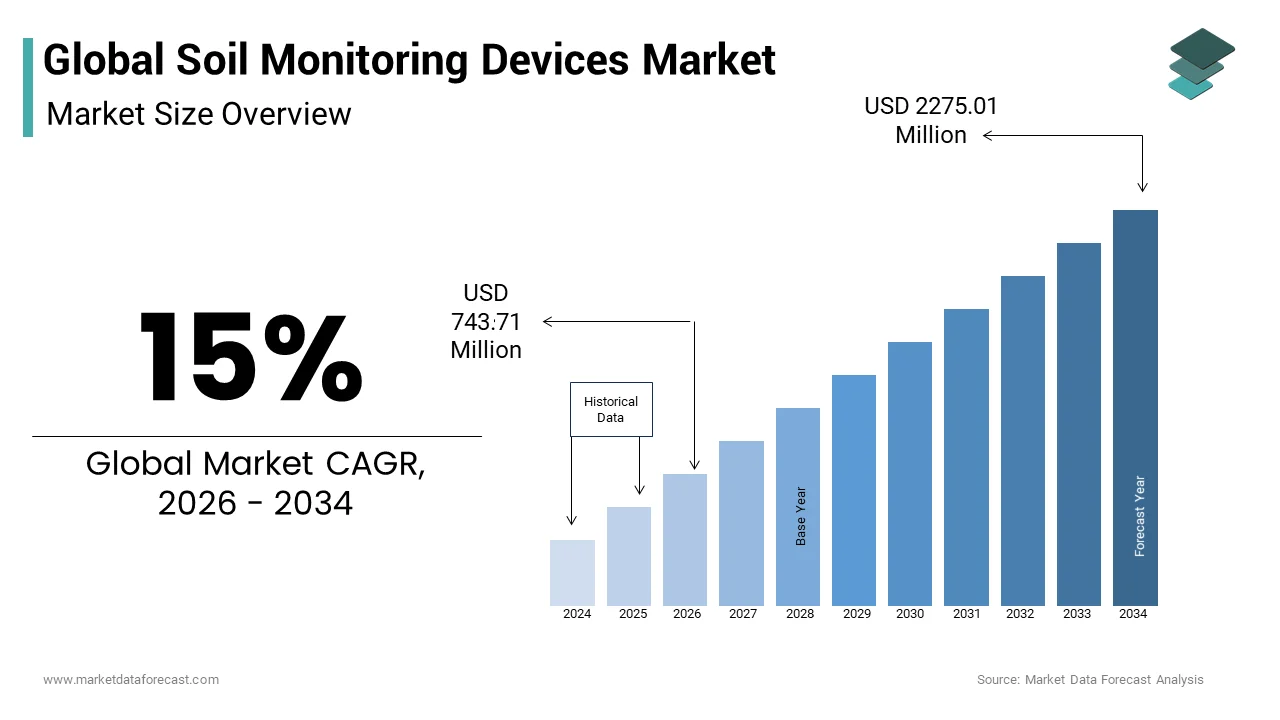
The Global Soil Monitoring Devices Market size was valued at USD 646.70 million in 2025, is estimated to reach USD 743.71 million in 2026, and is projected to expand to USD 2,275.01 million by 2034, registering a compound annual growth rate (CAGR) of 15.00% during the forecast period from 2026 to 2034. Driven by stringent environmental regulations, a major push toward precision agriculture, and the integration of IoT and AI-powered analytics, the market is experiencing rapid global growth.
Key Executive Metrics (At-a-Glance)
- 2025 Base Valuation: USD 646.70 Million
- 2026 Current Valuation: USD 743.71 Million
- 2034 Forecast Valuation: USD 2,275.01 Million
- Compound Annual Growth Rate (CAGR): 15.00% (2026–2034)
- Leading Regional Market: North America (holding 36.8% market share in 2025)
- Key Growth Hubs: North America, Europe, and Asia-Pacific
Core Market Drivers
- Regulatory Mandates: Stringent government frameworks (such as the EU Soil Strategy for 2030 and Nitrates Directive) compelling sustainable land management.
- Precision Agriculture Adoption: Surging demand for resource efficiency, variable rate irrigation, and fertilizer optimization to boost crop yields and reduce waste.
- AI & IoT Integration: Emergence of smart sensors with predictive analytics and edge computing to provide actionable real-time insights.
Primary Market Restraints & Challenges
- High Initial Capital Outlay: Substantial upfront costs for advanced sensor arrays and infrastructure, limiting accessibility for smallholders.
- Technical Complexity & Calibration Drift: Digital literacy gaps among traditional farmers and harsh field conditions causing sensor degradation or data drift.
Market Segmentation: Largest and Fastest-Growing Segments
| Segment Category | Largest Segment | Fastest-Growing Segment |
|---|---|---|
| By Product Type (Offering) | Hardware Components (55.4% share in 2025) | Software Solutions (15.2% CAGR) |
| By Application | Moisture Monitoring | Nutrient & Temperature Monitoring |
| By End User | Farming Usage (Agricultural Enterprises) | Carbon Farming & Ecosystem Services |
| By Region | North America (36.8% share) | Europe (Driven by strict soil regulations) & Asia-Pacific |
Major Industry Players Profiled
Key market participants shaping the global soil monitoring devices landscape include Trimble Inc., Raven Industries Inc., Sentek Limited, Stevens Water Monitoring Systems Inc., The Toro Company, and Spectrum Technologies, Inc.
 Download Free Sample Report
Global Soil Monitoring Devices Market Size
The global soil monitoring devices market size was valued at USD 646.70 million in 2025 and is anticipated to reach USD 743.71 million in 2026 to reach USD 2275.01 million by 2034, growing at a CAGR of 15% during the forecast period from 2026 to 2034.
MARKET OVERVIEW AND DEFINITION
The soil monitoring devices are sensors and analytical tools designed to measure physical chemical and biological properties of soil in real time. These devices track parameters, such as moisture content temperature pH levels electrical conductivity and nutrient concentration to provide actionable insights for agricultural and environmental management. The integration of Internet of Things connectivity allows for remote data transmission enabling precise decision making in precision agriculture and land conservation efforts. As per the European Environment Agency, approximately 60 to 70% of soils in the European Union are unhealthy due to degradation processes such as erosion compaction and loss of organic carbon. This widespread degradation threatens food security and biodiversity prompting governments to mandate sustainable land management practices. Furthermore, the European Commission’s Soil Strategy for 2030 aims to restore degraded soils and ensure all soil ecosystems are healthy by 2050. This regulatory push combined with the increasing frequency of extreme weather events such as droughts and floods necessitates the use of advanced monitoring systems to optimize water usage and maintain soil resilience. The transition towards data driven farming practices is thus becoming a fundamental requirement for modern agricultural sustainability and environmental stewardship across the continent.
MARKET DRIVERS
Regulatory Mandates for Sustainable Land Management Drive Adoption
The implementation of rigorous environmental regulations and sustainability mandates is fuelling the growth of the soil monitoring devices market. Governments are increasingly enforcing policies that require farmers and land managers to demonstrate compliance with soil health standards to mitigate degradation and protect ecosystems. The proposed Soil Monitoring Law aims to establish a comprehensive framework for identifying and remediating contaminated sites and preventing further soil deterioration. This legislative pressure compels agricultural enterprises to deploy monitoring technologies that provide verifiable data on soil conditions. The Common Agricultural Policy of the European Union links direct payments to farmers with adherence to environmental standards including soil protection measures. According to the European Court of Auditors effective monitoring is essential to ensure that these subsidies contribute to genuine environmental improvements. Additionally, the Nitrates Directive requires member states to monitor nitrate levels in soil and water to prevent pollution from agricultural sources. The Organisation for Economic Co operation and Development reports that agricultural policy reforms in Europe have increasingly focused on environmental performance indicators. This shift creates a mandatory demand for accurate and continuous soil data collection. Farmers must utilize advanced sensors to track nutrient leaching and optimize fertilizer application to avoid penalties and maintain subsidy eligibility.
Precision Agriculture Practices Enhance Resource Efficiency and Yield
The widespread adoption of precision agriculture techniques fueled by the need for resource efficiency and higher crop yields, significantly boosting the growth of the soil monitoring devices market. Modern farming operations rely on detailed spatial data to apply water fertilizers and pesticides only, where needed reducing waste and environmental impact. As per the Joint Research Centre of the European Commission, precision agriculture can reduce fertilizer use by up to 20% while maintaining or increasing crop productivity. Soil moisture sensors enable farmers to implement variable rate irrigation ensuring that crops receive optimal hydration without overwatering, which conserves water resources. This optimization not only lowers input costs but also minimizes greenhouse gas emissions associated with fertilizer production and application. Furthermore, the growing complexity of crop rotation strategies and the introduction of high value specialty crops require detailed soil profiling to maximize yield potential. The ability to monitor soil health in real time allows for immediate corrective actions preventing crop stress and disease.
MARKET RESTRAINTS
High Initial Investment Costs Limit Accessibility for Smallholders
The substantial financial burden associated with acquiring and installing advanced systems for small and medium sized agricultural enterprises is hindering the growth of the soil monitoring devices market. High precision sensors data loggers and connectivity infrastructure require considerable upfront capital which many smaller farms cannot afford. The average income of small farm holders in Europe remains volatile and often insufficient to justify large investments in digital technologies. The cost of a comprehensive soil monitoring setup including multiple sensor nodes and software subscriptions can exceed several thousand euros posing a barrier to entry. The European Investment Bank notes that access to finance for digital transformation in agriculture remains limited for smaller operators due to perceived risks and lack of collateral. Furthermore, the rapid pace of technological obsolescence means that equipment may need replacement or upgrading within a few years adding to the total cost of ownership. Maintenance and calibration of sensors also incur ongoing expenses that strain limited budgets. This financial disparity creates a digital divide in the agricultural sector where only well capitalized entities can leverage data driven insights.
Technical Complexity and Lack of Digital Literacy Hinder Implementation
The technical sophistication of soil monitoring devices and the associated data analytics platforms for users lacking digital literacy and technical expertise is also declining the growth of the soil monitoring devices market. Operating these systems requires knowledge of sensor installation data interpretation and software management, which many traditional farmers do not possess. The complexity of integrating soil data with other farm management systems often leads to user frustration and underutilization of the technology. Many farmers find it difficult to translate raw sensor data into actionable agronomic decisions without specialized assistance. The lack of user-friendly interfaces and standardized data formats further complicates the process. The Joint Research Centre reports that interoperability issues between different hardware and software providers create additional barriers for seamless integration. Consequently, even when devices are purchased they may not be used to their full potential resulting in poor perceived value. The agricultural sector faces a shortage of advisors who are proficient in both agronomy and digital technologies. This human capital deficit slows down the learning curve and discourages broader adoption.
MARKET OPPORTUNITIES
Integration with Artificial Intelligence Enables Predictive Analytics
The emergence of soil monitoring devices with artificial intelligence and machine learning algorithms for delivering predictive insights and automated decision support is to gear up the growth of the soil monitoring devices market. Advanced analytics can process vast amounts of historical and real time soil data to forecast crop performance disease outbreaks and optimal harvest times. As per the European Partnership on Artificial Intelligence the application of AI in agriculture is expected to grow significantly enhancing productivity and sustainability through data driven predictions. Machine learning models can identify complex patterns in soil behavior that are not apparent through manual analysis enabling proactive management strategies. Soil monitoring devices equipped with edge computing capabilities can process data locally providing immediate alerts for critical conditions, such as frost risk or nutrient deficiency. This real time responsiveness allows farmers to mitigate risks before they impact crop health. Furthermore, AI algorithms can optimize irrigation schedules based on predicted weather patterns and soil moisture trends maximizing water use efficiency. The European Institute of Innovation and Technology supports projects that integrate AI with IoT sensors to develop smart farming solutions. These innovations create new revenue streams for device manufacturers through subscription-based analytics services. The ability to offer actionable intelligence rather than just raw data enhances the value proposition of soil monitoring systems.
Expansion into Carbon Farming and Ecosystem Services Markets
The carbon farming and ecosystem services to play a central role in verifying soil carbon sequestration, which is also to leverage the growth of the soil monitoring devices market. Governments and private corporations are increasingly investing in initiatives that reward farmers for capturing carbon in soil thereby mitigating climate change. The carbon farming initiative aims to create a robust certification mechanism for carbon removals requiring accurate and transparent monitoring of soil organic carbon levels. Soil monitoring devices capable of measuring carbon content and related parameters are essential for validating these claims and ensuring compliance with certification standards. The soil carbon sequestration has the potential to offset a significant portion of global greenhouse gas emissions. Financial incentives for carbon credits create a new economic motive for farmers to adopt monitoring technologies. Soil sensors provide the continuous data necessary to track changes in carbon stocks over time offering proof of impact for investors and regulators. This verification capability transforms soil monitoring from a cost center into a revenue generating asset for farmers. Device manufacturers can partner with carbon credit platforms to offer integrated solutions that simplify the certification process.
MARKET CHALLENGES
Data Interoperability and Standardization Issues Fragment the Ecosystem
The lack of standardized data formats and interoperability protocols among different soil monitoring device manufacturers for seamless integration and data utilization is one of the major challenges for the growth of the soil monitoring devices market. Farmers often use equipment from multiple vendors leading to incompatible data streams that cannot be easily consolidated into a single management platform. The absence of universal communication standards for agricultural IoT devices hinders the development of cohesive digital farming ecosystems. This fragmentation forces users to manage multiple disjointed software applications reducing efficiency and increasing the risk of data errors. The Joint Research Centre emphasizes that interoperability is crucial for unlocking the full potential of precision agriculture but current market offerings remain siloed. Without standardized interfaces integrating soil data with machinery control systems and enterprise resource planning tools becomes technically challenging and costly. The European Innovation Partnership for Agricultural Productivity and Sustainability notes that data ownership and sharing concerns further complicate interoperability efforts. Farmers are hesitant to share data if they cannot ensure its portability and security across different platforms. This uncertainty limits the willingness to invest in interconnected monitoring systems. The industry lacks a unified framework for data exchange which stifles innovation and collaboration among technology providers.
Sensor Durability and Calibration Drift in Harsh Field Conditions
The harsh and variable conditions of agricultural environments is additionally to inhibit the growth of the soil monitoring devices market. Sensors are exposed to moisture temperature fluctuations mechanical stress and chemical corrosion which can lead to premature failure or data drift. As per the International Organization for Standardization, agricultural electronics must withstand extreme environmental conditions but maintaining long term accuracy remains difficult. Calibration drift occurs when sensor readings deviate from true values due to aging components or soil contamination requiring frequent recalibration. The Joint Research Centre reports that maintenance requirements for soil sensors are often underestimated leading to unreliable data and reduced trust in the technology. Farmers may neglect regular calibration due to labor constraints or lack of technical knowledge resulting in erroneous decisions based on faulty data. The European Agricultural Machinery Industry Association highlights that the lifespan of soil sensors in field conditions is typically shorter than in controlled environments increasing replacement costs. Biofouling and soil compaction around sensors can also affect measurement accuracy particularly for moisture and conductivity readings. Developing robust encapsulation materials and self cleaning mechanisms adds to manufacturing costs. The challenge of ensuring consistent performance across diverse soil types and climatic zones further complicates product design. Manufacturers must balance cost durability and accuracy to meet user expectations.
REPORT COVERAGE
| REPORT METRIC | DETAILS |
| Market Size Available | 2025 to 2034 |
| Base Year | 2025 |
| Forecast Period | 2026 to 2034 |
| CAGR | 15% |
| Segments Covered | By Product Type, Application, End-User, And Region |
| Various Analyses Covered | Global, Regional & Country Level Analysis, Segment-Level Analysis, DROC, PESTLE Analysis, Porter’s Five Forces Analysis, Competitive Landscape, Analyst Overview of Investment Opportunities |
| Regions Covered | North America, Europe, APAC, Latin America, Middle East & Africa |
| Market Leaders Profiled | Stevens Water Monitoring Systems Inc., The Toro Company, Spectrum Technologies, Inc., and Sentek Technologies |
SEGMENT ANALYSIS
By Offering Insights
The hardware components segment was the largest by holding 55.4% of the soil monitoring devices market share in 2025 with the fundamental requirement for physical sensors probes and data loggers to collect primary soil data. The sales of agricultural sensors and hardware instruments have grown steadily due to the widespread retrofitting of existing farming equipment with monitoring capabilities. The durability and precision of hardware devices are paramount for long term field operations necessitating regular replacement and upgrades. The average lifespan of a soil moisture sensor is three to five years creating a recurring demand for hardware replacements. Additionally, the expansion of IoT networks in rural areas has facilitated the deployment of connected hardware devices that transmit data seamlessly to cloud platforms. The International Telecommunication Union reports that cellular connectivity in agricultural regions of Europe has improved significantly enabling reliable data transmission from remote hardware units. Farmers invest heavily in high quality hardware to ensure data integrity and minimize maintenance downtime. The European Investment Bank indicates that capital expenditure on agricultural hardware constitutes the largest portion of digital farming budgets. The variety of hardware options including capacitive resistive and tensiometric sensors allows users to select solutions tailored to specific soil types and crops.
The software solutions segment is deemed to grow at a fastest CAGR of 15.2% throughout the forecast period owing to the increasing complexity of data analytics required to interpret vast amounts of soil information. Farmers and agronomists rely on sophisticated software to visualize trends predict outcomes and generate actionable recommendations from raw sensor data. The Joint Research Centre of the European Commission emphasizes that software interoperability and user-friendly interfaces are key factors driving adoption among non-technical users. Cloud based platforms enable remote access to soil data allowing stakeholders to monitor fields from anywhere in the world. The uptake of agricultural cloud services has grown significantly due to enhanced security and scalability features. Software providers are increasingly offering subscription-based models which lower the entry barrier for small and medium sized farms. This tangible economic benefit encourages farmers to invest in premium software packages. Furthermore, the integration of software with other farm management tools creates a holistic digital ecosystem that enhances operational efficiency.
REGIONAL ANALYSIS
North America Market Analysis
North America was the out performer in the global Soil Monitoring Devices Market with 36.8% of the share in 2025 with the advanced technological adoption and strong government support for precision agriculture. The region benefits from robust infrastructure for data transmission and a high level of digital literacy among farmers. Canada also contributes significantly with its focus on sustainable resource management and climate smart agriculture initiatives. The Canadian Government’s Living Laboratories Initiative supports the development and demonstration of innovative agricultural technologies including soil sensors. The Environmental Protection Agency in the US enforces strict guidelines on agricultural runoff prompting farmers to adopt monitoring solutions. The presence of major agtech companies in Silicon Valley and other tech hubs fosters continuous innovation in sensor technology and data analytics.
Europe Market Analysis
Europe soil monitoring devices market growth held next position by holding 32.1% of the share in 2025 with the stringent environmental regulations and a commitment to sustainable agriculture. As per the European Environment Agency, 60 to 70% of soils in the EU are unhealthy requiring immediate attention and monitoring to restore health. Germany, France, and the Netherlands, are key countries within the region due to their advanced agricultural sectors and technological expertise. The European Commission’s Soil Strategy for 2030 sets ambitious targets for soil restoration creating a regulatory push for monitoring adoption. The region is characterized by a high density of small and medium sized farms which are increasingly adopting shared monitoring solutions and cooperative models. The Joint Research Centre of the European Commission provides scientific support and data infrastructure for soil monitoring initiatives across the continent. European consumers’ demand for sustainably produced food also incentivizes farmers to demonstrate responsible land management through data verification. The Common Agricultural Policy provides financial incentives for farmers who implement precision agriculture practices. The presence of renowned research institutions and universities drives innovation in sensor technology and soil science. Europe’s focus on data privacy and interoperability standards shapes the development of secure and compatible monitoring solutions.
Asia Pacific Market Analysis
The Asia Pacific soil monitoring devices market growth is amplifying with the rapid population growth and the need to enhance agricultural productivity. China, India, and Australia, are the primary contributors to the regional market with China being the largest producer of agricultural goods globally. The region faces challenges related to soil degradation and water scarcity which necessitate the adoption of efficient monitoring technologies. India’s Digital Agriculture Mission aims to create a unified platform for agricultural data encouraging the use of soil sensors and analytics. The Australian Government’s National Soil Strategy emphasizes the importance of soil health for food security and environmental sustainability driving investment in monitoring tools. The presence of low cost manufacturing hubs in China and Southeast Asia makes soil monitoring devices more affordable for local farmers. However, the fragmentation of land holdings and limited digital infrastructure in rural areas pose challenges to widespread adoption. Governments are investing in rural connectivity and training programs to overcome these barriers. The growing middle class and changing dietary habits increase demand for high quality produce further motivating farmers to adopt precision techniques.
Latin America Market Analysis
Latin America soil monitoring devices market growth is likely to grow with the expansion of commercial agriculture and export oriented farming. Brazil and Argentina are the largest contibutors in the region due to their significant production of soybeans corn and other cash crops. The region’s vast arable land and favorable climate conditions attract investment in modern farming practices. Soil monitoring devices are essential for managing nutrient levels and moisture in large scale monocultures prevalent in the region. Economic volatility and currency fluctuations can impact purchasing power but the long term benefits of resource efficiency drive adoption among large agribusinesses. The Argentine Ministry of Agriculture promotes the use of technology to enhance competitiveness in global markets. The region faces challenges related to deforestation and soil erosion, which monitoring technologies can help mitigate through better land management practices. International organizations, such as the Food and Agriculture Organization provide technical assistance and funding for sustainable agriculture projects.
Middle East and Africa Market Analysis
The Middle East and Africa soil monitoring devices market growth is driven by the need to address water scarcity and improve food security in arid environments. Countries in the Gulf Cooperation Council, such as the United Arab Emirates and Saudi Arabia are investing heavily in smart agriculture and controlled environment farming. As per the Saudi Vision 2030 plan the kingdom is allocating significant resources to develop sustainable agricultural practices including the use of advanced soil monitoring technologies. The harsh climate and limited arable land make efficient water and nutrient management critical for agricultural success. Soil monitoring devices help optimize irrigation in desert farming and greenhouse operations reducing water consumption. South Africa and Egypt are leading markets in the region with established commercial farming sectors adopting precision technologies. Limited infrastructure and financial resources hinder widespread adoption in sub Saharan Africa but pilot projects and donor funded initiatives are demonstrating the benefits of soil monitoring. International partnerships and knowledge transfer programs facilitate the introduction of monitoring technologies to the region.
COMPETITIVE LANDSCAPE
The competition in the Soil Monitoring Devices Market is characterized by a mix of established technology giants and specialized agritech startups striving to offer superior data accuracy and usability. Major players leverage their extensive distribution networks and brand recognition to maintain strong market presence while newer entrants disrupt with innovative sensor technologies and flexible pricing models. The market sees intense rivalry in software capabilities where companies compete to provide the most intuitive and insightful data analytics platforms. Interoperability remains a key differentiator as farmers seek solutions that integrate seamlessly with their existing equipment and management systems. Price sensitivity varies across regions with developed markets prioritizing advanced features while emerging economies focus on affordability and durability. Strategic alliances between hardware manufacturers and software developers are common as firms aim to offer end to end solutions. Intellectual property protection is crucial as companies patent unique sensor designs and algorithms to safeguard their innovations. Customer support and training services play a vital role in building trust and ensuring effective utilization of complex monitoring systems. The race to achieve greater precision and ease of use drives continuous improvement in product offerings.
KEY MARKET PLAYERS
Key players in the soil monitoring devices market include
- Stevens Water Monitoring Systems Inc.
- The Toro Company
- Trimble Inc
- Sentek Limited
- Raven Industries Inc
- Spectrum Technologies, Inc.
- Sentek Technologies.
Top Players In The Market
- Trimble Inc is a global leader in precision agriculture technology offering advanced soil monitoring solutions that integrate seamlessly with farm management systems. The company provides a comprehensive suite of sensors and software platforms that enable farmers to optimize input usage and enhance crop productivity. Trimble recently expanded its portfolio by launching new wireless soil moisture probes that offer real time data transmission via cellular networks. This innovation allows for remote monitoring and automated irrigation control reducing water waste significantly. The company actively collaborates with agronomists and research institutions to refine algorithms for better nutrient management recommendations. Trimble also focuses on interoperability ensuring its devices work with various third party machinery and software.
- Raven Industries Inc specializes in applied technology solutions for agriculture including sophisticated soil monitoring and variable rate application systems. The company’s Slingshot platform integrates soil data with field operations enabling precise mapping and analysis of soil variability. Raven recently introduced enhanced sensor technologies that measure multiple soil parameters simultaneously providing a holistic view of field conditions. These advancements support targeted fertilizer application which minimizes environmental impact and lowers costs for farmers. The company strengthens its market position through strategic partnerships with equipment manufacturers to embed its technology into mainstream agricultural machinery. Raven also invests heavily in research and development to improve sensor accuracy and longevity in harsh field environments. Their focus on open architecture allows farmers to combine Raven solutions with other digital tools creating customized farm management ecosystems.
- Sentek Limited is a prominent provider of soil monitoring instruments known for its innovative capacitance based sensor technology. The company offers a wide range of probes and data loggers designed for accurate measurement of soil moisture salinity and temperature. Sentek recently launched the EnviroSCAN series which features modular design allowing users to customize sensor configurations based on specific crop needs. This flexibility appeals to both small scale growers and large commercial operations seeking tailored solutions. The company emphasizes educational initiatives providing training and support to help users interpret soil data effectively. Sentek also focuses on developing low power consumption devices suitable for remote locations with limited infrastructure.
Top Strategies Used By Key Market Participants
Key players in the Soil Monitoring Devices Market primarily focus on product innovation and strategic partnerships to enhance their competitive edge. Companies invest heavily in research and development to create sensors with higher accuracy durability and connectivity features. Integrating artificial intelligence into software platforms allows for predictive analytics and automated decision support which adds significant value for users. Collaborations with agricultural machinery manufacturers enable seamless integration of monitoring devices into existing farming equipment fostering broader adoption. Expanding into emerging markets through local distributors helps companies reach smallholder farmers who are increasingly adopting digital tools. Offering subscription based services for data analytics creates recurring revenue streams and strengthens customer loyalty. Companies also prioritize interoperability ensuring their devices can communicate with various farm management software systems. Educational programs and technical support services are essential strategies to overcome barriers related to digital literacy.
RECENT MARKET NEWS
In January 2024, John Deere, an agricultural machinery corporation, partnered with a soil analytics startup to integrate advanced sensing into its equipment. This partnership is anticipated to allow John Deere to enhance precision farming offerings and strengthen the Soil Monitoring Devices Market.
MARKET SEGMENTATION
This research report on the global soil monitoring devices market is segmented and sub-segmented into the following categories.
By Product Type
- Software
- Hardware
By Application
- Moisture Monitoring
- Salinity Monitoring
- Temperature Monitoring
- Others
By End User
- Farming Usage
- Non-Farming Usage
By Region
- North America
- Asia Pacific
- Europe
- Latin America
- Middle East & Africa