- Product Description Description
- Table of Contents TOC
- List of Table & Figure LOT
- Get Free Sample PDF Sample PDF
Market Size, 2025
$0.74 BnMarket Estimate, 2026
$1.05 BnMarket Forecast, 2034
$16.90 BnCAGR, 2026–2034
41.57%Executive Summary: Global Solar Vehicle Market
- Market Scope: Global solar vehicle market analysis covering vehicle types, battery chemistries, solar panel technologies, and regional leadership frameworks.
- Market Valuation: Valued at USD 0.74 billion (2025), estimated at USD 1.05 billion (2026), and projected to reach USD 16.90 billion by 2034, registering a robust CAGR of 41.57% (2026–2034).
- Primary Growth Drivers: Aggressive regulatory pressure to decarbonize urban mobility and advancements in high-efficiency lightweight photovoltaic materials like perovskite. The market benefits from expanding solar charging infrastructure in sun-rich emerging economies, integration with smart grid systems, and a transition toward functional energy harvesting.
Key Market Segment Metrics (2026–2034)
| Category | Leading Segment (2025 Position) | Fastest-Growing Segment |
|---|---|---|
| By Vehicle Type | Battery Electric Vehicles (BEVs) (dominated in 2025 due to seamless photovoltaic integration) | Plug-in Hybrid Electric Vehicles (PHEVs) (expected to grow at the fastest CAGR of 21.3%) |
| By Battery Technology | Lithium-ion Batteries (led the battery segment in 2025) | Lead-Carbon Batteries (projected as the fastest-growing segment at 18.7% CAGR) |
| By Solar Technology | Monocrystalline Panels (held the majority share in 2025 due to superior efficiency) | Advanced perovskite and thin-film photovoltaic integrations |
| By Region | Europe (top performer capturing a 34.6% share in 2025) | Asia-Pacific (capturing a 29.9% share with strong regional manufacturing growth) |
Major Market Players & Market Structure
Market Structure: Highly collaborative and innovative automotive-solar ecosystem featuring major global automakers and specialized tech pioneers competing on next-generation photovoltaic integration, perovskite cell efficiency, and scalable manufacturing partnerships.
Key Companies: TOYOTA MOTOR CORPORATION, Volkswagen AG, Aptera Motors, Lightyear, Panasonic Corporation, ZF Friedrichshafen AG, AB Volvo, BYD Company Ltd., Schaeffler AG, Continental AG, Tesla, Nissan, Mahindra & Mahindra Ltd., Sono Motors, GM Cruise LLC, Hanergy Thin Film Power Group Limited, Solar Electric Vehicle Company, Atlas Technologies, JJ PV Solar, Trina Solar, Surat Exim Pvt. Ltd., Jinko Solar, Sikco Sustainability Assured, and Venturi Automobiles.
Global Solar Vehicle Market Size
The global solar vehicle market size was valued at USD 0.74 billion in 2025 and is anticipated to reach a valuation of USD 1.05 billion in 2026 and USD 16.90 billion by 2034, growing at a CAGR of 41.57%, from 2026 to 2034.
Solar vehicle refers to the transport solutions, ranging from passenger cars to light commercial and specialized utility vehicles, that embed photovoltaic cells directly into their bodywork to generate electricity for propulsion or auxiliary power. Unlike standard battery electric vehicles that rely exclusively on grid charging, solar vehicles harness ambient sunlight to supplement energy needs, thereby extending driving range and reducing charging frequency. Moreover, commercial deployment remains limited, with fewer purpose-built solar-integrated vehicles globally. The market is largely experimental, driven by innovation rather than volume sales, with key players leading prototype development. Laboratory breakthroughs have pushed photovoltaic conversion efficiency beyond notable shares using perovskite-based cells. Despite these advances, the market remains in its infancy, shaped more by regulatory ambition and technological curiosity than consumer demand.
MARKET DRIVERS
Rising Regulatory Pressure to Decarbonize Urban Mobility
Governments across major economies are enforcing aggressive vehicle emission standards that indirectly bolster interest in solar-assisted mobility, and thereby fuel the growth of the solar vehicle market. Regulations within the European Union indicate a future requirement for significant reductions in emissions for new vehicles, aiming toward an eventual transition to zero-emission models. One major region in the United States has introduced rules that will require all new passenger vehicles sold to be zero-emission within the next decade. Many nations across the globe are moving towards a transition away from vehicles powered by fossil fuels within the 2030 to 2040 timeframe. These policies compel automakers to explore every viable emissions reduction lever, including marginal gains from solar integration. Integrating solar panels into vehicle designs has the potential to generate a meaningful amount of a car’s annual energy needs, particularly when used in sunnier climates. Even modest solar contributions improve a vehicle’s lifecycle carbon intensity, making solar augmentation a strategic compliance tool in tightening regulatory environments.
Advancements in High-Efficiency Lightweight Photovoltaic Materials
Material science breakthroughs are overcoming historical barriers to automotive solar integration, which contributes to the expansion of the solar vehicle market. Traditional silicon panels are too heavy and rigid, but next-generation technologies, particularly perovskite and organic photovoltaics, offer flexibility, light weight, and high efficiency. A notable trend is the achievement of over thirty percent efficiency in certain advanced solar cell technologies that combine different materials. More specifically, recent developments in flexible solar modules show efficiencies exceeding twenty percent while remaining exceptionally lightweight. This enables seamless integration onto curved surfaces without compromising vehicle dynamics. Such performance transforms solar from a symbolic feature into a functional energy harvesting system, which attracts serious engineering investment from OEMs and component suppliers alike.
MARKET RESTRAINTS
Inadequate Energy Yield Relative to Vehicle Power Demands
The core limitation of these vehicles lies in the physical mismatch between available surface area and energy consumption, which in turn hampers the growth of the solar vehicle market. A typical electric car uses notable kilowatt hours per hundred kilometers. Even with five square meters of state-of-the-art, twenty-five percent efficient panels, daily solar generation in optimal conditions typically results in an energy output that reflects the high solar irradiance of sunny regions. This translates to roughly forty kilometers of additional range, insufficient for most daily travel needs. In temperate climates like Germany or the United Kingdom, daily energy generation from the same panels is consistently lower, yielding significantly less power due to reduced sunlight hours and intensity compared to sunnier regions. Consequently, solar cannot serve as a primary energy source but only as a minor supplement. This functional limitation reduces consumer appeal, especially where public charging is accessible, and diminishes the return on the added cost and complexity of solar integration.
High Incremental Cost and Limited Economies of Scale
Solar integration significantly increases vehicle manufacturing costs without proportional consumer benefits, and is a major obstacle for the solar vehicle market. Specialized photovoltaic modules are engineered with features like durability, curvature, and weather resistance for automotive applications. These modules have a comparatively higher cost per square meter than standard solar panels. Integrating these photovoltaic systems into vehicles adds a notable cost to the overall material expenses. A limited number of entities currently produce vehicle-integrated photovoltaics on a commercial level. This limited commercial scale prevents potential cost reductions often associated with mass production. Consumer willingness to pay remains low. Without dramatic cost declines or policy subsidies, solar vehicles will remain a premium niche, inaccessible to mainstream markets.
MARKET OPPORTUNITIES
Expansion of Solar Charging Infrastructure in Sun-Richch Emerging Economies
Emerging economies with high solar irradiance and weak grid infrastructure offer fertile ground for solar vehicle adoption, particularly in the last mile and rural transport. This is setting up new opportunities for the solar vehicle market. Regions like India, Nigeria, and Indonesia have considerable potential for solar energy generation due to high levels of sunlight exposure. In some emerging economies, a significant portion of rural populations lack consistent access to the main power grid. Solar-assisted three-wheelers, common in South Asia, benefit from high surface area to energy demand ratios. Trials involving solar-powered light transport vehicles suggest they can operate for meaningful distances daily without needing conventional grid charging. With millions of three-wheelers in India, the addressable market is substantial. Government programs like India’s FAME II scheme further accelerate adoption through purchase incentives, positioning solar vehicles as a practical solution for decentralized, off-grid mobility.
Integration with Smart Grid and Vehicle-to-Grid Systems
These vehicles can evolve beyond transport into dynamic energy assets within smart grids, which is likely to promote fresh prospects for the expansion of the solar vehicle market. When paired with vehicle-to-grid technology, they store surplus solar energy and discharge it during peak demand, enhancing grid resilience. The use of a large number of solar-integrated vehicles has the potential to contribute to clean energy provision, with a combined output comparable to a significant solar energy installation. Moreover, in areas experiencing high solar energy production during certain times, vehicle-integrated energy systems offer a way to store and redistribute power to meet later demand peaks. The application of this vehicle technology may offer a decrease in home energy expenses and could also provide an opportunity for vehicle owners to earn income through participation in grid services. The development of smart charging protocols will enable solar electric vehicles to autonomously manage energy flow according to grid signals and dynamic pricing, which provides value as flexible mobility assets and power resources in the evolving decentralized energy ecosystem.
MARKET CHALLENGES
Intermittency and Geographic Limitations of Solar Resource
The performance of solar vehicles is highly sensitive to geographic and seasonal sunlight variability, which is a serious barrier to the solar vehicle market. In high latitude regions, winter solar insolation is significantly reduced compared to summer months, often falling to minimal levels. The significant decrease in winter solar irradiance in Nordic countries renders solar power contribution negligible during the cold months when heating energy demands are at their peak. Even in moderately sunny regions like Germany, the average annual insolation is sufficient to provide only a modest amount of daily solar energy generation throughout most of the year. Urban environments compound the issue through building shading, pollution, and limited sun exposure in parking areas. This geographic and temporal inconsistency restricts solar vehicles to a narrow band of sun-abundant regions, hindering global scalability.
Material Durability and Longevity Under Automotive Operating Conditions
Vehicle-integrated photovoltaics face extreme mechanical and environmental stress absent in stationary applications, and thereby obstruct the expansion of the solar vehicle market. Continuous vibration, thermal cycling from minus twenty to plus eighty degrees Celsius, stone impacts, and moisture exposure accelerate degradation. Flexible organic photovoltaics are especially vulnerable. Current encapsulation methods struggle to balance transparency, flexibility, and protection against UV and humidity. Moreover, no automotive-specific certification standard exists for solar modules, which creates liability and warranty uncertainties. Consumer and manufacturer confidence will remain limited, thus constraining market expansion, until photovoltaic (PV) systems demonstrate an eight to ten-year durability under real-world automotive stress.
REPORT COVERAGE
| REPORT METRIC | DETAILS |
| Market Size Available | 2025 to 2034 |
| Base Year | 2025 |
| Forecast Period | 2026 to 2034 |
| CAGR | 41.57% |
| Segments Covered | By Vehicle, Propulsion, Battery, Solar Panel, Charging, Application, and Region. |
|
Various Analyses Covered | Global, Regional, Country-Level Analysis, Segment-Level Analysis, DROC, PESTLE Analysis, Porter’s Five Forces Analysis, Competitive Landscape, Analyst Overview of Investment Opportunities |
| Regions Covered | North America, Europe, APAC, Latin America, Middle East & Africa |
| Market Leaders Profiled | TOYOTA MOTOR CORPORATION; Volkswagen AG; Panasonic Corporation; ZF Friedrichshafen AG; AB Volvo; BYD Company Ltd.; Schaeffler AG; Continental AG; Tesla; Nissan; Mahindra & Mahindra Ltd.; Sono Motors; GM Cruise LLC; Hanergy Thin Film Power Group Limited; Solar Electric Vehicle Company; Atlas Technologies; JJ PV Solar; Trina Solar; Surat Exim Pvt. Ltd.; Jinko Solar; Sikco Sustainability Assured Venturi Automobiles, and Others. |
SEGMENT ANALYSIS
By Electric Vehicle Insights
The Battery Electric Vehicles (BEVs) segment dominated the solar vehicle market by capturing s substantial share in 2025. The leading position of the BEV segment is credited to its full electrification architecture, which enables seamless integration of photovoltaic systems without the mechanical complexity of internal combustion components. Unlike hybrid variants, BEVs rely entirely on stored electrical energy, making supplementary solar charging a logical extension to enhance range and reduce grid dependency. BEVs offer unobstructed surface areas and simplified electrical architectures that facilitate the embedding of solar panels into roofs, hoods, and even body panels. The absence of exhaust systems, fuel tanks, and engine blocks allows designers to maximize photovoltaic coverage. According to sources, a typical BEV platform can accommodate meters of solar cells without compromising aerodynamics or safety. This physical advantage translates into meaningful energy gains. In isolated regions, such integration can yield notable kilowatt hours daily, extending range. Automakers have leveraged this compatibility to develop vehicles where solar contributes over twenty percent of annual energy needs, which reinforces BEVs as the natural host for solar technology. Global regulatory frameworks increasingly favor pure electric drivetrains, indirectly promoting solar BEVs. The policy bias channels R&D investment toward solar augmented BEVs rather than hybrid platforms.
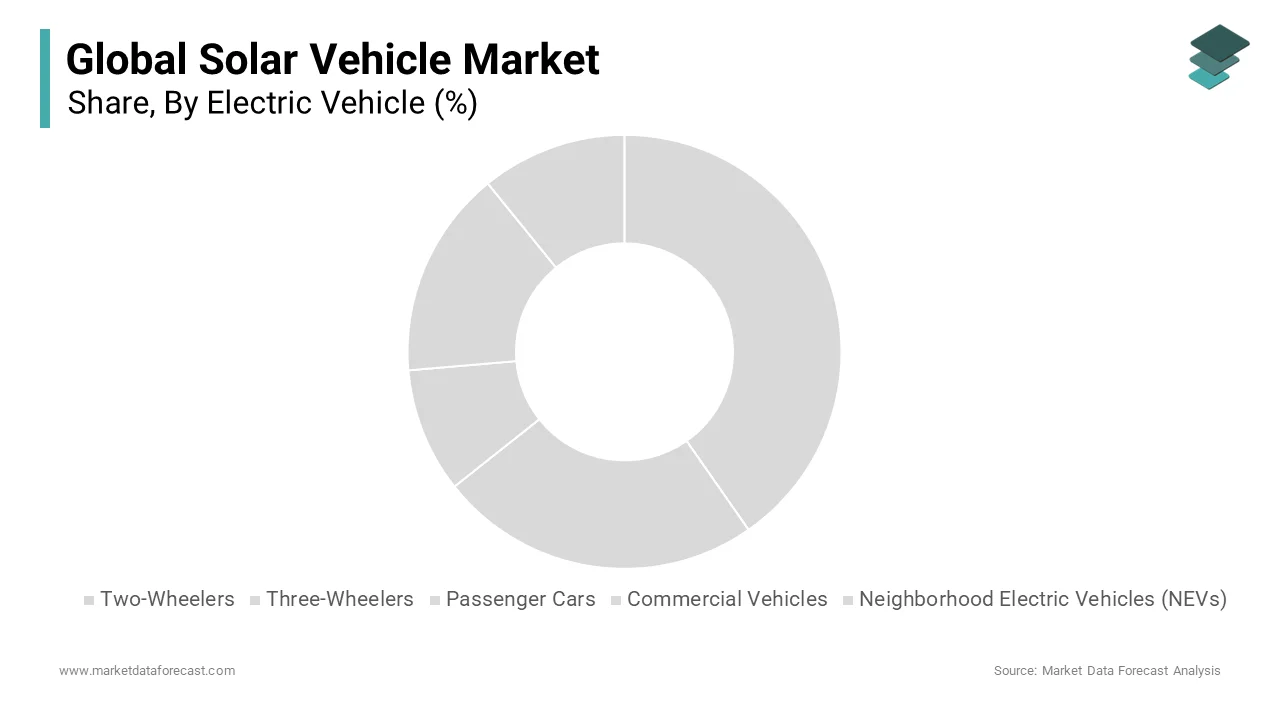
The Plug-in Hybrid Electric Vehicles (PHEVs) segment is likely to experience the fastest CAGR of 21.3% during the forecast periodits transitional appeal in markets with underdeveloped charging infrastructure and consumer range anxiety. In regions like Southeast Asia and parts of Latin America, sparse public charging networks hinder full BEV adoption. PHEVs equipped with solar panels offer a pragmatic compromise by using solar energy to power the electric mode for short urban trips while retaining a gasoline engine for longer journeys. The dual energy strategy resonates with cost-conscious consumers unwilling to fully commit to BEVs. Commercial fleet operators are increasingly trialing solar PHEVs for last-mile logistics due to their operational flexibility. Companies require vehicles that can complete urban routes on electric power to meet city emission zones while retaining range for intercity legs. These tangible fuel savings, combined with compliance in low-emission zones, are accelerating fleet-level adoption and driving segment growth.
By Battery Insights
The lithium-ion batteries segment led the solar vehicle market and captured a significant share in 2025. The dominance of the lithium-ion batteries segment is attributed to superior energy density, longevity, and compatibility with intermittent solar charging cycles. Lithium-ion cells offer notable energy densities per kilogram, compared to those of lead-acid batteries. This allows solar vehicles, often constrained by limited roof area and weight budgets, to store more energy without compromising efficiency. In contrast, an equivalent lead-acid system would weigh significant kilograms, making it impractical for road use. The weight savings directly enhance solar vehicle viability by reducing rolling resistance and improving aerodynamics, critical for maximizing the impact of limited solar input. Solar charging typically occurs in small, irregular increments throughout the day, resulting in batteries operating in a partial state of charge, a condition that rapidly degrades lead-based chemistries. Lithium-ion batteries, however, tolerate thousands of shallow cycles with minimal degradation. This durability is essential for solar vehicles that rarely undergo full charge-discharge cycles, ensuring long-term reliability and reducing the total cost of ownership.
The lead carbon batteries segment is on the rise and is expected to be the fastest-growing segment in the market by witnessing a CAGR of 18.7% over the forecast period, owing to low-speed solar utility vehicles in emerging markets. In rural India, Africa, and Southeast Asia, solar-powered three-wheelers and cargo carts operate at lower speeds per hour and require modest energy storage. Lead Carbon batteries cost less compared to lithium-ion. Affordability is a major factor influencing battery technology choices for certain electric vehicles. Alternative battery types can be significantly less expensive than some common options, like lithium-ion. The price of certain vehicles in these transportation segments is relatively low, making the cost of the battery a crucial consideration. The presence of local processing facilities for materials may also influence the preference for specific battery chemistries. Lead carbon battery technology is a prevalent choice in specific regional markets, likely driven by cost and infrastructure factors. Lead Carbon technology incorporates activated carbon into the negative electrode, dramatically improving charge acceptance and cycle life under a partial state of charge, common in solar applications. This performance uplift, combined with existing manufacturing and recycling ecosystems in developing economies, is fueling rapid adoption in cost-sensitive solar mobility niches.
By Solar Panel Insights
The monocrystalline panels segment held the majority share of the solar vehicle market in 2025. The prevalence of the monocrystalline panels segment is driven by unmatched efficiency and space efficiency—critical attributes for vehicle integration. Monocrystalline silicon cells generally achieve higher module efficiencies in commercial production compared to polycrystalline panels. The efficiency difference between the two types can result in a notable daily energy difference on a vehicle with a limited surface area in sunny regions. Higher efficiency outputs can enable greater electric range for solar vehicles. Improvements in efficiency on a vehicle can directly expand practical usability. Monocrystalline technology tends to be the preferred choice for solar vehicles where performance is a key consideration. Vehicles operate in dynamic lighting and thermal environments where polycrystalline panels suffer greater efficiency losses. In real-world conditions, such as urban driving in summer, where panel temperatures exceed sixty degrees Celsius, monocrystalline systems outperform by ten to fifteen percent. Additionally, their superior low-light response allows energy generation during dawn, dusk, and cloudy conditions, critical for consistent daily yield.
REGIONAL ANALYSIS
Europe Market Analysis
Europe was the top performer in the global solar vehicle market by capturing a 34.6% share in 2025. The leading position of Europe in the global market is driven by aggressive decarbonization policies, strong engineering capabilities, and pilot deployments across multiple countries. Germany serves as the innovation hub, hosting companies like Sono Motors and research institutions such as the Fraunhofer Institute. Germany alone accounts for a notable share of European solar vehicle registrations, driven by federal subsidies covering g considerable amount per vehicle under the Innovation Bonus scheme. Additionally, the region’s moderate but consistent solar insolation enables reliable year-round energy harvesting, supporting real-world viability assessments.
Asia Pacific Market Analysis
Asia Pacific followed closely in the solar vehicle market and occupied a 29.9% share in 2025 because of diverse applications across developed and emerging economies. Japan and South Korea focus on high-efficiency passenger solar vehicles, while India and Southeast Asia lead in solar-assisted three-wheelers and utility carts. Solar technology is being integrated into vehicles for testing in pilot programs. Prototypes using integrated solar panels are demonstrating potential to significantly extend vehicle range. Government initiatives and incentive programs are encouraging the use of solar-powered transportation options in various regions. Solar-powered electric rickshaws are becoming more common in certain areas. The region benefits from high solar insolation. The immense number of three-wheelers in the subcontinent presents a substantial, mostly unexploited opportunity for solar augmentation.
North America Market Analysis
North America grew steadily in the global solar vehicle market, with the United States dominating regional activity. California is the epicenter, leveraging its Advanced Clean Cars II regulation and abundant sunshine to foster innovation. Consumer interest in solar electric vehicles is growing, with a notable number of initial customer commitments for a specific model. Certain regions are particularly suitable for maximizing solar energy collection in integrated vehicle panels, which offer high daily energy potential. Government incentives promoting qualifying electric vehicles are likely to encourage the development of solar battery electric vehicles (BEVs). Apart from these, university research programs at institutions like Stanford and MIT are advancing vehicle-integrated photovoltaics, which creates a robust innovation pipeline that sustains North America’s leadership in high-performance solar mobility.
Middle East and Africa Market Analysis
The Middle East and Africa region is an attractive region in the solar vehicle market, with growth concentrated in sun-rich nations seeking energy-independent transport. The UAE is actively pursuing the integration of solar mobility solutions within its urban transport infrastructure through pilot programs and future deployment targets. Saudi Arabia is incorporating solar mobility initiatives into its national economic diversification and renewable energy strategy as outlined in Vision 2030. African countries such as Kenya and South Africa are pioneering the use of solar utility vehicles to provide essential services like healthcare and delivery in rural areas. The region possesses exceptional solar energy resources, enabling significant potential for solar-powered applications with minimal reliance on traditional energy grids.
Latin America Market Analysis
Latin America is predicted to grow notably in the solar vehicle market from 2205 to 2033, with Brazil and Mexico emerging as key adopters. Brazil’s strong ethanol infrastructure is now being complemented by solar electric mobility initiatives, particularly in São Paulo and Rio de Janeiro. Mexico City’s low-emission zone regulations have spurred interest in solar-assisted delivery vans. Favorable solar conditions across Latin America, specifically noted as adequate for harvesting by the Latin American Energy Organization, are supporting pilot programs in the region. Companies such as Volta Trucks operating in Colombia and Chile are demonstrating sufficient daily solar yields for urban logistics operations. These trials are being further accelerated by government incentives in Chile and Uruguay, which offer significant purchase subsidies for electric commercial vehicles. Latin America's combination of urban gridlock, abundant solar power, and policy momentum creates a strong foundation for rapid growth in the solar vehicle sector.
COMPETITIVE LANDSCAPE
The solar vehicle market features intense but nascent competition characterized by technological differentiation rather than price rivalry. With no mass production incumbent, startups dominate the landscape, each pursuing distinct design philosophies ranging from ultra-efficient three-wheelers to conventional four-door sedans with solar roofs. Competition centers on energy harvesting efficiency, vehicle range autonomy, and integration aesthetics. Established automakers largely remain on the sidelines, observing or engaging through pilot partnerships rather than direct product launches. Barriers to entry remain high due to the need for specialized expertise in both automotive engineering and photovoltaics. However, the absence of standardized platforms creates opportunities for agile innovators. Intellectual property around solar integration methods and lightweight materials serves as a key competitive moat. As regulatory pressure mounts and battery costs decline, the race is on to demonstrate real-world viability and secure first-mover advantage in this emerging niche.
KEY MARKET PLAYERS
A few of the market players in the solar vehicle market include
- TOYOTA MOTOR CORPORATION
- Volkswagen AG
- Aptera Motors
- Lightyear
- Panasonic Corporation
- ZF Friedrichshafen AG
- AB Volvo
- BYD Company Ltd.
- Schaeffler AG
- Continental AG
- Tesla
- Nissan
- Mahindra & Mahindra Ltd.
- Sono Motors
- GM Cruise LLC
- Hanergy Thin Film Power Group Limited
- Solar Electric Vehicle Company
- Atlas Technologies
- JJ PV Solar
- Trina Solar
- Surat Exim Pvt. Ltd
- Jinko Solar
- Sikco Sustainability Assured
- Venturi Automobiles
Top Players In The Market
- Lightyear is a Dutch mobility innovator focused exclusively on developing long-range solar electric vehicles. The company pioneered the integration of high-efficiency monocrystalline solar panels across the entire upper surface of its vehicles to maximize energy harvesting. It continues to collaborate with European research institutions and component suppliers to refine vehicle-integrated photovoltaics and remains a key technology benchmark in the global solar vehicle ecosystem.
- Sono Motors is a German company that embeds solar cells into every exterior panel of its Sion vehicle to enable daily solar charging. The company emphasizes affordability and urban practicality, designing a compact vehicle with a target range supplemented significantly by solar energy. It has since partnered with companies like Valmet Automotive and RCV to apply its solar skin to buses and delivery vans. This B2B pivot demonstrates its commitment to advancing solar mobility beyond passenger cars and establishing its proprietary technology as an industry standard.
- Aptera Motors is an American startup developing an ultra-efficient three-wheeled solar electric vehicle with a claimed range of up to one thousand six hundred kilometers on a single charge. Its vehicle features over three square meters of embedded solar panels capable of delivering up to sixty-four kilometers of range per day under optimal conditions. The company is scaling its manufacturing readiness through partnerships with battery and semiconductor suppliers while advancing its composite body production. By focusing on energy efficiency and solar autonomy, Aptera is redefining the technical boundaries of what solar vehicles can achieve in real-world conditions.
Top Strategies Used By The Key Market Participants
Key players in the solar vehicle market primarily adopt technology licensing to commercial fleets to diversify revenue beyond consumer sales. They invest heavily in next-generation photovoltaic integration using perovskite and monocrystalline cells to boost energy yield. Strategic partnerships with established automotive contract manufacturers enable rapid prototyping and production scaling without massive capital expenditure. Companies also pursue regulatory engagement to position solar vehicles within zero-emission vehicle frameworks and access public subsidies. Additionally, they focus on modular solar skin designs that can be retrofitted or adapted across multiple vehicle platforms, enhancing scalability and reducing development costs.
MARKET SEGMENTATION
This research report on the global solar vehicle market is segmented and sub-segmented into the following categories.
By Electric Vehicle Type
- Two-Wheelers
- Three-Wheelers
- Passenger Cars
- Commercial Vehicles
- Neighborhood Electric Vehicles (NEVs)
By Propulsion Type
- Battery Electric Vehicles (BEV)
- Hybrid Electric Vehicles (HEV)
- Plug-in Hybrid Electric Vehicles (PHEV)
By Battery Type
- Lithium-Ion
- Lead-Acid
- Lead-Carbon
- Solid-State
By Solar Panel Type
- Monocrystalline Solar Panels
- Polycrystalline Solar Panels
- Thin-Film Solar Cells
By Charging Type
- Slow Charging
- Fast Charging
By Application
- Personal Use
- Commercial Use
- Industrial Utility
By Region
- North America
- Europe
- Asia Pacific
- Latin America
- Middle East & Africa