- Product Description Description
- Table of Contents TOC
- List of Table & Figure LOT
- Get Free Sample PDF Sample PDF
Market Size, 2025
$2.75 BnMarket Estimate, 2026
$2.80 BnMarket Forecast, 2034
$3.14 BnCAGR, 2026–2034
1.68%Executive Summary: Global Sprinkler Irrigation Systems Market
- Market Scope: Comprehensive analysis of the global sprinkler irrigation systems sector, evaluating system types, mobility configurations, agricultural and landscape applications, and regional adoption dynamics.
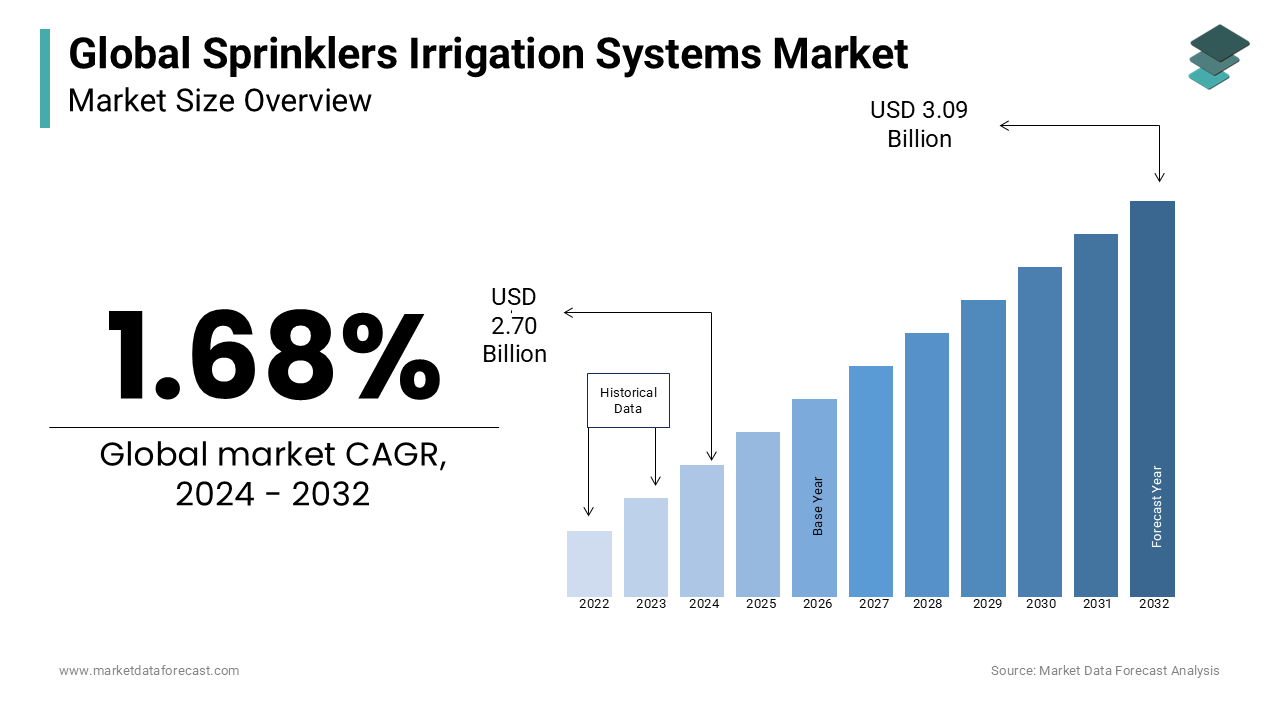
- Market Valuation: Valued at USD 2.75 billion in 2025, reaching USD 2.80 billion in 2026, and projected to expand to USD 3.14 billion by 2034, progressing at a steady CAGR of 1.68% during the forecast period.
- Primary Growth Drivers: Escalating global water scarcity prompting water-efficient agricultural practices, alongside the rapid integration of precision farming, IoT-enabled sensors, and automated smart controls.
Key Market Segment Metrics
| Category | Leading Segment (Base Year Position) | Fastest-Growing / High-Impact Segment |
|---|---|---|
| By Type | Center Pivot Sprinkler Systems (dominant market leader capturing 38.2% baseline revenue via automated, large-scale commercial farming deployment) | Solid Set Sprinkler Systems (fastest-growing type expanding at a 9.6% CAGR, driven by orchard, vineyard, and greenhouse frost protection) |
| By Mobility | Stationary Sprinkler Systems (leading category holding 44.8% share anchored by permanent agricultural and urban landscaping installations) | Towable Sprinkler Systems (fastest-growing mobile segment expanding at a 10.1% CAGR favored by smallholders for rotational farming) |
| By Application | Field Crops (dominant segment accounting for 42.3% of market revenue across staple crops like wheat, maize, and soybeans) | Landscape & Turf (fastest-growing application registering a 9.8% CAGR fueled by urban greening, golf courses, and smart turf management) |
Major Market Players & Market Structure
Market Structure: Globally competitive agricultural technology landscape featuring established multinational equipment manufacturers competing through IoT automation, energy efficiency, and digital app integration.
Key Companies: Jain Irrigation Systems Ltd., The Toro Company, Netafim, Valmont Industries Inc., Reinke Manufacturing Company Inc., T-L Irrigation Co., and Lindsay Corporation.
Global Sprinkler Irrigation Systems Market Size
The global sprinkler irrigation systems market size was valued at USD 2.75 billion in 2025 and is anticipated to reach USD 2.80 billion in 2026 and to reach USD 3.14 billion by 2034, growing at a CAGR of 1.68% during the forecast period from 2026 to 2034.
Sprinkler irrigation systems are advanced agricultural technologies designed to efficiently distribute water over farmland through a network of pipes, nozzles, and pumps that mimic natural rainfall. These systems are widely used in both large-scale commercial farming and smallholder agriculture to optimize water usage, enhance crop yield, and reduce labor dependency. As global concerns around water scarcity and sustainable agriculture intensify, sprinkler irrigation has emerged as a crucial solution for improving farm productivity while conserving vital resources.
The adoption of sprinkler irrigation is being driven by increasing government support for modernized irrigation techniques, especially in arid and semi-arid regions where water conservation is critical. According to the Food and Agriculture Organization of the United Nations, nearly 70% of global freshwater withdrawals are used for agriculture, underscoring the need for more efficient irrigation practices.
Moreover, rising awareness among farmers about the benefits of mechanized irrigation methods—such as uniform water distribution, reduced soil erosion, and improved nutrient management—has contributed to the growing preference for sprinkler-based solutions. These developments collectively shape the current landscape of the Sprinkler Irrigation Systems Market.
MARKET DRIVERS
Growing Demand for Water-Efficient Agricultural Practices
A primary factor accelerating the growth of the sprinkler irrigation systems market is the escalating demand for water-efficient agricultural practices in response to global water shortages and environmental sustainability goals. Traditional flood irrigation methods are highly inefficient, often leading to excessive water wastage due to runoff and evaporation. In contrast, sprinkler irrigation systems offer a more controlled and uniform application of water, significantly reducing consumption while maintaining optimal soil moisture levels for crops.
Sprinkler systems mitigate this issue by delivering water directly to the root zone with minimal losses. According to the International Water Management Institute, these systems can achieve water savings of up to 40% in certain cropping conditions, making them an attractive option for governments and farmers alike.
Additionally, as reported by the World Resources Institute, over 25% of the world’s population resides in areas facing extreme water stress, prompting policymakers to promote modern irrigation technologies. Government subsidies and incentives, particularly in developing economies, further encourage the adoption of sprinkler irrigation as a key strategy for sustainable water use and enhanced agricultural productivity.
Expansion of Precision Farming and Technological Integration
Technological advancements and the widespread adoption of precision farming are playing a pivotal role in driving the sprinkler irrigation systems market. Modern sprinkler systems are increasingly integrated with smart sensors, IoT-enabled controllers, and GPS mapping tools, allowing farmers to automate irrigation schedules, monitor soil moisture levels, and adjust water delivery based on real-time data. This level of precision not only enhances operational efficiency but also improves crop yields and reduces input costs.
Many manufacturers now offer intelligent sprinkler systems that can be managed remotely via mobile applications, enabling better control and responsiveness to changing weather conditions.
Furthermore, the U.S. Department of Agriculture highlights that farms utilizing precision irrigation technologies have seen up to a notable increase in water-use efficiency and a corresponding rise in agricultural output. So, with increasing investment from agri-tech firms and growing farmer interest in data-driven decision-making, the integration of smart technologies into sprinkler irrigation is accelerating market expansion across both developed and emerging agricultural economies.
MARKET RESTRAINTS
High Initial Investment and Maintenance Costs
A significant barrier limiting the widespread adoption of sprinkler irrigation systems is the high initial capital required for installation and maintenance. Unlike traditional surface irrigation methods, which rely on basic infrastructure and manual labor, sprinkler systems necessitate complex components such as pumps, pipelines, nozzles, and automation controls.
In addition to installation costs, ongoing maintenance expenses—including repairs, replacement parts, and energy consumption—add to the financial burden. Sprinkler systems require regular cleaning and servicing to prevent clogging and ensure uniform water distribution.
Moreover, access to financing remains a challenge in many rural and developing regions. According to the International Fund for Agricultural Development, lesa smallermber of small-scale farmers in low-income countries have access to formal credit or government-backed loans for irrigation equipment. Without adequate financial support, the affordability gap continues to hinder the penetration of sprinkler irrigation systems, particularly in economically constrained agricultural sectors.
Limited Suitability for Certain Soil Types and Terrains
A further critical restraint affecting the adoption of sprinkler irrigation systems is their limited suitability for specific soil types and topographical conditions. While these systems perform optimally on flat or gently sloped land with well-drained soils, they face challenges in rocky, uneven, or highly permeable terrains. For instance, sandy soils tend to allow rapid infiltration, causing uneven wetting patterns, whereas clay soils may experience runoff if water application rates exceed infiltration capacity.
According to the Food and Agriculture Organization of the United Nations, sprinkler irrigation is most effective in loamy soils with moderate infiltration rates, making it unsuitable for a notable share of global farmland that consists of extreme soil types. Besides, steeply sloped fields are prone to water runoff and wind drift when using overhead sprinklers, diminishing efficiency and increasing water loss.
As noted by the International Water Management Institute, alternative irrigation methods such as drip irrigation are more adaptable to diverse terrain and soil conditions, offering higher efficiency in challenging environments. Farmers in hilly or irregular landscapes often find sprinkler systems impractical, leading to lower adoption rates in such regions despite their potential benefits in other contexts.
MARKET OPPORTUNITY
Increasing Adoption of Smart and Automated Sprinkler Technologies
A major opportunity shaping the future of the sprinkler irrigation systems market is the rising integration of smart and automated technologies into irrigation infrastructure. The convergence of Internet of Things (IoT), artificial intelligence, and cloud computing has enabled the development of intelligent sprinkler systems capable of real-time monitoring and adaptive water management. These systems utilize soil moisture sensors, weather forecasts, and satellite imagery to optimize irrigation schedules, ensuring precise water delivery tailored to crop needs.
According to the International Society for Precision Agriculture, the adoption of smart irrigation technologies has been growing at a double-digit pace, driven by the need for resource-efficient farming solutions.
Moreover, government initiatives promoting digital agriculture are further accelerating the uptake of automated sprinkler systems. As per the European Commission, smart irrigation adoption in the EU has surged due to a regulatory push for sustainable water use and carbon footprint reduction. With increasing investments from agri-tech startups and major irrigation equipment manufacturers, the transition toward intelligent sprinkler systems is expected to unlock substantial market growth opportunities globally.
Expansion of Agricultural Mechanization in Emerging Economies
The growing trend of agricultural mechanization in emerging economies presents a compelling opportunity for the sprinkler irrigation systems market. As rural labor shortages intensify due to urban migration and aging farming populations, there is a pressing need for automated irrigation solutions that reduce dependence on manual labor. Governments and international organizations are actively supporting this shift through policy incentives, training programs, and financial aid aimed at modernizing irrigation practices.
According to the Food and Agriculture Organization of the United Nations, nearly 60% of smallholder farmers in sub-Saharan Africa and South Asia still rely on manual irrigation methods, highlighting vast untapped potential for mechanized alternatives. In countries like India and Brazil, national irrigation missions have prioritized the promotion of sprinkler systems to improve water efficiency and boost agricultural productivity.
Hence, the market is poised for strong growth in developing regions where traditional farming practices are gradually giving way to modern, technology-driven solutions.
MARKET CHALLENGES
Energy Dependency and Operational Costs
A significant challenge facing the irrigation systems Market is the high energy dependency and associated operational costs linked to continuous system performance. Sprinkler systems, particularly center pivot and lateral move variants, require substantial power inputs to operate pumps and maintain pressure across extensive field coverage. This reliance on electricity or diesel generators makes them vulnerable to fluctuating energy prices and supply inconsistencies, especially in remote or off-grid agricultural zones.
According to the International Energy Agency, irrigation accounts for nearly 30% of total energy consumption in the agricultural sector, with pressurized systems like sprinklers contributing significantly to this demand. In regions where electricity is unreliable or costly, farmers may find suthe stained operation of sprinkler systems financially unviable. As per the U.S. Department of Agriculture, energy costs can constitute up to 25% of total irrigation expenses, influencing adoption decisions even in developed markets.
To mitigate this challenge, industry players are exploring solar-powered sprinkler alternatives and energy-efficient pump designs. However, until renewable energy integration becomes widespread and cost-effective, the high energy demands of sprinkler irrigation will remain a persistent hurdle to broader market expansion.
Regulatory and Environmental Compliance Pressures
Regulatory scrutiny and environmental compliance requirements pose another formidable challenge for the Sprinkler Irrigation Systems Market. Governments worldwide are increasingly enforcing stringent water usage policies to combat the depletion of groundwater reserves and promote sustainable agricultural practices. In several regions, authorities mandate permits for large-scale irrigation projects and impose restrictions on water extraction volumes, directly impacting the deployment of sprinkler systems.
Also, environmental agencies such as the U.S. Environmental Protection Agency emphasize the need for water audits and sustainable irrigation planning before approving new installations.
These regulations, while beneficial for long-term ecological balance, can delay project approvals and increase administrative burdens for farmers and irrigation providers. Moreover, non-compliance risks financial penalties and legal action, discouraging potential adopters. So, as regulatory frameworks continue to evolve, companies must align product offerings with sustainability standards and invest in water-saving innovations to navigate this evolving compliance landscape successfully.
REPORT COVERAGE
| REPORT METRIC | DETAILS |
| Market Size Available | 2024 to 2033 |
| Base Year | 2024 |
| Forecast Period | 2025 to 2033 |
| CAGR | 1.68% |
| Segments Covered | By Type, Mobility, Application |
| Various Analyses Covered | Global, Regional & Country Level Analysis, Segment-Level Analysis, DROC, PESTLE Analysis, Porter’s Five Forces Analysis, Competitive Landscape, Analyst Overview on Investment Opportunities |
| Regions Covered | North America, Europe, APAC, Latin America, Middle East & Africa |
| Market Leaders Profiled | Jain Irrigation Systems Ltd., Valmont Industries Inc., Reinke Manufacturing Company Inc., T-L Irrigation Co., and Lindsay Corporation |
SEGMENTAL ANALYSIS
By Type Insights
Center Pivot Sprinkler Systems
The center pivot sprinkler systems segment held the largest market share in the sprinkler irrigation systems market, accounting for 38.2% of total revenue in 2024. This dominance is primarily attributed to their widespread adoption in large-scale commercial farming, particularly in countries with vast agricultural landscapes such as the United States, Brazil, and Australia.
One key driver behind this segment’s leadership is the high efficiency and automation capabilities offered by center pivot systems. According to the U.S. Department of Agriculture, over 140 million acres of farmland in the U.S. utilize mechanized irrigation systems, with more than half relying on center pivot technology. These systems provide uniform water distribution across circular fields, making them ideal for crops like corn, wheat, and soybeans.
Besides, as reported by the Food and Agriculture Organization of the United Nations, center pivot systems can reduce labor requirements compared to manual irrigation methods. Their compatibility with precision agriculture technologies—such as GPS guidance and remote monitoring—further enhances their appeal among modern agribusinesses, reinforcing their dominant position in the market.
Solid Set Sprinkler Systems
The solid set sprinkler systems segment is projected to grow at the highest CAGR of 9.6% during the forecast period. These systems consist of permanently installed lateral pipelines and sprinklers that cover a fixed area, commonly used in orchards, vineyards, and greenhouse applications where consistent water application is critical.
A major factor contributing to this rapid growth is the increasing demand for frost protection and microclimate control in high-value horticultural crops. With rising investments in protected cropping and controlled-environment agriculture, this segment is gaining traction across both developed and emerging markets, positioning it for accelerated expansion.
By Mobility Insights
Stationary Sprinkler Systems
The stationary sprinkler systems segment prevailed in the market, representing a4.8% of the sprinkler irrigation systems market in 2024. This influence is due to their extensive use in permanent agricultural installations, particularly in orchard cultivation, greenhouses, and landscape irrigation, where mobility is not a primary requirement.
A significant driver of this segment's leading position is the growing emphasis on long-term infrastructure investment in commercial farms and urban landscaping projects.
Also, stationary sprinkler systems offer superior reliability and ease of maintenance when deployed in structured environments. Their compatibility with smart irrigation controllers and drip-line enhancements further boosts their efficiency, making them a preferred choice among large agri-businesses and municipal authorities managing public parks and golf courses.
Towable Sprinkler Systems
The towable sprinkler systems segment is anticipated to register the fastest growth, with a projected CAGR of 10.1%. These mobile irrigation units are increasingly adopted by small and mid-sized farmers who require flexible, cost-effective irrigation solutions without the need for permanent installation.
This surge is largely driven by the rising demand for adaptable irrigation equipment in mixed-crop and rotational farming systems. According to the Food and Agriculture Organization of the United Nations, nearly 60% of smallholder farmers in Asia and Africa rely on portable irrigation devices due to land fragmentation and seasonal crop changes.
Furthermore, as per the International Water Management Institute, towable systems can be easily relocated across fields, allowing efficient water management in diverse topographies. Government-backed rural development programs in countries like India and Nigeria have also supported the procurement of towable sprinklers through subsidies and financing schemes, accelerating their adoption and fueling market growth.
By Application Insights
Field Crops
The field crops application segment commanded the market, representing 42.3% of theSprinklers Irrigation Systems Market in 2024. This dominance is primarily driven by the extensive use of sprinkler irrigation in staple crops such as wheat, maize, rice, and soybeans, particularly in large-scale mechanized farming operations.
One of the main factors supporting this segment's leadership is the increasing shift from traditional flood irrigation to more efficient pressurized systems.
Additionally, as per the Food and Agriculture Organization of the United Nations, field crops account for nearly 70% of global agricultural production, highlighting the necessity for scalable and uniform irrigation techniques. The adaptability of sprinkler systems to different soil types and field sizes makes them particularly suitable for broad-acre farming, reinforcing their dominant position in this application category.
Landscape & Turf
The landscape and turf application segment is expected to witness the fastest growth, registering a CAGR of 9.8% from 2025 to 2033. This surge is primarily fueled by the expanding use of sprinkler systems in urban landscaping, sports fields, golf courses, and residential lawns, especially in developed economies with high aesthetic and recreational demands.
According to the National Recreation and Park Association, over 16,000 golf courses and more than 100,000 public parks exist in the United States alone, all requiring consistent and efficient irrigation. Sprinkler systems provide precise water distribution, ensuring healthy turf growth with minimal wastage.
Moreover, as per the American Society of Landscape Architects, urban greening initiatives and sustainable city planning policies are driving increased investment in automated irrigation systems. Municipalities and private developers alike are adopting smart sprinkler solutions integrated with weather sensors and moisture detectors to optimize water usage, contributing significantly to the rapid expansion of this segment.
REGIONAL ANALYSIS
North America Market Analysis
North America held a prominent position in the sprinkler irrigation systems market, capturing 28.1% of total market revenue in 2024. This is primarily driven by the region’s strong agricultural sector, advanced farm mechanization, and widespread adoption of precision irrigation technologies.
A key growth factor is the extensive use of center pivot and lateral move sprinkler systems in large-scale row crop farming across the U.S. Great Plains and Midwest. Moreover, as reported by the Canadian Agricultural Partnership, government incentives for water-efficient farming practices have encouraged Canadian farmers to adopt automated sprinkler technologies. The presence of major manufacturers such as Lindsay Corporation and Jain Irrigation further supports regional dominance, ensuring continuous innovation and product availability in the North American market.

Europe Market Analysis
Europe is witnessing a steady growth in the sprinkler irrigation systems market, driven by stringent water conservation regulations and increasing investments in sustainable agriculture. Countries such as Spain, Italy, and France have seen a rise in sprinkler adoption, particularly in horticulture and vineyard sectors.
According to the European Environment Agency, over 40% of the EU’s agricultural land experiences seasonal water stress, necessitating efficient irrigation solutions. The Common Agricultural Policy (CAP) supports subsidies for modern irrigation technologies, promoting the transition from flood to sprinkler-based systems.
As per the European Commission, precision agriculture adoption in the region has grown by over 7% annually, with sprinkler systems playing a crucial role in optimizing resource use. Also, the integration of smart irrigation controllers and IoT-enabled sprinkler networks is further enhancing efficiency, contributing to sustained market growth across the continent.
Asia Pacific – Fastest Emerging Market with 19% Share
Asia Pacific represents a rapidly growing market. This region is witnessing increased adoption of sprinkler irrigation due to rising concerns over water scarcity, declining groundwater levels, and the push for modernized farming techniques.
India and China are leading the charge, with government initiatives such as India’s Pradhan Mantri Krishi Sinchayee Yojana (PMKSY) aiming to bring 10 million hectares under micro-irrigation by 2025.
Additionally, as per the Food and Agriculture Organization of the United Nations, China has invested heavily in smart agriculture, integrating sprinkler systems with AI-driven climate control mechanisms. With growing rural electrification and financial support for farmers, the Asia Pacific region is poised for continued expansion in the sprinkler irrigation market.
Latin America – Expanding Agricultural Infrastructure with 14% Share
Latin America is an expanding player in the sprinkler irrigation systems market, with Brazil, Argentina, and Mexico leading the way in adoption. The region benefits from expansive arable land and a growing focus on improving agricultural productivity through mechanized irrigation.
The country’s National Program for Strengthening Family Agriculture (PRONAF) offers credit lines for irrigation equipment, encouraging small and medium farmers to upgrade their systems. Moreover, as per the International Water Management Institute, water variability in the Andean region is pushing for more efficient irrigation alternatives. With rising foreign direct investment in agro-processing and export-oriented farming, Latin America is emerging as a key growth hub for sprinkler irrigation systems.
Middle East and Africa Market Analysis
The Middle East and Africa collectively represent a notable share of the sprinkler irrigation systems market, characterized by strategic investments in water-scarce regions where efficient irrigation is essential for food security. Countries such as Saudi Arabia, Egypt, and South Africa are prioritizing advanced irrigation solutions to combat desertification and groundwater depletion.
According to the Food and Agriculture Organization of the United Nations, over 65% of cultivated land in the Middle East relies on irrigation, with limited rainfall making sprinkler and drip systems crucial for sustaining agriculture. In Saudi Arabia, Vision 2030 includes plans to phase out unsustainable wheat production and promote water-efficient irrigation technologies. With international aid and regional policy support, the MEA region continues to evolve as a strategic market for sprinkler irrigation systems despite its relatively smaller scale compared to other continents.
COMPETITIVE LANDSCAPE
The competition in the Sprinklers Irrigation Systems Market is characterized by a mix of well-established multinational corporations and regional players vying for dominance through differentiation in technology, service offerings, and geographic reach. As the demand for water-efficient irrigation grows globally, companies are intensifying efforts to innovate and customize solutions that align with varying agricultural practices, climatic conditions, and policy environments. Technological advancement remains a central battleground, with manufacturers striving to incorporate smart controls, automation, and data analytics into sprinkler systems to appeal to precision farming enthusiasts. Additionally, customer education and after-sales support have become critical differentiators, as end-users seek long-term value beyond just hardware procurement. While large firms leverage brand reputation and extensive distribution networks to maintain leadership positions, smaller players are focusing on niche segments and cost-effective alternatives to capture market share. Regulatory pressures around water usage and environmental sustainability are further shaping competitive strategies, pushing companies toward eco-friendly and resource-optimizing irrigation solutions.
KEY MARKET PLAYERS
Some of the market players dominate the global sprinkler irrigation system market.
- Jain Irrigation Systems Ltd.
- The Toro Company
- Netafim
- Valmont Industries Inc.
- Reinke Manufacturing Company Inc.
- T-L Irrigation Co.
- Lindsay Corporation
Top Players In the Market
- Lindsay Corporation is a leading global manufacturer of irrigation equipment, renowned for its Zimmatic brand of center pivot and lateral move sprinkler systems. The company has played a pivotal role in advancing mechanized irrigation by integrating smart technology with traditional sprinkler setups. Their focus on automation, remote monitoring, and precision agriculture has made their systems highly adaptable to diverse farming conditions, significantly contributing to improved water efficiency and crop yields worldwide.
- The Toro Company offers a comprehensive range of sprinkler irrigation solutions tailored for both agricultural and landscape applications. Known for its innovation and reliability, Toro has been instrumental in developing energy-efficient and weather-responsive sprinkler systems that cater to commercial farms, golf courses, and urban green spaces. Its commitment to sustainability and product durability has positioned it as a trusted name in the global irrigation industry.
- Netafim is a pioneer in precision irrigation, widely recognized for revolutionizing drip irrigation, but it also holds a strong presence in the sprinkler irrigation market. The company provides customized sprinkler solutions that integrate seamlessly with digital irrigation platforms. Netafim’s emphasis on water conservation, coupled with advanced agronomic support services, enables farmers across different geographies to optimize resource use and improve productivity through efficient sprinkler technologies.
Top Strategies Used By Key Market Participants
- One major strategy employed by key players in the Sprinklers Irrigation Systems Market is product innovation and technological integration. Companies are continuously developing advanced systems embedded with IoT, AI, and cloud-based control mechanisms to enhance efficiency and ease of use, meeting the growing demand for smart agriculture.
- Another crucial approach is strategic partnerships and collaborations, where manufacturers work closely with research institutions, government bodies, and agri-tech firms to validate new technologies, access local markets, and streamline product adoption among farmers.
- Lastly, expansion into emerging markets through localized distribution networks and financial assistance programs is a key tactic used by leading firms. By offering region-specific products and facilitating access to financing options, companies are effectively increasing market penetration in developing regions where modern irrigation adoption is gaining momentum.
RECENT MARKET NEWS
In March 2024, Lindsay Corporation launched an upgraded version of its FieldNET mobile irrigation management app, enabling real-time control and diagnostics for center pivot sprinkler systems across multiple devices.
- In February 2024, The Toro Company introduced a new line of low-pressure sprinkler nozzles designed to reduce energy consumption while maintaining uniform water distribution for field crops and turf applications.
- In January 2024, Netafim partnered with a leading agritech startup to integrate AI-driven soil moisture analysis into its sprinkler irrigation systems, enhancing decision-making capabilities for farmers using automated irrigation.
- In November 2023, Lindsay Corporation expanded its manufacturing facility in Nebraska to increase production capacity for smart-enabled sprinkler systems, supporting growing international demand for precision irrigation solutions.
- In September 2023, The Toro Company acquired a European-based irrigation software firm to strengthen its digital irrigation portfolio and offer more integrated control systems for large-scale agricultural and landscaping operations.
MARKET SEGMENTATION
This research report on the global sprinkler irrigation system market is segmented and sub-segmented into the following categories.
By Type
- Rotating Head System (central pivot, lateral roller, and large mobile barrel)
- Perforated Tube System (lateral movement)
By Mobility
- Stationary
- Towable
By Application
- Residential
- Non-residential (hotel and resort, office, and others)
- Agricultural (extensive crops)
By Region
- North America
- Asia Pacific
- Europe
- Latin America
- Middle East and Africa