- Product Description Description
- Table of Contents TOC
- List of Table & Figure LOT
- Get Free Sample PDF Sample PDF
Market Size, 2025
$217.58 BnMarket Estimate, 2026
$228.61 BnMarket Forecast, 2034
$339.57 BnCAGR, 2026–2034
5.07%Global Stainless Steel Market Summary
The global stainless steel market was valued at USD 217.58 billion in 2025 and is projected to reach USD 228.61 billion in 2026 and to reach USD 339.57 billion by 2034, growing at a CAGR of 5.07% from 2026 to 2034. The growth of the stainless steel market is driven by increasing demand from construction, automotive, and industrial applications, rising infrastructure investments, and innovations in stainless steel alloys and processing technologies.
Key Market Trends
- Expanding usage in construction and infrastructure projects due to corrosion resistance and durability.
- Growing demand in the automotive and transportation sectors for lightweight and strong materials.
- Increasing adoption in industrial equipment, kitchenware, and household appliances.
- Focus on high-performance and specialty stainless steel grades to meet diverse application requirements.
- Rising investments in green buildings and sustainable construction are fueling demand for stainless steel products.
Segmental Insights
- Based on type, the Cold Rolled Flat (CRF) segment dominated the market in 2025 with a 36.2% share due to its superior surface finish and dimensional accuracy.
- Based on application, the construction sector held the largest share of 28.3% in 2025, driven by increasing infrastructure development and urbanization.
Regional Insights
- Asia-Pacific led the global stainless steel market by accounting for 70.2% share in 2025, driven by high production capacity, rapid industrialization, and growing construction activities.
- Europe witnessed steady growth due to demand from the automotive and industrial sectors.
- North America showed moderate growth supported by construction and manufacturing activities.
- Latin America experienced gradual growth due to infrastructure development and industrial expansion.
- Middle East & Africa is emerging as a potential market with increasing demand for stainless steel in the construction and energy sectors.
Competitive Landscape
The global stainless steel market is moderately consolidated with key players focusing on capacity expansion, technological innovations, and regional presence. Major players include Acerinox S.A. (Spain), Aperam S.A. (Luxembourg), ArcelorMittal S.A. (Luxembourg), Baosteel Group Corporation (China), Jindal Stainless Group (India), Nippon Steel Corporation (Japan), Outokumpu Oyj (Finland), POSCO (South Korea), Acciai Speciali Terni S.p.A (Italy), and Yieh Corporation (Taiwan).
Global Stainless Steel Market Size
The Stainless Steel market size was valued at USD 217.58 billion in 2025 and is anticipated to reach USD 228.61 billion in 2026 to reach USD 339.57 billion by 2034, growing at a CAGR of 5.07% during the forecast period from 2026 to 2034.

Stainless steel is a corrosion-resistant alloy primarily composed of iron, chromium (minimum 10.5%), nickel, and molybdenum, engineered for durability, hygiene, and aesthetic longevity. Its unique properties make it indispensable across sectors requiring resilience to moisture, heat, and chemical exposure. According to the World Steel Association, global crude steel production reached 1.88 billion metric tons in 2023, of which stainless steel accounted for approximately 55 million metric tons.
MARKET DRIVERS
Expansion of Urban Infrastructure and Water Management Systems
The global push for resilient urban infrastructure in water supply, sewage treatment, and public construction is accelerating the growth of the pyridine market. According to the United Nations Department of Economic and Social Affairs, over 60% of the world’s population will reside in urban areas by 2030, necessitating vast investments in durable, hygienic materials for pipelines and treatment facilities. Stainless steel, especially grades 304 and 316, is increasingly used in potable water piping due to its non-leaching properties and 100-year service life.
Rising Adoption in Renewable Energy and Hydrogen Infrastructure
Stainless steel is becoming integral to the clean energy transition in hydrogen production, storage, and distribution systems, which is fuelling the growth of the pyridine market. As per the International Energy Agency, global hydrogen demand could increase fivefold by 2050 under net-zero scenarios, with electrolyzers and high-pressure storage tanks requiring materials resistant to hydrogen embrittlement. Austenitic stainless steels such as 316L and 310S are widely used in proton exchange membrane (PEM) electrolyzers due to their conductivity and corrosion resistance. The European Clean Hydrogen Partnership reports that each gigawatt-scale hydrogen plant requires up to 15,000 tons of stainless steel for piping, heat exchangers, and support structures.
MARKET RESTRAINTS
Volatility in Key Raw Material Prices, Particularly Nickel and Chromium
The economic viability of stainless steel production is highly sensitive to fluctuations in the prices of alloying elements, especially nickel and chromium, which are major factors degrading the growth of the yridine market. Chromium ore prices, though more stable, rose by 18% in 2023 as reported by the South African Department of Mineral Resources and Energy, driven by energy costs in key refining regions. These volatilities compress margins for producers and create pricing uncertainty for downstream industries. According to the London Metal Exchange, nickel accounts for up to 70% of the variable cost in austenitic stainless steel production, which is making long-term project planning difficult.
Stringent Environmental Regulations on Emissions from Ferroalloy Production
The production of ferrochromium and nickel pig iron is energy-intensive and emits significant greenhouse gases, which are impeding the growth of the pyridine market. According to the Intergovernmental Panel on Climate Change, ferroalloy production contributes approximately 1.2% of global industrial CO₂ emissions, with carbon dioxide and perfluorocarbons released during smelting. The European Union’s Emissions Trading System (EU ETS) has increased carbon allowance prices to over €80 per ton in 2023, directly impacting the operating costs of electric arc furnace (EAF) and submerged arc furnace (SAF) operators. As per Eurofer, the European Steel Association, stainless steel producers face a 20–25% increase in compliance costs by 2030 under the Carbon Border Adjustment Mechanism (CBAM).
MARKET OPPORTUNITIES
Growth in Medical and Pharmaceutical Equipment Manufacturing
The expanding global healthcare infrastructure is creating sustained demand for medical-grade stainless steel in surgical instruments, implants, and pharmaceutical processing equipment, which is likely to set up new opportunities for the growth of the pyridine market. Stainless steel grades such as 316L and 440C are preferred for their biocompatibility, sterilization resistance, and non-reactivity. The U.S. Food and Drug Administration mandates the use of corrosion-resistant materials in drug manufacturing equipment, which favors stainless steel over alternatives.
Increasing Use in Electric Vehicle (EV) Battery and Powertrain Systems
The growing traction in electric vehicle components due to their strength-to-weight ratio, thermal stability, and resistance to battery electrolyte corrosion is expected to further fuel the growth of the pyridine market. The Fraunhofer Institute for Manufacturing Technology reports that 301 and 304 stainless steel grades are being adopted for EV battery trays due to their crash resistance and thermal management properties.
MARKET CHALLENGES
Competition from Alternative Materials in Lightweight Applications
The increasing competition from advanced aluminum alloys, composites, and high-strength carbon steels in industries prioritizing weight reduction, such as automotive and aerospace, is likely to inhibit the growth of the pyridine market. According to the Aluminum Association, aluminum use in North American light vehicles reached 213 kg per vehicle in 2023, offering a 40% weight advantage over steel equivalents. In aircraft manufacturing, Boeing and Airbus utilize titanium and carbon-fiber-reinforced polymers for major components, limiting stainless steel to niche applications. According to the U.S. Department of Transportation, every 10% reduction in vehicle weight improves fuel efficiency by 6–8%, incentivizing automakers to adopt lighter materials. This material substitution trend pressures stainless steel producers to innovate or risk losing market share in high-growth mobility sectors.
Complexities in Recycling Mixed and Contaminated Scrap Streams
The efficiency of recycling is hampered by contamination from mixed metal streams and residual coatings in end-of-life products, which additionally inhibits the growth of the pyridine market. According to the International Stainless Steel Forum, while over 70% of stainless steel is recovered globally, only 60% is reprocessed into new stainless steel due to sorting inefficiencies. The presence of galvanized steel, copper, or plastics in scrap reduces the quality of recycled melt, requiring costly refining. The European Scrap Recycling Industry reports that up to 15% of incoming ferrous scrap at processing plants contains non-ferrous contaminants, increasing energy use and slag formation during melting. Additionally, sensor-based sorting technologies remain limited in detecting minor alloy variations, such as between 304 and 316 grades.
REPORT COVERAGE
| REPORT METRIC | DETAILS |
| Market Size Available | 2025 to 2034 |
| Base Year | 2025 |
| Forecast Period | 2026 to 2034 |
| CAGR | 5.07% |
| Segments Covered | By Type, Application, and Region |
| Various Analyses Covered | Global, Regional, and Country-Level Analysis, Segment-Level Analysis; DROC, PESTLE Analysis; Porter’s Five Forces Analysis; Competitive Landscape; Analyst Overview of Investment Opportunities |
| Regions Covered | North America, Europe, APAC, Latin America, Middle East & Africa |
| Market Leaders Profiled | Acerinox S.A. (Spain), Aperam S.A. (Luxembourg), ArcelorMittal S.A. (Luxembourg), Baosteel Group Corporation (China), Jindal Stainless Group (India), Nippon Steel Corporation (Japan), Outokumpu Oyj (Finland), POSCO (South Korea), Acciai Speciali Terni S.p.A (Italy), Yieh Corporation (Taiwan) |
SEGMENTAL ANALYSIS
By Type Insights
The Cold Rolled Flat (CRF) segment accounted in holding 36.2% of the stainless steel market share in 2025, with the CRF’s superior surface finish, dimensional precision, and enhanced mechanical properties. The demand for aesthetically pleasing and corrosion-resistant materials in urban infrastructure has significantly elevated CRF’s prominence. The integration of architectural innovation and appliance manufacturing continues to solidify CRF’s position at the forefront of stainless steel consumption.
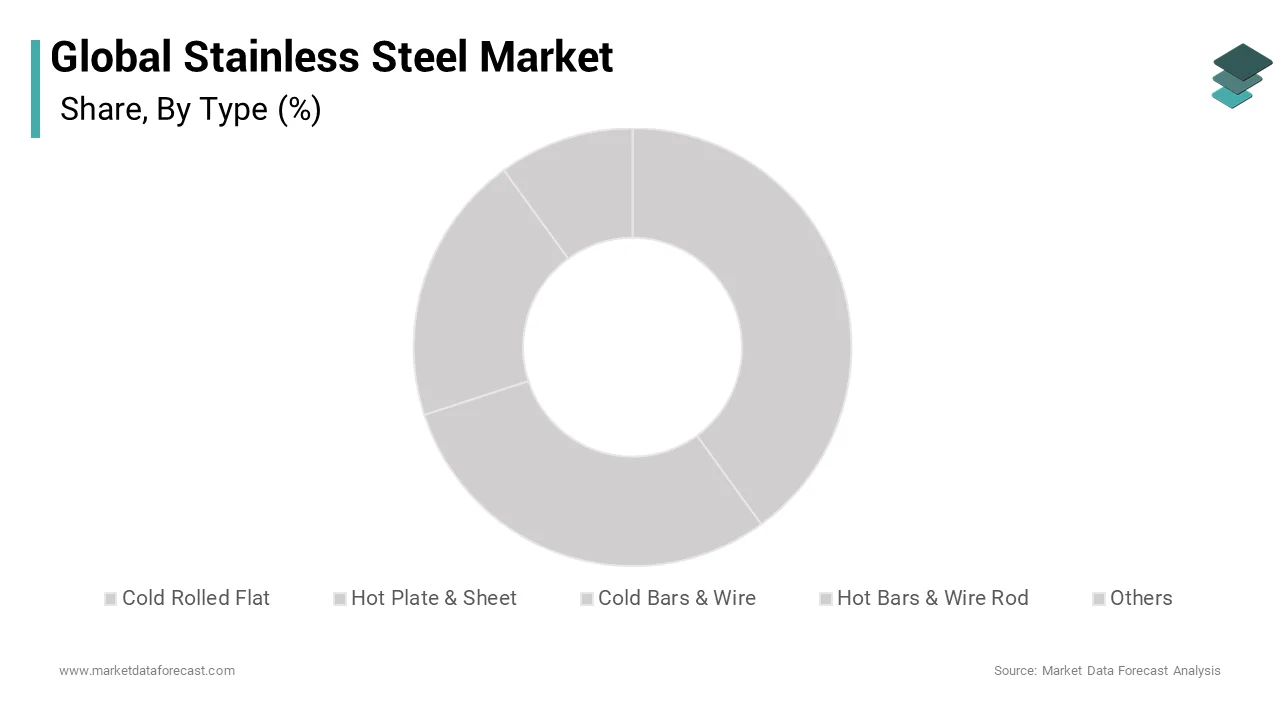
The Hot Bars & Wire Rod segment is projected to expand at a CAGR of 6.7% from 2025 to 203,3 with the escalating demand from the automotive and industrial machinery sectors, where hot-finished bars serve as raw inputs for axles, fasteners, and shafts. Furthermore, infrastructure development in emerging economies, where India alone invested USD 1.4 trillion in infrastructure between 2020 and 2025, according to the National Infrastructure Pipeline.
By Application Insights
The construction sector segment held 28.3% of the stainless steel market share in 20,24 with the material’s durability, low maintenance, and aesthetic versatility in modern architectural design. Moreover, green building certifications like LEED and BREEAM incentivize the use of recyclable materials; stainless steel boasts a global recycling rate of over 90%, the highest among structural metals, per the ISSF. Public infrastructure projects, such as Japan’s ongoing Shinkansen rail expansion and Germany’s Energiewende building retrofit program, further amplify demand.
The Electrical Machinery segment is anticipated to witness a CAGR of 7.2% from 2025 to 2033 with the global transition to renewable energy and electrification. Stainless steel used to is manufacture components for transformers, motors, and inverters due to its magnetic properties and thermal stability.
REGIONAL ANALYSIS
Asia Pacific Market Analysis
Asia Pacific was the top performer of the global stainless steel market by accounting for 70.2% of the share in 2024. As the industrial heartland of the world, the region’s dominance is anchored in China, which alone produced 59 million metric tons of stainless steel in 2023. India’s production grew by 8.4% year-on-year in the same period, which is driven by government initiatives like "Make in India" and rising infrastructure spending.

Europe Market Analysis
Europe stainless steel market was positioned second by holding 14.3% of the global stainless steel market in 2025. Germany was the largest producer in Europe with 4.1 million metric tons manufactured in 2023. The region’s stringent environmental regulations have also spurred innovation in low-carbon production; Outokumpu, a Finnish producer, achieved 85% CO₂ reduction per ton through electric arc furnace use, as reported in its 2023 sustainability report.
North America Market Analysis
North America stainless steel market is likely to have a significant CAGR throughout the forecast period. The resilient demand in construction, oil & gas, and medical equipment is majorly influencing the growth of the stainless steel market. The Biden-Harris administration’s investment of USD 1.2 trillion in the Infrastructure Investment and Jobs Act is expected to increase demand for corrosion-resistant alloys in bridges and water systems.
Middle East And Africa Market Analysis
Middle East & Africa stainless steel market is likely to grow with significant growth opportunities throughout the forecast period. The Gulf Cooperation Council (GCC) countries are driving regional demand through megaprojects such as Saudi Arabia’s NEOM, a USD 500 billion smart city development, which will require over 2 million tons of specialty metals, including stainless steel, according to project disclosures. The UAE’s construction sector grew by 6.8% in 2023, supported by Expo City Dubai and tourism-driven real estate, as reported by Dubai’s Department of Economy and Tourism.
Latin America Market Analysis
Latin America's stainless steel market growth is likely to grow, with Brazil dominating regional production and consumption. According to the Brazilian Steel Institute (IABr), Brazil produced 1.1 million metric tons of stainless steel in 2023, primarily for domestic construction and appliance manufacturing. The country’s automotive sector, which consumed over 180,000 tons of stainless steel in 2023, is rebounding after years of stagnation, as noted by ANFAVEA, the national vehicle manufacturers association.
COMPETITIVE LANDSCAPE
The stainless steel market is highly competitive, which is driven by technological innovation, cost efficiency, and sustainability demands. Major global players compete with regional producers in the Asia Pacific, where rising industrialization and infrastructure development fuel demand. Competition centers on product differentiation, energy-efficient production, and low-carbon offerings. Companies invest in advanced manufacturing techniques and digital supply chains to gain an edge. Price volatility of raw materials like nickel and chromium intensifies strategic sourcing efforts. Emerging players from China and India challenge established firms with cost-effective production models. At the same time, leading companies leverage brand reputation, technical expertise, and environmental credentials to maintain dominance. Collaborations, capacity upgrades, and sustainability certifications are key differentiators.
KEY MARKET PLAYERS
A few of the market players in the global stainless steel market include
- AcerinoxS.A.A (Spain)
- Aperam S.A. (Luxembourg)
- ArcelorMittal S.A. (Luxembourg)
- Baosteel Group Corporation (China)
- Jindal Stainless Group (India)
- Nippon Steel Corporation (Japan)
- Outokumpu Oyj (Finland)
- POSCO (South Korea)
- Acciai Speciali Terni S.p.A (Italy)
- Yieh Corporation (Taiwan)
Top Players In The Market
- Outokumpu was headquartered in Finland, which is a leading stainless steel producer with a strong focus on sustainability and innovation. In the Asia Pacific region, the company plays a strategic role by supplying high-quality stainless steel to industries such as construction, automotive, and consumer goods through distribution partnerships and tailored service centers. Outokumpu has intensified its engagement in the region by expanding technical support networks and investing in low-carbon production technologies.
- Acerin,is based in Spain, is a global stainless steel manufacturer with growing influence in the Asia Pacific market through strategic exports and joint development programs. The company supplies a wide range of austenitic and duplex stainless steels used in chemical processing, architecture, and transportation sectors across countries like India, South Korea, and Australia. Acerinox has enhanced its regional footprint by optimizing logistics networks and strengthening customer service centers in key ports. Recently, the company invested in advanced cold-rolling technology to improve product precision and surface quality, directly benefiting high-end Asian clients. It also launched a digital customer portal offering real-time technical support and material certifications, improving accessibility for APAC buyers.
- A subsidiary of Nippon Steel Corporation, this Japanese firm is a major innovator in stainless steel manufacturing, particularly in high-performance alloys for automotive, electronics, and energy applications. In the Asia Pacific region, the company is deeply integrated into supply chains, serving markets in China, Southeast Asia, and India with precision-engineered products. The company has recently focused on developing ultra-thin, corrosion-resistant stainless grades for use in electric vehicle components and renewable energy systems. It has also strengthened R&D collaborations with regional universities and industrial partners to accelerate material innovation. In 2023, the company commissioned an upgraded finishing line in its Hirohata plant to enhance surface treatment capabilities, catering to stringent quality demands in Asian electronics manufacturing.
Top Strategies Used by the Key Market Participants
Key players in the stainless steel market employ vertical integration to control raw material supply and reduce production costs. They invest heavily in R&D to develop advanced, corrosion-resistant, and lightweight alloys for the automotive and aerospace sectors. Strategic partnerships with local distributors expand regional reach, especially in emerging Asia Pacific economies. Companies are adopting green steel initiatives, including electric arc furnaces and carbon capture, to meet sustainability goals. Digital transformation through smart manufacturing and IoT-enabled monitoring improves efficiency. Additionally, capacity expansion and plant modernization enhance output quality. Export optimization and just-in-time delivery models strengthen customer relationships.
MARKET SEGMENTATION
This research report on the global stainless steel market is segmented and sub-segmented into the following categories.
By Type
- Cold Rolled Flat
- Hot Plate & Sheet
- Cold Bars & Wire
- Hot Bars & Wire Rod
- Others
By Application
- Metal Products
- Electrical Machinery
- Engineering
- Construction
- Automotive Parts
- Others
By Region
- North America
- Europe
- Asia-Pacific
- Latin America
- Middle-East & Africa