- Product Description Description
- Table of Contents TOC
- List of Table & Figure LOT
- Get Free Sample PDF Sample PDF
Market Size, 2025
$7.84 BnMarket Estimate, 2026
$8.55 BnMarket Forecast, 2034
$17.03 BnCAGR, 2026–2034
9%Executive Summary: Sterilization Services Market
- Market Scope: Global sterilization services market analysis covering method categories, end-user segments, regional leadership frameworks, and infection control adoption metrics.
- Market Valuation: Valued at USD 7.84 billion in 2025, estimated at USD 8.55 billion in 2026, and projected to reach USD 17.03 billion by 2034, registering a CAGR of 9% from 2026 to 2034.
- Primary Growth Drivers: Rising demand for single-use medical devices, expansion of biopharmaceutical and advanced therapy sectors, increasing infection control requirements across healthcare, growing use of sterilized medical devices and biologics, alongside stringent regulatory compliance.
Key Market Segment Metrics (2026–2034)
| Category | Leading Segment (Position) | Fastest-Growing / Key Growth Segment |
|---|---|---|
| By Sterilization Method | Ethylene Oxide (EtO) Sterilization (largest method) | Electron Beam (E-beam) Sterilization (fastest-growing method) |
| By End User Segment | Pharmaceuticals (largest end user) | Food & Beverage (fastest-growing end user) |
| By Technology & Innovation | Traditional gas and gamma irradiation sterilization infrastructure | Environmentally sustainable technologies, hydrogen peroxide plasma, and supercritical CO₂ sterilization |
| By Region / Country | North America (leading regional market) | Asia Pacific (fastest-growing regional market) |
Major Market Players & Market Structure
Market Structure: Highly competitive global sterilization services industry characterized by contract sterilization expansions, e-beam and low-temperature tech investments, CDMO integration, and strategic capacity-building partnerships.
Key Companies: STERIS Corporation, Getinge Group, Advanced Sterilization Products, 3M Company, Belimed AG, Cantel Medical Corporation, Anderson Products, Matachana Group, MMM Group, and Sterigenics International Inc.
 Download Free Sample Report
Global Sterilization Services Market Size
The global sterilization services market size was valued at USD 7.84 billion in 2025. The global market is anticipated to grow at a CAGR of 9% from 2026 to 2034 and be worth USD 17.03 billion by 2034 from USD 8.55 billion in 2026.
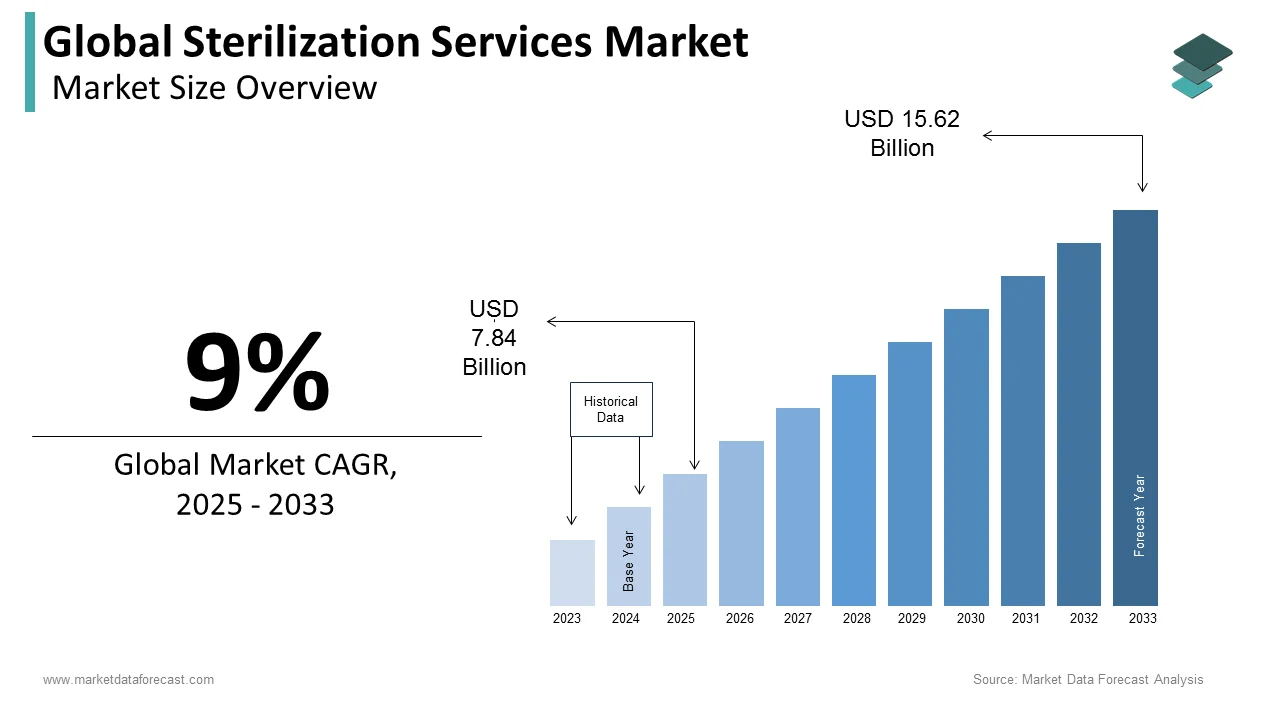
Sterilization Services refers to specialized procedures designed to eliminate or reduce microbial contamination from medical devices, pharmaceutical products, laboratory equipment, and packaging materials using physical or chemical methods such as ethylene oxide (EtO), gamma irradiation, steam autoclaving, and electron beam technology. These services are important in ensuring product safety and regulatory compliance across healthcare, biotechnology, and life sciences industries. According to the World Health Organization (WHO), unsafe medical injections due to inadequate sterilization contribute to over 1.3 million deaths annually, primarily from hepatitis B, hepatitis C, and HIV transmission in low-resource settings. Furthermore, the FDA mandates that sterile medical devices undergo validated sterilization.
MARKET DRIVERS
Rising Demand for Single-Use Medical Devices
The escalating global demand for single-use medical devices, which cannot be reprocessed in clinical settings and must be terminally sterilized before distribution, drives the growth of Sterilization Services Market. According to the study, a portion of medical devices used in surgical procedures in the United States are single-use, including catheters, syringes, implants, and minimally invasive surgical tools. This trend is mirrored globally, with single-use device consumption in low- and middle-income countries increased. It is driven by infection control priorities and surgical volume growth. Apart from these, according to research, millions of transcatheter aortic valve implantations (TAVI) are performed annually worldwide, each requiring multiple sterilized disposable components. The inability to re-sterilize these complex, often polymer-based devices in hospitals necessitates reliance on industrial-scale sterilization services. This creates sustained demand for third-party providers.
Expansion of Biopharmaceutical and Advanced Therapy Sectors
The expansion of the biopharmaceutical and advanced therapy sectors, where aseptic manufacturing and contamination control are paramount, is propelling the growth of sterilization services market. According to the research, several clinical trials for cell and gene therapies were active globally, many involving autologous or allogeneic cell products that require sterile collection, processing, and delivery systems. These therapies often use single-use bioprocessing equipment, such as bioreactor bags, tubing sets, and filters, that must be pre-sterilized to maintain integrity. As per study, a portion of biologics manufacturing facilities operate under closed, single-use systems, reducing cross-contamination risks. Thus, the need for certified and scalable sterilization services continues to intensify, particularly for gamma and e-beam modalities compatible with sensitive biological materials because biomanufacturing is shifting toward decentralized and point-of-care production models.
MARKET RESTRAINTS
Environmental and Regulatory Burden on Ethylene Oxide (EtO)
The growing environmental and regulatory burden on ethylene oxide (EtO) restricts the growth of the Sterilization Services Market. It is a widely used sterilization method, due to its classification as a carcinogenic and hazardous air pollutant. According to the study, EtO emissions from sterilization facilities contributed to cancer risk exceedances in surrounding communities, prompting the closure of multiple facilities in Illinois and Georgia. The European Chemicals Agency (ECHA) has also classified EtO as a substance of very high concern (SVHC), restricting its use under REACH regulations. In response, France banned non-essential EtO sterilization in 2023 by forcing medical device manufacturers to seek alternative methods. However, transitioning to gamma or steam sterilization is not always feasible due to material incompatibility, particularly with heat-sensitive polymers, leading to supply chain disruptions. This emphasizes the systemic risk posed by regulatory and environmental limitations.
Geographic Concentration of Sterilization Infrastructure
The geographic concentration of sterilization infrastructure, which creates logistical inefficiencies and supply chain vulnerabilities, particularly in emerging markets, is degrading the growth of sterilization services market. According to the study, a portion of industrial-scale gamma and EtO sterilization facilities are located in North America, Europe, and Japan, leaving large regions of Africa, South Asia, and Latin America with limited access. As per study, only few countries on the continent have operational gamma irradiation centers, forcing medical device importers to ship products abroad for sterilization before re-entry. It is a process that can extend lead times by weeks. This inefficiency increases costs and delays product availability, particularly for time-sensitive items like surgical kits and emergency diagnostics. Apart from these, regulatory harmonization for irradiated medical products remains inconsistent across borders by complicating cross-regional distribution. The global sterilization network remains fragmented and inefficient due to the lack of localized infrastructure investment.
MARKET OPPORTUNITIES
Adoption of Environmentally Sustainable and Advanced Sterilization Technologies
The development and adoption of alternative sterilization technologies that are environmentally sustainable, scalable, and compatible with sensitive materials is setting up new opportunities for the growth of sterilization market. According to the study, electron beam (e-beam) sterilization consumes less energy than gamma irradiation and produces no radioactive waste, making it an attractive alternative. Apart from these, companies like Xylem and Steris are advancing low-temperature steam and hydrogen peroxide (H₂O₂) plasma systems, which are effective for heat-sensitive endoscopes and electronic components. The European Commission’s Horizon Europe program allocated notable amount to fund research into pulsed light and supercritical CO₂ sterilization methods, which show promise for biologics and packaging. These innovations not only address environmental concerns but also enable decentralized sterilization which reduces reliance on centralized irradiation hubs.
Integration of Sterilization Services into CDMO Offerings
Its integration into contract development and manufacturing organizations (CDMOs), offering end-to-end solutions for biopharma and medtech firms, is likely to promote new opportunities for the sterilization services market. According to the study, a portion of biopharmaceutical companies outsource at least one aspect of manufacturing, including sterilization, to reduce capital expenditure and accelerate time-to-market. CDMOs such as Catalent, Lonza, and Thermo Fisher Scientific are expanding their service portfolios to include validated sterilization as part of integrated aseptic fill-finish and device packaging workflows. This shift toward bundled and compliant services positions CDMOs as strategic partners which transforms sterilization from a utility function into a value-added component of global supply chains.
MARKET CHALLENGES
Shortage of Skilled Personnel and Technical Expertise in Sterilization Services
The shortage of skilled personnel and technical expertise required to operate and validate advanced sterilization systems is challenging the growth of sterilization services market. According to the research, there is a global deficit of qualified sterilization validation specialists, particularly in radiation and aseptic processing. As per a study, a portion of sterilization facilities in Southeast Asia and Africa lack staff certified in ISO 11135 (EtO) and ISO 11137 (radiation) standards, compromising compliance and safety. Apart from these, the complexity of validation protocols by requiring biological indicators, dose mapping, and environmental monitoring which demands rigorous training and documentation. The U.S. FDA issued warning letters related to inadequate sterilization validation, many citing insufficient staff competency. New technologies like e-beam and plasma systems gain traction. As a result, the skills gap is widening and threatening service quality and regulatory acceptance, particularly in rapidly industrializing regions.
Rising Cost and Supply Volatility of Radioactive Isotopes in Gamma Sterilization
The rising cost and volatility of radioactive isotopes used in gamma sterilization, particularly cobalt-60, degrades the growth of sterilization services market. It is essential for large-scale terminal sterilization. According to the study, global cobalt-60 supply is controlled by a handful of nuclear reactors, making the market highly susceptible to geopolitical and operational disruptions. Apart from these, the price of cobalt-60 increased due to limited production capacity and transportation constraints. The European Commission has flagged this dependency as a strategic vulnerability, urging investment in alternative modalities. The gamma sterilization segment remains exposed to systemic risks that could disrupt medical device availability globally because of the lack of diversified supply chains or scalable substitutes.
REPORT COVERAGE
| REPORT METRIC | DETAILS |
| Market Size Available | 2025 to 2034 |
| Base Year | 2025 |
| Forecast Period | 2026 to 2034 |
| Segments Covered | By Method, Type, End-User, and Region. |
| Various Analyses Covered | Global, Regional and Country-Level Analysis, Segment-Level Analysis, Drivers, Restraints, Opportunities, Challenges; PESTLE Analysis; Porter’s Five Forces Analysis, Competitive Landscape, Analyst Overview of Investment Opportunities |
| Regions Covered | North America, Europe, Asia-Pacific, Latin America, Middle East and Africa |
| Market Leaders Profiled | STERIS Corporation, Getinge Group, Advanced Sterilization Products, 3M Company, Belimed AG, Cantel Medical Corporation, Anderson Products Matachana Group, MMM Group, and Sterigenics International Inc. |
SEGMENTAL ANALYSIS
By Method Insights
The ethylene oxide (EtO) sterilization segment dominated the Sterilization Services Market by capturing 38.3% of the global market share in 2025. The growth of the ethylene oxide (EtO) sterilization segment is primarily driven by its unparalleled compatibility with heat-sensitive and complex medical devices, including polymeric implants, catheters, and electronic surgical tools that cannot withstand steam or radiation. According to the study, a portion of all medical devices in the U.S. market require EtO for terminal sterilization due to material constraints. Its irreplaceability for certain device categories, such as neurovascular stents and respiratory circuits, maintains strong demand despite environmental concerns. This strengthens its global utility across both advanced and resource-limited healthcare systems.
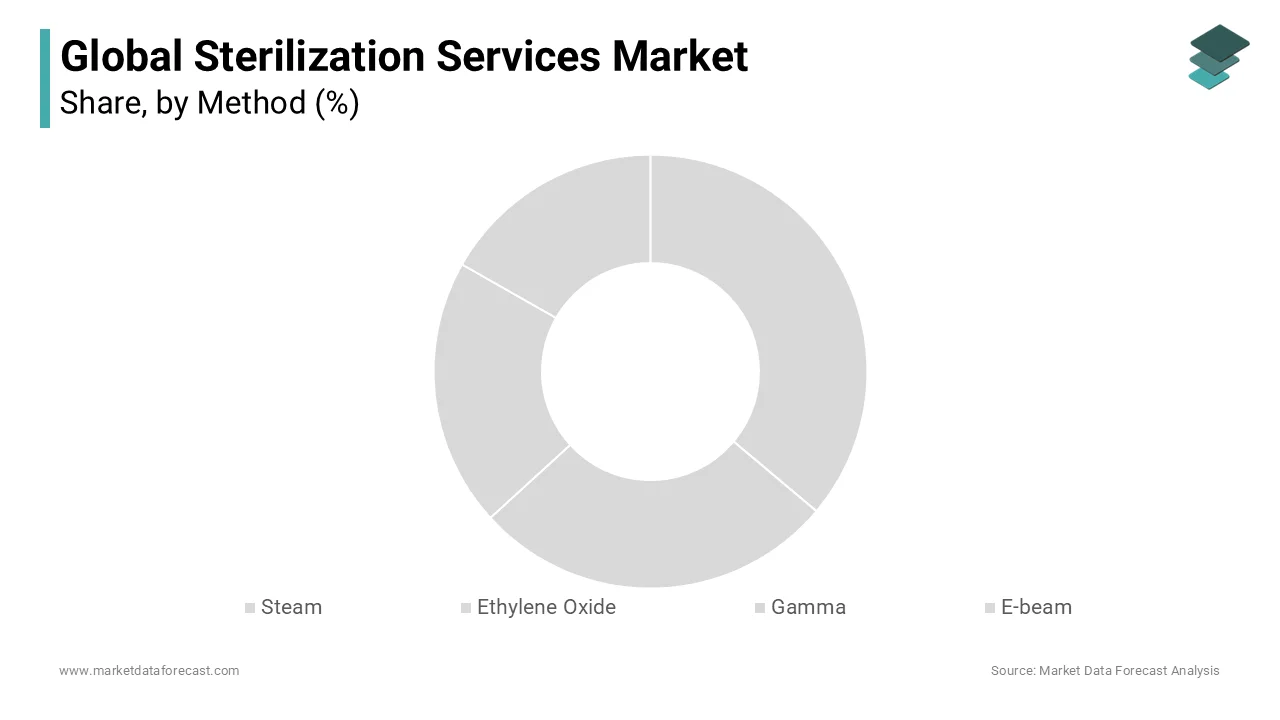
The e-beam (electron beam) sterilization segment is estimated to register the fastest CAGR of 11.3% from 2025 to 2030 due to its environmental sustainability, speed, and precision. Unlike gamma irradiation, e-beam does not rely on radioactive isotopes, eliminating concerns related to cobalt-60 supply chain instability and long-term waste management. According to study, e-beam facilities consume less energy per cycle and emit no greenhouse gases, aligning with corporate sustainability goals. Apart from these, companies like Steris and Synergy Health are investing in modular e-beam units that can be integrated directly into manufacturing lines, reducing logistics complexity. This scalability and eco-efficiency are accelerating adoption, particularly in Europe and North America, where regulatory and environmental burdens are intensifying.
By End-User Insights
The pharmaceuticals segment led the Sterilization Services Market by capturing 46.2% of the global market share in 2025. The growth of the pharmaceuticals segment is driven by the stringent regulatory requirements for sterility in injectable drugs, biologics, and aseptically manufactured products. According to the research, aportion of sterile drug manufacturing facilities rely on third-party sterilization providers for gamma or steam validation of primary packaging, such as vials and syringes. The rise of biologics which accounts for a portion of new drug approvals further intensifies demand, as these products often require single-use and pre-sterilized bioprocessing components. Apart from these, the World Health Organization (WHO) emphasizes that contamination in sterile pharmaceuticals can lead to fatal outcomes which makes sterilization a non-negotiable component of quality control. As a result, this ensures sustained investment in compliant external services.
The food and beverage segment is estimated to register the fastest CAGR of 9.8% between 2025 and 2033 owing to escalating food safety regulations and consumer demand for extended shelf life without preservatives. According to the research, foodborne pathogens cause millions of illnesses and numerous deaths annually, prompting governments to adopt advanced microbial control measures. In response, food manufacturers are increasingly adopting irradiation and cold plasma sterilization for spices, dried herbs, and ready-to-eat meals. Apart from these, as per study, many countries now permit food irradiation, with Brazil and India significantly increasing processing capacity. This regulatory acceptance is rising demand for clean-label products are accelerating the adoption of industrial sterilization services in the food supply chain.
REGIONAL ANALYSIS
North America Sterilization Services Market Analysis
North America was the top performer in the Sterilization Services Market in 2025 and accounted for 37.1% of the global market share in 2025. The domination of North America in the global market is primarily driven by its dense concentration of medical device manufacturers, biopharmaceutical firms, and highly regulated healthcare infrastructure. The United States alone accounts a portion of global medical device production, according to the study by creating immense demand for terminal sterilization. The region is investing in next-generation e-beam and hydrogen peroxide plasma facilities despite environmental scrutiny of ethylene oxide. Hence, North America remains the epicenter of technological innovation and regulatory rigor in sterilization services because many commercial sterilization sites are operational.

Europe Sterilization Services Market Analysis
Europe is the second-largest in the Sterilization Services Market accounted for 32.3% of the global market share in 2025. The growth of Europe in the global market is propelled by its robust regulatory framework and high standards for medical and pharmaceutical safety. The European Union’s Medical Device Regulation (MDR) and In Vitro Diagnostic Regulation (IVDR) have elevated sterilization validation requirements, mandating comprehensive documentation and periodic re-audits. According to the study, number of medical devices underwent sterilization validation to comply with MDR timelines. Countries like Germany and the Netherlands host major sterilization hubs, with AkzoNobel’s gamma facility in Bergkvara, Sweden, serving numeous clients across the continent. Apart from these, the EU’s Green Deal is driving investment in non-EtO alternatives, with France and Germany funding pilot projects for pulsed UV and supercritical CO₂ sterilization. This blend of regulatory stringency and environmental consciousness positions Europe as a leader in sustainable and compliant sterilization practices.
Asia Pacific Sterilization Services Market Analysis
Asia Pacific is expected to be the most lucrative region in the sterilization services market, with rapid growth fueled by expanding healthcare infrastructure, rising medical device production, and increasing regulatory alignment with global standards. China and India are key contributors, with India’s pharmaceutical exports are surging which necessitates internationally recognized sterilization protocols. The National Medical Products Administration (NMPA) of China has adopted ISO 11135 and ISO 11137 standards for medical device sterilization, encouraging foreign investment in compliant facilities. According to the study, medical device manufacturing in Southeast Asia grew, supported by Thailand and Malaysia’s development of specialized industrial zones. Apart from these, Japan’s aging population has increased demand for sterile implants and single-use surgical kits. Thus, the region is witnessing a surge in contract sterilization partnerships and technology transfer agreements with Western providers as governments are prioritizing self-reliance in healthcare supply chains.
Latin America Sterilization Services Market Analysis
Latin America grew steadily in the sterilization services market, with Brazil and Mexico leading in sterilization service adoption due to expanding healthcare access and pharmaceutical manufacturing. According to the research, Brazil performs number of surgeries annually, driving demand for sterile instruments and disposable kits. In addition, Mexico’s pharmaceutical sector grew, as per study, increasing reliance on contract sterilization for export-oriented production. However, the region faces challenges in infrastructure, with only few industrial-scale sterilization facilities operational across countries, as per the research. However, growing foreign investment and regional harmonization efforts under PAHO are creating opportunities for market expansion, particularly in gamma and steam-based services.
Middle East and Africa Sterilization Services Market Analysis
Middle East and Africa is likely to grow in the sterilization services market, with growth concentrated in the Gulf Cooperation Council (GCC) countries and select African economies. According to the research, a portion of medical devices used in sub-Saharan Africa are imported, many requiring pre-sterilization before entry. The UAE and Saudi Arabia are investing heavily in healthcare modernization, Saudi Arabia’s Vision 2030 includes a significant health sector upgrade, with sterilization infrastructure as a priority. Apart from these, Egypt and Kenya are developing medical device manufacturing zones with integrated sterilization capabilities. The region is gradually strengthening its sterilization ecosystem which is Supported by international partnerships and donor-funded programs. However, scalability remains constrained by regulatory fragmentation and technical capacity gaps.
COMPETITIVE LANDSCAPE
The competition in the Sterilization Services Market is characterized by a concentrated landscape dominated by multinational specialists offering scalable, compliant, and technologically advanced solutions. The market is increasingly shaped by environmental regulations, particularly restrictions on ethylene oxide emissions, which are forcing operators to innovate or consolidate. Technological differentiation, especially in e-beam and hydrogen peroxide plasma systems, is becoming a key competitive lever. Apart from these, the integration of digital monitoring, blockchain-based traceability, and predictive maintenance is redefining service quality. Medical device and biopharma production are decentralizing.The competition is shifting from pure capacity to reliability, speed, and regulatory agility, with providers that offer end-to-end validation and rapid turnaround times gaining strategic advantage in global supply chains.
KEY MARKET PLAYERS
Some of the companies that are playing a dominating role in the global sterilization services market include
- STERIS Corporation
- Getinge Group
- Advanced Sterilization Products
- 3M Company
- Belimed AG
- Cantel Medical Corporation
- Anderson Products Matachana Group
- MMM Group
- Sterigenics International Inc.
TOP PLAYERS IN THE MARKET
- STERIS plc is a leading global provider of sterilization services, with a growing and strategic presence across the Asia Pacific region. The company has strengthened its footprint through localized infrastructure investments, including the expansion of its advanced ethylene oxide and steam sterilization facility in Singapore to serve Southeast Asian medical device manufacturers. The company also launched a technical training initiative in collaboration with hospitals in Thailand and Australia to enhance sterile processing protocols in surgical settings. Its integration of digital monitoring systems has strengthened trust among pharmaceutical and medtech clients seeking full traceability and regulatory compliance.
- Sterigenics International LLC plays a pivotal role in advancing industrial sterilization capabilities throughout Asia Pacific, leveraging its expertise in gamma and electron beam technologies. The company operates a state-of-the-art gamma irradiation center in Malaysia, one of the few in Southeast Asia capable of handling high-volume medical device and pharmaceutical packaging sterilization. Recognizing environmental concerns around ethylene oxide, Sterigenics invested in alternative modalities, commissioning an e-beam facility in Shanghai capable of processing heat-sensitive polymers. Furthermore, its participation in ASEAN’s harmonization taskforce on medical device regulations has positioned Sterigenics as a trusted advisor in regional compliance and quality assurance frameworks.
- Nordion Inc., a key player in gamma sterilization through its cobalt-60 supply and irradiation technology, has significantly influenced sterilization infrastructure development in Asia Pacific. The company supplies a portion of the region’s cobalt-60 isotope demand, powering gamma facilities in India, China, and Indonesia. The company also supported the commissioning of a new irradiation plant in Jakarta, aimed at serving Indonesia’s expanding medical device sector.
TOP STRATEGIES USED BY THE KEY MARKET PARTICIPANTS
Key players in the Sterilization Services Market are deploying a combination of technological diversification, geographic expansion, regulatory alignment, and strategic partnerships to strengthen their market dominance. Companies are investing in multi-modal sterilization platforms by offering gamma, e-beam, EtO, and steam to provide flexible, client-specific solutions. Expansion into high-growth regions like Asia Pacific is being accelerated through localized facilities and joint ventures with regional manufacturers. Firms are also prioritizing sustainability by reducing reliance on ethylene oxide and advancing non-radioactive alternatives. Regulatory compliance is enhanced through ISO certification, digital validation records, and AI-driven process monitoring. Apart from these, providers are integrating sterilization into broader service ecosystems, including logistics, packaging, and quality auditing, to deliver end-to-end solutions. Workforce training and technical support programs further differentiate service offerings which ensures long-term client retention and operational excellence in a highly regulated environment.
GLOBAL STERILIZATION SERVICES MARKET NEWS
- In March 2024, Steris introduced the Verfit sterilization covers and bags for EU GMP Annex 1 compliance. It comes with a new characteristic called a viewing window to check visually and ensure the dryness of a sterilized component.
- In January 2023, vaporized hydrogen peroxide was marked and registered by the FDA as an established sterilization method for medical devices. This is connected to the agency’s efforts to provide a substitute for ethylene oxide sterilization in the form of revised directions for sterile medical device manufacturers.
- In July 2024, the Center for Devices and Radiological Health (CDRH) added extra steps further to advance the development of novel medical device sterilization. This was done by revising their Recognized Consensus Standards database to incorporate the entire acknowledgment of one sterilization standard known as ISO 22441:2022 and two Technical Information Reports, i.e., AAMI TIR104:2022 and AAMI TIR17:2019/(R)2020.
MARKET SEGMENTATION
This research report on the global sterilization services market has been segmented and sub-segmented based on method, type, end-user, and region.
By Method
- Steam
- Ethylene Oxide
- Gamma
- E-beam
By Type
- Contract Sterilization Service
- Validation Services
By End-User
- Hospitals and Clinics
- Food and Beverage
- Pharmaceuticals
By Region
- North America
- Europe
- Asia-Pacific
- Latin America
- Middle East and Africa