- Product Description Description
- Table of Contents TOC
- List of Table & Figure LOT
- Get Free Sample PDF Sample PDF
Market Size, 2025
$5.15 BnMarket Estimate, 2026
$5.97 BnMarket Forecast, 2034
$19.59 BnCAGR, 2026–2034
16%Global Supercapacitor Market Size, Share & Growth Analysis (2026–2034)
The global supercapacitor market was valued at USD 5.15 billion in 2025, reaching USD 5.97 billion in 2026, and is projected to expand to USD 19.59 billion by 2034, registering a compound annual growth rate (CAGR) of 16% during the forecast period from 2026 to 2034.
- Market Scope: Comprehensive global evaluation spanning product types, module variants, raw materials, end-use applications, and regional landscapes across North America, Europe, Asia-Pacific, Latin America, and the Middle East & Africa.
- Primary Growth Drivers: Escalating demand for clean and alternative energy integration (solar PV and wind), rapid electrification and growth in the automotive/EV sector, and superior high power-density capabilities compared to traditional batteries.
Key Market Segment Metrics
| Category | Leading Segment | Fastest-Growing / Promising Segment |
|---|---|---|
| By Product Type | Pseudocapacitors (Historically demonstrated major revenue traction through fast Faradaic redox reactions) | Hybrid Capacitors (Merging battery-like energy density with capacitor-like power density) |
| By Module Type | Less Than 10 Volts / Low-Voltage Modules (Dominating consumer electronics and portable IoT layouts) | 25V to 50V & Above 100V Modules (Scaling rapidly across heavy industrial automation and electric transit grids) |
| By Material | Activated Carbon (Anchored by high surface-area availability, reliable electrical conductivity, and cost-efficiency) | Graphene & Carbide-Derived Carbon (Propelled by advanced material R&D to optimize energy density) |
| By Application / End-Use | Automotive (Fueled by start-stop systems, regenerative braking, and heavy EV/HEV integration) | Energy / Renewable Grid Storage (Driven by solar/wind balancing, grid frequency stabilization, and microgrid backups) |
| By Region | Asia-Pacific (Captured the largest regional market share, driven by electronics manufacturing and clean mobility in China and India) | North America & Europe (Expands steadily on aggressive federal clean-energy allocations, EV mandates, and smart grid automation) |
Major Market Players & Industry Landscape
Competitive Structure: A specialized high-technology arena populated by prominent electronic component and advanced energy storage conglomerates focusing on voltage optimization, miniaturization, and hybrid battery integration.
Leading Companies: Nippon Chemi-Con Corp, Panasonic, Eaton Corporation, Cap-XX Limited, SPEL Technologies Private Limited, IOXUS Inc., Skeleton Technologies, and Evans Capacitor Company.
 Download Free Sample Report
Global Supercapacitor Market Size
The Global Supercapacitor Market was worth US$ 5.15 billion in 2025 and is anticipated to reach a valuation of US$ 19.59 billion by 2034 from US$ 5.97 billion in 2026, and it is predicted to register a CAGR of 16% from 2026 to 2034.

The supercapacitor market encompasses advanced energy storage devices that bridge the gap between conventional capacitors and rechargeable batteries by offering high power density and rapid charge-discharge cycles. These electrochemical double-layer capacitors are increasingly utilized in applications requiring burst power, regenerative braking, and backup power systems across automotive, industrial, and consumer electronics sectors. According to the International Energy Agency, the global deployment of electric vehicles is expected to reach 145 million by 2030, creating a substantial demand for efficient energy management systems where supercapacitors play a critical role in handling peak power loads. According to the Institute of Electrical and Electronics Engineers, supercapacitors can endure over 1 million charge-discharge cycles with minimal degradation, significantly outperforming lithium-ion batteries, which typically last only 3,000 to 5,000 cycles. These statistics underscore the unique value proposition of supercapacitors in enhancing the longevity and reliability of electronic systems. The market dynamics are further influenced by the growing adoption of renewable energy sources, the expansion of smart grid infrastructure, and the miniaturization of portable electronic devices. As industries prioritize sustainability and operational efficiency, the integration of supercapacitors into hybrid energy storage systems continues to accelerate, driving innovation in electrode materials and electrolyte formulations.
MARKET DRIVERS
Rapid Growth of Electric and Hybrid Vehicle Adoption
The accelerating adoption of electric and hybrid vehicles directly fuels the supercapacitor market growth due to their ability to manage high power bursts and recover energy during braking. Unlike batteries, which provide sustained energy, supercapacitors excel in delivering instant power for acceleration and capturing kinetic energy efficiently, thereby extending battery life and improving overall vehicle performance. According to the International Council on Clean Transportation, electric vehicle sales accounted for nearly 14% of all new car sales globally in recent years, indicating a massive shift in automotive propulsion technologies. This transition necessitates robust energy storage solutions that can handle the frequent and intense power fluctuations inherent in electric drivetrains. Furthermore, according to the Society of Automotive Engineers, integrating supercapacitors into hybrid energy storage systems can improve fuel efficiency by up to 20% in heavy-duty vehicles by optimizing regenerative braking processes. The harsh operating conditions of automotive environments require components with high thermal stability and long cycle life. As automakers strive to meet stringent emission standards and enhance driving range, the reliance on supercapacitors for power management intensifies. This automotive transformation creates a sustained and growing market for high-performance supercapacitors capable of supporting the next generation of mobility solutions.
Expansion of Renewable Energy Infrastructure and Smart Grids
The global expansion of renewable energy infrastructure and the modernization of power grids significantly favor the global supercapacitor market expansion. Renewable sources, such as wind and solar, are intermittent by nature, causing fluctuations in power output that can destabilize the grid if not properly managed. According to the International Renewable Energy Agency, renewable energy capacity additions reached record levels recently, with solar and wind contributing over 80% of new capacity, increasing the need for fast-responding storage solutions. Supercapacitors offer millisecond response times, making them ideal for smoothing out these short-term variability issues and maintaining grid stability. Additionally, according to the IEEE Power and Energy Society, supercapacitors can enhance the quality of power supply by mitigating voltage sags and swells, which are critical for protecting sensitive industrial equipment. As smart grid technologies evolve, the integration of distributed energy resources requires localized storage systems that can react quickly to changes in supply and demand. Supercapacitors fulfil this role effectively by providing immediate power support during transient events. The push towards decarbonization and grid resilience drives utilities and industrial consumers to invest in hybrid storage systems where supercapacitors complement batteries, ensuring reliable and efficient energy distribution.
MARKET RESTRAINTS
Low Energy Density Compared to Batteries
The relatively low energy density of supercapacitors compared to lithium-ion batteries significantly restrains the global supercapacitor market growth. While supercapacitors excel in power density, they store significantly less energy per unit volume or mass, limiting their use as standalone power sources for extended periods. According to the Journal of Power Sources, typical supercapacitors have an energy density of 5 to 10 watt-hours per kilogram, whereas lithium-ion batteries offer 150 to 250 watt-hours per kilogram. This disparity means that supercapacitors cannot replace batteries in most consumer electronics or electric vehicles where range and runtime are primary concerns. Consequently, they are often relegated to niche roles, such as backup power or peak shaving, rather than primary energy storage. According to the Department of Energy, while research is ongoing to improve energy density through novel materials like graphene, current commercial technologies remain limited in this regard. This fundamental physical limitation restricts the addressable market for supercapacitors, forcing designers to use them in conjunction with batteries, which adds complexity and cost to system architecture. Until significant breakthroughs in electrode materials occur, the low energy density will continue to hinder broader market penetration.
High Manufacturing Costs and Material Expenses
The high manufacturing costs associated with supercapacitors, particularly those using advanced materials like activated carbon and organic electrolytes, are a significant barrier to mass-market adoption. The production process involves sophisticated techniques for electrode fabrication and cell assembly, which are more expensive than traditional capacitor or battery manufacturing. According to the Electrochemical Society, the cost per watt-hour for supercapacitors remains significantly higher than that of lithium-ion batteries, making them less economically viable for large-scale energy storage applications. Additionally, the reliance on specialized materials, such as high-surface-area carbon and rare metal oxides, contributes to elevated raw material costs. Fluctuations in the supply chain for these precursors can further exacerbate price volatility. According to the National Association of Manufacturers, high initial capital expenditure discourages smaller enterprises from integrating supercapacitors into their products, limiting market growth to high-value sectors like aerospace and defense. While economies of scale are expected to reduce costs over time, current pricing structures make supercapacitors a premium component. This financial constraint restricts their use in cost-sensitive consumer markets, slowing down the overall expansion of the industry despite their technical advantages.
MARKET OPPORTUNITIES
Integration in Internet of Things and Wearable Electronics
The proliferation of Internet of Things devices and wearable electronics is a significant opportunity for supercapacitors due to their ability to provide rapid charging and long cycle life. IoT sensors and wearables often operate in remote or hard-to-access locations where frequent battery replacement is impractical or impossible. According to the GSMA Intelligence Unit, the number of active IoT connections is projected to exceed 25 billion globally by 2025, creating a vast market for autonomous power solutions. Supercapacitors can be charged quickly via energy harvesting methods, such as solar, thermal, or kinetic energy, enabling self-sustaining devices that require minimal maintenance. Furthermore, according to the IEEE Internet of Things Journal, supercapacitors offer superior safety profiles compared to batteries, reducing the risk of leakage or explosion in compact wearable designs. Their ability to withstand extreme temperatures and harsh environmental conditions makes them ideal for industrial IoT applications in manufacturing and logistics. As device miniaturization continues, the demand for small form-factor energy storage with high reliability grows. Manufacturers can capitalize on this trend by developing flexible and thin-film supercapacitors that integrate seamlessly into wearable fabrics and smart sensors. This alignment with the IoT revolution opens new revenue streams and expands the application scope beyond traditional industrial uses.
Advancements in Public Transportation and Rail Systems
The modernization of public transportation and rail systems offers substantial opportunities for supercapacitor deployment in regenerative braking and station-to-station power management. Trams, buses, and metro systems frequently stop and start, generating significant kinetic energy that can be captured and reused. According to the International Union of Railways, electrified rail networks are expanding rapidly in urban centers worldwide, with many cities investing in green transit solutions to reduce emissions. Supercapacitors installed on board or at stations can store braking energy and release it during acceleration, reducing overall energy consumption by up to 30%. Additionally, they enable catenary-free operation for short distances, allowing trams to navigate historic city centers without overhead wires. According to the American Public Transportation Association, agencies are prioritizing technologies that improve efficiency and reduce operational costs, making supercapacitors an attractive investment. The high power capability and long lifespan of supercapacitors align perfectly with the rigorous demands of public transit operations. As governments push for sustainable urban mobility, the adoption of supercapacitor-based energy recovery systems in rail and bus fleets is expected to grow, driving demand for high-capacity modules tailored for heavy-duty transport applications.
MARKET CHALLENGES
Complexity of System Integration and Management
The complexity of integrating supercapacitors into existing electrical systems and managing their unique charging characteristics is a significant challenge to market adoption. Unlike batteries, supercapacitors have a linear voltage drop during discharge, requiring sophisticated power electronics and DC-DC converters to maintain stable output voltage. According to the IEEE Transactions on Industrial Electronics, designing efficient balance circuits for series-connected supercapacitor cells is technically challenging and adds to system cost and size. This additional hardware requirement complicates the design process for original equipment manufacturers who may lack expertise in supercapacitor technology. Furthermore, the lack of standardized interfaces and communication protocols for supercapacitor modules hinders seamless integration with battery management systems. According to the Society of Automotive Engineers, improper management can lead to cell imbalance and reduced performance, negating the benefits of the technology. Engineers must carefully tailor control algorithms to optimize charging and discharging rates, which increases development time and resource allocation. Until plug-and-play solutions with integrated management systems become widely available, the technical barrier to entry will remain high. This complexity discourages smaller players from adopting the technology and slows down the pace of innovation in end-user applications.
Limited Standardization and Regulatory Frameworks
The lack of comprehensive standardization and clear regulatory frameworks for supercapacitors creates uncertainty and hinders consistent quality assurance across the industry. While standards exist for batteries, specific guidelines for supercapacitor testing, safety, and performance metrics are still evolving and vary by region. The International Electrotechnical Commission is working on harmonizing standards, but gaps remain in areas such as lifecycle testing and environmental impact assessment. According to the Journal of Energy Storage, inconsistent testing methodologies make it difficult for customers to compare products from different manufacturers reliably. This ambiguity leads to confusion in procurement and increases the risk of selecting underperforming components. Additionally, the absence of unified recycling regulations for supercapacitors raises concerns about environmental sustainability and end-of-life management. According to the Environmental Protection Agency, proper disposal protocols are essential to prevent contamination from electrolytes, yet clear guidelines are lacking in many jurisdictions. This regulatory vacuum complicates compliance for manufacturers operating in multiple markets and increases legal risks. Until global standards are established and enforced, the market will face fragmentation and inefficiencies that impede widespread acceptance and trust in supercapacitor technology.
REPORT COVERAGE
| REPORT METRIC | DETAILS |
| Market Size Available | 2025 to 2034 |
| Base Year | 2025 |
| Forecast Period | 2026 to 2034 |
| Segments Covered | By Product Type, Module Type, Material, Application, and Region. |
| Various Analyses Covered | Global, Regional, and country-level analysis; Segment-Level Analysis, DROC, PESTLE Analysis, Porter’s Five Forces Analysis, Competitive Landscape, Analyst Overview of Investment Opportunities |
| Regions Covered | North America, Europe, APAC, Latin America, Middle East & Africa |
| Market Leaders Profiled | Nippon Chemi-Con Corp, Panasonic, Eaton Corporation, Cap-XX Limited, SPEL Technologies Private Limited, IOXUS Inc., Skeleton Technologies, Evans Capacitor Company, and Others. |
SEGMENTAL ANALYSIS
By Product Type Insights
The double-layer capacitors segment captured 60.3% of the global market share in 2025. The dominance of the double-layer capacitors segment in the global market is primarily attributed to their mature technology, high power density, and superior cycle life and reliability, which are critical for industrial and automotive applications. Unlike batteries that degrade with each cycle, double-layer capacitors can withstand millions of charge-discharge cycles with negligible performance loss. According to the Journal of Power Sources, electric double-layer capacitors typically endure over 1 million cycles, whereas lithium-ion batteries often fail after 3,000 to 5,000 cycles. This longevity reduces maintenance costs and total cost of ownership for end users. Furthermore, according to the Institute of Electrical and Electronics Engineers, the absence of faradaic reactions in double-layer capacitors minimizes heat generation and enhances safety in high-power applications. This makes them ideal for regenerative braking systems in trains and buses where frequent energy capture is required. The robustness of these devices ensures consistent performance in harsh environments, from extreme temperatures to high-vibration settings. Industries prioritize reliability to avoid downtime, making double-layer capacitors the preferred choice for backup power and peak shaving. Their proven track record in demanding conditions sustains their market leadership as manufacturers continue to optimize electrode materials for higher efficiency.
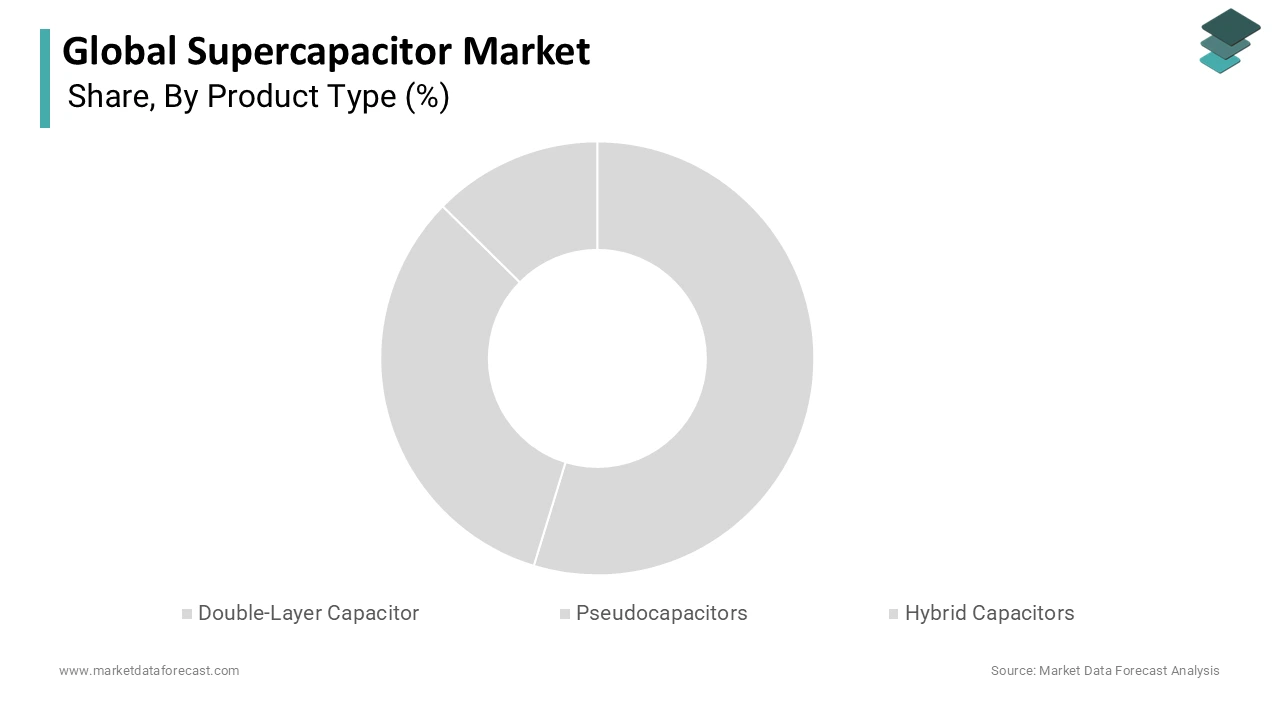
On the other end, the hybrid capacitors segment is on the rise and is estimated to witness a CAGR of 13.4% over the forecast period owing to their ability to bridge the gap between power and energy density, making them suitable for emerging applications like electric vehicles and renewable energy storage. Hybrid capacitors use one battery-type electrode and one capacitor-type electrode, allowing them to store more energy than traditional supercapacitors while maintaining fast charging capabilities. According to the Journal of Energy Storage, hybrid capacitors can achieve energy densities of 30 to 50 watt-hours per kilogram, significantly higher than the 5 to 10 watt-hours per kilogram of standard double-layer capacitors. This improvement enables their use in applications where longer runtime is required without sacrificing power delivery. Furthermore, according to the International Battery Association, hybrid capacitors are increasingly being integrated into electric vehicle powertrains to extend driving range and improve acceleration performance. The automotive industry’s push for electrification drives demand for storage solutions that offer both endurance and burst power. As battery technology faces limitations in charging speed and cycle life, hybrid capacitors offer a compelling alternative. Their versatility allows them to complement batteries in hybrid energy storage systems, optimizing overall system efficiency. This dual capability positions hybrid capacitors as a key enabler for next-generation mobility and grid storage solutions.
By Module Type Insights
The less than 10 volts modules segment occupied the leading share of the global market in 2025. The dominance of this segment in the global market can be credited to its widespread use in consumer electronics, memory backup, and small-scale industrial applications,s and the proliferation of consumer electronics and Internet of Things devices that require compact and reliable power sources. Smartphones, wearables, and smart sensors often use low-voltage supercapacitors for peak power assistance during data transmission or camera flashes. According to the GSMA Intelligence Unit, the number of active IoT connections is expected to exceed 25 billion globally by 2025, creating massive demand for small form-factor energy storage. These devices benefit from the fast charging and long cycle life of low-voltage supercapacitors, which outperform small batteries in terms of longevity. Furthermore, according to the Consumer Technology Association, the miniaturization of electronic components has increased the need for integrated power solutions that fit within tight space constraints. Low-voltage modules are ideal for this purpose due to their small footprint and flexible design options. The ease of integration into printed circuit boards makes them a preferred choice for manufacturers of portable gadgets. As the IoT ecosystem expands, the volume of low-voltage supercapacitor shipments continues to rise. This high-volume consumption sustains the segment's leadership despite the lower unit price compared to higher-voltage modules.
However, the modules rated between 25 volts and 50 volts segment is estimated to record a prominent CAGR of 12.5% over the forecast period owing to the expansion of automotive electrification and the adoption of hybrid energy storage systems in vehicles. Many electric and hybrid vehicles operate auxiliary systems at 48 volts, which is a standard that balances safety and efficiency. According to the Society of Automotive Engineers, 48-volt mild hybrid systems are becoming increasingly common in mainstream vehicles to improve fuel efficiency and reduce emissions. These systems rely on supercapacitor modules in the 25 to 50 volt range to handle regenerative braking energy and provide boost power during acceleration. Furthermore, according to the International Council on Clean Transportation, the shift towards 48-volt architectures allows for the electrification of heavy loads like air conditioning compressors and water pumps, increasing the demand for compatible energy storage. Supercapacitors in this voltage range offer the necessary power density and cycle life to withstand the rigorous demands of automotive environments. Their ability to operate efficiently in this voltage window makes them indispensable for modern vehicle power management. As automakers accelerate the transition to electrified platforms, the demand for mid-voltage supercapacitor modules will continue to surge.
By Application Insights
The automotive segment led the market by holding 41.4% of the global market share in 2025. The growth of the automotive segment in the global market is attributed to increasing integration of supercapacitors in start-stop systems, regenerative braking, and hybrid electric vehicles, es and the widespread implementation of regenerative braking and start-stop systems in modern vehicles. These systems require energy storage devices that can rapidly absorb and release large amounts of energya task where supercapacitors excel. According to the International Energy Agency, over 50% of new cars sold globally now feature start-stop technology, creating a massive installed base for supercapacitors. Regenerative braking systems in hybrid and electric vehicles also rely on supercapacitors to capture kinetic energy efficiently during deceleration. According to the Society of Automotive Engineers, using supercapacitors for this purpose can improve fuel economy by up to 15% in urban driving conditions. The ability of supercapacitors to endure millions of cycles without degradation makes them ideal for the frequent stopping and starting inherent in city traffic. Automakers prioritize these benefits to meet stringent emission standards and improve vehicle performance. As regulatory pressures intensify, the adoption of supercapacitor-assisted powertrains is expected to grow. This operational necessity ensures that the automotive sector remains the largest consumer of supercapacitors globally.
However, the energy segment is projected to grow at the fastest CAGR of 14.5% over the forecast period in the global market owing to the integration of supercapacitors with renewable energy sources such as wind and solar power. These sources are intermittent and variable, requiring fast-responding energy storage to stabilize output and ensure grid compatibility. According to the International Renewable Energy Agency, renewable energy capacity additions reached record levels recently, with solar and wind contributing over 80% of new capacity. Supercapacitors provide millisecond response times, making them ideal for smoothing out short-term fluctuations in power generation. Furthermore, according to the IEEE Power and Energy Society, supercapacitors help mitigate voltage sags and swells, improving the overall quality of power supplied to the grid. As the share of renewables in the energy mix increases, the need for such stabilization technologies grows. Utilities and independent power producers are investing in hybrid storage systems that combine batteries with supercapacitors to optimize performance and cost. This strategic shift drives the adoption of supercapacitors in large-scale energy projects. The ability to enhance grid resilience and reliability positions supercapacitors as a critical component of the future energy landscape.
COUNTRY LEVEL ANALYSIS
North America Supercapacitor Market Analysis
North America held 37.4% of the global supercapacitor market share in 2025 and is likely to maintain its dominant position and experience steady expansion over the next few years due to the advanced technological infrastructure, strong government support for clean energy, a robust automotive industry, and significant investments in electric vehicle manufacturing and grid modernization. According to the Department of Energy, billions of dollars have been allocated to battery and energy storage research, fostering innovation in supercapacitor technologies. The presence of major automotive manufacturers accelerating the transition to electric vehicles drives demand for high-performance energy storage solutions. Additionally, according to the North American Electric Reliability Corporation, the need for grid stability as renewable energy integration increases boosts adoption of supercapacitors for frequency regulation. The region benefits from a well-established supply chain and strong intellectual property protection, encouraging research and development. Strict environmental regulations also push industries towards efficient energy management systems. The mature market sees high adoption of supercapacitors in industrial automation and aerospace applications. Leading companies in the region are focusing on developing next-generation materials to enhance performance. These factors combine to make North America a key hub for supercapacitor innovation and consumption.
Europe Supercapacitor Market Analysis
Europe is expected to witness steady market consolidation and enhanced integration of green energy technologies over the next few years, representing a mature and highly regulated market in the Supercapacitor sector, characterized by stringent environmental standards and ambitious climate goals. Countries like Germany, France, and the United Kingdom are leading the adoption of supercapacitors in public transportation and renewable energy systems. According to the European Commission, the Green Deal aims to make Europe climate-neutral by 2050, driving massive investments in clean technologies. This policy framework supports the deployment of supercapacitors in electric buses and trams for regenerative braking. According to the International Union of Railways, European rail networks are increasingly adopting catenary-free operations enabled by onboard energy storage. The region also has a strong industrial base that utilizes supercapacitors for peak shaving and backup power. Regulatory support for circular economy principles encourages the development of recyclable energy storage solutions. Research institutions in Europe are actively collaborating with industry to advance supercapacitor materials. The focus on sustainability and efficiency ensures steady market growth. Reimbursement schemes for green technologies further incentivize adoption. These dynamics position Europe as a leader in sustainable energy storage applications.
Asia Pacific Supercapacitor Market Analysis
Asia Pacific is expected to emerge as the fastest-growing region with a CAGR of 14.6% over the next few years, driven by rapid industrialization, expanding electronics manufacturing, and government initiatives promoting electric mobility. China, Japan, and South Korea are the primary growth engines, with China being the largest producer and consumer of supercapacitors globally. According to the Ministry of Industry and Information Technology in China, the country accounts for over 60% of global supercapacitor production, supported by a robust supply chain for raw materials. The rising adoption of electric vehicles in the region, particularly in China, drives significant demand for automotive-grade supercapacitors. Japan leads in technological innovation, with companies developing advanced materials like graphene and higher-performance devices. According to the Asian Development Bank, infrastructure development in emerging economies is increasing the need for reliable power backup solutions. The consumer electronics boom in countries like India and Vietnam also contributes to market growth. Local manufacturing capabilities are reducing costs and improving accessibility. Government subsidies for green energy projects further stimulate demand. The region’s vast population and economic growth offer immense potential for future expansion.
Latin America Supercapacitor Market Analysis
Latin America is likely to experience gradual modernization of transport infrastructure and increased adoption of renewable solutions over the next few years, presenting an emerging market for Supercapacitors, characterized by growing interest in renewable energy and modernization of public transportation. Brazil and Mexico are the largest markets, with initiatives to expand electric bus fleets and improve grid reliability. According to the Inter-American Development Bank, investments in sustainable transport are increasing, creating opportunities for supercapacitor adoption in regenerative braking systems. The region faces challenges related to grid instability, making supercapacitors attractive for power quality improvement in industrial settings. However, high initial costs and limited local manufacturing capacity restrain widespread adoption. Most supercapacitors are imported, leading to higher prices and longer lead times. Regulatory frameworks are evolving to support clean energy technologies, but implementation varies by country. Public-private partnerships are helping to fund pilot projects in energy storage. Awareness of supercapacitor benefits is growing among engineers and policymakers. As economic conditions improve and local assembly capabilities develop, the market is expected to grow. The focus on reducing carbon emissions aligns with global trends, supporting long-term potential.
Middle East and Africa Supercapacitor Market Analysis
Middle East and Africa are projected to witness targeted smart city expansion and industrial diversification over the next few years, showing varied performance in the Supercapacitor Market, with Gulf Cooperation Council countries leading in adoption due to diversification efforts away from oil. Saudi Arabia and the United Arab Emirates are investing in smart city projects and renewable energy infrastructure, driving demand for advanced energy storage. According to the International Renewable Energy Agency, solar energy projects in the region are expanding rapidly, creating needs for power smoothing solutions. Supercapacitors are used in these projects to manage intermittency and protect sensitive equipment. In Africa, the focus is on off-grid power solutions and backup systems for telecommunications and healthcare facilities. The lack of reliable grid infrastructure in many areas makes supercapacitors valuable for short-duration backup. However, limited financial resources and technical expertise hinder market growth. International aid and development programs are supporting the deployment of renewable energy systems that may include supercapacitors. The market is small but has potential as infrastructure improves. Regulatory harmonization in the GCC is facilitating trade and investment. The region’s commitment to sustainability suggests positive long-term prospects despite current challenges.
COMPETITIVE LANDSCAPE
The competition in the Supercapacitor Market is characterized by the presence of established electronics manufacturers and specialized energy storage startups who compete on technology and performance metrics. Major corporations dominate the segment for standard double-layer capacitors due to their extensive production capabilities and established distribution networks. They differentiate themselves through consistent quality, broad product portfolios, and global service support. Specialized players focus on niche high-performance applications using advanced materials like graphene to offer superior power density and faster charging speeds. Competitive dynamics are driven by continuous innovation in electrode architecture and electrolyte formulations to improve energy storage capacity. Price competition is moderate in the premium automotive and industrial segments where performance is paramount but intense in the consumer electronics market where cost sensitivity is high. Companies also compete on intellectual property rights and patent portfolios to protect their technological advantages. The entry of new materials and hybrid technologies challenges incumbents to accelerate their research and development cycles. Strategic acquisitions and joint ventures are common tactics used to access new technologies and expand geographic reach. This dynamic environment encourages constant improvement and ensures that customers benefit from increasingly efficient and versatile supercapacitor solutions tailored to diverse energy management needs.
KEY MARKET PLAYERS
Some of the companies that are playing a dominating role in the Global Supercapacitors Market include
- Nippon Chemi-Con Corp.
- Panasonic
- Eaton Corporation
- CAP-XX Limited
- SPEL Technologies Private Limited
- Ioxus Inc.
- Skeleton Technologies
- Evans Capacitor Company
TOP LEADING PLAYERS IN THE MARKET
- Maxwell Technologies maintains a strong presence in the Supercapacitor Market through its advanced dry electrode technology and high power density modules. The company focuses on delivering reliable energy storage solutions for automotive, industrial, and renewable energy applications. Recent initiatives include expanding production capacity to meet the growing demand for electric vehicle components. Maxwell collaborates with major automakers to integrate supercapacitors into regenerative braking systems. Their commitment to innovation drives the development of next-generation cells with improved energy density. By offering robust technical support and customized engineering services, Maxwell ensures optimal performance for clients. These strategic efforts reinforce their reputation for technological leadership and strengthen their competitive position in the evolving global energy storage landscape.
- Skeleton Technologies contributes significantly to the market by providing ultra-high-power supercapacitors based on proprietary curved graphene material. The company emphasizes rapid charging capabilities and exceptional cycle life for demanding industrial and automotive uses. Skeleton has recently strengthened its market position by securing partnerships with leading European bus manufacturers for electric transit projects. These collaborations demonstrate the practical benefits of their technology in real-world applications. The company actively participates in research consortia to advance graphene-based energy storage solutions. Their focus on sustainability and performance enhances brand trust among eco-conscious industries. These actions drive sustained growth by addressing critical needs for efficient and durable power management in heavy-duty vehicles.
- Nippon Chemi Con Corporation plays a pivotal role in the market by offering a wide range of electric double-layer capacitors for consumer electronics and industrial equipment. The company is dedicated to maintaining high quality standards and reliability in compact form factors. Nippon Chemi Con has recently expanded its manufacturing facilities in Asia to improve supply chain resilience and reduce lead times. This localization strategy ensures faster delivery to key markets in the region. The company also introduces a new series of low-resistance supercapacitors designed for peak power assistance in portable devices. Their commitment to precision engineering makes them a preferred supplier for electronics manufacturers. These comprehensive efforts solidify Nippon Chemi Con’s position as a key provider of essential energy storage components globally.
TOP STRATEGIES USED BY KEY MARKET PARTICIPANTS
Key players in the Supercapacitor Market employ several strategic approaches to strengthen their competitive standing and expand their reach. One primary strategy involves continuous research and development focused on novel electrode materials such as graphene and carbon nanotubes to enhance energy density. Companies are investing heavily in material science to bridge the performance gap with batteries. Another critical strategy is forming strategic partnerships with automotive and renewable energy firms to co-develop customized solutions. These collaborations ensure early adoption and integration into next-generation products. Additionally, firms are expanding manufacturing capacities in key regions to reduce costs and improve supply chain reliability. Localization of production helps mitigate trade barriers and logistical challenges. Companies also focus on obtaining rigorous international certifications to build trust and facilitate market entry. By combining technological innovation with strategic alliances and operational efficiency, market participants create long-term value and maintain leadership positions in this rapidly evolving sector.
MARKET SEGMENTATION
This research report on the Global Supercapacitor Market is segmented and sub-segmented into the following categories
By Product Type
- Double-Layer Capacitor
- Pseudocapacitors
- Hybrid Capacitors
By Module Type
- Less Than 10 Volts Modules
- 10 Volts to 25 Volts Modules
- 25 Volts to 50 Volts Modules
- 50 Volts to 100 Volts Modules
- Above 100 Volts Modules
By Material
- Activated carbon
- Carbide Derived Carbon
- Carbon Aerogel
- Others
By Application
- Automotive
- Industrial
- Energy
- Consumer Electronics
- Aerospace & Defense