- Product Description Description
- Table of Contents TOC
- List of Table & Figure LOT
- Get Free Sample PDF Sample PDF
Market Size, 2025
$1.31 BnMarket Estimate, 2026
$1.45 BnMarket Forecast, 2034
$3.24 BnCAGR, 2026–2034
10.58%Global Superconducting Wire Market Size, Growth, Trends & Forecast (2026–2034)
The Global Superconducting Wire Market size was valued at USD 1.31 billion in 2025, is estimated to reach USD 1.45 billion in 2026, and is projected to expand to USD 3.24 billion by 2034, registering a compound annual growth rate (CAGR) of 10.58% during the forecast period from 2026 to 2034. Driven by the rising deployment of MRI/NMR diagnostic imaging, cutting-edge fusion energy research, and modern grid modernization projects, the market continues to see robust high-tech adoption globally.
Key Executive Metrics (At-a-Glance)
- 2025 Base Valuation: USD 1.31 Billion
- 2026 Current Valuation: USD 1.45 Billion
- 2034 Forecast Valuation: USD 3.24 Billion
- Compound Annual Growth Rate (CAGR): 10.58% (2026–2034)
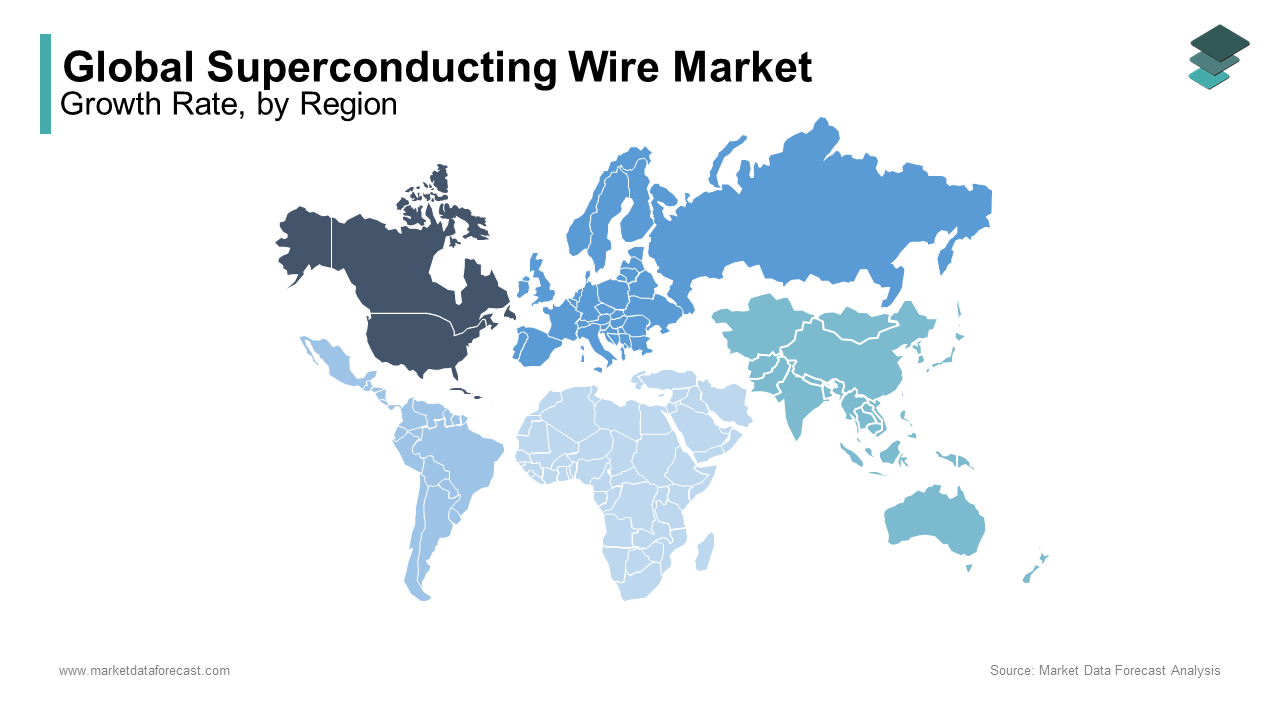
- Leading Region: North America (holding a dominant 35.3% share in 2025 supported by advanced healthcare infrastructure and defense funding)
- Key Growth Hubs: Asia-Pacific (led by Japan and China in fusion technology and superconductor production) and Europe
Core Market Drivers
- Healthcare & MRI Deployment: Expanding clinical diagnostic imaging worldwide requiring thousands of kilometers of Niobium-Titanium (NbTi) superconducting wire.
- Fusion Energy Projects: Large-scale tokamak ventures (such as ITER and SPARC) requiring ultra-high magnetic fields generated by specialized superconducting tapes.
Primary Market Restraints & Challenges
- Cryogenic Cooling & Helium Constraints: High infrastructure costs and limited global supplies of liquid helium required for low-temperature operations.
- High Production Costs: Complex manufacturing processes (such as MOCVD or PLD for REBCO HTS tapes) limiting high-volume scalability.
Market Segmentation: Largest and Fastest-Growing Segments
| Segment Category | Largest Segment | Fastest-Growing Segment |
|---|---|---|
| By Type | Low-Temperature Superconductor (LTS - Dominant share in 2025) | High-Temperature Superconductor (HTS - CAGR of 14.3%) |
| By End-User | Medical (56.2% share in 2025) | Energy & Power (CAGR of 13.8%) |
| By Region | North America (35.3% share in 2025) | Asia-Pacific & Europe |
Major Industry Players Profiled
Key market participants shaping the global superconducting wire landscape include American Superconductor Corporation, Fujikura Ltd, Furukawa Electric Co. Ltd, Hitachi Ltd, LS Cable & System Ltd, Nexans S.A, Sumitomo Electric Industries Ltd, Superconductor Technologies Inc, SuperPower Inc, THEVA Dünnschichttechnik GmbH, and Bruker Corporation.
Global Superconducting Wire Market Size
The global superconducting wire market size was valued at USD 1.31 billion in 2025 and is anticipated to reach USD 1.45 billion in 2026 and USD 3.24 billion by 2034, growing at a CAGR of 10.58% during the forecast period from 2026 to 2034.
The superconducting wire is an advanced conductive material capable of transmitting electrical current with zero resistance when cooled below a critical temperature, enabling highly efficient energy and magnetic field applications. As per the U.S. Department of Energy, superconducting systems can achieve energy efficiencies exceeding 99%, which drastically reduces transmission losses.
MARKET DRIVERS
Rising Deployment of MRI and NMR Systems Driving Demand for Superconducting Wire
The expanding deployment of magnetic resonance imaging (MRI) and nuclear magnetic resonance (NMR) systems in healthcare and research is driving the growth of the superconducting wire market. According to the World Health Organization, there are over 50,000 MRI units in clinical use worldwide, with demand growing steadily in emerging economies. Each MRI scanner requires approximately 15 to 25 kilometers of niobium-titanium superconducting wire to power its superconducting magnet, which operates at 4.2 K using liquid helium. The increasing prevalence of chronic diseases and aging populations is fueling diagnostic imaging demand. In the United States alone, over 40 million MRI procedures were performed in 2023, as reported by the American College of Radiology.
Fusion Energy Research and High-Field Applications Boosting Market Growth
The advancement of fusion energy research in large-scale tokamak and stellarator projects requiring ultra-high magnetic fields is also fuelling the growth of the superconducting wire market. The International Thermonuclear Experimental Reactor (ITER), under construction in France, will utilize over 600 tons of superconducting wire comprising 400 tons of Nb3Sn and 200 tons of NbTi to generate magnetic fields up to 13 tesla for plasma confinement. Additionally, private fusion ventures like Commonwealth Fusion Systems and Tokamak Energy are pioneering compact reactors using rare-earth barium copper oxide (REBCO) tapes, which offer higher current density and field strength.
MARKET RESTRAINTS
Cryogenic Cooling Challenges and Helium Supply Constraints
The complexity and cost associated with cryogenic cooling infrastructure are accelerating the growth of the superconducting wire market. Superconducting materials require operation at extremely low temperatures, NbTi at 4.2 K and REBCO tapes at up to 77 K, which necessitates liquid helium or nitrogen cooling systems. According to the U.S. National Institute of Standards and Technology, the global supply of liquid helium is limited, with annual production capped at around 30 million liters, and over 20% of it allocated to MRI systems alone. Helium prices have risen by more than 150% since 2010 due to supply constraints, as noted by the U.S. Geological Survey. The logistical challenges of maintaining cryogenic environments limit deployment in remote or cost-sensitive applications.
High Production Costs and Limited Scalability of HTS Wires
The limited scalability and high production cost of high-temperature superconducting (HTS) wires are restricting the growth of the superconducting wire market. Manufacturing REBCO involves complex processes such as metal organic chemical vapor deposition (MOCVD) or pulsed laser deposition (PLD), which are slow and require ultra-high vacuum conditions. As per Oak Ridge National Laboratory, the average production speed for REBCO tapes is less than 100 meters per hour, significantly lower than conventional copper wire drawing.
MARKET OPPORTUNITIES
Adoption of Superconducting Fault Current Limiters for Grid Modernization
The development of fault current limiters (FCLs) for modernizing aging electrical grids is primarily to elevate the growth of the superconducting wire market. According to the International Energy Agency, global electricity demand grew by 3.5% in 2023, with peak loads straining legacy infrastructure. Superconducting FCLs can detect and suppress fault currents within milliseconds, preventing cascading outages. Japan’s Chubu Electric has installed similar systems in Nagoya to protect substations.
Integration of Superconducting Wires in Electric Aircraft and Urban Air Mobility
The integration of superconducting wires in electric aircraft and urban air mobility (UAM) propulsion systems is also leveraging the growth of the superconducting wire market. NASA’s X-59 QueSST and Airbus’s ZEROe programs are exploring superconducting motors to achieve the power-to-weight ratios necessary for viable electric flight. In 2023, Rolls-Royce and Boeing partnered with Superconductor Technologies Inc. to test a 2.5 MW superconducting motor using YBCO tapes, aiming for flight demonstration by 2026. Urban air taxis, such as those developed by Joby Aviation and Lilium, require compact, high-efficiency propulsion, where superconducting windings reduce size and thermal load.
REPORT COVERAGE
| REPORT METRIC | DETAILS |
| Market Size Available | 2025 to 2034 |
| Base Year | 2025 |
| Forecast Period | 2026 to 2034 |
| CAGR | 10.58% |
| Segments Covered | By Type, End User, and Region |
| Various Analyses Covered | Global, Regional, and Country Level Analysis; Segment-Level Analysis; DROC; PESTLE Analysis; Porter’s Five Forces Analysis; Competitive Landscape; Analyst Overview of Investment Opportunities |
| Regions Covered | North America, Europe, APAC, Latin America, Middle East & Africa |
| Market Leaders Profiled | American Superconductor Corporation, Fujikura Ltd, Furukawa Electric Co. Ltd, Hitachi Ltd, LS Cable & System Ltd, Nexans S.A, Sumitomo Electric Industries Ltd, Superconductor Technologies Inc, SuperPower Inc, and THEVA Dünnschichttechnik GmbH |
SEGMENTAL ANALYSIS
By Type Insights
The low-temperature superconductor (LTS) segment held a dominant share of the superconducting wire market in 2025 with its widespread use in medical imaging systems, particularly magnetic resonance imaging (MRI) scanners. Niobium-titanium (NbTi), the most common LTS material, operates effectively at 4.2 K and remains the preferred choice for superconducting magnets due to its mechanical robustness and proven reliability. According to the World Health Organization, over 45,000 MRI units are in clinical operation worldwide, with more than 70% relying on NbTi-based magnet systems.

The high-temperature superconductor (HTS) segment is projected to register a CAGR of 14.3% during the forecast period, with the superior performance of HTS materials such as REBCO (rare-earth barium copper oxide) and BSCCO in high-field and compact applications. REBCO tapes can operate at temperatures up to 77 K, enabling cooling with liquid nitrogen instead of scarce and expensive liquid helium, a critical economic advantage. The SPARC tokamak project by Commonwealth Fusion Systems relies entirely on REBCO tapes to achieve a compact, high-field design. Additionally, Japan’s National Institute for Materials Science reported that HTS-based power cables have demonstrated transmission capacities exceeding 200 MVA in grid trials.
By End-User Insights
The medical end-user segment dominated the superconducting wire market by capturing 56.2% of the market share in 2025, with the global reliance on superconducting magnets for magnetic resonance imaging (MRI) and nuclear magnetic resonance (NMR) systems. Each MRI scanner requires between 15 and 25 kilometers of niobium-titanium (NbTi) superconducting wire to generate stable, high-field magnetic environments essential for high-resolution imaging. In Europe, the European Society of Radiology notes that MRI scanner density exceeds 35 units per million population in countries like Germany and France, far above the global average.
The energy & power segment is projected to expand at a CAGR of 13.8% during the forecast period, with the urgent need to modernize aging electrical grids and integrate renewable energy sources without compromising stability. Superconducting cables and fault current limiters (FCLs) offer near-zero resistance transmission and instantaneous protection against surges, addressing critical grid reliability issues.
REGIONAL ANALYSIS
North America Market Analysis
North America was the top performer of the global superconducting wire market with 35.3% of the share in 2025, with its advanced healthcare infrastructure, robust defense spending, and pioneering role in scientific research. Additionally, the Department of Energy has invested over $200 million in superconducting technologies for fusion and quantum applications since 2021. The SPARC and ITER U.S. contributions rely heavily on domestic LTS and HTS supply chains. NASA and the U.S. Air Force are also exploring superconducting motors for next-generation aircraft, with test programs underway at Glenn Research Center.
Europe Market Analysis
Europe's superconducting wire market was positioned second by holding 30.3% of the share in 2025, with its strong industrial base and commitment to sustainable energy and scientific innovation. Germany alone hosts over 40% of Europe’s MRI installations, according to the European Federation of Organisations for Medical Physics. The UK’s National Grid has tested HTS cables in London to manage urban load density, while Sweden’s NKT is developing kilometer-scale HTS cable systems.
Asia Pacific Market Analysis
Asia Pacific superconducting wire market growth is likely to grow with the rapid industrialization, healthcare expansion, and national investments in high-tech infrastructure. Japan remains a technological leader, producing over 40% of the world’s high-performance NbTi wire through companies like Furukawa Electric and Sumitomo Electric. The latter has supplied REBCO tapes for the JT-60SA fusion reactor and urban power projects in Tokyo. China has significantly scaled its domestic superconducting capabilities, with Yongtai Superconducting Wire Co. achieving mass production of BSCCO and REBCO tapes. The Chinese Ministry of Science and Technology has included superconductivity in its 14th Five-Year Plan for advanced materials, allocating over ¥2 billion in funding.
Middle East & Africa Market Analysis
The Middle East & Africa superconducting wire market is likely to grow with the rapid urbanization. The United Arab Emirates, through its Advanced Technology Research Council, has initiated feasibility studies for superconducting power cables in Masdar City, a zero-carbon urban development. Saudi Arabia’s NEOM project includes plans for a smart, high-capacity energy grid, potentially integrating HTS technologies for efficiency. South Africa hosts the Square Kilometre Array (SKA) radio telescope, which uses superconducting components in its signal processing systems, as confirmed by the SKA Observatory.
Latin America Market Analysis
Latin America's superconducting wire market growth is expected to grow with limited but targeted adoption in research and healthcare. Brazil operates the largest number of MRI units in the region, over 1,800, as reported by the Brazilian Health Regulatory Agency (ANVISA). The country’s National Laboratory of Synchrotron Light (LNLS) uses superconducting magnets in particle accelerator research, requiring specialized NbTi and Nb3Sn wires. Chile’s Atacama Large Millimeter Array (ALMA) telescope, operated in partnership with ESO, relies on superconducting sensors cooled to near absolute zero for astrophysical observations.
COMPETITION OVERVIEW
The competitive landscape of the superconducting wire market is defined by technological specialization, long development cycles, and a concentrated base of high-precision manufacturers. The market lacks mass-scale commoditization, which is shaped by material expertise, production consistency, and alignment with strategic applications such as fusion, healthcare, and quantum systems. European and Japanese firms dominate in LTS and HTS wire quality, while U.S. companies lead in system integration and defense applications. Emerging players in China and South Korea are rapidly closing the technology gap through state-backed R&D initiatives. Competition is less price-driven and more focused on performance reliability, scalability, and cryogenic compatibility. The absence of standardized global testing protocols allows differentiation through proprietary manufacturing techniques.
KEY MARKET PLAYERS
A few of the dominating players in the global superconducting wire market include
- American Superconductor Corporation
- Fujikura Ltd
- Furukawa Electric Co., Ltd
- Hitachi Ltd
- LS Cable & System Ltd
- Nexans S.A
- Sumitomo Electric Industries Ltd
- Superconductor Technologies Inc
- SuperPower Inc
- THEVA Dünnschichttechnik GmbH
TOP STRATEGIES USED BY KEY MARKET PARTICIPANTS
Key players in the superconducting wire market are employing vertical integration, strategic research collaborations, technology diversification, geographic expansion, and pilot project deployment to consolidate their competitive standing. Companies are investing in end-to-end control over material synthesis, wire fabrication, and system integration to ensure quality and reduce dependency on external suppliers. Collaborations with national laboratories and academic institutions are critical for validating performance in extreme environments such as fusion reactors and space applications. Firms are also expanding into adjacent high-growth sectors like quantum computing and electric aviation to diversify demand. Geographic localization of production and technical support centers enables faster response to regional regulatory and environmental requirements.
LEADING PLAYERS IN THE SUPERCONDUCTING WIRE MARKET
Sumitomo Electric Industries
Sumitomo Electric Industries has been a pioneering force in high-temperature superconducting (HTS) wire development, particularly in the Asia Pacific region. The company commercialized BSCCO and later REBCO (rare-earth barium copper oxide) tapes, establishing a strong foothold in power and scientific applications. In Japan, Sumitomo supplies HTS wire for the JT-60SA fusion reactor and has deployed superconducting cables in Tokyo’s power grid in collaboration with Tokyo Electric Power Company. In 2023, the company launched a next-generation REBCO wire with enhanced current density under magnetic fields, targeting compact fusion and quantum computing systems. It also expanded its production capacity at the Osaka facility to meet rising demand from Asian research institutions and energy utilities.
Furukawa Electric Co., Ltd
Furukawa Electric Co., Ltd. is a key innovator in both low-temperature and high-temperature superconducting wires, with significant contributions to the advancement of NbTi and REBCO-based systems in the Asia Pacific. The company’s Super OXREB® REBCO tape is widely used in high-field magnet applications, including MRI prototypes and maglev research. Furukawa has collaborated with Japan’s National Institute for Materials Science to improve the performance of coated conductors under high strain and magnetic flux. In 2022, it supplied HTS wire for a 300-meter-long superconducting power cable demonstration in Yokohama, one of the longest in Asia. The company also supports fusion research by providing conductors for domestic and international tokamak projects.
Bruker Corporation
Bruker Corporation plays a pivotal role in the superconducting wire ecosystem, primarily as a major end-user and technology integrator, while also influencing material specifications through its high-field magnet systems. Although headquartered in the U.S., Bruker has a strong presence in the Asia Pacific through collaborations with research centers and healthcare providers in China, Japan, and India. The company’s superconducting magnets for NMR and MRI systems drive demand for high-purity NbTi wire, often sourced from regional partners.
MARKET SEGMENTATION
This research report on the global superconducting wire market is segmented and sub-segmented into the following categories.
By Type
- LTS
- MTS
- HTS
By End-User
- Medical
- Defense
- Transportatio
- Energy & Power
- Others
By Region
- North America
- Europe
- Latin America
- Asia Pacific
- Middle East & Africa