- Product Description Description
- Table of Contents TOC
- List of Table & Figure LOT
- Get Free Sample PDF Sample PDF
Market Size, 2025
$9.18 BnMarket Estimate, 2026
$9.78 BnMarket Forecast, 2034
$16.22 BnCAGR, 2026–2034
6.53%Global Textile Recycling Market Size, Growth, Trends & Forecast (2026–2034)
The global textile recycling market was valued at USD 9.18 billion in 2025, is estimated at USD 9.78 billion in 2026, and is projected to reach USD 16.22 billion by 2034, registering a steady compound annual growth rate (CAGR) of 6.53% from 2026 to 2034. Driven by Extended Producer Responsibility (EPR) mandates, rising industrial demand for recycled feedstocks, and sustainability innovations, the textile recycling industry continues to scale globally.
Key Executive Metrics (At-a-Glance)
- 2025 Base Valuation: USD 9.18 Billion
- 2026 Current Valuation: USD 9.78 Billion
- 2034 Forecast Valuation: USD 16.22 Billion
- Compound Annual Growth Rate (CAGR): 6.53% (2026–2034)
- Dominant Material Segment: Cotton (41.6% market share in 2025)
- Fastest-Growing Material Segment: Polyamide (14.2% CAGR)
- Dominant End-User Industry Segment: Apparel Waste
- Fastest-Growing End-User Industry Segment: Industrial Waste (12.8% CAGR)
Core Market Drivers
- EPR Mandates Drive Brand Investment: Intensifying Extended Producer Responsibility regulations compel brands to internalize end-of-life costs, boosting brand-backed recycling partnerships and take-back infrastructure.
- Rising Industrial Demand: Exponential rise in industrial demand for recycled feedstock across non-apparel sectors, such as automotive and construction, accelerates market expansion.
- Technological Innovations: Deployment of bio-based depolymerization and blockchain traceability mechanisms to authenticate recycled content and improve sorting accuracy.
Primary Market Restraints & Challenges
- Blended Fiber Separation Challenges: Persistent technological inadequacy in separating blended fiber compositions at scale restricts recycling yields.
- Weak Infrastructure & Sorting Gaps: Infrastructure fragmentation and a lack of integrated sorting facilities slow down systematic scale globally.
- Economic & Cost Pressures: High operational costs and fiber quality mismatches threaten short-term economic viability without policy or financial incentives.
Global Textile Recycling Market Segmentation Breakdown
| Segment Category | Leading Sub-Segment (2025 Base) | Fastest-Growing Sub-Segment (2026–2034) |
|---|---|---|
| By Material | Cotton (held 41.6% market share in 2025 due to ubiquity in apparel) | Polyamide (estimated at a 14.2% CAGR) |
| By End-User Industry | Apparel Waste (led market share driven by fast fashion turnover) | Industrial Waste (anticipated at a 12.8% CAGR) |
| By Region | Europe (accounted for a 39% share in 2025 backed by circular EU strategies) | Latin America & Asia-Pacific (expanding via emerging EPR laws and industrial initiatives) |
Major Industry Players Profiled
Key corporations shaping the competitive global textile recycling market include Lenzing AG (Austria), Birla Cellulose (India), HYOSUNG TNC (South Korea), Unifi, Inc. (US), and Patagonia, Inc. (US).
Global Textile Recycling Market Size
The textile recycling market was projected at USD 9.18 billion in 2025, projected to grow at a CAGR of 6.53% during the forecast period. The textile recycling market size is esteemed to reach USD 16.22 billion by 2034 from USD 9.78 billion in 2026.
Textile recycling is the process of reclaiming and re-purposing used, discarded, or waste textiles to create new products, either through reuse, mechanical processing, or chemical processing. As per the United Nations Environment Programme, approximately 92 million tonnes of textile waste are generated annually, with less than 15% undergoing any form of recycling globally. As per the Ellen MacArthur Foundation, fewer than 1% of discarded garments are recycled into new apparel, revealing a profound circularity deficit. Textile recycling covers mechanical, chemical, and hybrid technologieas, each calibrated to fiber composition, contamination level, and end-use specification, which transforming waste streams into industrial feedstocks or regenerated yarns without aesthetic compromise.
MARKET DRIVERS
EPR Mandates Drive Brand Investment in Textile Recycling
Intensifying Extended Producer Responsibility mandates are compelling brands to internalize end-of-life costs, which in turn drives the growth of the textile recycling market. As per the European Environment Agency, number of EU member states have legislated EPR schemes for textiles, which requires producers to finance collection and recycling of placed-on-market volumes. France’s enforced fines on unsold apparel destroyed, triggering a surge in brand-backed recycling partnerships, according to ADEME. Similarly, California's SB 707 mandates that apparel and textile producers join a Producer Responsibility Organization (PRO) to fund recycling programs, which accelerates investment in mono-material design and take-back infrastructure by major retailers.
Rising Industrial Demand Fuels Recycled Textile Adoption
The exponential rise in industrial demand for recycled feedstock in non-apparel sectors, particularly automotive and construction, boosts the expansion of the textile recycling market. As per the International Council on Clean Transportation, global automakers integrated significant metric tons of mechanically recycled polyester into seat fabrics and trunk liners, a YoY increase, to meet fleet-wide carbon footprint targets. The U.S. Green Building Council’s LEED v4.1 standard awards points for use of post-consumer recycled content in interior textiles, prompting commercial real estate developers to source 100% recycled curtain and upholstery fabrics. According to the Interface Inc., 94% of its commercial carpet tiles now contain regenerated nylon from discarded fishing nets and carpet waste, which validates scalability beyond fashion.
MARKET RESTRAINTS
Blended Fiber Separation Challenges Limit Recycling Scale
The persistent technological inadequacy in separating blended fiber compositions at scale, particularly polyester-cotton mixes that dominate global apparel waste, restricts the growth of the textile recycling market. As per sources, fewer share of existing mechanical recycling facilities can efficiently segregate cotton from synthetic fibers without downgrading quality. The result is that a portion of collected blended garments are either downcycled into insulation or landfilled, according to WRAP UK. Even advanced chemical recycling pilot plants, such as Worn Again Technologies' chemical recycling process is actually designed to separate and decontaminate polyester and cotton from textiles, including those with blends and accessories, to produce new, high-quality raw materials.
Weak Infrastructure Slows Global Textile Recycling Growth
Infrastructure fragmentation further impedes systemic scale, which slows down the expansion of the textile recycling market. As per sources, only few countries possess nationwide collection systems for post-consumer textiles, and of those, merely 8 have integrated sorting facilities capable of grading by fiber type and contamination level. In India, despite generating millions of tonnes of textile waste annually, the Bureau of Indian Standards notes that only few formal recycling units comply with standards for regenerated fiber quality. Informal sector dominance, handling a portion of waste streams, results in inconsistent input quality and undocumented chemical usage, deterring brand procurement and violating OECD due diligence guidelines for supply chain traceability.
MARKET OPPORTUNITIES
Bio-Based Recycling Innovations Unlock New Market Growth
The deployment of enzymatic and bio-based depolymerization technologies capable of selectively breaking down cellulose or polyester at molecular level without solvents generates new opportunities for the textile recycling market growth. As per the Novozymes-TextileGenesis, enzymatic recycling of cotton achieved notable fiber purity with tensile strength retention compared to virgin cotton, which enables closed-loop garment-to-garment recycling. Similarly, Carbios’ biological depolymerization facility in France processed thousands of tonnes of PET-rich textile waste, which regenerates food-grade rPET pellets. These bio-processes operate at ambient temperatures, reducing energy intensity versus thermal methods, as per the International Energy Agency’s Tracker.
Blockchain Traceability Boosts Consumer Take-Back Systems
The integration of blockchain-enabled traceability to authenticate recycled content and incentivize consumer returns offers potential prospects for the expansion of the textile recycling market. As per the Higg Index, brands using digital product passports saw an increase in consumer take-back participation when paired with loyalty rewards. H&M’s Garment Collecting Initiative, powered by TextileGenesis blockchain, verified the chain-of-custody for 15,000-20,000 tonnes of returned garments in recent years, which enables precise allocation to mechanical or chemical recycling streams. The European Commission’s Digital Product Passport mandate for textiles by 2026 will institutionalize this infrastructure, creating a verifiable data layer that unlocks premium B2B pricing for certified recycled content and deters greenwashing.
MARKET CHALLENGES
Fiber Quality Mismatch Restricts Mechanical Recycling Use
The mismatch between fiber input quality and industrial output specifications, particularly in mechanical recycling where staple length and contamination dictate usability, hinders the growth of the textile recycling market. As per sources, mechanically recycled cotton from post-consumer sources averages 8mm staple length, shorter than virgin cotton, which restrictes use to low-value nonwovens unless blended with longer fibers. The U.S. Federal Trade Commission’s Green Guides specify that marketers making recycled content claims should qualify the claims if the product is only partially made from recycled materials, such as Made from 30% recycled material. The claim must be accurate and substantiated. Yet Textile Exchange develops standards like the Recycled Claim Standard (RCS) and Global Recycled Standard (GRS) which require third-party verification to confirm the percentage of recycled content and ensure traceability, which exposes brands to litigation risk and eroding consumer trust.
High Operational Costs Threaten Textile Recycling Viability
Economic non-viability at current scales remains a structural impediment that hampers the expansion of the textile recycling market. As per the World Resources Institute’s Apparel Recycling Cost Model, the cost to collect, sort, and mechanically recycle one kilogram of post-consumer cotton is notable, while the market price for the output fiber is cost-to-revenue deficit. Chemical recycling, though higher yielding, incurs notable amount per kg, according to the Nova Institute, with no current market willing to absorb the premium. Thus, recycling operators remain dependent on philanthropic or public funding due to the absence of the extended Producer Responsibility fees as well as carbon credit monetization, or policy-backed minimum recycled content mandates, which stalls private capital deployment and industrial replication.
REPORT COVERAGE
| REPORT METRIC | DETAILS |
| Market Size Available | 2025 to 2034 |
| Base Year | 2025 |
| Forecast Period | 2026 to 2034 |
| CAGR | 6.53% |
| Segments Covered | By Material, Textile Waste, Distribution Channel, Process, End-User Industry, and Region |
| Various Analyses Covered | Global, Regional, & Country Level Analysis; Segment-Level Analysis, DROC, PESTLE Analysis, Porter’s Five Forces Analysis, Competitive Landscape, Analyst Overview of Investment Opportunities |
| Regions Covered | North America, Europe, Asia Pacific, Latin America, and Middle East & Africa |
| Market Leaders Profiled | Lenzing AG (Austria), Birla Cellulose (India), HYOSUNG TNC (South Korea), Unifi, Inc. (US), Patagonia, Inc. (US) |
SEGMENTAL ANALYSIS
By Material Insights
The cotton segment was the largest segment and held 41.6% of the textile recycling market share in 2025. The growth of the cotton segment in the global market is primarily due to its ubiquity in global apparel. According to sources, cotton constitutes a portion of all natural fiber garments discarded annually, creating a vast, consistent feedstock. Mechanically recycled cotton is preferred in insulation, wiping cloths, and nonwovens due to its biodegradability and low processing toxicity. As per research, a notable share of cotton waste collected in North America is mechanically processed, as enzymatic or chemical routes remain cost-prohibitive at scale. India has a well-established textile recycling system that dates back to the 1990s and is supported by a well-networked value chain.
The polyamide segment is estimated to register the fastest CAGR of 14.2% from 2026 to 2034 owing to high-value recovery imperatives. Nylon 6 from discarded fishing nets and carpet fluff can be depolymerized into caprolactam and repolymerized without quality loss. Aquafil’s ECONYL® regeneration process recovered 18,000 tonnes of polyamide waste in 2023, supplying luxury brands like Prada and Stella McCartney. As per sources, federal marine contracts prioritize suppliers using recycled nylon, which triggering an increase in U.S. Coast Guard procurement of regenerated polyamide ropes. Automotive airbag recycling, governed by ISO 22627, further fuels demand, with notable nylon recovery efficiency.
By End-User Industry Insights
In 2025, the apparel waste segment led the textile recycling market by occupying substantial share of the global market in 2025. The sheer volume of fast fashion turnover has majorly contributed to the domination of the apparel waste segment in the global market. The Ellen MacArthur Foundation calculates that over 100 billion garments are produced annually, with a portion discarded within several months of purchase. Brand-led take-back schemes collected significant tonnes of used apparel, which channels materials into mechanical or chemical recycling streams. According to the French Environment and Energy Management Agency, a portion of EPR-compliant collections originate from household apparel bins, not industrial offcuts. Sorting infrastructure in the EU now classifies apparel by fiber blend, enabling targeted recycling a share of polyester-cotton blends are diverted to cement kiln fuel substitution per Eurostat waste codes.
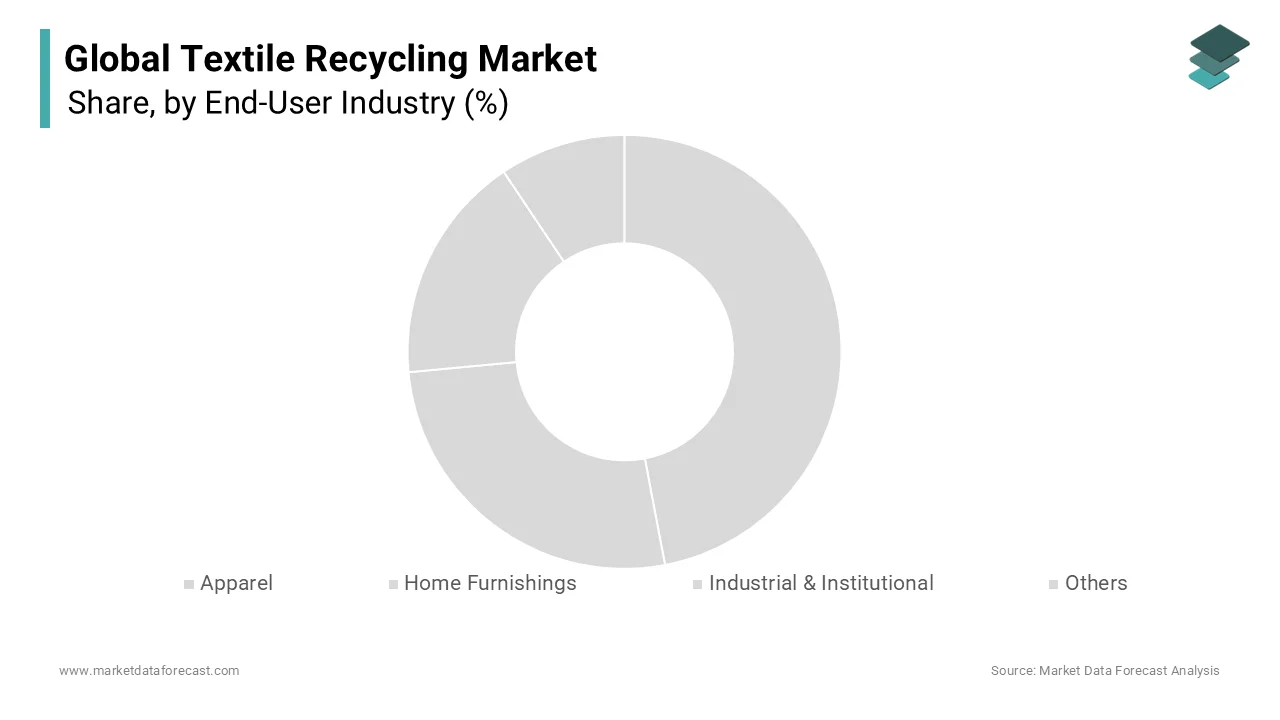
The industrial waste segment is anticipated to witness the fastest CAGR of 12.8% during the forecast period. Factors such as zero-waste manufacturing mandates are boosting the expansion of industrial waste segment in the global market. H&M’s supplier code now requires notable utilization of cutting-room scraps, up from that in 2020. The U.S. Federal Trade Commission’s Green Guides incentivize brands to disclose pre-consumer recycling rates, which prompts Levi’s to integrate 100% selvage and cutting waste into new denim collections. Automotive airbag manufacturers, governed by standards, recycled notable tonnes of nylon 6, a YoY increase, via closed-loop systems with tier-1 suppliers. Japan saw that a portion of domestic textile mills now operate on-site shredding and re-spinning units, which minimizes off-site transport emissions and securing LEED certification points.
REGIONAL ANALYSIS
Europe Market Analysis
Europe dominated the global textile recycling market and accounted for a 39% share in 2025. The domination of the Europe in the global market is institutional as the EU’s Strategy for Sustainable and Circular Textiles mandates separate collection in member states, with France and Sweden already achieving notable household capture rates. According to sources, notable tonnes of post-consumer textiles were mechanically recycled, primarily into insulation and automotive padding. The Netherlands hosts the world’s first enzymatic cotton recycling plant by Reju Company, processing 50,000 tonnes annually. Spain launch a textile waste management pilot in collaboration with the fashion industry, funded by EPR fees, the program was announced in October 2025.
Asia Pacific Market Analysis
Asia Pacific followed closely in the textile recycling market by capturing 31.5% share in 2025. Informal sector volume and emerging regulation are primarily boosting the growth of the Asia Pacific in the global market. India pointed out notable million tonnes of textile waste processed, via unorganized shredding units supplying low-cost to home furnishing clusters. China's government announced a pilot for general waste sorting in 46 cities by 2020 and has a nationwide textile recycling target of 30% by 2030. South Korea has a robust EPR program.
North America Market Analysis
North America grew steadily in the textile recycling market owing to industrial and regulatory drivers. The U.S. Environmental Protection Agency’s National Recycling Strategy targets textile diversion, prompts to mandate brand-funded take-back systems. As per studies, a portion of member brands now integrate pre-consumer scrap into new products, Nike's own website states it diverts an annual average of 1 billion plastic bottles from landfills and waterways by turning them into recycled polyester, which is used for various products, including some Flyknit fabrics. In 2023, British Columbia's EPR programs diverted approximately 425 million kilograms (468,482.3 tons) of various products, including electronics and beverage containers. Mexico’s maquiladoras increasingly adopt closed-loop cutting waste systems to comply with USMCA environmental annexes, reducing export compliance risk.
Latin America Market Analysis
Latin America is predicted to string growth in the textile recycling market, with Brazil’s industrial recycling initiatives. The Brazilian Association of Textile Industries confirms notable tonnes of cutting waste were regenerated into new yarns in 2023, primarily for domestic denim and knitwear. Some textile collection initiatives may exist in São Paulo. Also, as per studies, there has been the lack of a structured, city-wide selective textile waste collection system. In 2023, Chile's environment ministry included textiles under its Extended Producer Responsibility (EPR) law, requiring importers to report volume and fund management. Further, there are efforts to promote a circular economy in Colombia have focused on city-specific strategies, such as Bogotá's Circular Fashion Network.
Middle East & Africa Market Analysis
Middle East & Africa is likely to grow in the textile recycling market, with growth concentrated in GCC policy pilots and African upcycling clusters. The UAE’s Ministry of Climate Change mandated textile recycling bins in all Dubai malls in 2023, collecting notable tonnes in the first year. South Africa’s saw a portion of collected textiles are mechanically downcycled into mattress stuffing or insulation, with piloting enzymatic trials.
COMPETITIVE LANDSCAPE
KEY MARKET PLAYERS
Some of the key players dominating the global textile recycling market are
- Lenzing AG (Austria)
- Birla Cellulose (India)
- HYOSUNG TNC (South Korea)
- Unifi, Inc. (US)
- Patagonia, Inc. (US)
TOP STRATEGIES USED BY KEY MARKET PLAYERS
Deployment of enzymatic and solvent-based separation technologies to handle blended textiles, formation of brand-backed collection alliances to secure consistent feedstock, establishment of regional licensing models to circumvent capital risk, integration of blockchain for chain-of-custody verification, and co-development of regional policy frameworks to align recycling infrastructure with EPR mandates — these five strategies define competitive differentiation. Players avoid commoditization by embedding proprietary bio-processes or digital traceability layers that cannot be replicated by informal recyclers. Strategic localization through joint ventures rather than wholly owned subsidiaries reduces regulatory exposure while accelerating market entry in fragmented Asian jurisdictions.
COMPETITION OVERVIEW
The textile recycling market is characterized by technological asymmetry and regulatory fragmentation, where innovation capability outweighs scale as a competitive determinant. No single entity controls feedstock or distribution — instead, dominance is earned through proprietary depolymerization chemistries, AI-enhanced sorting accuracy, or blockchain-verified material passports. According to MIT’s Sustainability Intelligence Lab, top players allocate 12–18% of revenue to R&D, focusing on yield optimization and contamination tolerance. Asia Pacific intensifies rivalry through informal sector dominance, forcing formal recyclers to either integrate grassroots collectors or develop contamination-resistant processes. Competition is less about market share and more about securing brand partnerships through certified circularity, turning recycling into a B2B2C trust infrastructure rather than a commodity supply chain.
MARKET SEGMENTATION
This research report on the global textile recycling market has been segmented and sub-segmented based on material, textile waste, distribution channel, process, end-user industry, and region.
By Material
- Cotton
- Polyester & Polyester Fiber
- Wool
- Nylon & Nylon Fiber
- Others
By Textile Waste
- Pre-consumer
- Post-consumer
By Distribution Channel
- Online
- Retail & Departmental Stores
By Process
- Mechanical
- Chemical
By End-User Industry
- Apparel
- Home Furnishings
- Industrial & Institutional
- Others
By Region
- North America
- Europe
- Asia-Pacific
- Latin America
- Middle East & Africa