- Product Description Description
- Table of Contents TOC
- List of Table & Figure LOT
- Get Free Sample PDF Sample PDF
Market Size, 2025
$17.75 BnMarket Estimate, 2026
$19.16 BnMarket Forecast, 2034
$35.33 BnCAGR, 2026–2034
7.95%Global Texture Paint Market Size
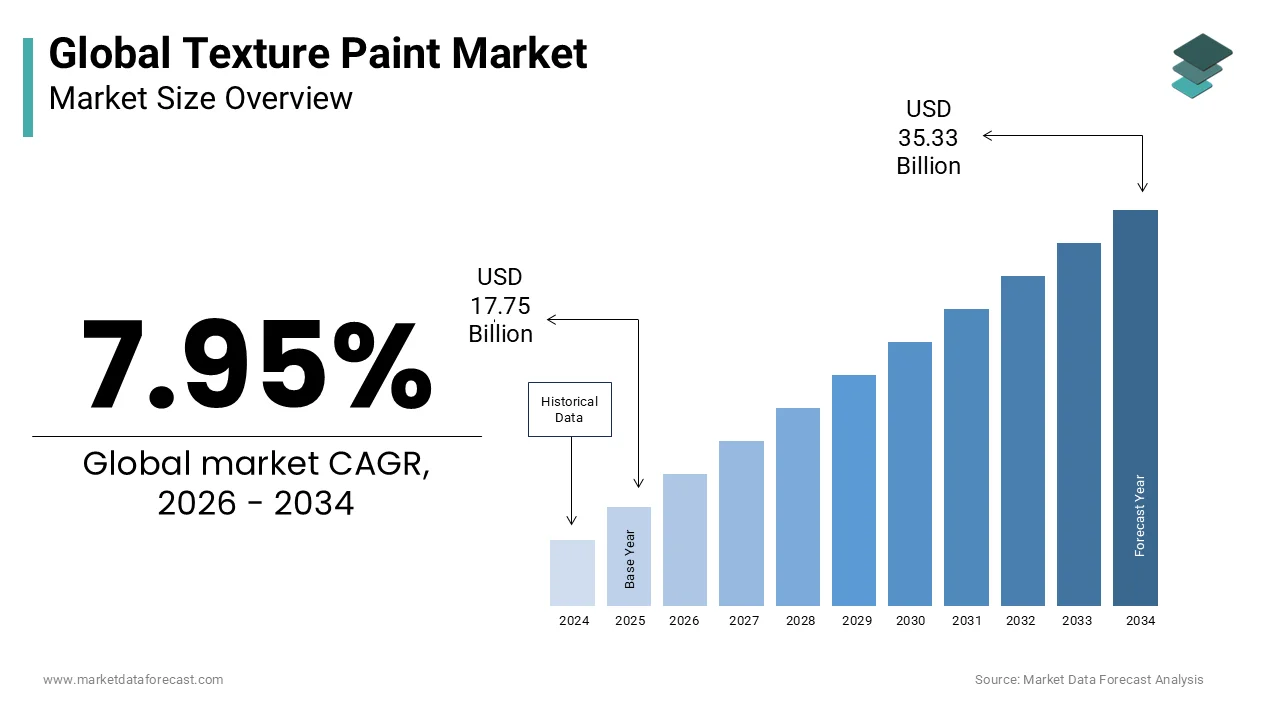
The global texture paint market size was valued at USD 17.75 billion in 2025, and the global market size is expected to reach USD 35.33 billion by 2034 from USD 19.16 billion in 2026. The market's promising CAGR for the predicted period is 7.95%.
New technologies and innovations are expected to stimulate demand for textured paints in the construction industry. The creation of new businesses and the expansion of several existing businesses entail the need to construct new industrial and commercial buildings, as well as to renovate existing structures. The high aesthetic worth of texture paints and their affordability are the driving force behind the worldwide texture paint industry. This, coupled with the growth of interior design and the growing demand for home interiors, should drive the growth of the texture paint market. Textured paints have certainly stood out in today's home décor segment. The unmatched visuals that can be created using texture paints offset its high cost compared to ordinary paints. Growing demand from end-use industries such as construction and construction is driving growth in the global textured paint market. Also, the increase in the use of textured paint for interior decoration of homes the increase in demand for paint, and the repainting of residential structures are the key factors that should stimulate growth in the global textured paint market.
Population growth improved living standards, and increased homeownership are other factors that are expected to increase growth in the global textured paint market. Increasing household purchasing power in home improvement should have a positive impact on the market during the forecast period. The primary aesthetic value of texture paints, as well as their affordability, fosters the global market. This, coupled with the addition in interior design and the growing demand for home interiors, should drive market growth. The high disposable income and the growing need for housing development are important factors that should stimulate the growth of the world market for textured paints. Furthermore, rapid urbanization and growing demand for housing are among other factors that should support the growth of the world market.
The high cost of texture paint compared to conventional paint is expected to slow the growth of the global texture paint market. The high price compared to conventional paints is a key factor that should hinder the growth of the global market for these paints. Additionally, texture paints require more time and skilled labor for effective application, which can also limit product demand to some degree.
Market Opportunities
Texture paints enhance the benefit of covering uneven surfaces and protecting the wall surface from damage. Not only that, texture paints are priced comparable to wallpaper and offer a wide range of patterns that can be created using a mix of different colors. Therefore, the aesthetic and functional value associated with these paints should stimulate the market for textured paints in the future. The expansion of the construction and construction industry in developing countries like India and China should provide lucrative opportunities for the growth of the global textured paint market. Intensive construction and reconstruction of residential and non-residential buildings translate into increased demand for paint and siding products, which in turn is expected to drive growth in the world market during the forecast period. Furthermore, government policies favorable to economic growth in developing countries are leading to an increase in architectural construction and industrial activities, which is anticipated to accelerate the expansion of the global texture paint market in the coming days.
Market Challenges
Textured paint requires skilled labor and more application time than conventional paint, which can hinder the demand for the textured paint market in the following years.
REPORT COVERAGE
| REPORT METRIC | DETAILS |
| Market Size Available | 2025 to 2034 |
| Base Year | 2025 |
| Forecast Period | 2026 to 2034 |
| CAGR | 7.95% |
| Segments Covered | By Product Type, Application, and Region |
| Various Analyses Covered | Global, Regional & Country Level Analysis, Segment-Level Analysis, DROC, PESTLE Analysis, Porter’s Five Forces Analysis, Competitive Landscape, Analyst Overview of Investment Opportunities |
| Regions Covered | North America, Europe, Asia Pacific, Latin America, and Middle East & Africa |
| Market Leaders Profiled | AkzoNobel N.V. (Netherlands), S K Kaken Co., Ltd. (Japan), Hempel A/S (Denmark), Spectra Texture Wall Coating Pvt. Ltd. (India), Kelly-Moore Paints (U.S.), Nippon Paint Holdings Co., Ltd. (Japan), PPG Industries, Inc. (US), Kansai Neroloac Paints Ltd. (India), Jotun A/S (Norway), Andura Coatings (UK) |
SEGMENTAL ANALYSIS
Global Texture Paint Market By Product Type
The interior texture paint sector is predicted to be the biggest product type in the global business. The increasing use of texture paints for home interior decoration is among the most important factors that should stimulate the growth of the interior texture paint segment. Improving living standards and infrastructure development in emerging economies are additional factors that are expected to stimulate demand for interior textured paints in the forecast period. Improving living standards, infrastructure developments and the increasing use of textured paints for the interior decoration of houses raises the domestic market.
Global Texture Paint Market By Application
The non-residential segment is determined to record the most substantial portion of the global texture paint market because of the rising consumer awareness about the benefits of reconstruction.
REGIONAL ANALYSIS
Among the globally segmented regions, the Asia Pacific region is anticipated to be the fastest-growing region during the forecast period owing to regional characteristics such as cheap labor and ease of resource availability. This is the reason for the concentration of the majority of key market participants manufacturing units in the Asia Pacific region. Also, the high scope of future opportunities in this region due to the fast-developing economies is another reason for the interest of these companies to invest in countries like India, China, and Japan.
North America is next in the lead for the global Texture Paint market followed by Europe. The large customer base and well-established industries in these regions is the main reason for the survival of the regional market over high competition globally. There is close competition between North America and Europe in the global texture paint market due to their regionally dominating companies. On the other hand, the Middle East & Africa, and Latin America regions, being in the low developing countries due to the contribution of low GDP countries, have fewer chances for industry growth. Hence, the Texture Paint Market in these regions is slow-growing in nature.
KEY MARKET PLAYERS
The major key players in the global Texture Paint Market are AkzoNobel N.V. (Netherlands), S K Kaken Co., Ltd. (Japan), Hempel A/S (Denmark), Spectra Texture Wall Coating Pvt. Ltd. (India), Kelly-Moore Paints (U.S.), Nippon Paint Holdings Co., Ltd. (Japan), PPG Industries, Inc. (US), Kansai Neroloac Paints Ltd. (India), Jotun A/S (Norway), Andura Coatings (UK), The Valspar Corporation. (U.S.), Berger Paints India Ltd. (India), and others.
RECENT HAPPENINGS IN THE MARKET
As the times have come where each can now design their own customized house, the world has witnessed the evolution of different types of paint colors and textures. This inspires companies to come up with newer concepts of paints and textures. For instance, a grasscloth adds texture at the same time is eco-friendly to nature. Venetian plasters also add texture, elegance, and warmth to the room. Merely the mood in a room can be deeply enhanced by the texture and type of walls.
MARKET SEGMENTATION
This research report on the global texture paint market has been segmented and sub-segmented based on product type, application, and region.
By Product Type
- Interior
- Exterior
By Application
- Residential
- Non-residential
By Region
- North America
- Latin America
- Europe
- Asia Pacific
- Middle East & Africa