- Product Description Description
- Table of Contents TOC
- List of Table & Figure LOT
- Get Free Sample PDF Sample PDF
Market Size, 2025
$4.65 BnMarket Estimate, 2026
$4.95 BnMarket Forecast, 2034
$8.17 BnCAGR, 2026–2034
6.46%Executive Summary: Thermal Paper Market
- Market Scope: Comprehensive global thermal paper market analysis covering product categories, basis weight segments, end-user verticals, regional leadership frameworks, and physical documentation/logistics metrics.
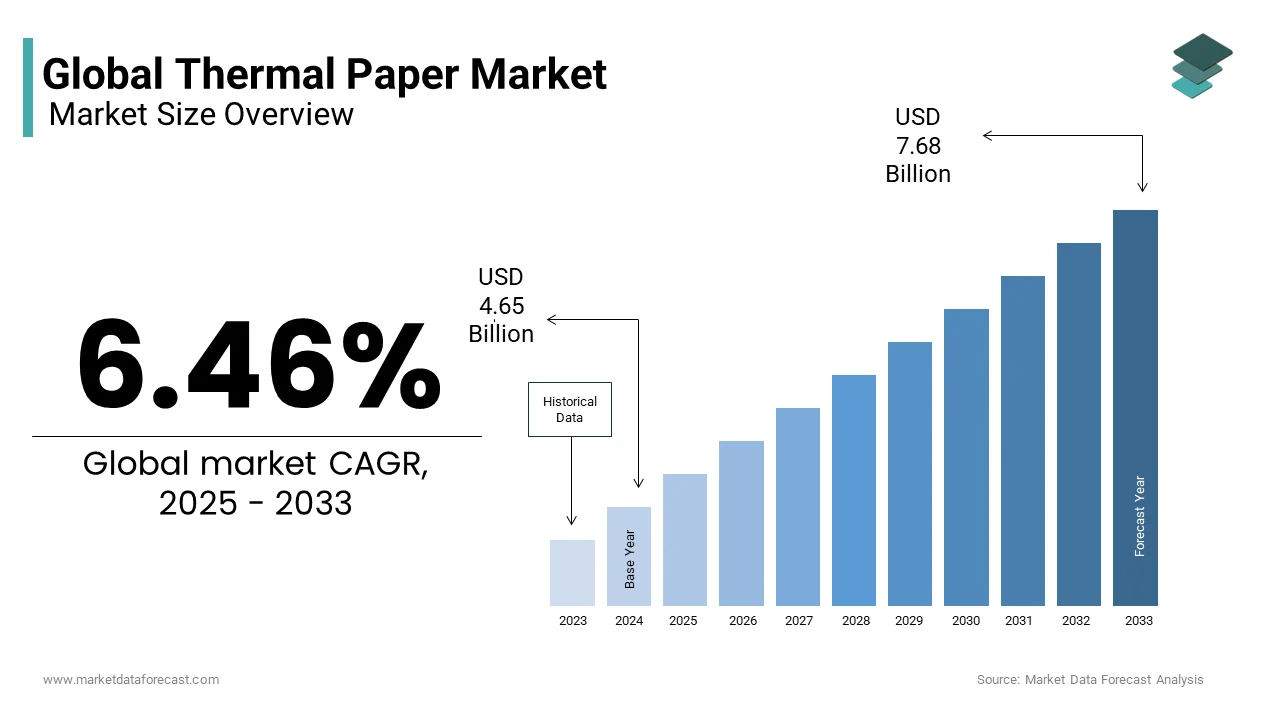
- Market Valuation: Valued at USD 4.65 billion (2025), estimated at USD 4.95 billion (2026), and projected to reach USD 8.17 billion by 2034, registering a steady CAGR of 6.46% (2026–2034).
- Primary Growth Drivers: Persistent demand for physical documentation, e-commerce parcel shipping, and stringent regulatory safety compliance. Key consumer and trade highlights include 74% of U.S. consumers expecting printed checkout receipts (rising to 89% among shoppers over 55), 96% of international parcels requiring physical thermal labels, India recording a 23% YoY increase in e-commerce shipments in 2025, and EU restrictions driving a 41% YoY increase in BPA-free adoption in 2025.
Key Market Segment Metrics (2026–2034)
| Category | Leading Segment (2025 Position) | Fastest-Growing Segment |
|---|---|---|
| By Product & Coating Type | Non-Top-Coated Thermal Paper (held dominant product share in 2025) | BPA-Free & Phenol-Free Eco-Friendly Thermal Paper (projected to grow at a 6.2% CAGR) |
| By Basis Weight | 56–70 GSM Segment (led by basis weight in 2025 for standard receipts and labels) | Heavier Basis Weights & Specialized Durability Thermal Papers (forecasted at a 7.2% CAGR) |
| By End-User Vertical | Retail (largest end-user segment; 83% of 117 billion U.S. retail transactions generated thermal receipts) | Logistics, Shipping, & E-Commerce Labeling (projected to grow at a 5.4% CAGR) |
| By Region / Country | Asia-Pacific (dominated globally with a 39.1% share in 2025), followed by North America (21.3%) | Asia-Pacific Emerging Retail & Logistics Hubs (driven by rapid e-commerce expansion) |
Major Market Players & Market Structure
Market Structure: Highly competitive global specialty paper manufacturing landscape featuring major international pulp and paper corporations competing intensely on phenol-free coatings, biodegradable products, smart barcode labeling solutions, and strict environmental regulatory compliance.
Key Companies: Oji Holdings, Koehler Paper, Ricoh, Appvion, Mitsubishi HiTec Paper Europe, Hansol Paper, Kanzaki Specialty Papers, Jujo Thermal, Iconex, and Twin Rivers Paper Company.
 Download Free Sample Report
Global Thermal Paper Market Size
The global thermal paper market size was valued at USD 4.65 billion in 2025 and is anticipated to reach a valuation of USD 4.95 billion in 2026 and USD 8.17 billion by 2034, growing at a CAGR of 6.46% from 2026 to 2034.
Thermal paper is a functionally engineered substrate coated with heat-sensitive chromogenic layers that darken upon exposure to thermal print heads, which is eliminating the need for ink or ribbons. Its ubiquity spans point-of-sale receipts, shipping labels, lottery tickets, and medical diagnostic printouts. As per Japan’s Ministry of Economy, Trade and Industry, over 80% of retail transactions in convenience stores and pharmacies continue to generate thermal receipts, embedding the material into daily economic rituals.
MARKET DRIVERS
Persistent Reliance on Physical Transaction Records in Retail and Logistics
The physical thermal receipts and labels remain indispensable in global retail and logistics ecosystems due to regulatory mandates, consumer preference, and operational redundancy is fuelling the growth of the Thermal Paper Market. According to the U.S. National Retail Federation, 74% of American consumers still expect a printed receipt at checkout, a figure that rises to 89% among shoppers over 55. In logistics, DHL’s 2025 Global Connectedness Index confirms that 96% of international parcels still require physical thermal labels for customs and tracking compliance. India’s Ministry of Commerce reported a 23% year-over-year increase in e-commerce shipments in 2025.
Expansion of Quick-Service and Informal Retail in Emerging Economies
The proliferation of micro-retail, street vendors, and quick-service formats across Asia, Africa, and Latin America is prompting the growth of the Thermal Paper Market. According to the International Finance Corporation, over 140 million micro-retailers operate in emerging markets, 68% of whom adopted handheld thermal printers between 2020 and 2025 to formalize transactions and reduce cash-handling errors. In Indonesia, Bank Indonesia’s 2025 financial inclusion survey found that 71% of warungs (street kiosks) now issue thermal receipts to comply with new digital tax reporting rules.
MARKET RESTRAINTS
Regulatory Phase-Out of Bisphenol A and Analogues in Coating Formulations
Global chemical regulators are systematically restricting bisphenol compounds, which are historically the backbone of thermal paper’s developer layer, due to endocrine disruption risks. According to the European Chemicals Agency, the EU’s 2020 restriction on BPA in thermal paper reduced permissible concentrations to 0.02% by weight, forcing reformulation. In 2025, Health Canada extended this ban to include BPS and BPF, citing biomonitoring data showing detectable levels in 91% of tested urine samples. The U.S. EPA’s Safer Choice program now excludes any thermal paper containing bisphenols from certification.
Accelerated Degradation in High-Humidity and High-Temperature Climates
Thermal paper’s archival instability under tropical conditions is limiting the growth of the Thermal Paper Market. According to the Singapore Institute of Standards and Industrial Research, thermal receipts stored in Southeast Asian ambient conditions (average 85% RH, 32°C) lose 80% of image contrast within 90 days, which renders them legally non-compliant for tax or warranty purposes. India’s Bureau of Indian Standards found that 63% of thermal labels used in southern states faded beyond readability within six months, triggering disputes in e-commerce returns.
MARKET OPPORTUNITIES
Adoption of Phenol-Free and Biodegradable Thermal Coating Technologies
Innovation in non-toxic, eco-compatible thermal coatings is to realign the material with circular economy and health safety mandates, which is escalating the growth of the thermal Paper Market. According to Germany’s Fraunhofer Institute for Silicate Research, developers based on vitamin C derivatives and cellulose nanocrystals now achieve 90% of conventional thermal sensitivity at 22% higher production cost. Japan’s Ricoh Company launched its “Eco-Thermal” paper in 2025, certified compostable under ISO 17088, and adopted by 7-Eleven Japan across 21,000 stores.
Integration with Smart Labeling and Track-and-Trace Systems
Thermal paper is evolving beyond passive receipting into an interactive medium by embedding QR codes, RFID-compatible inks, or time-temperature indicators, which will further elevate the growth of the Thermal Paper Market. India’s Drug Controller General mandated in 2025 that all vaccine transport labels include thermal-printed QR codes, which is driving a 19% uptick in specialty thermal paper demand.
MARKET CHALLENGES
Consumer and Regulatory Mistrust Due to Chemical Legacy
The thermal paper battles entrenched perception as a toxic medium with a stigma amplified by NGO campaigns and fragmented regulatory messaging is strictly impeding the growth of the Thermal Paper Market. According to a 2025 YouGov global survey, 67% of consumers in the EU and North America believe “all thermal paper is harmful,” even when labeled BPA-free. The U.S. Public Interest Research Group’s “Checkout Toxicity” campaign continues to cite outdated studies, conflating legacy and modern formulations. As per the UK’s Advertising Standards Authority, three major retailers were reprimanded in 2025 for “misleading” claims about “chemical-free thermal receipts”. This reputational drag forces manufacturers into costly education campaigns and third-party certifications, which are delaying the adoption of safer alternatives and fragmenting market messaging.
Competition from Reusable Digital Interfaces and E-Receipt Platforms
Retailers and service providers are increasingly diverting transactions away from physical media to reduce cost, waste, and liability. According to the National Retail Federation’s 2025 sustainability report, 44% of U.S. retailers now offer e-receipts as default, with Apple, Target, and Walmart reporting 60–75% opt-in rates among loyalty program members. Square’s 2025 merchant survey found that 58% of small businesses using its POS system eliminated thermal printers, citing cost savings of $1,200 annually per terminal. In Sweden, the government’s “Green Checkout” initiative subsidized digital receipt adoption for 12,000 retailers in 2025, reducing thermal paper consumption by an estimated 8,300 tons.
REPORT COVERAGE
| REPORT METRIC | DETAILS |
| Market Size Available | 2025 to 2034 |
| Base Year | 2025 |
| Forecast Period | 2026 to 2034 |
| CAGR | 6.46% |
| Segments Covered | By Product, Basis Weight, End-User, And Region. |
| Various Analyses Covered | Global, Regional & Country Level Analysis, Segment-Level Analysis, DROC, PESTLE Analysis, Porter’s Five Forces Analysis, Competitive Landscape, Analyst Overview on Investment Opportunities |
| Regions Covered | North America, Europe, APAC, Latin America, Middle East & Africa |
| Market Leaders Profiled | Oji Holdings Corp, Koehler Paper SE, Ricoh Company Ltd, Appvion LLC, Mitsubishi HiTec Paper Europe GmbH, Hansol Paper Co. Ltd, Kanzaki Specialty Papers Inc, Jujo Thermal Ltd, Iconex LLC, Twin Rivers Paper Company Inc., Thermal Solutions International Inc, Henan JiangHE Paper Co. Ltd, Rotolificio Bergamasco SRL, Bizerba SE and Co. KG, Paper Rolls Plus, Panda Paper Roll, Telemark Diversified Graphics, Nakagawa Mfg (USA) Inc, Shenzhen Shen Paper Co, Jiangsu Wampolet Paper Co. |
SEGMENTAL ANALYSIS
By Product Insights
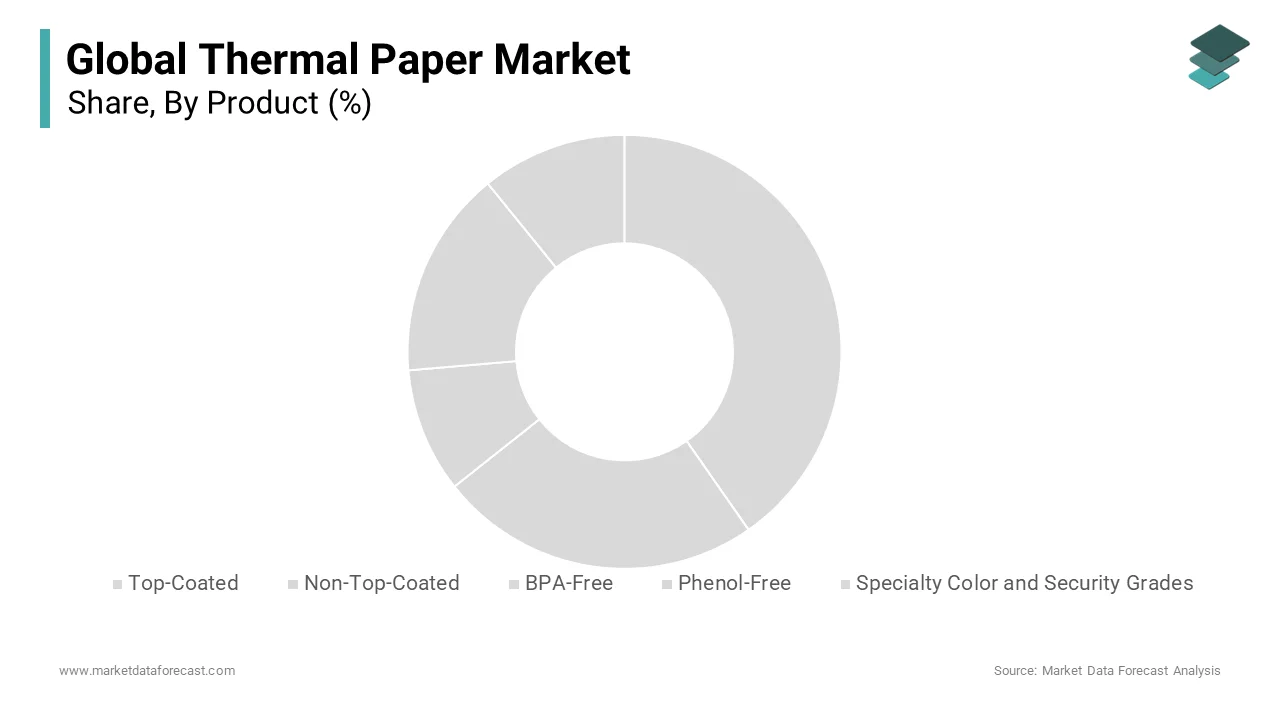
The non-top-coated thermal paper segment accounted in holding a dominant share of the Thermal Paper Market in 2025. According to Japan’s Thermal Paper Association, over 80% of convenience store receipts and logistics labels in Asia still utilize non-top-coated variants, owing to their 18–22% lower production cost compared to coated alternatives. India’s Ministry of Electronics and Information Technology found that 94% of micro-ATMs and POS terminals in tier-2 and tier-3 cities use non-top-coated rolls to minimize operational expenses.
The BPA-free segment is swiftly growing with an expected CAGR of 6.2% during the forecast period, as compliance-imperative, regulatory ba, ns and consumer pressure are forcing systemic substitution. According to the European Chemicals Agency, EU-wide restrictions on bisphenols in thermal paper triggered a 41% year-over-year increase in BPA-free adoption across member states in 2025. Health Canada’s enforcement of its 2022 ban on BPS and BPF in thermal coatings led to a complete market transition by Q1 2025, as confirmed by the Canadian Printing Industries Association. In South Korea, the Ministry of Environment mandated BPA-free receipts for all public sector transactions in 2025, catalyzing private sector adoption.
By Basis Weight Insights
The 56–70 GSM range segment was the largest and held a dominant share of the Thermal Paper Market. According to Germany’s Bundesverband Druck und Medien, 89% of European retail receipt printers are calibrated for 60–65 GSM paper, optimizing feed reliability and reducing jam rates by up to 34%. In the U.S., the National Automatic Merchandising Association found that 72% of vending machine and kiosk operators standardized on 63 GSM rolls to balance durability with cost-per-transaction. India’s Retailers Association confirmed that 60 GSM is the mandated minimum for GST-compliant receipts to ensure scanner readability.
The heavier basis weights segment is gaining traction with a CAGR of 7.2% during the forecast period. According to GS1, pharmaceutical transport labels in the EU must now meet a minimum 75 GSM specifications to survive cold-chain condensation and handling abrasion, which is triggering a 28% uptick in demand since 2022. Japan’s Ministry of Health, Labour and Welfare mandated 80 GSM thermal paper for all hospital diagnostic printouts in 2025 to ensure legibility over 5-year retention periods. Zebra Technologies reported that 44% of its 2025 industrial label sales in Southeast Asia specified 75–85 GSM paper for automotive and electronics part tracking.
By End-User Industry Insights
The retail segment was the largest by capturing a dominant share of the Thermal Paper Market in 2025. According to the U.S. Census Bureau, over 117 billion retail transactions occurred in 2025, 83% of which generated a thermal receipt. In Japan, the Ministry of Economy, Trade, and Industry found that 91% of convenience stores still print receipts by default even when customers decline them due to internal audit and return policy requirements. India’s Goods and Services Tax regime mandates physical or digital receipts for all transactions above ₹50, but 78% of small retailers still use thermal printers due to low digital literacy, as per the Confederation of All India Traders.
The logistics segment is exceptionally growing with an expected CAGR of 5.4% during the forecast period, with the global e-commerce expansion, regulatory tracking mandates, and warehouse automation. According to DHL’s Global Connectedness Index, international parcel volume grew 14% in 2025, each requiring at least two thermal labels.
REGIONAL ANALYSIS
Asia Pacific Market Analysis
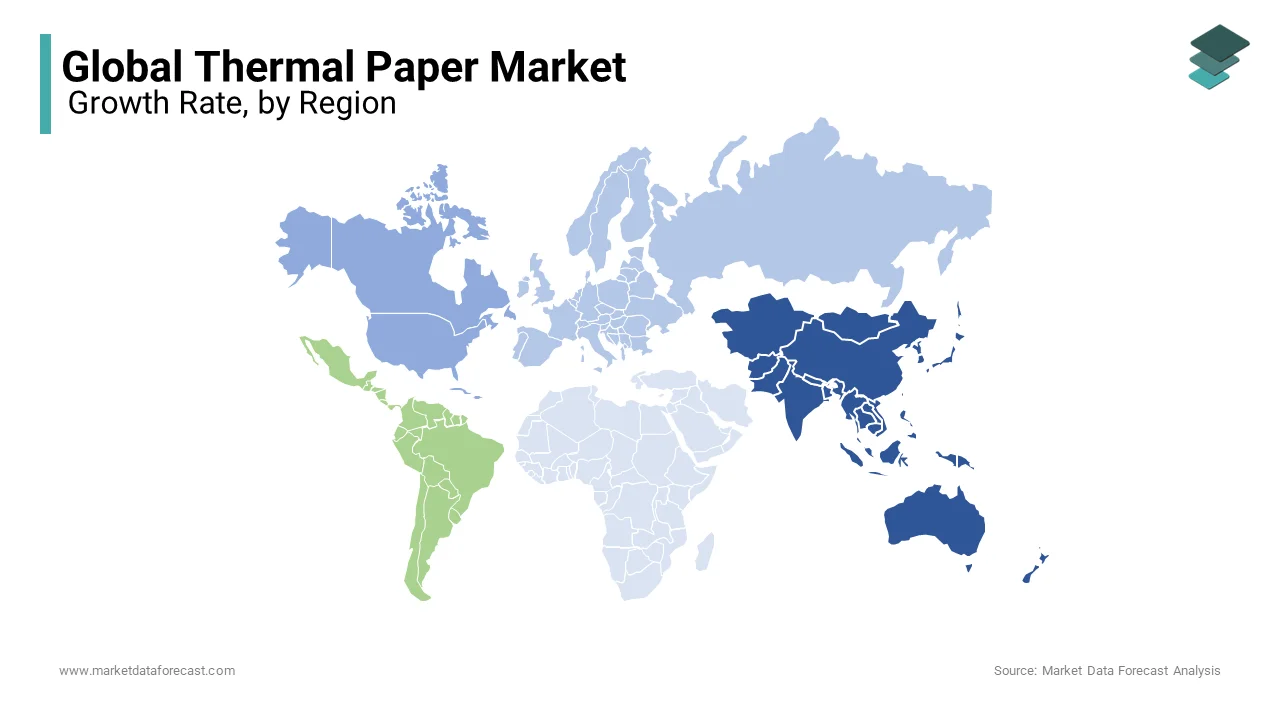
Asia Pacific was the top performer in the thermal paper market by capturing 39.1% the share in 2025, with the sheer transactional volume and informal retail density. China’s State Administration for Market Regulation confirmed that over 28 billion square meters of thermal paper were consumed in 2025, primarily for e-commerce logistics and street vendor receipts. Japan remains the quality bebenchmark7-Eleven alone prints over 4.2 billion receipts annually. Southeast Asia’s warung and sari-sari store digitization, backed by Gojek and Grab, is embedding thermal printers into micro-retail. The region’s growth is bottom-up, informal, and unstoppable.
North America Market Analysis
North America’s thermal paper market held 21.3% of the share in 2025, with regulatory friction and digital displacement due to entrenched retail and healthcare infrastructure. According to the U.S. Environmental Protection Agency, over 3.4 billion pounds of thermal paper were consumed in 2025, with 68% still containing BPA analogues despite state-level bans. Canada completed its national transition to BPA-free thermal paper in early 2025, as per Health Canada.
Europe Market Analysis
Europe Thermal Paper Market growth is growing lucratively with the regulatory laboratory for thermal paper, where chemical restrictions and circular economy mandates are reshaping formulation and usage. As per Germany’s Federal Environment Agency, 71% of retailers now use phenol-free or compostable thermal paper, up from 12% in 2019. France mandated in 2025 that all thermal receipts must be recyclable or compostable, triggering investment in cellulose-based coatings. The UK’s Advertising Standards Authority cracked down on “greenwashing” claims, forcing manufacturers to third-party certify formulations.
Latin America Market Analysis
Latin America’s thermal paper market growth is fueled by retail formalization and e-commerce logistics. According to Brazil’s National Treasury Secretariat, the mandatory use of thermal-printed fiscal receipts (NFC-e) in 12 states drove a 33% increase in consumption in 2025. Mexico’s SAT tax authority expanded its digital receipt mandate to 85% of formal retailers, which requires thermal printers with encrypted QR codes.
Middle East & Africa Market Analysis
The Middle East and Africa thermal paper market is expected to grow steadily throughout the forecast period. According to South Africa’s Revenue Service, the rollout of e-fiscal printers in 2025 increased thermal paper consumption by 29% among formal retailers.
COMPETITIVE LANDSCAPE
KEY MARKET PLAYERS
A few of the market players in the global thermal paper market include
- Oji Holdings Corp.
- Koehler Paper SE
- Ricoh Company Ltd.
- Appvion LLC
- Mitsubishi HiTec Paper Europe GmbH
- Hansol Paper Co. Ltd.
- Kanzaki Specialty Papers Inc.
- Jujo Thermal Ltd.
- Iconex LLC
- Twin Rivers Paper Company Inc.
- Thermal Solutions International Inc.
- Henan JiangHE Paper Co. Ltd.
- Rotolificio Bergamasco SRL
- Bizerba SE and Co. KG
- Paper Rolls Plus
- Panda Paper Roll
- Telemark Diversified Graphics
- Nakagawa Mfg (USA) Inc.
- Shenzhen Shen Paper Co.
- Jiangsu Wampolet Paper Co.
MARKET SEGMENTATION
This research report on the global thermal paper market is segmented and sub-segmented into the following categories.
By Product Type
- Top-Coated
- Non-Top-Coated
- BPA-Free
- Phenol-Free
- Specialty Color and Security Grades
By Basis Weight
- Equal to 55 gsm
- 56 -70 gsm
- Above 70 gsm
By Width Format
- 57 mm
- 58 - 79 mm
- 80 mm
By End-User Industry
- Retail
- Logistics
- Ticketing, Lottery, and Gaming
- Banking and Financial
- Medical and Pharmaceutical
- Parking and Transit
- Others
By Region
- North America
- Europe
- Asia-Pacific
- Latin America
- Middle East and Africa