- Product Description Description
- Table of Contents TOC
- List of Table & Figure LOT
- Get Free Sample PDF Sample PDF
Market Size, 2025
$7.26 BnMarket Estimate, 2026
$7.65 BnMarket Forecast, 2034
$11.65 BnCAGR, 2026–2034
5.40%Global Thinned Starches Market Report Summary
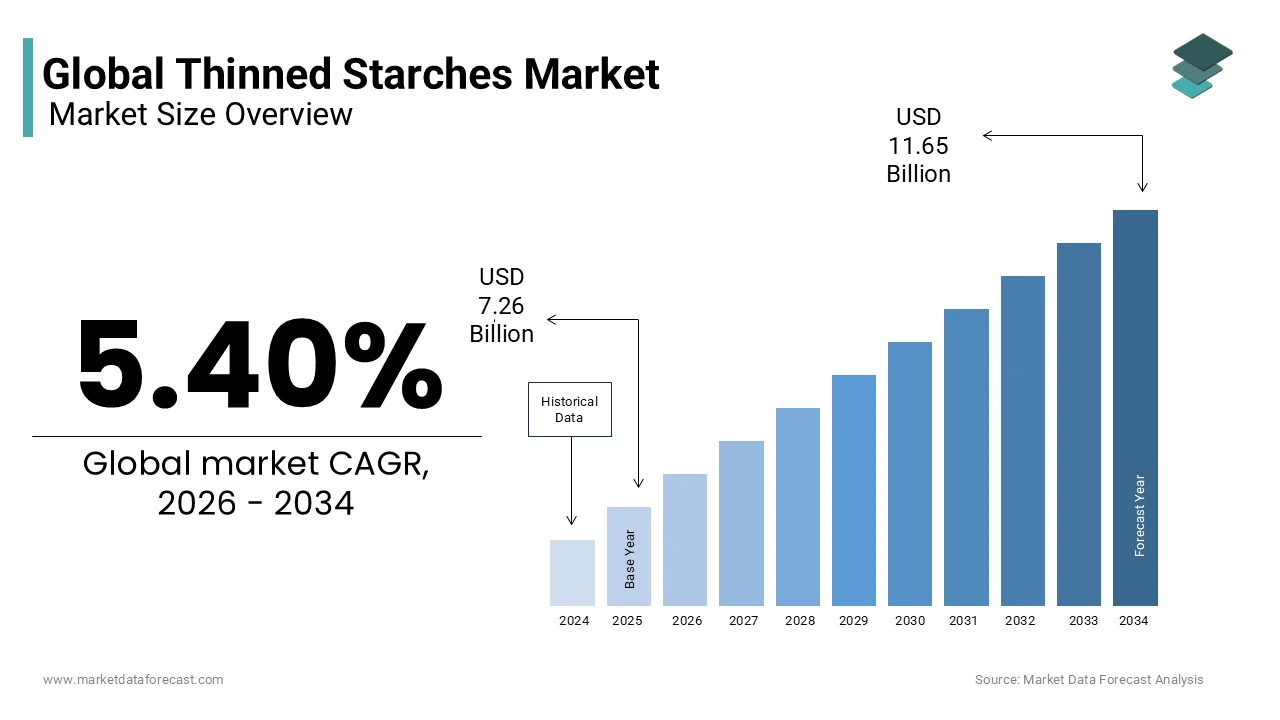
The global thinned starches market was valued at USD 7.26 billion in 2025, is estimated to reach USD 7.65 billion in 2026, and is projected to reach USD 11.65 billion by 2034, growing at a CAGR of 5.40% during the forecast period. The growth of the global thinned starches market is driven by increasing demand for functional food ingredients, rising consumption of processed and convenience foods, and expanding applications in the food, beverage, paper, textile, and pharmaceutical industries. Thinned starches are widely used for their excellent viscosity control, stability, and texturizing properties, making them essential ingredients in various industrial formulations. Additionally, continuous innovation in starch modification technologies and growing demand for clean-label food ingredients are supporting market expansion worldwide.
Key Market Trends
-
Rising demand for functional starch ingredients in processed and convenience foods is driving market growth.
-
Increasing use of thinned starches as texturizers, stabilizers, and viscosity modifiers is expanding their industrial applications.
-
Growing consumer preference for clean-label and naturally derived ingredients is encouraging the adoption of modified starch products.
-
Expanding applications in paper, textile, pharmaceutical, and adhesive industries are creating new growth opportunities.
-
Continuous advancements in starch processing technologies are improving product functionality and manufacturing efficiency.
Segmental Insights
-
Based on source, the corn segment dominated the global thinned starches market in 2025. The segment's leadership is attributed to the abundant availability of corn, cost-effective production processes, high starch yield, and widespread industrial utilization.
-
Based on application, the texturizers segment held the largest share of the global thinned starches market in 2025. The segment's dominance is driven by the increasing use of thinned starches to improve texture, consistency, mouthfeel, and stability across a wide range of food and beverage products.
-
Based on end use, the food and beverages segment accounted for the largest share of the global thinned starches market in 2025. The segment's growth is supported by the extensive use of starch-based ingredients in bakery products, confectionery, dairy, beverages, sauces, and processed foods to enhance product quality and processing performance.
Regional Insights
-
The global thinned starches market is witnessing steady growth due to increasing demand for functional ingredients, expanding processed food consumption, and growing industrial applications of modified starches.
-
North America dominated the global thinned starches market by accounting for 34.3% of the market share in 2025. The region's leadership is supported by its well-established food processing industry, increasing demand for high-performance functional ingredients, and continued investments in advanced starch processing technologies.
-
Europe remains a significant market due to strong demand for clean-label food ingredients, advanced food manufacturing capabilities, and increasing use of starch derivatives across multiple industries.
Competitive Landscape
The global thinned starches market is moderately competitive, with manufacturers focusing on product innovation, advanced starch modification technologies, and sustainable production practices to strengthen their market positions. Companies are investing in research and development, production capacity expansion, and strategic partnerships to meet the increasing demand for functional starch ingredients across food, beverage, pharmaceutical, paper, and industrial applications. Key players operating in the global thinned starches market include Everest Starch India Pvt. Ltd., Tate & Lyle, MGP Ingredients, Grain Processing Corporation, Visco Starch Manufacturers, SPAC Starch Products Ltd., Archer Daniels Midland Company, Angel Starch & Food Pvt. Ltd., Agrana Stärke GmbH, and Roquette Frères.
Global Thinned Starches Market Size
The global thinned starches market size was valued at USD 7.26 billion in 2025, and is expected to be worth USD 11.65 billion by 2034 from USD 7.65 billion by 2026. The market is growing at a CAGR of 5.40% during the forecast period.
Thinned starches also known as acid thinned or dextrinized starches represent a specific category of modified starches where the molecular weight of the native starch polymer is reduced through controlled hydrolysis using acids or enzymes. This process significantly lowers the viscosity of the starch paste while maintaining its gelatinization properties, making it indispensable in industries requiring high solids content with low viscosity. The global significance of this ingredient is underscored by its extensive application in food processing, paper manufacturing, and textile sizing. According to a ResearchGate study on global starch production, maize is the primary contributor to the market and accounts for 75% of global starch production. Furthermore, as per the United States Department of Agriculture 2025 Crop Production Summary, the United States produced 17 billion bushels of corn in 2025, a significant portion of which is processed into various starch derivatives including thinned starches. The demand for these functional ingredients is driven by their ability to improve texture, stability, and processability in end products. In the paper industry, thinned starches are critical for surface sizing to enhance printability and strength. The market is characterized by a shift toward sustainable and bio based modifiers, reflecting broader industrial trends toward environmental responsibility and resource efficiency in chemical processing.
MARKET DRIVERS
Expansion of the Processed Food Industry and Convenience Foods
The rapid expansion of the processed food industry and the growing consumer preference for convenience foods are propelling the thinned starches market growth and the market is poised to see continued growth as these food categories expand over the coming years. Thinned starches are extensively used as thickening agents, stabilizers, and texturizers in soups, sauces, gravies, and ready to eat meals due to their ability to provide body without excessive thickness. For instance, the demand for convenience foods and the prepared meal products in Europe are growing rapidly and driving demand for ingredients that ensure consistent quality and shelf stability. Thinned starches allow manufacturers to create products with high solid content that remain pourable and easy to process during manufacturing. This functionality is crucial for industrial scale production where pumping and mixing efficiency are paramount. Furthermore, the rise of clean label trends has prompted manufacturers to seek native or physically modified thinned starches that do not require chemical labeling. The versatility of these starches in maintaining texture under varying temperature and pH conditions makes them ideal for diverse food applications. Consequently, the sustained growth in processed food consumption directly translates to increased demand for thinned starches as a key functional ingredient.
Growing Demand in the Paper and Packaging Industry
The burgeoning demand in the paper and packaging industry is further contributing to the expansion of the global thinned starches market and this sector is likely to see robust expansion as e-commerce trends continue to prioritize fiber-based materials over the next few years. Thinned starches are essential for improving the surface strength, smoothness, and printability of paper products, which are critical for high speed printing and packaging operations. For instance, the paper market in Europe is projected to grow exponentially over the forecast period. As per industry reports, the shift toward e commerce has led to a surge in demand for corrugated boxes and packaging papers, which rely heavily on starch based adhesives and coatings. Thinned starches provide the necessary viscosity control for efficient application on high speed paper machines, reducing energy consumption and improving operational efficiency. Additionally, the push for sustainable packaging solutions has favored bio based starches over synthetic polymers. The ability of thinned starches to enhance the barrier properties of paper when combined with other biopolymers further expands their utility. This industrial reliance on starch for both structural integrity and surface quality ensures a steady and growing market presence, driven by the global increase in packaged goods and digital media consumption.
MARKET RESTRAINTS
Volatility in Raw Material Prices and Supply Chain Disruptions
Significant volatility in the prices of raw materials such as corn, wheat, and cassava poses a major restraint on the thinned starches market. These agricultural commodities are subject to fluctuating yields due to weather conditions, pest infestations, and geopolitical tensions, leading to unpredictable cost structures for manufacturers. According to the World Bank, global food price indices have experienced substantial swings, with grains like corn often seeing price fluctuations exceeding 30% during periods of supply instability. As per data from the United States Department of Agriculture, drought conditions in key producing regions have historically led to reduced harvests, tightening global supply and driving up input costs. These fluctuations force thinned starch producers to either absorb margin losses or pass costs to customers, which can dampen demand in price sensitive sectors. Additionally, supply chain disruptions caused by logistical bottlenecks and trade restrictions further exacerbate availability issues. As per industry analyses, transportation delays can lead to inventory shortages and production halts, affecting the reliability of supply for downstream industries. The dependence on seasonal harvests means that manufacturers must maintain large inventory buffers, increasing working capital requirements. Until supply chains become more resilient and commodity prices stabilize, the market will face persistent pressure on profitability and expansion capabilities, limiting investment in new capacities.
Stringent Regulatory Standards for Food Additives
Strict regulatory standards governing the use of modified starches in food and industrial applications impose significant constraints on the thinned starches market. Regulatory bodies such as the Food and Drug Administration in the United States and the European Food Safety Authority in Europe enforce rigorous guidelines on the purity, safety, and labeling of starch derivatives. According to the Codex Alimentarius, specific limits are placed on residual chemicals and heavy metals in modified starches, requiring manufacturers to implement stringent quality control measures. As per compliance reports, obtaining approval for new modification processes or sources can be time consuming and costly, delaying product launches. The distinction between native and chemically modified starches also affects labeling requirements, with consumers increasingly avoiding products with complex chemical names. This trend forces manufacturers to invest in cleaner production technologies, which may be more expensive. Furthermore, regulations regarding genetically modified organisms impact the sourcing of raw materials, particularly corn and soy based starches. As per data from the Non GMO Project, the demand for certified non GMO ingredients has risen, restricting the pool of acceptable raw materials for some manufacturers. Navigating this complex regulatory landscape requires continuous monitoring and adaptation, diverting resources from innovation and marketing. These compliance burdens can hinder market entry for smaller players and slow the adoption of novel thinned starch variants.
MARKET OPPORTUNITIES
Development of Clean Label and Native Thinned Starches
The growing consumer demand for clean label and natural ingredients presents a significant opportunity for the thinned starches market expansion. Consumers are increasingly scrutinizing ingredient lists, preferring recognizable and simple components over chemically modified additives. For instance, food and beverage product launches featuring clean label claims have seen an annual growth rate of approximately 15%, driving significant formulation shifts. As per surveys by the International Food Information Council, over 60% of consumers prefer products with natural ingredients, creating a strong market pull for native thinned starches. Manufacturers can leverage this trend by developing enzymatically thinned starches that offer similar functional properties to acid thinned versions but without the need for chemical labeling. These native alternatives are perceived as healthier and more sustainable, aligning with broader wellness trends. Furthermore, regulatory frameworks in many regions favor native starches due to their simpler approval processes. By investing in enzyme technology and physical modification processes, companies can differentiate their products and command premium pricing. This shift opens new avenues in health conscious segments such as organic foods and infant nutrition, where chemical residues are strictly prohibited. The opportunity lies in bridging the performance gap between native and chemically modified starches while meeting consumer expectations for transparency.
Expansion into Biodegradable Plastics and Industrial Applications
The expanding application of thinned starches in the production of biodegradable plastics and industrial adhesives offers substantial growth opportunities beyond traditional food and paper uses. As global efforts to reduce plastic pollution intensify, starch based bioplastics are gaining traction as sustainable alternatives to petroleum based polymers. According to the European Bioplastics Association, the global bioplastics production capacity is expected to reach 6.3 million tonnes by 2029, with starch based materials being a major feedstock. Thinned starches are used to modify the viscosity and processability of starch blends, improving their mechanical properties and film formation capabilities. As per research published in the Journal of Polymers and the Environment, the incorporation of thinned starches enhances the biodegradability and compostability of plastic materials, making them suitable for packaging and agricultural films. Additionally, in the textile and construction industries, thinned starches are used as eco-friendly binders and sizing agents, replacing synthetic chemicals. The versatility of thinned starches in various industrial formulations allows manufacturers to tap into diverse markets. Government incentives for green chemistry and circular economy initiatives further support this expansion. By positioning thinned starches as key components in sustainable industrial solutions, companies can diversify their revenue streams and reduce dependence on volatile food markets. This strategic shift aligns with global sustainability goals and drives long term market growth.
MARKET CHALLENGES
Technical Limitations in Stability and Performance
The inherent technical limitations of thinned starches regarding stability under extreme processing conditions pose a significant challenge to the thinned starches market growth. While thinned starches offer low viscosity, they often lack the shear stability and freeze thaw resistance required for certain industrial and food processes. According to studies in food hydrocolloids, acid thinned starches can undergo further degradation during high temperature processing, leading to inconsistent viscosity and texture in final products. As per technical data from starch manufacturers, maintaining consistent performance across different batches is difficult due to variations in raw material quality and modification levels. This variability can result in product failures and customer dissatisfaction, particularly in automated manufacturing lines where precision is critical. Furthermore, thinned starches may exhibit syneresis or water separation during storage, affecting the shelf life of products. Overcoming these limitations often requires blending with other hydrocolloids or using more expensive cross linked starches, which increases formulation complexity and cost. The need for specialized handling and storage conditions to prevent premature degradation also adds to operational challenges. Until these technical hurdles are addressed through advanced modification techniques or hybrid formulations, thinned starches may face resistance in demanding applications where reliability and consistency are paramount.
Competition from Synthetic and Alternative Hydrocolloids
Intense competition from synthetic hydrocolloids and alternative natural thickeners is further challenging the thinned starches market expansion. Materials such as carboxymethyl cellulose, xanthan gum, and guar gum offer superior stability, clarity, and performance in specific applications, often at competitive prices. For instance, the global hydrocolloids market is expanding rapidly, with synthetic options gaining share in industrial applications due to their consistent quality and ease of use. As per industry reports, synthetic thickeners can withstand wider pH and temperature ranges than thinned starches, making them preferred choices for harsh processing environments. Additionally, the rise of alternative plant based starches such as pea and lentil starches provides new options for manufacturers seeking non allergenic or non GMO sources. These alternatives often require less modification to achieve desired functionalities, reducing processing costs. The availability of these substitutes forces thinned starch producers to continuously innovate and lower prices to remain competitive. Furthermore, customer loyalty to established synthetic ingredients can be high due to familiarity and proven performance, creating barriers to entry for starch based solutions. This competitive landscape requires thinned starch manufacturers to demonstrate clear value propositions in terms of sustainability and cost effectiveness to retain and grow their market share.
REPORT COVERAGE
| REPORT METRIC | DETAILS |
| Market Size Available | 2025 to 2034 |
| Base Year | 2025 |
| Forecast Period | 2026 to 2034 |
| CAGR | 5.40% |
| Segments Covered | By Form, Source, Application, End Use, and Region. |
| Various Analyses Covered | Global, Regional & Country Level Analysis, Segment-Level Analysis, DROC, PESTLE Analysis, Porter’s Five Forces Analysis, Competitive Landscape, Analyst Overview of Investment Opportunities |
| Regions Covered | North America, Europe, APAC, Latin America, Middle East & Africa |
| Market Leaders Profiled | Everest Starch India Pvt. Ltd., Tate & Lyle, MGP Ingredients, Grain Processing Corporation, Visco Starch Manufacturers, SPAC Starch Products Ltd., Archer Daniel Midlands Company, Angel Starch & Food Pvt. Ltd., Agrana Straske GmbH, and Roquette Freres |
SEGMENTAL ANALYSIS
By Source Insights
The corn segment had the leading share of the global market in 2025 due to its abundant global supply and cost effective production processes. The United States, China, and Brazil are major producers, ensuring a steady availability of raw material for starch modification. According to a ResearchGate study, maize is the primary contributor to the global starch market, accounting for approximately 75% of production. As per the National Corn Growers Association, a substantial portion of the annual corn crop is utilized for industrial applications, including starch production. This scale allows manufacturers to achieve economies of scale, resulting in lower prices compared to other starch sources like potato or cassava. The established infrastructure for corn wet milling facilitates efficient extraction and modification, making it the preferred choice for high volume applications in food and paper industries. The consistency in quality and supply chain reliability further cements corn's dominance. Manufacturers can source corn starch year round, minimizing production disruptions. This economic advantage ensures that corn based thinned starches remain the standard for many industrial formulations where cost is a primary consideration. The widespread availability of genetically modified corn varieties with high starch content also enhances yield efficiency, supporting sustained market leadership.
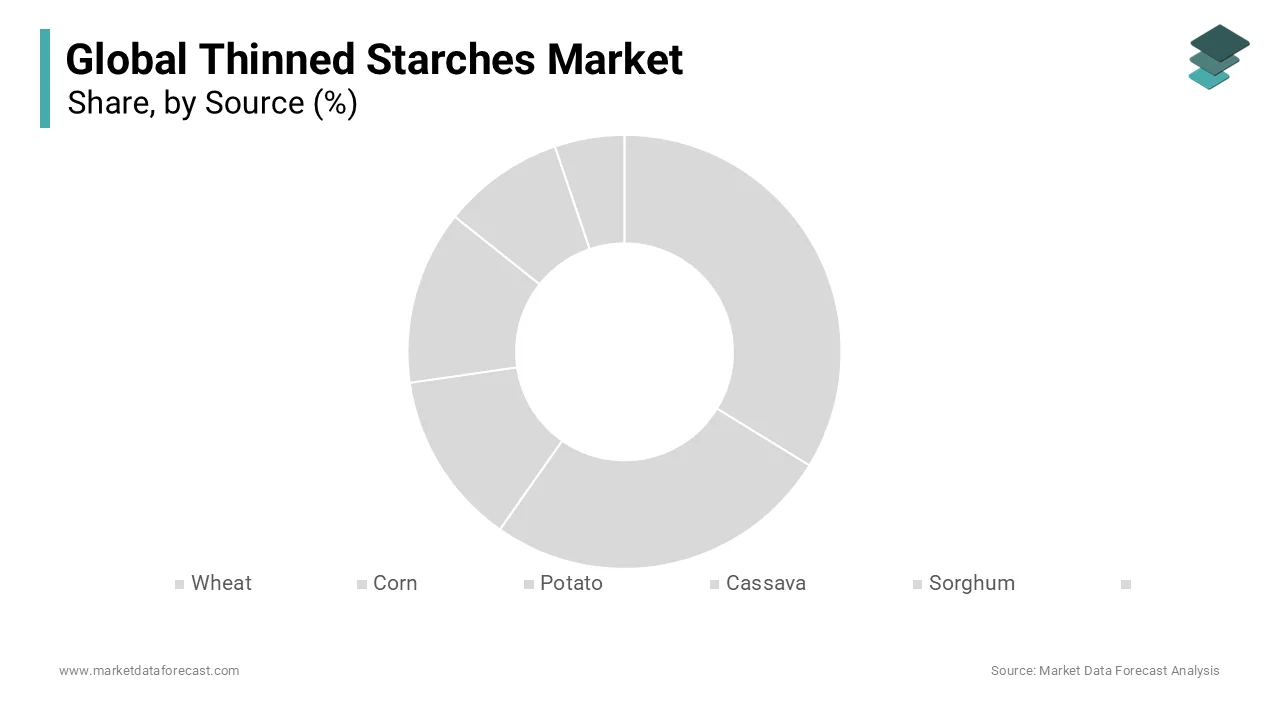
On the other end, the cassava segment is projected to be the fastest growing segment with 6.06% CAGR in the global market during the forecast period owing to the rising production in tropical regions and increasing focus on sustainable agricultural practices. Countries such as Thailand, Nigeria, and Vietnam are major exporters of cassava starch and is benefiting from favorable climatic conditions and low input costs. According to the Food and Agriculture Organization of the United Nations, global cassava production has shown consistent growth over the past decade, reflecting its increasing importance as both a staple food and a versatile industrial crop. As per data from the International Institute of Tropical Agriculture, cassava requires less water and fertilizer compared to corn, making it an environmentally friendly alternative for starch production. This sustainability appeal aligns with corporate goals to reduce carbon footprints and resource usage. The expansion of cassava processing facilities in Southeast Asia has improved the quality and consistency of exported starch, making it more competitive in global markets. Additionally, the non GMO status of most cassava varieties appeals to consumers seeking natural and clean label ingredients. These factors drive the adoption of cassava based thinned starches in premium food and industrial applications, which is fuelling rapid segment growth.
By Application Insights
The texturizers segment led the market by capturing the largest share of the global market in 2025. The dominance of texturizers segment in the global market can be credited to their critical role in enhancing the mouthfeel and consistency of processed foods. Thinned starches are widely used to provide body and creaminess to products such as yogurts, puddings, and salad dressings without excessive viscosity. According to the Institute of Food Technologists, texture is a primary determinant of consumer acceptance, with over 70% of purchasing decisions influenced by sensory attributes. As per data from major food manufacturers, the use of thinned starches allows for the creation of low calorie products that maintain desirable texture profiles by replacing fat content. This functionality is essential in the health conscious market where reduced fat formulations often suffer from poor mouthfeel. Thinned starches provide a smooth and creamy texture that mimics fat, enhancing palatability. Their ability to withstand shear stress during processing ensures consistent quality in high speed production lines. The widespread application in dairy and dessert products drives substantial volume demand. The versatility of thinned starches in modifying texture across different pH and temperature conditions makes them indispensable for food formulators. This central role in product quality sustains the dominance of the texturizer segment.
However, the film formers segment is the fastest growing application segment and is anticipated to register a CAGR of 6.2% during the forecast period owing to the surge in demand for biodegradable and edible packaging solutions. Thinned starches are used to create thin, flexible films that can serve as barriers for moisture and oxygen in food packaging. According to the European Bioplastics Association, the market for biodegradable plastics is expanding rapidly as regulations ban single use plastics. As per research published in the Journal of Applied Polymer Science, thinned starch films exhibit improved mechanical properties and transparency compared to native starch films, making them suitable for packaging applications. The ability of thinned starches to form cohesive films at lower concentrations reduces material usage and cost. This efficiency is crucial for commercial viability in the packaging industry. Additionally, the compostability of starch based films aligns with circular economy goals, attracting investment from major consumer goods companies. The development of active packaging technologies using starch films infused with antimicrobial agents further expands their utility. These innovations drive the rapid adoption of thinned starches as film formers, positioning this segment for sustained high growth.
By End Use Insights
The food and beverages segment held the dominant share of the global market in 2025 due to the massive consumption volume and diverse applications of starch based ingredients in daily diets. Thinned starches are ubiquitous in products ranging from beverages to snacks, serving as thickeners, stabilizers, and texturizers. According to the Food and Agriculture Organization of the United Nations, the global food processing industry utilizes millions of tons of starch derivatives annually to meet consumer demand for convenient and tasty products. As per data from the European Food Safety Authority, modified starches are among the most commonly used food additives, reflecting their integral role in modern food formulation. The versatility of thinned starches allows them to be used in a wide array of products including soups, sauces, dairy items, and confectionery. This broad applicability ensures steady and high volume demand. The growth of the global population and urbanization further drives the consumption of processed foods, directly benefiting the thinned starches market. The established regulatory status of starches as safe food ingredients facilitates their widespread use. This foundational role in the food industry secures the leading position of the Food and Beverages segment.
However, the pharmaceuticals segment is estimated to record a CAGR of 6.68% over the forecast period due to the rising demand for advanced drug delivery systems and excipients. Thinned starches are used as binders, disintegrants, and fillers in tablet and capsule formulations due to their compressibility and solubility. According to the World Health Organization, the global pharmaceutical market is expanding due to aging populations and increased prevalence of chronic diseases. As per data from the International Pharmaceutical Excipients Council, starch derivatives are among the most widely used excipients, with thinned starches offering specific advantages in controlled release formulations. The ability of thinned starches to modulate drug release rates enhances therapeutic efficacy and patient compliance. Their biocompatibility and safety profile make them suitable for oral and topical applications. The shift toward personalized medicine and complex drug formulations requires precise excipient performance, which thinned starches can provide. This technical utility drives adoption in pharmaceutical manufacturing. The stringent regulatory environment favors well established and safe ingredients like starch, facilitating approval processes. These factors contribute to the rapid growth of the pharmaceutical segment.
REGIONAL ANALYSIS
North America Thinned Starches Market Analysis
North America occupied 34.3% of the global market share in 2025 and the region is expected to maintain this leadership as food and packaging manufacturers continue to emphasize high-performance functional ingredients over the next few years. The United States is the primary contributor, benefiting from abundant corn production and sophisticated manufacturing capabilities. According to the United States Department of Agriculture, the United States produced 17 billion bushels of corn in 2025, providing a cost effective raw material base for starch modification. As per industry reports, the US food and beverage industry is highly innovative, constantly seeking functional ingredients like thinned starches to improve product quality. The presence of major starch manufacturers and research institutions fosters technological advancement and product development. Strict regulatory standards ensure high quality and safety, building consumer trust. The demand for clean label and non GMO products is particularly strong in this region, driving the adoption of native thinned starches. Canada also contributes with its robust paper and textile industries. The region’s focus on sustainability and efficiency supports the continued growth of the thinned starches market. North America’s leadership is maintained through innovation and strong supply chain infrastructure.
Europe Thinned Starches Market Analysis
Europe is likely to see sustained growth as regional sustainability and circular economy initiatives continue to favor bio-based alternatives over the coming years. The European Union’s Green Deal and circular economy initiatives promote the use of bio based materials, favoring starch derivatives over synthetic alternatives. According to Eurostat, the European paper and packaging industry is a major consumer of thinned starches for surface sizing and coating. As per data from Starch Europe, the region has a well established potato and wheat starch industry, providing diverse raw material sources. Consumer preference for natural and organic products drives demand for clean label thinned starches in the food sector. Germany, France, and the Netherlands are key markets with advanced processing technologies. Regulatory support for biodegradable plastics further boosts industrial applications. The region’s commitment to reducing plastic waste creates opportunities for starch based film formers. Europe’s mature market focuses on value added products and sustainable solutions. The strong regulatory framework ensures high standards but also encourages innovation in green chemistry. This balance sustains Europe’s significant market share.
Asia Pacific Thinned Starches Market Analysis
Asia Pacific represents the fastest growing region and the region is expected to demonstrate dynamic expansion as urbanization and dietary shifts increase the demand for processed goods during the next few years. China, India, and Thailand are key players, with Thailand being a major exporter of cassava starch. According to the Food and Agriculture Organization of the United Nations, Asia is a dominant producer of cassava and rice, providing ample raw materials for starch production. As per national statistics, the growing middle class is increasing consumption of processed foods and packaged goods, driving demand for thinned starches as functional ingredients. The expansion of the textile and paper industries in countries like India and Vietnam also contributes to market growth. Government initiatives to support local agriculture and processing industries enhance supply chain efficiency. The region’s price sensitivity favors cost effective starch solutions. Rapid urbanization and changing lifestyles accelerate the adoption of convenience foods. Asia Pacific’s dynamic economic growth and large population base ensure sustained high demand. The region is transitioning from a raw material supplier to a value added processor, boosting market potential.
Latin America Thinned Starches Market Analysis
Latin America is expected to show positive momentum as local food and paper industries continue to modernize over the next few years. Brazil and Argentina are the primary contributors. According to the Inter American Institute for Cooperation on Agriculture, Latin America is a key global supplier of agricultural commodities, supporting the starch industry. As per data from local industry associations, the food and beverage sector is expanding, driven by urbanization and economic development. The demand for processed foods and beverages is rising, creating opportunities for thinned starches as texturizers and stabilizers. The paper and packaging industry is also growing, particularly in Brazil, driven by e commerce and export activities. Economic volatility can impact investment, but the long term trend is positive. Local manufacturers are improving technology and quality to compete globally. The region’s focus on sustainable agriculture aligns with global trends, enhancing the appeal of starch based products. Latin America’s potential lies in its resource abundance and growing domestic consumption. Strategic investments in processing infrastructure will further unlock market growth.
Middle East and Africa Thinned Starches Market Analysis
The Middle East and Africa region is likely to experience gradual growth as industrialization and food processing capabilities expand in the coming years. South Africa and Egypt are key markets, with developing food processing and industrial sectors. According to the African Development Bank, infrastructure improvements and urbanization are driving economic growth and consumer demand. As per data from regional trade organizations, the import of processed foods and industrial materials is increasing, creating demand for functional ingredients like thinned starches. Local production of starches is limited but growing, with initiatives to support local agriculture. The region faces challenges related to supply chain logistics and economic stability. However, the young population and rising middle class offer long term potential. The adoption of international food safety standards is improving, facilitating market entry for global players. The focus on food security and local value addition is encouraging investment in processing facilities. While currently small, the market is poised for growth as economic conditions improve and industrialization advances. Strategic partnerships and capacity building are key to unlocking this potential.
COMPETITIVE LANDSCAPE
The competition in the global thinned starches market is characterized by intense rivalry among large integrated agribusinesses and specialized starch manufacturers. Major players compete primarily on the basis of product quality price competitiveness and technological innovation. The market features a mix of multinational corporations with vast resources and regional producers who leverage local raw material advantages. Innovation drives competitive advantage as firms strive to develop clean label and native like thinned starches that meet stringent consumer preferences for natural ingredients. Pricing strategies play a crucial role particularly in commodity driven segments where cost efficiency is paramount for high volume applications. Companies invest significantly in research and development to create customized solutions that address specific texture and stability challenges in food and industrial products. The entry of new players from emerging markets adds pressure on incumbents to offer competitive pricing and localized support. Regulatory compliance and sustainability credentials are becoming increasingly important factors influencing buyer decisions. Collaborations with academic institutions and industry consortia help accelerate innovation and standardize best practices. This multifaceted competition ensures continuous improvement in product offerings but requires substantial investment in technology and supply chain management.
KEY MARKET PLAYERS
Some of the key players in the global thinned starches market are
- Everest Starch India Pvt. Ltd.
- Tate & Lyle
- MGP Ingredients
- Grain Processing Corporation
- Visco Starch Manufacturers
- SPAC Starch Products Ltd.
- Archer Daniel Midlands Company
- Angel Starch & Food Pvt. Ltd.
- Agrana Straske GmbH
- Roquette Freres
Top Players in the Market
- Cargill Incorporated maintains a dominant position in the global thinned starches market through its extensive network of wet milling facilities and deep expertise in carbohydrate chemistry. The company produces a wide range of acid thinned and enzyme modified starches from corn, wheat, and tapioca for food and industrial applications. Recent strategic initiatives include expanding its production capacity in Asia to serve growing demand in emerging markets and investing in sustainable sourcing practices. Cargill actively collaborates with food manufacturers to develop customized texture solutions that meet clean label requirements. The company also focuses on digital tools to optimize supply chain efficiency and reduce environmental impact. By leveraging its global scale and technical innovation Cargill strengthens its reputation as a reliable partner for high quality starch ingredients. This commitment to sustainability and customer collaboration ensures its continued leadership in the evolving starch industry.
- Ingredion Incorporated plays a pivotal role in the global thinned starches market by offering specialized texturizing solutions derived from various botanical sources. The company is renowned for its advanced modification technologies that produce starches with precise viscosity and stability profiles for diverse applications. Recent actions include the launch of new native like thinned starches that provide functional benefits without chemical modification labels. Ingredion invests heavily in research and development to create innovative ingredients for plant based and health focused products. The company also expands its footprint in Latin America and Europe to enhance regional supply capabilities. By focusing on sensory science and application expertise Ingredion helps customers achieve optimal product performance. Its dedication to innovation and sustainability reinforces its position as a key provider of premium thinned starches globally.
- Tate & Lyle PLC contributes significantly to the global thinned starches market through its portfolio of specialty food ingredients and industrial starches. The company focuses on delivering high value solutions that improve texture and stability in processed foods and beverages. Recent strategic moves include divesting its primary processing business to concentrate on higher margin specialty ingredients including modified starches. Tate & Lyle invests in sustainable agriculture programs to secure raw material supplies and reduce carbon emissions. The company also develops novel enzymatic processes to produce cleaner and more efficient thinned starches. By prioritizing health and wellness trends Tate & Lyle creates ingredients that support sugar and fat reduction goals. This strategic focus on specialty markets and sustainability enhances its competitive edge and drives growth in the global thinned starches sector.
Top Strategies Used by Key Market Participants
Key players in the thinned starches market employ several strategic approaches to maintain and enhance their competitive positions. Product innovation remains a primary strategy with companies investing heavily in research and development to create novel formulations with improved efficacy and safety profiles. Expansion into digital health solutions is another critical tactic as firms integrate telemedicine and mobile applications to support patient engagement and adherence. Strategic partnerships with healthcare providers and insurance companies help facilitate better access to treatments and improve reimbursement coverage. Marketing campaigns focused on disease awareness and education are widely used to drive diagnosis rates and encourage early intervention. Companies also pursue geographic expansion within the region to tap into underserved markets and increase their customer base. Additionally many firms focus on portfolio diversification by adding combination therapies that address multiple symptoms simultaneously. These strategies collectively enable market participants to navigate regulatory challenges meet evolving patient needs and sustain growth in a dynamic healthcare environment.
MARKET SEGMENTATION
This research report on the global thinned starches market is segmented and sub-segmented into the following categories.
By Form
- Dry Form
- Liquid Form
By Source
- Wheat
- Corn
- Potato
- Cassava
- Sorghum
By Application
- Texturizers
- Viscosifiers
- Binders
- Emulsifiers
- Stabilizers
- Film-Formers
By End Use
- Food & Beverages
- Bakery
- Confectionery
- Dairy
- Soups & Sauces
- Textiles
- Infant milk formula
- Paper
- Pharmaceuticals
- Cosmetics
By Region
- North America
- Europe
- Asia Pacific
- Latin America
- Middle East & Africa