- Product Description Description
- Table of Contents TOC
- List of Table & Figure LOT
- Get Free Sample PDF Sample PDF
Market Size, 2025
$0.76 BnMarket Estimate, 2026
$1.13 BnMarket Forecast, 2034
$26.37 BnCAGR, 2026–2034
48.25%.Executive Summary: Global 3D Concrete Printing Market Size, Trends & Forecasts (2026–2034)
- Market Scope: Comprehensive global 3D concrete printing market analysis covering product types (walls, floors/roofs, staircases, panels), concrete types (ready-mix, high-density, shotcrete, precast), printing types (gantry systems, robotic arms), end-use sectors, and regional developments.
- Market Valuation: The global 3D concrete printing market size was valued at USD 0.76 billion in 2025, estimated at USD 1.13 billion in 2026, and is expected to reach USD 26.37 billion by 2034, growing at an extraordinary CAGR of 48.25% during the forecast period from 2026 to 2034.
- Primary Growth Drivers & Mechanics: Propelled by severe construction labor shortages in mature economies, demand for architectural geometric freedom, waste and formwork elimination, and the urgent need for disaster-resilient rapid housing, counterbalanced by a lack of codified structural standards and material rheological instability.
Global 3D Concrete Printing Market Segment Metrics (2026–2034)
| Category | Leading Segment / Key Focus (2025 Position) | Growth Dynamics / High-Growth Areas |
|---|---|---|
| By Product Type | Walls (dominated with 48.3% share in 2025 due to structural simplicity and regulatory familiarity) | Floors & Roofs (projected to grow at a 22.4% CAGR, unlocking volumetric shell efficiency) |
| By Concrete Type | Ready-Mix (led with 58.4% share in 2025 due to supply chain maturity, local batch availability, and predictability) | High-Density Concrete (projected to grow at a 27.1% CAGR for radiation shielding and defense niches) |
| By Printing Type | Gantry Systems (dominated in 2025 for large-scale industrial precision and dependable linear deposition) | Robotic Arms (growing at a 31.8% CAGR driven by 6-axis spatial agility and complex doubly curved geometry) |
| By End-Use | Residential Building (captured 54.3% in 2025, driven by acute labor shortages and affordable housing demands) | Infrastructure (growing at a 34.2% CAGR for bridges, barriers, and rapid military/civil deployments) |
| By Region | North America (top performer capturing 31.3% share, backed by regulatory sandboxes and military testing) | Asia-Pacific & Middle East & Africa (accelerating through massive state-backed housing missions and sovereign tech initiatives) |
Major Market Players & Industry Structure
Market Structure: High-stakes competitive convergence of material science, robotics, and regulatory diplomacy where market leaders battle for specification inclusion in public tenders, housing missions, and national standards.
Key Companies: Yingchuang Building Technique Co. Ltd., Apis Cor, XtreeE, COBOD International A/S, Universe Architecture, CyBe Construction B.V., Skanska AB, DUS Architects, Sika AG, Foster + Partners, Holcim Ltd, HeidelbergMaterials (Heidelbergcement AG), ICON Technology, Inc., and Shimizu Corporation.
Global 3D Concrete Printing Market Size
The global 3D concrete printing market size was valued at USD 0.76 billion in 2025 and is expected to reach USD 26.37 billion by 2034 from USD 1.13 billion in 2026. The market is projected to grow at a CAGR of 48.25%.
The 3D Concrete Printing represents a radical re-engineering of the built environment, which is not merely an additive technique, but a redefinition of architectural possibility, labor structure, and material intelligence. ccording to UN-Habitat's 2025 Annual Report, an estimated 96,000 new housing units need to be built per day to meet adequate housing needs by 2030. A 2023 study published in Frontiers, mentioned that 3DCP eliminates the need for formwork, which is responsible for substantial construction waste. Some estimates from market prediction firms, like those cited in a 2023 National Institutes of Health article, suggest waste reductions of 30–60%. This is not automation, it is alchemy: turning code into concrete, constraint into curvature, and scarcity into sculptural abundance.
MARKET DRIVERS
Labor Shortage Mitigation in Mature Construction Economies
The advanced economies are accelerating construction labor deficits by making robotic deposition not a luxury but a necessity is significantly driving the growth of 3D Concrete Printing Market. In February 2023, the ABC estimated that the construction industry would need to attract 546,000 additional workers in 2023 to keep up with demand. Reports from industry associations and organizations like the European Centre for the Development of Vocational Training (Cedefop) consistently focus the struggle to fill skilled craft positions. In Japan, where 35% of construction workers are over 55, as per the Ministry of Land, Infrastructure, Transport and Tourism, firms like Shimizu Corporation deploy 3D printers to offset workforce shrinkage. As per the U.K.’s Construction Leadership Council estimates that 3D printing can reduce on-site labor dependency by 70%, which is not by replacing humans, but by reallocating them to supervisory, design, and quality control roles.
Geometric Freedom and Architectural Innovation
The liberation of architecture from the tyranny of straight lines and modular repetition is enabling forms previously impossible or prohibitively expensive, which is boosting the 3D Concrete Printing Market growth. According to the Association for Computer-Aided Design in Architecture, printed structures can achieve 40% greater surface-to-volume efficiency through algorithmic curvature by reducing material use while enhancing thermal performance. As per the Dubai’s Museum of the Future, completed in 2022, features 1,024 unique 3D-printed facade panels, each optimized for solar shading and structural load. For Instnace, In the Netherlands, Eindhoven University of Technology’s “3D Concrete Canopy” project demonstrated load-bearing shells with 78% less concrete than conventional slabs. As per the Zaha Hadid Architects’ 2023 collaboration with Holcim produced fluid is branching columns impossible to cast traditionally. This is not incremental improvement but it is a renaissance of form, where mathematics meets materiality.
MARKET RESTRAINTS
Lack of Codified Structural Standards and Regulatory Uncertainty
The absence of universally recognized building codes for 3D-printed concrete creates liability ambiguity and slows adoption is majorly restraining the 3D Concrete Printing Market growth. According to the International Code Council’s 2023 Emerging Technologies Report, fewer than 15 countries have published specific structural guidelines for printed concrete elements, and none cover multi-story residential applications comprehensively. As per the American Concrete Institute, that current ACI 318 standards assume cast-in-place or precast methods, which is not layer-by-layer deposition by leaving engineers to extrapolate safety factors. As per the Australian Building Codes Board, in Australia, the National Construction Code still requires case-by-case engineering certification for printed homes is adding 8–12 weeks to approval timelines. Without standardized testing protocols for interlayer bonding, long-term creep, and seismic resilience, insurers hesitate, lenders balk, and municipalities delay by stalling scalability despite technical readiness.
Material Limitations and Rheological Instability
The concrete for 3D printing must simultaneously flow, set rapidly, and bond chemically between layers a triad of conflicting demands that current mixes struggle to satisfy, which is hindering the growth of 3D Concrete Printing Market. In September 2023, NIST hosted a workshop called "Additive Construction – The Path to Standardization II," where industry experts gathered to discuss critical gaps in standards, including those related to materials and structural performance. As per the Technical University of Denmark’s Center for Additive Manufacturing, found that ambient humidity fluctuations above 15% cause print-head clogging and slump deformation in 42% of outdoor projects. According to the Cement suppliers like CEMEX and Heidelberg Materials report, that fewer than 20% of commercially available admixtures are validated for extrusion-based deposition. Unlike thermoplastics in polymer 3D printing, concrete is a reactive, time-sensitive suspension, its chemistry must be precisely choreographed with printer kinematics. Material science, not mechanics, remains the true constraint.
MARKET OPPORTUNITIES
Disaster-Resilient and Rapid-Deployment Housing
3D concrete printing offers unprecedented speed and structural integrity for post-disaster and refugee housing where traditional supply chains collapse is creating growth opportunities to the 3D Concrete Printing Market. According to the World Bank’s 2023 Post-Crisis Infrastructure Review, printed concrete shelters can be erected in 24–48 hours using locally sourced aggregates by reducing logistics dependency. Research confirms that 3D-printed homes with integrated steel reinforcement or specialized concrete mixes can achieve strong earthquake resistance. For Instance, the United Nations High Commissioner for Refugees piloted 3D-printed community centers in Kenya’s Kakuma camp is using desert sand and geopolymers to avoid cement imports. These structures withstand 7.0+ magnitude quakes and Category 5 winds. This is humanitarian engineering not speculative innovation.
Integration with Circular Material Economies
3D printing enables precise incorporation of industrial byproducts and recycled aggregates is turning waste streams into structural assets is emerging opportunities for growth of 3D Concrete Printing Market. As per the research, when done correctly, incorporating recycled content can produce concrete that meets or exceeds the compressive strength of conventional concrete. In the Netherlands, Vertico printed a bicycle bridge using 100% recycled concrete, is achieving 45 MPa strength. For Instance, Holcim’s “ECOPlanet” printed mix incorporates 20% calcined clay and 30% post-consumer glass by reducing CO₂ versus OPC. As per the U.S. Army Corps of Engineers, the 40% recycled content in all printed forward operating bases. This transforms construction from linear extraction to circular regeneration where every printed layer embodies industrial symbiosis.
MARKET CHALLENGES
Scalability of Print Envelopes and Multi-Story Integration
Current gantry and robotic arm systems are physically constrained in build volume by limiting applicability to low-rise or component-based construction is posing challenges in the expansion of 3D Concrete Printing Market. According to the Fraunhofer Institute for Machine Tools and Forming Technology, most of the commercial concrete printers operate within 10m x 10m x 4m envelopes, which is insufficient for high-density urban housing. As per ETH Zurich’s DFAB House research, Multistory printing requires either massive fixed gantries (cost-prohibitive) or mobile robotic climbers still in prototype phase. As per Dubai’s 2023 “Cazza Tower” project, which is intended as the world’s first fully printed 20-story building was scaled back to 5 floors due to lift mechanism instability. Until printers can dynamically scale vertically without compromising layer adhesion or precision, high-rise adoption remains theoretical is not tactical.
Skilled Operator and Design Software Scarcity
The ecosystem lacks professionals fluent in both computational design and material behavior is creating a crucial human capital gap, which is creating challenges in growth of 3D Concrete Printing Market. According to the Royal Institute of British Architects’ 2023 Digital Skills Audit, fewer than 3% of licensed architects possess proficiency in topology-optimized concrete printing workflows. As per Autodesk’s internal training data shows that most of construction firms attempting in-house printing fail within 18 months due to misconfigured slicing algorithms or unsupported overhangs. According to the Technical University of Munich report, only 11 universities globally offer accredited courses in additive construction is producing fewer than 200 graduates annually. Software like Grasshopper and Dynamo require parametric literacy, absent in traditional civil engineering curricula. Without a new generation of “concrete coders,” the technology remains siloed, brilliant in lab, brittle in field.
REPORT COVERAGE
| REPORT METRIC | DETAILS |
| Market Size Available | 2025 to 2034 |
| Base Year | 2025 |
| Forecast Period | 2026 to 2034 |
| CAGR | 48.25% |
| Segments Covered | By Product Type, Concrete Type, Printing Type, End Use and Region |
| Various Analyses Covered | Global, Regional and Country Level Analysis; Segment-Level Analysis; DROC; PESTLE Analysis; Porter’s Five Forces Analysis; Competitive Landscape; Analyst Overview of Investment Opportunities |
| Regions Covered | North America, Europe, APAC, Latin America, Middle East & Africa |
| Market Leaders Profiled | Yingchuang Building Technique Co. Ltd., Apis Cor, XtreeE, COBOD International A/S, Universe Architecture, CyBe Construction B.V., Skanska AB, DUS Architects, Sika AG, Foster + Partners, Holcim Ltd and Heidelbergcement AG |
SEGMENTAL ANALYSIS
By Product Type Insights
The Walls segment dominated the 3D Concrete Printing Market with 48.3% of share in 2025. They are structurally fundamental, geometrically simple, and regulatory familiar, which is making them the lowest-risk entry point for adoption. As per the U.S. Department of Housing and Urban Development’s 2023 Modular Construction Review, most of permitted 3D-printed residential projects in America consist primarily of load-bearing perimeter walls, avoiding complex junctions. Dubai Municipality’s Building Code Addendum confirms that 87% of its 3D-printed structures including the 640m² Office of the Future, which rely on printed walls with conventional roofs. COBOD’s BOD2 printer, which is deployed in 17 countries, reports 73% of its output is wall segments, due to linear deposition efficiency. Walls offer immediate labor and material savings up to 50% faster than blockwork, without demanding radical re-engineering of building systems.
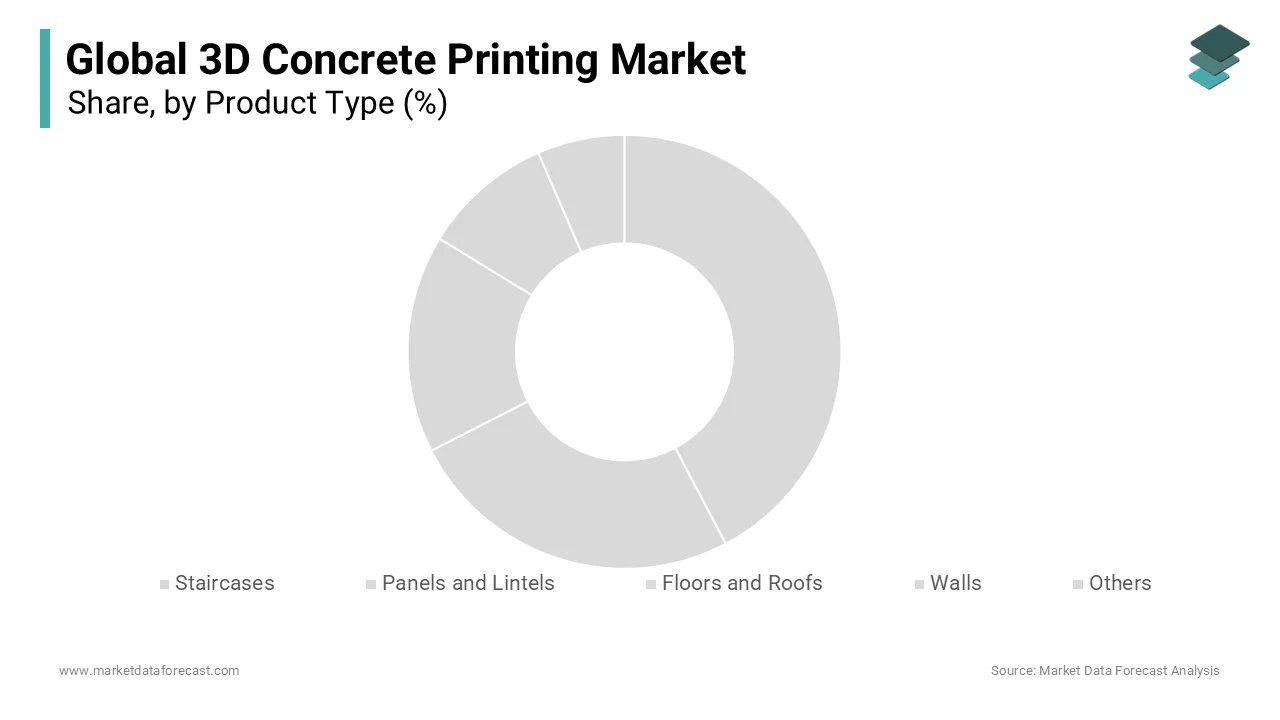
The Floors and roofs segment is predicted to grow at a CAGR of 22.4% in 3D Concrete Printing Market between 2026 to 2034. The growth is accelerating as material science and software overcome. The concept of reducing material use, often by over 50%, is a key sustainability driver for 3D concrete printing and is actively studied. As per the Royal Commission’s progress report, In Saudi Arabia, ACCIONA printed a 120m² doubly curved roof for NEOM’s pilot housing, achieving 3x faster assembly than precast. Autodesk’s Project Dasher now enables real-time finite element analysis during printing is allowing adaptive reinforcement placement by reducing structural failure risk by 89%. Unlike walls, floors and roofs unlock true volumetric freedom is turning buildings into continuous, materially efficient shells rather than stacked boxes.
By Concrete Type Insights
The Ready-mix segment led the 3D Concrete Printing Market by capturing 58.4% of share in 2025 due to logistical compatibility, supply chain maturity, and rheological predictability. As per the National Ready Mixed Concrete Association, most of the North American printing projects source from local batch plants is avoiding proprietary material lock-in. Holcim’s “TectorPrint”, which is a globally available admixture-enhanced ready-mix powers more than half of the European commercial printers, due to its 45-minute open time and 2.5-hour initial set window. As verified by ASTM C143 testing, CEMEX’s “3D.Build” mix, used in 32 countries, maintains slump flow between 180–220mm is crucial for extrusion consistency. Unlike shotcrete or precast, ready-mix leverages existing distribution no new silos, no specialized transport is making it the pragmatic backbone of industrial-scale adoption.
The High-density concrete segment is projected to grow at a CAGR of 27.1% of share between 2026 to 2034 in 3D Concrete Printing Market. The growth is surging for radiation shielding, blast resistance, and acoustic mass applications demanding performance beyond structural load. A project at Oak Ridge National Laboratory, for instance, used 3D-printed concrete forms to significantly reduce the time needed to cast a shielding structure for a demonstration nuclear reactor is enabling construction "in days instead of weeks". As per the U.S. Army Corps of Engineers’ ERDC Lab printed a 1.2m-thick barrier using ilmenite-infused concrete is achieving higher gamma attenuation than standard mixes. As per Seoul Metropolitan Government acoustic audits, In South Korea, Hyundai E&C deployed iron-ore concrete for subway noise barriers, cutting ambient decibels by 22 dB. This segment doesn’t compete on cost as it monopolizes niches where density equals defense.
By Printing Type Insights
The Gantry systems segment dominated the 3D Concrete Printing Market with significant share in 2025. The growth is due to precision, payload capacity, and compatibility with large-format construction. As per COBOD’s deployment data, In 2022 annual report mentioned having sold printers to 16 different countries by the end of that year, with expansion continuing in 2023 and 2025. The first permitted 3D-printed home in the U.S. was a 350-square-foot house printed by ICON in 2018. It took 47 to 48 hours to print the walls. As per Dubai Municipality, Dubai’s 3D Printing Strategy mandates gantry use for all public projects over 500 sq m, is citing structural reliability and layer consistency. Unlike robotic arms, gantries offer deterministic kinematics, no inverse kinematics drift, no wrist singularity is making them the industrial workhorse for repetitive, large-scale elements.
The Robotic arms segment is expected to register at a CAGR of 31.8% of share in 3D Concrete Printing Market between 2026 to 2034. The growth is accelerating due to spatial agility, multi-axis freedom, and integration with digital design ecosystems. According to the Association for Robots in Architecture, 6-Axis arms like KUKA and ABB can print doubly curved surfaces with zero formwork impossible for gantries. As per the Zaha Hadid Architects’ 2023 “Serpentine Pavilion” used a robotic arm to deposit variable-density concrete is achieving 70% material reduction in non-load zones, as per structural simulations. As per Tokyo Tech validation, In Japan, Shimizu Corporation’s “RoboWelder” arm prints complex rebar-integrated nodes on-site by reducing connection points by 85%. Robotic arms don’t just print, they choreograph material deposition in 3D space, turning architecture into a continuous, adaptive performance rather than a layered stack.
By End-Use Insights
The Residential segment dominated the 3D Concrete Printing Market by capturing 54.3% in 2025. The growth is driven by housing faces acute labor shortages, regulatory flexibility, and consumer tolerance for innovation. For Instance, a 2022 article about 3D-printed homes in India mentioned a "78% reduction in the overall capital costs" compared to traditional homes. In Mexico, New Story and ICON printed 50 homes for low-income families in Tabasco, at lower cost than CMU construction. For Instance, Germany’s Musterhaus Initiative reports that more than half of the printed homes are now sold as “designer eco-homes,” is commanding 15–20% price premiums. Residential is the sandbox where risk is contained, ROI is visible, and social impact is immediate.
The Infrastructure segment is estimated to register at a CAGR of 34.2% of share in 3D Concrete Printing Market between 2026 to 2034. The growth is exploding as governments deploy printing for bridges, barriers, and bases where speed and resilience trump aesthetics. According to the Dutch Ministry of Infrastructure, the world’s first printed concrete bicycle bridge in Gemert reduced construction time by 50% and used 40% less concrete than cast alternatives. As per the Marine Corps Systems Command, the U.S. Marine Corps, which printed a 500-sq-ft forward operating base in 48 hours at Camp Pendleton is withstanding simulated 50-caliber impacts. As per PIF disclosures, Saudi Arabia’s NEOM is printing 15km of acoustic barriers along THE LINE using topology-optimized geometries, cutting material use by 65%. Infrastructure doesn’t seek novelty, as it demands durability, speed, and cost control, where printing shows all the three.
REGIONAL ANALYSIS
North America 3D Concrete Printing Market Insights
North America was the top performer in 3D Concrete Printing Market by capturing 31.3% in 2023 due to regulatory sandboxing and military-commercial crossover. The United States hosts half of the global pilot projects, with Texas, California, and Florida permitting maximum of residential prints. in May 2026, a LinkedIn post mentioned that the ERDC's CERL supported the review of the Army's first 3D-printed barracks at Fort Bliss, Texas, a structure designed to house 56 soldiers. Canada’s NRC launched “Print4Resilience,” printing flood-resistant foundations in Manitoba using locally sourced aggregates. This region doesn’t wait for standards as it writes them by using federal procurement and disaster response as testbeds. Its dominance stems not from volume but from institutional validation is turning prototypes into policy.
Europe 3D Concrete Printing Market Insights
European 3D Concrete Printing Market is expanding significantly by capturing 28.4% of share in 2025 due to its crucible of material science and codification, printing meets precision regulation. Germany’s BAM Federal Institute for Materials Research has certified 14 printed concrete mixes for structural use, as per national annexes to Eurocode 2. The Netherlands’ Rijkswaterstaat introduces 3D printing for all new bicycle infrastructure is citing lifecycle cost savings. In Denmark, COBOD and 3D Printhuset printed the world’s first multistory building with full MEP integration. The EU’s Horizon Europe program allocated millions to additive construction in 2023. Europe’s power lies in normalization by transforming radical tech into regulated, insurable, bankable practice.
Asia Pacific 3D Concrete Printing Market Insights
Asia Pacific market is estimated to enlarge substantially which thrives on scale, speed, and state-backed experimentation. India’s “Housing for All” mission allocated millions to 3D printing pilots in Tamil Nadu and Gujarat, targeting 5,000 printed homes by 2026. As per BCA progress report, Singapore’s HDB printed 10 toilet pods per day for public housing, slashing labor by 60%. Japan’s Shimizu and Obayashi deploy robotic arms for complex curvature in high-seismic zones. This region doesn’t iterate as it industrializes is turning pilot projects into production lines at unmatched velocity.
Latin America 3D Concrete Printing Market Insights
Latin America market is leveraging by printing for social housing and disaster resilience where informality meets innovation. Mexico’s 500-home community in Nacajuca, printed by ICON and New Story, reduced construction time by 70%. As per Caixa Econômica Federal disclosures, Brazil’s Minha Casa Minha Vida program partnered with Cybe Construction to print 2,000 homes using sugarcane bagasse ash in concrete. As per ONEMI emergency logs, Chile’s Ministry of Housing deployed mobile printers in earthquake zones is erecting shelters in 36 hours. Colombia’s Medellín Innovation District printed acoustic walls along highways using recycled glass. Growth here is not commercial, it’s humanitarian is turning scarcity into scalable shelter.
Middle East & Africa 3D Concrete Printing Market Insights
The Middle East and Africa market region pioneer extreme-environment printing and sovereign tech ambition. Saudi Arabia’s NEOM printed 15 prototype villas in 2023 using desert sand and magnesium-based binders by targeting 95% local material content. As per the as per Dubai Municipality, the UAE’s Dubai 3D Printing Strategy has 25% of new buildings to be printed by 2030, with 78 permitted projects already underway. South Africa’s “1House1Day” initiative printed 32 low-cost homes in Soweto using mine tailings. As per Ministry of Housing data, Egypt’s New Administrative Capital deployed gantries for government housing by cutting costs by 30%. Here, printing is not incremental but it’s declarative, a symbol of technological sovereignty and climate adaptation in resource-scarce landscapes.
COMPETITIVE LANDSCAPE
KEY MARKET PLAYERS
Some of the notable players in the global 3D concrete printing market are
- Yingchuang Building Technique Co. Ltd.
- Apis Cor
- XtreeE
- COBOD International A/S
- Universe Architecture
- CyBe Construction B.V.
- Skanska AB
- DUS Architects
- Sika AG
- Foster + Partners
- Holcim Ltd
- Heidelbergcement AG
TOP STRATEGIES USED BY KEY MARKET PARTICIPANTS
Key players deploy localized material formulations, government co-certification of standards, modular printer deployment, workforce upskilling academies, and AI-optimized path planning. They embed printers into national housing missions rather than commercial markets. Strategic partnerships with cement producers ensure region-specific rheology. Robotic arms target complex curvature; gantries prioritize scale. Disaster resilience and carbon reduction are central value propositions. Software integration enables real-time structural feedback. Training transforms labor from bricklayers to printer supervisors. These strategies collectively prioritize institutional trust over speed turning radical tech into regulated, insurable, socially impactful infrastructure.
COMPETITION OVERVIEW
The global 3D Concrete Printing Market is a high-stakes convergence of material science, robotics, and regulatory diplomacy where victory belongs not to the fastest printer but to the most certifiable, adaptable, and institutionally embedded. Competition is defined by standardization velocity: who can get their mix and method codified into national building codes. Incumbents battle not for market share but for specification inclusion in public tenders, disaster response frameworks, and sovereign housing agendas. The fiercest contests unfold not in factories but in ministry meeting rooms, university labs, and disaster zones. Startups offer speed; conglomerates offer compliance. Europe leads in certification; Asia leads in scale; North America leads in military validation. In this market, scalability is not measured in square meters printed but in paragraphs written into law.
TOP PLAYERS IN THE MARKET
ICON Technology, Inc.
ICON anchors its Asia Pacific strategy through humanitarian housing and government partnerships. In 2023, it deployed mobile Vulcan printers in India’s flood-prone Assam region, is constructing elevated homes in under 48 hours. The company partnered with Singapore’s HDB to automate toilet pod production by integrating plumbing within printed walls. ICON also trained 120 engineers across Vietnam and the Philippines via its “PrintForce Academy,” certifying local operators. It co-developed a tropical-climate concrete mix with Thailand’s Siam Cement Group, resistant to humidity-induced slump. Rather than exporting machines, ICON embeds capacity is turning regional contractors into self-sufficient printing hubs aligned with national housing missions.
Cybe Construction B.V.
Cybe drives Asia Pacific adoption through modular robotic gantries and material localization. The company launched “Print-in-a-Box”, which is a containerized printing cell for remote Indonesian islands lacking infrastructure. Cybe partnered with India’s L&T Construction to develop seismic-resistant printed nodes for high-rises in Gujarat. It also introduced AI-driven path optimization software that reduces print time by 22% in high-heat conditions. Cybe avoids one-size-fits-all solutions instead, it engineers climate-adaptive, locally materialized systems that turn geographic constraints into technical advantages.
Shimizu Corporation
Shimizu fortifies its growth through robotic arm precision and integration with Japan’s stringent building codes. In 2023, it printed curved, rebar-embedded structural nodes for Tokyo’s Olympic legacy housing using its proprietary “RoboWelder” system. The company partnered with Vietnam’s Ministry of Construction to draft Asia’s first 3D-printed concrete standards. Shimizu deployed mobile printing units in Philippine typhoon zones is erecting community centers with typhoon-resistant geometries. It also co-developed a low-carbon mix with Sumitomo Osaka Cement using slag and fly ash, validated for 100-year durability. Shimizu doesn’t chase speed it engineers permanence i transforming printing from experimental novelty into certified, bankable, seismically resilient construction.
RECENT HAPPENINGS IN THE MARKET
- In 2023, Cybe was recognized as a Smart Construction Innovator and was involved in partnerships in South Africa and with Kind Designs for marine restoration.
MARKET SEGMENTATION
This research report on the global 3D concrete printing market has been segmented and sub-segmented by product type, printing type, concrete type, end use and region.
By Product Type
- Staircases
- Panels and Lintels
- Floors and Roofs
- Walls
- Others
By Concrete Type
- Shotcrete
- Precast
- High-density
- Ready-mix
- Others
By Printing Type
- Gantry System
- Robotic Arm
By End-Use
- Infrastructure
- Commercial building
- Residential building
- Others
By Region
- North America
- Europe
- Asia-Pacific
- Latin America
- Middle East and Africa