- Product Description Description
- Table of Contents TOC
- List of Table & Figure LOT
- Get Free Sample PDF Sample PDF
Global Tobacco Market Summary
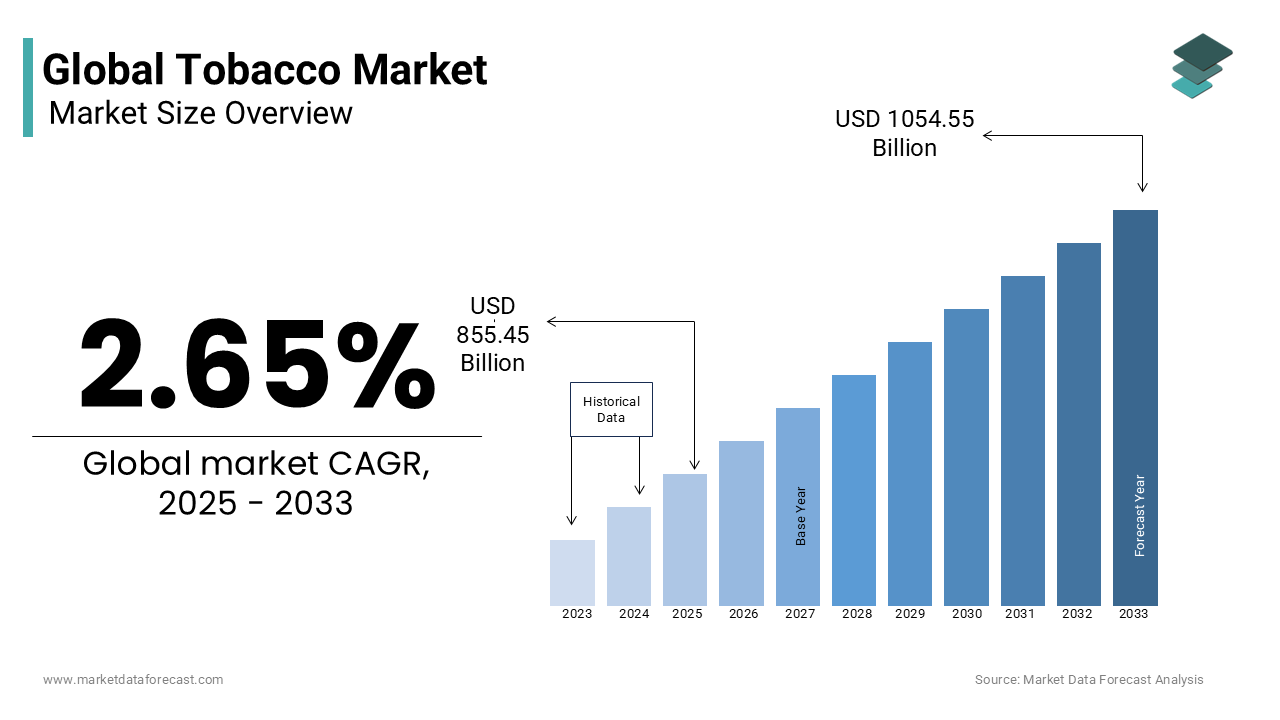
The global tobacco market was valued at USD 833.3 billion in 2024, is estimated to reach USD 855.45 billion in 2025, and is projected to reach USD 1,054.55 billion by 2033, expanding at a CAGR of 2.65% from 2025 to 2033. The growth of the global tobacco market is driven by rising demand for premium cigarette brands, strong distribution through retail and supermarkets, and expansion in emerging economies across Asia and Africa. In addition, the introduction of heated tobacco and reduced-risk products is reshaping consumer preferences, supporting market diversification despite growing health concerns and regulatory pressures.
Key Market Trends
- Increasing popularity of reduced-risk and heated tobacco products (HTPs).
- Rising demand for premium and flavored tobacco products in urban markets.
- Continued dominance of cigarette consumption, though alternatives are growing.
- Strong market penetration via supermarkets, hypermarkets, and convenience stores.
- Expansion strategies by global players into the Asia-Pacific and African markets.
Segmental Insights
- Based on product, the cigarettes segment dominated the global tobacco market in 2024, supported by widespread consumption across developing and developed nations.
- Based on distribution channel, the supermarkets and hypermarkets segment held a dominant share in 2024, ensuring large-scale accessibility and consumer reach.
Regional Insights
- Asia-Pacific was a major region in the global tobacco market in 2024, led by China and India, which are among the largest producers and consumers of tobacco.
- Europe remained a significant market, with strong demand for both cigarettes and alternative tobacco products.
- North America showed a steady shift toward e-cigarettes and heated tobacco products amid stricter regulations on traditional cigarettes.
- Latin America experienced stable growth, backed by a high smoking population in key countries like Brazil and Mexico.
- Middle East & Africa are witnessing gradual growth as companies expand into new consumer bases.
Competitive Landscape
Key players dominating the global tobacco market include Philip Morris International Inc. (USA), British American Tobacco plc (UK), Altria Group, Inc. (USA), Japan Tobacco Inc. (Japan), Imperial Brands plc (UK), ITC Limited (India), KT&G Corporation (South Korea), China National Tobacco Corporation (China), Swedish Match (Sweden), and Godfrey Phillips India Ltd. (India). These companies are focusing on new product launches, investment in reduced-risk products, and global market expansion to maintain their competitive edge.
Global Tobacco Market Size
The global tobacco market was valued at USD 833.3 billion in 2024, is estimated to reach USD 855.45 billion in 2025, and is projected to reach USD 1054.55 billion by 2033, growing at a CAGR of 2.65% from 2025 to 2033.
Despite decades of public health campaigns, tobacco remains one of the most widely consumed psychoactive substances globally that embedded in complex socio-economic and cultural frameworks. As per the World Health Organization, approximately 1.25 billion people aged 15 and over used tobacco in 2023, with over 80% residing in low- and middle-income countries. The crop supports the livelihoods of an estimated 100 million people across the supply chain, from smallholder farmers in Malawi and Zimbabwe to industrial processors in China and Brazil.
MARKET DRIVERS
Persistent Socio-Cultural Acceptance in Key Regions
The tobacco use remains deeply interwoven with social rituals, traditional practices, and daily routines, which is propelling the growth of the tobacco market. Similarly, in Eastern Europe, cigarette consumption is often associated with social bonding and stress relief, particularly in post-industrial communities. Russia reports an adult smoking prevalence of 27%, with higher rates in rural areas where cessation programs are limited, according to the Federal State Statistics Service. In sub-Saharan Africa, the use of smokeless tobacco and hand-rolled cigarettes persists due to affordability and cultural familiarity. These ingrained behaviors resist policy interventions and ensure a resilient consumer base, enabling sustained market activity even in the face of taxation and advertising restrictions.
Economic Dependence in Tobacco-Producing Nations
Tobacco cultivation is a source of foreign exchange and rural employment in several developing economies, which is creating structural incentives for continued production and export. The crop supports over 160,000 smallholder farmers and an additional 500,000 seasonal workers during harvest periods. Similarly, Malawi derives approximately 60% of its agricultural export income from tobacco, despite declining global demand, according to the National Statistical Office. Governments in these nations often resist stringent anti-tobacco policies due to fiscal reliance on the sector, which is indirectly supporting market continuity through agricultural subsidies and minimal regulatory enforcement.
MARKET RESTRAINTS
Escalating Global Regulatory Pressure and Taxation
Governments worldwide are intensifying tobacco control measures, which is significantly hampering the growth of tobacco market. The World Health Organization’s Framework Convention on Tobacco Control has been ratified by 182 countries, which mandates measures such as plain packaging, advertising bans, and health warnings. Taxation remains a primary deterrent. Additionally, cities like New York and Singapore have raised minimum purchase ages to 21 and 21+, which is further limits access. These policies collectively reduce affordability and social acceptability, eroding consumer bases.
Declining Youth Uptake and Shifting Social Perceptions
The diminishing appeal of smoking among younger demographics which is driven by heightened health awareness and digital anti-smoking campaigns. This shift is mirrored in the European Union, where only 18% of individuals aged 15–24 reported smoking in 2023, compared to 32% of those over 55, as per Eurostat. Social media platforms have amplified public health messaging, with campaigns by organizations like Truth Initiative reaching over 20 million young users annually. Moreover, smoking is increasingly stigmatized in urban professional environments by enforcing strict no-smoking policies on premises.
MARKET OPPORTUNITIES
Expansion of Reduced-Risk Nicotine Products
The emergence of science-based nicotine delivery systems is a creating new opportunities for the growth of tobacco market. Heated tobacco products (HTPs), nicotine pouches, and oral snus are gaining regulatory recognition as less harmful alternatives to combustible cigarettes. In Japan, HTPs accounted for over 30% of the nicotine market by volume in 2023, with Philip Morris International’s IQOS holding a dominant share, as stated by the National Institute of Public Health of Japan. Sweden, where snus has been widely used for decades, reports the lowest smoking rate in the EU at 5.7%, according to Eurostat, demonstrating the potential for harm reduction. Regulatory bodies such as the U.S. Food and Drug Administration have authorized several HTPs and nicotine pouches for sale with modified risk claims, signaling a shift in policy.
Strategic Market Penetration in Emerging Economies
The under-penetrated adult smoker populations and evolving regulatory landscapes are expected to drive the growth of the tobacco market. Similarly, in Nigeria, cigarette consumption has risen by 4.3% annually over the past five years, which is driven by urbanization and aggressive brand localization, as reported by the National Bureau of Statistics. Multinational tobacco firms are leveraging joint ventures and localized distribution networks to gain market share. For instance, Japan Tobacco International has expanded its retail footprint in Bangladesh by partnering with over 500,000 small vendors, increasing brand visibility.
MARKET CHALLENGES
Litigation and Financial Liability Exposure
Tobacco manufacturers face escalating legal risks stemming from public health litigation and government cost-recovery claims is restricting the growth of tobacco market. In 2023, Canadian provincial governments filed a $27 billion class-action lawsuit against Imperial Brands, JTI, and BAT, seeking compensation for healthcare costs linked to smoking, as reported by the Supreme Court of Ontario. These liabilities impact corporate balance sheets and deter investment, while also prompting divestment by institutional investors. The mounting legal environment forces companies to allocate substantial resources to defense and compliance, constraining strategic flexibility.
Environmental and Ethical Scrutiny of Tobacco Farming
The environmental footprint of tobacco cultivation is attracting increasing criticism with the industry’s social license to operate. According to the World Health Organization, tobacco farming is responsible for the annual deforestation of 200,000 hectares globally due to the curing process that requires wood fuel. Crop also depletes soil nutrients rapidly, which is requiring heavy pesticide use; the Food and Agriculture Organization notes that tobacco fields consume 16% of all pesticides used in Zimbabwe despite occupying less than 2% of arable land. Child labor remains a persistent issue, with the U.S. Department of Labor identifying tobacco as one of the worst forms of child labor in countries like Indonesia and the Philippines. These ethical and ecological concerns are prompting international development agencies to shift support away from tobacco-dependent communities, which is threatening long-term supply chain stability.
REPORT COVERAGE
| REPORT METRIC | DETAILS |
| Market Size Available | 2024 to 2033 |
| Base Year | 2024 |
| Forecast Period | 2025 to 2033 |
| Segments Covered | By Product, Distribution Channel and Region |
| Various Analyses Covered | Global, Regional, & Country Level Analysis; Segment-Level Analysis, Drivers, Restraints, Opportunities, Challenges, PESTLE Analysis, Porter’s Five Forces Analysis, Competitive Landscape, Analyst Overview of Investment Opportunities |
| Regions Covered | North America, Europe, Asia Pacific, Latin America, Middle East, and Africa |
| Key Market Players | Philip Morris International Inc. from the USA, British American Tobacco plc from the UK, Altria Group, Inc. from the USA, Japan Tobacco Inc. from Japan, Imperial Brands plc from the UK, ITC Limited from India, KT&G Corporation from South Korea, China National Tobacco Corporation from China, Swedish Match from Sweden, and Godfrey Phillips India Ltd. |
SEGMENTAL ANALYSIS
By Product Insights
The cigarettes segment was accounted in holding a dominant share of global tobacco market in 2024 with their widespread availability, standardized manufacturing, and entrenched consumer habits across both developed and emerging economies. The product’s dominance is further reinforced by its integration into social behaviors and stress-coping mechanisms in numerous cultures.
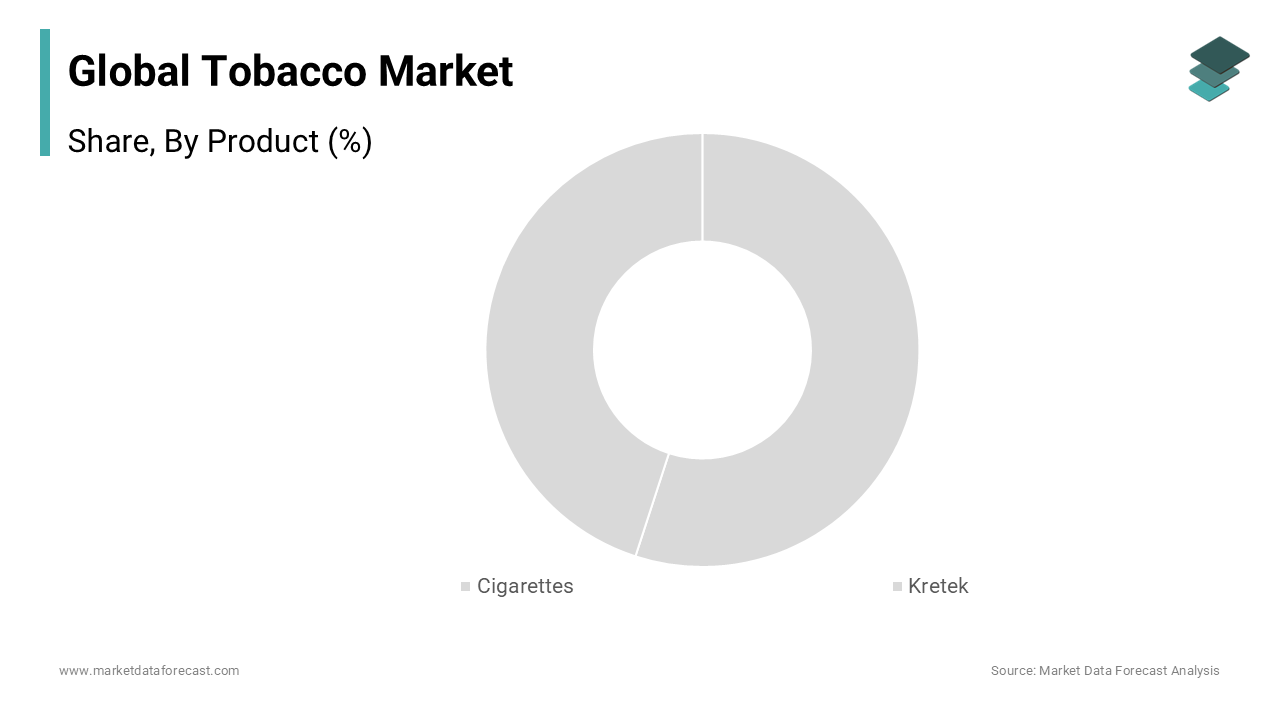
The Kretek, or clove-flavored cigarettes segment is projected to expand at a CAGR of 6.4% during the forecast period with the concentrated almost entirely in Southeast Asia, particularly Indonesia, where Kretek is not only a consumer product but a cultural institution. In 2023, kretek accounted for over 85% of total cigarette sales in Indonesia, with domestic consumption exceeding 160 billion sticks annually, as reported by the Indonesian Association of Cigarette and Tobacco Producers (GAPCI). Manufacturers have leveraged flavor customization and product differentiation to sustain kretek’s appeal, particularly among younger consumers. Companies like PT Gudang Garam and PT Djarum have introduced menthol-infused, low-tar, and flavored kretek variants that cater to evolving taste preferences.
By Distribution Channel Insights
The supermarkets and hypermarkets segment was the largest and held a dominant share of the tobacco market in 2024 with the point-of-sale restrictions limit informal vendors. Similarly, in Australia, Coles and Woolworths control nearly 70% of packaged tobacco sales, benefiting from nationwide distribution networks and compliance with plain packaging laws. The structured retail environment ensures product authenticity, tax compliance, and consistent pricing, which is making it the preferred channel for both consumers and regulators in high-income nations. Supermarkets leverage consumer behavior patterns to maximize tobacco sales through strategic product placement and bundling. In the United States, tobacco ranks among the top three categories for impulse purchases at checkout counters, with 38% of buyers adding cigarettes to their cart at the point of sale, as found in a 2023 study by the Point of Purchase Advertising International. Retailers like Walmart and Kroger optimize shelf positioning and lighting to increase visibility, despite advertising bans.
The online distribution channel segment is growing lucratively with an expected CAGR of 9.8% in the coming years with the shifting consumer preferences for convenience, privacy, and access to niche or premium products unavailable in physical stores. Similarly, in the United States, e-commerce tobacco sales grew by 22% in 2023, driven by subscription models and discreet delivery services, according to the Altria Group’s annual market review. Online platforms offer consumers a private and convenient way to purchase tobacco, especially in regions with stringent display bans and social stigma. In Norway, where tobacco advertising and in-store visibility are heavily restricted, online sales account for over 30% of cigarette purchases, according to Statistics Norway. The anonymity of digital transactions appeals to younger adults and those seeking to avoid judgment in public settings. Platforms such as Japan Tobacco’s online store and independent vendors like Cigarettes USA cater to international customers, offering global shipping despite regulatory complexities.
REGIONAL ANALYSIS
North America Tobacco Market Insights
North America was accounted in holding 18.2% of the global tobacco market share in 2024 with the United States’ large consumer base and advanced regulatory framework. The U.S. recorded 260 billion cigarette sticks sold in 2023, with adult smoking prevalence at 11.5%, according to the Centers for Disease Control and Prevention. Philip Morris International’s IQOS gained a 5.3% market share in the U.S. within two years of FDA authorization, as reported by the company’s 2023 annual report.
Europe Tobacco Market Insights
Europe held 22.3% of share in 2024 with notable divergence between Western and Eastern subregions. The European Union’s Tobacco Products Directive has standardized packaging and banned flavor descriptors, yet illicit trade accounts for 11.4% of consumption in Greece and Poland, according to the European Commission’s 2023 Illicit Trade Report. Sweden stands out with the EU’s lowest smoking rate due to widespread snus use, which is exempt from the EU ban with the impact of harm reduction policies on regional dynamics.
Asia Pacific Tobacco Market Insights
The growth of the Asia Pacificn market is likely to grow with the high smoking prevalence and large populations. China, home to 300 million smokers, produces and consumes over 2.4 trillion cigarettes annually, controlled by the state-owned China National Tobacco Corporation, which operates without competition, as reported by the State Tobacco Monopoly Administration. Indonesia records the highest youth smoking rates in the region, with 23% of boys aged 13–15 using tobacco, according to UNICEF. India has seen a shift toward bidis and smokeless forms with 29% of adults using non-cigarette tobacco, as per the National Health Survey.
Latin America Tobacco Market Insights
The Latin American market growth with Brazil and Mexico serving as key commercial hubs. Brazil is the world’s second-largest tobacco exporter, shipping 720,000 tons of leaf in 2023, primarily to Europe and Asia, according to the Brazilian Association of Tobacco Producers. Domestic cigarette consumption has declined to 68 billion sticks annually, but the informal market accounts for nearly 25% of sales, as reported by the Inter-American Heart Foundation. In Mexico, smoking prevalence among adults stands at 15.3%, with higher rates in northern border states influenced by U.S. consumption patterns, according to the National Institute of Public Health. Anti-tobacco campaigns have gained traction, but cross-border smuggling and weak retail enforcement limit policy effectiveness.
Middle East & Africa Tobacco Market Insights
The Middle East and Africa tobacco market is likely to grow with the significant variation across countries. In Egypt, smoking prevalence among adult males exceeds 40%, one of the highest in the region, according to the Egyptian Ministry of Health. South Africa enforces strict advertising bans and high taxes, yet illicit cigarette trade accounts for 28% of the market, as found in a 2023 audit by the South African Revenue Service. In contrast, Gulf Cooperation Council nations like Saudi Arabia and the UAE are investing in tobacco control as part of Vision 2030 health initiatives, aiming to reduce smoking rates to 5% by 2030.
COMPETITIVE LANDSCAPE
KEY MARKET PLAYERS
Some of the companies that are playing a dominating role in the global tobacco market include
- Philip Morris International Inc. (USA)
- British American Tobacco plc (UK)
- Altria Group, Inc. (USA)
- Japan Tobacco Inc. (Japan)
- Imperial Brands plc (UK)
- ITC Limited (India)
- KT&G Corporation (South Korea)
- China National Tobacco Corporation (China)
- Swedish Match (Sweden)
- Godfrey Phillips India Ltd. (India)
Competition in the tobacco market is undergoing a structural transformation, shifting from dominance by volume-driven cigarette sales to a more complex landscape defined by innovation, regulation, and consumer segmentation. While state-owned entities like China National Tobacco maintain monopolistic control in key markets, multinational corporations are competing aggressively through technological differentiation and harm reduction narratives. The rise of heated tobacco and vaping has created new battlegrounds, particularly in Asia Pacific and Eastern Europe. Illicit trade, pricing strategies, and youth targeting restrictions further complicate competitive dynamics. Companies are increasingly judged not only on market reach but also on environmental, social, and governance performance.
Top Players in the Tobacco Market
Philip Morris International (PMI)
Philip Morris International has intensified its strategic focus on the Asia Pacific region by accelerating the transition from combustible cigarettes to science-based alternatives. In Japan, PMI’s IQOS heated tobacco device captures a dominant position in the category, with over 14 million users as of 2023, according to the company’s regional update. The firm has expanded its "smoke-free future" initiative across South Korea, the Philippines, and Thailand, investing in consumer education and regulatory engagement. In 2023, PMI opened an innovation hub in Singapore to tailor product development for Southeast Asian preferences. The company also partnered with local distributors in Indonesia to enhance supply chain efficiency. These efforts reflect PMI’s long-term vision to establish a sustainable presence in high-potential markets while aligning with evolving public health expectations across the region.
British American Tobacco (BAT)
British American Tobacco maintains a strong operational footprint across Asia Pacific through localized production, strategic branding, and aggressive innovation in next-generation products. The company has launched its Vuse vaping and Velo nicotine pouch platforms in markets including India, Malaysia, and New Zealand, adapting flavors and packaging to regional tastes. In 2023, BAT inaugurated a $100 million manufacturing facility in the Philippines dedicated to reduced-risk products, enhancing its regional supply autonomy. It has also deepened engagement with farmers in Indonesia and Bangladesh to promote sustainable tobacco cultivation.
Japan Tobacco Inc. (JT)
Japan Tobacco leverages its domestic expertise in heated tobacco to lead market development across the Asia Pacific, capitalizing on the success of its Ploom TECH and Ploom X systems in Japan, where over 30% of adult smokers have switched from cigarettes, as reported in JT’s 2023 sustainability review. The company has extended its reach into South Korea, Taiwan, and Russia, tailoring product design and nicotine delivery to local preferences. In 2023, JT launched a new R&D center in Bangkok to accelerate product localization and regulatory compliance in Southeast Asia. It also strengthened distribution partnerships in Indonesia and the Philippines to expand retail penetration.
Top Strategies Used by the Key Market Participants
Key players in the tobacco market are deploying a multi-pronged strategic approach centered on product innovation, geographic expansion, and regulatory engagement. Companies are prioritizing the development and commercialization of reduced-risk products, including heated tobacco, e-cigarettes, and nicotine pouches, to diversify beyond traditional cigarettes. Strategic acquisitions and joint ventures are being used to enter emerging markets and enhance technological capabilities. Firms are also investing in digital platforms for direct consumer engagement and age-verified e-commerce. Sustainability initiatives, such as sustainable farming and carbon-neutral manufacturing, are increasingly leveraged for brand differentiation.
MARKET SEGMENTATION
The research report on the tobacco market has been segmented and sub-segmented based on categories.
By Product
- Cigarettes
- Kretek
By Distribution Channel
- Supermarket/Hypermarket
- Online
By Region
- North America
- Europe
- Asia-Pacific
- Latin America
- Middle East and Africa