- Product Description Description
- Table of Contents TOC
- List of Table & Figure LOT
- Get Free Sample PDF Sample PDF
Market Size, 2025
$3.72 BnMarket Estimate, 2026
$3.95 BnMarket Forecast, 2034
$6.42 BnCAGR, 2026–2034
6.25%Global Toilet Partition Market Size, Growth, Trends & Forecast (2026–2034)
The global toilet partition market size was valued at USD 3.72 billion in 2025, is anticipated to reach USD 3.95 billion in 2026, and is projected to expand up to USD 6.42 billion by 2034, registering a compound annual growth rate (CAGR) of 6.25% during the forecast period from 2026 to 2034. Growth is driven by rapid urban infrastructure development, evolving public health hygiene standards, and increasing green building initiatives.
Key Executive Metrics (At-a-Glance)
- 2025 Base Valuation: USD 3.72 Billion
- 2026 Current Valuation: USD 3.95 Billion
- 2034 Forecast Valuation: USD 6.42 Billion
- Compound Annual Growth Rate (CAGR): 6.25% (2026–2034)
- Dominant Material Segment: Stainless Steel (Captured 38.7% share in 2025 due to corrosion resistance and vandalism durability)
- Fastest-Growing Material Segment: Solid Phenolic (Projected at a CAGR of 6.8% due to moisture resistance and low-maintenance needs in humid environments)
- Dominant Product Type Segment: Floor-Mounted Partitions (Captured 52.7% share in 2025 due to architectural adaptability and lower installation complexity)
- Fastest-Growing Product Type Segment: Ceiling-Hung Partitions (Projected at a CAGR of 7.2% driven by seamless visual aesthetics and enhanced floor hygiene)
- Dominant End-Use Segment: Commercial Facilities (Held 48.2% share in 2025 from retail, office, and hospitality developments)
- Fastest-Growing End-Use Segment: Healthcare Facilities (Projected at a CAGR of 8.1% driven by infection prevention and patient privacy mandates)
- Dominant Price Segment: Mid-Range Partitions (Captured 55.4% share in 2025 providing optimal value and multi-year service life)
- Fastest-Growing Price Segment: High-End Partitions (Projected at a CAGR of 9.3% fueled by bespoke aesthetics and smart IoT features)
- Dominant Region: North America (Accounted for 42.7% share in 2025 due to mature building codes and active renovation cycles)
- Fastest-Growing Region: Asia-Pacific (Driven by unprecedented urbanization and public sanitation initiatives)
Core Market Drivers
- Urbanization & Commercial Growth: Expanding urban populations driving new commercial building construction and restroom modernization.
- Stringent Hygiene Regulations: Public health protocols elevating the demand for non-porous, antimicrobial surfaces and seamless partition designs.
Primary Market Restraints & Challenges
- Volatile Raw Material Costs: Price fluctuations in steel, aluminum, and phenolic resins constraining margin predictability and pricing stability.
- Regulatory Fragmentation & Labor Shortages: Complex national building codes and shortages of skilled installation professionals impeding project execution.
Global Toilet Partition Market Segmentation Breakdown
| Segment Category | Largest (Dominant) Sub-Segment | Fastest-Growing Sub-Segment |
|---|---|---|
| By Material | Stainless Steel | Solid Phenolic |
| By Product Type | Floor-Mounted Partitions | Ceiling-Hung Partitions |
| By End-Use | Commercial Facilities | Healthcare Facilities |
| By Price | Mid-Range Partitions | High-End Partitions |
| By Region | North America | Asia-Pacific |
Major Industry Players Profiled
Key corporations dominating the global toilet partition market include Bobrick Washroom Equipment, Inc., Bradley Corporation, Scranton Products, Hadrian Manufacturing Inc., General Partitions Mfg. Corp., Accurate Partitions Corp., ASI Global Partitions, Metpar Corp., Global Partitions Corp., and Ampco by AJW.
Global Toilet Partition Market Size
The global toilet partition market was valued at USD 3.72 billion in 2025 and is expected to have a 6.25% CAGR from 2026 to 2034, and be worth USD 6.42 billion by 2034 from USD 3.95 billion in 2026.

A toilet partition (or toilet cubicle) is a modular divider, stall wall, and door system used in public or commercial restrooms to create individual, private enclosures. These partitions serve as essential architectural components that balance functional requirements with aesthetic considerations across diverse facility types, including educational institutions, healthcare centers, transportation hubs, and corporate buildings. According to Eurostat data utilized by the European Commission, the European Union construction sector employs 12.7 million persons and generates 549 billion euros of value added, establishing a substantial foundational demand for interior finish products, ts including toilet partitions. Per the Federation of the European Construction Industry (FIEC), construction activity represents 10.6% of European gross domestic product, with housebuilding accounting for 31.2% of total construction output, creating consistent downstream demand for specialized building components. National European building regulations and inclusive design guidelines dictate that public facilities incorporate accessible restroom features, directly influencing partition specifications regarding door widths, maneuvering clearances, and hardware functionality as highlighted in AccessibleEU resource documentation. Regulatory frameworks such as the Construction Products Regulation encourage manufacturers to adopt practices that reduce waste and improve resource efficiency, contributing to circular economy objectives as noted by Interreg Europe. These non-market dynamics shape the operational landscape for partition manufacturers who must align product development with evolving statutory requirements while addressing practical installation constraints across heterogeneous European building stock.
MARKET DRIVERS
Urbanization Accelerates Commercial Infrastructure Development
Rapid urban population growth across European metropolitan areas generates sustained demand for new commercial construction, which drives the growth of the toilet partition market. Consequently, this drives facility modernization projects that incorporate toilet partitions as standard interior elements. According to United Nations data, approximately 75 percent of the European population resides in urban settings, with projections indicating continued migration toward city centers through 2030, creating pressure on existing public infrastructure and necessitating new restroom installations. As per Eurostat data, the number of enterprises in the European construction sector reached approximately 3.4 million, with specialized construction activities constituting the vast majority of these business entities by count and employment distribution. This expansion directly correlates with increased procurement of toilet partitions for offices,s retail centers, transportation terminals, and hospitality venues where privacy, durability,y and maintenance efficiency remain primary selection criteria. Municipal authorities across Germany, France, and the Netherlands have allocated substantial capital budgets for public building upgrades, with restroom modernization frequently included in renovation scopes according to FIEC statistical reporting. The concentration of commercial activity in urban cores amplifies foot traffic volumes, requiring partitions engineered for high-frequency use and vandal resistance. Manufacturers responding to this driver emphasize modular designs that facilitate rapid installation in constrained urban sites while meeting stringent fire safety and acoustic performance standards mandated by local building codes.
Stringent Hygiene Regulations Elevate Material Standards
Public health protocols and sanitation rules are constantly evolving across Europe, that are fuelling the toilet partition market forward. To meet these standards, facility operators must specify toilet partitions made from non-porous, antimicrobial materials that can withstand rigorous disinfection. Heightened public health awareness regarding high-touch surfaces in public facilities has accelerated market demand among building operators for toilet partitions featuring seamless surfaces, anti-microbial coatings, and minimal hardware crevices to optimize hygiene and maintenance workflows. As per AFNOR, the French standards organization, an accessible toilet design must incorporate specific dimensional criteria and surface treatments that facilitate effective sanitation while accommodating diverse user needs. Healthcare facilities, es educational institutions,ons and transportation hubs face particularly stringent oversight, with regulatory bodies conducting regular audits of restroom hygiene compliance according to national public health agencies. Partition manufacturers address this driver by developing solid phenolic high-pressure laminate and powder-coated steel products that resist moisture penetration, bacterial colonization,n and chemical cleaning agents. The European Chemicals Agency biocidal products regulation further influences material selection by restricting substances that could leach during cleaning operations according to compliance documentation. This regulatory environment creates a competitive advantage for suppliers who demonstrate third-party certification of antimicrobial performance and provide detailed maintenance guidelines aligned with institutional cleaning protocols.
MARKET RESTRAINTS
Volatile Raw Material Costs Constrain Pricing Stability
Fluctuating prices for steel, aluminum, phenolic resins, and polymer composites introduce significant uncertainty into toilet partition manufacturing economics, which constrains the growth of the toilet partition market. Consequently, this limits margin predictability and complicates long-term contract negotiations with commercial clients. According to Eurostat, producer prices for basic metals in the European Union experienced volatility exceeding 15 percent year over year during recent periods, ds reflecting global supply chain disruptions and energy cost pressures. As per the European Construction Sector Observatory and related industrial data, material cost inflation represents a primary constraint on construction project budgets, creating a highly sensitive pricing environment for building components and interior installations. Manufacturers operating in competitive European markets face challenges in passing increased costs to price-sensitive customers in public sector procurement, where the most compliant bid criteria dominate award decisions. Small and medium-sized partition fabricators lack the purchasing scale to secure favorable long-term supply agreements, exacerbating margin compression during raw material price spikes. The European Central Bank inflation monitoring indicates that industrial producer prices remain elevated relative to historical averages,s creating ongoing pressure on manufacturing cost structures, es according to monetary policy communications. This restraint incentivizes consolidation among partition suppliers as larger entities leverage diversified sourcing and vertical integration to mitigate input cost volatility while smaller players struggle to maintain profitability amid pricing uncertainty.
Complex Regulatory Fragmentation Increases Compliance Burden
Divergent national building codes, accessibility standards, and environmental regulations across European Union member states complicate market access, which slows down the expansion of the toilet partition market. This forces toilet partition manufacturers to navigate significant administrative complexity and elevated compliance costs to operate across the EU. According to AccessibleEU guidance documentation, while the European Accessibility Act establishes harmonized requirements for products and services placed on the market after June 202,5 member states retain discretion regarding built environment applications, ns leading to inconsistent interpretation of partition accessibility criteria. As per the European Committee for Standardization, standard EN 17210 addresses functional requirements for the built environment, yet national authorities may impose additional dimensional or performance mandates that require product adaptation for specific jurisdictions. Manufacturers must maintain separate technical documentation certification portfolios and labeling schemes to satisfy heterogeneous regulatory frameworks, risking increasing overhead without corresponding revenue enhancement. This restraint disproportionately affects small and medium enterprises lacking dedicated regulatory affairs resources, limiting their ability to compete across multiple European markets and reinforcing the dominance of large multinational partition suppliers with established compliance infrastructure.
MARKET OPPORTUNITIES
Sustainable Material Innovation Attracts Green Building Demand
Growing emphasis on environmental stewardship in construction creates substantial opportunity for manufacturers within the toilet partition market. This shift drives the development of products incorporating recycled content, bio-based materials, and end-of-life recyclability aligned with circular economy principles. As shown in Interreg Europe policy briefings, utilizing bio-based construction materials derived from agricultural residues offers a viable strategy to substitute petroleum-based components, significantly lowering the embodied carbon footprint of interior building fit-outs. Manufacturers leveraging these innovations qualify for preferential specification in projects pursuing BREEAM, LEE, D, or HQE sustainability certifications, ns which increasingly influence public procurement decisions across European municipalities. The European Green Deal industrial strategy provides funding mechanisms for research and development of eco-innovative construction products according to European Commission communications, creating financial support for material science advancement. Partition suppliers who document environmental product declarations and third-party sustainability certifications gain a competitive advantage in tenders where lifecycle assessment criteria influence award decisions. This opportunity extends beyond material composition to include design for disassembly principles that facilitate component recovery and reuse at the end of service life, aligning with European waste framework directive objectives.
Smart Restroom Integration Enhances Value Proposition
The emerging adoption of Internet of Things sensors, touchless interfaces, and data analytics in commercial restroom design creates opportunities for manufacturers within the toilet partition market. This helps to integrate intelligent features that improve user experience, operational efficiency, and maintenance planning. According to research, technology integration in restroom facilities is expected to grow at approximately 8 percent annually,y reflecting shifting expectations for connected building environments. The rapid evolution of commercial proptech has established software platforms that interface directly with partition-mounted hardware sensors, allowing facility managers to track occupancy monitoring, analyze real-time usage metrics, and execute predictive maintenance alerts. Manufacturers incorporating discreetly embedded proximity sensors, RS humidity monitors, or usage counters into partition designs enable facility managers to optimize cleaning schedules,s reduce consumable waste,e and identify maintenance needs before failures occur. The European Accessibility Act requirement for accessible information services extends to digital interfaces, creating an opportunity for partitions with integrated wayfinding or assistance request features according to AccessibleEU documentation. This opportunity allows partition suppliers to transition from commodity product providers to solution partners commanding premium pricing through value-added functionality while differentiating offerings in competitive European markets. Successful implementation requires collaboration with technology providers and adherence to data privacy regulations under the General Data Protection Regulation.
MARKET CHALLENGES
Skilled Labor Shortages Impede Installation Quality
Persistent deficits in trained construction tradespeople compromise the proper installation of toilet partitions, potentially undermining product performance, warranty validity, and end-user satisfaction, which holds back the growth of the toilet partition market. According to FIEC statistical reporting, 95 percent of construction enterprises in the European Union employ fewer than 20 workers,s indicating a fragmented contractor landscape with limited capacity for specialized training programs. As per the European Centre for the Development of Vocational Training, the construction sector skills shortages affect multiple trades, des including carpentry, metalwork,lwork, and finishing specialties essential for precision partition installation. Improperly installed partitions may exhibit alignment issues, hardware malfunction, or premature wear, generating customer dissatisfaction and reputational damage for manufacturers, despite product quality. The European Skills Agenda seeks to address these gaps through enhanced vocational education, yet implementation timelines extend beyond immediate market needs according to policy documentation. Manufacturers respond by developing simplified installation systems with pre-engineered components and detailed digital instructions, yet complex site conditions often require experienced judgment that scarce skilled labor provides. This challenge elevates the importance of manufacturer-supported installation networks and certified contractor programs as competitive differentiators while increasing project delivery risks for specifiers relying on generalist construction teams.
Economic Uncertainty Suppresses Capital Investment
Macroeconomic volatility, including inflationary pressures, interest rate fluctuations, and geopolitical tension,s constrains public and private capital allocation for facility upgrades, which negatively impacts the expansion of the toilet partition market. As per the European Investment Bank,nk infrastructure investment barriers include high initial costs and long payback periods that become less attractive when financing costs rise, or budget priorities shift toward immediate operational needs. Public sector restroom modernization projects face particular vulnerability to fiscal consolidation measures,s while commercial developers may postpone interior finish selections until leasing commitments solidify. The European Central Bank's monetary policy communications indicate that elevated borrowing costs may persist through near-term horizons, according to the inflation targeting framework,s creating headwinds for capital-intensive construction activities. This challenge incentivizes manufacturers to emphasize lifecycle cost advantages of premium partition products that reduce long-term maintenance expenses, yet budget-constrained purchasers often prioritize initial acquisition cost over total cost of ownership. Suppliers addressing this challenge develop flexible financing options, modular upgrade pathways, and value-engineered product tiers to maintain market access amid constrained capital availability while preserving margin integrity through differentiated value propositions.
REPORT COVERAGE
| REPORT METRIC | DETAILS |
| Market Size Available | 2025 to 2034 |
| Base Year | 2025 |
| Forecast Period | 2026 to 2034 |
| Segments Covered | By Material, Product Type, End-use, Price, and Region |
| Various Analyses Covered | Global, Regional, and Country Level Analysis, Segment-Level Analysis, DROC, PESTLE Analysis, Porter’s Five Forces Analysis, Competitive Landscape, Analyst Overview of Investment Opportunities |
| Regions Covered | North America, Europe, Asia Pacific, Latin America, Middle East & Africa |
| Market Leaders Profiled | Bobrick Washroom Equipment, Inc., Bradley Corporation, Scranton Products, Hadrian Manufacturing Inc., General Partitions Mfg. Corp., Accurate Partitions Corp., ASI Global Partitions, Metpar Corp., Global Partitions Cor,p. and Ampco by AJW. |
SEGMENTAL ANALYSIS
By Material Insights
The stainless steel segment dominated the global toilet partition market and accounted for a 38.7% share in 2025. This dominance of the segment was driven by its exceptional resistance to corrosion, vandalism, moisture, and re, re which aligns with stringent hygiene protocols in high-traffic facilities. Architectural guidelines for high-traffic commercial environments increasingly prioritize materials with durable and non-porous properties; stainless steel partitions meet these hygiene criteria while offering an average service life exceeding 20 years. Industry specifications for modern institutional construction projects frequently prioritize stainless steel fixtures for public restrooms due to their low lifecycle cost advantages, extreme vandalism resistance, and compatibility with universal accessibility requirements. The material withstands daily cleaning with industrial disinfectants without surface degradation, which reduces maintenance expenses compared to laminate alternatives. Furthermore,e stainless steel partitions support sustainable construction certifications such as LEED because they contain up to 60 percent recycled content and are fully recyclable at the end of life. Facility managers in transportation hubs and healthcare environments prioritize stainless steel for its ability to maintain aesthetic integrity under intensive use, which sustains its market leadership position across North America and Europe.
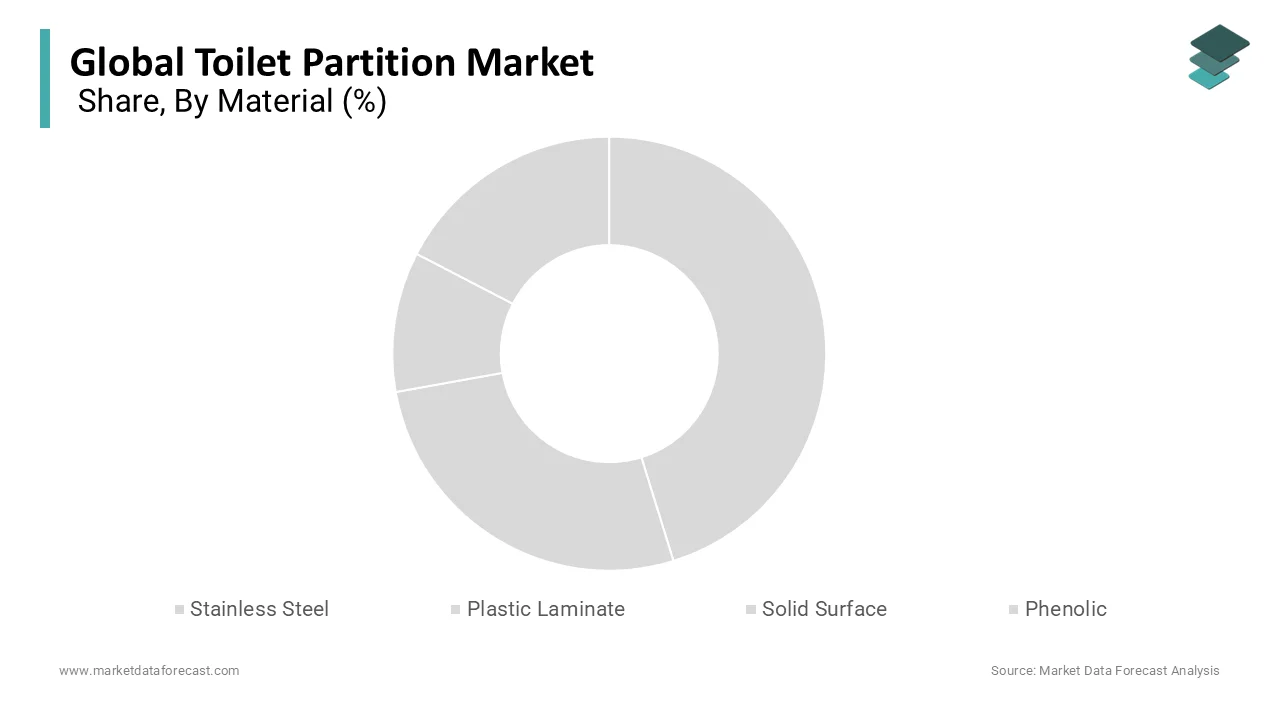
On the other hand, the solid phenolic segment is on the rise and is expected to be the fastest-growing segment in the market by witnessing a CAGR of 6.8% from 2026 to 2034 due to technological advancements in resin formulation and increasing demand for low-maintenance solutions in humid environments. Solid phenolic core panels certified under European standards exhibit negligible water absorption rates that prevent delamination, moisture retention, and subsequent bacterial growth, making them highly suitable for wet environments such as swimming pools, locker rooms, and gyms. Facilities engineering data demonstrates that utilizing solid phenolic partitions drastically reduces long-term replacement cycles compared to standard plastic laminate alternatives due to phenolic's superior impact resistance and durability in high-traffic settings. The material accepts digital printing and custom finishes, which enables architects to integrate partitions into branded interior designs without compromising structural performance. Additionally, phenolic partitions comply with fire safety standards, including ASTM E84 Class A rating,s which expands their eligibility for public sector procurement across educational and healthcare segments. Manufacturers are investing in automated production lines to reduce costs, ts which enhances price competitiveness against traditional materials.
By Product Type Insights
The floor-mounted partitions segment led the global market and captured a 52.7% share in 2025. This leading position of the segment was attributed to the fact that it accommodates diverse architectural layouts and requires minimal ceiling infrastructure, which reduces installation complexity and project timelines. Floor-mounted toilet partition systems are widely utilized in commercial restroom installations due to their mechanical adaptability to uneven concrete subfloors and ease of integration during structural retrofit applications. Toilet partition manufacturers' engineering universal design layouts utilize adjustable anchoring and hinge hardware to satisfy strict statutory ADA clearance rules and clear floor space mandates across varying wall dimensions. The design facilitates straightforward maintenance access to plumbing and electrical systems behind partitions,s which lowers facility operational costs annually. Furthermore, floor-mounted configurations allow phased replacement strategies, enabling facility managers to upgrade individual units without disrupting entire restroom operations. This practical advantage sustains preference among property owners managing multi-location portfolios where standardized yet flexible solutions optimize capital expenditure allocation.
However, the ceiling hung partitions segment is expected to exhibit a noteworthy CAGR of 7.2% during the forecast period,d owing to rising demand for seamless visual environments and improved hygiene protocols in premium commercial spaces. Ceiling-hung partition systems eliminate floor contact points, which inherently removes dirt-trapping structural basemolds, reduces potential bacterial accumulation zones, and streamlines routine janitorial floor-mopping operations. The floating aesthetic aligns with contemporary architectural trends favoring open sightlines and minimal visual clutter, which increases specification rates in hospitality, corporate, te and luxury retail developments. Manufacturers have introduced lightweight aluminum alloys that reduce structural load requirements,nts enabling installation in buildings with limited ceiling reinforcement capacity. Additionally, modular ceiling hung systems facilitate rapid reconfiguration during facility renovations, which appeals to adaptive reuse projects experiencing annual growth across European urban centers.
By End Use Insights
The commercial facilities segment held the majority share of 48.2% of the toilet partition market in 2025. This supremacy of the segment was credited to sustained investment in retail centers,s office towers, and hospitality venues, where restroom quality directly influences customer experience and brand perception. Modern European retail property developers increasingly invest in high-end public restroom renovations, utilizing premium and durable partition systems to improve the overall customer experience and support longer venue dwell times. As per the International Workplace Group (IWG), corporate office renovations increasingly prioritize employee wellbeing amenities, which drives the specification of durable, aesthetically refined partitions that support wellness certification criteria. The commercial segment benefits from shorter replacement cycles,s averaging 8 to 10 years, compared to institutional settings, which sustain recurring procurement opportunities. Furthermore, hospitality operators in European urban destinations report higher guest satisfaction scores when restrooms feature modern partition designs with integrated lighting and touchless hardware. This correlation between restroom quality and customer retention incentivizes continued investment in high-performance partition solutions across the commercial landscape.
On the contrary, the healthcare facilities segment is predicted to witness the highest CAGR of 8.1% between 2026 and 2034. This rapid growth is propelled by stringent infection prevention protocols and evolving patient-centered design requirements that mandate specialized partition performance. Healthcare facility sanitation protocols dictate that clinical patient-area restrooms must utilize non-porous, chemically resistant surfaces capable of withstanding aggressive and frequent disinfection regimes, heavily favoring solid phenolic and stainless steel partition materials. Statutory patient data privacy and acoustic confidentiality mandates in medical facilities require clinical and consultation area restrooms to feature enhanced structural privacy, frequently driving the specification of full-height toilet partition configurations. The segment continues to benefit from public health infrastructure investments, with various European Union member states leveraging regional development funds to upgrade institutional healthcare facilities and improve restroom sanitation standards. Additionally, healthcare facilities experience higher utilization rates with restrooms serving 30 to 50 users per hour in emergency departments,s which accelerates wear and necessitates frequent partition replacement. Manufacturers are developing healthcare-specific partition lines with integrated hand hygiene stations and contactless operation features, which align with post-pandemic safety expectations and drive specification growth.
By Price Insights
The mid-range partitions segment was the largest in the global market and occupied a 55.4% share in 2025. This prominence of the segment was supported by the optimal value it delivers by combining durable materials with cost-effective manufacturing processes that meet most commercial specification criteria. Commercial procurement guidelines heavily favor mid-tier toilet partition systems (such as standard powder-coated steel or basic plastic laminates) because they provide a cost-effective, multi-year service life without the high upfront expense of premium materials. As per the European Construction Sector Observatory, public procurement guidelines favor products with verified lifecycle cost advantage which mid-rangee partitions achieve through standardized components and regional manufacturing networks. The mid-range partition segment heavily benefits from industrial economies of scale, allowing manufacturers of standardized, mass-produced components to significantly reduce per-unit costs compared to custom-engineered architectural solutions. Furthermore, mid-range partitions accommodate common design preferences, including neutral finishes and modular configuration,s whichsimplifys specification across multi-location portfolios. This balance of performance, affordability, and availability sustains broad adoption across educational institutions and value-oriented commercial projects throughout Europe and North America.
But the high-end partitions segment is estimated to register the fastest CAGR of 9.3% over the forecast period. This quick surge of the segment is fuelled by increasing demand for bespoke aesthetic solutions and integrated digital features in premium hospitality, corporate, and cultural facilities. High-end interior architecture guidelines for five-star luxury hotel restroom renovations prioritize bespoke, high-privacy partition configurations featuring premium materials, such as architectural metal inlays, wood veneer laminates, and integrated lighting, to enhance the guest experience. Restroom partition systems equipped with embedded IoT occupancy sensors and usage analytics command a distinct pricing premium, but they significantly reduce facility operational costs over time by enabling data-driven, predictive maintenance and targeted janitorial workflows. The segment benefits from growing corporate investment in employee experience amenities with technology-enabled partitions supporting workplace wellness certifications that attract talent in competitive labor markets. Manufacturers are partnering with software developers to create proprietary ecosystem platforms that enable remote monitoring and predictive maintenance, which creates recurring revenue opportunities beyond initial hardware sales. Additionally, our high-end partitions increasingly incorporate sustainable materials such as FSC-certified wood composites and recycled metal alloys, which align with ESG procurement policies,s driving specification growth among environmentally conscious clients.
COUNTRY LEVEL ANALYSIS
North America Toilet Partition Market Analysis
North America outperformed other regions in the toilet partition market and accounted for a 42.7% share in 2025. This dominance of the regional market was driven by established building codes,s stringent accessibility requirements, ts and active facility renovation cycles across commercial and institutional sectors. United States commercial construction expenditures demonstrate significant baseline investments in corporate, institutional, and healthcare projects, driving a reliable volume of multi-tier restroom partition fit-outs across regional markets. Public infrastructure modernization programs in Canada continue to allocate substantial institutional funding toward upgrading aging public schools, healthcare facilities, and transportation hubs, driving consistent demand for durable restroom partition replacements. The region benefits from a high awareness of lifecycle cost analysis, which favors durable partition materials despite higher initial investment. Furthermore, North American facility managers prioritize compliance with ADA and CSA accessibility standards, which drives the specification of partitions with adjustable hardware and clear floor space configurations. The mature market experiences steady replacement demand with an average partition service life of 12 to 15 years, creating predictable procurement cycles that sustain manufacturer production planning and distribution networks across the continent.
Europe Toilet Partition Market Analysis
Europe followed closely behind in the global market and captured a 31.6% share in 2025. This position of the European market was supported by comprehensive environmental directives,s heritage preservation requirements, ts and strong public investment in facility modernization. According to the European Commission, the Renovation Wave strategy targets 35 million building upgrades by 2030, which encompasses holistic structural and interior improvements in public institutions, social facilities, and commercial properties. As per Eurostat short-term business statistics, production volumes in the European construction sector continue to navigate cyclical changes, with specialized construction and finishing activities representing a highly active segment of the broader building market. The region benefits from stringent REACH and EPD regulations that favor partitions with verified environmental credentials and recyclable material compositions. Furthermore, more European accessibility legislation mandates inclusive design features, which drive the specification of partitions with adjustable components and universal hardware configurations. Heritage building renovations require partitions that balance historical aesthetics with modern performance, which creates opportunities for custom finished systems that respect architectural context while meeting contemporary hygiene standards.
Asia Pacific Toilet Partition Market Analysis
Asia Pacific is quickly growing in the global market due to unprecedented urbanization, public sanitation initiatives, and commercial construction activity across emerging economies. According to the Asian Development Bank, the Asia-Pacific region requires approximately 1.7 trillion dollars annually in infrastructure investments through 2030 to meet economic and social goals, driving long-term public sanitation, transportation, and health amenities upgrades. As per the United Nations Economic and Social Commission for Asia and the Pacific (UNESCAP), rapid regional urban transformation continues to concentrate millions in major cities, intensifying demand for modern public building amenities and commercial restroom solutions. The region benefits from government-led sanitation programs such as India's Swachh Bharat mission, which has constructed over 100 million toilets since 2014, creating sustained partition procurement opportunities. Furthermore, rising middle-class consumption drives retail hospitality and office development, which increases the specification of premium partition systems in commercial environments. Manufacturers are establishing regional production facilities to reduce lead times and adapt products to local material preferences, which enhances market penetration across diverse Asian markets.
Latin America Toilet Partition Market Analysis
Latin America is moving ahead steadfastly in the global market,t owing to tourism expansion, public health initiatives,ves and gradual formalization of construction standards. According to the Inter-American Development Bank and associated multilateral reports, targeted funding for water supply and sanitation projects serves as a critical growth engine across Latin America, expanding essential building services in public transit networks and school facilities. As per UN Tourism, the ongoing post-pandemic recovery of international visitor arrivals across Latin America has stimulated hospitality sector investments, driving property renovations and restroom fixture replacements in major tourism zones. The region benefits from increasing adoption of international building codes, which drives the specification of durable partition materials suitable for tropical climate conditions. Furthermore, public health campaigns emphasizing hygiene awareness create demand for partitions with antimicrobial surfaces and easy clean configurations in healthcare and educational settings. Manufacturers are partnering with local distributors to offer value-oriented product lines that balance performance requirements with budget constraints prevalent across Latin American markets.
Middle East and Africa Toilet Partition Market AnalysisThe
Middle East and Africa region is an emerging regional market due to large-scale infrastructure projects, urban expansion,n and increasing focus on public facility standards. According to the African Development Bank, the institution achieved a historic milestone by approving projects valued at 11 billion dollars in 2024, deploying capital to scale up essential transit corridors, regional infrastructure, and institutional health facilities across the continent. As per regional construction requirements and Gulf Cooperation Council standardization frameworks, new commercial projects increasingly prioritize compliance with international accessibility and safety guidelines, driving the specification of premium, high-durability restroom partition materials. The region benefits from mega event preparations such as Expo and World Cup initiatives, which accelerate facility development, including high-performance partition installations. Furthermore, growing awareness of water conservation drives demand for partitions compatible with low-flow fixtures and moisture-resistant materials suitable for arid climate conditions. Manufacturers are establishing regional assembly operations to reduce import costs and adapt products to local architectural preferences, which enhances competitiveness across Middle Eastern and African markets.
COMPETITIVE LANDSCAPE
The toilet partition market features moderate fragmentation with established manufacturers competing through material innovation, design customization, and service differentiation. Leading players leverage brand reputation and distribution networks to maintaian n advantage, while emerging companies target niche segments with specialized material formulations or regional manufacturing capabilities. Competition intensifies in premium segments where aesthetic customization and smart technology integration create differentiation opportunities. Price competition remains significant in value-oriented segments, particularly across developing regions,s where budget constraints influence procurement decisions. Manufacturers increasingly compete on sustainability credentials with environmental product declarations, recycled content verification, and end-of-life takeback programs, influencing specification choices. Service capabilities, including design support, installation coordination, and maintenance programs, represent growing competitive dimensions as facility managers seek comprehensive solutions. Digital transformation initiatives, including augmented reality visualization and predictive maintenance platforms,s create new competitive frontiers that reward technology investment and partnership development.
KEY MARKET PLAYERS
Some of the companies that are playing a dominating role in the Global Toilet Partition Market include
- Bobrick Washroom Equipment, Inc.
- Bradley Corporation
- Scranton Products
- Hadrian Manufacturing Inc.
- General Partitions Mfg. Corp.
- Accurate Partitions Corp.
- ASI Global Partitions
- Metpar Corp.
- Global Partitions Corp.
- Ampco by AJW
TOP LEADING PLAYERS IN THE MARKET PLAYERS
- Bobrick Washroom Equipment maintains global leadership through comprehensive product portfolios spanning stainless steel,l phenol, ic and solid plastic partition systems. The company invests in research and development to introduce antimicrobial surface treatments and touchless hardware integration, which aligns with post-pandemic hygiene expectations. Recent initiatives include launching eco-friendly partition lines utilizing recycled materials and establishing regional manufacturing hubs to reduce delivery lead times. Bobrick collaborates with architectural firms to provide BIM-compatible design resources,s which streamlines specification processes for large-scale projects. The company emphasizes lifecycle cost advantages through durable construction and modular replacement components, which appeals to facility managers managing multi-location portfolios. Strategic partnerships with distribution networks ensure broad market coverage across North America, Europe, pe athe nd Asia Pacific regions.
- Bradley Corporation strengthens its market position through innovation in hygienic design and sustainable material engineering for toilet partition solutions. The company recently expanded automated production capabilities to improve manufacturing efficiency and reduce costs while maintaining quality standards. Bradley focuses on integrated restroom systems that combine partitions with fixtures and accessories, which simplifies procurement and installation for commercial clients. The company participates in green building certification programs by developing partitions with environmental product declarations and recycled content verification. Bradley collaborates with technology partners to incorporate smart features such as occupancy monitoring and maintenance alerts into partition designs. Strategic investments in digital design tools enable architects to visualize partition configurations within a building information modeling environment,s which accelerates project specification cycles.
- ASI Global Partitions enhances market presence through strategic acquisitions and product line expansions that broaden material and design offerings. The company recently acquired Marsh Industries to strengthen manufacturing capabilities and expand distribution reach across North American markets. ASI focuses on customizable partition solutions that accommodate diverse aesthetic preferences while meeting performance requirements for high-traffic environments. The company invests in digital printing technologies that enable custom graphics and branded finishes for hospitality and corporate applications. ASI emphasizes rapid prototyping and sample services, which support architect and designer specification processes for premium projects. Strategic partnerships with construction firms facilitate integrated installation services that reduce project timelines and enhance customer satisfaction across commercial and institutional segments.
TOP STRATEGIES USED BY KEY MARKET PARTICIPANTS
Key players in the toilet partition market employ product innovation strategies focusing on sustainable materials, smart technology integration,n and customizable design options to differentiate offerings. Companies pursue geographic expansion through regional manufacturing facilities and distribution partnerships to reduce lead times and adapt products to local preferences. Strategic acquisitions enable market consolidation and capability enhancement in specialized material segments such as HDPE and phenolic composites. Manufacturers invest in digital design sources, es including BIM libraries and configuration tools to streamline architect specification processes. Lifecycle cost analysis and environmental certifications support value-based selling approaches that appeal to facility managers and public procurement entities. Collaborative development with technology partners enables integration of occupancy sensors, maintenance monitoring,g and touchless operation features into partition systems.
GLOBAL TOILET PARTITION MARKET NEWS
In June 2025, Sky Island Capital, a private investment firm, acquired Scranton Products, a prominent manufacturer of HDPE toilet partitions, to strengthen innovation capacity and accelerate market expansion in the Toilet Partition Market.
MARKET SEGMENTATION
This research report on the global toilet partition market has been segmented and sub-segmented based on material, product type, end-user, price, and region.
By Material
- Stainless Steel
- Plastic Laminate
- Solid Surface
- Phenolic
- Others
By Product Type
- Floor-Mounted Overhead Braced
- Ceiling Hung
- Floor-Mounted
- Floor-To-Ceiling
By End-use
- Commercial
- Institutional
- Industrial
- Healthcare Facilities
By Price
- Low-end
- Mid-range
- High-end
By Region
- North America
- Europe
- Asia-Pacific
- Latin America
- Middle East & Africa