- Product Description Description
- Table of Contents TOC
- List of Table & Figure LOT
- Get Free Sample PDF Sample PDF
Market Size, 2025
$77.86 BnMarket Estimate, 2026
$88.76 BnMarket Forecast, 2034
$253.20 BnCAGR, 2026–2034
14%Executive Summary: Global Traffic Management Market
- Market Scope: Comprehensive global traffic management market evaluation covering components, hardware types, core solutions, service frameworks, and regional geographic dynamics across roads, railways, and airways.
- Market Valuation: Valued at USD 77.86 billion (2025), estimated at USD 88.76 billion (2026), and projected to reach USD 253.20 billion by 2034, registering a robust CAGR of 14.0% (2026–2034).
- Primary Growth Drivers: Rapidly expanding global urbanization and vehicle usage, government-led infrastructure modernization initiatives, increasing public safety demands, and the critical need to reduce traffic congestion and carbon emissions.
Key Market Segment Metrics (2026–2034)
| Category | Leading Segment (2025 Position) | Fastest-Growing / Key Segment |
|---|---|---|
| By Components | Traffic Management Software (represents the largest market share by optimizing route guidance and reducing city congestion) | Implementation & Integration Services / Support & Maintenance (projected to record high growth due to ongoing hardware/software upkeep needs) |
| By Hardware | Surveillance Cameras (expected to capture a dominating share driven by extensive deployment for mishap prevention and pattern monitoring) | Display Boards & Advanced Sensors (vital components supporting real-time data collection and traveler updates) |
| By Solutions | Route Guidance and Optimization (expected to account for significant revenue share due to global traffic density pressures) | Smart Signaling & Traffic Analytics (essential tools for dynamic traffic flow control and predictive modeling) |
| By Region | North America (foreseen to register the dominant market value, backed by advanced tech and strict compliance policies, closely followed by Europe) | Asia-Pacific (estimated to record the highest growth rate during the forecast period due to massive urban expansion and smart city projects) |
Major Market Participants & Market Structure
Market Structure: Highly competitive landscape featuring global technology vendors, engineering corporations, and logistics infrastructure specialists focusing on advanced analytics, real-time tracking, and automated traffic flow integration.
Key Companies: Accenture PLC, Atkins Group, Cellint, Cisco Systems, Inc., Citilog, Cubic Corporation, EFKON AG, Esri, FLIR Systems, Inc., and IBM Corporation.
 Download Free Sample Report
Global Traffic Management Market Size
The global traffic management market was worth USD 77.86 billion in 2025. The global market is predicted to reach USD 88.76 billion in 2026 and USD 253.20 billion by 2034, growing at a CAGR of 14% during the forecast period.
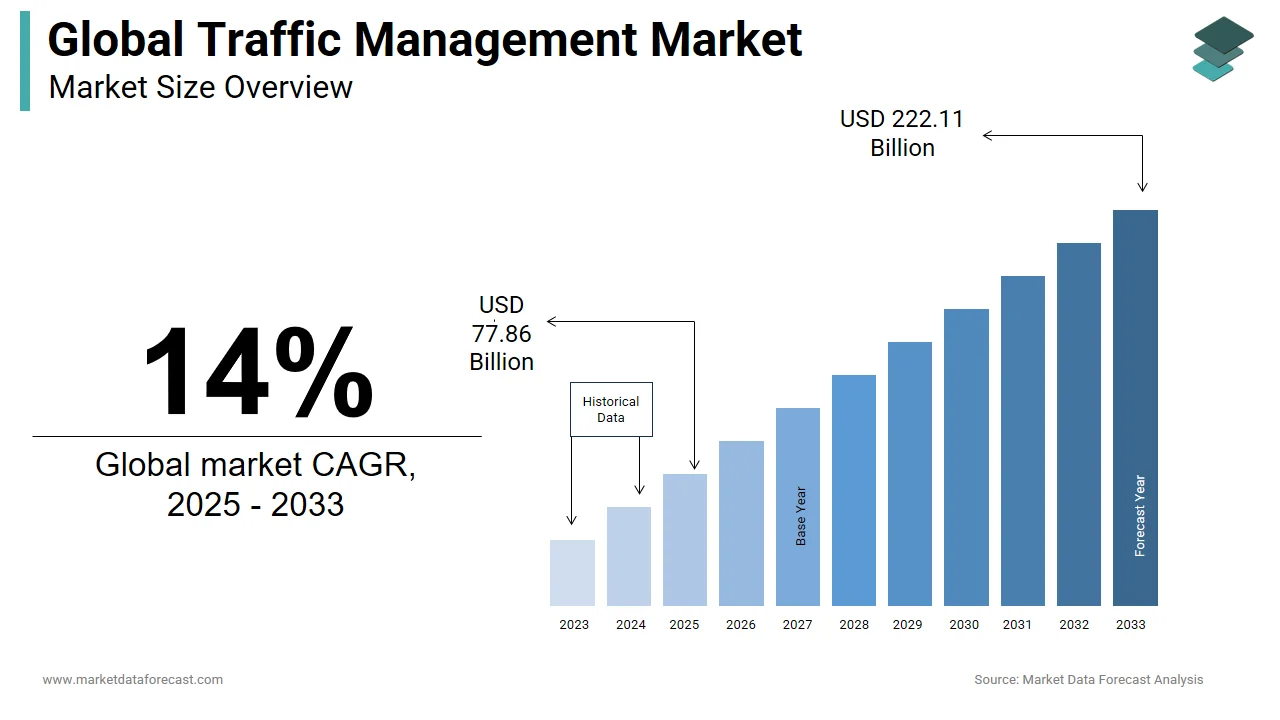
Traffic management refers to one of the crucial branches of logistics. It includes controlling and purchasing transport services, planning, and reducing traffic density. Traffic management systems offer real-time data and the ability to analyze and respond immediately. The increasing population around the world results in the increased usage of vehicles, which leads to congestion problems in almost all the nations of the world. Traffic management helps resolve the issues associated with such traffic concerns. It supports the free flow of vehicles on roads. Surveillance cameras, a prominent part of traffic management, will likely witness the highest demand and growth rate in the coming years.
MARKET DRIVERS
The main drivers of the global traffic management market include growing urbanization, government initiatives to modify traffic infrastructure, and growing public concern for security.
Increasing urbanization has intensified the levels of traffic density, making it difficult for the mass public to travel. The factors that drive the global traffic management market include the increase in the volume of airline traffic control. Due to inventions, the market is currently in its growth phase, and developing a new traffic management system that replaces obsolete technology contributes to market growth. The traffic management software segment represents the largest market share. Due to the development of advanced traffic management software that helps minimize air traffic volume, transportation needs, and increased traffic, this problem occurs mainly due to the population in the city, increased traffic, and urbanization. These problems are increased primarily due to the population increase in cities and urbanization. The implementation and integration services sector is expected to represent the highest CAGR. With the development of the Internet and communications industry, the traffic management system can reduce congestion, harmful emissions, and accidents.
The growing demand for intermodal transport planning, urban traffic management, and control, route guidance, predictive traffic modeling, etc., on roads, railways, and airways drives the global traffic management market. The increasing adoption of air travel, combined with the rise of the tourism industry and the increase in the number of low-cost air carriers, drives the demand for navigation and surveillance services and traffic management systems. This will reduce air traffic congestion and stimulate global air growth, supporting the rise in the traffic management market in the coming years.
MARKET RESTRAINTS
The restrictions associated with the global traffic management market include significant capital investment, legacy infrastructure systems, and traffic barriers due to processing downtime. Due to the lack of funds, governments in weak and developing countries refrain from investing in new technologies for circulation systems. Many urban areas in these countries do not have traffic lights. However, some countries have begun to include primary forms of traffic management systems, for example, CCTV cameras.
REPORT COVERAGE
| REPORT METRIC | DETAILS |
| Market Size Available | 2025 to 2034 |
| Base Year | 2025 |
| Forecast Period | 2026 to 2034 |
| CAGR | 14% |
| Segments Covered | By Components, Hardware, Solutions, Services, and Region |
|
Various Analyses Covered | Global, Regional & Country Level Analysis, Segment-Level Analysis, DROC, PESTLE Analysis, Porter’s Five Forces Analysis, Competitive Landscape, Analyst Overview on Investment Opportunities |
| Regions Covered | North America, Europe, APAC, Latin America, Middle East & Africa |
|
Market Leaders Profiled | Accenture PLC (Ireland), Atkins Group (United Kingdom), Cellint (Israel), Cisco Systems, Inc. (United States), Citilog (France), Cubic Corporation (USA), EFKON AG (Austria), Esri (California, USA), FLIR Systems, Inc. (USA), IBM Corporation (USA), and others. |
SEGMENTAL ANALYSIS
By Components Insights
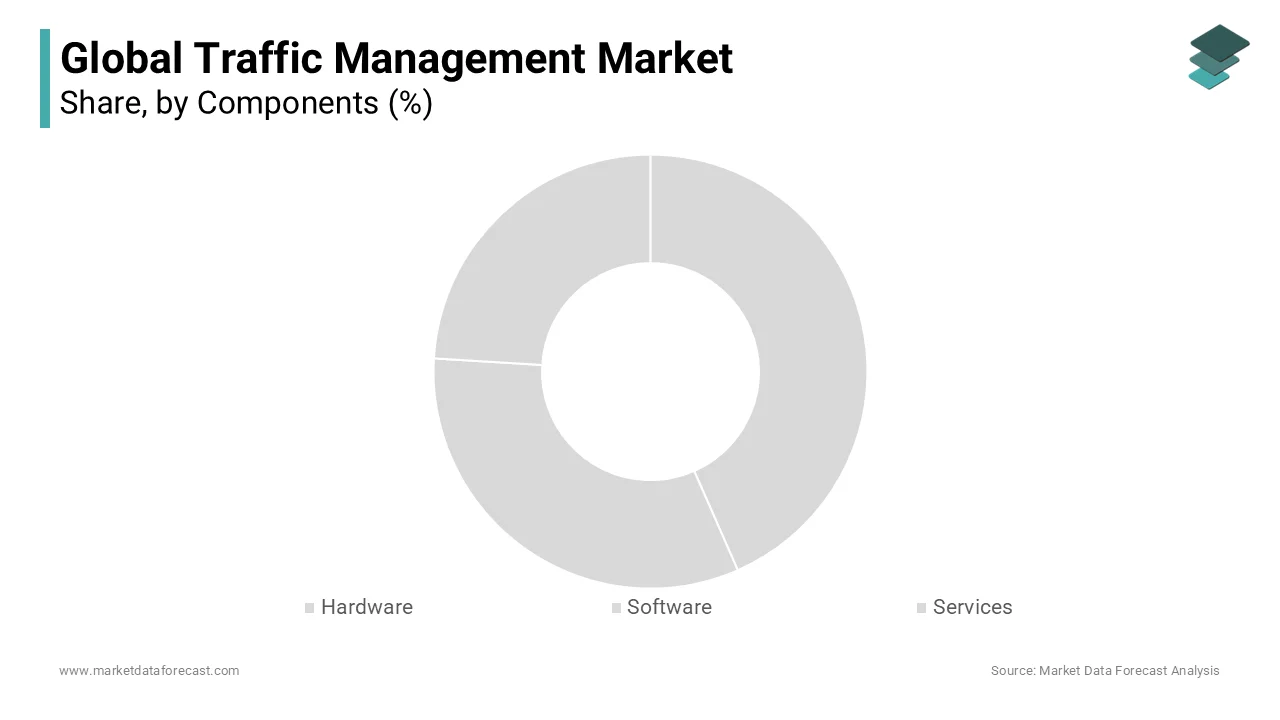
The global traffic management business is divided into hardware, solutions, and services. Of these, the services segment will likely expand with the highest growth rate in the coming years, attributed to the necessity for timely maintenance of the traffic management hardware and software after installation.
By Hardware Insights
The global traffic management market is divided into display boards, sensors, surveillance cameras, and others. The surveillance cameras segment is expected to account for the dominating share in the forecast period due to the increased adoption of surveillance cameras in developing regions to avoid mishaps and monitor traffic patterns.
By Solutions Insights
The global traffic management market is divided into intelligent signaling, route guidance and optimization, traffic analytics, and intelligent surveillance. The route guidance and optimization segment will likely account for a significant revenue share in the future because of the increasing demand for controlling traffic congestion worldwide.
By Services Insights
The worldwide traffic management market is segmented into consulting, integration and deployment, and backing and maintenance. The support and maintenance services are predicted to record the most substantial market value in the coming years.
REGIONAL ANALYSIS
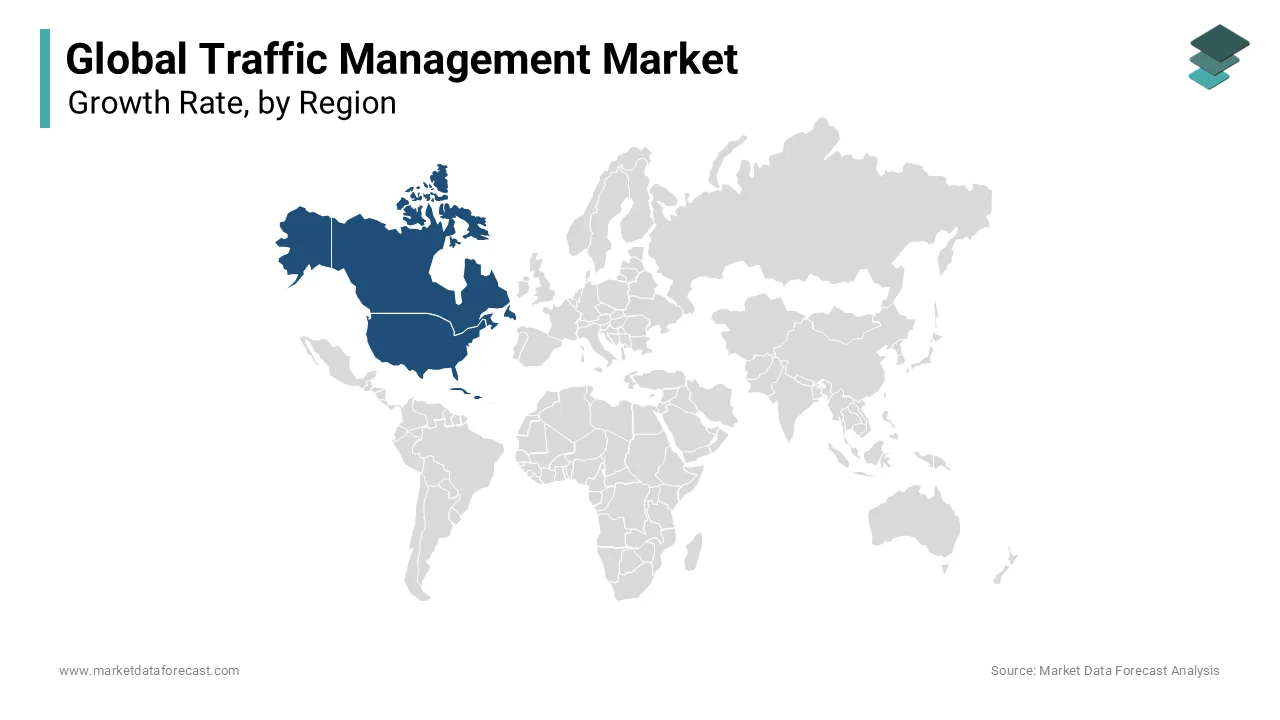
The North America traffic management market is foreseen to register the dominant value in the global business, followed by Europe. The early adoption of technology, the presence of key players, and strict government policies are supporting the dominion of the European industry. Nonetheless, the Asia Pacific traffic management market is estimated to record the highest growth rate in the estimated period.
KEY MARKET PARTICIPANTS
The major companies operating in the global traffic management market include Accenture PLC (Ireland), Atkins Group (United Kingdom), Cellint (Israel), Cisco Systems, Inc. (United States), Citilog (France), Cubic Corporation (USA), EFKON AG (Austria), Esri (California, USA), FLIR Systems, Inc. (USA), IBM Corporation (USA), among others.
RECENT MARKET HAPPENINGS
In October 2018, Kapsch TrafficCom and OMV Aktiengesellschaft (oil and gas producer and distributor) joined to provide a standardized European electronic toll service (EETS) for trucks.
MARKET SEGMENTATION
This research report on the global traffic management market has been segmented and sub-segmented based on the components, hardware, solutions, services, and region.
By Components
-
Hardware
-
Solutions
-
Services
By Hardware
-
Display Boards
-
Sensors
-
Surveillance Cameras
By solutions
-
Smart Signaling
-
Route Guidance and Optimization
-
Traffic Analytics
-
Smart Surveillance
By services
-
Consulting
-
Integration and Deployment
-
Support and Maintenance
By Region
-
North America
-
The United States
-
Canada
-
Rest of North America
-
-
Europe
-
The United Kingdom
-
Spain
-
Germany
-
Italy
-
France
-
Rest of Europe
-
-
The Asia Pacific
-
India
-
Japan
-
China
-
Australia
-
Singapore
-
Malaysia
-
South Korea
-
New Zealand
-
Southeast Asia
-
-
Latin America
-
Brazil
-
Argentina
-
Mexico
-
Rest of LATAM
-
-
The Middle East and Africa
-
Saudi Arabia
-
UAE
-
Lebanon
-
Jordan
-
Cyprus
-