- Product Description Description
- Table of Contents TOC
- List of Table & Figure LOT
- Get Free Sample PDF Sample PDF
Market Size, 2025
$262.01 BnMarket Estimate, 2026
$271.18 BnMarket Forecast, 2034
$357.09 BnCAGR, 2026–2034
3.50%Executive Summary: Global Transmission Repair Market
- Market Scope: Comprehensive global automotive transmission repair market analysis covering component parts, repair types, vehicle categories, regional dynamics, and powertrain transformation metrics.
- Market Valuation: Valued at USD 262.01 billion (2025), estimated at USD 271.18 billion (2026), and projected to reach USD 357.09 billion by 2034, registering a CAGR of 3.50% (2026–2034).
- Primary Growth Drivers: Expanding global vehicle parc and increasing average vehicle age requiring periodic maintenance and general repairs, rising adoption of hybrid and electric vehicles (HEVs) incorporating advanced hybrid transmissions, and massive manufacturing output in emerging automotive hubs. Restraints include the rapid market shift toward battery electric vehicles (BEVs) which feature simplified drivetrains and lower maintenance requirements, alongside pandemic-induced driving pattern adjustments.
Key Market Segment Metrics (2026–2034)
| Category | Leading Segment (2025 Position) | Fastest-Growing Segment |
|---|---|---|
| By Component | Gears, clutches, and standard mechanical replacement parts (vital for heavy-duty torque conversion and wear repair) | Transmission fluids and filters driven by preventive periodic maintenance services |
| By Repair Type | Transmission general repair (held ~79.2% market share, favored for extending vehicle lifecycle and improving fuel economy) | Transmission overhaul services for high-mileage commercial and passenger fleets |
| By Vehicle Type | Passenger vehicles (accounted for over 68% market share backed by massive global production and large active fleets) | Commercial vehicles undergoing intensive daily logistics operations |
| By Region | Asia-Pacific (dominates with ~35.9% global share driven by massive automotive manufacturing and sales hubs in China and India) | North America and Europe (steady expansion fueled by commercial vehicle fleets and premium transmission manufacturing) |
Major Market Players & Market Structure
Market Structure: Highly fragmented yet competitive aftermarket and OEM landscape featuring global tier-one powertrain suppliers, specialized transmission rebuild franchises, and quick-maintenance networks competing on electric axle (e-axle) integration, silicon carbide (SiC) inverter tech, and extended service convenience.
Key Companies: ZF Friedrichshafen (Germany), Schaeffler Group (Germany), Continental AG (Germany), BorgWarner Inc. (US), AAMCO Transmissions (US), Jiffy Lube (US), Driven Brands Inc. (US), Lee Myles (US), Aisin Seiki (Japan), Denso Corporation (Japan), and Mister Transmission (Canada).
Global Transmission Repair Market
The global transmission repair market size was valued at USD 262.01 billion in 2025 and is anticipated to reach a valuation of USD 271.18 billion in 2026 and USD 357.09 billion by 2034, growing at a CAGR of 3.5%, from 2026 to 2034.
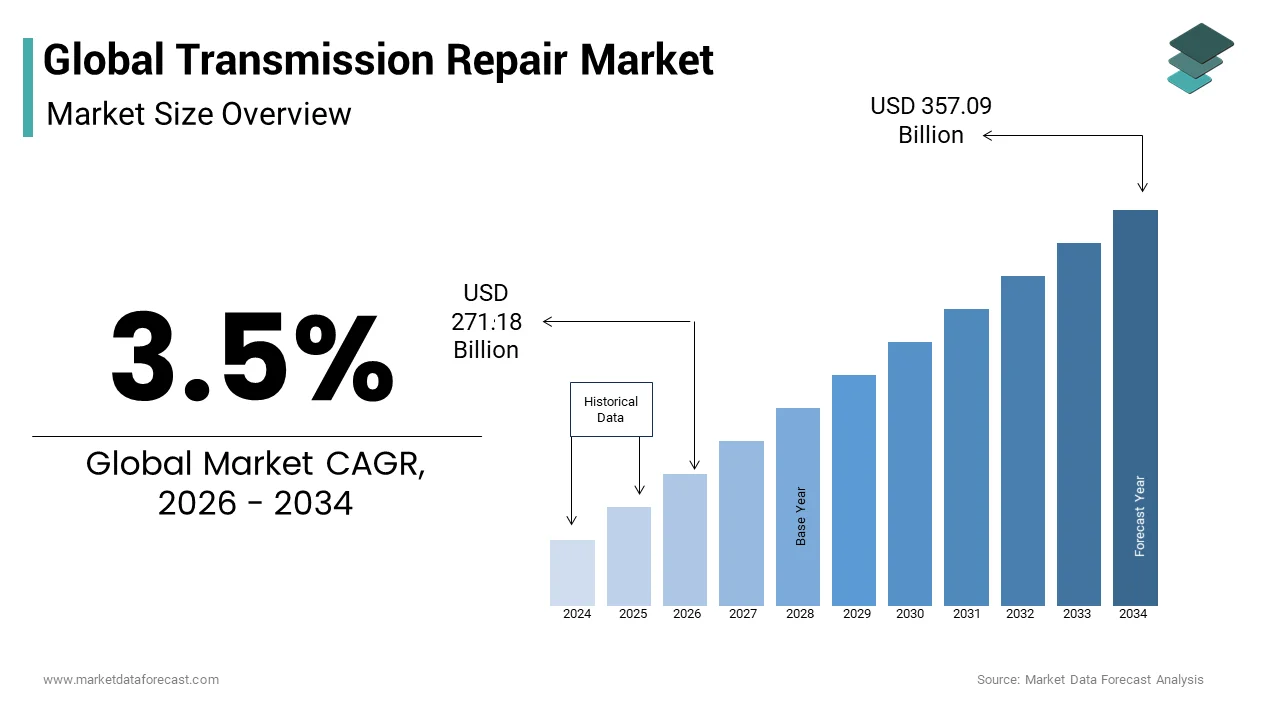
Transmission repair is specialized mechanical and electronic diagnostic, overhaul, rebuilding, and replacement services for manual, automatic, automated manual and continuously variable transmissions across commercial and passenger vehicle fleets. As a critical segment of the broader automotive aftermarket, this domain sustains operational longevity by restoring complex torque conversion and gear-shifting functionalities. According to S&P Global Mobility, the average age of light vehicles on western roadways reached 12.8 years, creating an expansive operational window where aging powertrains frequently require major internal component overhauls. This aging fleet dynamic directly drives workshop service volumes because older mechanical assemblies experience natural gear wear, seal degradation, and clutch friction failure. Furthermore, according to the International Organization of Motor Vehicle Manufacturers, global vehicle production surpassed 96.4 million units, establishing a massive long-term vehicle parc that continuously feeds future demand for specialized driveline maintenance and transmission restoration services.
MARKET DRIVERS
Aging Global Vehicle Parc and Extended Fleet Lifespans
Vehicle components reaching their operational design thresholds primarily propels the global transmission repair market growth as factory warranties have long expired and core transmission parts like torque converters, valve bodies and planetary gear sets succumb to thermal fatigue. Older vehicles require intensive mechanical interventions rather than simple fluid exchanges, driving vehicle owners to seek specialized rebuild services to avoid the prohibitive cost of acquiring brand-new replacement automobiles. According to the Federal Reserve Economic Data portal, consumer price indexes for motor vehicle maintenance and repair services experienced steady upward adjustments, mirroring heightened labor and specialized tooling requirements needed to service complex modern gearboxes. This economic environment relates directly to the transmission repair market by encouraging vehicle retention over replacement, thereby swelling service center appointment queues. Additionally, according to the United States Department of Transportation, national vehicle miles traveled metrics consistently hover near historic highs, accelerating mechanical wear on internal transmission components and cementing steady service demand.
Integration Of Advanced Multi-Speed And Electronic Control Systems
The technological shift away from simple mechanical gearboxes toward computer-controlled hydraulic systems that demand highly specialized diagnostic equipment, software recalibrations, and precise clutch pack replacements is further aiding the transmission repair market expansion. As per McKinsey and Company, the rapid proliferation of 8-speed, 9-speed, and dual-clutch transmission architectures introduces intricate electronic complexities that heavily boost professional repair service revenues. Modern transmissions rely heavily on integrated mechatronic control units and sensitive electronic solenoids that are prone to thermal degradation and electrical failure over time. According to the Automotive Aftermarket Suppliers Association, sales of advanced diagnostic tools and specialized electronic component replacements grew by 12% annually, highlighting the heavy reliance on professional intervention for modern transmission faults. This technical evolution relates directly to the transmission repair market because routine independent mechanics frequently lack the proprietary software and specialized training required to service complex transmissions, channeling distressed vehicle owners directly into dedicated transmission specialty shops. Furthermore, according to global automotive parts distribution surveys, complex transmission fluid and filter change compliance rates rose as vehicle manufacturers tightened maintenance parameters to preserve delicate internal components.
MARKET RESTRAINTS
Soaring Costs Of Replacement Assemblies And Specialized Components
The exorbitant price tag associated with purchasing brand-new OEM transmission assemblies is majorly hindering the transmission repair market expansion. As per the Bureau of Labor Statistics, persistent inflation in automotive parts manufacturing indices creates a heavy cost constraint that discourages consumers from opting for complete transmission replacements. When a transmission fails, the prohibitive cost of a full unit swap forces vehicle owners to seek localized rebuilding and targeted component repair as the only financially viable alternative. According to the Motor and Equipment Manufacturers Association, raw material input costs for precision steel gears and aluminum transmission housings increased across major fabrication hubs, driving up wholesale repair kit prices. This financial constraint relates directly to the transmission repair market by compressing consumer disposable budgets and forcing shop owners to navigate delicate pricing negotiations while maintaining service margins. Additionally, according to international automotive consumer reports, vehicle financing reluctance caused by elevated interest rates further deters consumers from buying new cars, leaving them trapped between high replacement costs and necessary localized transmission repairs.
Severe Shortage Of Certified Transmission Technicians And Specialized Labor
The high degree of specialized mechanical and electrical expertise required to successfully diagnose, teardown, rebuild, and calibrate modern computer-integrated transmissions is further impeding the global market growth. As per Automotive Service Association workforce studies, the acute and worsening deficit of skilled transmission technicians creates a major operational bottleneck that limits workshop throughput and expansion capabilities. As traditional master builders approach retirement age, vocational pipelines fail to inject an adequate volume of young technicians trained in advanced mechatronics and hydraulic fluid dynamics. According to the International Labour Organization, technical vocational education enrollment rates in advanced industrial trades lagged behind general service demands, creating a structural talent shortage across mechanical repair sectors. This labor deficit relates directly to the transmission repair market by extending vehicle turnaround times, elevating shop labor rates, and forcing transmission businesses to cap daily repair capacities. Furthermore, according to industry human resource benchmarks, shop owners must invest heavily in continuous proprietary training programs to keep existing staff updated on evolving gearbox technologies, adding substantial operational overhead expenses.
MARKET OPPORTUNITIES
Emergence Of Digital Diagnostic Platforms And Predictive Telematics
The shift from reactive breakdown repairs to proactive, data-driven maintenance enabled by onboard vehicle telematics that monitor transmission fluid health, slippage rates and operating temperatures in real-time is a promising opportunity for the global transmission repair market. As per Deloitte automotive insights, the integration of cloud-connected predictive diagnostics and automated fault-detection software unlocks lucrative modernization pathways for transmission repair enterprises. Advanced software tools allow repair facilities to pinpoint internal hydraulic pressure losses or valve body sticking before catastrophic mechanical failure occurs, transforming the customer acquisition model. According to the International Telecommunication Union, global enterprise investments in internet of things analytics platforms expanded by 18%, accelerating the deployment of remote vehicle health monitoring applications. This technological shift relates directly to the transmission repair market by enabling specialized shops to offer precision diagnostic subscriptions and targeted preventive maintenance services that build long-term consumer trust and recurring revenue streams. Additionally, according to aftermarket digital trade associations, repair shops utilizing automated customer relationship and digital diagnostic reporting software experience a 15% increase in repair approval speed.
Growth Of Specialized Remanufacturing And B2B Core Exchange Networks
The rising demand for pre-built, factory-spec remanufactured transmissions that an independent repair shop a reliable, time-saving alternative to complex in-house rebuilds is another notable opportunity for the global transmission repair market. As per aftermarket industry growth projections, the rapid expansion of standardized transmission remanufacturing programs creates powerful commercial opportunities for wholesale component suppliers and service networks. Remanufacturing centers take worn transmission cores, completely strip them, upgrade known factory defect points, and test them on computerized dyno benches before shipping them out with comprehensive warranties. According to the Automotive Aftermarket Industry Association, commercial core exchange program participation among independent repair facilities grew by 14% year-on-year, driven by the need for faster shop turnaround times. This operational evolution relates directly to the transmission repair market by standardizing repair quality, reducing vehicle bay occupancy times, and allowing smaller local mechanic shops to offer high-reliability transmission replacements backed by multi-year warranties. Furthermore, according to global logistics efficiency metrics, optimized reverse supply chains for heavy automotive cores have streamlined shipping transit times, enabling rapid nationwide delivery of specialized transmission units.
MARKET CHALLENGES
Extreme Complexity of Electric Vehicle Powertrain Transitions
The stark mechanical differences of electric vehicles that utilize single-speed reduction gearboxes containing significantly fewer moving parts, no multi-speed clutch packs, and zero traditional torque converters is a primary challenge to the global transmission repair market. As per International Energy Agency market evaluations, the accelerating global transition toward battery-electric vehicles presents a fundamental structural challenge to traditional internal combustion transmission repair businesses. Because electric vehicle reduction gears experience drastically lower mechanical wear and rarely require traditional rebuilding, the long-term addressable market for internal transmission repair shops faces a shrinking future revenue pool. According to S&P Global Mobility fleet composition studies, alternative propulsion vehicle registrations continue to scale upward across major metropolitan markets, gradually eating into the legacy internal combustion vehicle parc. This technological disruption relates directly to the transmission repair market by forcing traditional transmission specialists to diversify into electric drive unit maintenance, inverter cooling repairs, and high-voltage motor bearing replacements to survive. Additionally, according to automotive trade sentiment surveys, shop owners report high capital investment barriers when attempting to acquire the specialized insulated tools and high-voltage safety infrastructure required servicing electric vehicle drive units.
Escalating Costs of Proprietary Diagnostic Software and Specialized Tooling
Automakers restricting access to diagnostic source codes, flashing software and specialized transmission tuning parameters is another notable challenge to the global transmission repair market. As per independent automotive repair advocacy data, the rising barrier of proprietary software locks and expensive specialized tooling mandated by vehicle manufacturers creates severe operational friction. Modern transmission valve body replacements frequently require electronic flashing to sync with the vehicle's central computer, locking out shops that cannot afford continuous software licensing fees. According to the Federal Trade Commission market competition reviews, restricted access to digital repair documentation for complex vehicle subsystems adds significant overhead costs for independent service providers. This proprietary friction relates directly to the transmission repair market by threatening the viability of independent transmission shops that must compete with heavily equipped franchised dealership networks. Furthermore, according to equipment manufacturer financial disclosures, annual software update subscription fees for advanced diagnostic scanners increased by double digits, squeezing operational margins for independent transmission rebuilders.
REPORT COVERAGE
| REPORT METRIC | DETAILS |
| Market Size Available | 2025 to 2034 |
| Base Year | 2025 |
| Forecast Period | 2026 to 2034 |
| CAGR | 3.5% |
| Segments Covered | By Component, Type, Vehicle, and Region. |
| Various Analyses Covered | Global, Regional, & Country Level Analysis; Segment-Level Analysis; DROC; PESTLE Analysis; Porter’s Five Forces Analysis; Competitive Landscape; Analyst Overview of Investment Opportunities |
| Regions Covered | North America, Europe, APAC, Latin America, Middle East & Africa |
| Market Leaders Profiled | ZF (Germany), Schaeffler (Germany), Continental (Germany), BorgWarner (US), AAMCO Transmissions (US), Jiffy Lube (US), Driven Brands Inc (US), Lee Myles (US), Aisin Seiki (Japan), Denso (Japan), Mister Transmission (Canada), and Others. |
SEGMENT ANALYSIS
By Component Insights
The fluid segment led the market by capturing 30.3% of the global market share in 2025. The dominance of fluid segment in the global market can be credited to the essential function of hydraulic transmission oils in cooling, lubricating, and transmitting power across complex gear trains. This dominant position relates directly to the chemical breakdown and thermal degradation of specialized fluids under high operating temperatures, which requires vehicle owners to perform routine flush and fill interventions to prevent catastrophic internal slippage. Furthermore, according to the Automotive Aftermarket Suppliers Association, scheduled fluid maintenance compliance rates rose by 5% as vehicle manufacturers tightened viscosity specifications for modern multi-speed gearboxes.
However, the transmission filter segment emerges as the fastest growing category within the component classification and is anticipated to record a CAGR of 5.05% over the forecast period. This rapid expansion is driven by the heightened sensitivity of modern continuously variable and dual-clutch transmission valve bodies to microscopic metallic debris and friction clutch particulate contamination. According to the International Organization of Motor Vehicle Manufacturers, global production of advanced multi-speed automatic transmissions grew by 11%, increasing the operational density of internal hydraulic circuits that depend on pristine filtration. This accelerated growth rate connects directly to market expansion by making timely filter replacements a non-negotiable step during every major transmission service interval. Additionally, according to automotive parts distribution surveys, replacement sales of precision micro-mesh transmission filters surged by 14% year-on-year, highlighting the critical role clean filtration plays in extending modern transmission lifespans.
By Type Insights
The transmission general repair segment held the dominant position by accounting for 65.5% of the global market share in 2025. The growth of the transmission general repair segment in the global market is majorly driven by the high frequency of minor component fixes, fluid leak mitigations, and electronic solenoid replacements needed across aging vehicle populations. This dominant status relates directly to the reality that minor external seal leaks, sensor faults, and valve body cleanings occur far more frequently than complete internal mechanical cataclysms, drawing a steady stream of motorists into local service bays. Moreover, according to the Automotive Service Association, routine diagnostic and minor repair tickets represented over 70% of customer service transactions in urban automotive maintenance facilities.
On the other end, the transmission overhaul segment is expected to exhibit a prominent CAGR of 5.06% over the forecast period in the global market owing to the rising average age of light vehicles, which pushes accumulated mileage past critical thresholds where internal clutch packs, planetary gears, and steel torque converters suffer complete mechanical failure. According to S&P Global Mobility, the average operational age of passenger cars on western roadways reached 12.8 years, creating an expansive pool of high-mileage vehicles that require total teardown and rebuilding rather than basic surface repairs. This accelerated trend connects directly to the transmission repair market by driving high-value, high-margin workshop engagements that restore expired powertrains to factory specifications. Furthermore, according to the Motor and Equipment Manufacturers Association, specialized remanufacturing kit orders for complete transmission overhauls grew by 12% annually, cementing the strong financial trajectory of deep mechanical restoration services.
By Vehicle Type Insights
The passenger vehicles segment dominated the market by accounting for the 59.7% of the global market share in 2025 and establishing an unmatched baseline consumption volume for routine maintenance and component replacements. The dominance of passenger vehicles segment in the global market is anchored by massive global consumer ownership rates and the heavy daily utilization of personal automobiles. This dominant position relates directly to the sheer numerical superiority of passenger cars within the global vehicle parc, where millions of commuter vehicles continuously accumulate wear on automatic gearboxes. Additionally, according to the Federal Highway Administration, annual passenger vehicle miles traveled increased by 3.5%, accelerating thermal and mechanical stress on light-duty transmission components and ensuring a predictable flow of repair appointments.
However, the light commercial vehicles segment represents the fastest growing category and is projected to expand at a steady CAGR of 3.05% through the forecast period. This accelerated expansion is fueled by the explosive growth of last-mile e-commerce logistics, urban delivery fleets, and courier services that demand maximum vehicle uptime under punishing stop-and-go driving conditions. According to the International Road Transport Union, commercial delivery fleet utilization rates grew by 8% annually, subjecting delivery vans and light trucks to severe drivetrain loads that accelerate transmission wear. This rapid growth connects directly to the transmission repair market by forcing commercial operators to invest heavily in expedited maintenance, preventative overhauls, and robust fleet transmission contracts to avoid costly delivery delays. Furthermore, according to global logistics association benchmarks, commercial fleet managers allocate an estimated 15% of total maintenance budgets strictly toward drivetrain preservation and transmission upkeep.
REGIONAL ANALYSIS
Asia Pacific Market Analysis
Asia Pacific is likely to emerge as the fastest-growing regional market over the forecast period, propelled by massive automotive production output and soaring vehicle ownership rates across China and India. According to the China Association of Automobile Manufacturers, cumulative domestic vehicle production figures surpassed tens of millions of units annually, establishing an enormous foundational vehicle parc that is rapidly aging into the aftermarket repair window. This dominant regional position relates directly to the exponential surge in urban passenger car sales paired with punishing stop-and-go traffic conditions that accelerate automatic transmission clutch and fluid wear. Moreover, according to the Society of Indian Automobile Manufacturers, domestic commercial vehicle sales registered an 8% growth spike, driving heavy demand for ruggedized commercial transmission overhauls and rapid component replacements.
North America Market Analysis
North America is likely to maintain its dominant position and witness steady growth over the next few years, supported by a vast vehicle parc characterized by high average vehicle ages and a strong cultural preference for automatic transmissions. According to the United States Department of Transportation, national vehicle miles traveled reached historic peaks, placing continuous mechanical strain on light-duty torque converters and multi-speed gearboxes. This regional market status relates directly to the widespread saturation of complex automatic and continuously variable transmissions that require specialized professional intervention when mechanical failures occur. Additionally, according to the Specialty Equipment Market Association, regional automotive aftermarket service revenues expanded by 6% reflecting robust consumer spending on vehicle preservation and specialized transmission rebuild services.
Europe Market Analysis
Europe is likely to experience stable development and sustained moderate growth in the coming years, driven by rigorous environmental inspection standards, advanced engineering infrastructure, and a dense concentration of sophisticated dual-clutch and manual transmission vehicles. According to the European Automobile Manufacturers Association, the average operational lifespan of regional passenger cars exceeded 12 years, generating a steady pipeline of aging powertrains requiring expert mechanical restoration. This regional standing relates directly to strict continental roadworthiness codes that compel vehicle owners to repair fluid leaks and transmission faults promptly to pass mandatory safety inspections. Furthermore, according to the European Environment Agency, urban low-emission zone regulations prompted commercial operators to maintain existing delivery powertrains meticulously through specialized component replacements rather than early fleet disposal.
Latin America Market Analysis
Latin America is likely to show progressive commercial development and steady growth in the next few years, characterized by heavy reliance on aging passenger car fleets and localized independent mechanical repair workshops. According to the Economic Commission for Latin America and the Caribbean, regional vehicle import and registration volumes rose by 5%, steadily increasing the long-term addressable base for aftermarket transmission service providers. This market status relates directly to consumer economic pressures that favor vehicle retention and intensive rebuilding over purchasing brand-new replacement automobiles. Additionally, according to the Latin American Automotive Association, investments in regional independent garage networks grew by 7%, improving local technical capabilities for diagnosing complex hydraulic valve bodies and manual gear assemblies.
Middle East and Africa Market Analysis
The Middle East and Africa are likely to witness gradual commercial acceleration in the coming years, influenced by extreme ambient operating temperatures, heavy-duty commercial transport corridors, and high-performance luxury vehicle concentrations. According to the Arab Union of Railways and regional transport authorities, heavy commercial freight traffic expanded by 7%, creating intense mechanical demands on heavy-duty truck transmissions operating across severe desert environments. This regional market status relates directly to punishing thermal conditions that degrade transmission fluids rapidly, necessitating frequent filter changes, oil pump servicing, and specialized cooling maintenance. Furthermore, according to the African Development Bank, transnational trade corridor investments stimulated commercial fleet expansions, locking in steady regional demand for professional transmission rebuild services and replacement components.
COMPETITIVE LANDSCAPE
The global transmission repair market exhibits a moderately consolidated and fiercely competitive landscape governed by established multinational automotive suppliers and specialized component manufacturers. Industry participants continuously compete for high-value service contracts by offering engineered repair parts that comply with strict international durability, thermal tolerance, and environmental efficiency standards. Competition centers on technological innovation, inventory fulfillment speed, and the capacity to supply specialized rebuild kits for complex multi-speed automatic and dual-clutch gearboxes. Major market players heavily invest in localized distribution hubs, digital diagnostic integration, and comprehensive technician support programs to counteract supply chain volatility and reduce workshop turnaround times. Stringent regulatory compliance requirements and the expanding global average vehicle age further intensify rivalry, compelling firms to prioritize superior product reliability and robust customer service to secure long-term operational growth.
KEY MARKET PLAYERS
These are some of the major key players involved in the global transmission repair market.
- ZF (Germany)
- Schaeffler (Germany)
- Continental (Germany)
- Allison Transmission
- BorgWarner (US)
- AAMCO Transmissions (US)
- Jiffy Lube (US)
- Driven Brands Inc (US)
- Lee Myles (US)
- Aisin Seiki (Japan)
- Denso (Japan)
- Mister Transmission (Canada)
Top Players In The Market
- ZF Friedrichshafen AG operates as a prominent global technology company providing advanced drivetrain and chassis technology, supplying comprehensive aftermarket transmission components, remanufactured units, and technical service solutions for diverse vehicle categories. Its direct market involvement focuses on distributing original equipment replacement parts, diagnostic software tools, and repair kits that enable service workshops to efficiently restore multi-speed automatic and dual-clutch transmissions. To strengthen its commercial standing, the corporation continuously expands its global service network and digitalized logistics centers to accelerate spare parts delivery. Furthermore, the company invests heavily in advanced training programs for independent mechanics, ensuring technicians possess the specialized expertise required to service complex modern electronic transmission architectures.
- Schaeffler Group functions as a leading global automotive and industrial supplier recognized for delivering high-precision powertrain components, clutch systems, and specialized repair elements for manual, automatic, and continuously variable transmissions. Its core market involvement centers on engineering durable replacement components such as dual-mass flywheels, release bearings, and precision gear elements designed to withstand extreme thermal and mechanical operating loads. To reinforce its competitive position, the firm prioritizes accelerated research and development in mechatronic repair solutions and automated manufacturing lines that improve production accuracy. Additionally, the enterprise forms strategic partnerships with major independent aftermarket distributors, optimizing product availability and ensuring long-term customer retention across international automotive service networks.
- Allison Transmission holds a vital position globally as a premier designer and manufacturer of commercial duty fully automatic transmissions, providing extensive aftermarket support and specialized maintenance solutions. Its primary market involvement entails supplying robust replacement parts, transmission fluids, and remanufactured assemblies tailored specifically for heavy-duty commercial trucks, buses, and defense vehicles. For strengthening its competitive advantage, the corporation focuses on expanding its authorized service channel network and introducing advanced prognostic software tools that allow fleet managers to predict component wear before failure occurs. Moreover, the business continuously upgrades its digital catalog platforms and technical assistance infrastructure, ensuring swift troubleshooting capabilities and high operational uptime for commercial operators worldwide.
Top Strategies Used By Key Market Participants
Key market participants deploy advanced strategic initiatives including geographical expansion into high growth emerging economies, long-term supply agreements with commercial fleet operators, joint ventures for advanced diagnostic software development, and portfolio diversification into electrified vehicle drivetrain components. Furthermore, leading firms emphasize continuous investments in automated remanufacturing facilities, rigorous digital inventory tracking systems, and specialized technical training academies to maintain competitive advantages within the global industry.
Major Strategic Actions Taken By Key Companies
- In April 2024, DynaTouch, a kiosk solutions provider, acquired KioWare, a kiosk management software company, allowing DynaTouch to offer more comprehensive kiosk solutions and strengthen its market presence.
- In June 2024, ZF Friedrichshafen AG launched an expanded portfolio of digital diagnostic tools and remanufactured transmission modules to enhance service efficiency across independent European workshops.
- In October 2024, Schaeffler Group completed a major facility upgrade at its European distribution center to streamline the supply of precision clutch and transmission repair components.
- In January 2025, Allison Transmission announced a strategic expansion of its global authorized dealer network to improve regional availability of heavy-duty commercial vehicle parts.
- In March 2025, Continental AG introduced an advanced cloud-connected software suite designed to assist workshop technicians in identifying complex electronic transmission faults more rapidly.
MARKET SEGMENTATION
This research report on the global transmission repair market is segmented and sub-segmented based on component, type, vehicle, and region.
By Component
- Gasket & Seal
- Fluid, O-ring
- Transmission Filter
- Gear
- Clutch Plate
- Pressure Plate
- Oil Pump
By Type
- Transmission General Repair
- Transmission Overhaul.
By Vehicle
- Passenger
- Light Commercial
- Heavy Commercial Vehicles
By Region
- North America
- Europe
- Asia Pacific
- Latin America
- Middle East and Africa