- Product Description Description
- Table of Contents TOC
- List of Table & Figure LOT
- Get Free Sample PDF Sample PDF
Market Size, 2025
$18.90 BnMarket Estimate, 2026
$20.15 BnMarket Forecast, 2034
$33.60 BnCAGR, 2026–2034
6.6%Executive Summary: Global Truck and Bus Radial (TBR) Tire Market
- Market Scope: Comprehensive analysis of the global truck and bus radial (TBR) tire market evaluating vehicle categories, sales channels, application types, and regional market performances.
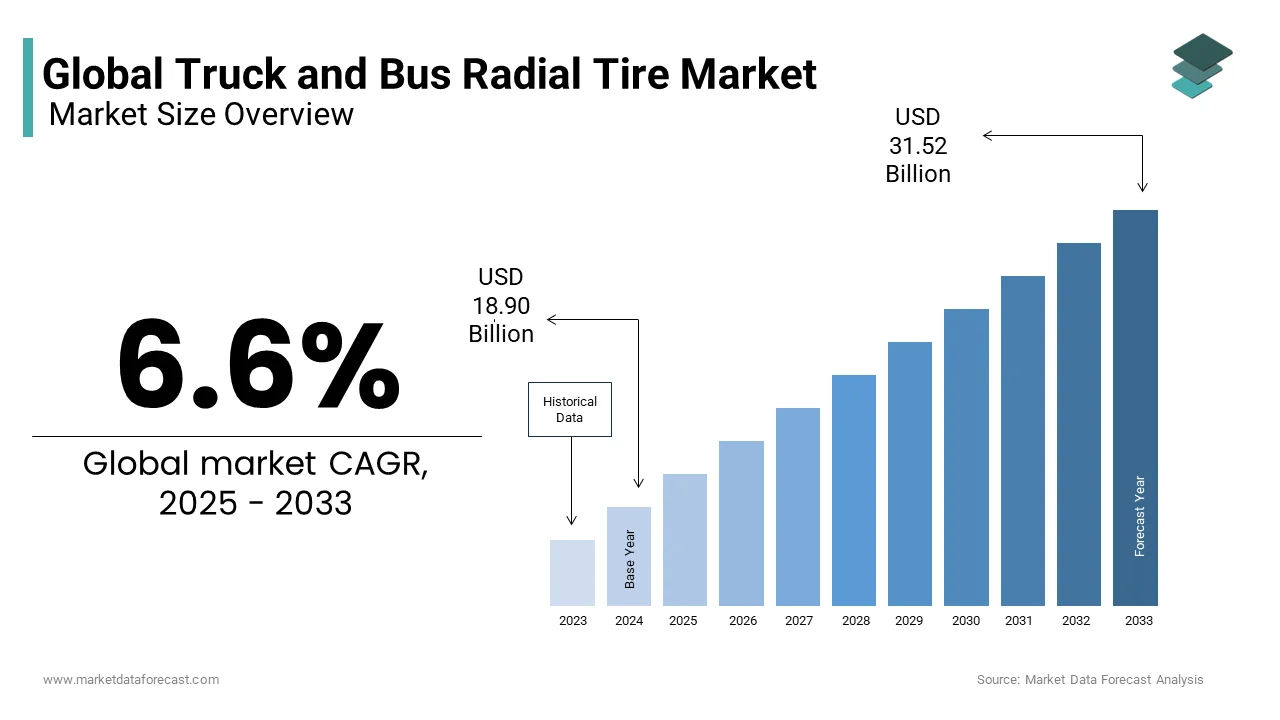
- Market Valuation: Valued at USD 18.90 billion in 2025, estimated at USD 20.15 billion in 2026, and projected to reach USD 33.60 billion by 2034, expanding at a strong CAGR of 6.6% from 2026 to 2034.
- Primary Growth Drivers: Rapid expansion of the global transportation and road freight industry, increasing urbanization, and escalating commercial vehicle fleet requirements.
Key Market Segment Metrics (2026–2034)
| Category | Leading Segment (Base Position) | Fastest-Growing / High-Growth Segment |
|---|---|---|
| By Vehicle Type | Heavy-Duty Trucks (dominates the market due to widespread utilization in long-distance freight, construction, and mining operations) | Buses & Medium-Duty Trucks (experiencing high growth driven by urban expansion and last-mile logistics demands) |
| By Sales Channel | OEM (Original Equipment Manufacturers) (leading segment backed by bulk factory installations and stable long-term supply contracts) | Aftermarket Sales (expanding rapidly due to high replacement frequency and commercial fleet maintenance cycles) |
| By Application | Long-Haul Applications (dominant segment requiring high durability, reduced rolling resistance, and exceptional tread life over cross-border routes) | Urban & Regional Haul (high-growth segments driven by stop-and-start city driving and e-commerce last-mile distribution) |
| By Region | Asia-Pacific (commands the largest market share fueled by rapid industrialization, urbanization, and major vehicle production hubs in China and India) | North America & Europe (key growth regions emphasizing fuel efficiency, smart tire technology, and strict environmental regulations) |
Major Market Players & Industry Landscape
Market Structure: Highly competitive global marketplace dominated by leading multinational tire corporations focusing on advanced material R&D, smart IoT sensor integration, and fuel-efficient product lines.
Key Companies: Bridgestone Corporation, Michelin, Goodyear Tire and Rubber Company, Continental AG, Pirelli & C. S.p.A., Sumitomo Rubber Industries Ltd., Yokohama Rubber Company Limited, Hankook Tire & Technology Co. Ltd., Apollo Tyres Ltd., and MRF Limited.
Global Truck and Bus Radial (TBR) Tire Market Size
The global truck and bus radial (TBR) tire market size was valued at USD 18.90 billion in 2025 and is anticipated to reach USD 20.15 billion to reach USD 33.60 billion in 2034, growing at a CAGR of 6.6% during the forecast period from 2026 to 2034.
Truck and Bus Radial (TBR) tires are a type of specialized tire designed for heavy-duty commercial vehicles such as trucks, buses, and other large transport vehicles. These tires are built with radial construction, which allows for more even flexing and better traction, resulting in improved fuel efficiency and longer tire life. TBR tires also have thicker sidewalls and deeper treads than passenger car tires, making them more durable and able to handle the high loads and stresses of heavy commercial use. Features such as reinforced casings and steel belts may also be included to provide additional strength and durability. TBR tires play a critical role in the transportation industry, enabling commercial vehicles to operate safely and efficiently over long distances while carrying heavy loads.
MARKET DRIVERS
The growth of the transportation industry, particularly in emerging markets, has driven the demand for Truck and Bus Radial (TBR) tires. With the increase in the number of commercial vehicles in fleets, the demand for durable and reliable tires that can withstand high loads and long distances has grown significantly. As a result, the TBR tire market has experienced substantial growth, with tire manufacturers investing in research and development to improve the performance and durability of TBR tires.
The trend of increasing urbanization has contributed to the growth of the Truck and Bus Radial (TBR) tire market. As more people move to cities, there is a greater need for commercial vehicles to transport goods and people in and around urban areas. These vehicles require durable and reliable tires that can handle the unique challenges of city driving, such as frequent stops and starts, tight turns, and uneven road surfaces. As a result, the demand for TBR tires, which are designed to provide superior performance and durability, has increased. Tire manufacturers have responded to this demand by developing new and innovative TBR tire designs that are optimized for urban driving conditions.
The increasing demand for commercial vehicles, particularly in the road freight sector, is driving growth in the Truck and Bus Radial (TBR) tire market. As heavy-duty commercial vehicles require tires that can withstand high loads and long distances, TBR tires are the preferred choice. The growth of the transportation industry, coupled with increasing international trade and e-commerce, is expected to continue driving demand for TBR tires in the coming years.
MARKET RESTRAINTS
The high cost of Truck and Bus Radial (TBR) tires is a significant restraint on the growth of the TBR tire market. This high cost can be a barrier to entry for smaller commercial vehicle operators, who may opt for cheaper alternatives such as retreaded tires. Additionally, even larger operators may be deterred from purchasing TBR tires due to their higher upfront costs. This can lead to a reduction in overall demand for TBR tires, particularly in price-sensitive markets. Tire manufacturers and suppliers may need to explore ways to reduce production costs or offer more affordable pricing options to make TBR tires more accessible to a wider range of customers and increase market demand.
MARKET OPPORTUNITIES
Advancements in tire design and materials are expected to drive innovation in the Truck and Bus Radial (TBR) tire market. Tire manufacturers are exploring the use of new materials to increase durability and fuel efficiency. Additionally, the integration of smart technology such as sensors and connectivity features is expected to enhance tire performance and provide valuable data insights. These advancements present opportunities for manufacturers and suppliers to differentiate themselves and offer unique value propositions to customers seeking high-performance and efficient TBR tires.
The expansion of e-commerce and last-mile delivery services presents a significant growth opportunity for the Truck and Bus Radial (TBR) tire market. The demand for smaller commercial vehicles such as vans and delivery trucks is increasing, which typically require smaller TBR tires. This presents an opportunity for tire manufacturers and suppliers to cater to this growing market segment with smaller TBR tire options. Additionally, the growth of e-commerce and last-mile delivery services is expected to drive increased demand for high-performance and durable TBR tires, creating opportunities for manufacturers and suppliers to differentiate themselves and offer value-added solutions.
COVID-19 Impact Market
The COVID-19 pandemic has had a significant impact on the Truck and Bus Radial (TBR) tire market. In the early stages of the pandemic, the market saw a decline in demand due to disruptions in the global supply chain and a decrease in transportation activity. However, as the pandemic continued, demand for TBR tires began to recover due to increased transportation needs for essential goods and services. On the supply side, tire manufacturers faced significant disruptions due to factory shutdowns and logistics challenges. This led to production delays and shortages in the market, which resulted in increased prices and longer lead times for customers. Additionally, the pandemic has accelerated the shift towards e-commerce and last-mile delivery, driving demand for smaller commercial vehicles and smaller TBR tires. This has created new opportunities for manufacturers and suppliers to cater to this growing market segment. Overall, while the pandemic initially had a mixed impact on the TBR tire market, the recovery of transportation activity and the shift towards e-commerce and last-mile delivery have created new opportunities for growth and innovation in the industry.
REPORT COVERAGE
| REPORT METRIC | DETAILS |
| Market Size Available | 2025 to 2034 |
| Base Year | 2025 |
| Forecast Period | 2026 to 2034 |
| CAGR | 6.6% |
| Segments Covered | By Vehicle, Sales Channel, Application, and Region. |
| Various Analyses Covered | Global, Regional & Country Level Analysis, Segment-Level Analysis, DROC, PESTLE Analysis, Porter’s Five Forces Analysis, Competitive Landscape, Analyst Overview of Investment Opportunities |
| Regions Covered | North America, Europe, APAC, Latin America, Middle East & Africa |
| Market Leaders Profiled | Bridgestone Corporation, Michelin, Goodyear Tire and Rubber Company, Continental AG, Pirelli & C. S.p.A., Sumitomo Rubber Industries Ltd., Yokohama Rubber Company, Limited, Hankook Tire & Technology Co. Ltd., Apollo Tyres Ltd., MRF Limited, and Others. |
SEGMENT ANALYSIS
By Vehicle Insights
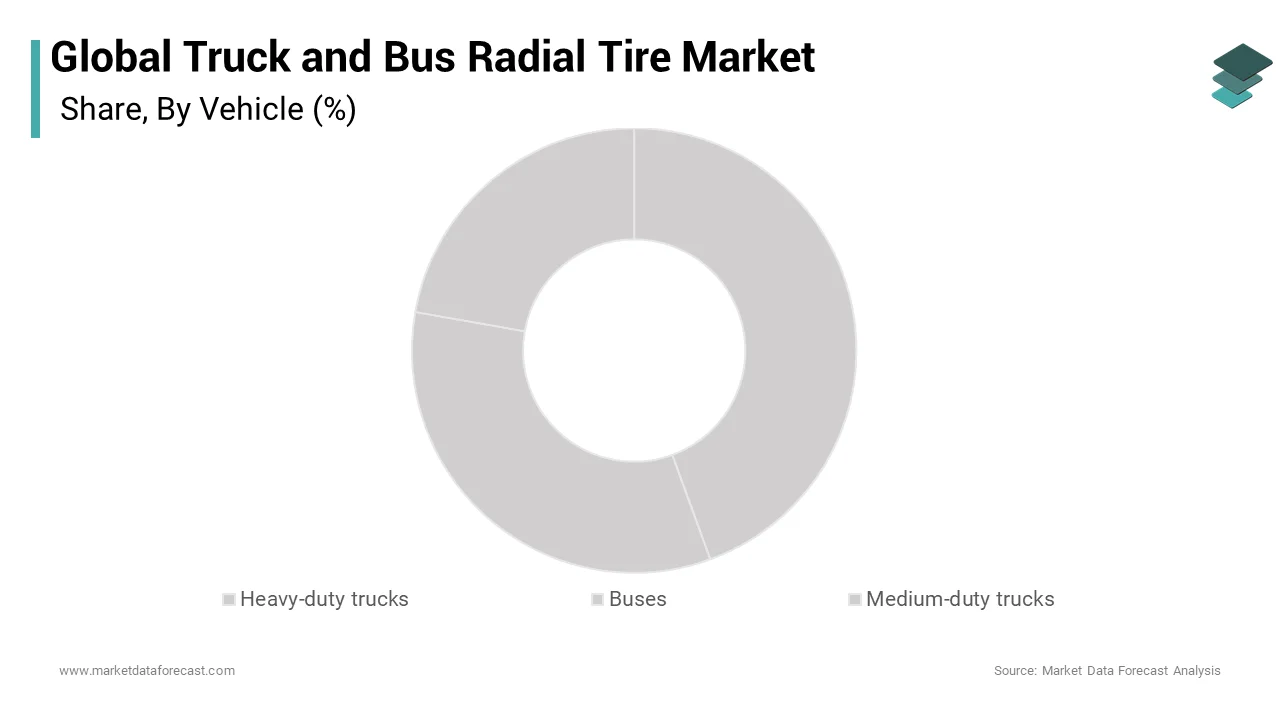
Heavy-duty trucks are currently dominating the market. This is because heavy-duty trucks are widely used in various industries such as construction, mining, and the transportation of goods over long distances. These trucks require durable and reliable tires that can withstand heavy loads and provide good traction and grip on various road surfaces. TBR tires are the preferred choice for heavy-duty trucks as they offer superior durability, reduced rolling resistance, and longer tread life compared to other tire types.
By Sales Channel Insights
The OEM (original equipment manufacturers) segment is currently dominating the TBR tire market in the sales channel segmentation. This is because OEMs are the primary customers for TBR tire manufacturers, as they purchase tires in bulk for installation on new commercial vehicles. Additionally, OEMs often have long-term contracts with tire manufacturers, which can provide stable and consistent demand for TBR tires.
By Application Insights
Long-haul applications are currently dominating the TBR tire market in the application type segmentation. Long-haul transportation involves transporting goods over long distances, often crossing state or national borders. This type of application requires tires that can withstand high speeds and heavy loads while maintaining fuel efficiency and providing good traction. TBR tires are ideal for long-haul applications as they offer high durability, longer tread life, and lower rolling resistance compared to other tire types.
REGIONAL ANALYSIS
Asia-Pacific is currently dominating the market, driven by the region's large and growing transportation industry, industrialization, and urbanization. The region's economies are rapidly developing, increasing the demand for commercial vehicles and subsequently, TBR tires. North America and Europe are also experiencing significant growth, driven by expanding transportation industries, the growth of e-commerce and manufacturing sectors, and government investments in infrastructure development. The Middle East and Africa TBR tire market is growing due to rising demand in heavy-duty applications such as construction and mining, as well as infrastructure development and economic growth. Latin America is also experiencing market growth, driven by the expansion of transportation industries, manufacturing, and construction sectors, and the presence of major tire manufacturers in the region. The TBR tire market's growth and dominance in these regions can be attributed to various factors, including demand for fuel-efficient tires, technological advancements, and increasing safety and environmental regulations.
COMPETITIVE LANDSCAPE
KEY MARKET PLAYERS
A few of the market players in the global truck and radial tire market include
- Bridgestone Corporation
- Michelin
- Goodyear Tire and Rubber Company
- Continental AG
- Pirelli & C. S.p.A.
- Sumitomo Rubber Industries Ltd
- Yokohama Rubber Company Limited
- Hankook Tire & Technology Co. Ltd
- Apollo Tyres Ltd
- MRF Limited.
RECENT MARKET NEWS
- In April 2021, Continental announced that it had expanded its range of TBR tires with the launch of the EcoContact 6, a new tire designed for use on electric buses and other commercial vehicles.
- In May 2021, Bridgestone announced that it had launched its new FuelTech range of TBR tires in Europe. These tires are designed to offer improved fuel efficiency and lower carbon emissions for commercial vehicles.
MARKET SEGMENTATION
This research report on the global truck and radial tire market is segmented and sub-segmented into the following categories.
By Vehicle
- Heavy-duty trucks
- Buses
- Medium-duty trucks
By Sales Channel
- OEM
- Aftermarket sales.
By Application
- Long haul
- Regional haul
- Urban applications
By Region
- North America
- Europe
- Asia-pacific
- Middle East and Africa
- Latin America