- Product Description Description
- Table of Contents TOC
- List of Table & Figure LOT
- Get Free Sample PDF Sample PDF
Market Size, 2025
$8.11 BnMarket Estimate, 2026
$8.70 BnMarket Forecast, 2034
$15.24 BnCAGR, 2026–2034
7.26%Executive Summary: Truck Market
- Market Scope: Comprehensive global truck market analysis covering weight classes, propulsion systems, end-use applications, regional leadership frameworks, and commercial transport metrics.
- Market Valuation: Valued at USD 8.11 billion (2025 base year), estimated at USD 8.70 billion (2026), and projected to reach USD 15.24 billion by 2034, registering a robust CAGR of 7.26% (2026–2034).
- Primary Growth Drivers: Expanding freight-corridor infrastructure, global transition toward electrification, and rigorous low-emission regulations. Key industry and trade highlights include electric truck sales reaching ~54,000 units in 2023 (China accounting for ~70%), India constructing ~19,826 km of freight-corridor infrastructure by March 2025, China operating a commercial truck fleet exceeding 33 million units, and Canada’s trucking sector supporting 55%–68% of cross-border trade with the U.S. (surpassing USD 2 billion daily).
Key Market Segment Metrics (2026–2034)
| Category | Leading Segment (2025 Position) | Fastest-Growing Segment |
|---|---|---|
| By Vehicle Class | Class 8 Trucks (dominated the class segment in 2025) | Class 3 Trucks (projected to register the fastest CAGR of 8.3%) |
| By Propulsion Type | Diesel Propulsion (commanded a substantial propulsion share in 2025) | Electric Propulsion & Hydrogen Fuel Cell Systems (projected at a 29.7% CAGR) |
| By End-Use Application | Logistics & Transportation (led applications with a 64.8% market share in 2025) | Retail & E-Commerce Logistics (projected to grow at a 10.4% CAGR) |
| By Region / Country | Asia Pacific (dominated geographically with 35.3% of the global market in 2025) | North American & European Low-Emission Freight Corridors |
Major Market Players & Market Structure
Market Structure: Highly competitive global commercial vehicle landscape featuring major multinational automotive and truck manufacturing enterprises competing intensely on fleet electrification, hydrogen-powered trucks, autonomous driving, advanced telematics, predictive maintenance, and localized manufacturing footprints to comply with strict standards like U.S. Phase 3 Heavy-Duty GHG rules and European low-emission zones.
Key Companies: Ashok Leyland, Daimler Trucks, Dongfeng Motor, Ford, Isuzu, Paccar, Scania, Tata Motors, Toyota, and Volvo Group.
Global Truck Market Size
The global trucks market size was valued at USD 8.11 billion in 2025 and is anticipated to reach a valuation of USD 8.70 billion in 2026 and USD 15.24 billion by 2034, growing at a CAGR of 7.26%, from 2026 to 2034.
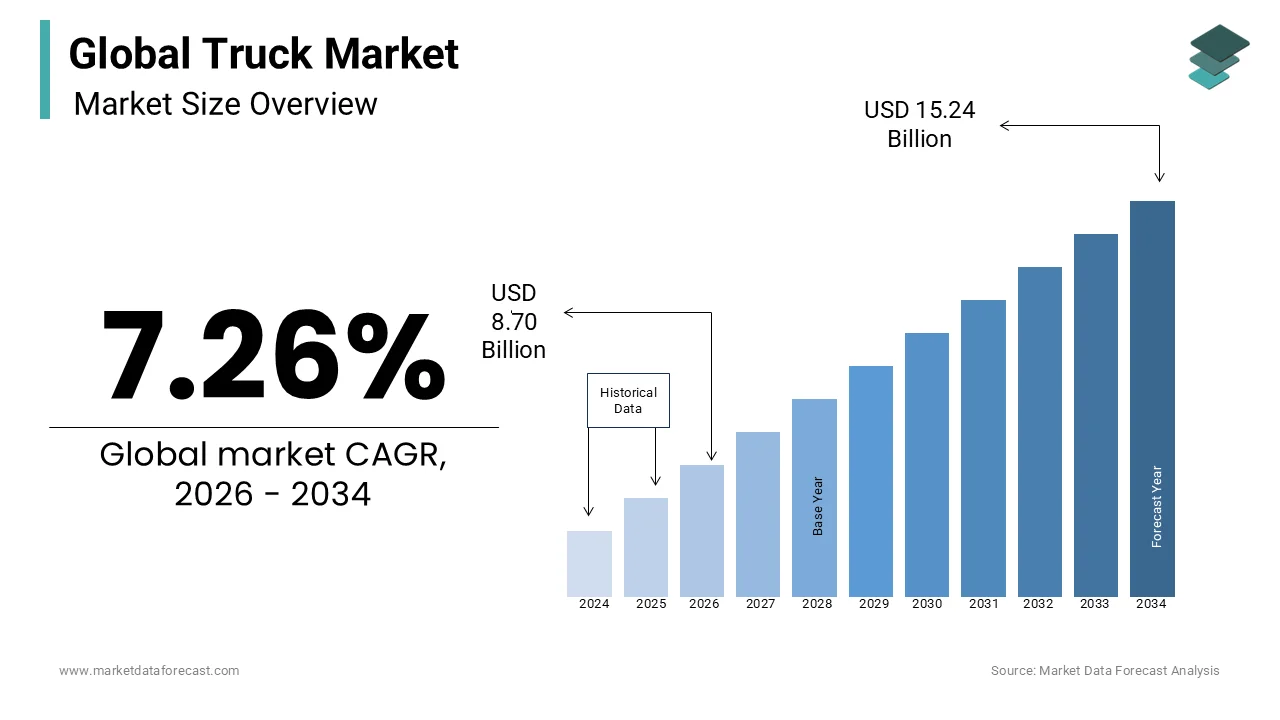
The truck vehicles are classified by gross vehicle weight (GVW), ranging from 3.5 to over 33 tons, which serve as the backbone of terrestrial supply chains that enable the movement of raw materials, consumer goods, and industrial equipment. According to the study, trucks account for a portion of global road freight activity and are responsible for a notable share of carbon dioxide emissions from freight transport, despite representing only a small share of total vehicle numbers on roads.
MARKET DRIVERS
Expansion of E-Commerce and Last-Mile Delivery Infrastructure
The exponential growth of online retail and unprecedented demand for light- and medium-duty delivery trucks optimized for urban logistics is driving the growth of the global truck market. According to the study, the global e-commerce sales surged in recent years, with a portion of final deliveries executed via road transport. In the United States, as per a study, last-mile delivery vehicles accounted for an increase in urban truck traffic. Amazon alone operates a fleet of custom electric delivery vans in North America and Europe, with plans to expand units, as per the research. Similarly, in China, JD.com and SF Express have continued to expand their logistics capabilities since 2021 to support same-day delivery.
Infrastructure-Led Freight Corridor Development in Emerging Economies
Large-scale infrastructure investments in transport networks for improving road connectivity and reducing transit are expected to enhance the growth of the global truck market. According to the study, as of March 2025, approximately 19,826 km had been constructed in India. The completion of Phase I is now expected by 2027–2028, a delay from the initial 2022 target. The African Union's Programme for Infrastructure Development in Africa (PIDA) aims to achieve continental infrastructure integration by 2040 across several sectors, including transport. In Southeast Asia, the ASEAN Highway Network has enhanced cross-border trucking efficiency, reducing travel time between Bangkok and Ho Chi Minh City by hours.
MARKET RESTRAINTS
Severe Shortage of Qualified Truck Drivers
The lack of professional drivers is restraining the growth of the global truck market. It is constraining trucking capacity and increasing operational costs across major markets. According to the study, the U.S. faced a shortage of drivers, a figure projected to rise by 2030 due to retirements and low recruitment. As per the study, the EU requires additional drivers to meet current freight demand, with Germany alone needing more drivers to avoid supply chain disruptions. In Australia, the driver shortages have increased freight costs. The issue is exacerbated by the physically demanding nature of the job, long periods away from home, and stringent licensing requirements. Countries like
Volatility in Diesel Fuel Supply and Pricing
The diesel price fluctuations are another factor limiting the growth of the global truck market. This significantly impacts trucking economics, as fuel constitutes a portion of operating costs for most fleets. In 2022, the price of diesel did increase substantially, driven by geopolitical conflicts and supply chain disruptions. This volatility forces operators to renegotiate contracts, delay fleet renewals, or pass costs to shippers, dampening demand for new truck purchases. Apart from these, carbon pricing mechanisms such as those in Canada are expected to increase diesel costs in the coming years, according to a study, which is further pressuring operators and reducing the economic viability of conventional diesel-powered trucks.
MARKET OPPORTUNITIES
Accelerated Adoption of Battery-Electric Trucks (BETs)
The transition to zero-emission freight is a major opportunity for the growth of the global truck market. According to the International Energy Agency (IEA), global sales of electric trucks were around 54,000 units in 2023, with China accounting for about 70% of the total. This growth in China was driven in part by a variety of factors, including specific policies that accelerate zero-emission truck adoption in major cities. In Europe, the number of electric truck charging hubs is operational along the TEN-T network, supporting long-haul pilots by Daimler and Volvo. Tesla’s Semi has secured pre-orders from PepsiCo, UPS, and Walmart. According to the study, the electric Class 8 trucks achieve lower operating costs per mile compared to diesel equivalents.
Integration of Telematics and Predictive Maintenance Systems
The digitalization of truck fleets through telematics, AI-driven diagnostics, and over-the-air (OTA) updates that enhance operational efficiency and reduce downtime is another opportunity for the growth of the global truck market. Daimler Trucks points out that its Fleetboard system collects data points per vehicle annually, enabling predictive maintenance that extends component life. According to research, electronic logging devices (ELDs), required for all commercial trucks, have improved compliance and scheduling accuracy.
MARKET CHALLENGES
Stringent Emission Regulations and Compliance Costs
The stringent emission regulations and compliance costs are a major challenge for the growth of the global truck market. Truck manufacturers face escalating pressure to meet evolving emissions standards, which require substantial investment in clean engine technologies and after-treatment systems. The EPA's Phase 3 Heavy-Duty Greenhouse Gas standards, effective starting with model year 2027, aim to reduce CO₂ emissions by up to 60% for some vehicle classes by 2032. In India, the transition to Bharat Stage VI (equivalent to Euro VI) has increased the cost of a new truck, as per the study. These regulatory burdens are particularly challenging for smaller manufacturers lacking R&D scale.
Urban Access Restrictions and Low-Emission Zones (LEZs)
The proliferation of urban low-emission and zero-emission zones in major cities is another attribute limiting the growth of the global truck market. As per the study, over 300 LEZs are now active across Europe, with cities like London, Paris, and Berlin imposing fines or outright bans on non-compliant diesel trucks. In 2025, the city of Amsterdam will introduce a zero-emission zone for all new vans and lorries within the S100 ring road, as per the research. China has established many clean transport zones in cities such as Beijing and Shanghai, which restrict older trucks and mandate real-time emissions monitoring. These policies compel logistics firms to invest in smaller electric delivery vehicles or adopt cargo consolidation hubs on city outskirts, increasing last-mile costs, according to research. The lack of harmonized regulations across municipalities further complicates fleet planning and route optimization.
REPORT COVERAGE
| REPORT METRIC | DETAILS |
| Market Size Available | 2025 to 2034 |
| Base Year | 2025 |
| Forecast Period | 2026 to 2034 |
| CAGR | 7.26% |
| Segments Covered | By Class, Propulsion, Application, and Region |
| Various Analyses Covered | Global, Regional & Country Level Analysis, Segment-Level Analysis, DROC, PESTLE Analysis, Porter’s Five Forces Analysis, Competitive Landscape, Analyst Overview on Investment Opportunities |
| Regions Covered | North America, Europe, APAC, Latin America, Middle East & Africa |
| Market Leaders Profiled | Ashok Leyland, Daimler Trucks, Dongfeng Motor, Ford, Isuzu, Paccar, Scania, Tata Motors, Toyota, Volvo Group. |
SEGMENT ANALYSIS
By Class Insights
The class 8 trucks segment dominated the truck market by accounting for a prominent share of the market in 2025. These vehicles, weighing significant pounds GVW, are the primary workhorses of long-haul freight, responsible for moving a portion of all domestic goods by road in the United States, according to the research. The growth of the class 8 trucks segment is driven by the structural reliance of national supply chains on over-the-road (OTR) tractor-trailers for cross-country cargo transport. In 2023, demand for new Class 8 trucks in North America, including the U.S., was resilient but not consistently sustained. The rise of just-in-time delivery models and the expansion of intermodal freight terminals have further amplified the need for high-capacity, fuel-efficient Class 8 units capable of operating 24/7 across interstate corridors.
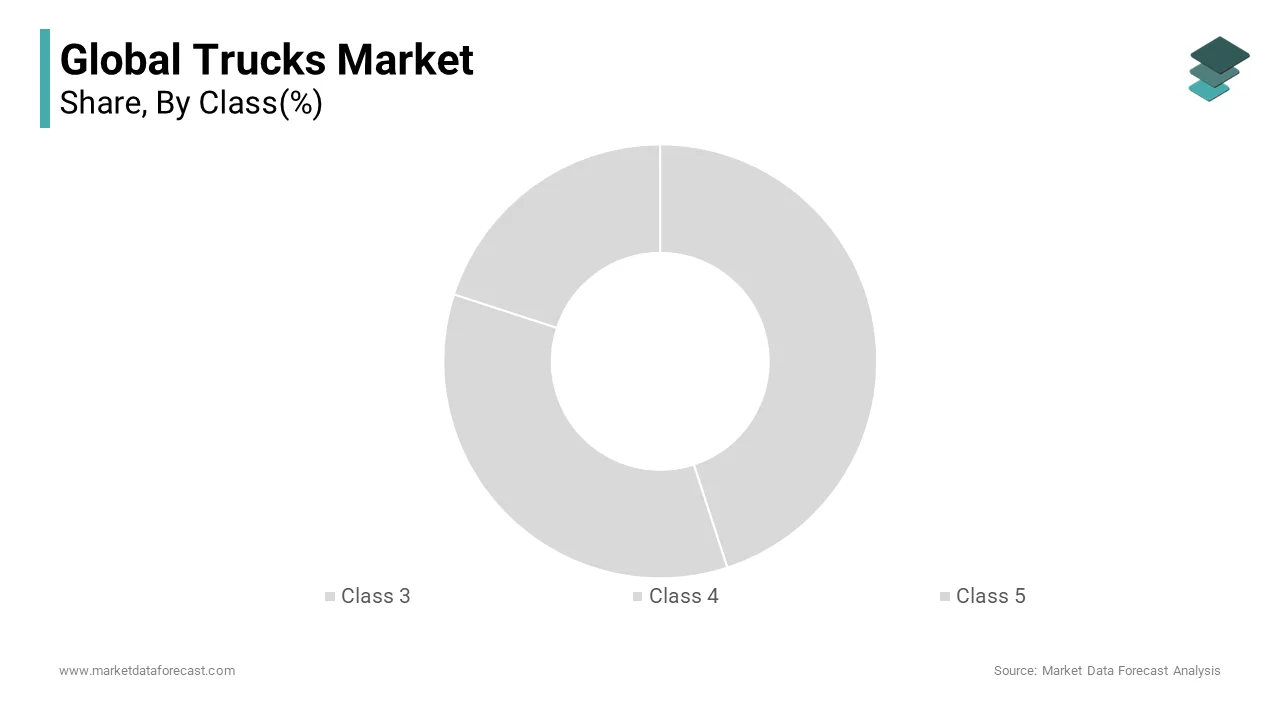
The Class 3 segment is anticipated to witness the fastest CAGR of 8.3% from 2025 to 2033. The growth of the segment can be attributed to the surge in last-mile delivery operations and the proliferation of e-commerce logistics networks. Class 3 trucks, ranging from 14,001 to 17,999 pounds GVW, are ideal for urban delivery fleets due to their maneuverability, lower operating costs, and compatibility with medium-duty electric platforms. According to the study, a portion of new delivery vans deployed by UPS, FedEx, and Amazon fell within the Class 3 category. Apart from these, municipal policies promoting off-hour deliveries and curb access for smaller trucks are accelerating adoption.
By Propulsion Insights
The diesel segment commanded the truck market by capturing a substantial share in 2025. The growth of the diesel segment is driven by its superior energy density, torque output, and established refueling infrastructure, which are long-haul and high-payload operations. According to the research, a portion of trucks operating on European motorways are diesel-powered, with fuel efficiency improvements due to advancements in common-rail injection and exhaust after-treatment systems. In India, diesel accounts for a notable share of commercial vehicle propulsion due to its better fuel economy compared to gasoline.
The Electric propulsion segment is likely to experience the fastest CAGR of 29.7% over the forecast period, owing to regulatory mandates, falling battery costs, and corporate sustainability commitments. The average price of lithium-ion batteries has declined since 2010, making electric trucks increasingly competitive on the total cost of ownership. In China, several battery-electric trucks were sold, supported by government subsidies and urban zero-emission zone policies, according to research. In the US, electric Class 6 and 7 trucks achieve lower maintenance costs than diesel equivalents due to fewer moving parts. Companies like Daimler, Volvo, and Tesla are scaling production, with Tesla’s Semi already achieving significant miles of real-world operation.
By Application Insights
The Logistics & Transportation segment led the market by accounting for 64.8% share in 2025. The growth of the logistics & transport segment is driven by the sector’s central role in global supply chains, with trucks moving a notable share of all intercity freight in major economies. According to the research, global road freight volume reached substantial ton-kilometers in 2023, driven by containerized cargo, cold-chain logistics, and parcel delivery networks. In Germany, logistics firms operate several trucks, representing a portion of the country’s commercial fleet, as per the study. The rise of third-party logistics (3PL) providers and digital freight platforms like Convoy and Flexport has intensified demand for standardized, GPS-enabled trucks with high uptime.
The Retail & E-Commerce application segment is on the rise and is expected to grow with a CAGR of 10.4% during the forecast period. The growth of the Retail & E-Commerce application segment is driven by the structural shift toward online shopping and the need for rapid, flexible delivery networks. Amazon has deployed numerous custom electric delivery vans in the U.S., with plans to surge in the coming years, as per the study. In Southeast Asia, Grab and Lazada have partnered with local fleets to deploy light- and medium-duty trucks for same-day delivery.
REGIONAL ANALYSIS
Asia Pacific was the top performer in the truck market in 2025 and accounted for a 35.3% share in 2025, with the rapid industrialization, expanding logistics networks, and robust domestic demand. China operates the world’s largest commercial truck fleet, exceeding 33 million units, with the number of new trucks registered in 2023 alone, according to a study. India’s truck fleet has grown annually, supported by the Bharatmala infrastructure program and rising e-commerce penetration, as per the research. Japan maintains a highly efficient logistics sector, with Toyota and Hino leading in hybrid and fuel-cell truck development.
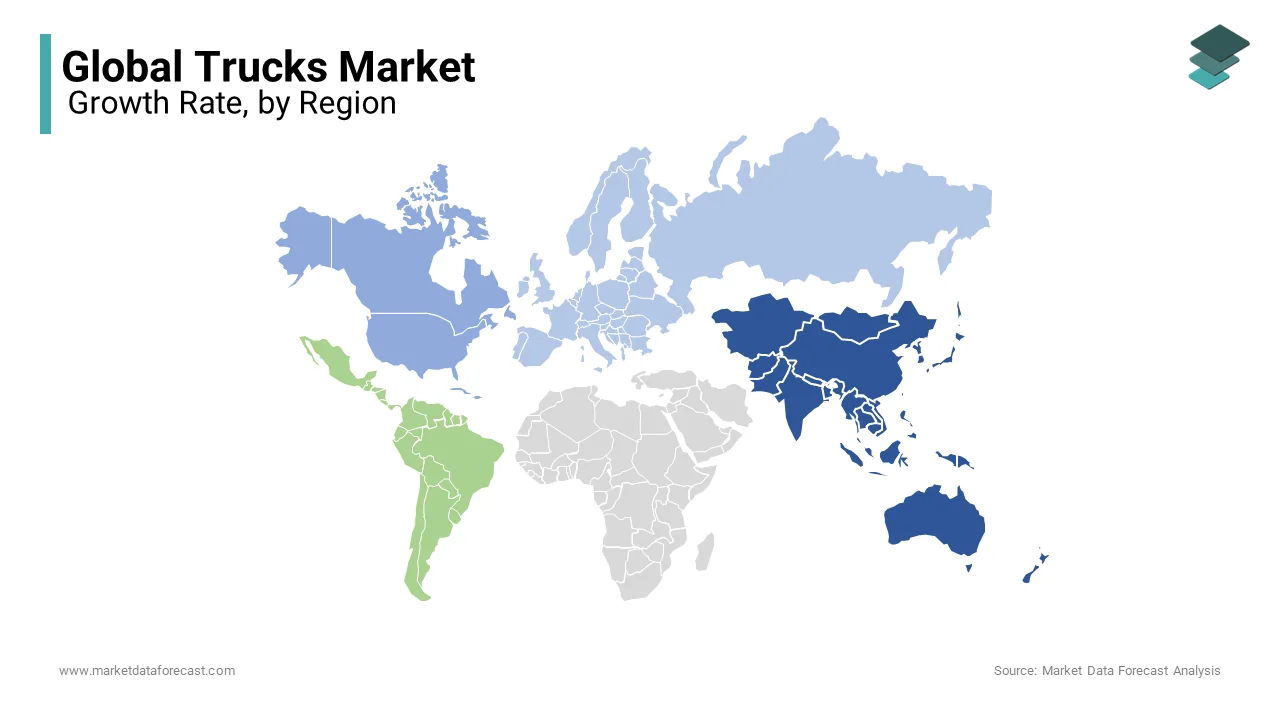
North America was positioned second in the global truck market due to its heavy-duty freight technology and fleet modernization. The United States dominated the regional landscape, operating a fleet of millions of commercial trucks, with Class 8 vehicles accounting for a large number of units, according to the study. Canada’s trucking industry supports over 55–68% of cross-border trade with the U.S., which amounts to over $2 billion in goods and services daily. The region’s extensive interstate highway network, spanning significant miles, enables high-efficiency long-haul operations. Apart from, the Inflation Reduction Act and Bipartisan Infrastructure Law have allocated a notable amount for zero-emission truck infrastructure, accelerating the adoption of electric and hydrogen-powered models.
The Europe truck market is expected to grow substantially, with a significant CAGR in the coming years, due to its advanced engineering, emission control, and sustainable freight solutions. Germany led the region with a number of commercial trucks in operation, the highest in the EU, according to the research. The country is home to major manufacturers like Daimler Truck, MAN, and Scania, which collectively produce a portion of Europe’s heavy-duty vehicles. France and the UK are at the forefront of electric truck adoption, with several charging hubs operational along major freight corridors, as per a study. The Euro VII emissions standards, expected in 2025, are driving investment in cleaner combustion technologies and hybrid systems.
Latin America's truck market growth is expected to have a steady pace in the coming years. Brazil operates a notable number of trucks, with a portion of freight moved by road, according to the study. The country’s vast agricultural exports, particularly soy, corn, and meat, require extensive long-haul trucking from inland farms to coastal ports.
The Middle East & Africa truck market, with the Gulf Cooperation Council (GCC) states leading in fleet modernization and freight infrastructure. Saudi Arabia’s Vision 2030 includes a significant investment in logistics, aiming to position the country as a global transport hub linking Asia, Europe, and Africa. The UAE's Jebel Ali Port and Dubai Logistics City support a growing fleet of refrigerated and container trucks. As of January 2025, RTA figures indicated there were over 400,000 registered commercial and logistics transport vehicles in Dubai, a number that reflects a 31% increase from the previous year.
KEY MARKET PLAYERS
Ashok Leyland, Daimler Trucks, Dongfeng Motor, Ford, Isuzu, Paccar, Scania, Tata Motors, Toyota, Volvo Group. These are the market players that are dominating the global trucks market.
Top Players In The Market
Daimler Truck Holding AG has established a robust presence in the Asia Pacific trucking sector through its premium brands Mercedes-Benz and Fuso, delivering technologically advanced commercial vehicles tailored to regional demands. The company has intensified its focus on electrification, launching the Fuso eCanter electric truck in Japan, Singapore, and Australia. Daimler has also expanded its service network in India and Southeast Asia, partnering with local logistics firms to offer integrated fleet management solutions. Apart from these, Daimler collaborates with Chinese battery manufacturers to localize powertrain components, reducing costs and improving supply chain resilience.
Volvo Group dominates the Asia Pacific market through strategic manufacturing investments, localized product development, and a strong emphasis on safety and sustainability. The company operates production facilities in China, India, and Malaysia, supplying both domestic markets and export hubs. In India, Volvo Eicher Commercial Vehicles (VECV) has expanded its range of fuel-efficient trucks for the infrastructure and logistics sectors, incorporating adaptive cruise control and collision mitigation systems. The company has also partnered with Australian rail operators to deploy autonomous truck platoons for mine-to-port transport.
Isuzu Motors maintains a dominant footprint in the light- and medium-duty truck segment across Asia Pacific, particularly in Southeast Asia, where its vehicles are widely used in last-mile delivery, construction, and rural transport. The company holds a leading position in Thailand, Indonesia, and the Philippines, supported by localized manufacturing and an extensive dealer network. It has also partnered with Japan’s NEC to integrate AI-based driver behavior analytics into its fleet telematics platform, improving safety and fuel efficiency. In India, Isuzu launched a new logistics-focused variant of its 4FTR truck, optimized for e-commerce distribution. The company’s investment in dual-fuel diesel-compressed natural gas (CNG) models caters to regions with limited charging infrastructure. Isuzu’s reputation for durability, low maintenance, and high residual value continues to drive loyalty among small and medium enterprises across the region.
Top Strategies Used By Key Market Participants
Key players in the truck market are leveraging technological innovation, regional localization, and strategic partnerships to consolidate their competitive advantage. Companies are investing heavily in electrification, with dedicated production lines for battery-electric and hydrogen-powered models. Expansion of service and charging infrastructure is crucial in emerging markets, where after-sales support influences procurement decisions. OEMs are forming alliances with battery suppliers, software firms, and logistics operators to offer integrated mobility solutions. Autonomous driving technologies, including platooning and advanced driver assistance systems, are being piloted in controlled environments to enhance safety and efficiency. Digital platforms for remote diagnostics, predictive maintenance, and fleet optimization are now standard offerings. Additionally, manufacturers are aligning with national sustainability policies to access subsidies and meet evolving emission standards, ensuring long-term market relevance in a rapidly transforming industry.
COMPETITION OVERVIEW
The truck market is marked by intense competition driven by technological disruption, regulatory divergence, and shifting customer expectations. Traditional OEMs face pressure from new entrants specializing in electric and autonomous platforms, compelling legacy players to accelerate R&D and reconfigure supply chains. Competition is no longer limited to vehicle performance but extends to total cost of ownership, software integration, and emissions compliance. European and Japanese manufacturers lead in precision engineering and fuel efficiency, while Chinese firms are gaining ground through aggressive pricing and rapid electrification. In the Asia Pacific, localized production and after-sales networks are key differentiators, with companies tailoring models to regional road conditions and payload requirements. The rise of digital freight platforms and subscription-based vehicle services is reshaping ownership models, which is intensifying the race for ecosystem dominance in this capital-intensive, innovation-driven sector.
MARKET SEGMENTATION
This research report on the global trucks market is segmented and sub-segmented into the following categories.
By Class
- Class 3
- Class 4
- Class 5
- Class 6
- Class 7
- Class 8
By Propulsion
- Gasoline
- Diesel
- Electric
- Natural gas
- FCEV
By Truck
- Light duty
- Medium duty
- Heavy duty
By Application
- Logistics & transportation
- Construction & infrastructure
- Retail & e-commerce
- Mining
- Others
By Region
- North America
- Europe
- Asia Pacific
- Latin America
- Middle East and Africa