- Product Description Description
- Table of Contents TOC
- List of Table & Figure LOT
- Get Free Sample PDF Sample PDF
Market Size, 2025
$6.14 BnMarket Estimate, 2026
$6.49 BnMarket Forecast, 2034
$10.11 BnCAGR, 2026–2034
5.7%Executive Summary: Global Turboprop Engine Market
- Market Scope: Comprehensive market evaluation of the global turboprop engine sector, analyzing power transmission types (single shaft vs. free turbine), technologies (conventional vs. electric/hybrid engines), applications (military vs. civil aircraft), and regional performance across North America, Europe, Asia-Pacific, Latin America, and the Middle East & Africa.
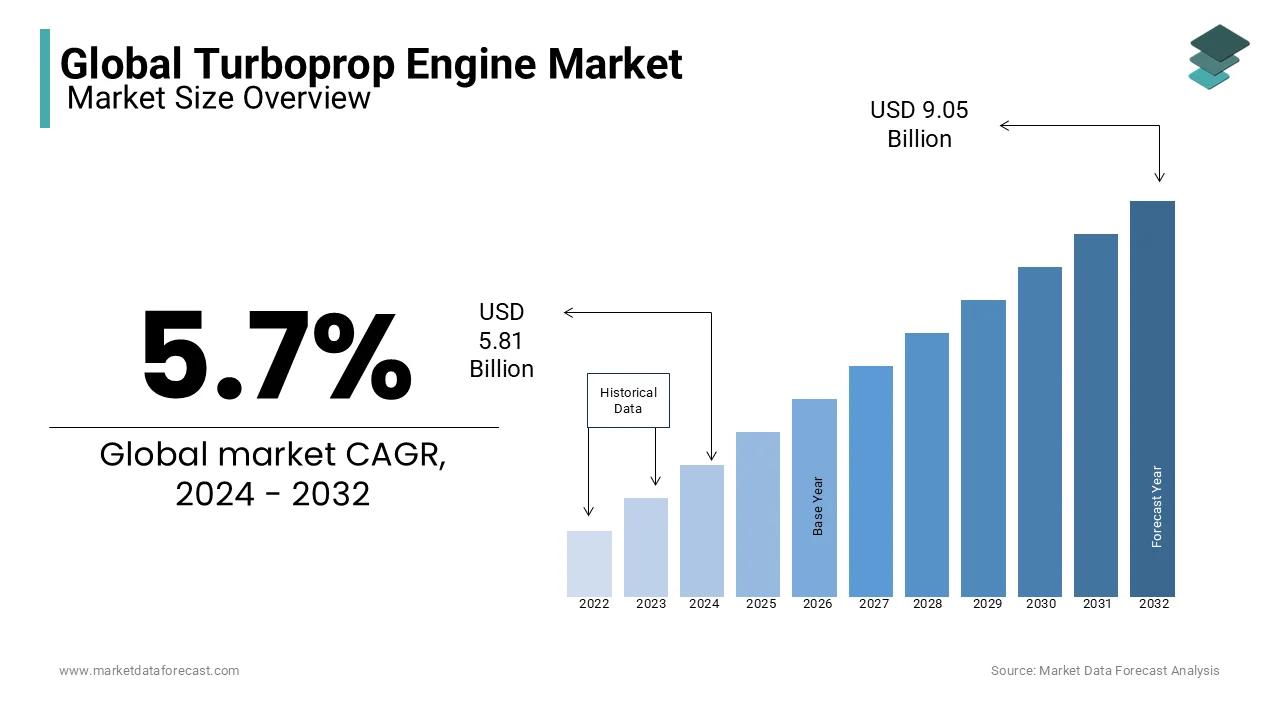
- Market Valuation: Valued at USD 6.14 billion in 2025, reaching USD 6.49 billion in 2026, and projected to scale up to USD 10.11 billion by 2034, registering a solid CAGR of 5.7% throughout the forecast period from 2026 to 2034.
- Primary Growth Drivers: High civil aviation demand for short-distance, low-altitude flights with high fuel efficiency; rising government investments in military and defense transport capabilities; and the proliferation of hybrid-electric engine upgrades replacing conventional legacy powerplants.
Key Market Segment Metrics
| Category | Leading Segment (Base Year Position) | Fastest-Growing / High-Impact Segment |
|---|---|---|
| By Power Transmission, Tech & Application | Single Shaft Segment (historically dominant architecture) & Civil Aircraft Application (anchored by regional travel and general aviation demand) | Free Turbine Segment (high demand for reducing starting torque loads) & Electric/Hybrid Engines (surging growth via sustainability mandates and conventional engine retrofits) |
| By Region | North America (the largest regional market holding roughly 50% of general aviation turbo aircraft via the U.S.) | Asia-Pacific (high-growth market propelled by small/medium airport developments, rising passenger traffic, and defense cargo/troop transport upgrades in China and India) |
Major Market Players & Market Structure
Market Structure: A consolidated, highly specialized aerospace propulsion landscape dominated by tier-1 gas turbine manufacturers competing on fuel efficiency, maintenance cost reductions, and hybrid-electric power integration.
Key Companies: Pratt & Whitney, Rolls-Royce plc, Motor Sich, PBS Velka Bites, GE Aviation, Safran, and Honeywell International, Inc.
 Download Free Sample Report
Global Turboprop Engine Market Size
The global turboprop engine market size was valued at USD 6.14 billion in 2025 and is anticipated to reach USD 6.49 billion in 2026 to reach USD 10.11 billion by 2034, growing at a CAGR of 5.7% during the foreseen period from 2026 to 2034.
The turboprop engine is a turbine that drives the aircraft's propeller. It is a variant of a jet engine that has been optimized to drive a propeller. The turboprop engine consists of an intake, reduction gearbox, compressor, combustor, turbine, and propelling nozzle. In turboprop engine aircraft, the air is drawn in intake; the compressor compresses the air. Fuel is then combined with the compressed air in the combustor, and then the hot combustion gases expand through the turbine to propel the aircraft. The turboprop engine-equipped aircraft are very efficient at low flight speeds, have less fuel consumption, and require significantly less runway or airstrip to take off or land an aircraft. The hybrid engines are most efficient at speeds between 250 and 400mph and altitudes between 18,000 and 30,000 feet.
MARKET DRIVERS
The turboprop engine has high demand in civil aviation due to its ability to fly at low altitudes, as it is very efficient for short distances. North America and the Asia Pacific region contribute to the largest market for the growth of the global turboprop engine market.
The increasing deployment of new technologies in aircraft and investment by the government to strengthen the defense boost the growth of the global turboprop engine market during the forecast period. The growing demand for newer general aviation craft that can fly at low altitudes and the growing military transportation are contributing to the growth of the global turboprop engine market.
Newly developed short routes and low altitude flying capability with an efficient cost increase the demand for the turboprop engine market in the future. The hybrid type of turboprop engine is dominating the turboprop engine market due to its increasing demand in civil aviation. The deployment of turboprop engines is also high as old aircraft are reinstalled with these hybrid engines. The newer aircraft have already come with this modern turboprop engine. The turboprop engines are very efficient in flying on low altitudes and short distances, need a small airstrip for take-off and landing, and increase fuel efficiency. Owing to these reasons, the air journey becomes more affordable and easier for the people due to which growing demand for turboprop engines is driving the market.
Moreover, with the growing demand for newer general aviation aircraft models featuring the latest avionics and technological advancements in performance & efficiency, several turboprop aircraft manufacturers are developing new aircraft to boost the growth of the global turboprop engine market. Additionally, the governments of various countries are spending on strengthening their defense to further boost the growth of the turboprop engine market in the forecasted period.
MARKET RESTRAINTS
The major restraint is the aircraft liquidity crisis that affects the growth of the global turboprop engine.
REPORT COVERAGE
| REPORT METRIC | DETAILS |
| Market Size Available | 2025 to 2034 |
| Base Year | 2025 |
| Forecast Period | 2026 to 2034 |
| CAGR | 5.7% |
| Segments Covered | By Power Transmission, Technology, Application, and Region. |
| Various Analyses Covered | Global, Regional & Country Level Analysis, Segment-Level Analysis, DROC, PESTLE Analysis, Porter’s Five Forces Analysis, Competitive Landscape, Analyst Overview of Investment Opportunities |
| Regions Covered | North America, Europe, APAC, Latin America, Middle East & Africa |
| Market Leaders Profiled | Pratt and Whitney, Rolls-Royce plc, Motor Sich, PBS Velka Bites, GE Aviation, Safran, Honeywell International, Inc., and Others. |
SEGMENTAL ANALYSIS
By Power Transmission Insights
Based on the power transmission, the single shaft segment is anticipated to dominate the market during the forecast period. The single-shaft turbine has a free mechanical connection from the gas generator to the reduction gearbox and propeller. In contrast, the free turbine has only an air link from the gas generator to the power turbines. The free-turbine turboprop engine is highly used to reduce the torque load when the engine starts. The start mechanism only needs to rotate the compressor and turbine, excluding the propeller and reduction gear. Owing to these factors, the free turbine turboprop engine is in more demand that driving the growth of the global turboprop engine market in the coming years.
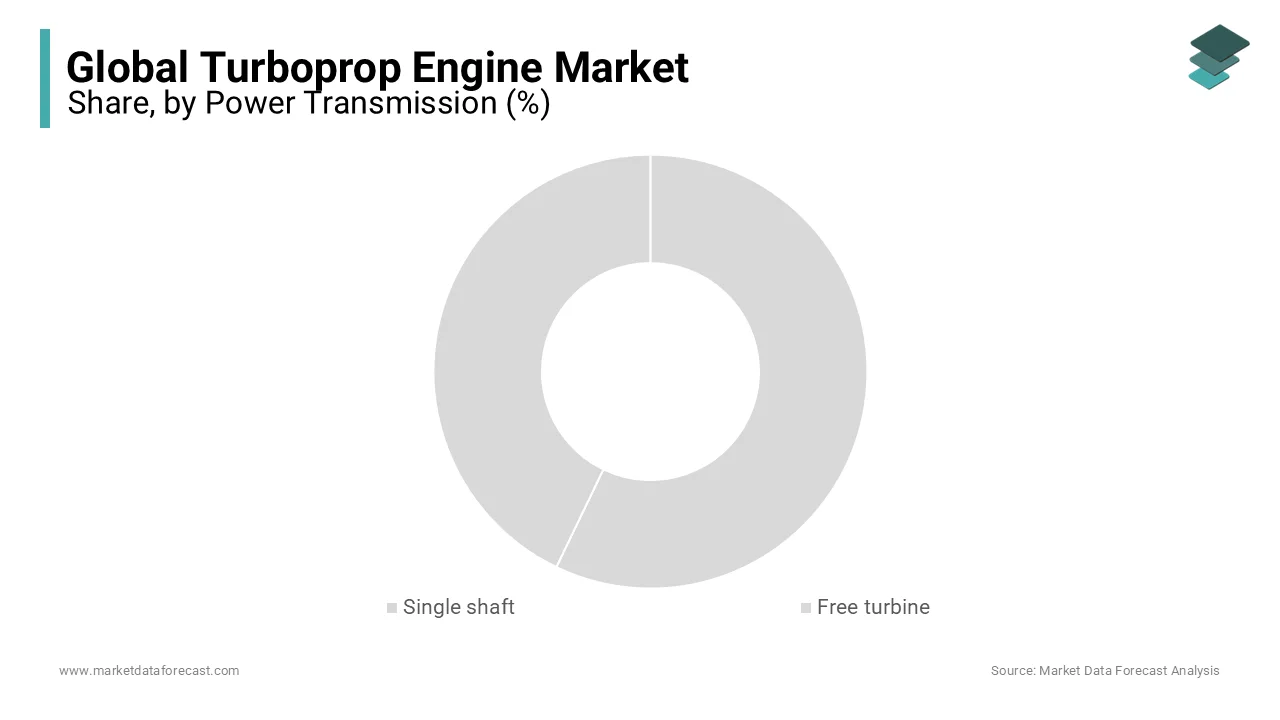
The free turbines segment is expected to hold a substantial share of the worldwide market during the forecast period. The hybrid type of turboprop engine is driving the growth of the turboprop engine market due to its increasing demand in civil aviation. Hybrid engines replace the conventional engines in those aircraft that have been in use for decades. The newly developed crafts are already installed with the hybrid engine.
By Technology Insights
The hybrid engines of turboprops are growing due to the upgradation of conventional engines with hybrid engines, and the newly developed aircraft are already installed with hybrid engines. The hybrid turboprop engine drives the propeller only through an electric motor. The engine power is derived from combustion and converted into electric power via a generator. Therefore, owing to these features, the growing demand for hybrid engines drives the global turboprop engines market during the forecast period.
By Application Insights
The demand for turboprop engines is growing in civil aircraft, as these turboprop engines are highly used for short distances and are very efficient for flying in low altitudes. Additionally, the development of new crafts powered by turboprop engines fuels the demand in the general aviation segment.
REGIONAL ANALYSIS

North America is the largest market for turboprop engines globally. It is also anticipated that North America will sustain its position in the forecasted period due to the increasing demand for turboprop aircraft in the United States. The United States alone holds 50% of turbo aircraft in the general aviation segment.
The Asia-Pacific countries like India, China, and Japan are significantly spending on defense to strengthen their respective air forces' cargo and troop transportation capabilities. The development of small and medium-sized airports in India and China is growing due to the increasing traffic of air passenger traffic. Due to newly developed routes between the states and cities, reducing the cost of fares will drive the growth of the turboprop engine market in the Asia-Pacific Region during the forecast period.
Europe is a prominent regional market for turboprop engines and is estimated to account for a considerable share of the global market during the forecast period, due to the acquisition of new turboprop aircraft by airlines fuels the demand for turboprop engines.
KEY MARKET PLAYERS
Companies playing a dominating role in the global turboprop engine market include
- Pratt and Whitney
- Rolls-Royce plc
- Motor Sich
- PBS Velka Bites
- GE Aviation
- Safran
- Honeywell International, Inc.
RECENT MARKET NEWS
- In December 2021, Pratt and Whitney Canada (a business unit of Pratt & Whitney) announced that Amphibious Aerospace Industry Pvt. Ltd. had selected a PT6A-67F turboprop engine to power its iconic twin-engine G-111T amphibious aircraft. The PT6A-67F is recognized as the engine of the PT6A family for the G-111T aircraft application. Pilots and operators fly PT6A craft easily and confidently, even in adverse weather conditions.
- In November 2021, Pratt & Whitney Canada announced its new engine series, “PW127XT”. This series has a new standard for operating economics, maintenance, and sustainability for regional turboprop engine crafts. “PW127XT” has been designed to improve 3% fuel efficiency, reduce 20% maintenance costs, and offer 40% extended time-on-wing service.
MARKET SEGMENTATION
This research report on the global turboprop engine market has been segmented and sub-segmented based on power transmission, technology, application, and region.
By Power Transmission
- Single shaft
- Free turbine
By Technology
- Conventional Engine
- Electric/Hybrid Engine
By Application
- Military Aircraft
- Civil Aircraft
By Region
- North America
- Europe
- Asia Pacific
- Latin America
- Middle East and Africa