- Product Description Description
- Table of Contents TOC
- List of Table & Figure LOT
- Get Free Sample PDF Sample PDF
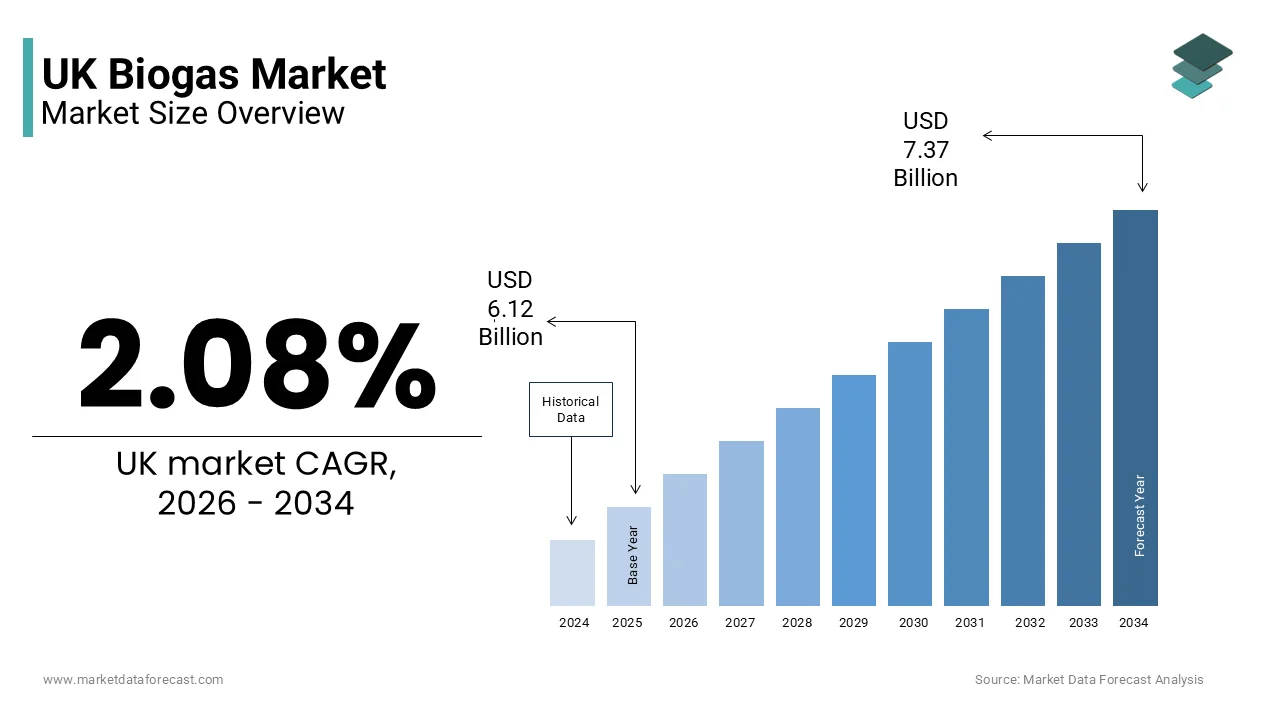
Market Size, 2025
$6.12 BnMarket Estimate, 2026
$6.24 BnMarket Forecast, 2034
$7.37 BnCAGR, 2026–2034
2.08%UK Biogas Market Report Summary
The UK biogas market was valued at USD 6.12 billion in 2025, is estimated to reach USD 6.24 billion in 2026, and is projected to reach USD 7.37 billion by 2034, growing at a CAGR of 2.08% during the forecast period. Market growth is driven by increasing investments in renewable energy, rising emphasis on waste management and circular economy initiatives, growing demand for low carbon energy sources, and supportive government policies promoting sustainable energy production. The expansion of biomethane projects and advancements in anaerobic digestion technologies continue to support market development across the United Kingdom.
Key Market Trends
- Growing demand for renewable and low carbon energy sources is driving market growth.
- Increasing utilization of organic waste for energy generation is boosting market expansion.
- Rising investments in biomethane production and grid injection infrastructure are supporting industry development.
- Expansion of sustainable waste management initiatives is enhancing market opportunities.
- Growing focus on carbon emission reduction and energy security is influencing market advancement.
Segmental Insights
- Based on feedstock, the organic residue and waste segment accounted for the largest share of the UK biogas market in 2025. This dominance is attributed to the abundant availability of agricultural waste, food waste, and other biodegradable materials suitable for biogas production.
- Based on production method, the biodigesters segment held the leading share of the UK biogas market in 2025, supported by widespread adoption of anaerobic digestion technologies for efficient renewable energy generation and waste treatment.
Regional Insights
- The United Kingdom accounted for a leading share of the European biogas market in 2025 and is expected to strengthen its position during the forecast period. Increasing biomethane production capacity, expanding renewable energy infrastructure, and growing commercial scale biogas projects continue to support market growth.
Competitive Landscape
The UK biogas market is highly competitive, with companies focusing on renewable energy innovation, biomethane production, waste to energy solutions, and infrastructure development to strengthen their market position. Market participants continue to invest in advanced anaerobic digestion technologies, grid integration capabilities, and sustainable energy projects. Major players operating in the UK biogas market include CNG Services, Biogen Green Energy, Dalkia UK, Future Biogas Ltd., GENeco, Severn Trent Green Power, Bio Capital Group, Agrivert Ltd., Biogen (UK) Ltd., Eco Sustainable Solutions Ltd., Tamar Energy Ltd., ReFood UK, Gasrec Ltd., Air Liquide UK, Engie UK, Ancala Bioenergy, PlanET Biogas UK, and Clarke Energy Ltd.
UK Biogas Market Size
The UK biogas market size was valued at USD 6.12 billion in 2025, and is projected to reach USD 7.37 billion by 2034 from USD 6.24 billion in 2026, growing at a CAGR of 2.08%.
As per the Anaerobic Digestion and Bioresources Association, there are currently 756 anaerobic digestion plants operational in the UK, contributing significantly to the national renewable gas supply. According to the Office for National Statistics, the agriculture and waste sectors generate millions of tonnes of organic material annually, which serves as a substantial resource base for biogas production. The government’s commitment to decarbonizing heat and transport has led to supportive policies, such as the Green Gas Support Scheme, which incentivizes the injection of biomethane into the national grid. Consumer awareness regarding circular economy principles has further bolstered demand for locally produced renewable energy. Regulatory frameworks enforced by Ofgem ensure that green gas certificates accurately reflect the environmental benefits of biogas. The market is also characterized by technological advancements in digestion efficiency and gas upgrading processes. This dynamic landscape requires stakeholders to balance economic viability with environmental stewardship while navigating evolving policy landscapes and infrastructure constraints to maximize the potential of this versatile renewable energy source.
MARKET DRIVERS
Stringent Government Policies and Net Zero Targets Drive Investment
The implementation of stringent government policies and ambitious net zero targets is a major factor driving the growth of the UK biogas market by creating a favorable regulatory environment and financial incentives for developers. The Climate Change Act mandates a reduction in greenhouse gas emissions by 100% by 2050 compared to 1990 levels, which necessitates a rapid shift away from fossil fuels. According to the Department for Energy Security and Net Zero, the Green Gas Support Scheme provides tariff support for new anaerobic digestion plants injecting biomethane into the grid, ensuring long term revenue stability for investors. This policy framework de risks projects and encourages private sector participation in the renewable energy sector. As per the National Grid, data indicates that biomethane production has increased significantly in recent years, reflecting the effectiveness of these incentives. The inclusion of biogas in the Renewable Heat Incentive scheme further stimulates demand from industrial and commercial users seeking to decarbonize their heating processes. Additionally, local authorities are increasingly mandated to separate food waste collections that ensure a consistent supply of high quality feedstock for digestion facilities. The Environmental Improvement Plan emphasizes the role of bioenergy in achieving sustainability goals, prompting further investment in infrastructure. These regulatory measures not only drive capacity expansion but also foster innovation in technology and process efficiency. As the government continues to refine its energy strategy, the certainty provided by long term policy commitments remains a crucial catalyst for market growth and development.
Increasing Organic Waste Generation and Circular Economy Initiatives
The rising volume of organic waste generation, coupled with strong circular economy initiatives is further boosting the biogas market expansion in the UK. According to the Waste and Resources Action Programme, the UK produces 10.2 million tonnes of food waste annually, which presents a significant opportunity for energy recovery through anaerobic digestion. Local councils and businesses are increasingly adopting separate food waste collection schemes to comply with environmental regulations and reduce landfill usage. This systematic separation enhances the quality of feedstock, leading to higher biogas yields and more efficient digestion processes. The Circular Economy Package introduced by the government sets ambitious recycling targets, which encourage the diversion of organic matter from landfills to energy recovery facilities. As per Defra, data shows that landfill tax increases have made disposal of organic waste economically unviable, further driving waste towards anaerobic digestion plants. Agricultural residues, such as slurries and crop leftovers, also contribute substantially to the feedstock mix, supporting rural energy independence. The integration of biogas production into waste management strategies reduces methane emissions from decomposing waste while generating renewable energy. This dual benefit aligns with both environmental and economic objectives, making biogas an attractive solution for waste processors and energy producers alike. As waste segregation practices improve, the availability of high quality feedstock will continue to support market expansion and operational efficiency.
MARKET RESTRAINTS
High Initial Capital Expenditure and Financing Constraints Restrain Growth
The substantial initial capital expenditure required for constructing anaerobic digestion plants and upgrading facilities is a significant restraint on the UK biogas market, limiting entry for smaller players and slowing project deployment. Building a commercial scale biogas plant involves complex engineering, including digesters, gas storage systems, and purification units, which require significant upfront investment. According to the Anaerobic Digestion and Bioresources Association, the average cost of establishing a new facility can range from several million to tens of millions of pounds, depending on capacity and technology. These high costs pose a barrier to entry, particularly for small and medium sized enterprises lacking access to affordable financing. The current economic climate, characterized by high interest rates and inflationary pressures on construction materials, further exacerbates financial challenges. As per the British Business Bank, data indicates that lending criteria for renewable energy projects have tightened, making it difficult for developers to secure necessary funds. Additionally, the long payback period associated with biogas projects deters risk averse investors, who prefer quicker returns. While government subsidies help mitigate some costs, they often do not cover the entire capital requirement, leaving developers exposed to financial risks. The complexity of planning permissions and grid connection agreements also adds to pre-construction costs and delays. Without accessible financing mechanisms and reduced capital costs, the pace of market expansion may remain constrained, despite strong policy support and demand for renewable gas.
Supply Chain Volatility and Feedstock Availability Issues
The volatility in supply chains and inconsistencies in feedstock availability pose significant challenges to the operational stability of the UK biogas market, affecting production efficiency and profitability. Anaerobic digestion plants rely on a continuous supply of organic matter, such as food waste, agricultural residues, and sewage sludge, which can be subject to seasonal fluctuations and logistical disruptions. According to the Waste and Resources Action Programme, variations in household food waste collection rates across different local authorities create uncertainty in feedstock volumes for many facilities. Transportation costs for moving wet, heavy feedstocks are high and sensitive to fuel price fluctuations, impacting overall operational expenses. As per the Department for Environment, Food and Rural Affairs, data highlights that contamination in separated food waste streams can reduce digestion efficiency and increase maintenance requirements. Agricultural feedstocks are also subject to weather conditions and crop yields, which can vary significantly from year to year. Competition for certain feedstocks, such as maize silage, with other industries like animal feed, further drives up prices and limits availability. The lack of standardized quality specifications for mixed organic wastes complicates the procurement process and requires additional pre-processing steps. These supply chain complexities force operators to maintain larger inventory buffers or invest in flexible processing technologies, which increase capital and operating costs. Ensuring a stable and high quality feedstock supply remains a critical operational hurdle for the industry.
MARKET OPPORTUNITIES
Expansion into Renewable Transport Fuels and Heavy Duty Vehicles
The growing demand for renewable transport fuels, particularly for heavy duty vehicles and public transport offers a substantial opportunity for the UK biogas market to expand beyond stationary power generation. Biomethane, compressed natural gas, and liquefied natural gas derived from biogas offer a cleaner alternative to diesel for buses, trucks, and refuse collection vehicles. According to the Department for Transport, the use of renewable gases in transport has increased as part of efforts to meet carbon reduction targets in the hard to electrify freight sector. The Renewable Transport Fuel Obligation mandates a certain percentage of renewable fuels in transport, providing a guaranteed market for biogas producers. As per NGV Services, data indicates that the number of biomethane powered vehicles in the UK is growing steadily, supported by expanding refueling infrastructure. Local authorities are increasingly transitioning their bus fleets to biomethane to improve air quality in urban areas. The development of dedicated refueling stations along major transport corridors enhances the viability of biomethane as a transport fuel. Additionally, advancements in vehicle engine technology have improved the efficiency and performance of gas powered engines, making them more competitive with traditional fuels. By targeting the transport sector, biogas producers can diversify their revenue streams and contribute to decarbonizing logistics. This strategic shift aligns with national goals for cleaner air and reduced reliance on imported fossil fuels, offering significant growth potential.
Integration with Hydrogen Production and Energy Storage Solutions
The integration of biogas facilities with hydrogen production and energy storage solutions offers an innovative opportunity for the UK biogas market to enhance its value proposition and grid stability services. Biogas plants can utilize excess electricity from renewable sources to produce green hydrogen through electrolysis, which can then be combined with carbon dioxide from biogas upgrading to create synthetic methane or other valuable chemicals. According to the Hydrogen Strategy published by the government, blending hydrogen into the gas grid is a key pathway for decarbonization, creating potential synergies with existing biogas infrastructure. As per the Energy Systems Catapult, data suggests that co locating biogas and hydrogen production facilities can optimize resource use and reduce overall costs. Biogas plants can also act as flexible energy assets by storing biomethane and adjusting production based on grid demand, providing balancing services. This flexibility is increasingly valuable as the share of intermittent renewable energy sources, like wind and solar, grows. The development of power to gas technologies allows for long term energy storage, addressing seasonal variations in energy demand. By positioning themselves as multi vector energy hubs, biogas operators can participate in emerging markets for hydrogen and grid services. This diversification enhances economic resilience and supports the broader transition to a low carbon energy system, offering new revenue streams and strategic importance.
MARKET CHALLENGES
Regulatory Uncertainty and Policy Transition Risks
The uncertainty surrounding future regulatory frameworks and the transition from existing support schemes is a significant challenge to the UK biogas market, affecting long term investment decisions and project viability. While current schemes like the Green Gas Support Scheme provide stability, their finite duration and potential changes in future policy create anxiety among investors. According to the Anaerobic Digestion and Bioresources Association, the lack of a clear long term roadmap beyond current support periods hinders planning for large scale infrastructure investments. Changes in government priorities or budget constraints could lead to reduced subsidies or altered eligibility criteria, impacting projected revenues. As per industry surveys, data indicates that policy instability is cited as a top concern by developers, affecting their ability to secure financing. The complexity of navigating multiple regulatory bodies, including Ofgem, Defra, and local planning authorities, adds to the administrative burden and risk. Additionally, the evolving definition of what constitutes sustainable biomass and the criteria for carbon accounting may change, requiring operators to adapt their practices and reporting methods. This regulatory flux creates an unpredictable business environment where sudden policy shifts can undermine the economic case for existing or planned projects. Stakeholders require greater clarity and consistency in policy design to foster confidence and sustain momentum in the sector.
Technical Limitations in Grid Injection and Infrastructure Compatibility
Technical limitations related to grid injection standards and infrastructure compatibility present ongoing challenges for the UK biogas market, restricting the seamless integration of biomethane into the national gas network. Not all parts of the gas grid are equipped to accept injected biomethane due to pressure constraints and pipeline specifications, which limits the locations where new plants can be economically viable. According to National Gas Transmission, the capacity for gas injection varies significantly across regions, creating bottlenecks for producers in areas with limited grid access. Upgrading local distribution networks to accommodate reverse flow and higher pressures requires substantial investment, which may not be prioritized by network operators. As per Ofgem, data highlights that connection queues and technical assessments can delay projects by months or even years, increasing development costs. Additionally, the quality requirements for biomethane injection are strict, necessitating advanced purification technologies to remove impurities such as siloxanes and sulfur compounds. Failure to meet these standards can result in rejection of gas or damage to grid infrastructure, leading to financial penalties. The lack of standardized connection procedures across different network operators adds complexity and inconsistency to the process. Overcoming these technical barriers requires coordinated investment and collaboration between biogas producers and network operators to ensure that infrastructure evolves in tandem with production capacity.
REPORT COVERAGE
| REPORT METRIC | DETAILS |
| Market Size Available | 2025 to 2034 |
| Base Year | 2025 |
| Forecast Period | 2026 to 2034 |
| CAGR | 2.08% |
| Segments Covered | By Feedstock, Production Method, Application, and Region. |
| Various Analyses Covered | Global, Regional and Country-Level Analysis, Segment-Level Analysis, Drivers, Restraints, Opportunities, Challenges; PESTLE Analysis; Porter’s Five Forces Analysis, Competitive Landscape, Analyst Overview of Investment Opportunities |
| Market Leaders Profiled | CNG Services, Biogen Green Energy, Dalkia UK, Future Biogas Ltd., GENeco, Severn Trent Green Power, Bio Capital Group, Agrivert Ltd., Biogen (UK) Ltd., Eco Sustainable Solutions Ltd., Tamar Energy Ltd., ReFood UK, Gasrec Ltd., Air Liquide UK, Engie UK, Ancala Bioenergy, PlanET Biogas UK, and Clarke Energy Ltd. |
SEGMENTAL ANALYSIS
By Feedstock Insights
The organic residue and waste segment dominated the market by holding the largest share of the UK market in 2025. The growth of the organic residue and waste segment in the UK market is primarily driven by stringent environmental regulations that mandate the diversion of biodegradable waste from landfills. This category includes municipal solid waste, sewage sludge, agricultural residues, and food waste, which are abundant and increasingly regulated resources. According to the Department for Environment, Food and Rural Affairs, the UK generates 10.2 million tonnes of food waste annually, much of which is now legally required to be separated and treated through anaerobic digestion rather than landfilling. The Landfill Tax, which has risen significantly over the years, makes disposal of organic waste economically unviable, thereby directing this material toward energy recovery facilities. As per the Waste and Resources Action Programme, data indicates that separate collection of food waste by local authorities has expanded to cover over 60% of households, ensuring a consistent and high quality feedstock supply for biogas plants. Agricultural waste, such as livestock manure and crop residues, also contributes substantially to this segment, supported by rural development grants that encourage on farm digestion. The circular economy principles embedded in government policy prioritize the use of waste materials over purpose grown crops to avoid competition with food production. This regulatory and economic framework ensures that organic residues remain the primary feedstock source, providing a stable and cost effective basis for biogas production while addressing national waste management challenges and reducing greenhouse gas emissions from decomposing organic matter.
On the other side, the energy crops segment is predicted to register a CAGR of 5.2% during the forecast period in the UK market owing to the advancements in agricultural technology and the need for consistent, high yield feedstocks. While waste based feedstocks are subject to variability in quality and volume, energy crops, such as maize silage, rye grass, and whole crop cereals, offer predictable methane yields and continuous supply throughout the year. According to the National Farmers Union, farmers are increasingly integrating energy crops into rotation systems to improve soil health and provide additional revenue streams during periods of low commodity prices. The reliability of energy crops allows biogas plants to operate at maximum capacity without the disruptions often caused by seasonal fluctuations in waste availability. As per the Agriculture and Horticulture Development Board, data shows that yields of maize silage have improved due to better seed varieties and farming practices, making it a more efficient source of biomethane per hectare. Although sustainability concerns regarding land use exist, strict guidelines ensure that energy crops do not compete with food production or harm biodiversity. The ability to store energy crops for extended periods provides operational flexibility for plant operators, enabling them to balance feedstock mixes and optimize digestion efficiency. As technology improves, the cost effectiveness of growing dedicated energy crops continues to enhance their appeal as a supplementary feedstock source.
By Production Method Insights
The biodigesters segment held the dominant position in the UK biogas market by holding the largest share of the UK market in 2025 due to their technological versatility and ability to process a wide range of organic feedstocks efficiently. This method involves the controlled anaerobic decomposition of organic matter in sealed tanks, producing biogas and digestate as byproducts. According to the Anaerobic Digestion and Bioresources Association, the entire anaerobic digestion industry digests approximately 46 million tonnes of organic material each year, reflecting its status as the industry standard. The modular nature of biodigesters allows for scalability from small on farm units to large industrial plants, catering to diverse operational needs. As per the Department for Energy Security and Net Zero, data indicates that biodigesters contribute the majority of biomethane injected into the national grid due to their high conversion efficiency and reliability. Advances in digester design, including continuous stirred tank reactors and plug flow systems, have enhanced performance and reduced maintenance requirements. The production of high quality digestate as a natural fertilizer further adds value to the process, supporting sustainable agriculture practices. Regulatory support for anaerobic digestion technologies has facilitated widespread adoption, with many projects benefiting from government incentives tailored to this specific production method. The proven track record of biodigesters in terms of operational stability and environmental benefits ensures their continued dominance in the market as the preferred method for converting organic waste into renewable energy.
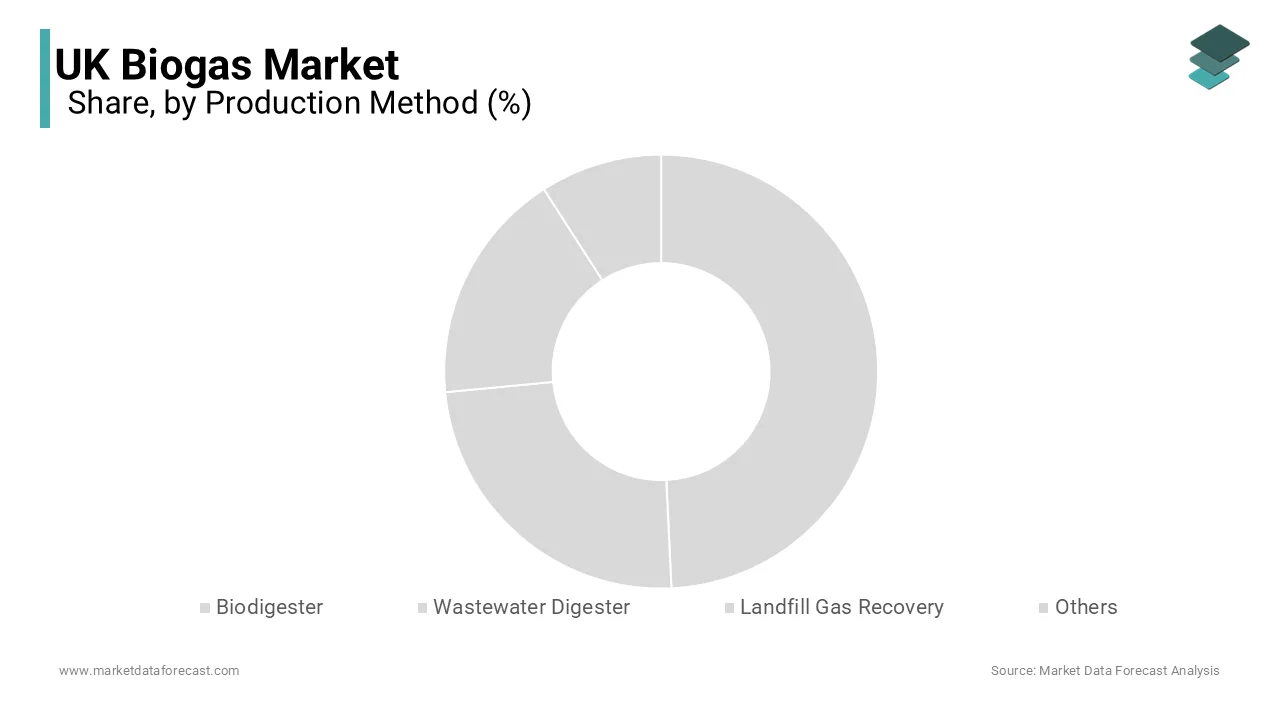
On the other side, the wastewater digesters segment is estimated to register a CAGR of 6.4% during the forecast period in the UK market owing to the significant investment from water utilities aiming to achieve energy self-sufficiency and reduce carbon footprints. Water treatment plants generate large volumes of sewage sludge, which is an ideal feedstock for anaerobic digestion, allowing utilities to produce biogas for onsite electricity and heat generation. According to Water UK, major water companies have committed to becoming net zero carbon emitters by 2030, prompting extensive upgrades to wastewater treatment infrastructure, including the installation of advanced digestion facilities. As per Ofwat, data reveals that billions of pounds are being invested in the water sector over the current regulatory period, with a significant portion allocated to energy efficiency and renewable energy projects. Wastewater digesters benefit from a consistent and centralized supply of feedstock, eliminating logistical challenges associated with transporting waste from multiple sources. The integration of thermal hydrolysis pre-treatment technologies has further increased biogas yields from sludge, making these projects more economically viable. By generating their own energy, water utilities can reduce operational costs and enhance resilience against fluctuating energy prices. This strategic shift towards circular resource management within the water sector drives the rapid expansion of wastewater digestion capabilities across the country.
COUNTRY LEVEL ANALYSIS
The UK had the leading share of the European market in 2025 and is expected to significantly scale its production volumes and strengthen grid infrastructure as a central hub for commercial biomethane projects over the next few years. As one of the early adopters of anaerobic digestion technology, the UK has developed a robust ecosystem of developers, operators, and technology providers that drive innovation and efficiency. According to the European Biogas Association, the UK ranks among the top countries in Europe for planned biomethane investments and production scaling, reflecting its substantial investment in the sector. The country benefits from a comprehensive regulatory environment, including the Green Gas Support Scheme and Renewable Heat Incentive, which have successfully stimulated market growth and attracted private investment. As per the Anaerobic Digestion and Bioresources Association, data shows that the UK has 756 operational anaerobic digestion plants, contributing significantly to national renewable energy supplies. The presence of major water utilities and agricultural sectors provides ample feedstock resources, supporting sustained production levels. Additionally, the UK’s ambitious net zero targets create a favorable long term outlook for biogas as a key component of the decarbonization strategy. The integration of biogas into the national gas grid and transport fuel markets further enhances its strategic importance. With ongoing technological advancements and supportive government policies, the UK continues to lead by example in leveraging biogas for sustainable energy and waste management solutions in Europe.
COMPETITIVE LANDSCAPE
The competition in the UK biogas market is characterized by a mix of specialized independent operators large utility companies and waste management firms vying for feedstock resources and grid connection capacity. Established players leverage their technical expertise and existing infrastructure to maintain operational efficiency while new entrants focus on innovative technologies and niche markets. The market sees continuous investment in plant upgrades and expansion projects as companies strive to maximize output and comply with evolving regulatory standards. Competition for high quality feedstock such as source separated food waste is intense driving up procurement costs and necessitating strong supplier relationships. Regulatory frameworks such as the Green Gas Support Scheme influence competitive dynamics by providing incentives that favor efficient and sustainable operations. Companies differentiate themselves through superior service reliability environmental credentials and ability to offer integrated energy solutions. The presence of mobile virtual network operators adds further pressure on margins forcing incumbents to innovate constantly. Digital customer experience and network quality have become key battlegrounds as operators seek to build loyalty in a saturated market. Consolidation trends continue as companies seek scale to fund expensive technology upgrades and remain competitive in a rapidly evolving digital economy.
KEY MARKET PLAYERS
Some of the companies that are playing a dominating role in the UK biogas market are
- CNG Services
- Biogen Green Energy
- Dalkia UK
- Future Biogas Ltd.
- GENeco
- Severn Trent Green Power
- Bio Capital Group
- Agrivert Ltd.
- Biogen (UK) Ltd.
- Eco Sustainable Solutions Ltd.
- Tamar Energy Ltd.
- ReFood UK
- Gasrec Ltd.
- Air Liquide UK
- Engie UK
- Ancala Bioenergy
- PlanET Biogas UK
- Clarke Energy Ltd.
Top Players in the Market
- CNG Services operates as a leading developer and operator of anaerobic digestion facilities in the UK focusing on converting organic waste into renewable biomethane. The company manages a diverse portfolio of plants that process food waste agricultural residues and sewage sludge to produce green gas for the national grid. Recently CNG Services has strengthened its market position by investing in advanced upgrading technologies that improve the purity and efficiency of biomethane production. The organization actively collaborates with local authorities and waste management firms to secure long term feedstock supply agreements ensuring operational stability. By prioritizing sustainable practices and community engagement CNG Services enhances its reputation as a responsible energy provider. Its strategic expansion into new regions and continuous optimization of plant performance demonstrate a commitment to supporting the UK’s net zero ambitions through reliable and scalable biogas solutions.
- Biogen Green Energy is a prominent player in the UK biogas sector specializing in the development and operation of large scale anaerobic digestion plants. The company focuses on processing source separated food waste from commercial and industrial sources to generate renewable electricity and heat. Recent actions include the implementation of innovative digestate treatment processes that enhance the quality of biofertilizer produced as a byproduct. Biogen Green Energy has also expanded its footprint by acquiring existing facilities and upgrading them with modern technology to increase capacity and efficiency. The company engages in strategic partnerships with major food retailers and producers to ensure a consistent supply of high quality feedstock. By demonstrating strong environmental stewardship and operational excellence Biogen Green Energy reinforces its role as a key contributor to the circular economy and renewable energy landscape in the UK.
- Dalkia UK provides comprehensive energy services including the design construction and operation of biogas facilities for various industrial and municipal clients. The company leverages its extensive expertise in energy efficiency and renewable technologies to deliver tailored biogas solutions that meet specific customer needs. Recently Dalkia UK has strengthened its market position by integrating digital monitoring systems into its biogas plants to optimize performance and reduce maintenance costs. The organization actively pursues contracts with water utilities and wastewater treatment plants to implement advanced digestion technologies that enhance energy self sufficiency. Dalkia UK also focuses on sustainability by helping clients achieve their carbon reduction targets through efficient biogas utilization. Its commitment to innovation and customer centric service ensures that it remains a competitive and trusted partner in the evolving UK biogas market driving growth through technical excellence and strategic project delivery.
Top Strategies Used By Key Market Participants
Key players in the UK biogas market employ several strategic approaches to maintain competitiveness and drive growth. Feedstock security remains central as companies establish long term contracts with waste producers and farmers to ensure consistent supply. Technological innovation is prioritized with investments in advanced digestion and upgrading systems to improve efficiency and biomethane quality. Strategic partnerships with utilities and grid operators facilitate smoother injection of renewable gas into the national network. Diversification into multiple revenue streams such as digestate sales and carbon credits enhances financial resilience. Sustainability initiatives including community engagement and environmental compliance strengthen brand reputation. Focus on operational excellence through digital monitoring and predictive maintenance reduces downtime and costs. Expansion into new geographic regions and sectors such as transport fuels allows companies to capture emerging opportunities and mitigate market risks associated with policy changes.
MARKET SEGMENTATION
This research report on the UK biogas market is segmented and sub-segmented into the following categories.
By Feedstock
- Organic Residue and Waste
- Biowaste
- Municipal Waste
- Sewage
- Agriculture Waste
- Others
- Energy Crops
By Production Method
- Biodigester
- Wastewater Digester
- Landfill Gas Recovery
- Others
By Application
- Electricity Generation
- Heating
- Combined Heat and Power (CHP)
- Others