- Product Description Description
- Table of Contents TOC
- List of Table & Figure LOT
- Get Free Sample PDF Sample PDF
Market Size, 2025
$14.05 BnMarket Estimate, 2026
$14.71 BnMarket Forecast, 2034
$21.27 BnCAGR, 2026–2034
4.72%UK Cement Market Report Summary
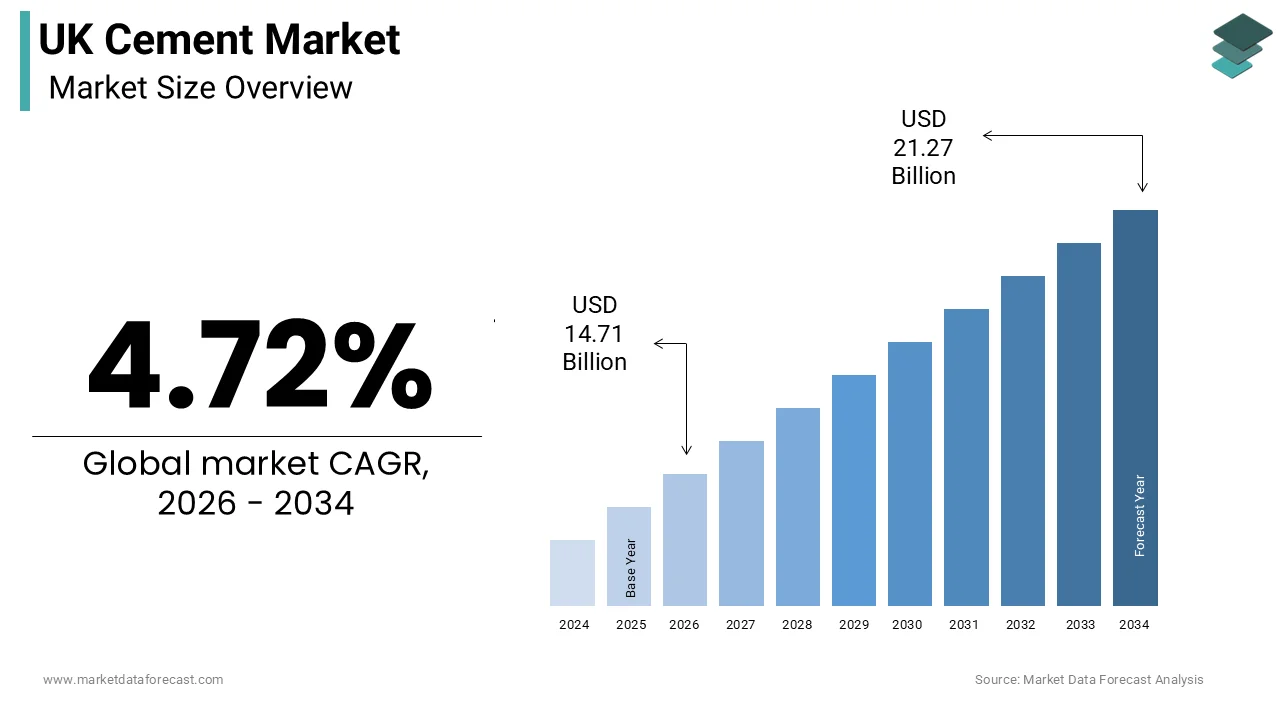
The United Kingdom cement market was valued at USD 14.05 billion in 2025 and is projected to reach USD 21.27 billion by 2034, growing from USD 14.71 billion in 2026 at a CAGR of 4.72% during the forecast period. Market growth is driven by increasing infrastructure development, residential and commercial construction activities, and government investments in transportation and renewable energy projects. The growing adoption of low-carbon cement and sustainable construction practices is further supporting the expansion of the UK cement market.
Key Market Trends
- Rising investments in infrastructure and transportation projects
- Increasing demand for low-carbon and sustainable cement products
- Growth in renewable energy and industrial construction projects
- Expansion of urban redevelopment and housing initiatives
- Increasing focus on carbon capture and green cement technologies
Segmental Insights
- Based on type, the Portland cement segment dominated the UK cement market in 2025 by accounting for 60.5% of the market share, owing to its extensive use in residential, commercial, and infrastructure construction.
- Based on application, the non-residential segment held the leading position in 2025 with 55.2% of the market share, driven by investments in commercial buildings, public infrastructure, industrial facilities, and transportation projects.
Regional Insights
- England dominated the UK cement market in 2025 by capturing 83.7% of the market share, supported by extensive construction activities, infrastructure upgrades, and a large population base.
- Scotland holds a notable position in the UK cement market due to ambitious renewable energy projects, infrastructure modernization programs, and increasing investments in sustainable construction.
Competitive Landscape
- The UK cement market is highly competitive, with manufacturers focusing on production efficiency, sustainability initiatives, and low-carbon cement technologies. Companies are investing in alternative fuels, carbon reduction technologies, and capacity expansions to strengthen their market positions.
- Key players operating in the UK cement market include Holcim UK, Heidelberg Materials UK, CEMEX UK, Breedon Group, Tarmac, CRH plc, Aggregate Industries UK, Mannok, Cementir Holding, Titan Cement Group, Ecocem, LKAB Minerals, Buzzi SpA, SigmaRoc plc, and Celtic Cement.
UK Cement Market Size
The UK cement market size was valued at USD 14.05 billion in 2025, and is projected to reach USD 21.27 billion by 2034 from USD 14.71 billion in 2026, growing at a CAGR of 4.72%.
Cement is a fine, powdery substance that acts as a binding agent in construction. Its production involves the calcination of limestone and other raw materials to create clinker, which is then ground into fine powder. This market is intrinsically linked to economic cycles and government investment in public works. According to official ONS construction tracking data, new construction work in current prices grew to over £140 billion, sustaining a major multi-billion-pound demand trajectory for the building material supply chain. The former Department for Levelling Up, Housing and Communities previously championed a historical target of 300,000 annual homes. However, revised national targets managed by the Ministry of Housing, Communities and Local Government have raised this mandatory expectation to 370,000 homes per year to aggressively resolve the UK's housing shortage. The market operates within a stringent regulatory framework aimed at reducing carbon emissions, given that cement manufacturing is energy-intensive. Producers are increasingly adopting alternative fuels and carbon capture technologies to align with net-zero targets. The geographic distribution of plants is concentrated in specific regions due to the availability of limestone quarries and logistical requirements for bulk transport. The market structure is characterized by a few major integrated producers who control both raw material extraction and final product distribution. Supply chain resilience has become a priority following recent global disruptions, prompting local stockpiling and diversified sourcing strategies. The transition toward sustainable construction practices is reshaping product formulations with a growing emphasis on low-carbon blends and recycled content integration.
MARKET DRIVERS
Government Infrastructure Investment Stimulates Demand For Concrete Materials
Substantial government commitment to infrastructure development fuels cement consumption in the country, which accelerates the growth of the United Kingdom cement market. This drives demand across transport, energy, and public service sectors. Major projects such as high-speed rail networks, road upgrades, and renewable energy installations require vast quantities of concrete for foundation structures and pavements. According to HM Treasury, the National Infrastructure Strategy outlines over 600 billion pounds of public and private investment planned through 2030 to modernize the country’s physical assets. As per Network Rai,l annual capital expenditure exceeds 5 billion pounds, focusing on track renewal, station improvements, and electrification projects that rely heavily on cement-based materials. The renovation of aging water treatment facilities and flood defense systems further contributes to steady demand as climate adaptation becomes a national priority. Local authorities also allocate significant budgets for school and hospital construction, ensuring a baseline level of activity regardless of private sector fluctuations. These long-term programs provide visibility for cement manufacturers, allowing them to plan production schedules and capacity utilization effectively. The multiplier effect of infrastructure spending stimulates related industries such as steel and aggregate,s creating a robust ecosystem for construction materials. Regulatory support for green infrastructure projects encourages the use of innovative cement blends that meet environmental standards while maintaining structural integrity. This sustained public sector engagement ensures that cement remains a critical component of national development efforts.
Urban Regeneration And Housing Development Projects Fuel Residential Construction
Rapid urban regeneration and an urgent demand for affordable housing are driving the United Kingdom cement market. Developers are actively accelerating residential construction across key metropolitan areas. Cities such as London, Manchester, and Birmingham are undergoing extensive redevelopment, transforming former industrial sites into mixed-use communities with high-density apartment blocks and supporting amenities. The Ministry of Housing, Communities and Local Government indicates a tightening development pipeline, with annual planning approvals in England hovering closer to 241,000 units rather than the cited 400,000 target. Updates from the Home Builders Federation clarify that UK new home completions actually decreased by 7% over the course of 2024, stifled by high mortgage interest constraints and planning delays. The shift toward modular construction techniques also influences cement demand as prefabricated components require precise high-strength mixes produced in controlled factory environments. Brownfield site remediation often involves substantial groundwork and foundation work, which consumes large volumes of ready-mix concrete. Government incentives such as stamp duty holidays and Help to Buy schemes have previously stimulated buyer interest, leading to increased developer confidence and project launches. The focus on building safety following regulatory changes has led to the use of higher-grade cement formulations that ensure durability and compliance with stricter structural standards. This residential boom creates consistent demand for standard and specialized cement products, supporting local production facilities and distribution networks across the country.
MARKET RESTRAINTS
Stringent Carbon Emission Regulations Increase Operational Costs
Rigorous environmental regulations targeting carbon emissions pose significant financial and operational burdens on cement manufacturers in the country, which hampers the growth of the United Kingdom cement market. These regulations affect profitability and competitive positioning. The cement industry is one of the most carbon-intensive industrial sectors, accounting for approximately 8 percent of global carbon dioxide emissions, primarily from the chemical process of calcination and fuel combustion. According to the Committee on Climate Change, the United Kingdom cement sector must reduce its emissions by 95 percent by 2050 to align with net zero goals, necessitating costly technological upgrades. As per the Environment Agency, operators must purchase allowances under the UK Emissions Trading Scheme, where carbon prices have fluctuated between 40 and 60 pounds per tonne in recent years, increasing production costs substantially. Compliance requires investment in carbon capture, utilization, and storage technologies, which are still in early commercial stages and require significant capital expenditure. Manufacturers also face pressure to switch from fossil fuels to alternative biomass or waste-derived fuels, which may have inconsistent quality and supply availability. These regulatory pressures limit the ability of companies to pass on costs to customers in a price-sensitive market, leading to margin compression. Smaller players struggle to afford the necessary investments, risking consolidation or exit from the market. The uncertainty surrounding future carbon pricing mechanisms complicates long-term strategic planning and discourages aggressive expansion despite underlying demand growth.
High Energy Prices Impact Production Efficiency And Profit Margins
Volatility in energy prices significantly impacts the country's production cost structure, which hinders the expansion of the United Kingdom cement market. This is because manufacturing processes are highly energy-intensive, requiring substantial heat and electricity inputs. The production of clinker involves heating raw materials to temperatures exceeding 1400 degrees Celsius, which typically relies on natural gas, coal, or petroleum coke. As per the Mineral Products Association, energy costs constitute up to 40 percent of total variable production costs for cement manufacturers, making them highly vulnerable to market fluctuations. Higher energy expenses force producers to either absorb the costs, reducing profit margin,s or increase product prices, which may dampen demand from cost-conscious construction firms. Some facilities have reduced output or scheduled maintenance during peak price periods to mitigate losses, leading to supply inconsistencies. The transition to renewable energy sources offers some relief but requires significant infrastructure investment and grid connectivity upgrades that take time to implement. Energy efficiency improvements, such as waste heat recovery systems, are being adopted, but cannot fully offset the impact of soaring base energy rates. This economic pressure restricts investment in innovation and expansion, forcing companies to prioritize short-term survival over long-term strategic growth in a challenging macroeconomic environment.
MARKET OPPORTUNITIES
Adoption of Low-Carbon Cement Blends Opens New Market Segments
The growing demand for sustainable construction materials provides a pathway for cement manufacturers within the United Kingdom cement market. This shift allows them to develop and market low-carbon blends that reduce environmental impact while meeting performance standards. Innovations such as ground granulated blast furnace slag and fly ash substitutions allow for a significant reduction in clinker content, thereby lowering the carbon footprint of the final product. According to the Concrete Centre, the use of supplementary cementitious materials can reduce embodied carbon by up to 50 percent compared to traditional Portland cement, appealing to environmentally conscious developers. As per the UK Green Building Council, an increasing number of commercial projects now require Environmental Product Declarations and low-carbon certifications, driving specification of these advanced blends. Government procurement policies are beginning to favor materials with lower embodied carbon, creating a preferential market for innovative cement products. Manufacturers who invest in research and development to optimize these formulations can differentiate themselves and command premium pricing. The retrofitting of existing buildings also offers opportunities for specialized repair mortars and grouts that utilize low-carbon binders. Collaboration with academic institutions and technology providers accelerates the commercialization of novel materials such as geopolymer cements, which offer even greater sustainability benefits. This shift aligns with corporate social responsibility goals of major construction firms, enhancing brand reputation and securing long-term contracts in a rapidly evolving regulatory landscape.
Digitalization And Smart Manufacturing Enhance Operational Efficiency
The integration of digital technologies and smart manufacturing practices offers significant opportunities for the country’s cement producers to optimize operations, reduce waste, and improve product consistency, which is likely to boost the expansion of the United Kingdom cement market. Advanced sensors and Internet of Things devices enable real-time monitoring of kiln temperatures, fuel consumption, and equipment health, allowing for predictive maintenance and minimized downtime. According to Deloitte, digital transformation in manufacturing can lead to a 10 percent to 20 percent increase in productivity and a 15 percent reduction in maintenance costs through data-driven decision making. As per the Institution of Civil Engineers, the adoption of artificial intelligence algorithms helps optimize fuel mixtures and raw material proportions, ensuring consistent quality while minimizing resource usage. Digital platforms facilitate better supply chain visibility, enabling manufacturers to respond quickly to changes in demand and logistics constraints. Customer-facing digital tools allow for easier ordering, tracking, and technical support, enhancing service levels and customer satisfaction. The use of digital twins for plant simulation enables scenario testing and process optimization without disrupting actual production. These technologies also support sustainability goals by identifying inefficiencies and reducing energy waste. Companies that embrace digitalization gain a competitive edge through improved agility and cost control, positioning themselves as modern, efficient partners in the construction value chain. This technological evolution transforms traditional heavy industry into a data-driven enterprise capable of meeting modern market expectations.
MARKET CHALLENGES
Supply Chain Disruptions Affect Raw Material Availability And Logistics
Persistent supply chain disruptions are holding back the growth of the United Kingdom cement market. These disruptions are affecting the timely availability of raw materials and the distribution of finished products to construction sites. Dependence on imported additives such as gypsum and slag makes the industry vulnerable to global trade fluctuations, port congestion, and shipping delays. Domestic quarrying operations also face challenges related to planning permissions and environmental restrictions, limiting the expansion of local raw material sources. Weather events such as flooding can disrupt quarry operations and damage transport infrastructure, further exacerbating supply issues. These disruptions lead to project delays and cost overruns for construction firms, straining relationships with cement suppliers. Inventory management becomes complex as companies balance the cost of holding stock against the risk of shortages. The lack of transparency in global supply chains makes it difficult to predict and mitigate risks effectively. Manufacturers must invest in diversified sourcing strategies and robust logistics partnerships to build resilience, but these measures require time and capital. The volatility undermines confidence in project planning and hampers the industry's ability to meet tight construction deadlines.
Skilled Labor Shortages Hinder Production And Technical Innovation
An acute shortage of skilled labor in the cement and broader construction industry impedes operational efficiency and slows the adoption of advanced technologies in the United Kingdom market. The aging workforce and insufficient influx of young talent into technical roles create gaps in expertise required for operating complex machinery and implementing new processes. The Construction Industry Training Board shows that the UK construction sector must secure nearly 225,000 new workers to keep pace with major infrastructure demands. As per the Mineral Products Association, specific roles such as kiln operators, maintenance engineers, and quality control specialists are particularly hard to fill, leading to overtime costs and potential safety risks. The transition to low-carbon technologies requires new skill sets in chemistry and digital systems, which existing staff may not possess without extensive retraining. Recruitment competitions with other industries offering better pay and conditions further exacerbate the talent crunch. This labor deficit limits production capacity and flexibility, preventing manufacturers from scaling up operations during periods of high demand. It also hinders innovation as companies lack the human capital to drive research and development initiatives effectively. Addressing this challenge requires collaborative efforts between industry bodies, educational institutions, and government to promote vocational training and improve the image of manufacturing careers. The market will struggle to maximize its potential and adapt to evolving market demands. This will remain true until the skills gap is closed.
REPORT COVERAGE
| REPORT METRIC | DETAILS |
| Market Size Available | 2025 to 2034 |
| Base Year | 2025 |
| Forecast Period | 2026 to 2034 |
| CAGR | 4.72% |
| Segments Covered | By Type, Application, and Region. |
| Various Analyses Covered | Global, Regional and Country-Level Analysis, Segment-Level Analysis, Drivers, Restraints, Opportunities, Challenges; PESTLE Analysis; Porter’s Five Forces Analysis, Competitive Landscape, Analyst Overview of Investment Opportunities |
| Market Leaders Profiled | Holcim UK, Heidelberg Materials UK, CEMEX UK, Breedon Group, Tarmac, CRH plc, Aggregate Industries UK, Mannok, Cementir Holding N.V., Titan Cement Group, Ecocem, LKAB Minerals, Buzzi SpA, SigmaRoc plc, Celtic Cement |
SEGMENTAL ANALYSIS
By Type Insights
In 2025, the Portland cement segment maintained the majority share of 60.5% of the United Kingdom cement market because of its universal applicability in structural concrete and widespread standardization across the construction industry. This type of cement serves as the primary binding agent for high-strength applications such as bridges, skyscrapers, and heavy infrastructure, where durability and load-bearing capacity are critical. According to the British Standards Institution, Portland cement complies with BS EN 197 1, which is the mandatory specification for most public sector and large-scale private construction projects, ensuring consistent quality and performance. The familiarity of engineers and contractors with its mixing properties, setting time,s and curing requirements reduces technical risk and simplifies project planning. Established supply chains and production facilities are optimized for Portland cement, ensuring reliable availability and competitive pricing compared to specialized alternatives. The extensive body of historical performance data provides confidence to insurers and regulators, further cementing its dominance. While environmental concerns are rising, the immediate need for proven structural integrity in major developments keeps Portland cement as the default choice. Manufacturers continue to refine production processes to improve efficiency without altering the fundamental chemical composition that the industry relies upon. This combination of regulatory acceptance, technical familiarity, and logistical efficiency ensures that Portland cement remains the backbone of the United Kingdom construction material landscape despite emerging alternatives.
However, the blended cement segment is anticipated to witness the fastest CAGR of 5.8% from 2026 to 2034 due to stringent carbon reduction targets and the integration of supplementary cementitious materials. This category includes cements mixed with ground granulated blast furnace slag, fly ash, or limestone, which significantly lower the clinker factor and associated carbon emissions. According to the Concrete Centre, the use of blended cements can reduce embodied carbon by up to 40 percent compared to pure Portland cement, making them essential for meeting green building certifications such as BREEAM. As per the UK Green Building Council, over 70 percent of new commercial developments now require low-carbon material specifications, driving architects and engineers to specify blended options. Government procurement policies increasingly favor sustainable materials, creating a preferential market for theseeco-friendlyy alternatives. The availability of industrial by-products such as slag from steel production provides a cost-effective and environmentally beneficial raw material source. Manufacturers are investing in new grinding facilities to produce these blends efficiently, ensuring consistent quality and performance. Technical advancements have improved the early strength development of blended cements, addressing previous limitations and expanding their suitability for a wider range of applications. The shift toward circular economy principles encourages the utilization of waste materials in construction, further boosting demand. Regulatory pressures are intensifying, and corporate sustainability goals are becoming increasingly ambitious. As a result, blended cement is poised to capture a growing market share, offering a practical pathway to decarbonization without compromising structural requirements.
By Application Insights
The non-residential segment was the largest in the United Kingdom cement market and occupied a 55.2% share in 2025. Large-scale infrastructure investments and commercial real estate development are supporting the supremacy of this segment. This segment encompasses roads, railways, airports, hospitals, schools, and office buildings, which require substantial quantities of concrete for foundations, structures, and pavements. According to HM Treasury, the National Infrastructure Strategy allocates over 600 billion pounds for public and private infrastructure projects through 2030, creating sustained demand for cement. As per Network Rail, annual capital expenditure exceeds 5 billion pounds, focusing on track renewal and station upgrades that rely heavily on concrete solutions. The commercial property sector also contributes significantly to major urban regeneration projects in cities like London and Manchester, involving high-rise constructions that utilize high-strength cement blends. Public sector spending on healthcare and education facilities remains robust, ensuring a steady baseline of activity regardless of economic fluctuations. These projects often have long timelines and large budgets, providing visibility and stability for cement suppliers. The complexity of non-residential projects requires specialized technical support and consistent supply, which established manufacturers are well-positioned to provide. Regulatory standards for public buildings emphasize durability and safety, further reinforcing the use of high-quality cement products. The scale of these developments ensures that the non-residential segment remains the primary driver of volume growth in the market.
The residential segment is likely to experience the fastest CAGR of 4.5% during the forecast period. This quick surge of the segment is propelled by the urgent need to address housing shortages and increase urban density. The government's target of delivering 300000 new homes annually has spurred significant construction activity, particularly in high-density urban areas where apartment blocks and mixed-use developments are prevalent. The shift toward modular and prefabricated construction techniques also influences cement demand as these methods require precise high-strength mixes for factory-produced components. Brownfield site redevelopment often involves substantial groundwork and foundation work, consuming large volumes of ready-mix concrete. First-time buyer incentives and help-to-buy schemes have previously stimulated demand, encouraging developers to launch new projects. The focus on building safety following regulatory changes has led to the use of higher-grade cement formulations, ensuring compliance with stricter structural standards. This residential boom creates consistent demand for standard and specialized cement products, supporting local production facilities and distribution networks across the country.
REGIONAL ANALYSIS
England Cement Market Analysis
England outperformed other regions in the United Kingdom cement market and accounted for an 83.7% share in 2025, owing to its high population density, concentration of economic activity, and extensive infrastructure network. The region contains the majority of the country's major cities, including London, Manchester, and Birmingham, which are centers of intense construction and redevelopment activity. According to the Office for National Statistics, England is home to over 56 million people, representing the largest consumer base for housing and commercial services. National economic intelligence shows that London and the South East lead Great Britain in construction output. The presence of major ports and logistics hubs facilitates the import of raw materials and the distribution of finished cement products. Large-scale infrastructure initiatives such as High Speed 2 and road upgrades are primarily located in England, generating significant demand for bulk cement. The dense urban environment supports efficient distribution networks, reducing logistical costs for suppliers. Industrial clusters in the Midlands and North provide steady demand from manufacturing and warehousing facilities. Continuous urban regeneration projects and new housing developments sustain long-term demand, ensuring that England remains the primary engine of growth for the United Kingdom's cement industry. The concentration of financial and professional services further drives commercial construction, maintaining a robust pipeline of projects.
Scotland Cement Market Analysis
Scotland holds a noteworthy position in the United Kingdom cement market due to strong growth potential driven by ambitious renewable energy targets and infrastructure renewal programs. The region is actively investing in wind farm foundations, hydroelectric upgrades, and grid connectivity projects, which require substantial amounts of specialized concrete. Also, the Scottish Government's National Planning Framework 4 (NPF4) legally prioritizes the expansion of low-carbon spatial infrastructure and renewable energy developments, establishing a sustained long-term framework for green energy supply chains and building material suppliers. Official budgeting from Transport Scotland demonstrates that annual network funding surpasses £1 billion for trunk roads and £1.5 billion for rail infrastructure, driving a consistent demand for core civil repair and construction materials. The harsher climate conditions in Scotland necessitate durable high-performance cement blends that can withstand freeze-thaw cycles and moisture exposure. Urban regeneration in Glasgow and Edinburgh drives commercial and residential construction while rural housing initiatives support local demand. The presence of limestone quarries in certain areas provides local sourcing opportunities, reducing transportation costs and carbon footprint. Government grants for energy-efficient home improvements also stimulate retrofitting activities that may involve concrete repairs and extensions. Scotland's commitment to environmental leadership positions it as a testbed for low-carbon cement technologies. This unique combination of renewable energy infrastructure, climatic requirements, and policy support ensures that Scotland remains a vital and growing component of the overall United Kingdom cement market landscape.
COMPETITION OVERVIEW
The United Kingdom cement market features intense competition among a few dominant integrated producers who control significant portions of raw material extraction and manufacturing capacity. These major players compete on product quality, reliability, and sustainability credentials as developers increasingly prioritize low-carbon materials for green building certifications. Price competition remains fierce due to the commoditized nature of standard cement products, forcing companies to differentiate through value-added services and technical support. The high barriers to entry, including capital-intensive plant requirements and strict environmental permits, limit new competitors but encourage consolidation among existing firms. Regulatory pressures drive innovation as manufacturers race to develop compliant low-emission technologies that offer competitive advantages. Supply chain efficiency becomes a critical differentiator, with companies investing in logistics and digital tools to ensure timely delivery. Customer loyalty is built through long-term contracts and collaborative relationships with large construction firms. The market dynamics are influenced by macroeconomic factors such as interest rates and government infrastructure spending, which affect overall demand levels. Companies must balance cost management with strategic investments in sustainability to maintain profitability and relevance in this mature yet evolving industry landscape.
KEY MARKET PLAYERS
A few major players in the UK cement market include
- Holcim UK
- Heidelberg Materials UK
- CEMEX UK
- Breedon Group
- Tarmac
- CRH plc
- Aggregate Industries UK
- Mannok
- Cementir Holding N.V.
- Titan Cement Group
- Ecocem
- LKAB Minerals
- Buzzi SpA
- SigmaRoc plc
- Celtic Cement
Top Strategies Used By Key Market Participants
Key players in the United Kingdom cement market prioritize sustainability by developing low-carbon blends and investing in carbon capture technologies to meet regulatory requirements. Companies enhance operational efficiency through digitalization using data analytics for predictive maintenance and supply chain optimization. Strategic partnerships with construction firms enable collaborative innovation and customized product solutions for specific project needs. Diversification into adjacent markets, such as ready mix concrete and aggregate,s provides integrated service offerings that increase customer retention. Investment in alternative fuels reduces reliance on fossil resources and lowers production costs while minimizing environmental impact. Continuous research and development efforts focus on improving material performance and durability to address evolving construction standards. These strategies collectively strengthen market positions by aligning with environmental goals and enhancing operational resilience in a competitive landscape.
Leading Players In The United Kingdom Cement Market
- Hanson UK operates as a leading integrated building materials supplier with extensive cement production facilities and distribution networks across the country. The company focuses on sustainable manufacturing by investing in alternative fuels and energy efficiency technologies to reduce carbon emissions. Recently, Hanson launched low-carbon cement blends that meet stringent environmental standards while maintaining high performance for construction projects. They have strengthened their logistics capabilities through digital tracking systems, ensuring timely delivery to major infrastructure sites. Their commitment to community engagement includes supporting local skills development and quarry restoration initiatives. By prioritizing innovation and sustainability, Hanson reinforces its reputation as a responsible industry leader. The company actively collaborates with contractors to provide technical expertise and customized solutions for complex engineering challenges. This approach ensures long-term partnerships and consistent demand for their diverse product portfolio in both residential and commercial sectors.
- Heidelberg Materials UK contributes significantly to the market through its advanced production plants and comprehensive range of cementitious products tailored to various construction needs. The organization emphasizes circular economy principles by utilizing industrial byproducts such as slag and fly ash in its blended cements. Recent actions include substantial investments in carbon capture pilot projects aiming to achieve net-zero operations in the coming decades. They have expanded their ready mix concrete services to offer integrated solutions that enhance customer convenience and project efficiency. Heidelberg Materials engages in rigorous quality control processes, ensuring compliance with international standards and local regulations. Their strategic focus on digitalization improves operational transparency and supply chain reliability. The company strengthens its position as a key enabler of green construction in the United Kingdom. It achieves this by promoting sustainable building practices and offering innovative, low-emission products.
- Cemex UK plays a vital role in the sector by delivering high-quality cement and concrete solutions supported by robust logistical infrastructure and technical support services. The company is dedicated to reducing its environmental footprint through the adoption of renewable energy sources and optimized transport routes. Recently, Cemex introduced smart concrete technologies that allow for real-time monitoring of structural health, enhancing safety and durability for clients. They have partnered with technology firms to develop digital platforms that streamline ordering and inventory management for customers. Cemex actively participates in industry forums to shape best practices for sustainable construction and waste reduction. Their investment in employee training ensures a skilled workforce capable of handling advanced materials and processes. Cemex maintains a competitive edge by focusing on innovation. This allows the company to support the evolving needs of the United Kingdom construction industry through highly customer-centric services.
MARKET SEGMENTATION
This research report on the UK cement market is segmented and sub-segmented into the following categories.
By Type
- Portland
- Blended
- Others
By Application
- Residential
- Non-Residential