- Product Description Description
- Table of Contents TOC
- List of Table & Figure LOT
- Get Free Sample PDF Sample PDF
Market Size, 2025
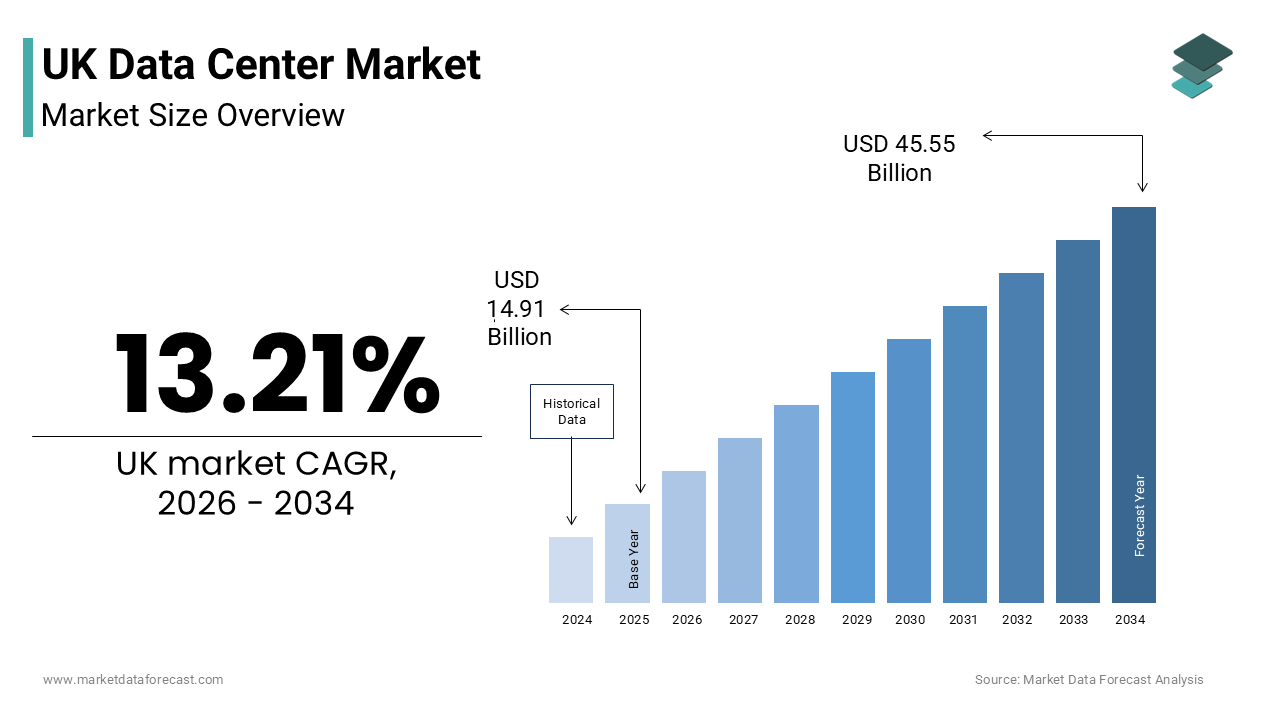
$14.91 BnMarket Estimate, 2026
$16.88 BnMarket Forecast, 2034
$45.55 BnCAGR, 2026–2034
13.21%United Kingdom Data Center Market Report Summary
The United Kingdom data center market was valued at USD 14.91 billion in 2025 and is anticipated to reach USD 16.88 billion in 2026 from USD 45.55 billion by 2034, growing at a CAGR of 13.21% during the forecast period from 2026 to 2034. The growth of the United Kingdom data center market is driven by increasing cloud computing adoption, rising investments from hyperscale cloud providers, and growing demand for artificial intelligence and high-performance computing infrastructure. Expanding digital transformation initiatives across industries, increasing deployment of edge computing networks, and growing reliance on data-intensive applications are further accelerating market growth. Moreover, advancements in sustainable cooling technologies, expansion of renewable energy integration, and increasing demand for low-latency digital services are supporting the expansion of the United Kingdom data center market.
Key Market Trends
- Rising investments by hyperscale cloud providers to expand large-scale data center infrastructure across the United Kingdom.
- Increasing adoption of artificial intelligence and high-performance computing workloads requiring high-density power and cooling solutions.
- Growing deployment of edge data centers to support 5G networks, IoT applications, and low-latency services.
- Strong focus on renewable energy integration and sustainable cooling technologies to meet environmental targets.
- Expansion of hybrid cloud and multi-cloud strategies among enterprises driving colocation demand.
Segmental Insights
- Based on data center size, the large and mega data centers segment dominated the United Kingdom data center market and held the largest share in 2025. The segment’s dominance is attributed to growing hyperscale cloud investments, economies of scale, increasing enterprise cloud migration, and rising demand for high-capacity digital infrastructure.
- The edge data centers segment is projected to witness the fastest CAGR during the forecast period owing to increasing adoption of IoT devices, expansion of 5G connectivity, rising demand for real-time data processing, and growing need for localized computing capabilities.
- Based on tier type, the Tier 3 segment accounted for the leading share of the United Kingdom data center market in 2025. The dominance of this segment is driven by high reliability standards, concurrent maintainability features, cost efficiency, and widespread adoption among enterprise and colocation customers.
- The Tier 4 segment is anticipated to register the fastest CAGR during the forecast period due to increasing demand for zero-downtime operations, rising adoption by financial institutions and government organizations, and growing requirements for mission-critical digital infrastructure.
- Based on data center type, the colocation data centers segment held the major share of the United Kingdom data center market in 2025 owing to operational flexibility, reduced infrastructure management burdens, strong connectivity ecosystems, and cost-effective scalability for enterprise customers.
- The hyperscale self-built data centers segment is expected to witness rapid growth during the forecast period because of aggressive expansion plans by major cloud providers, increasing demand for customized infrastructure, and growing investments in large-scale cloud service delivery networks.
- Based on end user, the IT and ITES segment dominated the United Kingdom data center market in 2025 due to increasing cloud adoption, software-as-a-service deployment, digital transformation initiatives, and growing demand for scalable computing infrastructure.
- The BFSI segment is projected to witness the fastest CAGR during the forecast period owing to increasing digital banking adoption, growing fintech activities, rising real-time transaction processing requirements, and expanding regulatory compliance demands.
Regional Insights
The United Kingdom remains one of the largest and most advanced data center markets in Europe, supported by strong digital infrastructure, high internet penetration, and its strategic position as a global connectivity hub. London continues to dominate the market due to its concentration of financial services, extensive fiber connectivity, and presence of major cloud providers. Growing investments in secondary markets such as Manchester and other regional hubs are further supporting the expansion of data center capacity across the country.
Competitive Landscape
The United Kingdom data center market is highly competitive and characterized by the presence of global colocation providers, hyperscale operators, infrastructure investors, and cloud service companies competing through capacity expansion, sustainability initiatives, and advanced connectivity solutions. Leading companies are focusing on renewable energy adoption, development of AI-ready infrastructure, enhancement of interconnection ecosystems, and expansion of hyperscale campuses. Strategic partnerships with telecommunications providers, cloud platforms, and renewable energy companies are further strengthening market positioning across the data center ecosystem. Prominent players in the United Kingdom data center market include Equinix, Digital Realty, CyrusOne, NTT Global Data Centers, Vantage Data Centers, Global Switch, Telehouse, Iron Mountain Data Centers, Colt Data Centre Services, Ark Data Centres, Virtus Data Centres, Kao Data, Yondr Group, Microsoft, Amazon Web Services (AWS), and Google Cloud
UK Data Center Market Size
The UK data center market size was valued at USD 14.91 billion in 2025 and is anticipated to reach USD 16.88 billion in 2026 from USD 45.55 billion by 2034, growing at a CAGR of 13.21% during the forecast period from 2026 to 2034.
The data center is digital infrastructure hub for the storage processing and distribution of vast amounts of data for enterprises cloud providers and government entities. The high density power requirements and advanced cooling technologies necessary to maintain operational efficiency and uptime. London remains one of the top three largest data centers in Europe alongside Frankfurt and Amsterdam due to its connectivity and financial services concentration. The internet traffic in the UK has grown exponentially with broadband speeds averaging over 60 megabits per second across fixed lines, as per a study. The transition toward hybrid cloud architectures and artificial intelligence workloads is reshaping facility designs requiring higher power densities and liquid cooling solutions. Regulatory frameworks such as the Energy Security Strategy emphasize the need for sustainable data operations driving investment in renewable energy integration. The presence of major submarine cable landing stations further enhances the UK’s status as a global connectivity gateway.
MARKET DRIVERS
Surge in Cloud Computing and Hyperscale Expansion
The rapid adoption of cloud computing and the subsequent expansion of hyperscale data centers by generating immense demand for scalable and reliable infrastructure is fuelling the growth of the United Kingdom data center market. Enterprises are increasingly migrating legacy systems to public and private clouds to enhance agility reduce capital expenditure and improve disaster recovery capabilities. Major technology companies, including Amazon Web Services, Microsoft Azure, and Google Cloud, have announced significant investments in UK regions to meet this growing demand. These hyperscalers require large scale facilities with high power capacity and redundant connectivity to serve millions of users simultaneously. According to industry analysis the shift toward hybrid cloud models allows organizations to keep sensitive data on premise while leveraging public cloud resources for burst capacity further driving colocation demand. The proliferation of software as a service applications also contributes to this trend as providers seek low latency environments to deliver seamless user experiences. The concentration of these facilities in key hubs like Slough and Manchester creates clusters of digital activity that attract further investment. This structural shift in IT consumption ensures that data center construction and modernization remain priority initiatives for both technology giants and enterprise customers seeking competitive advantage through digital transformation.
Adoption of Artificial Intelligence and High Performance Computing
The widespread adoption of artificial intelligence and high-performance computing by necessitating specialized infrastructure capable of handling intensive computational workloads is also accelerating the growth of the United kingdom data center market. AI models particularly large language models require massive amounts of data processing and storage, which traditional data centers are not designed to support efficiently. The UK is a global leader in AI research and development leading to increased deployment of GPU accelerated servers in local facilities. These high-performance computing environments generate significantly more heat and consume substantially more power than standard server racks prompting operators to upgrade cooling systems and power distribution units. The demand for AI ready data center space is expected to grow at a double-digit rate as industries from healthcare to finance integrate machine learning into their operations. The need for low latency processing for real time AI applications also drives the development of edge data centers closer to end users. Government initiatives supporting AI innovation further stimulate investment in specialized infrastructure. This technological evolution transforms data centers from passive storage repositories into active computing hubs. The requirement for liquid cooling and direct to chip thermal management solutions creates new opportunities for equipment manufacturers and facility designers.
MARKET RESTRAINTS
Stringent Planning Permissions and Land Availability Constraints
The stringent planning permissions and limited land availability is delaying project timelines and increasing development costs, which is hampering the growth of the United Kingdom data center market. Local authorities often impose strict regulations on noise levels visual impact and traffic generation associated with large scale data center constructions. The approval process for major infrastructure projects can take several years due to complex bureaucratic procedures and community objections. The scarcity of suitable land near key connectivity hubs, such as London exacerbates this issue forcing developers to look at less optimal locations with higher connectivity costs. The protection of green belt areas further restricts the expansion of data center campuses in high demand regions. Developers must navigate a fragmented regulations, where different councils have varying requirements for sustainability and community benefits. This uncertainty discourages some international investors who prefer markets with streamlined approval processes. The lack of designated zones for digital infrastructure means that each project requires individual negotiation and assessment.
High Energy Costs and Grid Capacity Limitations
The high energy costs and constraints on national grid capacity by impacting operational profitability and expansion feasibility is another factor declining the growth of the United Kingdom data center market. Data centers are energy intensive facilities requiring continuous power supply for servers and cooling systems making electricity prices a major component of operating expenses. The UK has experienced significant volatility in wholesale energy prices affecting the long term cost predictions for facility operators. Furthermore, the national electricity grid faces capacity challenges in certain regions limiting the amount of power that can be allocated to new data center projects. ESO connection queues for large power demands have lengthened significantly causing delays of several years for new facilities seeking grid access. This factor is to invest in expensive onsite generation or battery storage solutions to ensure reliability. The high cost of power also affects the competitiveness of UK data centers compared to other European markets with cheaper energy sources. Operators must balance the need for high availability with cost efficiency, which is becoming increasingly difficult. The uncertainty surrounding future energy pricing and grid upgrades creates financial risk for long term contracts.
MARKET OPPORTUNITIES
Integration of Renewable Energy and Sustainable Cooling Technologies
The integration of renewable energy sources and sustainable cooling technologies by aligning with corporate sustainability goals and regulatory requirements, which is also setting up new opportunities for the growth of the United Kingdom data center market. Organizations are increasingly prioritizing green data centers that minimize carbon footprints through the use of solar wind and hydroelectric power. Many UK data center operators are committing to net zero targets by 2030, driving investment in power purchase agreements with renewable energy providers. The adoption of innovative cooling methods such as immersion cooling and adiabatic systems reduces water usage and energy consumption significantly. The achieve high sustainability certifications attract premium tenants who are mandated to report on environmental social and governance metrics. The UK government’s emphasis on green growth provides incentives for operators who invest in energy efficient infrastructure. Partnerships with technology firms developing waste heat recovery systems allow data centers to supply warmth to local communities creating additional revenue streams. This circular economy approach enhances social license to operate and improves community relations. The development of modular data centers powered by renewable microgrids offers flexibility and resilience.
Expansion of Edge Computing Infrastructure
The expansion of edge computing infrastructure by addressing the need for low latency data processing in distributed networks, which is another factor to elevate the growth of the United Kingdom data center market. As Internet of Things devices and 5G networks, proliferate the volume of data generated at the network edge increases requiring localized processing capabilities. The rollout of 5G, across the UK creates demand for small scale data centers located closer to end users to minimize latency. Edge data centers support applications such as autonomous vehicles smart cities and augmented reality, which require real time response times. According to telecommunications analysts the deployment of multi access edge computing nodes will drive growth in secondary cities and rural areas beyond traditional hubs. This decentralization allows operators to tap into new markets and diversify their geographic footprint. Retailers and manufacturing firms are investing in edge facilities to optimize supply chain logistics and predictive maintenance. The modularity of edge data centers enables rapid deployment and scalability making them attractive for specific use cases. Partnerships with telecom providers facilitate the sharing of infrastructure reducing capital expenditure. This shift toward distributed computing complements central hyperscale facilities and creates a layered architecture that enhances overall network performance.
MARKET CHALLENGES
Skilled Workforce Shortage and Talent Retention Issues
The shortage of skilled workforce and challenges in talent retention is to pose as a major challenge for the growth of the United Kingdom data center market. The industry requires specialized professionals with expertise in electrical engineering mechanical systems cyber security and IT infrastructure management. There is a significant skills gap in the UK tech sector with thousands of unfilled positions in infrastructure roles. The rapid evolution of technology means that existing staff require continuous training to manage new systems, such as liquid cooling and AI optimized hardware. The high turnover rates in the data center sector are driven by competition from other tech industries offering higher salaries and flexible working conditions. The lack of standardized training programs and career pathways makes it difficult to attract new entrants to the field. Aging workforce demographics further exacerbate the problem as experienced engineers retire without adequate replacements. This talent crunch leads to increased labor costs and potential operational risks due to understaffing. Companies must invest heavily in recruitment and development initiatives to build a sustainable pipeline of skilled workers. Collaboration with educational institutions to create specialized curricula is essential but takes time to yield results.
Cybersecurity Threats and Physical Security Risks
The cybersecurity threats and physical security risks is compromising data integrity and operational continuity is also to impede the growth of the United Kingdom data center market. Data centers are prime targets for cyberattacks, including ransomware distributed denial of service and insider threats due to the concentration of valuable information. The infrastructure sector faces persistent and sophisticated attacks that require constant vigilance and advanced defense mechanisms. Physical security is equally unauthorized access to facilities can lead to hardware theft or sabotage. The compliance with rigorous security protocols such as ISO 27001 is mandatory but maintaining these standards requires substantial investment in personnel and technology. The emergence of operational technology and information technology expands the attack surface making systems more vulnerable to exploitation. Supply chain vulnerabilities also pose risks as compromised components can introduce backdoors into infrastructure. The cost of implementing comprehensive security measures including biometric access controls and real time monitoring systems adds to operational expenses. Breaches can result in severe reputational damage and legal liabilities eroding client trust. The evolving nature of threats means that security strategies must be continuously updated and tested. Balancing accessibility for legitimate users with robust protection against malicious actors remains a complex and ongoing challenge for data center operators in the UK.
REPORT COVERAGE
| REPORT METRIC | DETAILS |
| Market Size Available | 2025 to 2034 |
| Base Year | 2025 |
| Forecast Period | 2026 to 2034 |
| CAGR | 13.21% |
| Segments Covered | By Data Center Size,Tier Type, Data Center Type, End User and Region. |
| Various Analyses Covered | Global, Regional & Country Level Analysis, Segment-Level Analysis, DROC, PESTLE Analysis, Porter’s Five Forces Analysis, Competitive Landscape, Analyst Overview of Investment Opportunities |
| Market Leaders Profiled | Equinix, Digital Realty, CyrusOne, NTT Global Data Centers, Vantage Data Centers, Global Switch, Telehouse, Iron Mountain Data Centers, Colt Data Centre Services, Ark Data Centres, Virtus Data Centres, Kao Data, Yondr Group, Microsoft, Amazon Web Services (AWS), and Google Cloud. |
SEGMENTAL ANALYSIS
By Data Center Size Insights
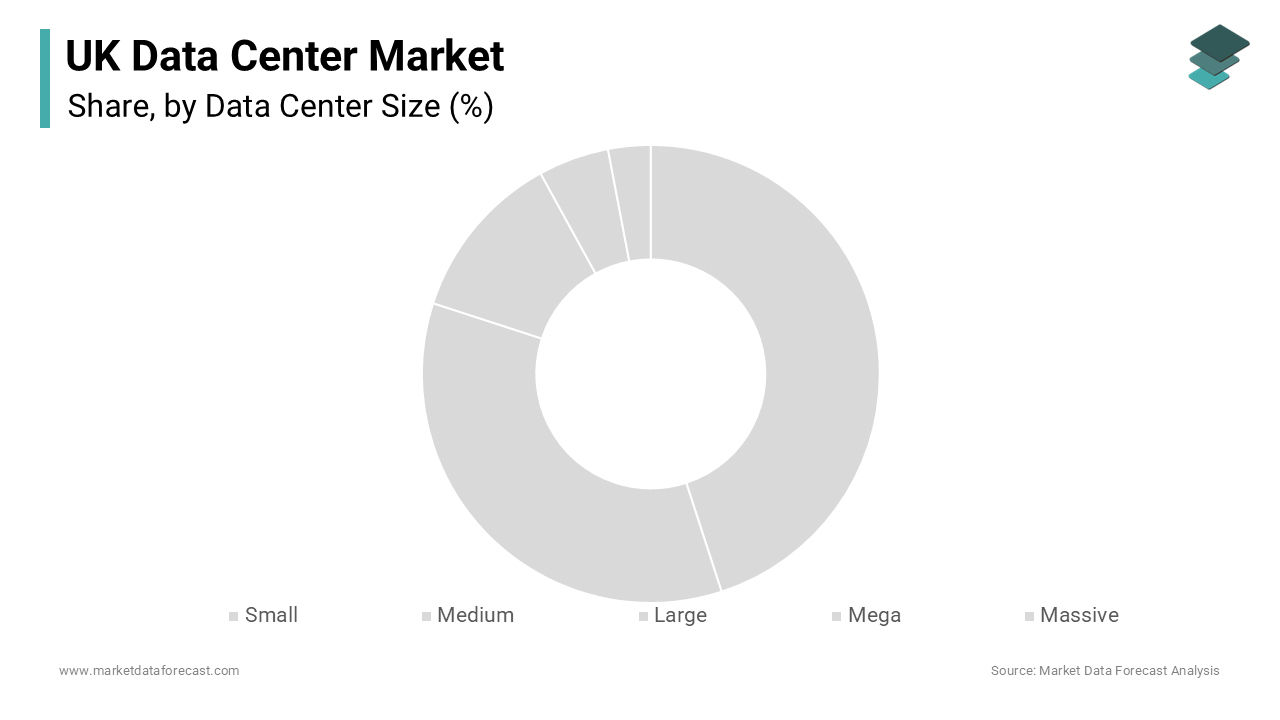
The large and mega data centers was the largest by holding 44.3% of the United Kingdom data center market share in 2025 due to their ability to provide economies of scale for hyperscale cloud providers and large enterprises requiring massive computational power. These facilities typically exceed 10 megawatts in power capacity and are designed to support thousands of servers efficiently. The majority of new power capacity added in the UK in recent years has been driven by hyperscalers, such as Amazon Web Services and Microsoft Azure, who prefer large consolidated campuses. The concentration of infrastructure allows for optimized cooling systems and power distribution which reduces the overall cost per unit of compute. The demand for cloud services has grown exponentially with businesses migrating workloads to these large scale environments. The ability to offer high density racks and advanced connectivity options makes these facilities indispensable for modern digital operations. Large data centers also benefit from strategic locations near fiber optic backbones ensuring low latency connections to global networks. This structural advantage ensures that they remain the primary choice for organizations seeking reliability and scalability. The continuous investment in expanding existing mega facilities rather than building numerous small ones reflects the industry trend toward consolidation and efficiency.
The edge data centers segment is likely to grow at a fastest CAGR of 18.5% from 2026 to 2034 with the proliferation of Internet of Things devices and the rollout of 5G networks. These small-scale facilities are located closer to end users to process data locally reducing latency and bandwidth usage. Edge data centers enable real time processing for applications such as autonomous vehicles smart cities and industrial automation which demand immediate response times. According to telecommunications industry analysis the number of connected IoT devices in the UK is expected to reach hundreds of millions in the coming years creating a substantial need for localized processing power. The modular nature of edge data centers allows for rapid deployment in diverse locations including retail stores factories and cell towers. This flexibility enables service providers to extend their reach beyond traditional urban hubs into rural and semi urban areas. The ability to process sensitive data locally also addresses privacy concerns and regulatory requirements regarding data sovereignty.
By Tier Type Insights
The Tier 3 data centers hold the leading position in the UK market because they offer an optimal balance between high availability and cost efficiency for most enterprise and colocation customers. These facilities provide concurrent maintainability meaning that any component can be removed or replaced without disrupting operations which ensures 99.982% uptime. As per standards defined by the Uptime Institute Tier 3 certification is widely recognized as the industry benchmark for reliable commercial data centers. Most businesses do not require the fault tolerance of Tier 4 facilities but need more reliability than Tier 1 or 2 can offer. The majority of colocation providers in the UK operate Tier 3 certified facilities to meet the expectations of corporate clients. The cost of building and operating a Tier 3 data center is significantly lower than Tier 4, making it more accessible for a broader range of customers. The widespread availability of Tier 3 facilities in major UK cities ensures that customers have ample choice and competitive pricing.
The tier 4 data centers segment is likely to grow at a fastest CAGR of 12.3% from 2026 to 2034 with the increasing need for zero downtime in critical infrastructure applications. These facilities provide fault tolerant infrastructure with 99.995% uptime ensuring continuous operation even in the event of multiple simultaneous failures. The rise of digital banking and real time payment systems requires absolute reliability, which only Tier 4 designs can guarantee. The cost of downtime for major financial and healthcare organizations can run into millions of pounds per hour justifying the higher investment in Tier 4 infrastructure. The adoption of mission applications in government and defense sectors, also contributes to this growth as national security depends on uninterrupted data availability. Tier 4 facilities feature fully redundant subsystems including power and cooling which eliminate single points of failure. This level of resilience is becoming essential for organizations that operate 24/7 globally.
By Data Center Type Insights
The colocation data centers segment held a significant share of the United Kingdom data center market in 2025, as they allow enterprises to outsource infrastructure management, while retaining control over their hardware and software. Companies can rent space power and cooling on a pay as you go basis which improves cash flow and financial predictability. The ability to quickly expand or reduce footprint in response to business needs is a primary driver for colocation adoption. Colocation providers offer robust connectivity options allowing customers to connect with multiple cloud providers and network carriers within the same facility. This interconnection ecosystem enhances performance and reduces latency for hybrid cloud architectures. The expertise of colocation providers in security compliance and maintenance ensures high availability without the burden on internal IT teams. This operational efficiency allows businesses to focus on their core competencies rather than facility management. The widespread availability of colocation facilities across the UK provides geographic diversity for disaster recovery purposes.
The hyperscale self-built data centers segment is anticipated to grow at a fastest CAGR 15.7% from 2026 to 2034 with the aggressive expansion plans of major cloud service providers. Companies like Amazon, Microsoft, and Google, are investing billions in building dedicated facilities to support their growing customer base. The foreign direct investment in the UK digital infrastructure sector has surged with hyperscalers leading the charge. These providers require massive scale to achieve the efficiency and performance needed for global cloud services. The announcements several new hyperscale campuses are under construction in regions like the Thames Valley and the North of England. The self-built model allows these companies to customize every aspect of the facility from power design to cooling systems for optimal performance. This level of customization is not possible in standard colocation facilities. The sheer volume of power and space required by hyperscalers drives significant growth in this segment.
By End User Insights
The IT and Information Technology Enabled Services segment held a prominent share of the United Kingdom data center market in 2025 due to its central role in driving digital transformation and cloud adoption across the economy. These companies are the primary consumers of data center resources as they develop host and manage software applications for various industries. Software as a service providers gaming companies and managed service providers rely heavily on colocation and hyperscale facilities to deliver their services. The shift toward agile development and continuous deployment requires flexible and scalable infrastructure, which data centers provide. The growth of remote work has also increased the demand for IT services that support collaboration and productivity tools. These services are hosted in data centers ensuring availability and performance for users. The IT sector’s continuous innovation cycle drives regular upgrades and expansion of data center capacity.
The Banking Financial Services and Insurance sector is growing at an expected CAGR of 14.9% from 2026 to 2034 owing to the rapid digitization of financial services. Traditional banks and fintech startups are launching digital first products that require secure and scalable infrastructure. The number of active digital banking users in the UK has risen sharply increasing the load on backend systems. Mobile payments online lending and robo advisory services all rely on data centers for real time processing and security. According to industry reports financial institutions are migrating legacy systems to modern cloud and colocation environments to improve agility and reduce costs. The need for high frequency trading platforms also demands ultra low latency connections provided by premium data centers. The competitive landscape in financial services forces companies to innovate rapidly requiring flexible infrastructure that can support new applications. The growth of open banking initiatives further increases data exchange volumes requiring robust interconnection capabilities.
COMPETITIVE LANDSCAPE
The competition in the UK data center market is intense and characterized by the presence of global real estate investment trusts specialized operators and telecom providers vying for limited power and land resources. Major players compete on the basis of location connectivity sustainability credentials and technical capabilities rather than price alone. The market is constrained by grid capacity and planning permissions which creates a barrier to entry and favors established incumbents with existing infrastructure. Hyperscale demand drives consolidation as large providers acquire smaller assets to expand their footprints quickly. Differentiation is achieved through offering superior interconnection ecosystems and meeting strict environmental social and governance standards. Customer retention relies on providing reliable uptime and flexible service models that support hybrid cloud strategies. The entry of new investors into the sector increases capital availability but also raises expectations for returns. Regulatory pressures regarding energy usage and carbon emissions force all participants to innovate continuously.
KEY MARKET PLAYERS
Some of the promising companies that are playing a dominating role in the UK data center market include
- Equinix
- Digital Realty
- CyrusOne
- NTT Global Data Centers
- Vantage Data Centers
- Global Switch
- Telehouse
- Iron Mountain Data Centers
- Colt Data Centre Services
- Ark Data Centres
- Virtus Data Centres
- Kao Data
- Yondr Group
- Microsoft
- Amazon Web Services
- Google Cloud
Top Players in the UK Data Center Market
Digital Realty Trust Inc
Digital Realty Trust Inc operates as a global leader in data center solutions with a significant presence in key UK locations such as London and Manchester. The company provides colocation and interconnection services that enable businesses to scale their digital infrastructure efficiently. Recently Digital Realty has strengthened its market position by expanding its campus capacity in Slough to meet the growing demand from hyperscale customers. The firm focuses on sustainability by investing in renewable energy sources and advanced cooling technologies to reduce carbon emissions. Their strategic investments in fiber networks enhance network performance and reliability.
Equinix Inc
Equinix Inc is a prominent provider of digital infrastructure services operating multiple International Business Exchange campuses across the United Kingdom. The company specializes in interconnection and colocation allowing organizations to connect directly with partners and cloud providers. Recently Equinix has expanded its facilities in London and Slough to support the increasing need for low latency connectivity and hybrid cloud architectures. The firm actively promotes sustainable operations by committing to 100% renewable energy usage across its global portfolio. Equinix enhances customer value through its Platform Equinix which offers automated interconnection services.
Global Switch Holdings Limited
Global Switch Holdings Limited is a leading owner operator and developer of high quality data centers in major European cities including London and Manchester. The company serves large enterprise and hyperscale clients with customized infrastructure solutions designed for high availability and security. Recently Global Switch has invested heavily in expanding its London East campus to accommodate the rising demand for cloud and AI workloads. The firm prioritizes energy efficiency by implementing innovative cooling systems and securing long term power purchase agreements for green energy. Global Switch maintains strong relationships with telecommunications providers ensuring superior connectivity for its tenants. Their focus on operational excellence and customer centric design differentiates them in the competitive world. These strategic developments enhance their capacity and service quality solidifying their position as a key player in the UK data center industry.
Top Strategies Used by Key Market Participants
Key players in the UK data center market primarily focus on sustainability initiatives to meet net zero targets and regulatory requirements through renewable energy adoption. Companies invest heavily in expanding capacity in strategic locations like London and Manchester to address the shortage of power and space. Developing advanced cooling technologies such as liquid immersion helps manage higher power densities from AI workloads efficiently. Strategic partnerships with cloud providers and telecommunications firms enhance interconnection ecosystems and attract more tenants. Automating operations through artificial intelligence improves energy efficiency and reduces operational costs significantly. Securing long term power supply agreements ensures stability amidst grid constraints and rising energy prices. Offering flexible colocation and managed services caters to diverse customer needs from startups to hyperscalers. These strategies enable participants to navigate regulatory challenges optimize resource usage and maintain competitiveness in a rapidly evolving digital infrastructure landscape.
MARKET SEGMENTATION
This research report on the UK data center market has been segmented based on the following categories.
By Data Center Size
- Small
- Medium
- Large
- Mega
- Massive
By Tier Type
- Tier 1 and 2
- Tier 3
- Tier 4
By Data Center Type
- Hyperscale / Self-built
- Enterprise / Edge
By End User
- BFSI
- IT and ITES
- E-Commerce
- Government
- Manufacturing
- Media and Entertainment
- Telecom
- Other End Users
By Country
- U.K