- Product Description Description
- Table of Contents TOC
- List of Table & Figure LOT
- Get Free Sample PDF Sample PDF
Market Size, 2025
$2,185.31 BnMarket Estimate, 2026
$2,713.72 BnMarket Forecast, 2034
$15,345.41 BnCAGR, 2026–2034
24.18%UK Energy Storage Market Report Summary
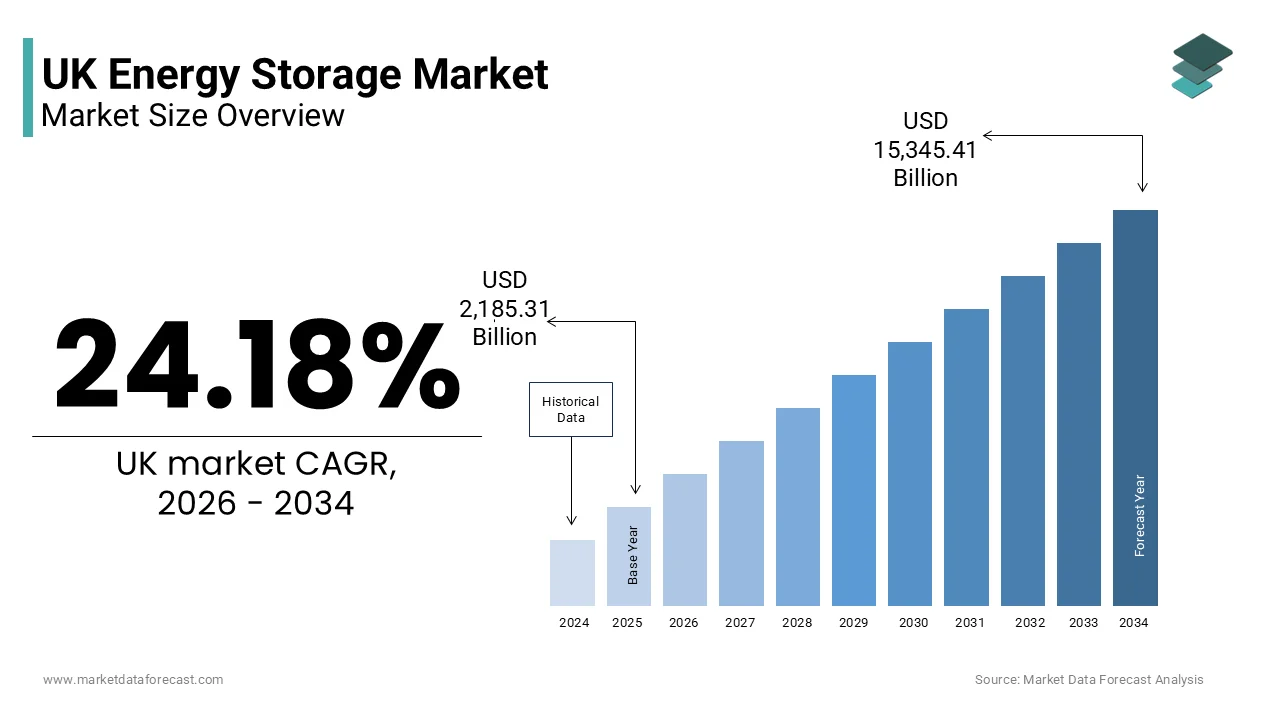
The UK energy storage market was valued at USD 2,185.31 billion in 2025, is estimated to reach USD 2,713.72 billion in 2026, and is projected to reach USD 15,345.41 billion by 2034, growing at a CAGR of 24.18% during the forecast period. Market growth is driven by increasing renewable energy integration, rising grid modernization initiatives, growing demand for energy flexibility, and supportive government policies promoting clean energy transition. The rapid deployment of battery energy storage systems and advancements in energy management technologies are further accelerating market expansion across the United Kingdom.
Key Market Trends
- Growing integration of renewable energy sources is driving market growth.
- Increasing investments in grid stability and energy resilience are boosting market expansion.
- Rising deployment of battery energy storage systems is supporting industry development.
- Expansion of utility scale energy storage projects is enhancing market opportunities.
- Growing focus on decarbonization and energy transition strategies is influencing market advancement.
Segmental Insights
- Based on type, the battery energy storage systems segment accounted for the largest share of the UK energy storage market in 2025. This dominance is attributed to declining battery costs, improved energy efficiency, and increasing deployment across utility, commercial, and residential applications.
- Based on application, the utility scale segment held the leading share of the UK energy storage market in 2025, driven by the need for grid balancing, renewable energy integration, and large scale energy management solutions.
Regional Insights
- The United Kingdom held the dominant position in the European energy storage market in 2025 and remains one of the most advanced and active energy storage markets in Europe. Strong policy support, significant renewable energy capacity additions, and large scale storage project developments continue to strengthen the country's market leadership.
Competitive Landscape
The UK energy storage market is highly competitive, with companies focusing on battery technology innovation, grid scale storage deployment, renewable energy integration, and energy optimization solutions to strengthen their market position. Market participants continue to invest in advanced storage technologies, smart grid solutions, and long duration energy storage projects. Major players operating in the UK energy storage market include Harmony Energy Ltd, Gresham House Energy Storage Fund plc, EDF Energy, E.ON UK plc, SSE plc, Zenobe Energy Ltd, Fluence Energy, Inc., Tesla, Inc., Wärtsilä Corporation, and Highview Power.
UK Energy Storage Market Size
The UK energy storage market size was valued at USD 2,185.31 billion in 2025, and is projected to reach USD 15,345.41 billion by 2034 from USD 2,713.72 billion in 2026, growing at a CAGR of 24.18%.
According to the Department for Business, Energy and Industrial Strategy, the UK aims to decarbonize its power system by 2035, which is necessitating substantial investments in flexible capacity to manage intermittent wind and solar generation. As per data from National Grid ESO, the grid requires increasing levels of inertia and frequency response services, which energy storage systems provide more efficiently than traditional fossil fuel plants. The cultural and political commitment to net-zero emissions has accelerated policy support, with over 14 gigawatts of renewable capacity already installed, creating an urgent need for storage integration. Regulatory frameworks governed by Ofgem are evolving to recognize storage as a distinct asset class, enabling participation in multiple revenue streams such as the Capacity Market and balancing mechanisms. Consumer awareness regarding energy independence is rising, with households increasingly adopting behind-the-meter storage solutions alongside solar photovoltaic installations. The market operates at the intersection of technological innovation, regulatory reform, and climate urgency, driving significant capital inflow and strategic partnerships across the value chain. This dynamic environment positions the UK as a leading European hub for energy storage deployment and technological advancement.
MARKET DRIVERS
Aggressive Government Decarbonization Targets and Net Zero Mandates
The UK government’s legally binding commitment to achieve net-zero greenhouse gas emissions by 2050 is primarily driving the expansion of the UK energy storage market and is driving unprecedented policy support and investment. The Climate Change Act mandates a 78% reduction in carbon emissions by 2035 compared to 1990 levels, requiring a fundamental restructuring of the power generation mix away from fossil fuels. According to the Committee on Climate Change, the electricity sector must be fully decarbonized by 2035, which implies a massive expansion of variable renewable energy sources such as offshore wind and solar photovoltaics. As per data from the Department for Energy Security and Net Zero, renewable sources accounted for over 40% of electricity generation in recent years, creating significant intermittency challenges that only large-scale storage can mitigate. The government has introduced specific funding mechanisms, such as the Long Duration Energy Storage competition, to encourage innovation in technologies capable of storing energy for extended periods. These mandates create a guaranteed demand pipeline for storage developers, who can secure long-term contracts through government-backed schemes. The strategic importance of energy security, following global geopolitical tensions, has further reinforced the need for domestic storage capacity to reduce reliance on imported gas. This regulatory certainty provides investors with the confidence required to commit capital to large-scale infrastructure projects, ensuring sustained market growth.
Integration of Variable Renewable Energy Sources
The rapid proliferation of variable renewable energy sources, particularly offshore wind and solar power is further boosting the expansion of the UK energy storage market. The UK is a global leader in offshore wind capacity, with over 14 gigawatts installed and plans to reach 50 gigawatts by 2030, according to the Crown Estate. However, wind generation is inherently unpredictable, leading to periods of excess supply that can destabilize the grid if not managed effectively. Energy storage systems absorb this surplus energy during peak generation times and release it during periods of low wind or high demand, ensuring a consistent power supply. According to National Grid ESO, balancing costs have increased significantly due to the growing share of renewables, making storage an economically viable solution for frequency regulation and voltage control. Solar capacity is also expanding rapidly, with domestic installations surging as homeowners seek to maximize self-consumption of generated electricity. As per data from the Solar Trade Association, pairing solar panels with battery storage can increase self-sufficiency rates from 30% to over 70%, reducing reliance on the grid. This technical necessity transforms storage from an optional add-on to a critical infrastructure requirement. As renewable penetration deepens, the grid becomes increasingly dependent on fast-responding storage assets to maintain reliability, driving continuous deployment across both utility and distributed scales.
MARKET RESTRAINTS
High Initial Capital Expenditure and Financing Barriers
The substantial upfront capital required for deploying energy storage systems is impeding the growth of the UK market, particularly for smaller developers and residential consumers. Lithium-ion battery systems, which dominate the current landscape, involve high costs for raw materials, manufacturing, and installation, which can deter widespread adoption despite falling prices. According to the UK Energy Research Centre, the levelized cost of storage remains higher than conventional peaking plants in certain scenarios, making project economics sensitive to interest rates and financing terms. As per data from the Bank of England, rising base rates have increased the cost of borrowing for infrastructure projects, reducing the internal rate of return for potential investors. Residential battery storage systems can cost between 5,000 and 10,000 pounds depending on capacity, which is prohibitive for many households without substantial subsidies. Commercial and industrial users face similar barriers when evaluating the payback period for large-scale installations. Although operational costs are low, the initial outlay requires significant equity or debt financing, which may be difficult to secure in a tight credit market. Supply chain constraints for critical minerals, such as lithium and cobalt, further exacerbate price volatility, creating uncertainty for long-term budgeting. These financial hurdles slow down the pace of deployment, particularly in sectors where immediate profitability is not guaranteed, limiting the overall market expansion rate.
Complex Regulatory Frameworks and Market Access Issues
Navigating the complex and evolving regulatory landscape is another significant factor hampering the UK energy storage market growth, which is creating uncertainty and administrative burdens. While Ofgem has made strides in recognizing storage as a distinct asset class, double-charging issues and unclear connection rules still hinder market participation. According to the Energy Networks Association, storage projects often face lengthy and expensive grid connection queues, with wait times extending several years due to network congestion. As per data from National Grid ESO, thousands of megawatts of storage capacity are stuck in the connection pipeline, waiting for infrastructure upgrades that are delayed by planning permissions and local opposition. The current market design favors established generation assets, making it difficult for storage to compete on a level playing field in ancillary service markets. Rules regarding stacking multiple revenue streams, such as arbitrage and frequency response, are frequently updated, requiring operators to constantly adapt their business models. Additionally, local planning authorities often lack clear guidelines for approving large-scale battery farms, leading to inconsistent decision-making and project delays. The ambiguity surrounding liability for fire safety and environmental impact assessments adds another layer of complexity. These regulatory frictions increase development risks and costs, discouraging new entrants and slowing the deployment of much-needed storage capacity across the nation.
MARKET OPPORTUNITIES
Expansion of Vehicle to Grid Technology and Electric Vehicle Integration
The convergence of electric vehicle adoption and energy storage is a significant opportunity for the UK market through vehicle-to-grid technology, which allows EV batteries to serve as distributed storage assets. With the government ban on new petrol and diesel cars set for 2035, the number of electric vehicles on UK roads is projected to reach millions, creating a vast pool of mobile battery capacity. According to the Society of Motor Manufacturers and Traders, electric vehicle sales now account for over 20% of new car registrations, providing a substantial resource for grid balancing. Vehicle-to-grid systems enable EV owners to sell excess energy back to the grid during peak demand periods, generating revenue while supporting network stability. As per data from National Grid ESO, aggregated EV batteries could provide up to 6 gigawatts of flexible capacity by 2030, equivalent to several large power stations. Energy suppliers are launching tariffs that incentivize smart charging and discharging, encouraging consumer participation. This decentralized storage model reduces the need for expensive stationary infrastructure and enhances grid resilience. Automakers and energy companies are forming partnerships to develop compatible hardware and software platforms, facilitating seamless integration. As battery technology improves and charging infrastructure expands, vehicle-to-grid offers a scalable and cost-effective solution for managing renewable intermittency, while empowering consumers to become active participants in the energy market.
Development of Long Duration Energy Storage Solutions
The emerging need for long-duration energy storage is another prominent opportunity for the UK energy storage market. While lithium-ion batteries are effective for short-term balancing, they are less economical for seasonal shifting or extended periods of low renewable generation. According to the Department for Energy Security and Net Zero, the government has launched a 200 million pound competition to support the commercialization of long-duration storage technologies, such as flow batteries, compressed air, and liquid air energy storage. These technologies offer longer lifespans and lower degradation rates, making them suitable for large-scale applications where duration is critical. As per data from the Royal Academy of Engineering, long-duration storage will be essential for achieving a fully decarbonized grid by 2035, potentially accounting for 30% of total storage capacity. Projects like the Advanced Adiabatic Compressed Air Energy Storage plant in Scotland demonstrate the viability of these alternatives. Investors are increasingly interested in diverse technology portfolios to mitigate supply chain risks associated with lithium. The potential to repurpose existing industrial sites, such as salt caverns or abandoned mines for storage, further enhances feasibility. By supporting pilot projects and scaling up proven technologies, the UK can establish itself as a global leader in next-generation storage solutions, addressing the limitations of current battery chemistries.
MARKET CHALLENGES
Supply Chain Vulnerabilities and Critical Material Scarcity
The UK energy storage market faces significant challenges related to supply chain vulnerabilities and the scarcity of critical raw materials required for battery production. Most lithium-ion batteries rely on materials such as lithium, cobalt, and nickel, which are sourced from a limited number of countries, creating geopolitical risks and price volatility. According to the British Geological Survey, the UK has minimal domestic reserves of these critical minerals, making it heavily dependent on imports from Asia and Africa. As per data from the International Energy Agency, demand for lithium could increase by 40 times by 2040, potentially outstripping supply and driving up costs. Trade disruptions and export restrictions from producing nations can severely impact project timelines and budgets. The lack of a robust domestic recycling industry for end-of-life batteries further exacerbates material shortages and environmental concerns. Although the government is developing a critical minerals strategy, building a resilient supply chain takes time and significant investment. Manufacturers are exploring alternative chemistries, such as sodium-ion, but these are not yet commercially mature. Ensuring ethical sourcing and compliance with environmental standards adds complexity to procurement processes. These supply-side constraints threaten the scalability of energy storage deployments and require strategic diversification and international cooperation to mitigate risks.
Public Perception and Safety Concerns Regarding Battery Fires
Public apprehension regarding the safety of large-scale battery storage facilities is further challenging the UK energy storage market growth. High-profile incidents of battery fires globally have raised concerns about thermal runaway and the difficulty of extinguishing lithium-ion blazes, leading to local opposition against proposed sites. According to the National Fire Chiefs Council, fire services require specialized training and equipment to handle battery incidents, which are not yet universally available across all UK regions. As per data from local planning records, a significant number of battery storage applications face objections from community groups, citing safety and aesthetic impacts. The lack of standardized national guidelines for fire safety distances and containment measures creates inconsistency in approval processes. Developers must invest heavily in community engagement and advanced safety systems, such as early detection and suppression technologies, to gain trust. Insurance premiums for storage facilities remain high due to perceived risks, affecting project economics. Negative media coverage can amplify fears, making it difficult to secure a social license to operate. Addressing these concerns requires transparent communication, rigorous safety testing, and collaboration with emergency services to demonstrate that modern storage systems are safe and reliable. Overcoming this social hurdle is critical for accelerating deployment.
REPORT COVERAGE
| REPORT METRIC | DETAILS |
| Market Size Available | 2025 to 2034 |
| Base Year | 2025 |
| Forecast Period | 2026 to 2034 |
| CAGR | 24.18% |
| Segments Covered | By Type, Application, and Region. |
| Various Analyses Covered | Global, Regional and Country-Level Analysis, Segment-Level Analysis, Drivers, Restraints, Opportunities, Challenges; PESTLE Analysis; Porter’s Five Forces Analysis, Competitive Landscape, Analyst Overview of Investment Opportunities |
| Market Leaders Profiled | Harmony Energy Ltd, Gresham House Energy Storage Fund plc, EDF Energy, E.ON UK plc, SSE plc, Zenobe Energy Ltd, Fluence Energy, Inc., Tesla, Inc., Wärtsilä Corporation, and Highview Power |
SEGMENTAL ANALYSIS
By Type Insights
The battery energy storage systems segment accounted for the major share of the UK market in 2025. The growth of the BESS segment in the UK market is driven by their modular scalability, rapid response times, and declining capital costs. Unlike traditional generation assets, batteries can be deployed in a matter of months rather than years, making them ideal for addressing immediate grid stability needs and renewable integration challenges. According to National Grid ESO, battery storage units provide frequency response services within milliseconds, which is significantly faster than gas turbines or pumped hydro facilities, ensuring the grid remains stable during sudden fluctuations in supply or demand. As per data from the Department for Energy Security and Net Zero, over 2 gigawatts of battery capacity are currently operational or under construction, reflecting the technology's preference among developers. The versatility of batteries allows them to be sited close to demand centers or renewable generation sites, reducing transmission losses and congestion charges. Furthermore, the maturity of the supply chain and established manufacturing processes have led to an 80% reduction in battery pack prices over the last decade, as reported by BloombergNEF, making projects economically viable without heavy subsidies. The ability to stack multiple revenue streams, including arbitrage, capacity market payments, and ancillary services, enhances project bankability. This combination of technical performance, economic feasibility, and deployment speed ensures that battery storage remains the backbone of the UK’s flexibility strategy.
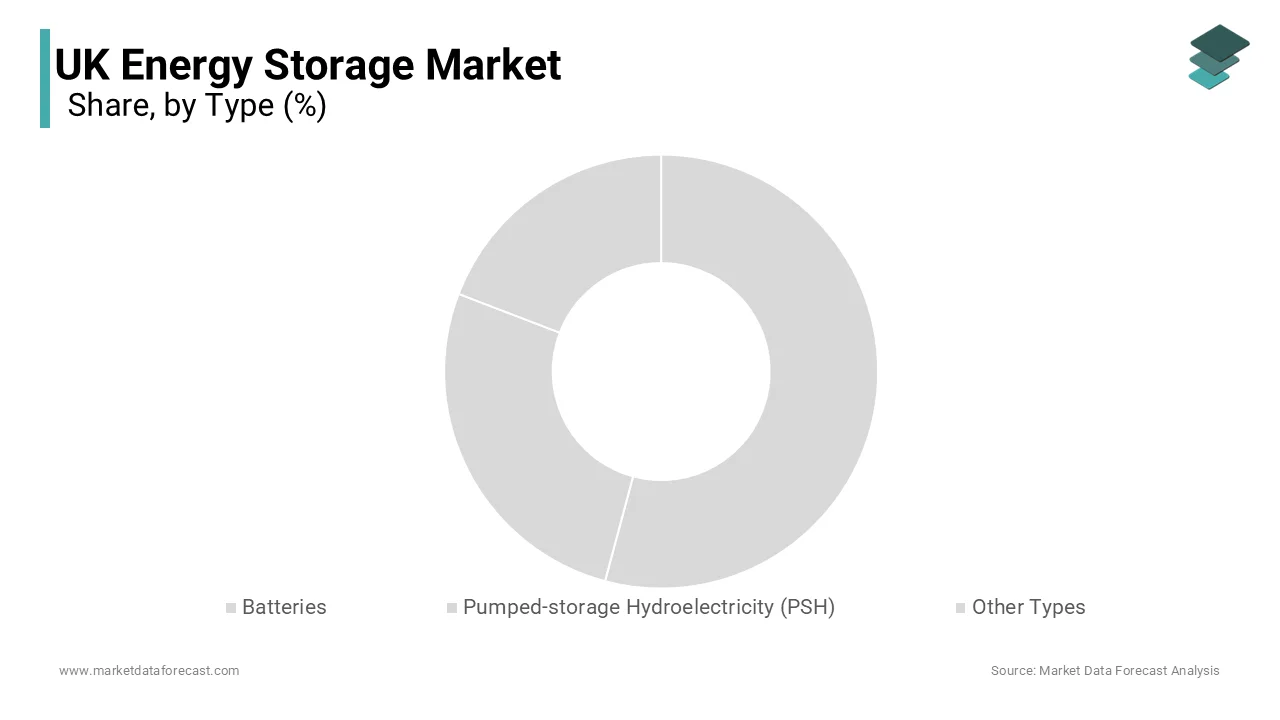
On the other end, the pumped storage hydroelectricity segment is estimated to record a CAGr of 16.2% during the forecast period owing to the urgent need for long-duration energy storage to support deep decarbonization. While existing facilities like Dinorwig have served the grid for decades, new projects such as Coire Glas in Scotland are revitalizing this technology due to its ability to store vast amounts of energy for days or weeks. According to SSE Renewables, the Coire Glas project alone will provide 30 gigawatt-hours of storage capacity, which is enough to power two million homes for five hours, offering a level of security that short-duration batteries cannot match. The Committee on Climate Change emphasizes that long-duration storage is essential for managing seasonal variations in wind and solar generation, particularly during calm winter periods when renewable output is low. Government funding through the Long Duration Energy Storage competition has de-risked these capital-intensive projects, encouraging private investment. As per data from the Crown Estate, the potential for additional pumped storage sites in the Scottish Highlands is highly favorable due to the topography. These projects create significant local employment and contribute to regional economic regeneration. As the grid moves toward higher renewable penetration, the unique ability of pumped hydro to provide inertia and black start capabilities makes it an indispensable component of the future energy mix, driving its rapid resurgence.
By Application Insights
The utility-scale segment led the market by capturing the highest share of the UK market in 2025, as national grid operators and large independent power producers deploy massive battery farms to maintain system stability and facilitate renewable energy integration. These large installations typically range from 50 megawatts to over 300 megawatts and are connected directly to the transmission network to provide critical services such as frequency regulation, voltage control, and constraint management. According to National Grid ESO, the cost of balancing the grid has risen sharply due to the intermittency of wind and solar, making utility-scale storage an economically attractive solution for reducing system-wide inefficiencies. As per data from Aurora Energy Research, utility-scale batteries captured over 60% of all frequency response contracts in recent auctions, demonstrating their superior performance compared to traditional thermal plants. The Capacity Market mechanism provides a steady revenue stream for these assets, ensuring long-term financial viability while allowing them to participate in wholesale energy trading for additional profits. Large-scale projects benefit from economies of scale in procurement and installation, lowering the per-kilowatt-hour cost significantly. Furthermore, government policies prioritize grid-level flexibility to meet net-zero targets, driving tender opportunities for major developers. This strategic importance in maintaining national energy security and enabling the phase-out of fossil fuels cements the leading position of the utility-scale segment.
However, the residential energy storage segment is emerging as the fastest growing application segment and is estimated to grow at a CAGR of 17.4% during the forecast period owing to the rising electricity prices, increased solar adoption, and consumer desire for energy independence. Homeowners are increasingly pairing rooftop solar photovoltaic systems with battery storage to maximize self-consumption and reduce reliance on the grid during peak tariff periods. According to the Solar Trade Association, the number of domestic battery installations in the UK has doubled annually since 2020, as consumers seek protection against volatile energy markets. The introduction of smart export guarantees and time-of-use tariffs incentivizes households to store cheap, off-peak electricity or excess solar generation for use during expensive evening hours. As per data from Ofgem, dynamic pricing models are becoming more widespread, encouraging behavioral shifts toward storage utilization. Advances in battery technology have improved safety and lifespan, making residential systems more appealing to mainstream buyers. Government grants and local authority initiatives further support uptake in social housing and low-income communities. The rise of electric vehicle ownership also drives interest in home energy management systems that integrate car charging with household storage. This convergence of economic savings, technological maturity, and environmental consciousness propels the residential segment into a period of rapid expansion.
COUNTRY LEVEL ANALYSIS
The UK held the dominant position in the European market in 2025 and stands as the most advanced and active energy storage market in Europe, characterized by progressive regulatory reforms, substantial renewable energy penetration, and strong government commitment to net-zero emissions. The nation serves as a global testbed for innovative storage technologies and market mechanisms due to its isolated grid structure, which necessitates high levels of flexibility and resilience. According to the Department for Energy Security and Net Zero, the UK has successfully decoupled economic growth from carbon emissions, with renewable sources generating record shares of electricity and creating an urgent operational need for storage solutions. The country boasts one of the largest pipelines of battery storage projects in the world, with over 10 gigawatts in development as reported by Regen, a leading energy consultancy. Ofgem has implemented landmark reforms to remove barriers for storage participation in electricity markets, enabling assets to stack multiple revenue streams and improve project economics. The UK also leads in policy innovation, with specific competitions for long-duration storage and clear pathways for hydrogen integration. As per data from the International Renewable Energy Agency, the UK is a top destination for clean energy investment in Europe. Strong academic institutions and research centers drive technological advancements, while a supportive financial sector provides necessary capital. This combination of regulatory clarity, market depth, and strategic ambition positions the UK as the undisputed leader in the European energy storage landscape, setting benchmarks for other nations to follow.
COMPETITIVE LANDSCAPE
The UK energy storage market features intense competition characterized by the presence of global technology providers specialized developers and established utility companies vying for project opportunities. Established corporations leverage extensive balance sheets and engineering expertise to dominate large scale infrastructure tenders while agile tech firms disrupt the status quo with innovative battery chemistries and software solutions. Competitive dynamics are shaped by the urgent need to meet net zero targets prompting rapid deployment of diverse storage technologies across the nation. Cost efficiency drives differentiation as companies race to lower levelized costs through economies of scale and technological advancements. Regulatory changes regarding grid connection queues and market participation rules create both barriers and opportunities for new entrants. Brand reputation for safety and reliability becomes crucial as high profile incidents raise public scrutiny. The race to secure limited grid capacity locations intensifies rivalry among developers. Success depends on balancing technical innovation financial viability and stakeholder engagement while navigating a complex policy landscape. Collaboration often emerges as a key strategy to share risks and accelerate project delivery in this rapidly evolving sector.
KEY MARKET PLAYERS
Some of the companies that are playing a dominating role in the UK energy storage market are
- Harmony Energy Ltd
- Gresham House Energy Storage Fund plc
- EDF Energy
- E.ON UK plc
- SSE plc
- Zenobe Energy Ltd
- Fluence Energy, Inc.
- Tesla, Inc.
- Wärtsilä Corporation
- Highview Power
Top Three Players in the Market
- Fluence maintains a significant presence in the UK by providing advanced battery energy storage systems and digital optimization software that enhance grid reliability and renewable integration. The company leverages its global expertise to deliver scalable solutions for utility scale projects across the nation. Recent actions include partnering with major UK developers to deploy large capacity battery farms that support frequency response and arbitrage services. Fluence invests heavily in artificial intelligence driven energy management platforms that maximize asset performance and revenue potential. The company collaborates with local supply chain partners to ensure timely delivery and installation of components. By focusing on technological innovation and operational excellence Fluence strengthens its reputation as a trusted provider of critical infrastructure. Their commitment to sustainability and safety ensures long term value for stakeholders in the evolving UK energy landscape.
- SSE Renewables plays a pivotal role in the UK energy storage sector through its development of massive pumped storage hydroelectricity projects and hybrid renewable facilities. The company is leading the construction of the Coire Glas project which will be one of the largest clean energy storage sites in Europe. Recent efforts involve securing regulatory approvals and investing in community engagement to ensure local support for these transformative infrastructure initiatives. SSE integrates storage with its extensive wind farm portfolio to create stable and predictable power outputs. The company advocates for policy reforms that recognize the value of long duration storage in achieving net zero targets. By leveraging its engineering heritage and financial strength SSE drives innovation in large scale storage technologies. This strategic focus on sustainable and reliable energy solutions reinforces its position as a key contributor to the UK’s decarbonization goals.
- Highview Power contributes significantly to the UK market by pioneering liquid air energy storage technology which offers a sustainable alternative to lithium ion batteries for long duration applications. The company operates the world’s first commercial scale liquid air storage plant in Manchester demonstrating the viability of this innovative approach. Recent actions include expanding its project pipeline with new facilities planned across the UK to provide grid scale flexibility. Highview Power utilizes waste heat and cold from industrial processes to improve efficiency making its solution highly circular and environmentally friendly. The company collaborates with research institutions to optimize system performance and reduce costs. By championing a technology that uses abundant atmospheric air Highview Power addresses supply chain constraints associated with critical minerals. Their leadership in long duration storage positions them as a vital enabler of a fully renewable grid in the UK.
Top Strategies Used By Key Market Participants
Key players in the UK energy storage market employ several strategic approaches to maintain competitiveness and drive growth. Technology diversification is central as companies develop both short duration battery systems and long duration solutions like pumped hydro or liquid air to address varying grid needs. Strategic partnerships with renewable energy developers enable integrated project offerings that enhance stability and revenue potential. Regulatory advocacy focuses on shaping market rules to allow storage assets to access multiple revenue streams such as capacity markets and balancing services. Supply chain resilience is strengthened through local sourcing agreements and investment in domestic manufacturing capabilities. Digital innovation involves deploying advanced software for real time optimization and predictive maintenance to maximize asset lifespan. Sustainability commitments include recycling programs and low carbon manufacturing processes. These combined strategies allow market participants to navigate complex regulatory environments and capitalize on the urgent demand for grid flexibility.
MARKET SEGMENTATION
This research report on the UK energy storage market is segmented and sub-segmented into the following categories.
By Type
- Batteries
- Pumped-storage Hydroelectricity (PSH)
- Other Types
By Application
- Residential
- Commercial and Industrial (C&I)